Vue normale
-
Igor
- MSI announces MPG Ai TS power supplies with active real-time protection for upcoming RTX-50 graphics cards
MSI announces MPG Ai TS power supplies with active real-time protection for upcoming RTX-50 graphics cards
-
Igor
- MSI RTX 5090 Lightning Z breaks every boundary, 3.75 GHz GPU clock, 2500 watt XOC BIOS and a technical statement beyond reason (Update)
MSI RTX 5090 Lightning Z breaks every boundary, 3.75 GHz GPU clock, 2500 watt XOC BIOS and a technical statement beyond reason (Update)
-
Igor
- Jensen Huang and the “trillion-dollar dinner”, why NVIDIA is embracing Taiwan more strategically than ever before
Jensen Huang and the “trillion-dollar dinner”, why NVIDIA is embracing Taiwan more strategically than ever before
Digital identities as the primary target of modern cyber operations in 2026
-
Igor
- Artificial ageing and durability testing of thermal pastes in practice – long-term measurements with the Nanotest TTV10 and the TTV10 TCU
Artificial ageing and durability testing of thermal pastes in practice – long-term measurements with the Nanotest TTV10 and the TTV10 TCU
YPlasma to debut world’s first plasma-cooled laptop at CES 2026
The death of the mechanical laptop fan may be closer than expected. YPlasma, a deep-tech startup based in Newark and Spain, has announced it will unveil a revolutionary solid-state cooling solution at CES 2026. Replacing traditional rotary fans with “Dielectric Barrier Discharge” (DBD) plasma actuators, the company claims to have achieved high-performance cooling with zero moving parts, zero noise, and a form factor thinner than that of a typical cooling solution.
To achieve this feat, YPlasma (via Techpowerup) is using a 200-micron cooling film, an ultra-thin layer that uses electrically charged plasma to generate a high-velocity “ionic wind”. While ionic cooling has been explored before, it typically relied on “corona discharge”, which suffered from needle erosion and the production of harmful ozone. YPlasma's DBD approach uses a physical dielectric barrier to stabilise the discharge, making it ozone-free and durable enough to last the entire lifespan of a consumer device. Because there are no bearings or blades, the system operates at a virtually silent 17 dBA.
The 200-micron thickness also allows thermal engineers to integrate cooling directly into the chassis walls or heat sinks, potentially enabling a new generation of “hyper-thin” laptops that don't have to throttle performance due to a lack of airflow. Interestingly, the actuators are also the first in the world capable of dual-mode operation, providing both cooling and heating within the same film.
YPlasma will be hosting a live demonstration of a plasma-cooled laptop prototype at CES 2026 on Wednesday, January 7th.
KitGuru says: If YPlasma can deliver on its promise, this could be the most significant shift in PC cooling since the transition from passive heatsinks to active fans.
The post YPlasma to debut world’s first plasma-cooled laptop at CES 2026 first appeared on KitGuru.AMD Radeon RX 9070 sees growth in latest Steam hardware survey
The RDNA 4 architecture has finally broken its silence on the Steam Hardware Survey, nearly a year after the Radeon RX 9000 series was released. While Nvidia's Blackwell architecture began appearing in the charts shortly after its early 2025 debut, AMD's latest generation had been curiously absent, leading to significant speculation about RDNA 4's market performance and the accuracy of Valve's reporting.
As of the December 2025 survey, the Radeon RX 9070 has officially debuted with a 0.21% share. This makes it the sole representative of the RX 9000 series on the list, as the flagship RX 9070 XT and the more budget-friendly RX 9060 models have not yet met the threshold for a named entry. This initial appearance places the RX 9070 alongside legacy GPUs like the RX 5500 XT and Intel's HD Graphics 4600.
![]()
In comparison, Nvidia's Blackwell generation has seen a much more aggressive ramp-up. The best representative of Nvidia's lineup is the RTX 5070, which leads the current-gen charge at 3.05%, followed by the RTX 5060 with 2.21%. The worst is the RTX 5090, but even so, with its 0.60%, it's almost three times higher than that of the Radeon RX 9070. At the top is the RTX 3060 with a whopping 6.53%, followed by the RTX 4060 Laptop with 5.85% and the RTX 4060 desktop with 5.84%.
Moving on to CPUs, another interesting bit is AMD's race to 50% share. Currently sitting at 44.42%, the red team has never been closer to surpassing Intel than it is now.
KitGuru says: The “missing” RDNA 4 cards were likely due to identification bugs rather than poor sales. With the RX 9070 finally on the board, we expect the 9070 XT to make a sudden jump in the early 2026 surveys as Valve refines its hardware detection.
The post AMD Radeon RX 9070 sees growth in latest Steam hardware survey first appeared on KitGuru.Lionsgate says John Wick and Saw videogames are on the way
Lionsgate is finally pulling the trigger on full-scale interactive expansions for its two most valuable franchises. During the studio's Q2 2026 earnings call, Adam Fogelson, Chairman of the Lionsgate Motion Picture Group, confirmed that high-budget AAA video game adaptations of John Wick and Saw are in active development, with formal reveals expected shortly.
For years, the studio favoured low-risk licensing deals such as the tactical John Wick Hex or crossover skins in Fortnite and Dead by Daylight. However, it seems Lionsgate wants to move things up a notch into AAA gaming. As per Adam Fogelson's words (via Tech4Gamers), “our AAA game opportunities and other gaming opportunities around John Wick and Saw and some others that we'll be announcing soon”.
By moving away from “no-risk licensing” toward AAA productions, Lionsgate can capture the visceral “gun-fu” action of Wick and the complex psychological horror of Saw in ways that previous mobile and mid-tier titles could not. Whether the game is a direct retelling of the films or a spin-off like the Ballerina movie, it would be nice to see Keanu Reeves return, especially after seeing his work as Johnny Silverhand in Cyberpunk 2077.
On the other hand, Saw already had some games like Saw (2009) and Saw II: Flesh & Blood (2010), but the new one will hopefully be better received. While Fogelson was tight-lipped on specifics, it's not that hard to imagine how a Saw game can look. The most obvious would be a survival horror title, but a multiplayer game akin to Dead by Daylight is also a possibility.
KitGuru says: If Lionsgate partners with a high-tier combat studio like Sloclap (Sifu), we could finally get the John Wick game fans have been building in their heads for years. On another note, what “some other” franchises do you think Fogelson was referring to?
The post Lionsgate says John Wick and Saw videogames are on the way first appeared on KitGuru.MSI MPG 341CQR QD-OLED X36 Review - Brighter, Sharper, Harder, Faster

GeForce Now is getting 14 new games in January
Nvidia is entering 2026 by expanding the GeForce Now library and pushing its cloud infrastructure further into the current generation of hardware. This month’s update brings a diverse range of titles to the service, while also marking the point at which previously announced usage restrictions begin to affect the broader subscriber base.
Nvidia GeForce Now's library expansion kicks off immediately with several high-profile additions. Steam’s recent release of My Winter Car leads the pack, joined by Eternights and the Epic Games Store version of Warhammer 40,000: Space Marine 2. For those using the platform’s integration with Microsoft’s ecosystem, Banishers: Ghosts of New Eden and The Casting of Frank Stone are now accessible via Xbox Game Pass licences.
![]()
More games are expected to join throughout January, with StarRupture and Pathologic 3 scheduled to arrive in the coming weeks, followed by titles like Quarantine Zone: The Last Check, MIO: Memories in Orbit, and Nova Roma. Other games coming to the cloud gaming service include Guild Wars: Reforged (Steam), Mon Bazou (Steam), Supermarket Simulator (Xbox, available on Game Pass), and Tavern Keeper (Steam).
Moreover, Nvidia is leveraging its latest architecture by enabling RTX 5080-powered servers for two new games: Factorio and Warhammer 40,000: Space Marine 2.
KitGuru says: Interested in any of the new games joining the GeForce Now platform?
The post GeForce Now is getting 14 new games in January first appeared on KitGuru.MSI shows off the MPG 341CQR X36 – its first 5th-Gen QD-OLED Monitor
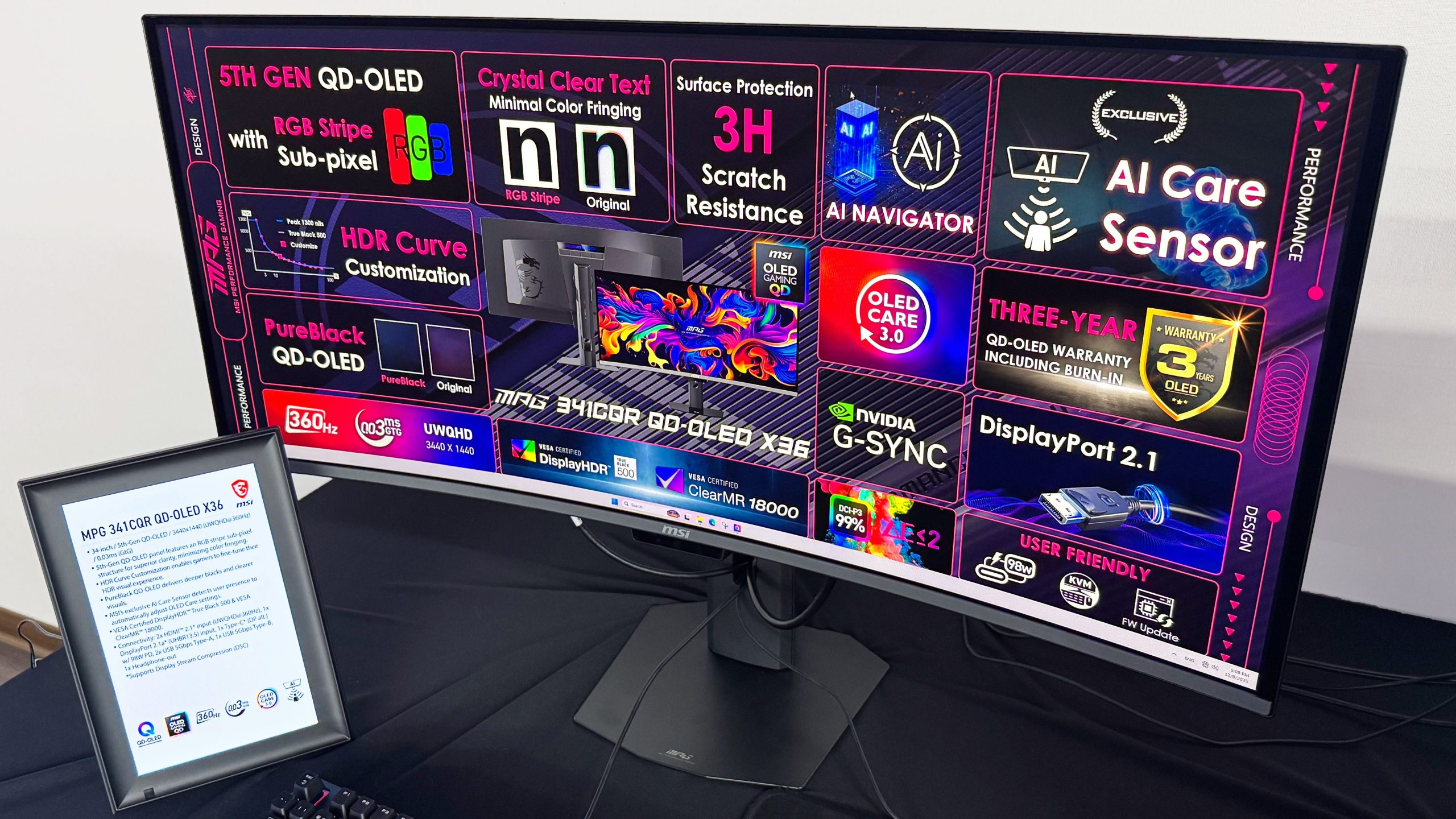
CES 2026 will see the launch of a next-generation gaming monitor from MSI, built around Samsung Display’s latest fifth generation QD-OLED panel technology. Well ahead of the public announcement, KitGuru was invited to MSI’s headquarters in Taipei as part of the EHA Tech Tour – to receive an early briefing on the new display platform, including a technical deep dive.
Fifth-Gen QD-OLED Technology Improvements
Samsung’s fifth generation QD-OLED technology is not a radical departure from what came before, but a concentrated refinement of the areas that matter most to PC users who spend long hours in front of a screen. The improvements focus on clarity, durability, HDR consistency and longevity – rather than chasing ‘headline numbers’ alone. In other words, this is not about 8K or 800Hz refresh rates as much as delivering the best possible experience for serious gamers in 2026.
The most important change is the move away from the previous Q-stripe sub-pixel layout towards a new V-stripe structure. While QD-OLED has long delivered excellent colour volume and contrast, earlier implementations could still show artefacts in fine text and UI elements, particularly in desktop use. The V-stripe layout is designed to improve sub-pixel alignment and light distribution, resulting in sharper text rendering, more consistent viewing angles, and fewer colour fringing issues across the panel.
Alongside this architectural change, Samsung and MSI have also addressed practical, real-world concerns raised by early OLED adopters. The panel surface itself has been hardened, moving from a 2H to a 3H rating, which should make it more resistant to micro-scratches during cleaning and day-to-day use. The screen coating has also been reworked, using a deliberately asymmetric texture rather than a uniform finish, allowing it to absorb and diffuse ambient light more effectively without introducing visible grain. The result is reduced glare without the heavy haze sometimes associated with aggressive matte coatings.
HDR performance is another major focus. The MPG 341CQR QD-OLED X36 is rated for peak brightness of up to 1,300 nits, while maintaining OLED’s (claimed) near-infinite contrast characteristics. Combined with VESA DisplayHDR True Black 500 certification, this allows the panel to span an extremely wide dynamic range, from deep/detail-rich blacks to small, intense highlights. MSI has built this around a set of 14 user-selectable HDR profiles, giving users fine-grained control depending on content type, ambient lighting, and personal preference rather than forcing a single fixed tone curve.
Burn-in mitigation and panel longevity have also been expanded beyond previous generations. MSI’s OLED Care suite has evolved further, now supported by an AI Care Sensor that uses real-time image analysis and human presence detection. Key functions include real human detection (fake humans beware), wake-on-approach and ‘lock-on-leave’ behaviour. There’s also adaptive dimming for static elements, automatic brightness and colour temperature adjustment based on environment – as well as broad multi-platform compatibility including macOS. This was previously the realm of LG only. The aim here is not only to protect the panel over time, but to do so in a way that is largely invisible to the user.
Samsung, QD-OLED, and MSI: Context and Continuity
Samsung’s position in the display industry stretches back more than five decades, with the company producing its first television panels in the late 1960s. Commercial OLED displays arrived much later, with Samsung Display refining OLED for consumer use through the 2010s before introducing QD-OLED as a distinct platform in the early 2020s. MSI, meanwhile, has worked with Samsung as a panel supplier for well over a decade, long before OLED entered the gaming monitor space, and that relationship has deepened as display technology has moved upmarket.
Samsung’s internal framing of QD-OLED development is best understood in generational steps:-
- First-generation
QD-OLED panels, introduced in 2022, established the core concept of blue OLED light combined with quantum dot colour conversion - Second-generation
These panels arrived in 2023 with improved efficiency and thermal behaviour, allowing higher sustained brightness - Third-generation
Refined uniformity and HDR handling, making QD-OLED viable across a wider range of gaming monitors - Fourth-generation
Increased popularity in 2025 pushed refresh rates to extreme levels, including 500Hz at QHD, while laying the groundwork for changes to sub-pixel structure.
The fifth-generation platform builds on all of this.
It introduces the V-stripe sub-pixel layout, higher usable brightness, improved anti-reflective coatings, increased panel hardness, and further reductions in burn-in risk, which Samsung estimates at around 30 percent compared to earlier implementations. Crucially, it is designed to scale these improvements to higher resolutions and larger panel sizes, enabling products like MSI’s 34-inch, 360Hz ultrawide display.
That evolution matters because MSI’s previous-generation flagship, the MPG 321URX, set a very high bar. When we reviewed it in April 2024, we were struck by how well it combined 4K resolution, a 240Hz refresh rate, and the visual strengths of QD-OLED into a genuinely versatile high-end display. It spent months at the top of our Best Monitors chart despite its premium pricing, a clear sign that performance and image quality were strong enough to justify the cost.
The shift from Q-stripe to V-stripe is therefore not a minor footnote, but the key change that MSI and Samsung will be relying on to move beyond what was already an excellent panel.
The Economics of the Modern PC Displays
While market pressure on core PC components is increasing due to high demand for memory and high-performance CPUs and GPUs in the AI market, costs are driving higher. Yet the monitor market appears to be moving in the opposite direction.
Samsung estimates that out of roughly 130 million displays sold in 2025, around 29 million will be gaming monitors, rising to 31 million in 2026. Growth is strongest at the premium end, with monitors priced above $500 increasing from around 2.6 million units in 2024 to a projected 3 million units in 2025. Average selling prices in this segment peaked above $900 during 2024.
The implication is clear. Even as buyers become more cost-conscious about CPUs, GPUs and memory – many are still willing to invest heavily in large, high-quality displays that define their daily experience across work, gaming, and media consumption. High-end QD-OLED panels sit squarely in that category.
KitGuru Says: On paper, the MSI MPG 341CQR QD-OLED X36 represents a meaningful step forward rather than a cosmetic update. We've been fortunate enough to have one of these units in for review already, so if you want to see our full in-depth testing and results, you can find the review HERE.
The post MSI shows off the MPG 341CQR X36 – its first 5th-Gen QD-OLED Monitor first appeared on KitGuru.MSI MPG 341CQR QD-OLED X36 Review (5th Gen Ultrawide)
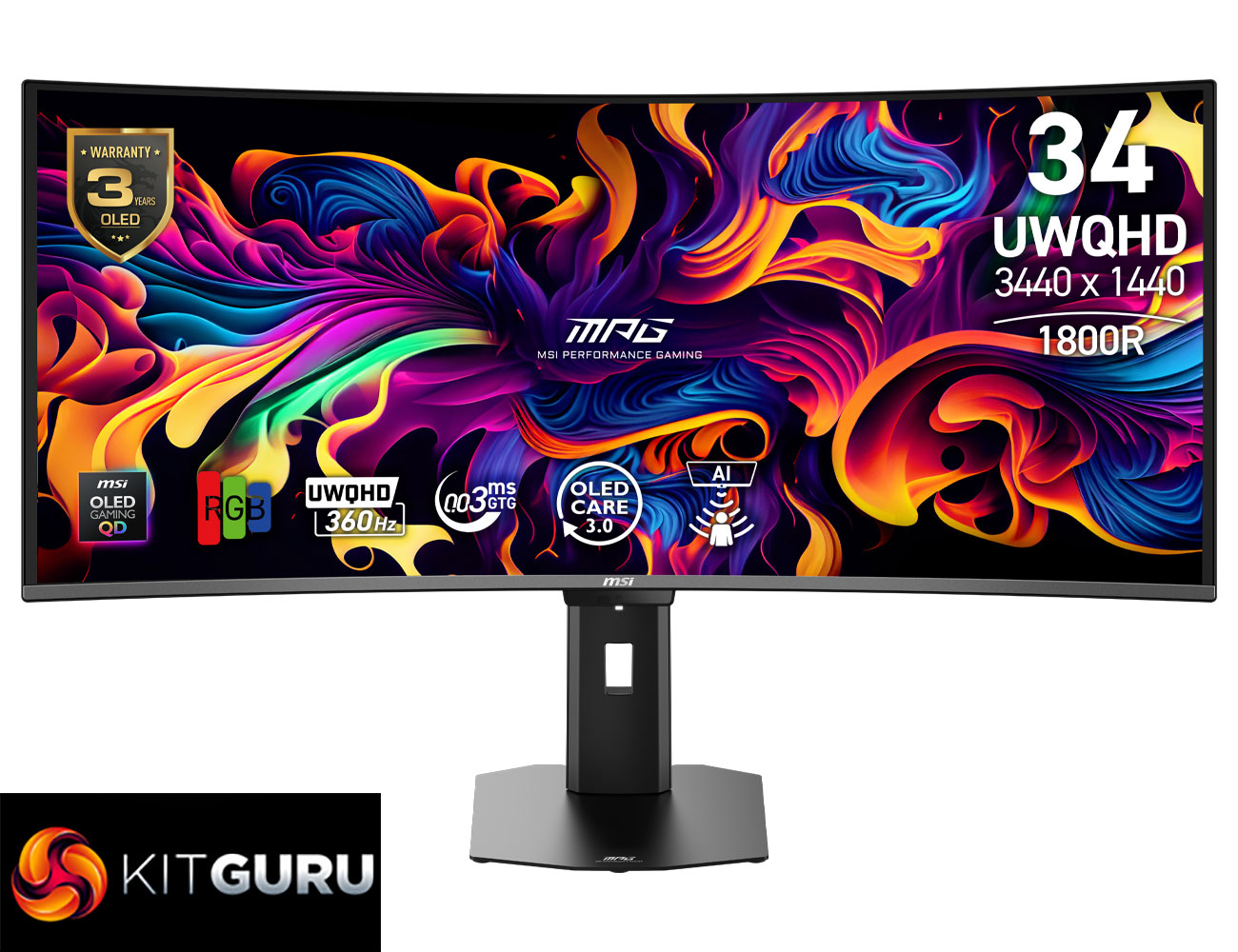
Today MSI has announced its latest QD-OLED monitor, the MPG 341CQR QD-OLED X36. Built on a new 5th Gen panel from Samsung, this is a curved ultrawide with a 360Hz refresh rate, making it the fastest 21:9 OLED monitor to date. It's also packing a number of improvements to the sub-pixel layout and coating, alongside increased brightness for both SDR and HDR. There's a lot to talk about, so let's get into it.
Timestamps
00:00 Intro
00:45 Key panel improvements
02:20 Design overview
03:23 Connectivity
03:51 New panel coating vs older QD-OLED + WOLED
05:51 Sub-pixel structure is also improved
07:12 Out of the box testing
09:20 sRGB mode + calibrated results
09:53 Response times, motion clarity
11:23 Real-world gaming experience
15:44 HDR issues ‘update’
17:12 Closing thoughts
Starting with the new 5th Gen QD-OLED panel from Samsung, this is packing in some key improvements designed to overcome known limitations of earlier QD-OLED panels. It's got a new RGB V-stripe sub-pixel layout, replacing the older diamond shape, AKA Q-stripe, layout that could cause some fringing around text. It also has a new and improved coating to help improve black depth in brighter conditions, designed to fix the issue where older QD-OLED panels would see elevated black levels depending on the ambient lighting. On top of that, the surface hardness has been increased from 2H to 3H, increasing scratch resistance.
Those appear to be the key improvements with the new panel, given the underlying EL 3.0 technology has not changed from 4th Gen QD-OLED. It still offers improved brightness compared to most other QD-OLEDs, though performance here is similar to the enhanced 272QP X50, with MSI claiming up to 1300 nits for HDR and 300 nits for SDR. And of course, as mentioned earlier, it's a new 360Hz refresh rate, too, up from the previous 240Hz limit for ultrawide QD-OLED panels.
In terms of pricing, MSI told us the MSRP is £999, or $1099, so it's not cheap, but about as expected for a new QD-OLED panel.
Specification:
- Model: MPG 341CQR QD-OLED X36
- Panel size: 34″ QD-OLED
- Aspect ratio: 21:9
- Panel resolution: 3440 x 1440 (UWQHD)
- Pixel pitch (H x V): 0.2315 (H) x 0.2315 (V)
- Refresh rate: 360Hz
- Response time: 0.03ms (GtG)
- Viewing angle: 178° (H) / 178° (V)
- Brightness: SDR: 300 nits; HDR: 1300 nits
- Contrast ratio: 1,500,000:1
- DisplayPort: 1x DisplayPort 2.1a (UHBR13.5) (UWQHD@360Hz)
- HDMI: 2x HDMI
2.1 (48Gbps) (UWQHD@360Hz) - USB Type-C: 1x Type-C (DP Alt Mode) with 98W Power Delivery
- USB Type-A: 2x USB 5Gbps Type-A
- USB Type-B: 1x USB 5Gbps Type-B
- ETD: 12/B-12/M
- MSRP: £999/$1,099
Firmware tested: FW.014
The post MSI MPG 341CQR QD-OLED X36 Review (5th Gen Ultrawide) first appeared on KitGuru.-
Igor
- LeakWatch 2026 – LeakWatch analysis of the holidays and calendar week 1 as an atypical situation assessment
LeakWatch 2026 – LeakWatch analysis of the holidays and calendar week 1 as an atypical situation assessment
-
Igor
- MSI GeForce RTX 5090 Lightning Z OCER: 40-phase VRM, 3.45 GHz GPU clock and 36 Gbps GDDR7 as a challenge to the competition
MSI GeForce RTX 5090 Lightning Z OCER: 40-phase VRM, 3.45 GHz GPU clock and 36 Gbps GDDR7 as a challenge to the competition
TSMC raises allegations of possible breach of secrecy after former top executive joins Intel
-
Igor
- MacBook Air with M1 chip saves lives, stops shrapnel and protects Ukrainian soldier from fatal injury
MacBook Air with M1 chip saves lives, stops shrapnel and protects Ukrainian soldier from fatal injury
-
Igor
- TSMC’s US expansion eats into margins, why American fabs are an expensive must-have program for the contract manufacturer
TSMC’s US expansion eats into margins, why American fabs are an expensive must-have program for the contract manufacturer
RAM prices continue to rise, memory crisis worsens significantly
Noiseless Plasma Cooling May Be The Next Big Laptop Breakthrough At CES
Killjoy Microsoft Shuts Down Windows 11 Activation Without An Internet Connection
-
PC Perspective
- Podcast #850 – RTX 5090 Rising, SSDs the Next DDR5, New DDR4 Motherboards in 2026, GOG, Dumb TVs and MORE
Podcast #850 – RTX 5090 Rising, SSDs the Next DDR5, New DDR4 Motherboards in 2026, GOG, Dumb TVs and MORE
There are FOUR lights!
But besides that, we have AMD news on Redstone, their B650 chipset and so much DDR pricing and related news that you'll platz. Oh, Kohler has got a…