 Connexion
CES 2026: ASUS Republic of Gamers Celebrates It’s 20th Anniversary
6 janvier 2026 à 21:20
NVIDIA's G-SYNC Pulsar technology was first revealed at CES 2024, but we didn't hear too much about it again until now. There will be four G-SYNC Pulsar displays available tomorrow, from…
Phison is showing off their chops at CES 2026, detailing several new PCIe 5.0 controllers and, you guessed it, new AI acceleration technology. We will get the AI over with first, as…
While CES 2026 is expectedly an AI fest, AMD has offered some new consumer hardware, as evidenced by portions of their official client news summary:
- AMD introduces new Ryzen AI 400 and PRO…
Digital Storm is showing off two very different systems at CES 2026, the Vector and Aventum 5. The Vector is a mere 18 x 13 x 4", yet it can hold…
Samsung is at CES 2026 and has put together a quick overview of what to expect from them this year, and as you should have guessed it is all AI focused. …
 There's a whole lot of uncertainty in the consumer DRAM and storage space with AI pushing demand for NAND flash memory chips to unprecedented levels, but one thing is for certain—the accompanying parts are in place for whenever the market settles down. Driving that point home is Phison's new PS5037-E37T controller designed to give mainstream
As tech enthusiasts gather at CES 2026, a groundbreaking but brief (more on that in a quick second) showcase from Samsung Display has likely revealed the future of Apple’s most anticipated hardware: the iPhone Fold.
Samsung Galaxy Z Fold 8 Display at CES👀
pic.twitter.com/rSzfoQSkdt
— Max Jambor (@MaxJmb) January 6, 2026 Early eyes-on
There's a whole lot of uncertainty in the consumer DRAM and storage space with AI pushing demand for NAND flash memory chips to unprecedented levels, but one thing is for certain—the accompanying parts are in place for whenever the market settles down. Driving that point home is Phison's new PS5037-E37T controller designed to give mainstream
As tech enthusiasts gather at CES 2026, a groundbreaking but brief (more on that in a quick second) showcase from Samsung Display has likely revealed the future of Apple’s most anticipated hardware: the iPhone Fold.
Samsung Galaxy Z Fold 8 Display at CES👀
pic.twitter.com/rSzfoQSkdt
— Max Jambor (@MaxJmb) January 6, 2026 Early eyes-onAhead of CES, members of the European Hardware Association, including KitGuru, were invited to Asus HQ to get an early look at upcoming gaming hardware. Here, we take you through Asus ROG's next-generation gaming monitors, as well as new peripherals and WiFi 8 devices.
Visual output and immersion
ASUS framed its 2026 display line-up as a series of portfolios, rather than a set of isolated products. Gaming and professional are well understood market segments, but there is now increased emphasis on ‘prosumer’ products that bridge the gap.Across all markets, ASUS is clearly trying to address clarity, brightness control and long-term usability.
A key technical change highlighted early in our tour of the company’s new products was the shift to a new RGB stripe pixel layout in next-generation OLED panels. ASUS stressed that this change is central to improving text clarity and colour precision as well as overall image stability, particularly at higher brightness levels. Alongside this, ASUS is using its own BlackShield film-coating technology to improve perceived black levels and reduce glare by up to 40%. Hardness is also increased for 2.5x more scratch resistance. This enhancement for the ROG Swift OLED PG34WCDN certainly adds to the premium look/feel of this screen.
At the gaming end of the spectrum we have the ROG Swift OLED PG27UCWM (Tandem RGB OLED) and PG34WCDN (RGB QD-OLED). ASUS claims higher sustained brightness, improved colour volume (PG27UCWM) & refresh rates designed to match next-generation GPUs, with DisplayPort 2.1a support positioned as an important part of future-proofing.
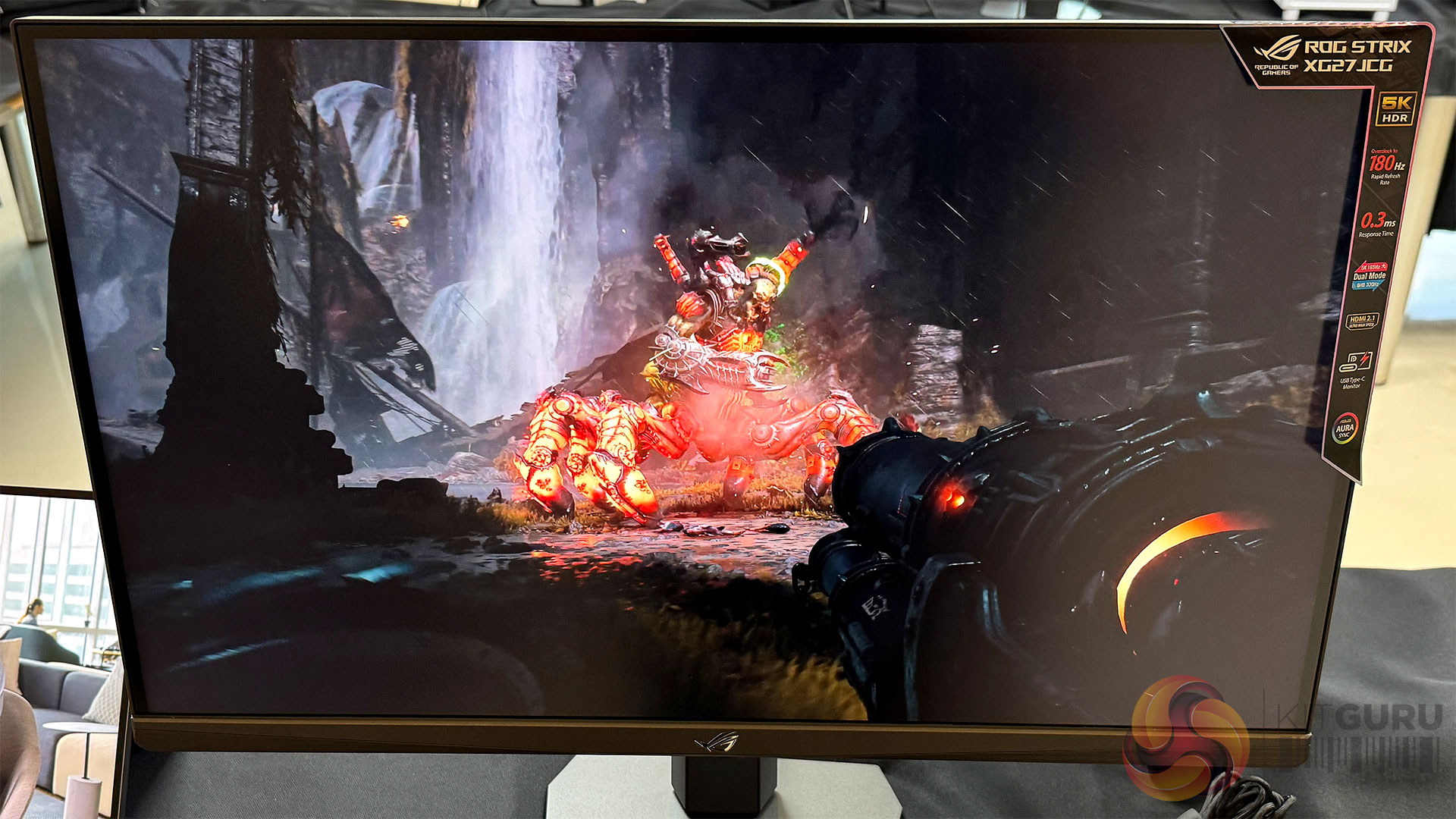
The ROG Strix 5K XG27JCG pushes resolution and refresh rate simultaneously. This 5K screen uses a fast IPS panel with a 0.3ms G2G response and 218 PPI density, guaranteeing that you won’t see any pixels from a normal seated distance. Other nice features included DisplayWidget Center, AI gaming AI features like Dynamic Crosshair, Dynamic Shadow Boost and AI Visual. This screen will initially list close to £699. The Dual Mode feature allows for effortless switching between immersive 5K at 180Hz for cinematic adventures and lightning-fast QHD (2560 x 1440) at 330Hz for peak performance.
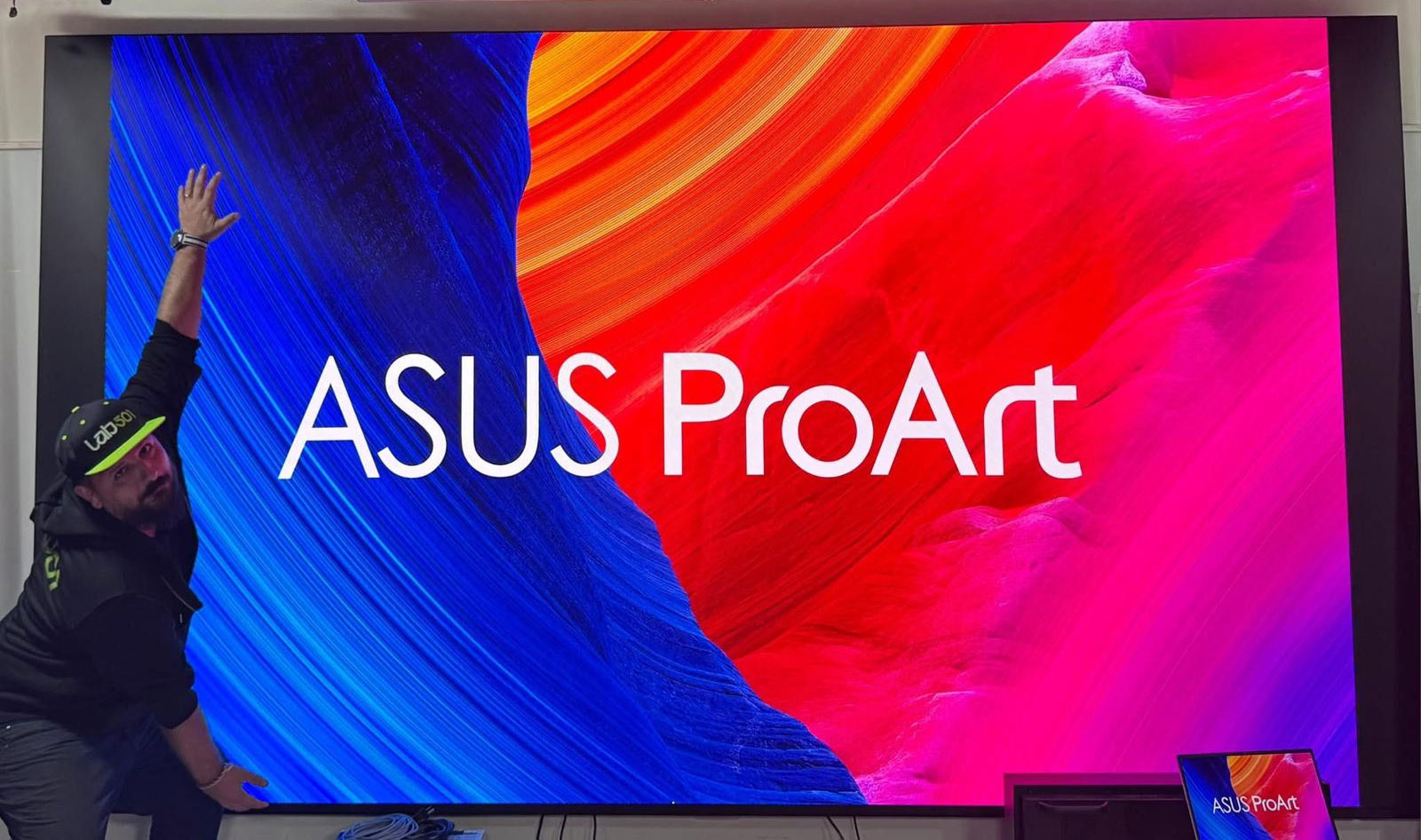
ASUS also presented a timeline of gaming monitor evolution, showing how OLED and high refresh rates have converged over recent years. Extending that timeline further into the future, ASUS demonstrated something very different during the tour – for which we were taken to a secured area on another floor. The product being guarded was the ProArt Cinema PQ09. This is a 162-inch Micro LED display with a 4K 10-bit panel, 0.93mm pixel pitch, 1,200 nits peak brightness, a claimed 1,000,000:1 contrast ratio and 99 percent DCI-P3 coverage with Delta E below 2. To help you get a sense of the true size of this monitor, we enlisted the help (and wing span) of Tudor from Lab501. With an indicated price of around $160,000, this is obviously not a ‘general consumer product’ right now, and it is unlikely to be appearing in everyday gaming setups any time soon. That said, it serves as a useful reference point for where display technology is heading, and it underlines how much headroom still exists beyond today’s OLED panels.
ASUS is also continuing to explore alternative ways to experience large-format displays. The ROG XREAL R1 AR gaming glasses aim to deliver a perceived screen size of up to 171” with refresh rates peaking as high as 240Hz. ASUS acknowledges that adoption of wearable displays remains uncertain, but the technical ambition is clear. Certainly if you need a large desktop are on a plane or train, then your traditional LED options will be limited – so the ROG gaming glasses could make sense for certain categories of user.
At the professional end of the spectrum, ASUS highlighted a deliberate strategy of pushing flagship ProArt products further upmarket while simultaneously broadening access for creators and prosumers. Displays such as the ProArt Display OLED PA27USD and PA32UCDMR-K are designed for users who have outgrown basic office monitors, but who don’t necessarily operate in full studio environments.
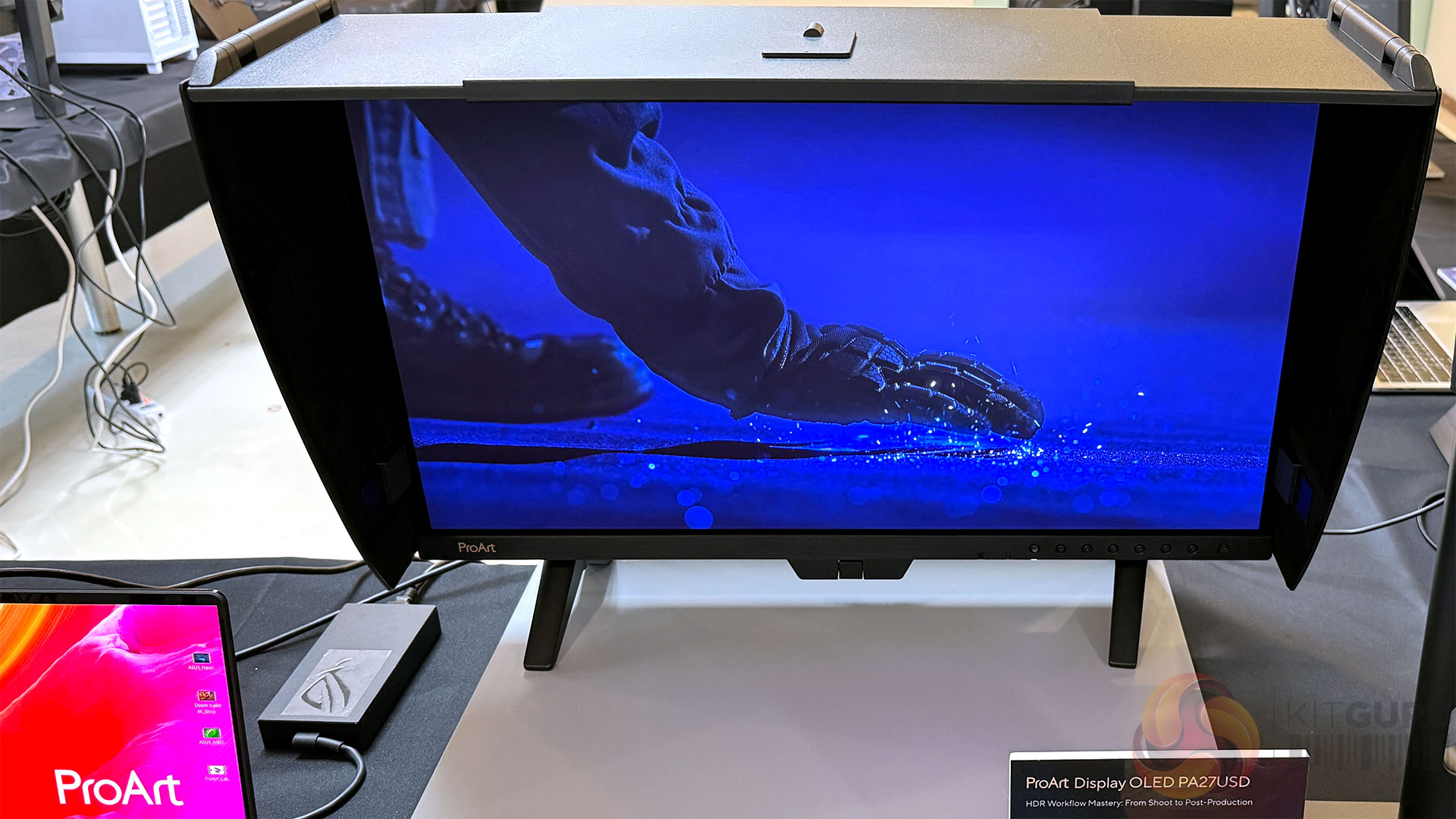
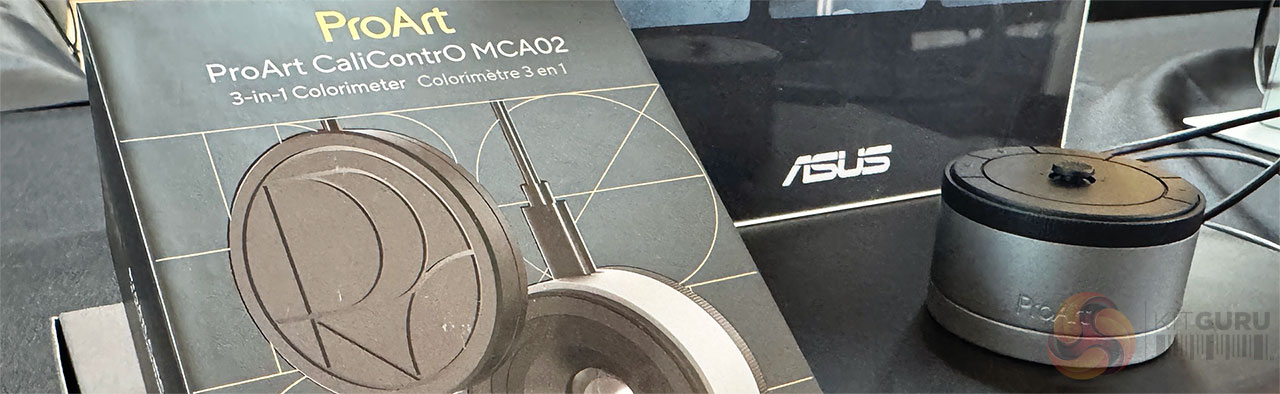
ASUS cited growing demand from content creators and hybrid professionals who need accurate colour, higher brightness and modern connectivity without stepping into prohibitively expensive territory. ASUS insists that its ProArt screens have been targeted at professional creators. As such, thePA32UCDMR-K is Calman Ready with ColourSpace integrated and is supplied with a monitor hood – as well as the latest version of ASUS' Colorimeter, the MCA02.
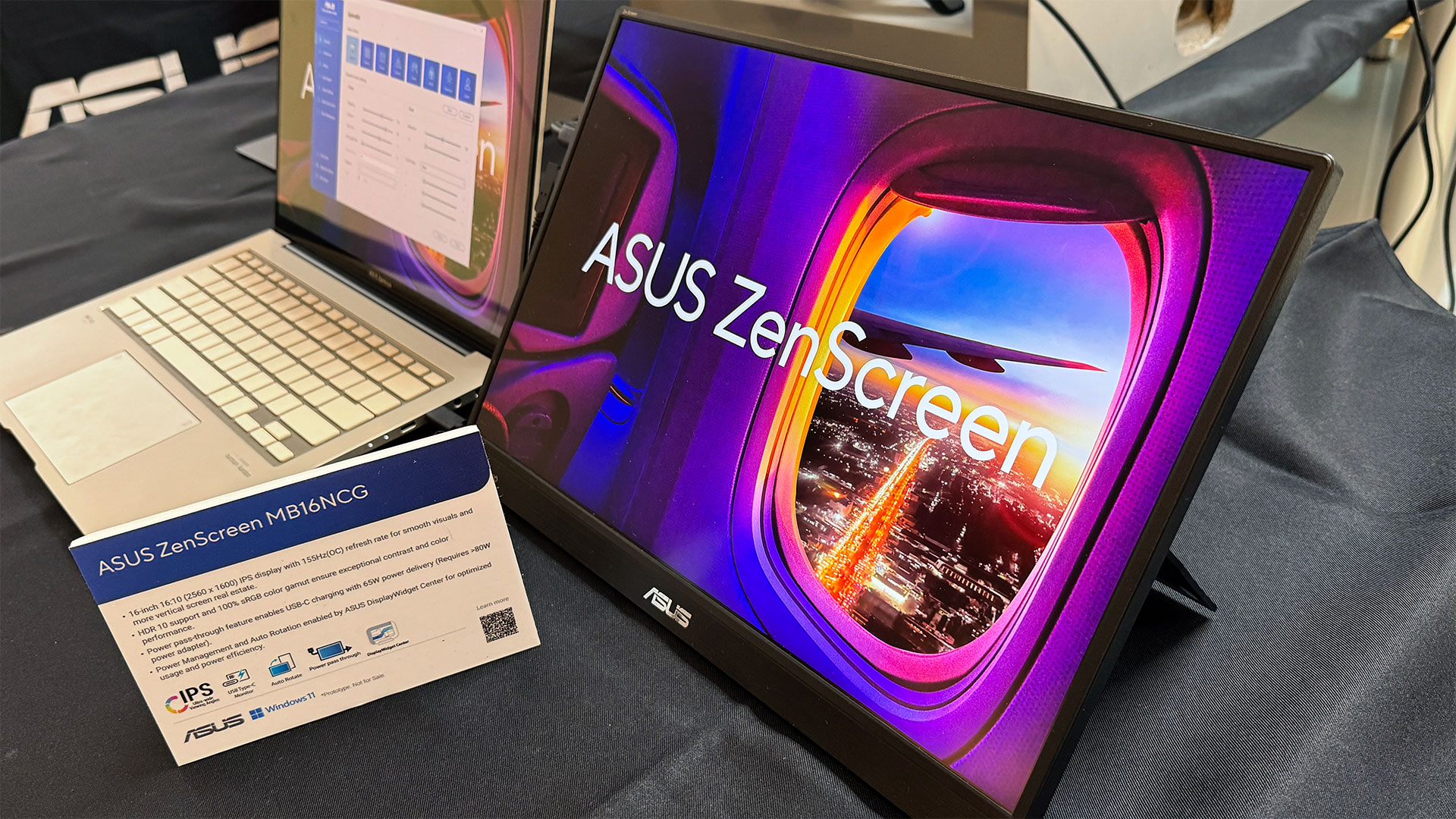
Finally, ASUS briefly covered more consumer-oriented and portable displays, including the ZenScreen OLED MQ16FC and ZenScreen MB16NCG. While these products sit slightly outside KitGuru’s core focus, the USB Type-C connectivity, power pass through, 100% sRGB high refresh rates and sub-1kg weight of 16” (16:10 ratio) models like the MB16NCG, make them genuinely interesting as laptop companions for travel and flexible work setups.
Networking and routers
Networking was presented as one of the most misunderstood performance bottlenecks in modern systems. ASUS was keen to emphasise that WiFi-7 is not obsolete, nor is it a failed standard. In fact, ASUS positions WiFi-7 as very much ‘now’, with meaningful improvements over WiFi-6 when implemented properly.
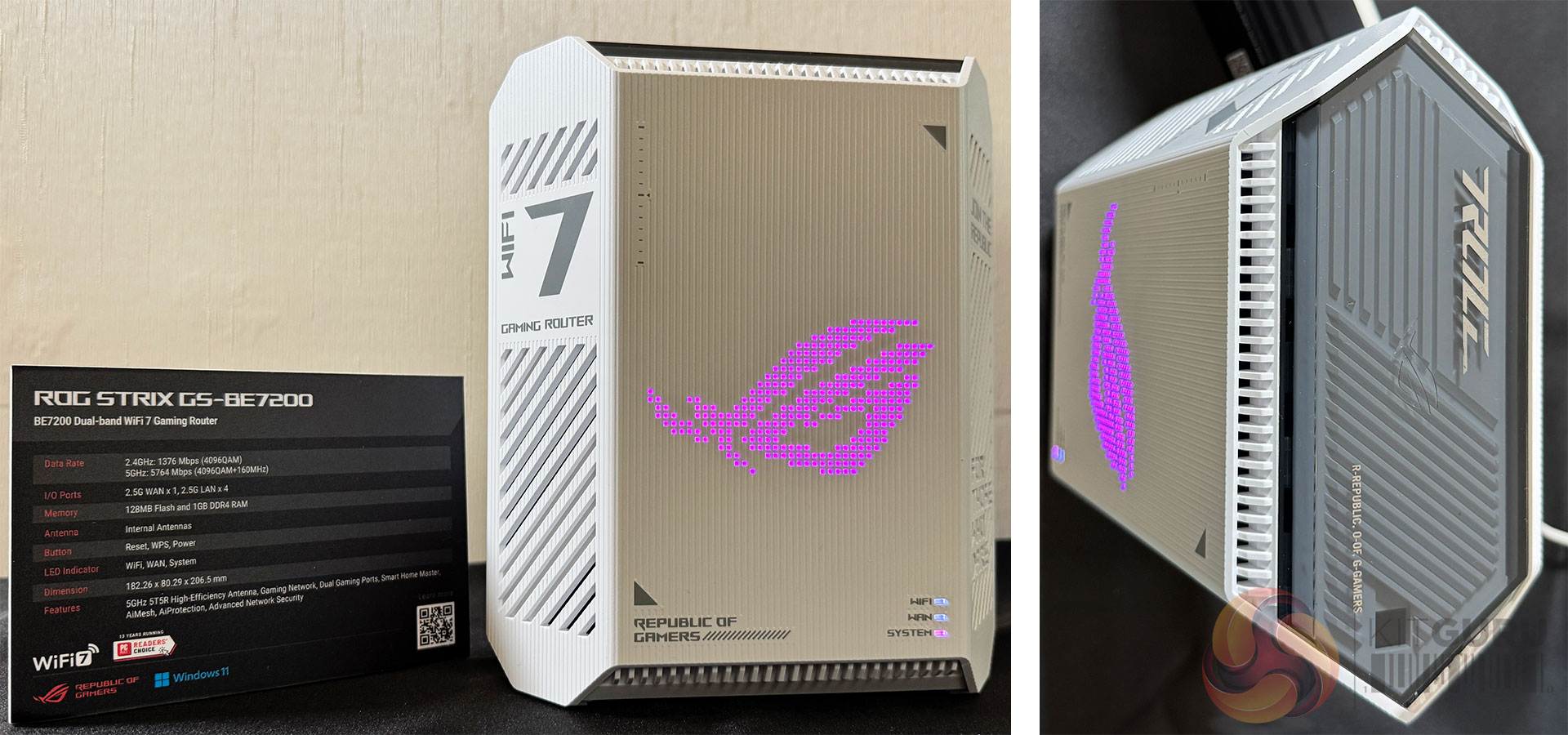
Products such as the ROG Strix GS-BE7200 were used to demonstrate what a well-executed WiFi-7 router can deliver today, including improved 5GHz performance at range, better handling of DFS channels and more consistent throughput in real homes. ASUS claims up to 15 percent better 5GHz performance compared to previous designs (5GHz 4T4R), though as with all such figures, real-world results will depend on environment and client devices.
At the same time, ASUS acknowledged that WiFi-7 adoption has been slower than expected. One reason is that many users struggled to see a compelling upgrade path from a strong WiFi-6 router to an average WiFi-7 one, particularly when headline speed increases did not always translate into day-to-day improvements. We’ve certainly found gaps between manufacturer’s claimed maximum speeds and our own real-world testing in 3-floor houses built with bricks.
Slides covering WiFi-8 made it clear that ASUS expects early hardware to arrive ahead of 802.11bn standards receiving final ratification. The standard could be finalised around the middle of 2028 – while WiFi-8 hardware could start to ship as early as 2026. Bear in mind that we are talking about WiFi-8 routers and not clients – which will normally follow on a little later. For reference, KitGuru saw its first WiFi-7 dongle at IFA 2025, back in August.
Crucially, ASUS is framing WiFi-8 as a shift in priorities, rather than a simple speed race. Specifically emphasising the move towards aggregate bandwidth, multi-user performance and latency consistency, rather than peak single-device throughput. ASUS claims improvements of up to two times mid-range throughput, two times lower latency, and significantly higher reliability compared to WiFi-7, with a particular focus on more balanced uplink and downlink performance.
ASUS also leaned into the idea that AI-driven optimisation will increasingly sit at the network layer. Many users intuitively expect AI to make complex systems behave better without manual tuning, and ASUS positions WiFi-8 routers as platforms that can intelligently manage traffic based on device behaviour, workload type, and contention, rather than simply pushing more raw bandwidth.
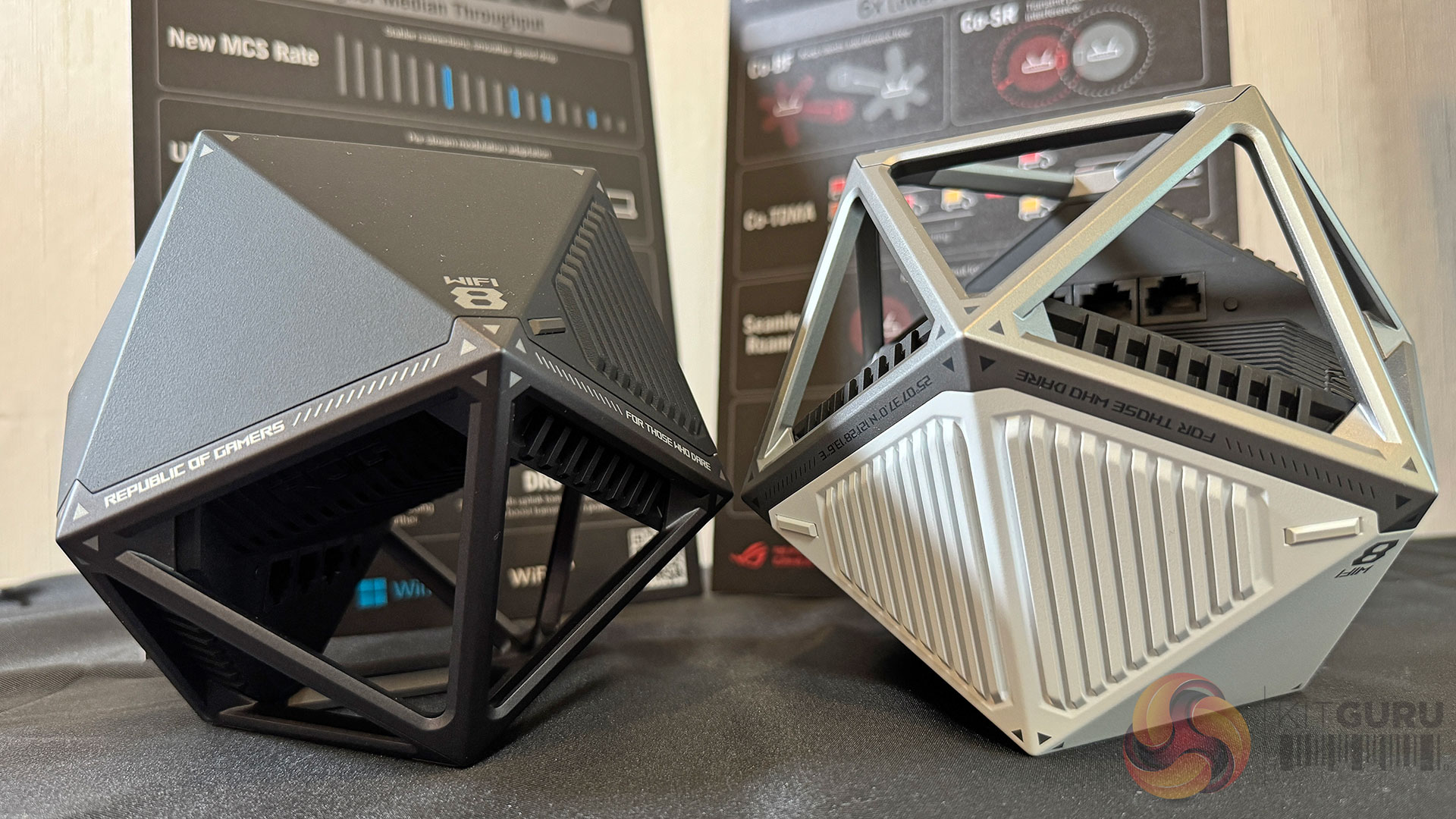
On this Tech Tour, we got to hold WiFi-8 routers that bear more than a passing resemblance to next-gen TIE Fighters from Star Wars.
Alongside consumer and gaming routers, ASUS highlighted its ProArt Creator networking products, including the ProArt Router PRT-BE5000 and ProArt Switch PQG-U1080. These are positioned as practical solutions for creators and small studios who need reliable wired and wireless performance, multi-gigabit connectivity, and simple management, without stepping into full enterprise networking complexity. Moving to an expensive next-gen router at home will be far harder to justify than installing such devices in a video/creator studio environment.
Gaming peripherals
ASUS’ gaming peripherals presentation focused on refinement rather than reinvention. Across keyboards, mice, and headsets, the emphasis was on precision, consistency, and wireless maturity.
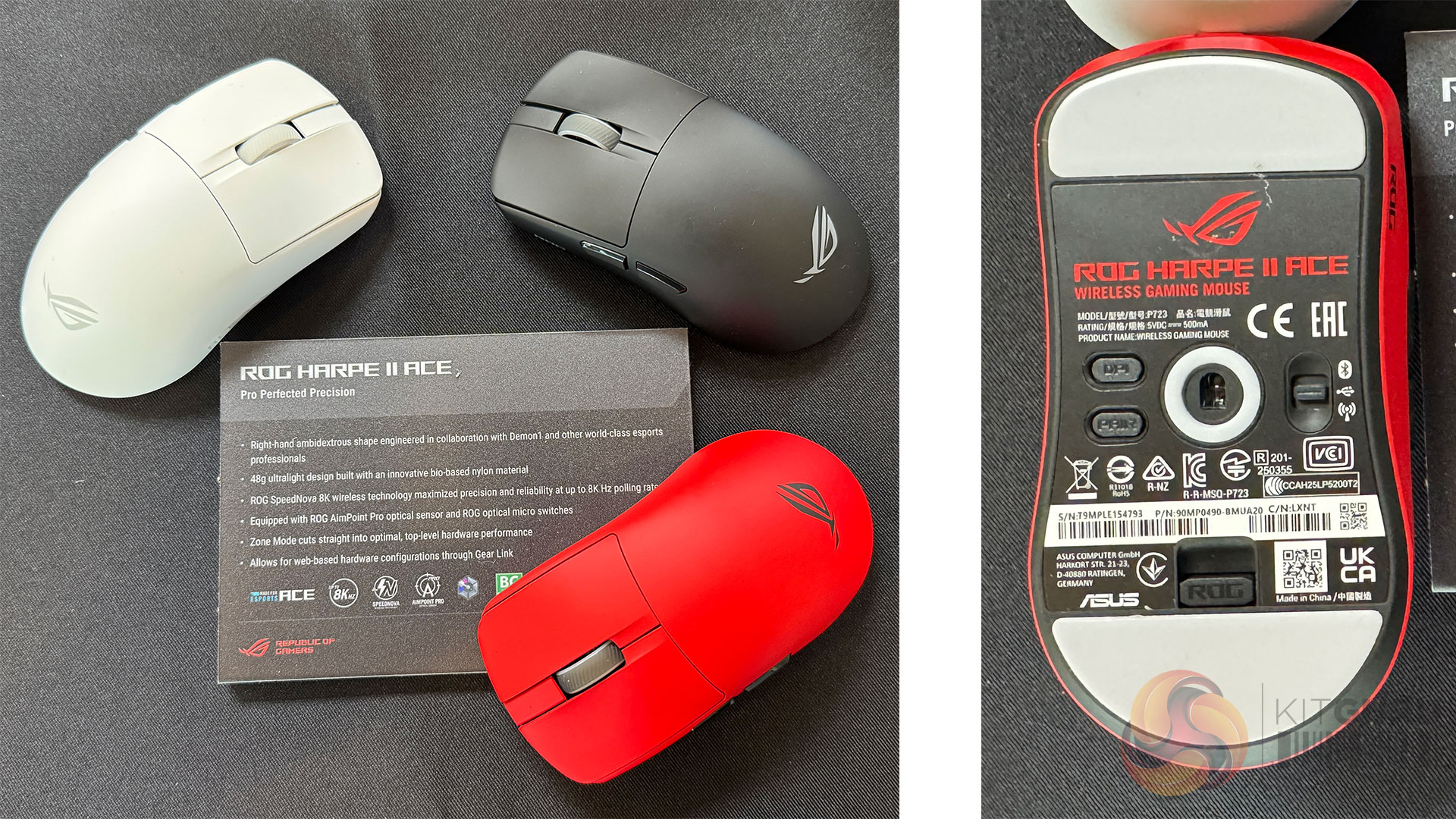
Keyboards such as the ROG Falchion Ace 75 HE, reflect the continued move towards Hall Effect and ROG HFX V2 magnetic switches, with ASUS focusing on actuation consistency and longevity. Similarly, mice like the ROG Harpe II Ace and ROG Keris II Origin build on optical sensors, high polling rates, and shapes informed by esports feedback, where marginal gains are now more about ergonomics and feel than raw specifications. Essentially, physically-lighter mice in cooler colours with faster responses.
Wireless technology is no longer treated as a compromise. ROG’s SpeedNova technology appears across multiple devices, supporting low latency, stable connections, and multi-device setups. In practical terms, wireless input now feels like the default at the high end, rather than an optional convenience. In general, you can choose your own battery life by keeping the RGB disco lights on or off.
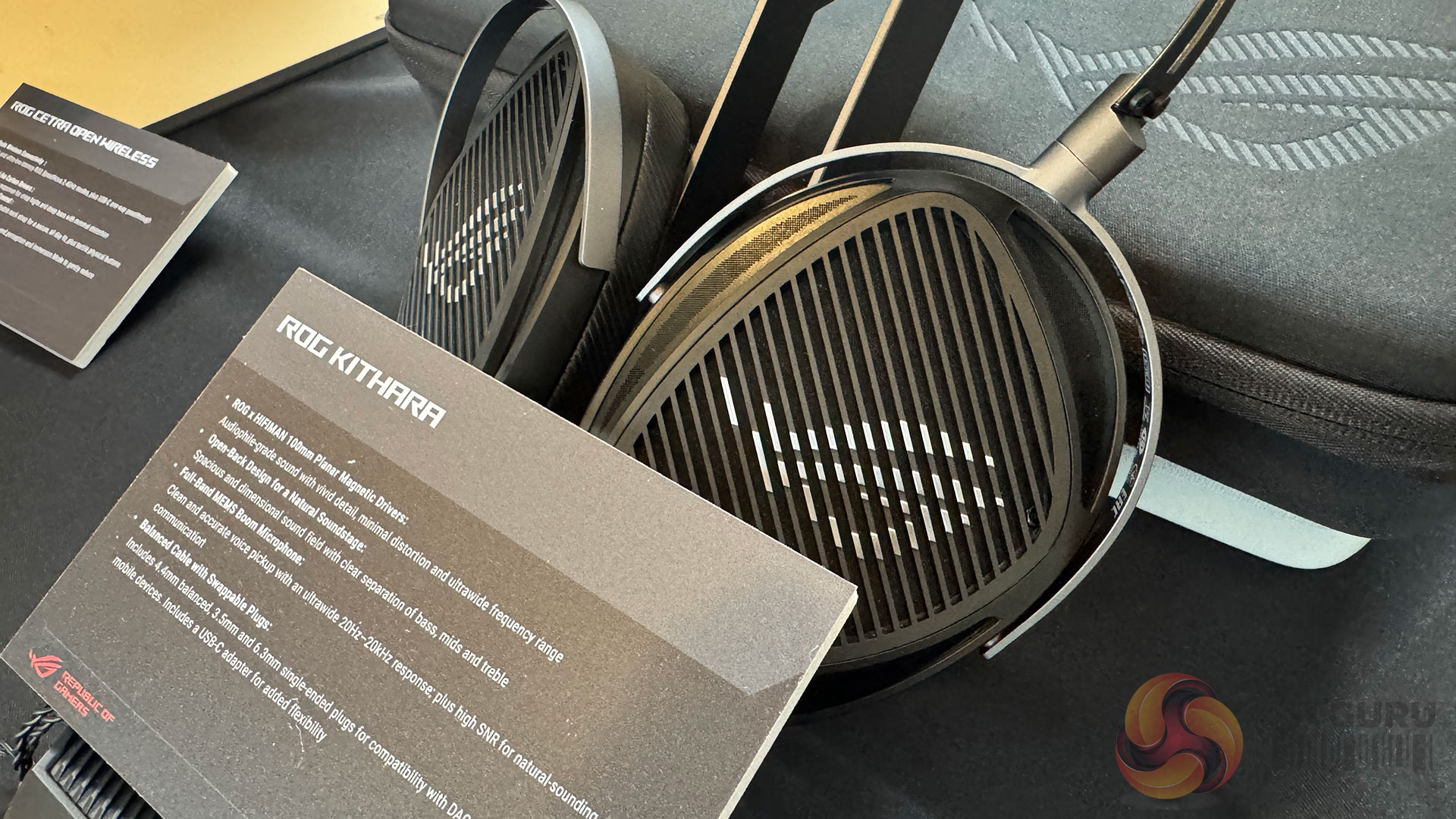
Audio was clearly the centrepiece of the peripherals briefing. The ROG Kithara was positioned as a flagship product, with ASUS indicating an expected price point around $299 at launch. This is not a budget product, but instead aims to deliver high quality audio for those who value mobility as well as audiophile-grade sound. ROG-customised HIFIMAN 100mm planar magnetic drivers deliver lifelike audio with sharp, precise detail. Engineered for competitive play, the Kithara headset features an integrated full-band MEMS microphone for clear in-game communication.
A balanced headphone cable with swappable plugs, along with a USB-C adapter, ensures uncompromised audio fidelity and broad compatibility across a wide range of devices. At this price level, expectations will be high, and independent testing will be essential to determine whether the experience justifies the price.
The KJP series of peripherals was also shown as a design-led extension of the ROG ecosystem, including headset, mouse and mouse pad. While these products are more about aesthetic and brand expression than performance leadership, they sit alongside a broader line-up that remains firmly focused on competitive use.
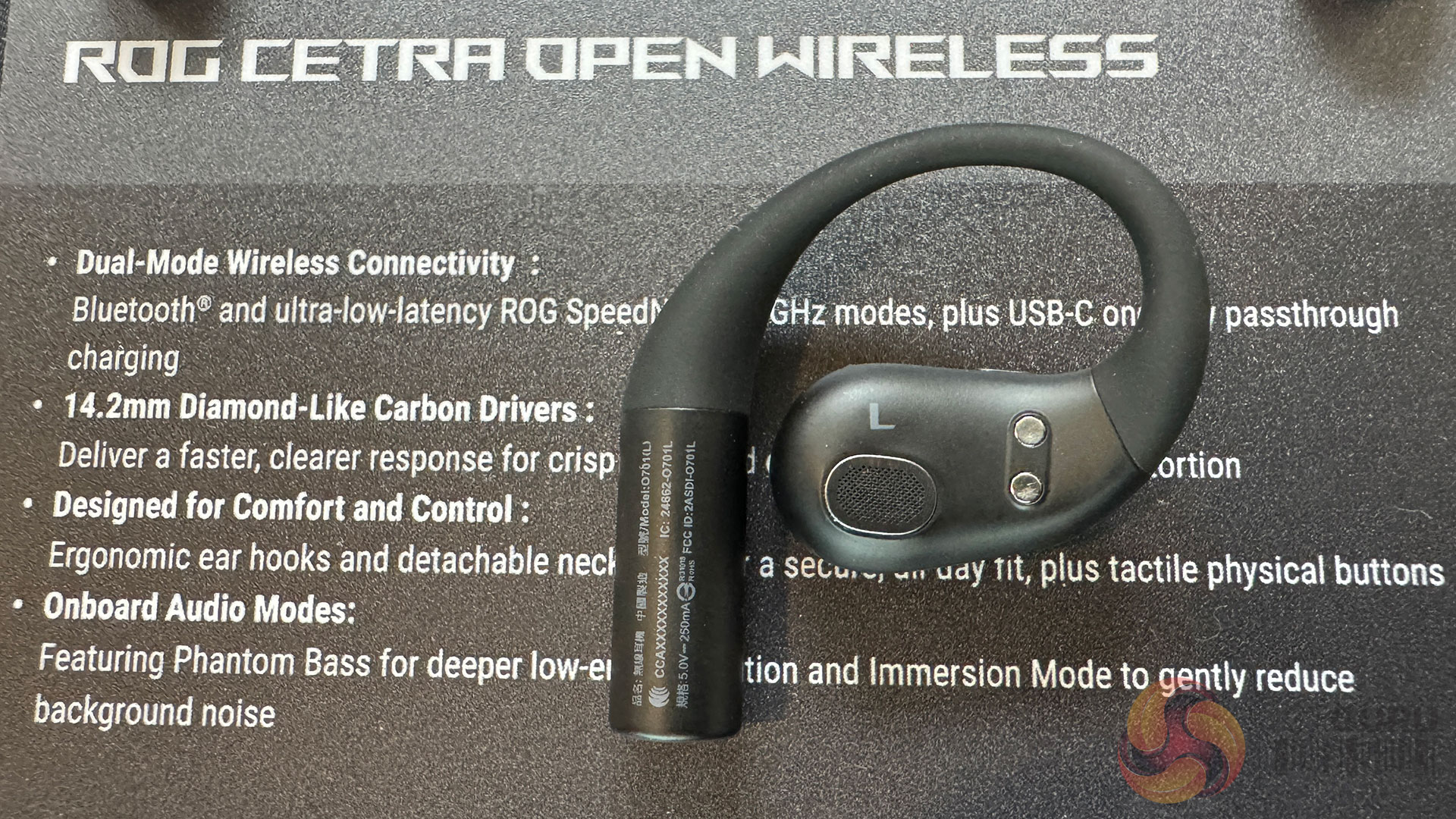
Finally, another neatly-designed audio product comes to market in the form of the ROG Cetra Open Wireless earbuds. In addition to Bluetooth, they offer ultra-low-latency ROG SpeedNova 2.4GHz – as well as USB-C one-way pass-through charging. The 14.2mm diamond-like carbon drivers promise faster, clearer response and, overall, the ‘ergonomic ear hook' design promises comfort should you decide to use them all day. There are tactical/physical buttons to make them easier to adjust – and the Cetra features Phantom Bass for deeper low-end perceived tones – as well as ‘Immersion Mode' to get rid of the noise of the outside world.
Compact compute and NUC systems
The ASUS NUC and mini PC strategy spans a wide range of use cases, from education and commercial deployments to gaming and AI development. What became clear during the briefing is that not all AI performance figures are created equal. Specifically, there’s a lot of questionable emphasis on TOPS figures at the lower end of the performance scale.
Systems such as the ASUS NUC 16 Pro and ExpertCenter PN55 offer between 55 AI TOPS and 180 platform TOPS of AI performance, depending on configuration. In real-world terms, this level of capability is sufficient for local assistants, transcription, image processing and OS-level features such as Microsoft Copilot+. It could be useful, but it is not transformative compute. At this level, AI performance often feels like a compliance requirement rather than a compelling reason to upgrade, and it is difficult to ignore the influence of platform mandates and co-marketing incentives in shaping these products.
The complexities involved in building modern NUCs is not to be under-estimated. Cooling with longevity, as the components themselves continue to get better, is a challenge.
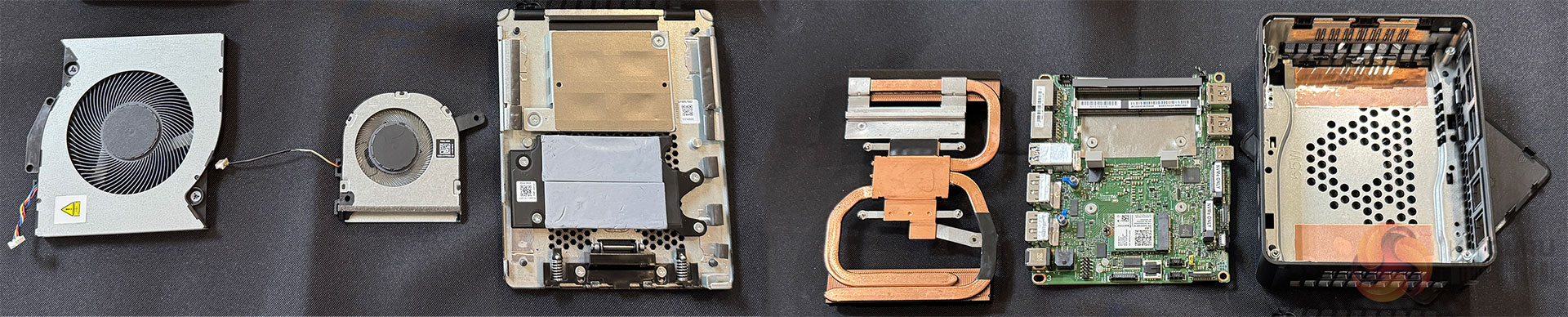
That doesn’t make these systems irrelevant. They could definitely make sense for colleges, offices and edge deployment situations where space, power efficiency, manageability and reliability matter more than raw AI throughput. ASUS’ own categorisation of these devices as ‘Everyday AI’ and ‘Next Level AI’ is accurate, rather than hugely overstated.
The ROG GR70 is where the compact compute story becomes far more convincing. With CPU options up to the AMD Ryzen 9 9955HX3D processor and an NVIDIA GeForce RTX 5070 Laptop GPU in a 3-litre chassis – this is a serious gaming system rather than a marketing exercise. Here, performance will be judged on frame rates, thermals and acoustics. On paper, the specification suggests a genuinely capable compact gaming machine.
The stand-out product, however, is the ASUS Ascent GX10. With a claimed 1 petaFLOP of AI performance, powered by the NVIDIA GB10 Grace Blackwell Superchip and supported by 128GB of unified memory, this system moves decisively into desktop supercomputer territory.
ASUS claims the GX10 can handle models of up to 200 billion parameters, bringing serious AI development capability into an ultra-compact 150×150×51mm enclosure.
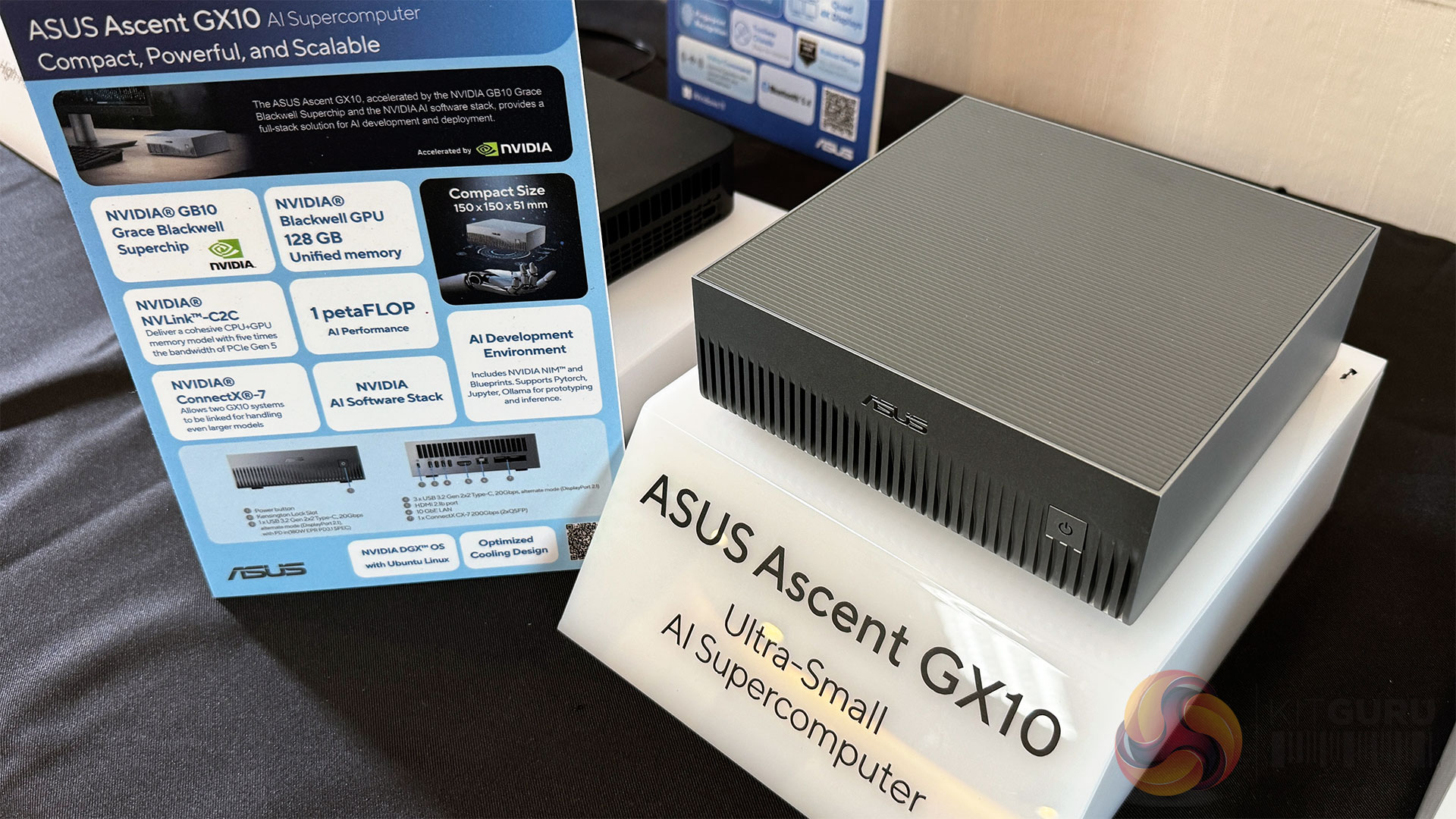
This mirrors the philosophy behind the larger ET900N G3 shown earlier in the tour, but in an even more accessible form. For organisations and developers looking to build, test, and refine AI models locally, offline, or in secure environments, the Ascent GX10 could prove genuinely compelling.
KitGuru says: Across displays, networking, peripherals, and compact systems, the ASUS 2026 portfolio reflects a shift towards experience and integration as the primary differentiators. Many of the performance figures discussed here come directly from ASUS briefings, and KitGuru will be looking to validate those claims through independent testing as products become available.
The post Asus reveals next-gen displays, new gaming peripherals and WiFi 8 devices first appeared on KitGuru.At CES this week, Sapphire has introduced the EDGE+ VPR-7P132, a Mini‑ITX AMD Embedded+ motherboard designed to handle increasingly complex AI workloads at the edge. The board combines AMD’s new Ryzen AI Embedded P132 Series APU with a Versal AI Edge Series Gen 2 adaptive SoC, creating a dual‑processor platform aimed at robotics, machine vision, industrial automation, and other latency‑sensitive deployments.
The design allows workloads to be split across CPU cores, RDNA 3.5 graphics, the XDNA 2 NPU, and the Versal device’s programmable logic and AI engines. The Ryzen AI Embedded processor manages OS, networking, visualisation, and general application tasks, delivering more than 50 TOPS of AI performance and supporting quad‑4K output, high‑speed Ethernet, USB, and NVMe storage. The Versal AI Edge Gen 2 SoC handles deterministic, real‑time functions such as sensor ingress, pre‑processing, and inference, ensuring predictable behaviour when timing is critical.
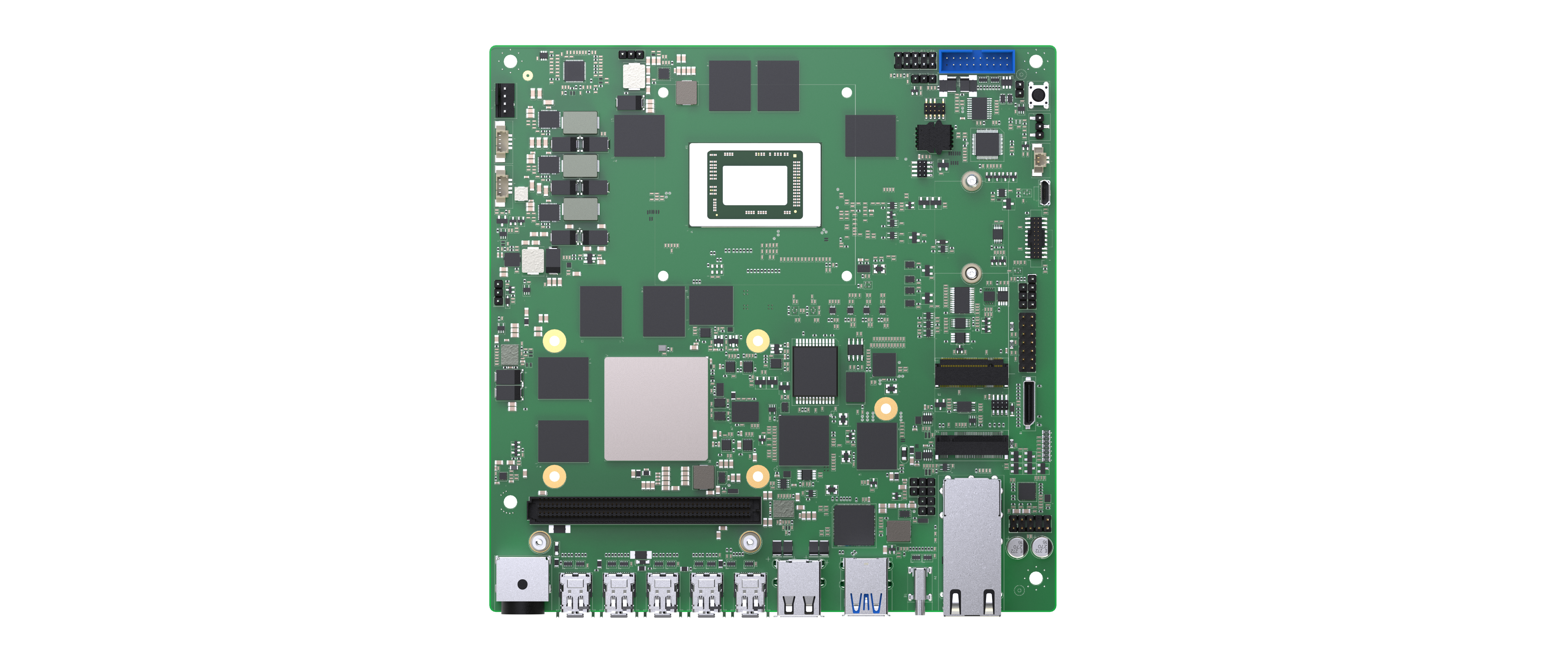
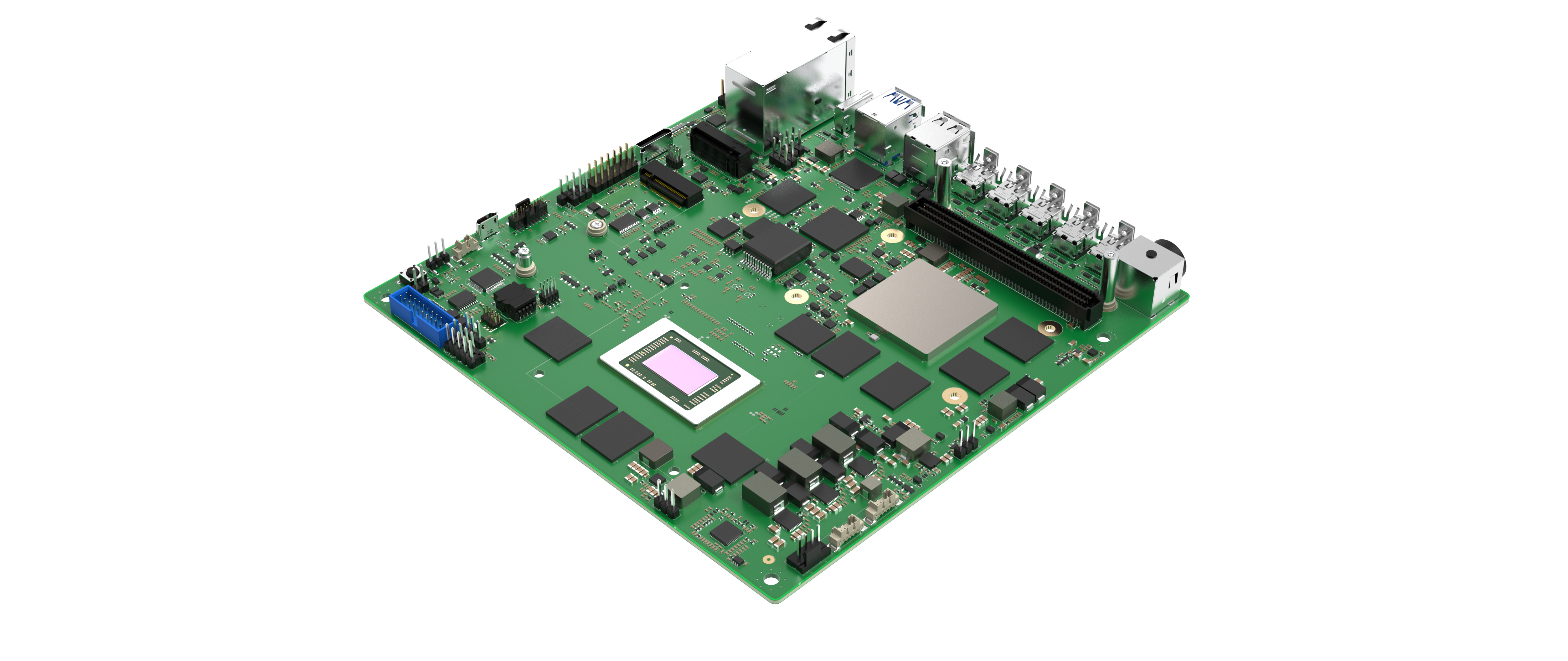
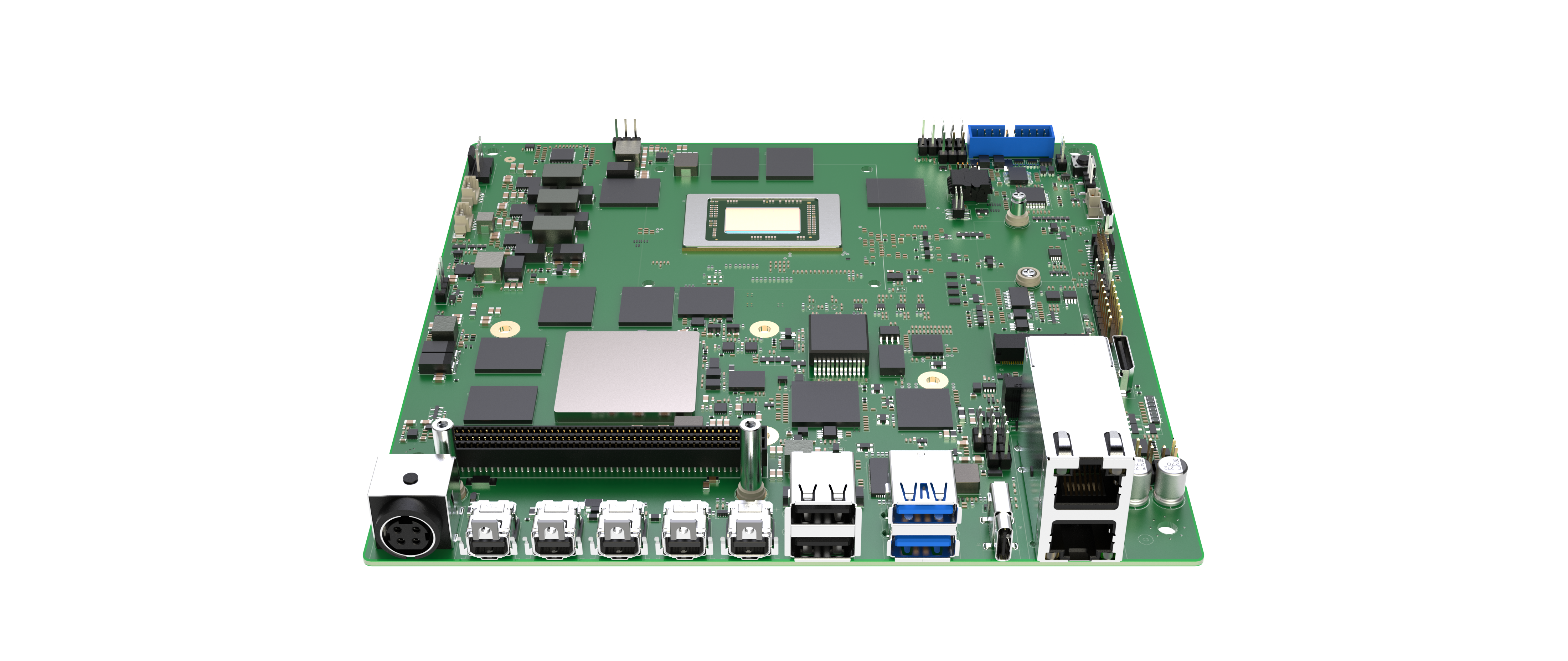
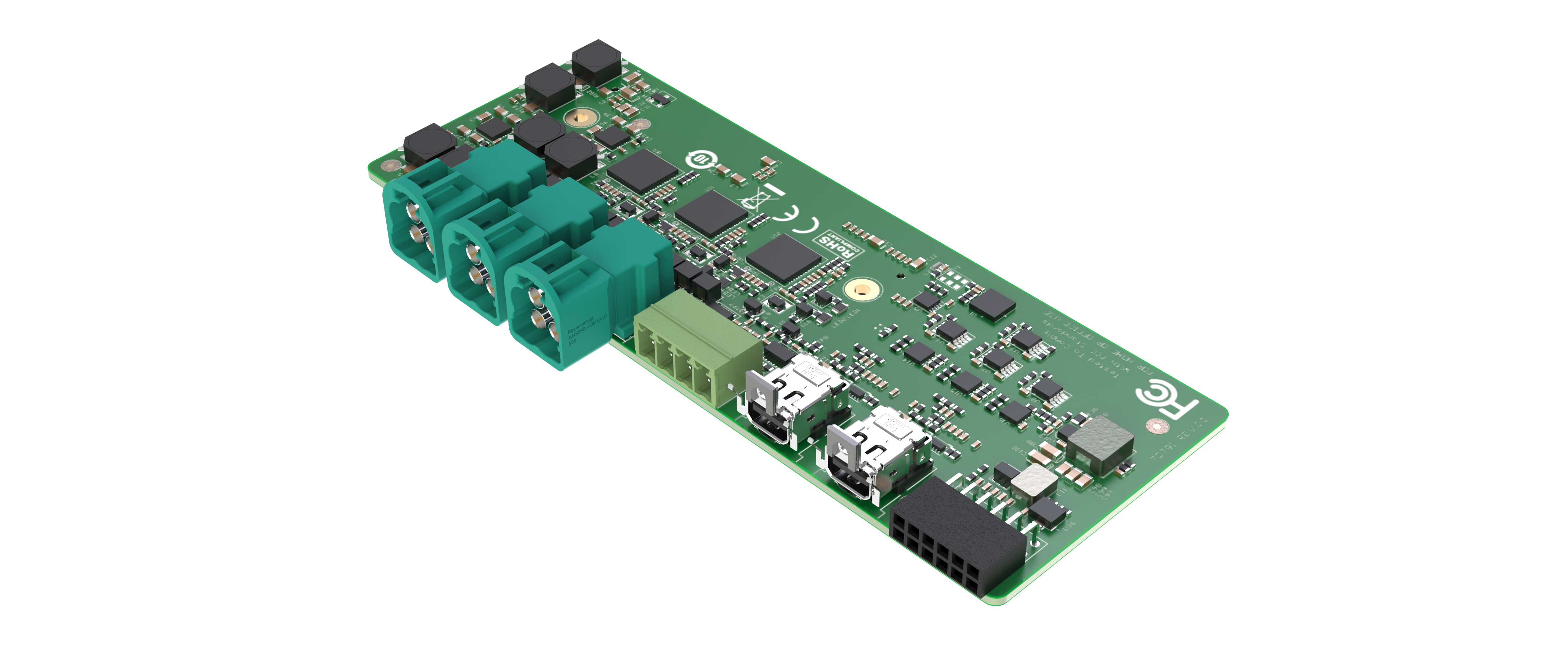
Despite its 170×170mm footprint, the EDGE+ VPR-7P132 includes five display outputs, dual 10Gb Ethernet, USB4, multiple USB and audio interfaces, and PCIe Gen4 expansion via M.2 and OCuLink. An optional I/O daughterboard expands support further with three Quad GMSL2 C/D‑PHY interfaces for up to 12 cameras, two CAN‑FD ports, and additional mini DisplayPort outputs tied directly to the Versal subsystem.
The platform is built for continuous operation, with LPDDR5 support, onboard UFS storage, TPM 2.0, and compatibility with Ubuntu, Yocto Linux, QNX, and VxWorks. SAPPHIRE positions the board as a scalable solution for developers building edge systems that need both high‑performance application processing and deterministic AI acceleration.
KitGuru Says: This isn't necessarily something that will be of interest to the gamers in our audience, but those in IT and enterprise looking to integrate AI throughout their workflows will want to keep an eye on the work Sapphire is doing in the AI Mini PC space.
The post CES 2026: Sapphire launches new Edge+ motherboard with embedded Ryzen AI first appeared on KitGuru.Ubisoft has been one of the better publishers when it comes to updating their back-catalogue of games for current-gen hardware, with multiple Assassin’s Creed titles; Far Cry entries and most recently The Division 1 all getting 60fps patches on PS5 and Series X|S. It appears as though more such updates are in the works, with Ubisoft teasing that the iconic Far Cry 3 could be next in line.
Responding to one Twitter user who wrote: “Far Cry 3 classic edition and Blood Dragon 60fps update when? Please tell me soon!” the official Far Cry page posted a meme featuring the known ‘smug stickman’ – suggesting that such an update is in the works.
As mentioned, Ubisoft have released a ton of performance patches for various last-gen titles, including but not limited to: Far Cry 4; Far Cry 5; Assassin’s Creed Syndicate; AC: Origins; Odyssey and The Division 1. As such it is unsurprising that one of the most iconic titles ‘Far Cry 3’ would be seeing a similar treatment.

All that being said, as with pretty much all previous 60fps updates, expect little else in the way of enhancements. This means that Far Cry 3 on PS5 will likely still operate at 1440p albeit at 60fps instead of 30. Unfortunately, don’t expect any major changes otherwise – meaning it will still likely feature a rather narrow field of view (among other last-gen compromises).
Still, having as many last-gen titles as possible updated to offer 60fps at the very least is welcome to see. Hopefully we get a formal announcement soon.
KitGuru says: What do you think of Ubisoft’s ongoing support for last-gen titles? Would you like to see more games get native current-gen enhancements instead? Or is 60fps enough of an improvement? Let us know down below.
The post Far Cry 3 seemingly next in line to receive 60fps current-gen patch first appeared on KitGuru.be quiet! is kicking off CES 2026 with a major refresh across its cooling, PSU, and peripheral lines — including its first products to feature integrated LCD displays. The company’s showcase spans new AIO and air coolers, high‑wattage power supplies, and a pair of ultra‑light gaming mice.
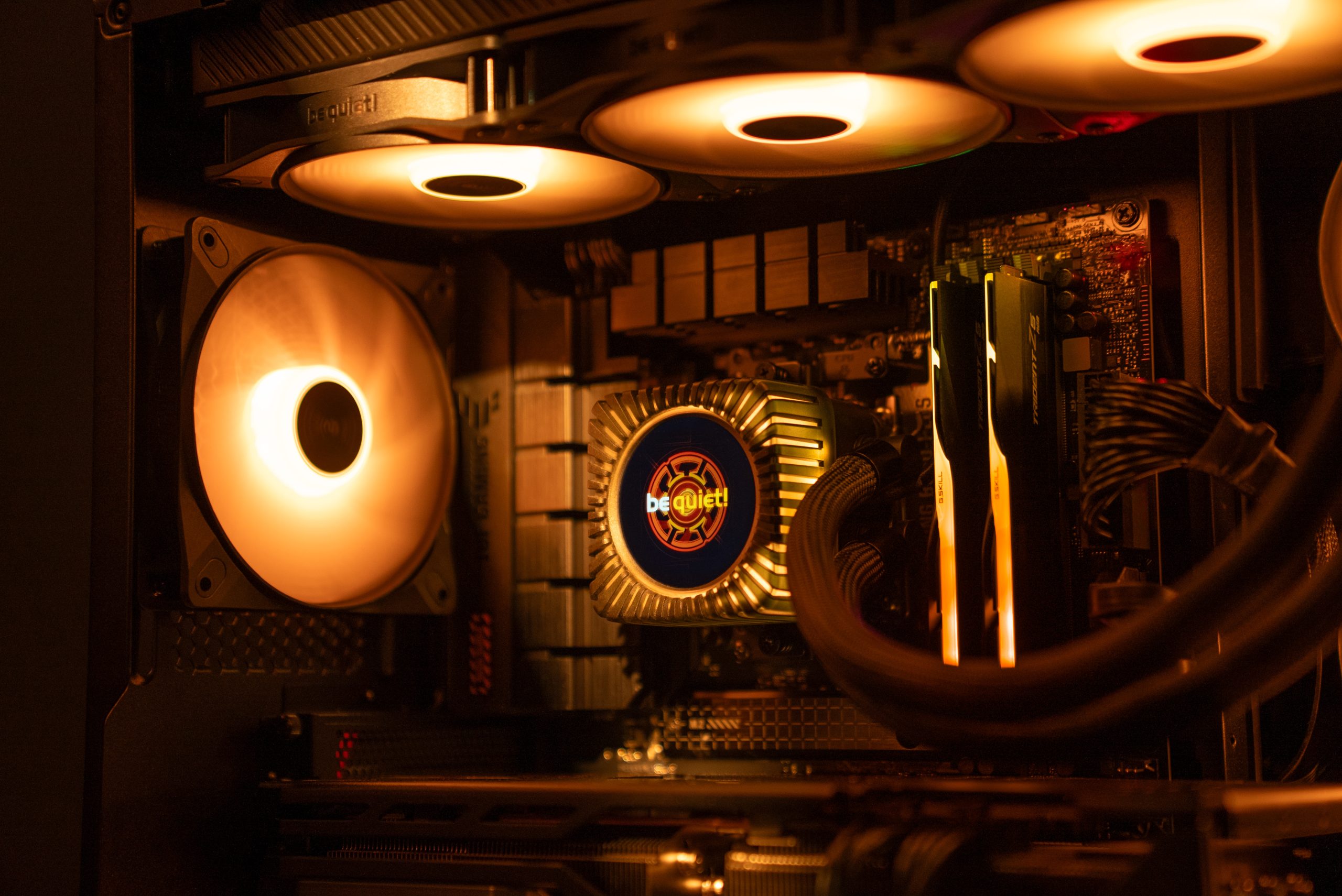
The headline announcement is the Light Loop IO LCD, an AIO liquid cooler built for high‑end and overclocked systems. It features a 2.1‑inch IPS display capable of showing system telemetry, images, videos, or custom presets, all at 500 nits of brightness. Cooling is handled by a redesigned pump, a new jet‑plate and cold‑plate assembly, and three daisy‑chained Light Wings LX PWM fans. Full control is available through the updated IO Center software, including ARGB effects and a new Screen Sync mode. The cooler will ship in 360mm and 240mm sizes, in both black and white.
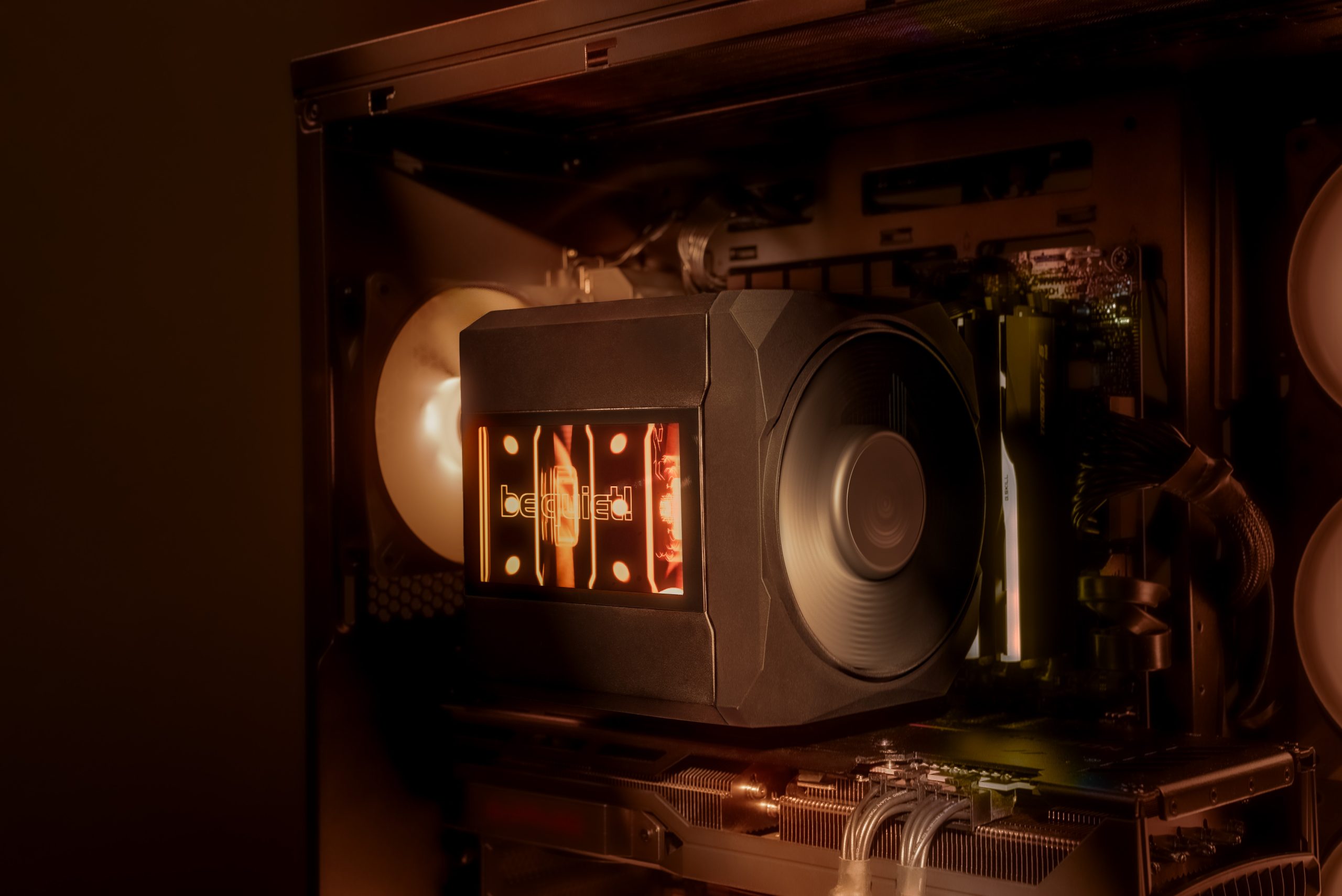

Alongside the AIO, be quiet! is expanding its flagship air‑cooling line with the Dark Rock 6 and Dark Rock Pro 6. The Pro model uses seven heat pipes and dual Silent Wings PWM fans to handle heavily overclocked CPUs, while the standard Dark Rock 6 offers a more compact six‑pipe design with a 135mm fan. Both coolers support semi‑passive operation for silent idle workloads. An early prototype of the Dark Rock Pro 6 IO LCD was also shown, adding a 4.5‑inch IPS display with the same customisation options as the Light Loop IO LCD.
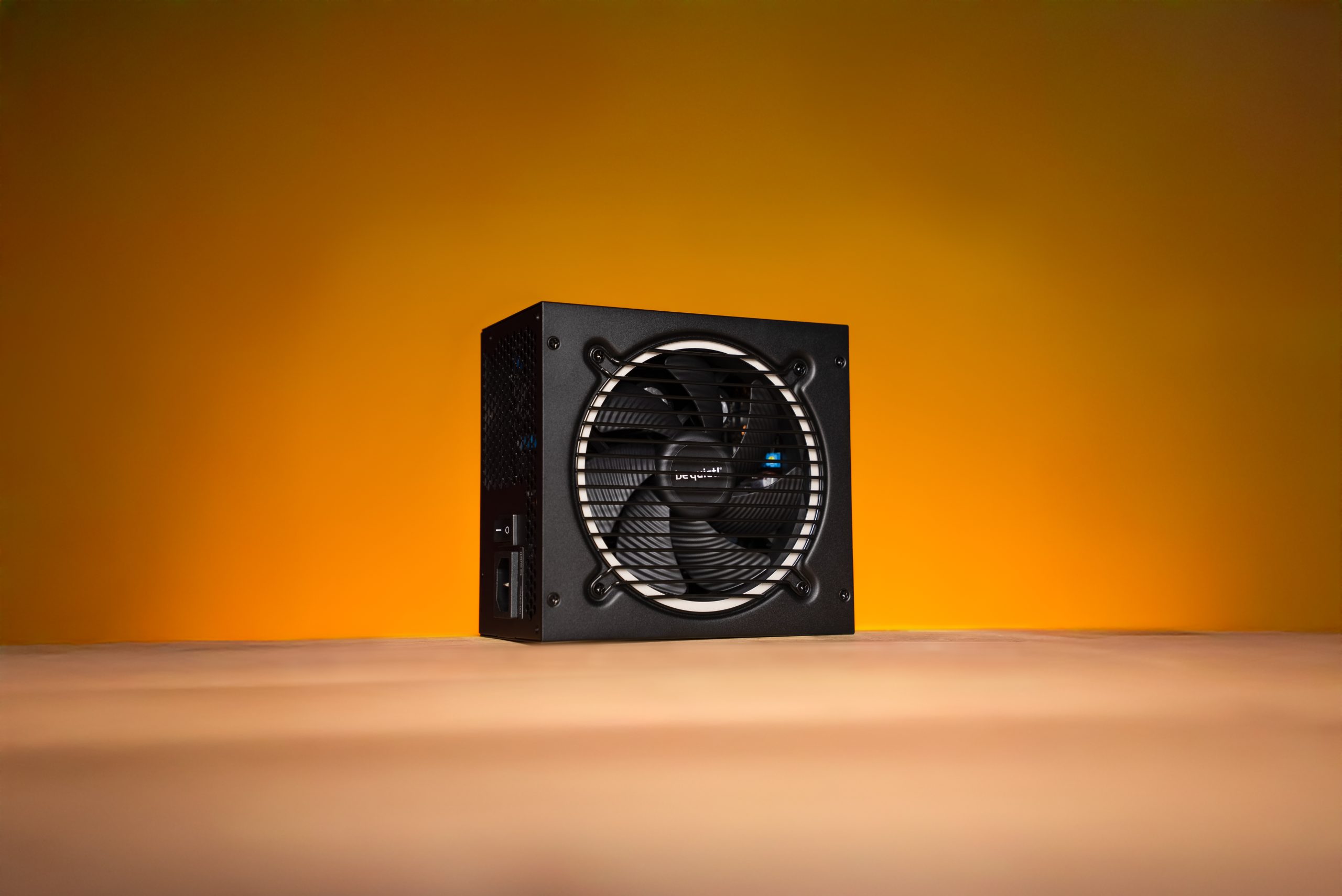
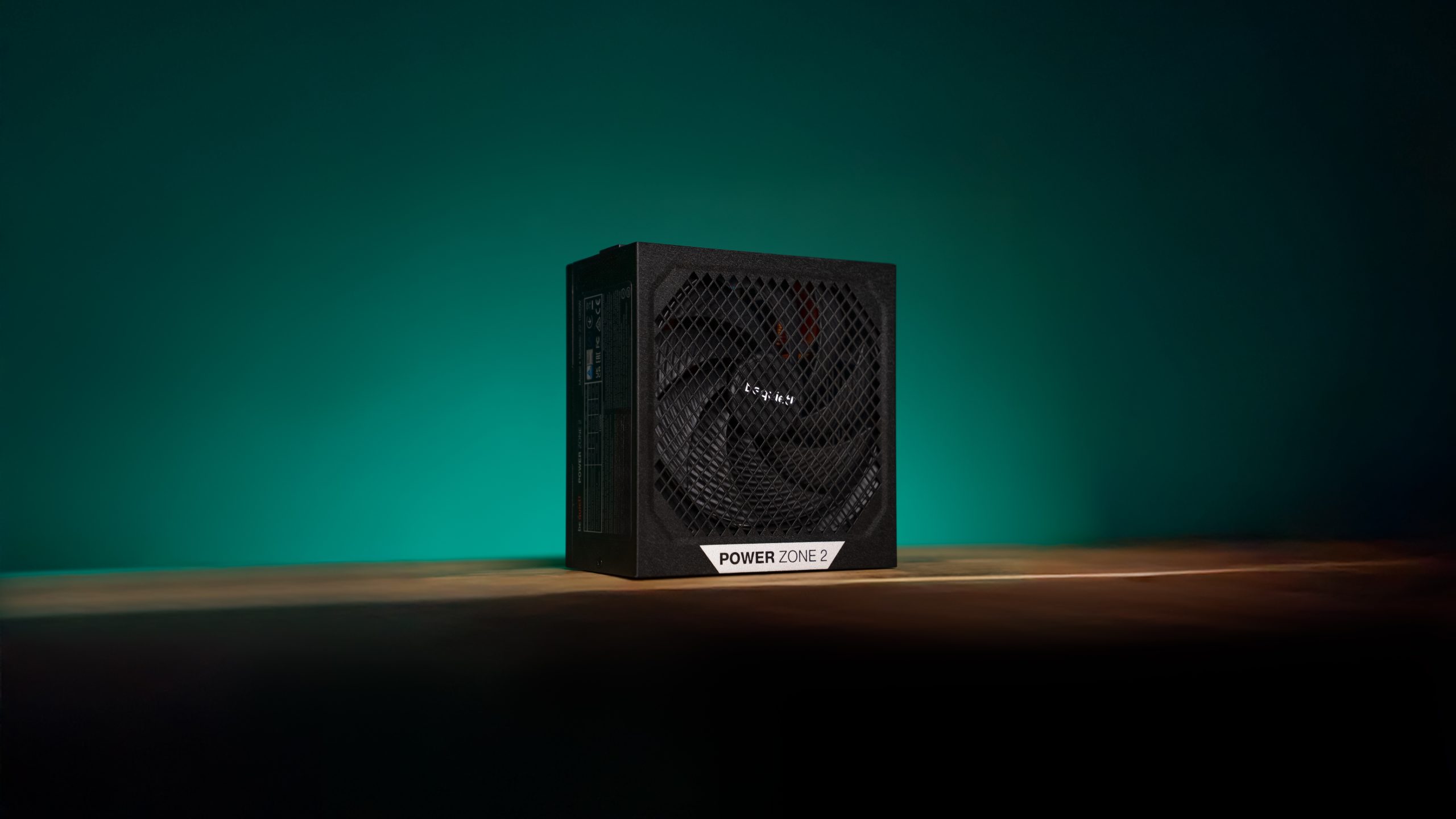
For power delivery, the company is introducing 1200W versions of its Power Zone 2 and Pure Power 13 M PSUs. The former targets high‑end builds with 80 PLUS Platinum efficiency, Cybenetics Platinum certification, and full ATX 3.1/PCIe 5.1 support. The Pure Power 13 M 1200W offers 80 PLUS Gold efficiency and semi‑passive cooling, with both units capable of handling extreme power excursions.
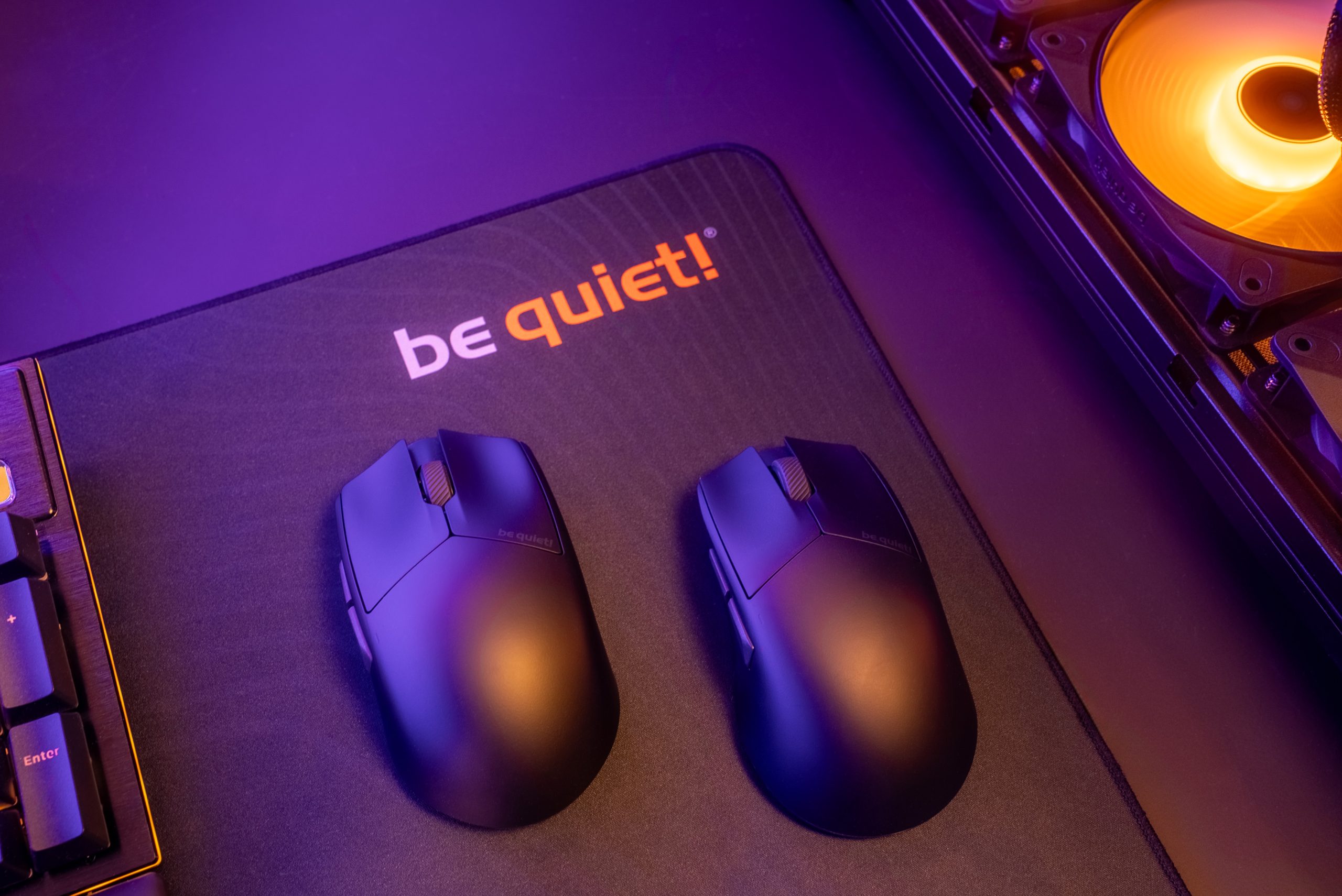
Rounding out the lineup are the Dark Perk Ergo and Dark Perk Sym gaming mice — 55g wireless models with 8,000Hz polling, a 32,000 DPI PixArt sensor, optical switches, and up to 110 hours of battery life.
KitGuru Says: Will you be keeping your eye out for any of be quiet!'s new gear in the coming months?
The post CES 2026: be quiet! announces its first LCD-equipped AIO cooler, Dark Rock 6 and more first appeared on KitGuru.8BitDo has amassed a strong reputation over the past few years for their high quality 3rd party controllers, with an emphasis on offering throwback designs and colour schemes to systems of old. In an interesting addition to their line-up of accessories, the hardware maker has now unveiled the FlipPad: A new, unique mobile controller built specifically for vertical gaming.
Making the announcement via a brief teaser video on Twitter, the official 8BitDo account officially unveiled the FlipPad “a flip-style gamepad designed for mobile gaming.”
Said to be arriving some time this Summer, the unique vertically-aligned controller attaches to your phone using USB-C for minimal latency. After connecting the controller, the faceplate / button pad then flips to cover the lower 3rd of your phone screen.
Up until now, only one other controller maker has attempted to create such a product, with the Hyperkin Smart Boy originally being announced as an April Fool’s joke – though it was ultimately turned into a real product.
Given the fact that many earlier handhelds were designed as vertical systems, the 8BitDo FlipPad will serve as a great way to play emulated titles on your smartphone without the need for a relatively chunky telescopic accessory. Hopefully the buttons themselves feel satisfying to use.
KitGuru says: What do you think of the 8BitDo FlipPad? Could it inspire a new wave of vertical controllers? How much do you think it’ll cost? Let us know down below.
The post 8BitDo announces unique ‘FlipPad’ vertical smartphone controller first appeared on KitGuru.Cooler Master is using CES 2026 to show the new entries to its enthusiast stack, bringing back some of its most iconic sub‑brands. The manufacturer's showcase in Las Vegas this week focuses on the “FreeForm 2.0” design philosophy, a modular approach that spans everything from the massive new Cosmos Alpha flagship to PSUs equipped with proactive GPU protection.
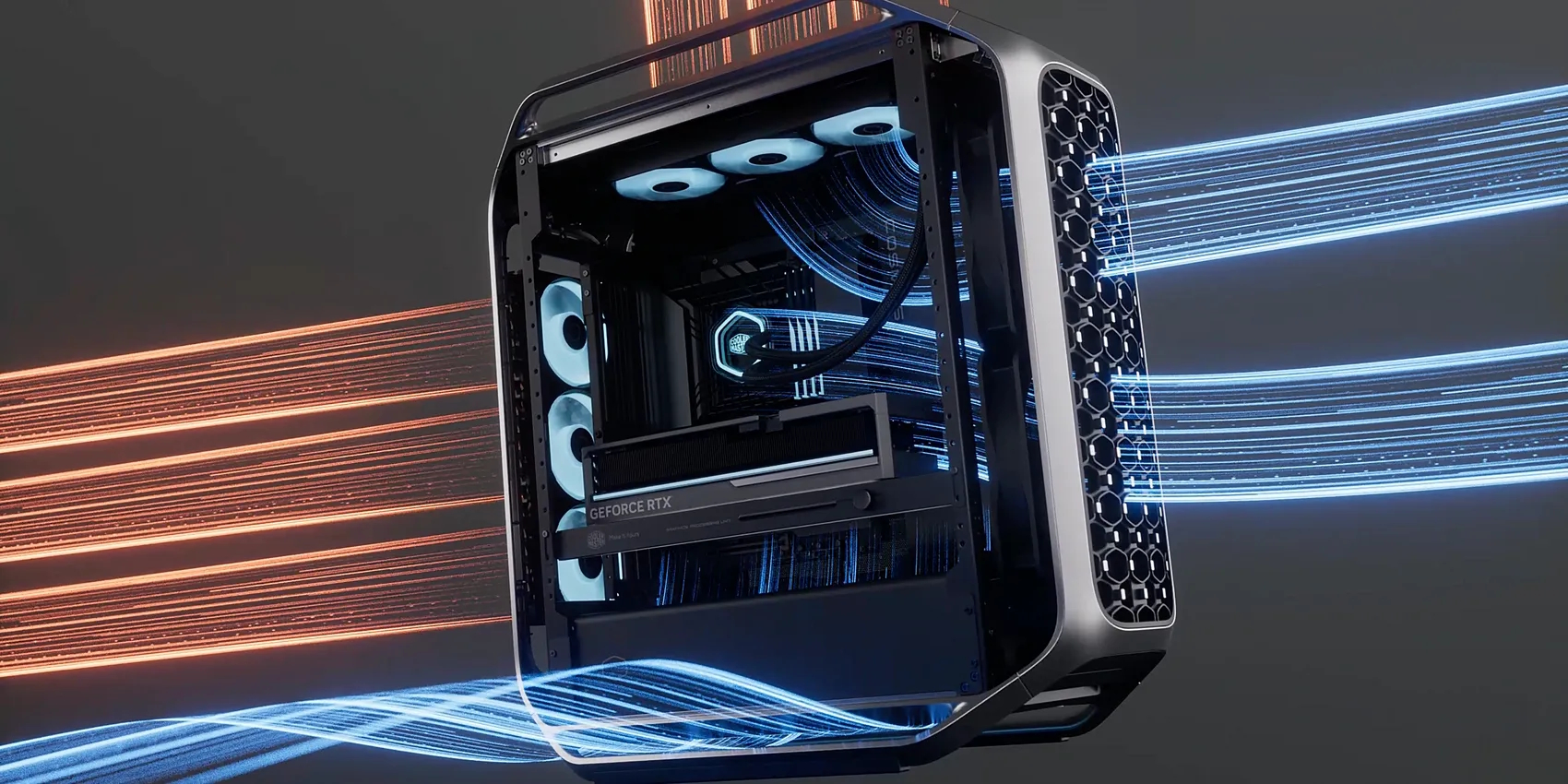
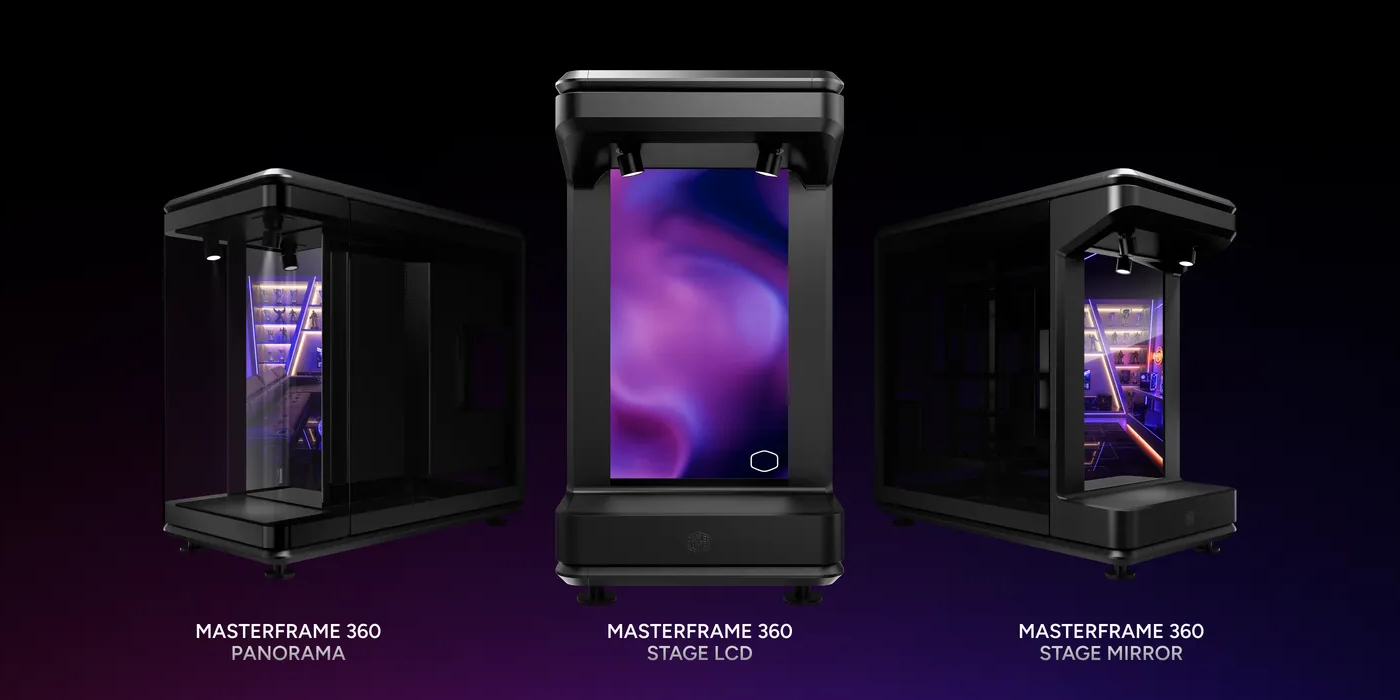
The centrepiece of the case lineup is the Cosmos Alpha, a full‑tower that serves as the spiritual successor to the C700 series. This new revision emphasises internal modularity through a sliding motherboard tray, allowing builders to shift the system’s position to prioritise either radiator clearance or increase the size of the cable‑management chamber. The chassis arrives with two extra‑thick 200x38mm fans pre‑installed and supports up to 420mm radiators. Alongside the flagship, the MasterFrame 360 series offers an open‑frame showcase designed for collectors. Available in Panorama, Stage Mirror, and Stage LCD variants, the latter includes a 15.6‑inch 1080p display at the front for personalised animations or telemetry.
For cooling, we have the return of the V8 series with the V8 ACE. This high‑end air cooler uses Cooler Master’s 3DHP technology, which integrates a 3D vapour chamber directly with the heat‑pipe structure to eliminate traditional thermal bottlenecks at the CPU contact point. On the liquid‑cooling side, the Core Nex Digital 240 and Core Nex LCD 360 make their debut, featuring a refined dual‑chamber pump design. Alongside these AIOs, Cooler Master is introducing the MasterFan A series, which features an aluminium construction, and the MasterFan M ARGB series, offering a more balanced approach to durability, acoustics, and visuals.
Perhaps the most practical advancement for modern builders is found in the MWE Gold V4 PSU series. These units introduce GPU Shield, a hardware‑level protection system integrated into the 12V‑2×6 power delivery standard. Unlike traditional passive cables, GPU Shield actively monitors the connection for abnormal thermal or electrical conditions, providing real‑time alerts and intervening before a “melting” scenario can occur.
To round out the ecosystem, Cooler Master also unveiled the Master Meter, a standalone digital tachometer, and the Master Vision 12.3‑inch external display for dedicated system monitoring.
KitGuru says: Interested in any of Cooler Master's new PC parts?
The post CES 2026: Cooler Master launches new cases, PSUs and cooling solutions first appeared on KitGuru.Meta is delaying the international roll-out for Ray-Ban Display Glasses with Neural Band while a handwriting feature arrives in the United States.
Meta's handwriting feature promises heads-up input on any surface while wearing the Neural Band. The feature launches first in Early Access in the United States for the English language with the "ability to send messages on WhatsApp and Messenger by writing with their finger on any surface."
Citing "unprecedented demand and limited inventory," Meta said it is also pausing "our planned international expansion to the UK, France, Italy, and Canada, which was originally scheduled for early 2026."
"Product waitlists now extend well into 2026," a Meta blog post reads. "We’ll continue to focus on fulfilling orders in the US while we re-evaluate our approach to international availability."
Meanwhile, Meta is rolling out pedestrian navigation for the Display glasses in Denver, Las Vegas, Portland and Salt Lake City joining dozens of existing cities with support. Meta also announced a "phased rollout" for a new teleprompter feature for the Display glasses.
Our review described the Display glasses as "first generation heads-up mobile computing" and we awarded the band "Best New Hardware" of 2025 for its breakthrough interface.
A team of astronomers have uncovered an unusually hot 12 billion year-old gas cluster that challenges everything we thought we knew about the early growth of the universe.
Peering back to about 1.4 billion years after the Big Bang, an international group of researchers has identified a baby galaxy cluster, cataloged as SPT2349-56, that's
It took a minute, but NVIDIA has finally answered the call to deliver a native Linux app for its GeForce NOW cloud gaming service (timely too, with recent Steam's survey data showing Linux on the rise for gaming). Same goes for select Amazon Fire TV Stick devices, both of which can tap into the service's GeForce RTX 5080-class pods to stream
In a world where you usually have to choose between ignoring your friends with noise-canceling earmuffs or annoying them with a portable boombox, a new gadget has arrived at CES 2026 to ensure you can do both with a single flick of the wrist.
The TDM Neo has officially been unveiled and it's determined to solve a problem that exactly three
We already reported on the serious slick ROG Xreal R1 gaming glasses yesterday, but ASUS didn't come to CES 2026 with just one big reveal. The company's Republic of Gamers brand rolled out updated Zephyrus laptops with more GPU headroom, a bold new take on the dual-screen Zephyrus Duo, a Kojima Productions–themed Flow Z13 that looks like a
Samsung is making quick work of deploying Intel's newly launched Core Ultra Series 3 processors, otherwise known as Panther Lake, which underpin its latest generation Galaxy Book6 laptop lineup. Announced at CES, the new Galaxy Book6 laptops draw inevitable design language comparisons Apple's MacBook Pro, though internally, these are very
PNY put the GeForce RTX 50 series on a diet with a new lineup of slim models designed for small form factor (SFF) gaming PCs, or anyone who simply wants a more compact GPU. The new cards span the GeForce RTX 5070, GeForce RTX 5070 Ti, and GeForce RTX 5080, each of which are packaged in a dual-slot configuration.
These are true 2-slot cards,
If the mission is to go big or go home, someone tell Dell not to stay up waiting. At the Consumer Electronics Show (CES) in Las Vegas Dell unveiled a big and bold 52-inch ultrawide display with a curved IPS Black panel, 6K resolution, and built in Thunderbolt hub. Yeah, it's like that.
For the intended audience—financial traders, data scientists,Hi-Fi Rush has had an interesting life. Developed by Tango Gameworks and published by Microsoft following their acquisition of ZeniMax Media (aka Bethesda), the rhythm-focused action title received high praise across the board and was reportedly a success on all fronts according to Xbox. Unfortunately, Tango Gameworks would later be shut down – though it was thankfully revived by KRAFTON. Now under a new label, a physical release for Hi-Fi Rush has been officially announced.
Making the official announcement, physical media specialists Limited Run Games have revealed that they are releasing a disc version of Hi-Fi Rush.
Available for PS5/Xbox in 3 different variants, the Rhythm (standard) Edition includes the base game alongside all Digital Deluxe Edition content. The Smidge Edition meanwhile offers you a physical version of the game alongside a 3-disc soundtrack with developer notes; a special edition box and a bunch of in-game bonuses.
Last but certainly not least, the Project Armstrong Edition includes all of the above plus:



All three versions of Hi-Fi Rush will be available to pre-order from the 16th of January until the 1st of March, with the Rhythm Edition costing you $39.99; the Smidge Edition going for $69.99 and the Project Armstrong Edition setting you back a whole $174.99.
Given the behind-the-scenes drama surrounding Tango Gameworks and Microsoft, it makes some sense that this physical release has taken quite a while to come to fruition. Still, for those who want a disc version of one of Tango Gameworks’ best titles, it is finally happening.
KitGuru says: What did you think of Hi-Fi Rush? Is the physical version arriving too late? What do you think of each edition’s contents? Let us know down below.
The post Hi-Fi Rush to get a physical release with pre-orders going live next week first appeared on KitGuru.