The ASUS Zenbook DUO remains the undisputed king of versatile portable multitasking. The seamless dual-screen design powered by the Core Ultra X9 388H deliver both snappy performance and amazing battery life—a rare feat for this category. Intel's Arc B390 offers the best integrated graphics solution in the segment. With color-accurate OLED displays and a top-tier keyboard, this isn't just a gadget; it’s a serious tool for professionals.
Arrow Lake is the codename for Intel's Core Ultra 200 series processors, which are currently its latest-generation desktop CPUs despite that they've been somewhat superseded by the Core Ultra 300 series on mobile. Before we receive the truly next-generation Nova Lake processors on a new platform later this year or early next year, we're expecting
Developer Pixelity confirmed that Evangelion: Δ Cross Reflections will be shown at the franchise's 30th anniversary event this month.
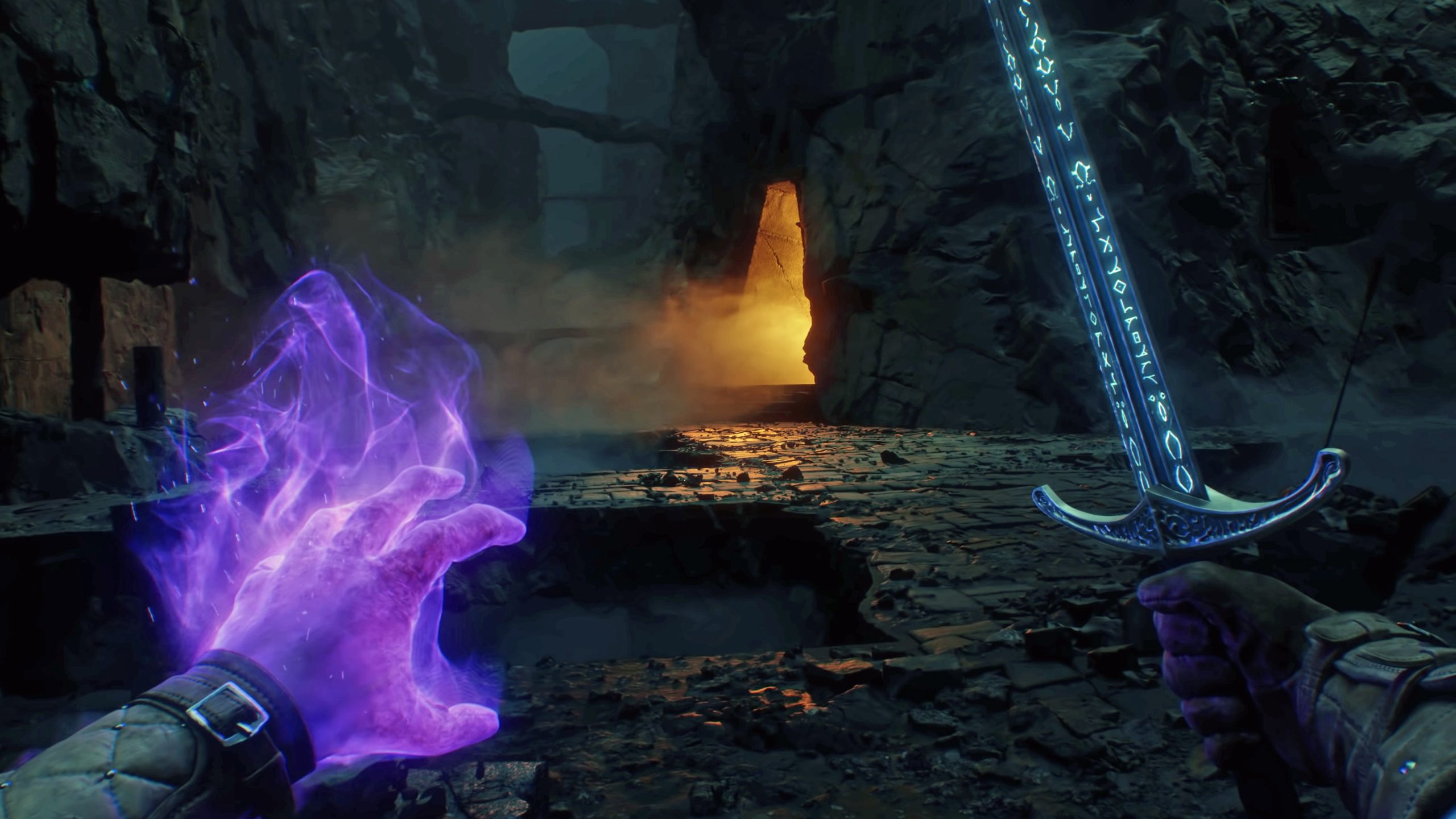
Korea-based indie studio Pixelity announced a VR game based on the iconic Neon Genesis Evangelion franchise back in February 2025, and now fans have gotten their first teaser image. According to past statements, Evangelion: Δ Cross Reflections will tell an original story set in the world of the classic '90s anime and will be released in three parts.
The first installment in this series is expected to launch at some point in 2026, but a select group of fans will get to try Evangelion: Δ Cross Reflections out for themselves in a hands-on demo during the upcoming Evangelion 30th anniversary event. It will take place in the Yokohama Arena in Yokohama, Japan from February 21 to February 23, as reported here.
📢 25 days until "EVANGELION:30+; 30th ANNIVERSARY OF EVANGELION"!
News of Evangelion: Δ Cross Reflections' presence among the festivities was confirmed alongside a teaser image of the game on social media, which seems to show the player character signing up with the angel-battling organization NERV. This screenshot reveals a cel-shaded art style in a similar vein to games like Persona 5 or Dragon Ball: Sparking! Zero.
As noted before, there is still no official release date for Evangelion: Δ Cross Reflections, nor is there any word on what platforms the game will be available on when it does launch. Late last year, Pixelity announced that it was accepting public Focus Group Test applications ahead of this year's release.
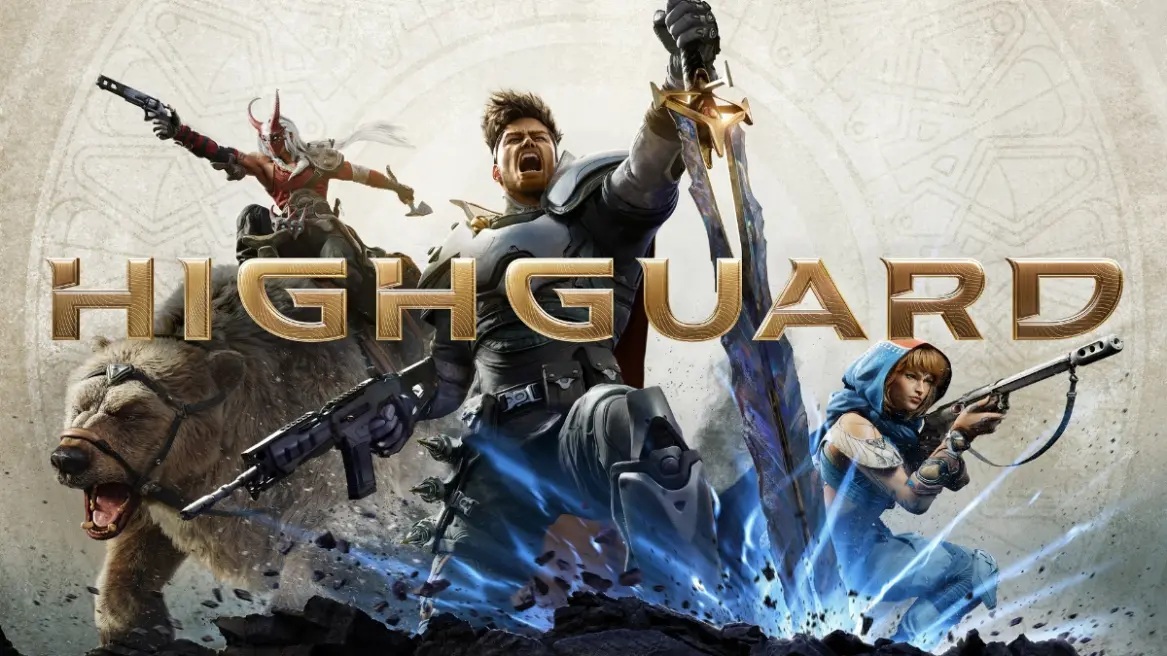
Last week in an effort to improve player sentiment around the game's launch, the team behind Highguard rushed out a 5v5 mode, a highly requested feature amongst players who felt that the game's launch map was simply too large for 3v3 matches. Initially, this was only going to be a limited-time game mode, but it is now being turned into a permanent addition to the game.
When Highguard launched last week with its 3v3 PvP mode, many players were quick to complain that the map feels like it was designed for larger-scale battles. Now the team at Wildlight has addressed this with the permanent addition of the 5v5 raid mode.
Interestingly over the weekend, Wildlight said it saw a “fairly even split” between those queuing for 3v3 matches and 5v5 matches. However, many players have expressed that the 5v5 mode feels like the way Highguard is supposed to be played, so those numbers might skew now that the mode is a permanent fixture of the game.
Highguard initially launched on the 26th of January, peaking at over 100,000 concurrent players, all drawn in from the game's announcement at The Game Awards, followed by several weeks of silence while the devs prepared for launch. The game's player numbers have since dipped, but it is still pulling in over 10,000 players each day.
Last week, Wildlight also revealed a huge roadmap for Highguard, with plans for monthly updates through the rest of the year.
KitGuru Says: Are you glad to see 5v5 becoming a permanent mode in Highguard?
Samsung has overhauled its display strategy for 2026, officially bringing Nvidia G-Sync Compatibility to its entire flagship OLED TV range and the latest Odyssey gaming monitors. This move appears designed to bridge the gap for GeForce users who have previously looked toward competitors for guaranteed variable refresh rate support. The updated list of compatible hardware includes the S95H, S90H, and S85H television models, as well as the Odyssey G6 series.
On the television side, the 2026 OLED lineup has seen a notable increase in gaming-centric specifications. The flagship S95H and the mid-tier S90H now support refresh rates up to 165Hz, a jump from the 144Hz standard seen in previous years. The entry-level S85H remains at a respectable 120Hz. These displays also debut what Samsung calls HDR10+ ADVANCED, a format that reportedly uses AI-driven algorithms to manage brightness and motion accuracy frame by frame. Additionally, the premium S95H and S90H models are expected to feature a proprietary Glare Free coating that suppresses ambient reflections without the typical haziness associated with matte screens.
Additionally, Samsung is also launching the 27-inch Odyssey G6 G60H, one of the first consumer displays to reach 1,040Hz. This is achieved through a Dual Mode feature that allows the screen to operate at its peak frequency in HD resolution while still offering a substantial 600Hz at its native QHD resolution. For those prioritising panel technology over raw frequency, the Odyssey G6 G61SH variant utilises a QD-OLED panel with a more balanced 240Hz refresh rate at QHD, paired with the near-instant 0.03ms G2G response times and deep contrast levels typical of QD-OLEDs.
KitGuru says: Are you thinking of picking up a Samsung gaming monitor or TV this year?
The first wave of Game Pass titles for February 2026 has now been announced. Starting today, games like Final Fantasy 2 and Like a Dragon: Pirate Yakuza in Hawaii are available across all Game Pass platforms, but there is much more to come later in the month, including the day-one release of High on Life 2.
High on Life 2 is the sequel Squanch Games' debut action title, blending over the top humour with a shootout against aliens. The sequel will offer larger and more open environments, a stronger narrative focus with reactive dialogue and branching conversations, as well as improved combat with additional enemy archetypes and a bigger roster of weapons.
Here is the full list of titles coming to Game Pass over the next two weeks along with platforms and dates:
Final Fantasy II (Cloud, Xbox Series X/S, PC) – February 3
Like a Dragon: Pirate Yakuza in Hawaii (Cloud, Console, Handheld, PC) – February 3
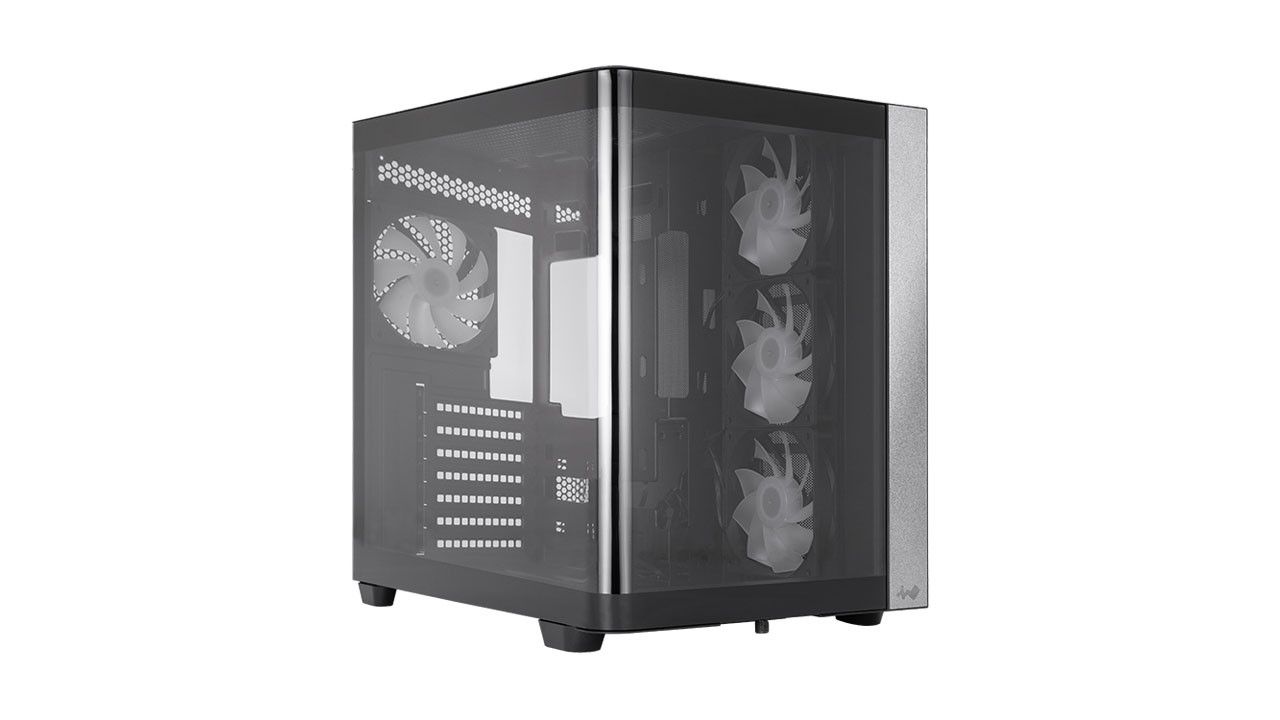
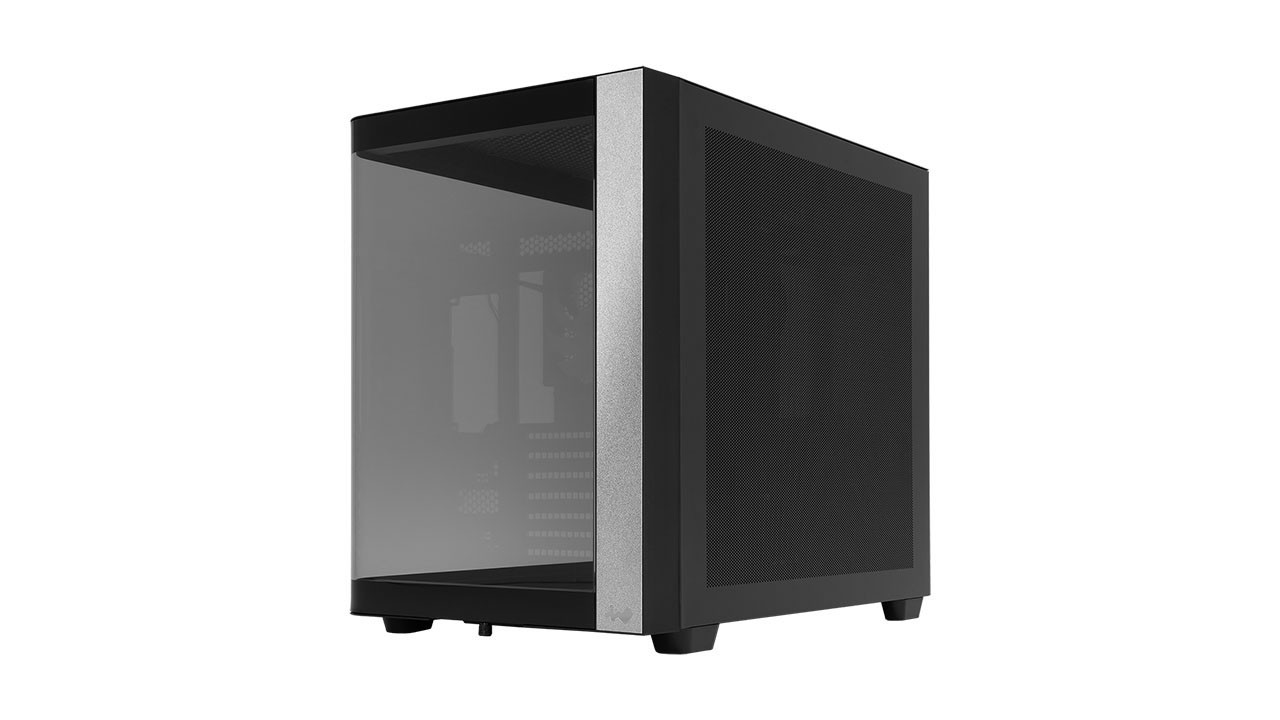
After its CES 2026 reveal, InWin has officially announced the W31. This mid-tower chassis aims to balance a compact footprint with the high-end “panoramic” aesthetic currently dominating the market.
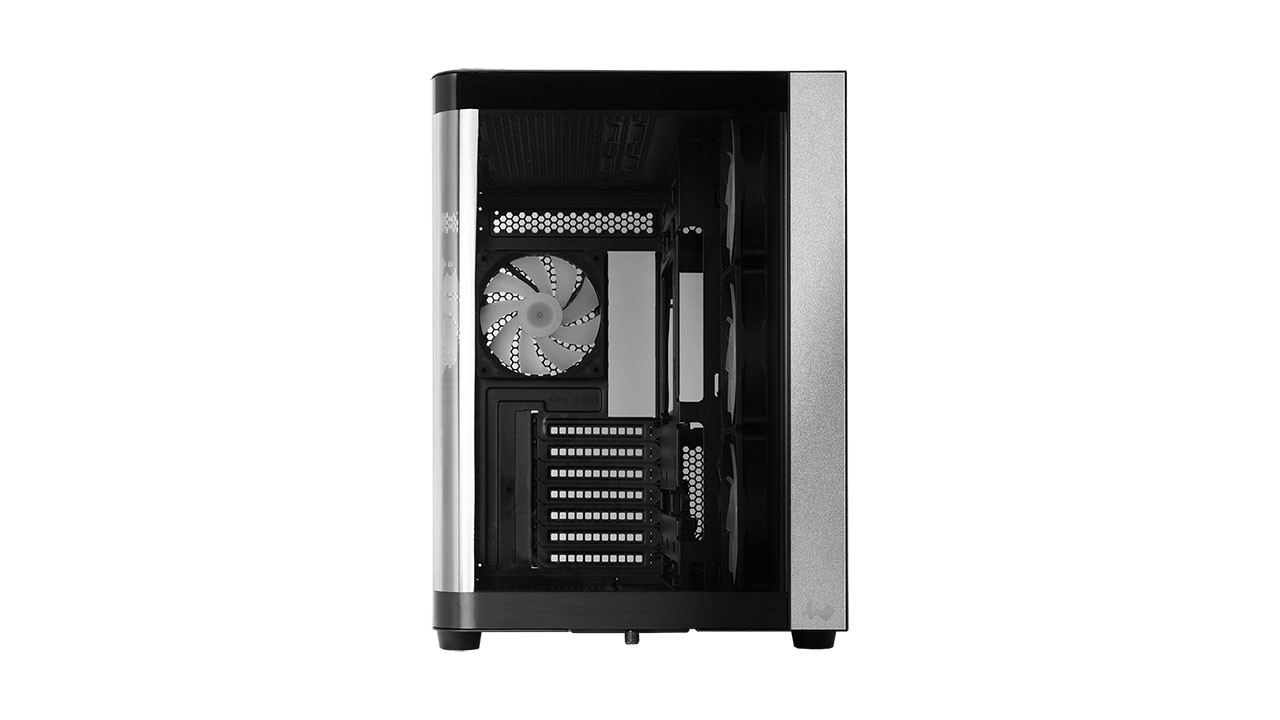
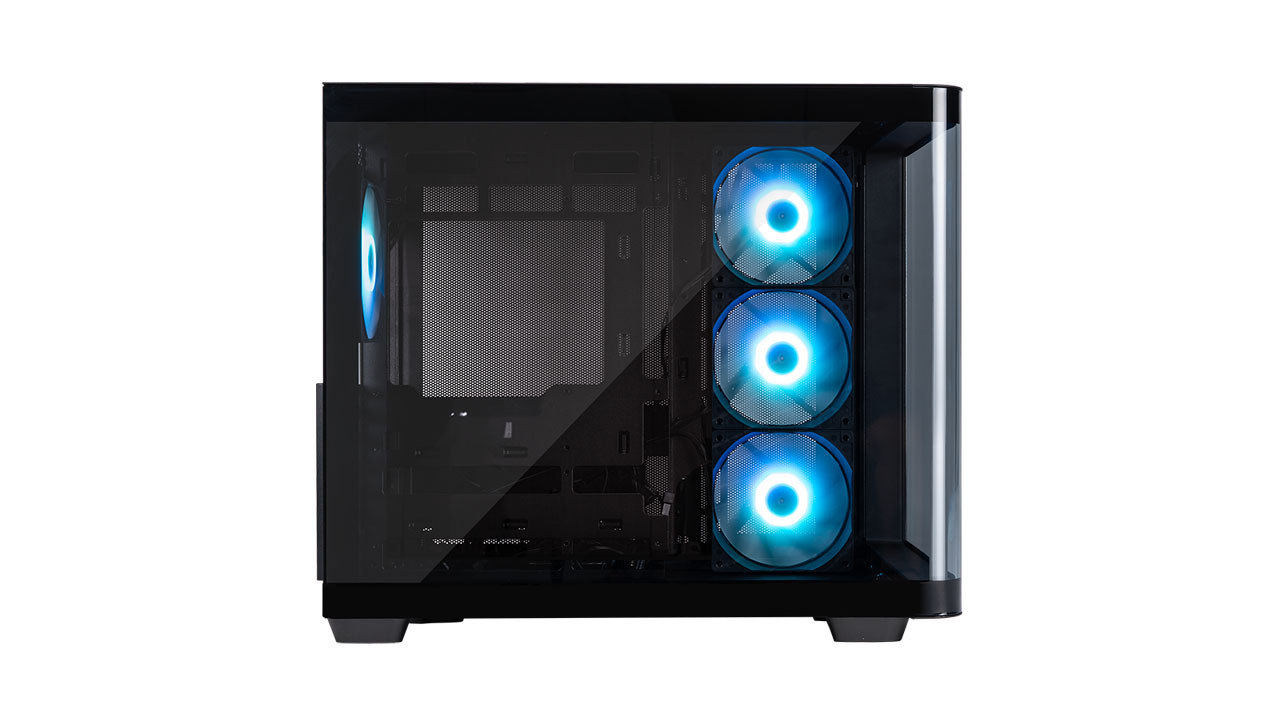
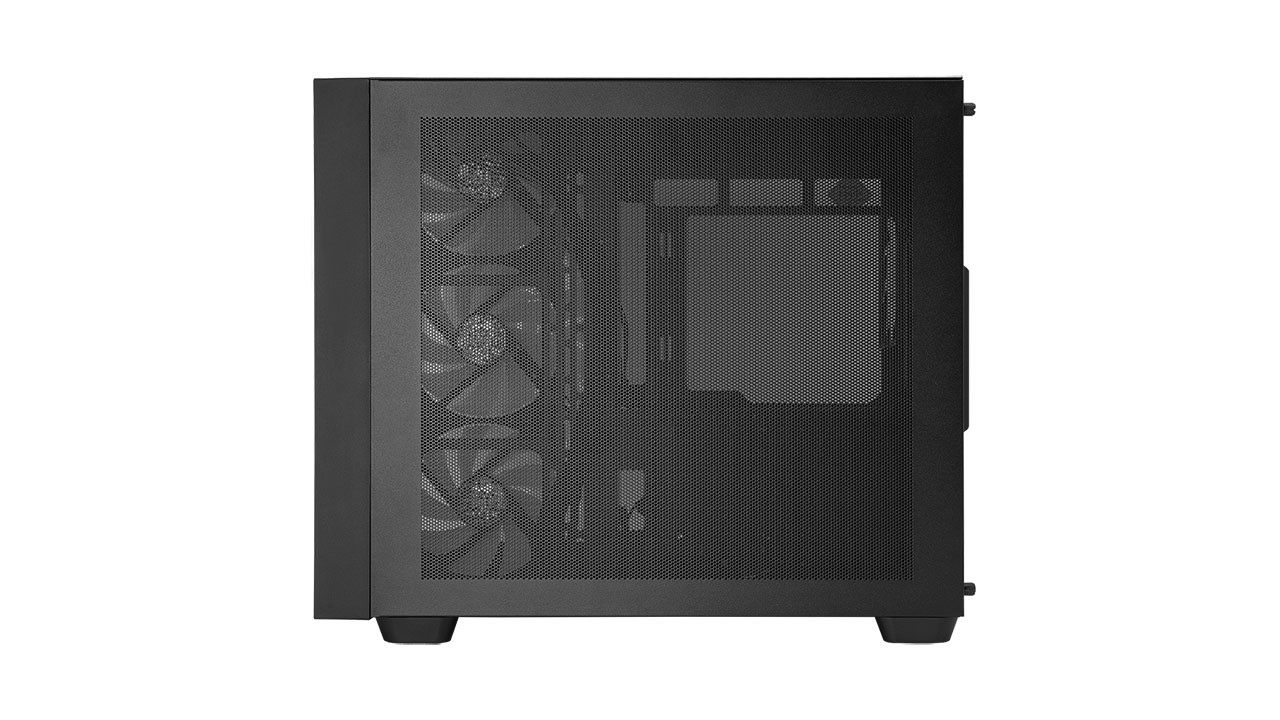
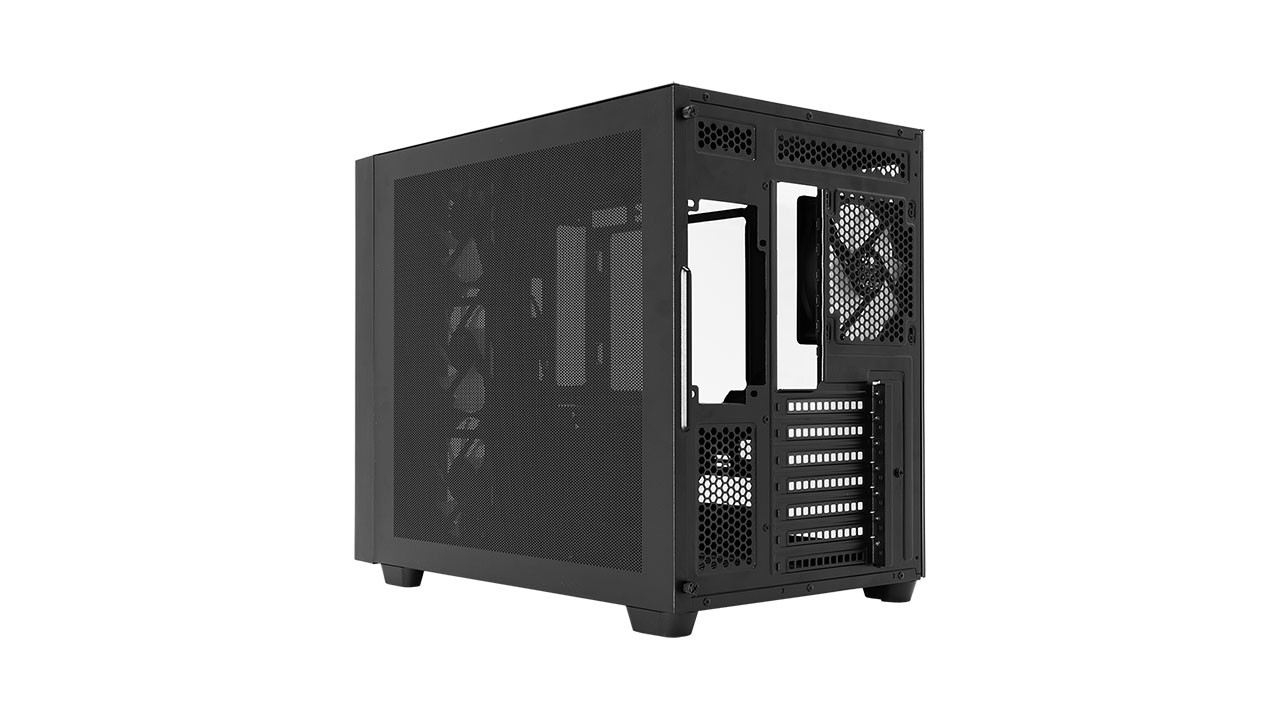
The W31 (via Cowcotland) features a seamless curved tempered glass panel that wraps around the front and side, secured by a single thumbscrew for tool-less access. Despite its relatively modest dimensions of 460 x 285 x 400mm, the chassis is claimed to support full ATX motherboards, including the increasingly popular back-connector designs like Asus BTF and MSI Project Zero.
The internal layout features a dual-chamber design to isolate the PSU and storage drives behind the motherboard tray, maximising airflow to the primary components. Cooling appears to be a major focus, as the W31 is supposed to support up to ten 120mm fans. Out of the box, it ships with four pre-installed fans: a single 120mm exhaust at the rear and three reverse-blade 120mm fans along the side intake. While liquid-cooling enthusiasts can mount a 360mm radiator at the top or bottom, potential builders should note that side-mounted radiator support is limited to 240/280mm due to height constraints.
Hardware compatibility remains generous for a case of this size. It can accommodate graphics cards up to 410mm long, power supplies up to 240mm long, and CPU air coolers up to 160mm tall. Connectivity is handled by a top-mounted I/O panel featuring a 20Gbps USB-C 3.2 Gen 2×2 port, two USB-A 3.0 ports, and dedicated controls for the integrated ARGB lighting hub.
KitGuru says: The InWin W31 seems to be a well-considered addition to the panoramic case market, particularly for those who want the “fishtank” look without sacrificing desk space.
2025 ended up being an absolutely huge year for Obsidian Entertainment. The studio has shipped more games than any other first-party Xbox studio, with three arriving last year alone, including Avowed, Grounded 2 and The Outer Worlds 2. Unfortunately, two of these games did ‘fall below expectations' and while Obsidian already has plans for future Avowed titles, the same can't be said for its Sci-Fi series.
In a massive article posted by Bloomberg's Jason Schreier this week, we get a breakdown of Obsidian's view of its big year, as well as what to expect in the future. While Obsidian did succeed in shipping three titles through last year, it turns out that both Avowed and The Outer Worlds 2 suffered from ‘inflated' production costs due to their lengthy 6-year development timelines. This unfortunately meant that sales expectations were also higher, but neither game managed to meet those targets.
Of course, there is still time for that to change. The Outer Worlds 2 has only been out for a few months and still has expansions on the way. Avowed on the other hand has remained an Xbox console exclusive since launch. Avowed's PS5 release this month should bring a sales boost along with it.
In the article, Obsidian leaders like CEO, Feargus Urquhart described some ways that both of its major 2025 titles could have been improved. The Outer Worlds 2 could have used stronger companions, while Avowed could have improved player agency by allowing them to steal and potentially draw the ire of town and city guards, a staple in many fantasy RPGs.
Moving forward, there are plans to continue making games in the Avowed and Pillars of Eternity universe. However, there are currently no plans for an Outer Worlds 3. That could change after the second game's DLCs have all wrapped up but for now, it sounds like Obsidian's Sci-Fi series may be put on ice.
KitGuru Says: I really enjoyed both Avowed and The Outer Worlds 2, but I was definitely let down by the latest Outer Worlds in a few ways. The companions weren't as memorable as the original game and ultimately, I think the game lacked playstyle variety, with very few options to speech check your way through situations throughout the story and somewhat limited stealth opportunities.
For a couple of years now, the Nintendo Switch has slowly been catching up to the Nintendo DS in lifetime sales. Now as of the end of 2025, the Switch has officially surpassed Nintendo's three-generations old handheld, becoming the highest-selling Nintendo console of all time. The Switch 2 is also gaining ground as the fastest-selling Nintendo system ever.
In its most recent financial report (via VGC), Nintendo notes that as of the 31st of December 2025, the Nintendo Switch console has sold a total of 155.37 million units, officially surpassing the Nintendo DS, which sold just over 154 million units during its lifetime. Nintendo also expects to sell another 750,000 original Switch consoles during this year, although Switch 2 sales are swiftly picking up steam.
The Nintendo Switch 2, which officially launched in June last year, has now sold 17 million units. This means that Nintendo's strategy of doubling down on consumer supply to avoid issues with scalpers has paid off, even if it meant that early on, game developers were struggling to obtain the hardware. Since the launch, Nintendo has solved its Switch 2 development kit issues and now, most major studios have access to Nintendo's latest hardware.
We are expecting to see a new wave of game ports announced for the Switch 2 as early as this week, as it has been claimed that a Nintendo Direct showcase will be taking place, focused on third-party titles.
KitGuru Says: The Nintendo Switch deserves its spot at the top of Nintendo's all-time list. While the console may have lacked power compared to other home consoles, it still managed to put out an insane library of titles and we saw more than a few miracle ports for the system, including the likes of The Witcher 3 and DOOM.
The specialist system integrator Puget Systems has released its detailed annual reliability report for 2025, offering a transparent look at which hardware brands passed its rigorous internal testing and customer use. While these results are intended to reflect the company's specific internal standards and may not mirror the broader industry, the data provides a valuable snapshot of the hardware landscape.
In the enterprise sector, Intel appears to have reclaimed the reliability crown from AMD's Threadripper lineup, with the Xeon W-2500 and W-3500 series reportedly achieving a flawless 0% failure rate throughout the year, based on Puget Systems data. The battle for consumer CPU dominance was much closer, with the Ryzen 9000 and Intel Core 200 series showing nearly identical failure rates of 2.52% and 2.49%, respectively. Within those families, however, certain models stood out as supposedly more resilient, such as the Intel Core Ultra 7 265K, which reportedly saw failures in only 0.77% of units. On AMD's side, the Ryzen X3D series maintained a respectable 1.5% failure rate. It is noted that the vast majority of these issues were identified during burn-in before systems ever left the company.
Nvidia's professional-grade hardware also performed well, with the RTX Ada Generation and RTX Pro Blackwell GPUs exhibiting extremely low failure rates. Excluding the high-wattage RTX Pro 6000 Blackwell Workstation Edition, the report mentions only a handful of failures across the entire Blackwell and Ada stacks. In the consumer segment, with a mere 0.25% failure rate, Nvidia's Founders Edition models were the most dependable GeForce RTX cards. They were followed closely by Asus (0.40%) and PNY (0.45%).
Motherboards remained a more volatile category, though the Asus TUF B850M-Plus WIFI was highlighted for its near-perfect record. Meanwhile, Kingston and Micron emerged as the most reliable memory partners. As for storage, the Samsung 870 QVO 8TB SATA SSD was particularly noteworthy, finishing the year with no reported failures. Power supplies rounded out the report, with Super Flower's Leadex units and the Corsair SF1000 Platinum proving the most dependable options for the integrator's builds.
KitGuru says: These figures are always interesting to see. For the most part, failure rates are quite low across the board, although some chips manage better than others.
Logitech is out to prove that you don't need to spend hundreds of dollars on a wireless gaming headset, or even a hundred dollars for that matter. The company's new G325 Lightspeed with multi-platform support bucks the general trend of attaching a premium price to anything and everything aimed at gamers, with a budget-friendly $79.99 MSRP.
It's
As with most other software products, web browsers are full speed ahead in implementing AI features. However, Firefox has encountered push-back from a significant portion of its user base who want “nothing to do” with AI. Mozilla is hoping to juggle building in more AI features without alienating users by offering a way to turn these features
Apple memorabilia tends to fetch exorbitant sums at auction, especially when it's an item containing a signature by Steve Jobs or Steve Wozniak, two of company's three co-founders. Even so, a check for $500 signed by both Steves shattered expectations at auction with the winning bid exceeding $2.4 million, which is more than 4,800 times the
As gamers continue to feel the sting of rising memory and storage prices, there are still some reasonably priced options to consider when it comes to upping your audio game. Regardless if someone is playing on PC, PlayStation, Xbox, or a handheld device like the Nintendo Switch 2, there are headsets that can bridge platforms, delivering great
For well over a decade, the DS ranked as Nintendo's top-selling console of all time, with lifetime sales now sitting at a little over 154 million units. Now there is a new king of Nintendo consoles, and it's name is Switch. The first-generation Switch console rode a holiday sales surge to claim the top spot with lifetime sales at 155.37 million
RedMagic 11 Pro - Starting At $749 The RedMagic 11 Pro is a powerful, stylish, and affordable Android gaming phone that boasts a liquid-cooled Snapdragon 8 Elite Gen 5 chip and a big 7,500mAh battery. Solid value Ultra-cool design Beautiful 144Hz display Blazing performance Outstanding battery life Wireless charging ×Alert slider...
The Utah NeuroRobotics Lab is exploring Meta's Neural Band as an accessibility tool instead of relying on chin joysticks, head switches, and sip-and-puff controls.
Surface electromyography (sEMG) is already being used to interpret intended hand and finger movements for people with limited mobility, but the technology currently used for research can be bulky, awkward, and relatively expensive. The Neural Band is a slim, stylish mass-produced sEMG wristband bundled with the Meta Ray-Ban Display glasses, making it a great option for future research.
Neural signals captured at the wrist can often be detected even when physical movement is limited or impossible. The research includes participants with spinal cord injuries and motor impairments, exploring how reliably those signals can be translated into digital input across different users. It’s early-stage work, but it targets a long-standing problem in human-computer interaction.
Accessibility Research Areas
The Utah NeuroRobotics Lab develops assistive technologies for people with neuromuscular impairments such as stroke, spinal cord injury, traumatic brain injury, ALS, and limb loss. The possible solutions are quite diverse, ranging from robotics and prosthetic limbs, exoskeletons, adaptive wheelchairs, and adaptive skiing systems that restore mobility or sensation.
The benefits could be substantial. Rather than chin joysticks, head switches, and sip-and-puff controls, the Neural Band could decode a person’s motor intention from nerve and muscle signals to control this technology intuitively. The goal is to leverage the Neural Band to control computers, smart devices, and physical devices, greatly expanding ease and functionality.
The University of Utah partnership is focused on understanding signal quality, consistency, and long-term viability. It’s unclear when or if Meta’s Neural Band will launch as a standalone accessory to connect to computers and assistive devices. However, the data gathered here could influence multiple categories of assistive and adaptive technology in the near future.
Testing this technology with users who have atypical neuromuscular signals could increase adaptability. That kind of robustness benefits accessibility first, but it also improves the experience for everyone else.
The Neural Band Is Already Assistive
We recently covered how Meta’s Neural Band can translate subtle signals into text input, effectively enabling handwriting-style interaction without a physical keyboard. Neural Band handwriting recognition focuses on productivity and AR use cases, but the accessibility implications are already clear.
If a system can detect intent rather than completed physical motion, it could enable users to access a variety of devices to type, navigate menus, and interact with interfaces without touchscreens, controllers, or large hand-waving gestures. Neural input offers a silent, private alternative to voice control, which is important in shared and public spaces.
Developer Teravision Games announced through an official statement that Orcs Must Die: By The Blade will now release on February 12, after a brief delay in late January.
Originally set to release on January 22, developer Teravision Games announced Orcs Must Die: By The Blade’s new release date. With the game now launching on February 12, the statement goes on to explain that they had to postpone the original launch due to an issue found during certification. Made for Quest systems, the Quest 2 version had unexpected crashes that made the decision to delay it inevitable. The Quest 3/3S version will now release on that new date, while the older model’s version will be available at a later unspecified date.
Orcs Must Die: By The Blade is a VR reimagining of the famous tower defense series created by Robot Entertainment. Now featuring from-the-ground-up virtual reality mechanics like physically swinging a sword and timed parries, the medieval campaign will last 12 missions across three chapters. It will also be fully playable in online co-op. Well-placed traps and its trademark comedy will be staples of the experience, with magic, 15 different traps, and 15 weapons at players’ disposal to make short work of the dangerous orcs.
VR veterans Teravision Games had formerly worked on Captain ToonHead vs. The Punks from Outer Space, most recently ported to PlayStation VR2 in 2024. Orcs Must Die: By The Blade launches February 12 on Meta Quest 3/3S, with a Quest 2 version in the works.
While consoles are of course first and foremost used to play video games, their utility as an all-round media player is not to be dismissed, starting with support for DVDs, then Blu Rays and streaming services. With the console now over 20 years old, Netflix has announced they are officially dropping support for the PS3 next month.
As discovered by one ResetEra user, in going to the Netflix app on PS3 subscribers are now met with the message “Unfortunately, Netflix will no longer be available on this device after March 2, 2026.”
While not too much of a surprise given the age of the console, many users have expressed disappointment with the announcement, especially as the PS3 version allowed for native 4:3 content support (and did not feature any ads).
Still, while unfortunate to see, it was only a matter of time. Given the continued popularity of the PS4, it will be interesting to see how many more years of support it will receive.
KitGuru says: Did you stream Netflix on your PS3 back in the day? How many people do you reckon were still using the console in 2026? Let us know your thoughts down below.
MindsEye was easily one of 2025’s biggest fumbles, with the ambitious title from ex-Rockstar president Leslie Benzies and studio Build A Rocket Boy receiving less-than-stellar reviews upon its initial launch last year. Being the first title released via IO Interactive’s publishing division, MindsEye was not the greatest of starts for this partnership – with studio Build a Rocket Boy now reportedly set to cut ties with its publisher.
As reported by known leaker Tom Henderson via Insider-Gaming, Build a Rocket Boy “are planning to announce soon that they have decided to part ways with their publisher, IO Interactive.”
According to the report, this decision is being made in order to “bring its publishing in-house and gain more control over its future. That includes faster decision-making, simpler communication, and greater control over the player experience.”
As per the report, the choice to part ways was supposedly made by Build a Rocket Boy and not IOI. That said, back in September of last year IO Interactive revealed that they would be backing away from publishing other studios’ titles – and so Build a Rocket Boy’s desire to part ways likely came as a relief to IOI.
Regardless, with the MindsEye x HITMAN crossover said to no longer be happening, it will be interesting to see what Build a Rocket Boy has planned for the game – and whether it can ever become more than what it currently is.
KitGuru says: What do you think of this decision? Is it for the best? Can MindsEye ever become a game worth playing? Let us know your thoughts down below.
For a while, Microsoft was pushing its Xbox PC app quite heavily, with the promise of Game Pass and Xbox Play Anywhere giving users a reason to purchase their PC titles through Xbox as opposed to other storefronts. With Steam continuing to dominate the space however, it appears as though Microsoft might be conceding to the platform – with insiders claiming that more PC titles are set to make their way over to Steam.
As reported by known Xbox insider Jez Corden (via Windows Central), Microsoft “wants to bring more of its experiences to Windows and Steam alike” claiming to have “heard some heavy-hitting Xbox first-party experiences, presently not on Steam, will show up there in the coming months.”
No further details were provided, but given the fact that most of the first-party Xbox games from the past generation launched day-and-date on Valve's platform, Corden is likely referring to older releases.
With Microsoft owning the likes of Zenimax and Activision, there are dozens of games no longer available on Steam – either due to them never appearing on the platform in the first place, or were eventually delisted for whatever reason.
Of course, there have been various leaks and rumours claiming that older Transformers titles published under Activision back in the day could make a return. Similarly, older Wolfenstein and Prey titles were delisted from Steam years ago.
By far the biggest deal however would be if Microsoft were to bring Minecraft and World of Warcraft to Steam – though this is little more than speculation.
Regardless, having more titles available on as many platforms would be welcome to see, for the sake of preservation if nothing else.
KitGuru says: What do you think of this rumour? What titles do you think Corden is referring to? What older/delisted Xbox games would you like to see brought over? Let us know down below.
2025 was a great year for kart racers, with the latest entry in the Mario Kart series launching alongside the Nintendo Switch 2, and SEGA’s Sonic Racing series returning in all its glory after some less-than-stellar entries. Following the announcement that Sonic Racing Crossworlds had sold 1 million copies in its first month, SEGA has now offered updated sales data.
“We recently announced that worldwide cumulative sales have surpassed 1 million units. However, initial performance did not meet our expectations, and we are aiming to sell approximately another 1 million units within this fiscal year.”
Fukazawa continued, “We aim to sustain long-term sales by encouraging players to enjoy the game over time through the continued support of the title including ongoing release of additional downloadable content.”
It is interesting to see that the 1 million figure has not been to SEGA’s satisfaction, especially as Crossworlds represents the most expensive Sonic game yet – retailing initially for $70. Of course, unlike Nintendo’s Mario Kart, Crossworlds has already had multiple sales and so it will likely continue to slowly but surely push more units.
Additionally, Crossworlds still has plenty of previously-announced post-launch content to drop, which should further bring in more players as and when they are released.
Even so, despite being far superior to its last entry, Crossworlds still has quite a ways to go in order to surpass the sales of 2019’s Team Sonic Racing.
KitGuru says: What do you think of Sonic Racing Crossworlds? How does it compare to Mario Kart? Is it the best Sonic Kart racer yet? Let us know your thoughts down below.
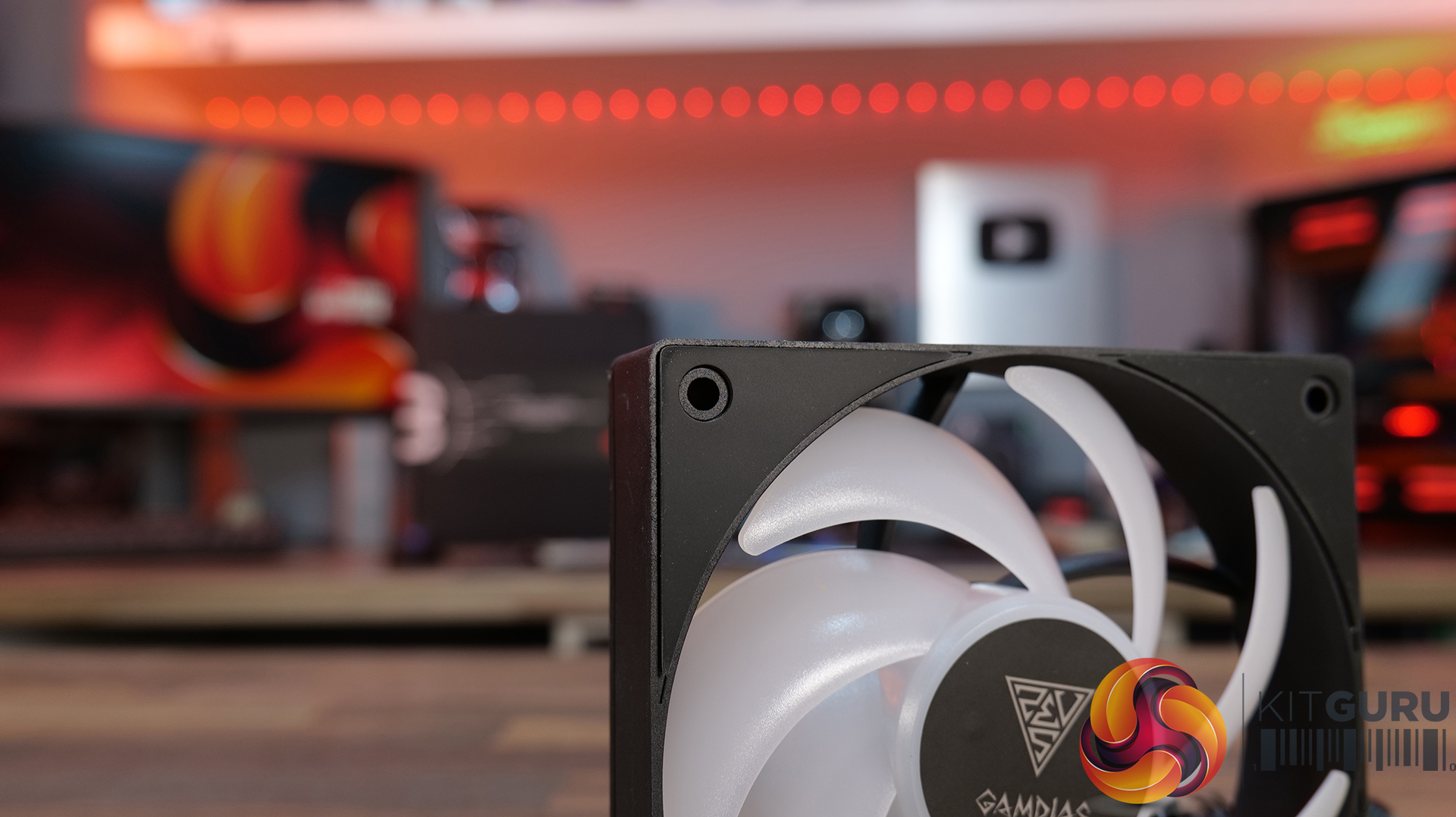
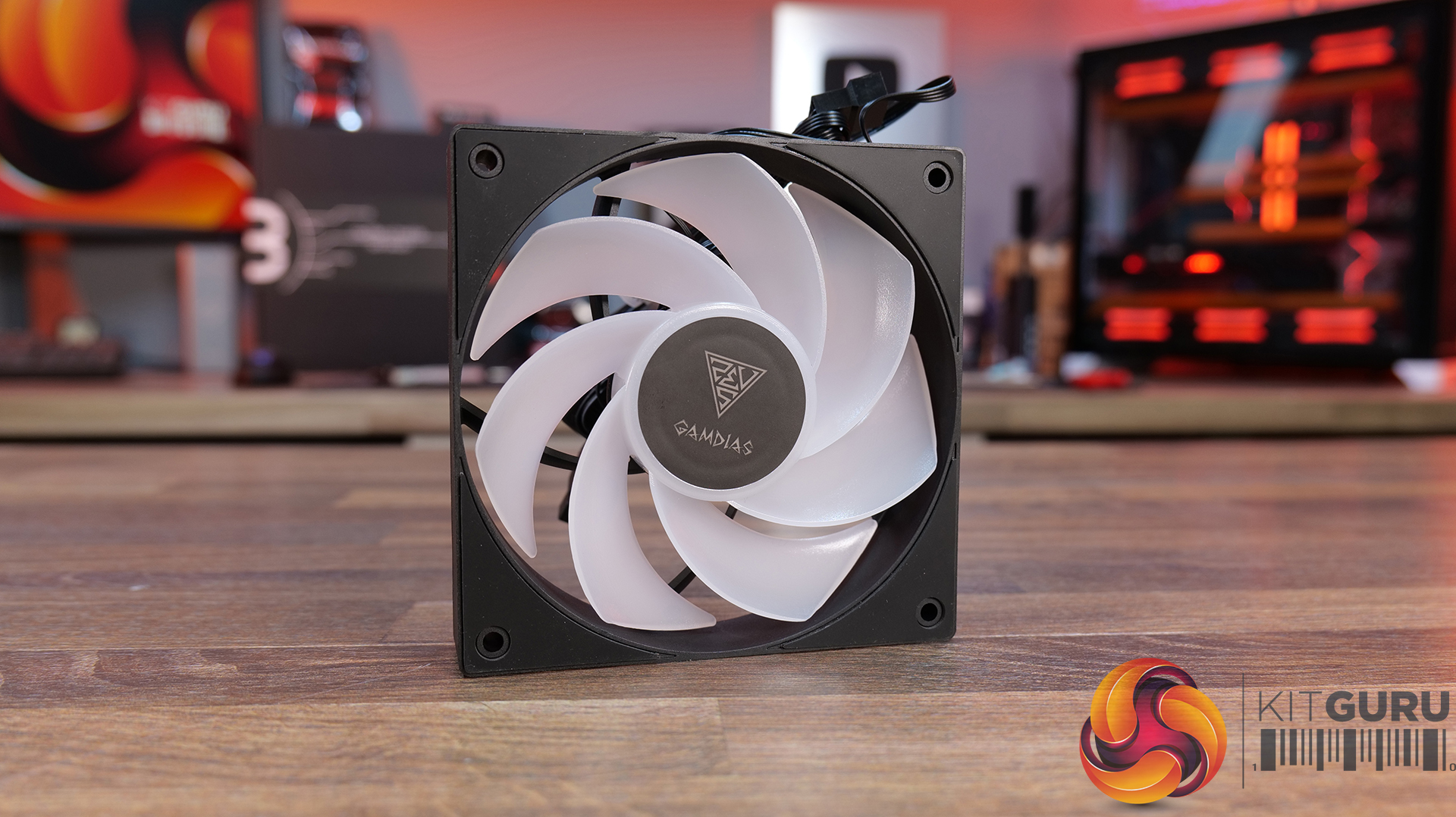
Today we are taking a look at some budget 120mm fans with reversible blades. The Gamdias Notus M1-1201 ARGB fans take the pain out of selecting forward and reverse blade fans for your build, with both forward and reverse blades included in the kit that can be quickly swapped out to suit fan placement in your case. We’ll test noise, CPU/GPU temperature and case thermals in this review to see if they represent good value or just another noisy budget fan.
Features:
Clean ARGB implementation – Notus M1-1201 ARGB is equipped with addressable RGB lighting that connects directly to a standard 3-pin 5V headers, allowing simple synchronisation with motherboard software.
Optimal cooling performance – Featuring a speed range of 400–1600 RPM, maximum airflow of 57.56 CFM and 1.75 mmH₂O max static pressure, making it suitable for both case ventilation and use on radiators and heat sinks.
Refined acoustics and operation – A hydraulic bearing and narrow blade-tip clearance help keep noise levels under control, to provide a sensible balance between airflow and acoustics rather than prioritising one over the expense of the other.
Useful design choices – Anti-vibration pads and the inclusion of interchangeable forward and reverse blades adds flexibility for different airflow setups without overcomplicating installation.
Specifications:
Model: Notus M1-1201 ARGB
Package contents: Fan x1, Reverse fan blade x1, Lubricant x1
Fan size: 120 mm
Dimensions: 120 × 120 × 25 mm
Lighting effect: Addressable RGB (ARGB)
LED count: 8 LEDs
Bearing type: Hydraulic bearing
Connectors: 4-pin PWM fan connector, 3-pin ARGB connector
Fan speed: 400–1600 RPM (±10%)
Maximum airflow: 57.56 CFM
Static pressure: 1.75 mmH₂O
Rated voltage: 12 V (fan) / 5 V (LED)
PWM support: Yes
Gamdias Notus M1 fans come in two different pack sizes, either single or 3 packs, branded 1201 or 1203, respectively. They are essentially the same fans, just the quantities inside the boxes determine the model name.
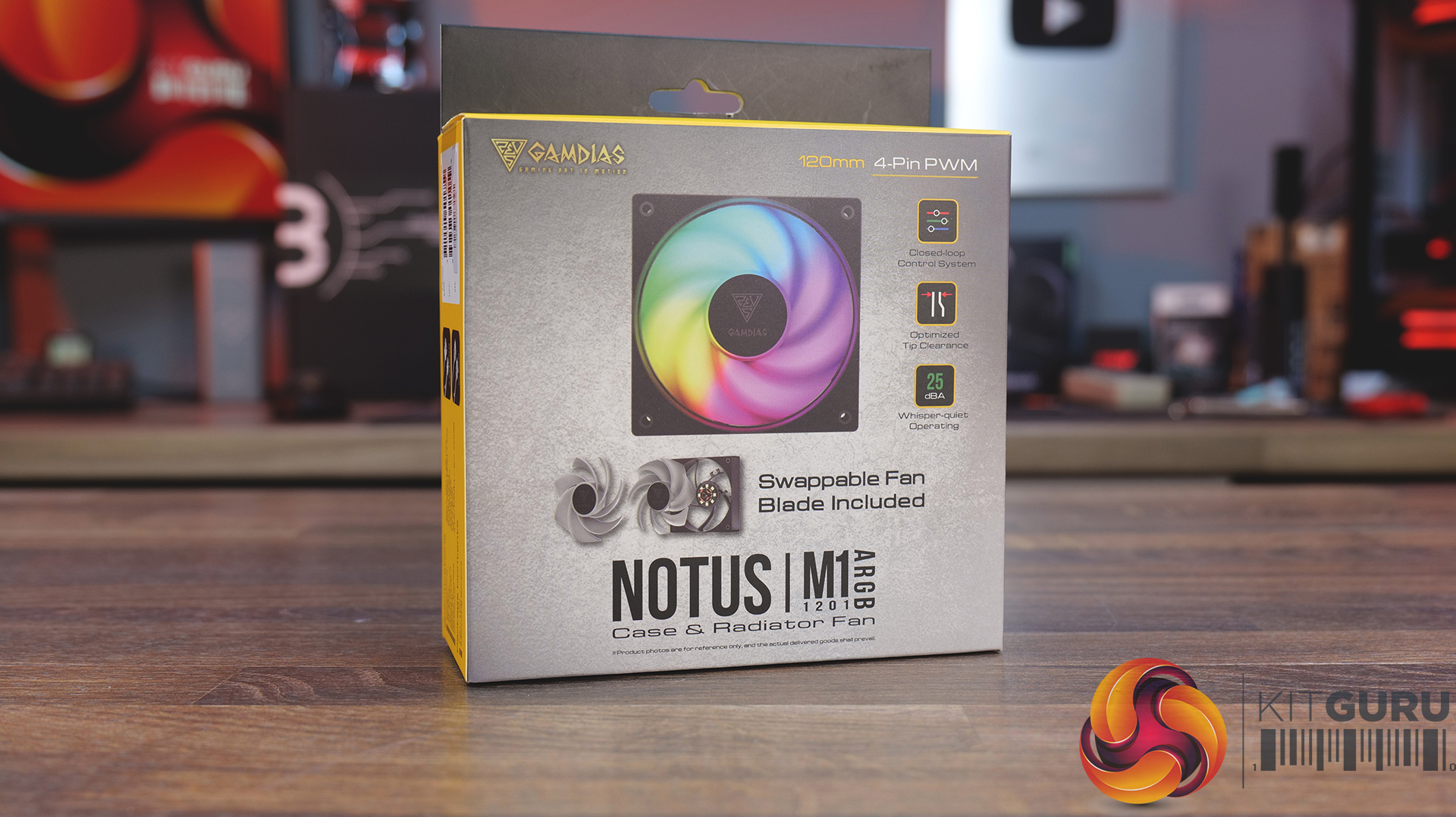
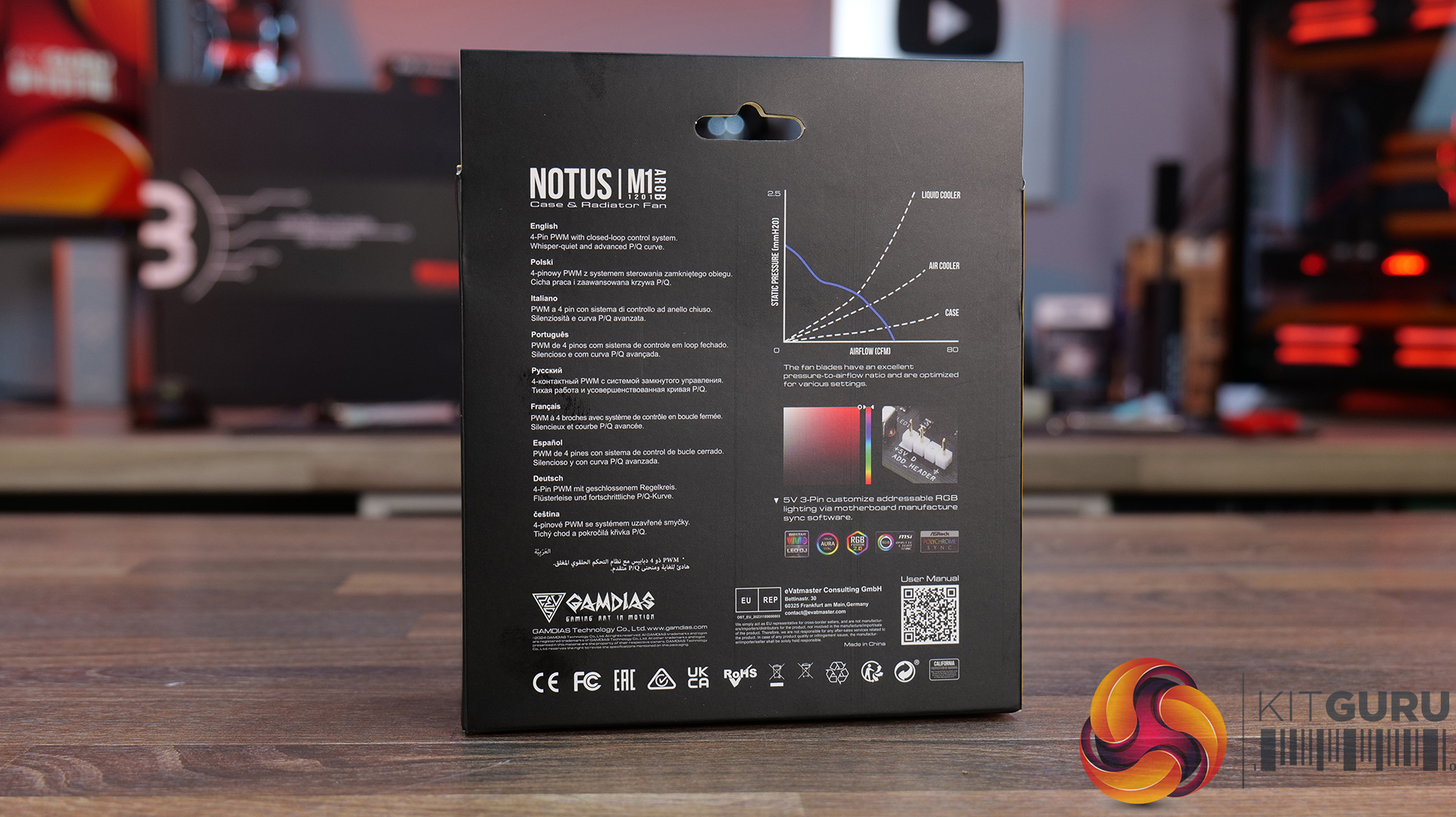
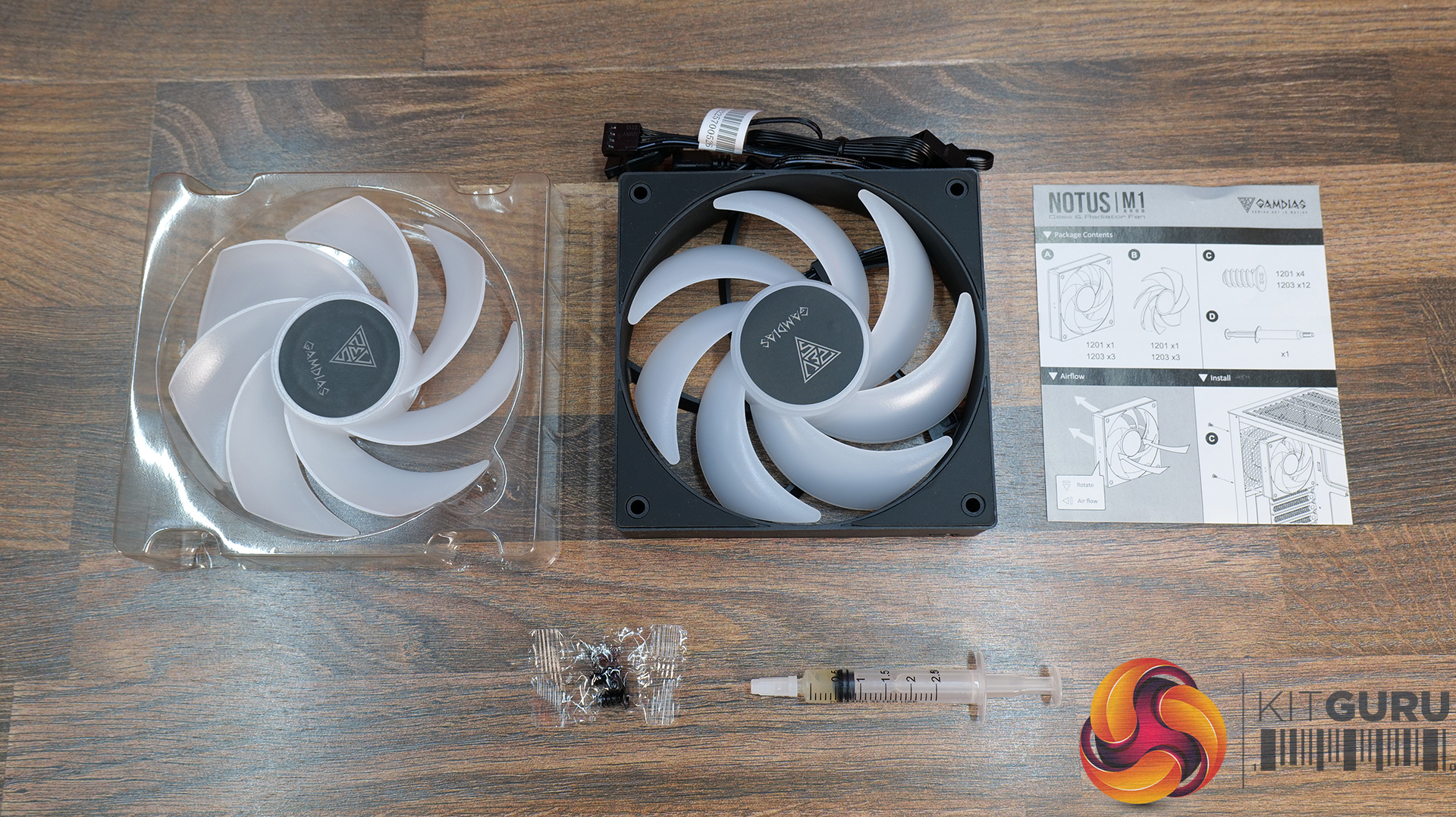
We are looking at the single pack, so 1201 branding, which comes with a single fan packed in a cardboard box. On the front of the box are several images of the fans and some key features listed. On the rear are the specifications and performance charts. Inside is the fan, an extra reverse blade, a user manual, mounting screws and some bearing lube.
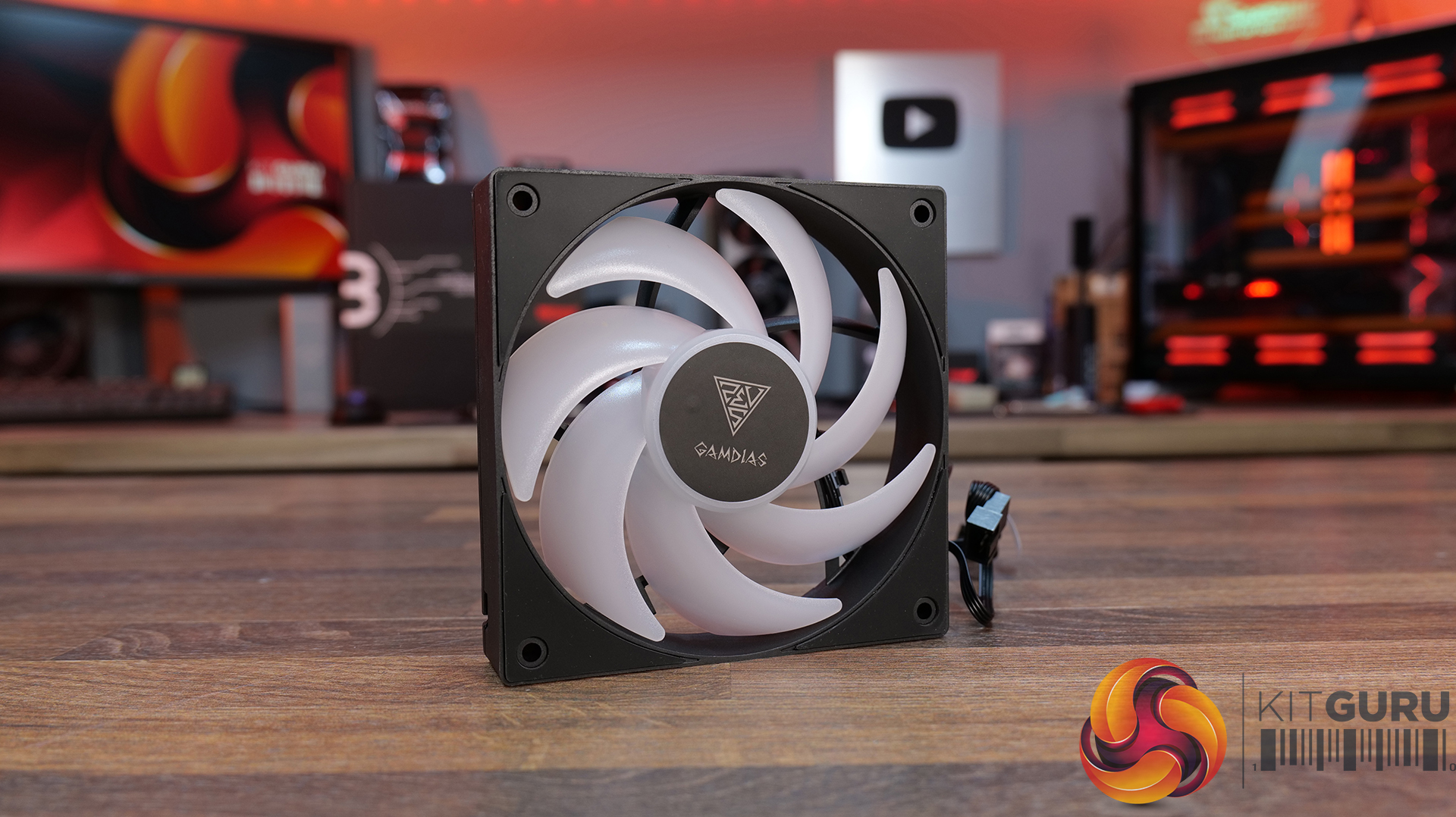
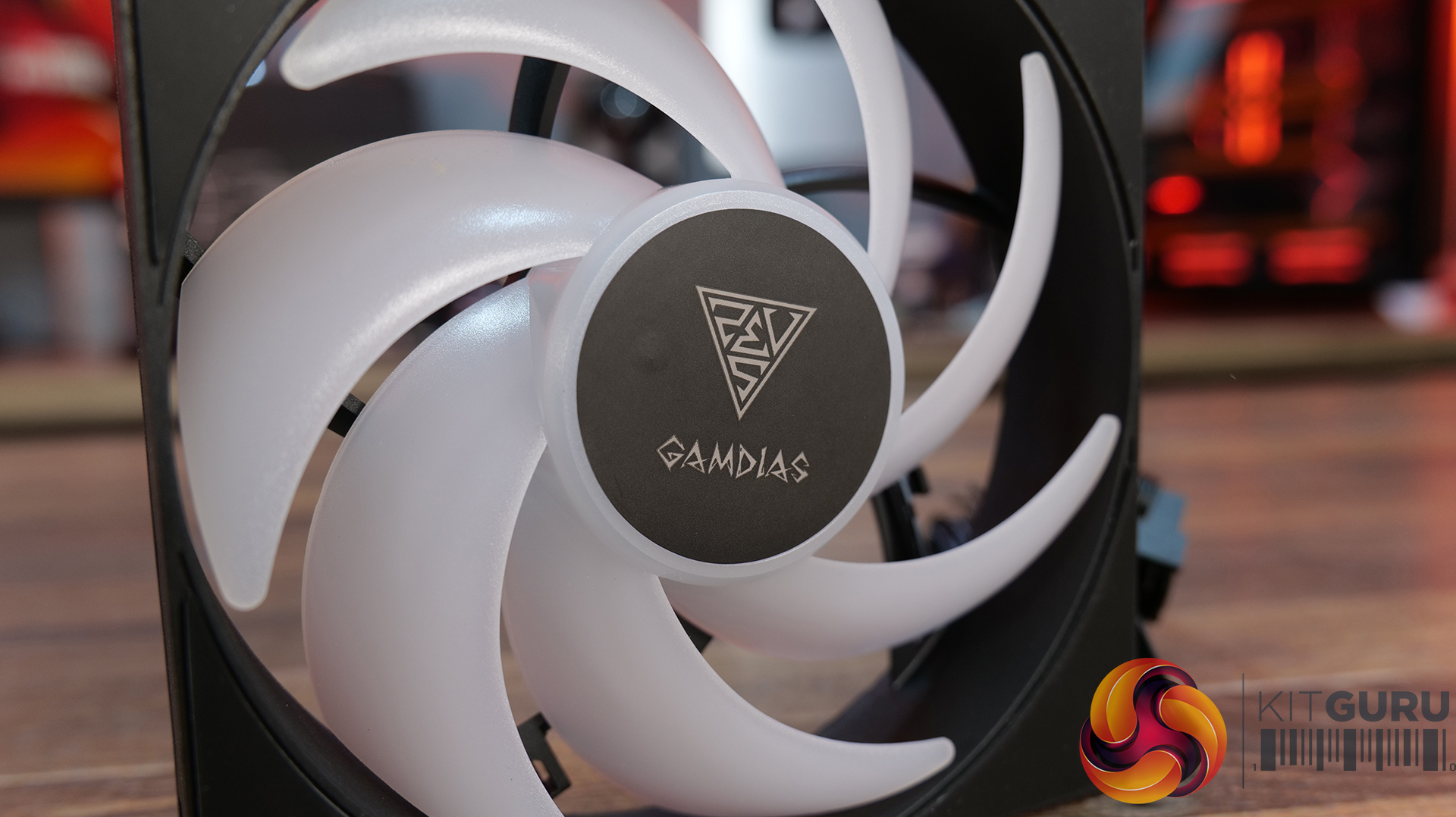
The fan frames are built from PBT (Polybutylene Terephthalate) material, which is widely used in electronic equipment due to its strength and durability. There are rubber anti-vibration pads fitted to the mounting points and the fan blades are opaque in colour to display and diffuse the RGB lighting.
The rear frame of the fan has strengthening bars to mount the motor, there's anti-vibration rubber pads on the rear of the mounting points, as well as a label showing some brief information and the Gamdias branding.
All wiring uses standard headers. There's a 4-pin PWM cable that has a daisy-chainable tail so users can interconnect fans and use a single motherboard header to connect multiple units. RGB lighting can also be interconnected and uses a 3-pin 5V connection that can be connected to the motherboard or an ARGB hub. Interestingly, the PWM cable has a warranty void sticker on it, which seems like an odd thing to attach to a cable.
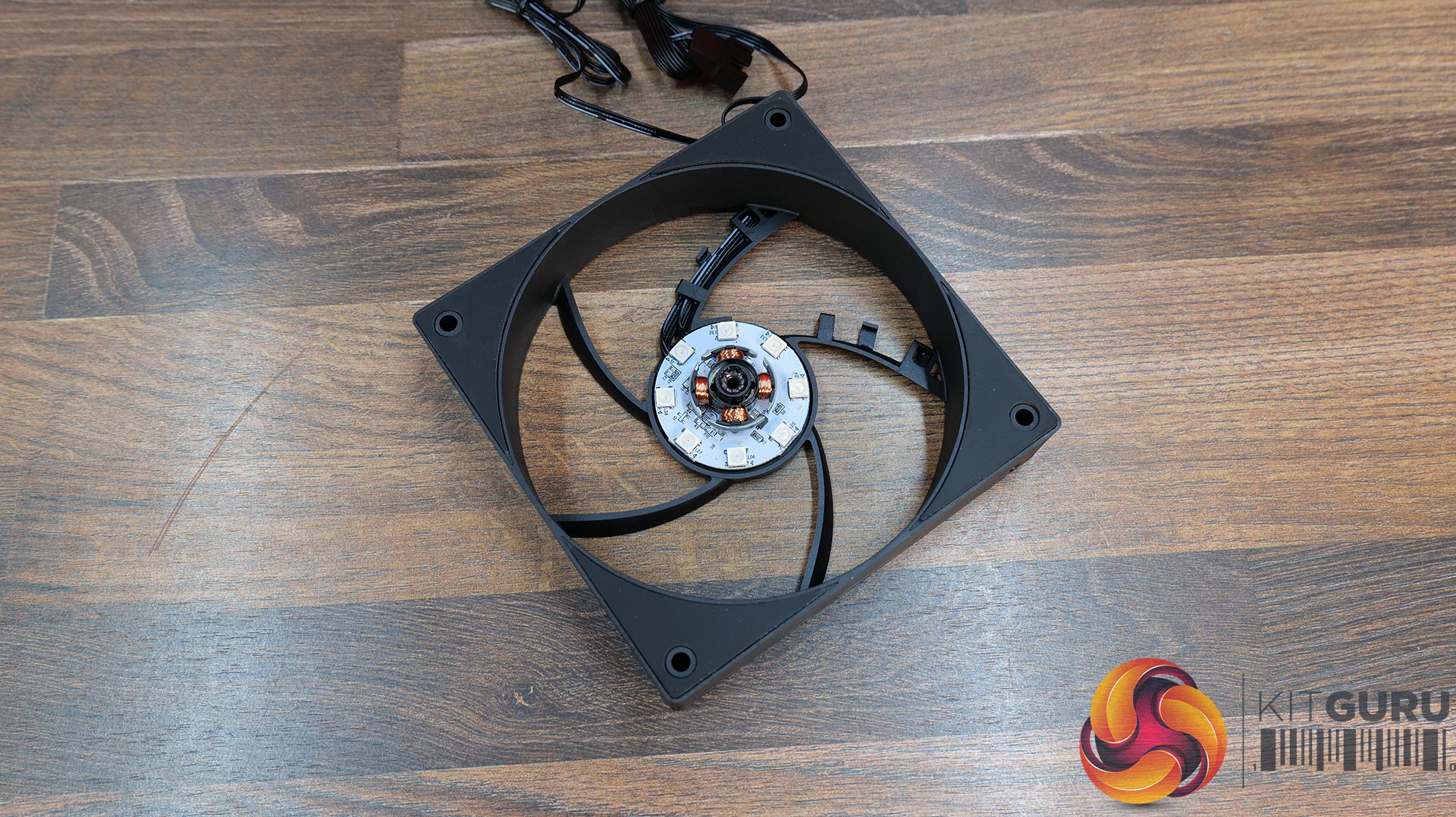
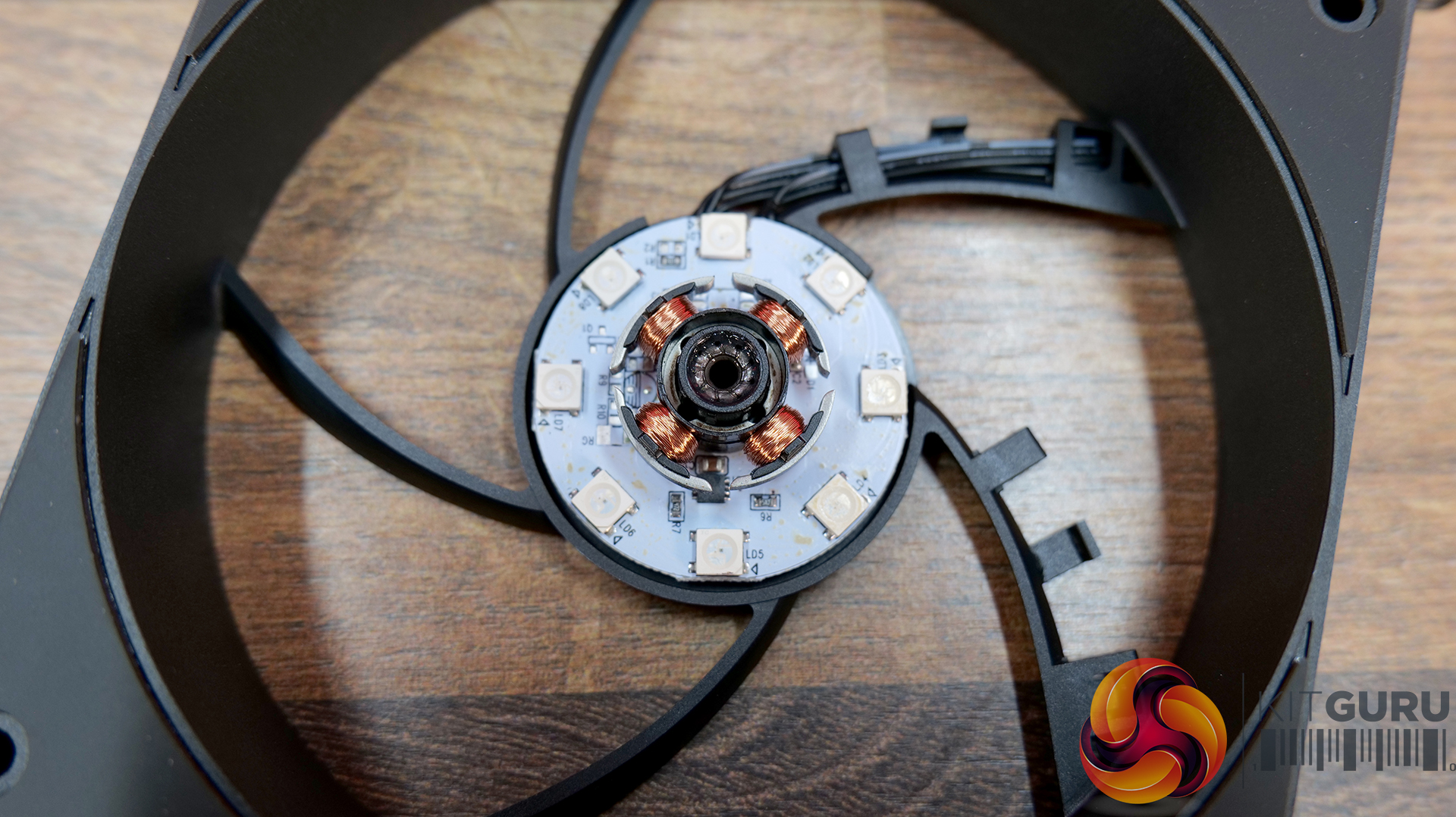
A key feature of the fans is the option to change the fan blade. Forward and reverse blades are included in the pack, and it’s a simple case of pushing one blade off and clipping the replacement blade in place. When the blade is removed, you can see the motor windings, the PCB and LEDs for the ARGB lighting, too.
The be quiet! Light Base 500 LX is not just a more compact dual-chamber case when compared to the 600 series, but is designed completely differently from the ground up. It focuses on functionality while bundling four retail-grade ARGB fans at a price that makes it easy to overlook some of the shortcomings.
 Connexion