↩ Accueil

Vue normale

Reçu aujourd’hui — 5 décembre 2025 6.5 📰 Sciences English

Simple feedback mechanism keeps flapping flyers stable when hovering

5 décembre 2025 à 10:00

Researchers in the US have shed new light on the puzzling and complex flight physics of creatures such as hummingbirds, bumblebees and dragonflies that flap their wings to hover in place. According to an interdisciplinary team at the University of Cincinnati, the mechanism these animals deploy can be described by a very simple, computationally basic, stable and natural feedback mechanism that operates in real time. The work could aid the development of hovering robots, including those that could act as artificial pollinators for crops.

If you’ve ever watched a flapping insect or hummingbird hover in place – often while engaged in other activities such as feeding or even mating – you’ll appreciate how remarkable they are. To stay aloft and stable, these animals must constantly sense their position and motion and make corresponding adjustments to their wing flaps.

Feedback mechanism relies on two main components

Biophysicists have previously put forward many highly complex explanations for how they do this, but according to the Cincinnati team of Sameh Eisa and Ahmed Elgohary, some of this complexity is not necessary. Earlier this year, the pair developed their own mathematical and control theory based on a mechanism they call “extremum seeking for vibrational stabilization”.

Eisa describes this mechanism as “very natural” because it relies on just two main components. The first is the wing flapping motion itself, which he says is “naturally built in” for flapping creatures that use it to propel themselves. The second is a simple feedback mechanism involving sensations and measurements related to the altitude at which the creatures aim to stabilize their hovering.

The general principle, he continues, is that a system (in this case an insect or hummingbird) can steer itself towards a stable position by continuously adjusting a high-amplitude, high-frequency input control or signal (in this case, a flapping wing action). “This adjustment is simply based on the feedback of measurement (the insects’ perceptions) and stabilization (hovering) occurs when the system optimizes what it is measuring,” he says.

As well as being relatively easy to describe, Eisa tells Physics World that this mechanism is biologically plausible and computationally basic, dramatically simplifying the physics of hovering. “It is also categorically different from all available results and explanations in the literature for how stable hovering by insects and hummingbirds can be achieved,” he adds.

Researchers at dinner
The researchers and colleagues. (Courtesy: S Eisa)

Interdisciplinary work

In the latest study, which is detailed in Physical Review E, the researchers compared their simulation results to reported biological data on a hummingbird and five flapping insects (a bumblebee, a cranefly, a dragonfly, a hawkmoth and a hoverfly). They found that their simulation fit the data very closely. They also ran an experiment on a flapping, light-sensing robot and observed that it behaved like a moth: it elevated itself to the level of the light source and then stabilized its hovering motion.

Eisa says he has always been fascinated by such optimized biological behaviours. “This is especially true for flyers, where mistakes in execution could potentially mean death,” he says. “The physics behind the way they do it is intriguing and it probably needs elegant and sophisticated mathematics to be described. However, the hovering creatures appear to be doing this very simply and I found discovering the secret of this puzzle very interesting and exciting.”

Eisa adds that this element of the work ended up being very interdisciplinary, and both his own PhD in applied mathematics and the aerospace engineering background of Elgohary came in very useful. “We also benefited from lengthy discussions with a biologist colleague who was a reviewer of our paper,” Eisa says. “Luckily, they recognized the value of our proposed technique and ended up providing us with very valuable inputs.”

Eisa thinks the work could open up new lines of research in several areas of science and engineering. “For example, it opens up new ideas in neuroscience and animal sensory mechanisms and could almost certainly be applied to the development of airborne robotics and perhaps even artificial pollinators,” he says. “The latter might come in useful in the future given the high rate of death many species of pollinating insects are encountering today.”

The post Simple feedback mechanism keeps flapping flyers stable when hovering appeared first on Physics World.

Final proposals leave SpaceX and Amazon with 4% of $20 billion rural broadband subsidies

4 décembre 2025 à 22:07

SpaceX and Amazon stand to get about 4% of the nearly $20 billion that states have proposed for rural broadband buildouts, representing roughly 21% of the locations under the federal BEAD program.

The post Final proposals leave SpaceX and Amazon with 4% of $20 billion rural broadband subsidies appeared first on SpaceNews.

Reçu hier — 4 décembre 2025 6.5 📰 Sciences English

Welcome, Jared Isaacman

4 décembre 2025 à 18:52
Isaacman

Welcome, Jared Isaacman. We who love NASA, or at least the idea of NASA, wish you the very best in taking leadership of the great American space agency. You seem to be an agent for change and NASA sorely needs that. Its human spaceflight program, which garners most of its public attention and financial support, […]

The post Welcome, Jared Isaacman appeared first on SpaceNews.

Celestis Selects Stoke Space’s Nova for Infinite Flight: Humanity’s Next Deep-Space Memorial Mission

4 décembre 2025 à 16:53

HOUSTON, TX – December 3, 2025 – For more than three decades, Celestis, Inc. has transformed remembrance into exploration, sending the names, ashes, and DNA of pioneers and visionaries into […]

The post Celestis Selects Stoke Space’s Nova for Infinite Flight: Humanity’s Next Deep-Space Memorial Mission appeared first on SpaceNews.

Building a quantum future using topological phases of matter and error correction

4 décembre 2025 à 15:55

This episode of the Physics World Weekly podcast features Tim Hsieh of Canada’s Perimeter Institute for Theoretical Physics. We explore some of today’s hottest topics in quantum science and technology – including topological phases of matter; quantum error correction and quantum simulation.

Our conversation begins with an exploration of the quirky properties quantum matter and how these can be exploited to create quantum technologies. We look at the challenges that must be overcome to create large-scale quantum computers; and Hsieh reveals which problem he would solve first if he had access to a powerful quantum processor.

This interview was recorded earlier this autumn when I had the pleasure of visiting the Perimeter Institute and speaking to four physicists about their research. This is the third of those conversations to appear on the podcast.

The first interview in this series from the Perimeter Institute was with Javier Toledo-Marín, “Quantum computing and AI join forces for particle physics”; and the second was with Bianca Dittrich, “Quantum gravity: we explore spin foams and other potential solutions to this enduring challenge“.

APS logo


This episode is supported by the APS Global Physics Summit, which takes place on 15–20 March, 2026, in Denver, Colorado, and online.

The post Building a quantum future using topological phases of matter and error correction appeared first on Physics World.

Generative AI model detects blood cell abnormalities

4 décembre 2025 à 14:00
Blood cell images
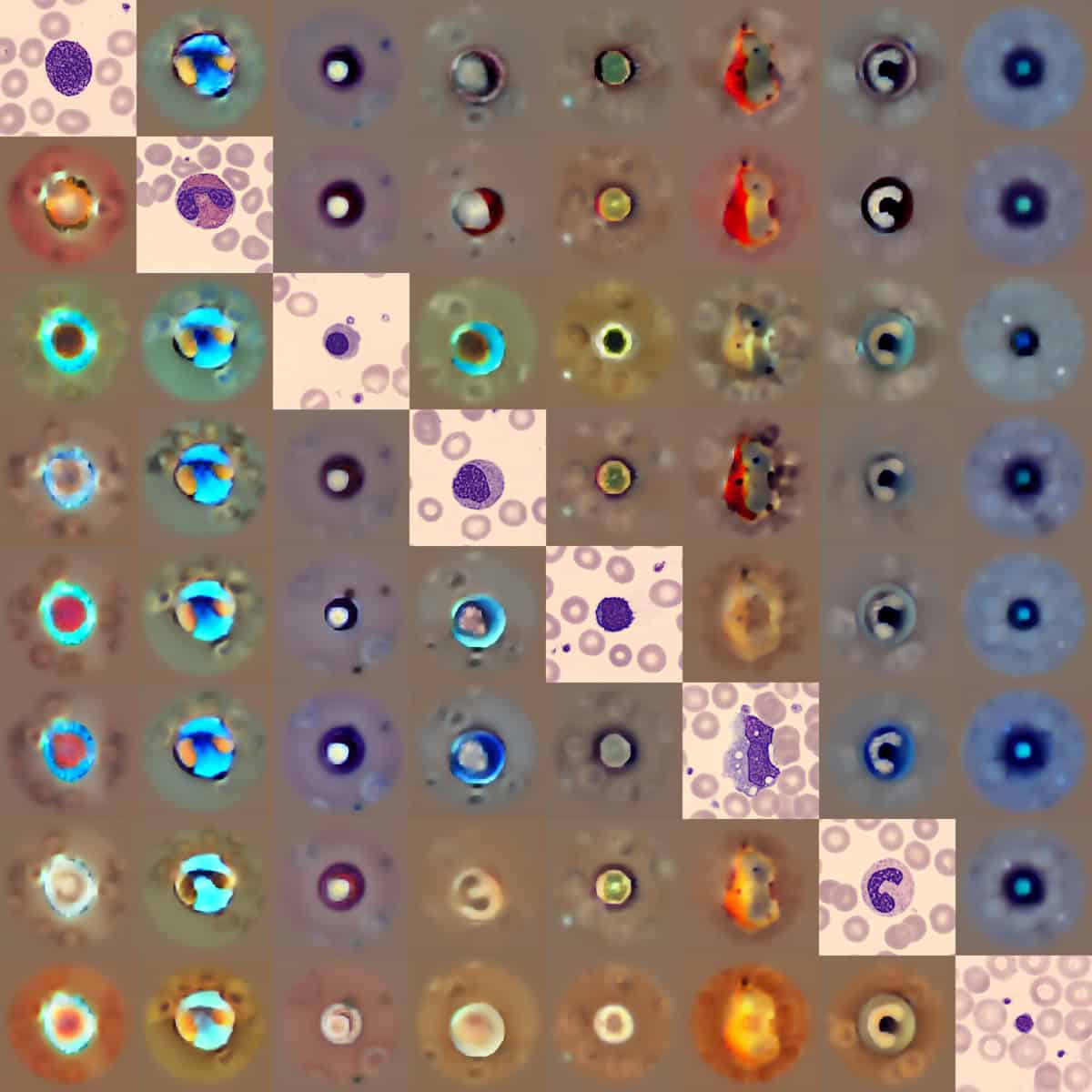
Generative classification The CytoDiffusion classifier accurately identifies a wide range of blood cell appearances and detects unusual or rare blood cells that may indicate disease. The diagonal grid elements display original images of each cell type, while the off-diagonal elements show heat maps that provide insight into the model’s decision-making rationale. (Courtesy: Simon Deltadahl)

The shape and structure of blood cells provide vital indicators for diagnosis and management of blood disease and disorders. Recognizing subtle differences in the appearance of cells under a microscope, however, requires the skills of experts with years of training, motivating researchers to investigate whether artificial intelligence (AI) could help automate this onerous task. A UK-led research team has now developed a generative AI-based model, known as CytoDiffusion, that characterizes blood cell morphology with greater accuracy and reliability than human experts.

Conventional discriminative machine learning models can match human performance at classifying cells in blood samples into predefined classes. But discriminative models, which learn to recognise cell images based on expert labels, struggle with never-before-seen cell types and images from differing microscopes and staining techniques.

To address these shortfalls, the team – headed up at the University of Cambridge, University College London and Queen Mary University of London – created CytoDiffusion around a diffusion-based generative AI classifier. Rather than just learning to separate cell categories, CytoDiffusion models the full range of blood cell morphologies to provide accurate classification with robust anomaly detection.

“Our approach is motivated by the desire to achieve a model with superhuman fidelity, flexibility and metacognitive awareness that can capture the distribution of all possible morphological appearances,” the researchers write.

Authenticity and accuracy

For AI-based analysis to be adopted in the clinic, it’s essential that users trust a model’s learned representations. To assess whether CytoDiffusion could effectively capture the distribution of blood cell images, the team used it to generate synthetic blood cell images. Analysis by experienced haematologists revealed that these synthetic images were near-indistinguishable from genuine images, showing that CytoDiffusion genuinely learns the morphological distribution of blood cells rather than using artefactual shortcuts.

The researchers used multiple datasets to develop and evaluate their diffusion classifier, including CytoData, a custom dataset containing more than half a million anonymized cell images from almost 3000 blood smear slides. In standard classification tasks across these datasets, CytoDiffusion achieved state-of-the-art performance, matching or exceeding the capabilities of traditional discriminative models.

Effective diagnosis from blood smear samples also requires the ability to detect rare or previously unseen cell types. The researchers evaluated CytoDiffusion’s ability to detect blast cells (immature blood cells) in the test datasets. Blast cells are associated with blood malignancies such as leukaemia, and high detection sensitivity is essential to minimize false negatives.

In one dataset, CytoDiffusion detected blast cells with sensitivity and specificity of 0.905 and 0.962, respectively. In contrast, a discriminative model exhibited a poor sensitivity of 0.281. In datasets with erythroblasts as the abnormal cells, CytoDiffusion again outperformed the discriminative model, demonstrating that it can detect abnormal cell types not present in its training data, with the high sensitivity required for clinical applications.

Robust model

It’s important that a classification model is robust to different imaging conditions and can function with sparse training data, as commonly found in clinical applications. When trained and tested on diverse image datasets (different hospitals, microscopes and staining procedures), CytoDiffusion achieved state-of-the-art accuracy in all cases. Likewise, after training on limited subsets of 10, 20 and 50 images per class, CytoDiffusion consistently outperformed discriminative models, particularly in the most data-scarce conditions.

Another essential feature of clinical classification tasks, whether performed by a human or an algorithm, is knowing the uncertainty in the final decision. The researchers developed a framework for evaluating uncertainty and showed that CytoDiffusion produced superior uncertainty estimates to human experts. With uncertainty quantified, cases with high certainty could be processed automatically, with uncertain cases flagged for human review.

“When we tested its accuracy, the system was slightly better than humans,” says first author Simon Deltadahl from the University of Cambridge in a press statement. “But where it really stood out was in knowing when it was uncertain. Our model would never say it was certain and then be wrong, but that is something that humans sometimes do.”

Finally, the team demonstrated CytoDiffusion’s ability to create heat maps highlighting regions that would need to change for an image to be reclassified. This feature provides insight into the model’s decision-making process and shows that it understands subtle differences between similar cell types. Such transparency is essential for clinical deployment of AI, making models more trustworthy as practitioners can verify that classifications are based on legitimate morphological features.

“The true value of healthcare AI lies not in approximating human expertise at lower cost, but in enabling greater diagnostic, prognostic and prescriptive power than either experts or simple statistical models can achieve,” adds co-senior author Parashkev Nachev from University College London.

CytoDiffusion is described in Nature Machine Intelligence.

The post Generative AI model detects blood cell abnormalities appeared first on Physics World.

❌