The Trump administration’s new national security strategy has rightly drawn criticism for presuming to tell our European allies how to arrange their domestic affairs. Equally as baffling is its near silence on a genuine United States national security concern — bolstering our offensive and defensive capabilities in space. Amid much MAGA trollery that blames Europe […]
SAN FRANCISCO – EraDrive, a Stanford University spinoff developing software and hardware for satellite autonomy, raised $5.3 million in an oversubscribed seed round, the startup announced Dec. 16. “EraDrive is very much about this idea of the self-driving spacecraft,” Justin Kruger, EraDrive chief technology officer and co-founder, told SpaceNews. EraDrive is developing a software-hardware module […]
A reported close approach between a Starlink satellite and a recently launched Chinese spacecraft highlights the challenges of coordinating spacecraft operations and verifying potential close calls in orbit.
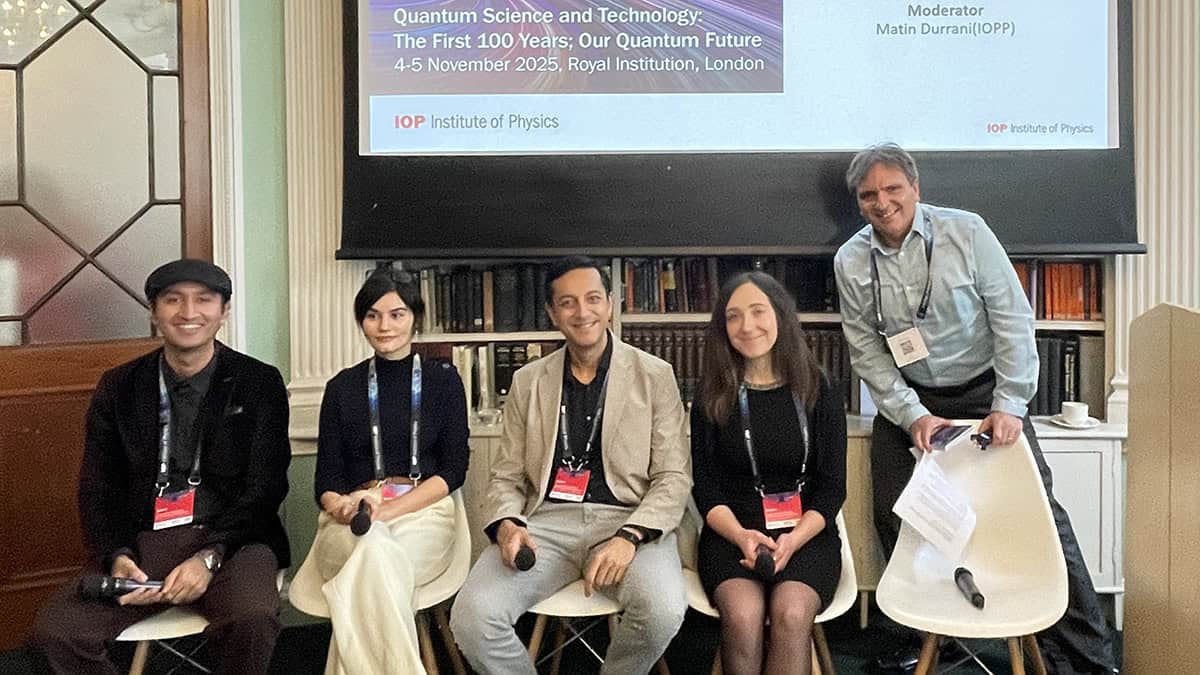
The International Year of Quantum Science and Technology has celebrated all the great developments in the sector – but what challenges and opportunities lie in store? That was the question deliberated by four future leaders in the field at the Royal Institution in central London in November. The discussion took place during the two-day conference “Quantum science and technology: the first 100 years; our quantum future”, which was part of a week-long series of quantum-related events in the UK organized by the Institute of Physics.
As well as outlining the technical challenges in their fields, the speakers all stressed the importance of developing a “skills pipeline” so that the quantum sector has enough talented people to meet its needs. Also vital will be the need to communicate the mysteries and potential of quantum technology – not just to the public but to industrialists, government officials and venture capitalists.
Two of the speakers – Nicole Gillett (Riverlane) and Muhammad Hamza Waseem (Quantinuum) – are from the quantum tech industry, with Mehul Malik (Heriot-Watt University) and Sarah Alam Malik (University College London) based in academia. The following is an edited version of the discussion.
Quantum’s future leaders
Deep thinkers The challenges and opportunities for quantum science and technology were discussed during a conference organized by the Institute of Physics at the Royal Institution on 5 November 2025 by (left to right, seated) Muhammad Hamza Waseem; Sarah Alam Malik; Mehul Malik; and Nicole Gillett. The discussion was chaired by Physics World editor-in-chief Matin Durrani (standing, far right). (Courtesy: Tushna Commissariat)
Nicole Gillett is a senior software engineer at Riverlane, in Cambridge, UK. The company is a leader in quantum error correction, which is a critical part of a fully functioning, fault-tolerant quantum computer. Errors arise because quantum bits, or qubits, are so fragile and correcting them is far trickier than with classical devices. Riverlane is therefore trying to find ways to correct for errors without disturbing a device’s quantum states. Gillett is part of a team trying to understand how best to implement error-correcting algorithms on real quantum-computing chips.
Mehul Malik, who studied physics at a liberal arts college in New York, was attracted to quantum physics because of what he calls a “weird middle ground between artistic creative thought and the rigour of physics”. After doing a PhD at the University of Rochester, he spent five years as a postdoc with Anton Zeilinger at the University of Vienna in Austria before moving to Heriot-Watt University in the UK. As head of its Beyond Binary Quantum Information research group, Malik works on quantum information processing and communication and fundamental studies of entanglement.
Sarah AlamMalik is a particle physicist at University College London, using particle colliders to detect and study potential candidates for dark matter. She is also trying to use quantum computers to speed up the discovery of new physics given that what she calls “our most cherished and compelling theories” for physics beyond the Standard Model, such as supersymmetry, have not yet been seen. In particular, Malik is trying to find new physics in a way that’s “model agnostic” – in other words, using quantum computers to search particle-collision data for anomalous events that have not been seen before.
Muhammad Hamza Waseem studied electrical engineering in Pakistan, but got hooked on quantum physics after getting involved in recreating experiments to test Bell’s inequalities in what he claims was the first quantum optics lab in the country. Waseem then moved to the the University of Oxford in the UK, to do a PhD studying spin waves to make classical and quantum logic circuits. Unable to work when his lab shut during the COVID-19 pandemic, Waseem approached Quantinuum to see if he could help them in their quest to build quantum computers using ion traps. Now based at the company, he studies how quantum computers can do natural-language processing. “Think ChatGPT, but powered with quantum computers,” he says.
What will be the biggest or most important application of quantum technology in your field over the next 10 years?
Nicole Gillett: If you look at roadmaps of quantum-computing companies, you’ll find that IBM, for example, intends to build the world’s first utility scale and fault-tolerant quantum computer by the end of the decade. Beyond 2033, they’re committing to have a system that could support 2000 “logical qubits”, which are essentially error-corrected qubits, in which the data of one qubit has been encoded into many qubits.
What can be achieved with that number of qubits is a difficult question to answer but some theorists, such as Juan Maldacena, have proposed some very exotic ideas, such as using a system of 7000 qubits to simulate black-hole dynamics. Now that might not be a particularly useful industry application, but it tells you about the potential power of a machine like this.
Mehul Malik: In my field, quantum networks that can distribute individual quantum particles or entangled states over large and short distances will have a significant impact within the next 10 years. Quantum networks will connect smaller, powerful quantum processors to make a larger quantum device, whether for computing or communication. The technology is quite mature – in fact, we’ve already got a quantum network connecting banks in London.
I will also add something slightly controversial. We often try to distinguish between quantum and non-quantum technologies, but what we’re heading towards is combining classical state-of-the-art devices with technology based on inherently quantum effects – what you might call “quantum adjacent technology”. Single-photon detectors, for example, are going to revolutionize healthcare, medical imaging and even long-distance communication.
Sarah Alam Malik: For me, the biggest impact of quantum technology will be applying quantum computing algorithms in physics. Can we quantum simulate the dynamics of, say, proton–proton collisions in a more efficient and accurate manner? Can we combine quantum computing with machine learning to sift through data and identify anomalous collisions that are beyond those expected from the Standard Model?
Quantum technology is letting us ask very fundamental questions about nature.
Sarah Alam Malik, University College London
Quantum technology, in other words, is letting us ask very fundamental questions about nature. Emerging in theoretical physics, for example, is the idea that the fundamental layer of reality may not be particles and fields, but units of quantum information. We’re looking at the world through this new quantum-theoretic lens and asking questions like, whether it’s possible to measure entanglement in top quarks and even explore Bell-type inequalities at particle colliders.
One interesting quantity is “magic”, which is a measure of how far you are from having something that can be classically simulable (Phys. Rev. D110 116016). The more magic there is in a system the less easy it is to simulate classically – and thereforethe greater the computational resource it possesses for quantum computing. We’re asking how much “magic” there is in, for instance, top quarks produced at the Large Hadron Collider. So one of the most important developments for me may well be asking questions in a very different way to before.
Muhammad Hamza Waseem: Technologically speaking, the biggest impact will be simulating quantum systems using a quantum computer. In fact, researchers from Google already claim to have simulated a wormhole in a quantum computer, albeit a very simple version that could have been tackled with a classical device (Nature612 55).
But the most significant impact has to do with education. I believe quantum theory teaches us that reality is not about particles and individuals – but relations. I’m not saying that particles don’t exist but they emerge from the relations. In fact, with colleagues at the University of Oxford, we’ve used this idea to develop a new way of teaching quantum theory, called Quantum in Pictures.
We’ve already tried our diagrammatic approach with a group of 16–18-year-olds, teaching them the entire quantum-information course that’s normally given to postgraduates at Oxford. At the end of our two-month course, which had one lecture and tutorial per week, students took an exam with questions from past Oxford papers. An amazing 80% of students passed and half got distinctions.
For quantum theory to have a big impact, we have to make quantum physics more accessible to everyone.
Muhammad Hamza Waseem, Quantinuum
I’ve also tried the same approach on pupils in Pakistan: the youngest, who was just 13, can now explain quantum teleportation and quantum entanglement. My point is that for quantum theory to have a big impact, we have to make quantum physics more accessible to everyone.
What will be the biggest challenges and difficulties over the next 10 years for people in quantum science and technology?
Nicole Gillett: The challenge will be building up a big enough quantum workforce. Sometimes people hear the words “quantum computer” and get scared, worrying they’re going to have to solve Hamiltonians all the time. But is it possible to teach students at high-school level about these concepts? Can we get the ideas across in a way that is easy to understand so people are interested and excited about quantum computing?
At Riverlane, we’ve run week-long summer workshops for the last two years, where we try to teach undergraduate students enough about quantum error correction so they can do “decoding”. That’s when you take the results of error correction and try to figure out what errors occurred on your qubits. By combining lectures and hands-on tutorials we found we could teach students about error corrections – and get them really excited too.
Our biggest challenge will be not having a workforce ready for quantum computing.
Nicole Gillett, Riverlane
We had students from physics, philosophy, maths and computer science take the course – the only pre-requisite, apart from being curious about quantum computers, is some kind of coding ability. My point is that these kinds of boot camps are going to be so important to inspire future generations. We need to make the information accessible to people because otherwise our biggest challenge will be not having a workforce ready for quantum computing.
Mehul Malik: One of the big challenges is international cooperation and collaboration. Imagine if, in the early days of the Internet, the US military had decided they’d keep it to themselves for national-security reasons or if CERN hadn’t made the World Wide Web open source. We face the same challenge today because we live in a world that’s becoming polarized and protectionist – and we don’t want that to hamper international collaboration.
Over the last few decades, quantum science has developed in a very international way and we have come so far because of that. I have lived in four different continents, but when I try to recruit internationally, I face significant hurdles from the UK government, from visa fees and so on. To really progress in quantum tech, we need to collaborate and develop science in a way that’s best for humanity not just for each nation.
Sarah Alam Malik: One of the most important challenges will be managing the hype that inevitably surrounds the field right now. We’ve already seen this with artificial intelligence (AI), which has gone though the whole hype cycle. Lots of people were initially interested, then the funding dried up when reality didn’t match expectations. But now AI has come back with such resounding force that we’re almost unprepared for all the implications of it.
Quantum can learn from the AI hype cycle, finding ways to manage expectations of what could be a very transformative technology. In the near- and mid-term, we need to not overplay things and be cautious of this potentially transformative technology – yet be braced for the impact it could potentially have. It’s a case of balancing hype with reality.
Muhammad Hamza Waseem: Another important challenge is how to distribute funding between research on applications and research on foundations. A lot of the good technology we use today emerged from foundational ideas in ways that were not foreseen by the people originally working on them. So we must ensure that foundational research gets the funding it deserves or we’ll hit a dead end at some point.
Will quantum tech alter how we do research, just as AI could do?
Mehul Malik: AI is already changing how I do research, speeding up the way I discover knowledge. Using Google Gemini, for example, I now ask my browser questions instead of searching for specific things. But you still have to verify all the information you gather, for example, by checking the links it cites. I recently asked AI a complex physics question to which I knew the answer and the solution it gave was terrible. As for how quantum is changing research, I’m less sure, but better detectors through quantum-enabled research will certainly be good.
Muhammad Hamza Waseem: AI is already being deployed in foundational research, for example, to discover materials for more efficient batteries. A lot of these applications could be integrated with quantum computing in some way to speed work up. In other words, a better understanding of quantum tech will let us develop AI that is safer, more reliable, more interpretable – and if something goes wrong, you know how to fix it. It’s an exciting time to be a researcher, especially in physics.
Sarah Alam Malik: I’ve often wondered if AI, with the breadth of knowledge that it has across all different fields, already has answers to questions that we couldn’t answer – or haven’t been able to answer – just because of the boundaries between disciplines. I’m a physicist and so can’t easily solve problems in biology. But could AI help us to do breakthrough research at the interface between disciplines?
What lessons can we learn from the boom in AI when it comes to the long-term future of quantum tech?
Nicole Gillett: As a software engineer, I once worked at an Internet security company called CloudFlare, which taught me that it’s never too early to be thinking about how any new technology – both AI and quantum – might be abused. What’s also really interesting is whether AI and machine learning can be used to build quantum computers by developing the coding algorithms they need. Companies like Google are active in this area and so are Riverlane too.
Mehul Malik: I recently discussed this question with a friend who works in AI, who said that the huge AI boom in industry, with all the money flowing in to it, has effectively killed academic research in the field. A lot of AI research is now industry-led and goal-orientated – and there’s a risk that the economic advantages of AI will kill curiosity-driven research. The remedy, according to my friend, is to pay academics in AI more as they are currently being offered much larger salaries to work in the private sector.
We need to diversify so that the power to control or chart the course of quantum technologies is not in the hands of a few privileged monopolies.
Mehul Malik, Heriot-Watt University
Another issue is that a lot of power is in the hands a just a few companies, such as Nvidia and ASML. The lesson for the quantum sector is that we need to diversify early on so that the power to control or chart the course of quantum technologies is not in the hands of a few privileged monopolies.
Sarah Alam Malik: Quantum technology has a lot to learn from AI, which has shown that we need to break down the barriers between disciplines. After all, some of the most interesting and impactful research in AI has happened because companies can hire whoever they need to work on a particular problem, whether it’s a computer scientist, a biologist, a chemist, a physicist or a mathematician.
Nature doesn’t differentiate between biology and physics. In academia we not only need people who are hyper specialized but also a crop of generalists who are knee-deep in one field but have experience in other areas too.
The lesson from the AI boom is to blur the artificial boundaries between disciplines and make them more porous. In fact, quantum is a fantastic playground for that because it is inherently interdisciplinary. You have to bring together people from different disciplines to deliver this kind of technology.
Muhammad Hamza Waseem: AI research is in a weird situation where there are lots of excellent applications but so little is understood about how AI machines work. We have no good scientific theory of intelligence or of consciousness. We need to make sure that quantum computing research does not become like that and that academic research scientists are well-funded and not distracted by all the hype that industry always creates.
At the start of the previous century, the mathematician David Hilbert said something like “physics is becoming too difficult for the physicists”. I think quantum computing is also somewhat becoming too challenging for the quantum physicists. We need everyone to get involved for the field to reach its true potential.
Towards “green” quantum technology
(Courtesy: iStock/Peach)
Today’s AI systems use vast amounts of energy, but should we also be concerned about the environmental impact of quantum computers? Google, for example, has already carried out quantum error-correction experiments in which data from the company’s quantum computers had to be processed once every microsecond per round of error correction (Nature638 920). “Finding ways to process it to keep up with the rate at which it’s being generated is a very interesting area of research,” says Nicole Gillett.
However, quantum computers could cut our energy consumption by allowing calculations to be performed far more quickly and efficiently than is possible with classical machines. For Mehul Malik, another important step towards “green” quantum technology will be to lower the energy that quantum devices require and to build detectors that work at room temperature and are robust against noise. Quantum computers themselves can also help, he thinks, by discovering energy-efficient technologies, materials and batteries.
A quantum laptop?
(Courtesy: iStock/inkoly)
Will we ever see portable quantum computers or will they always be like today’s cloud-computing devices in distant data centres? Muhammad Hamza Waseem certainly does not envisage a word processor that uses a quantum computer. But he points to companies like SPINQ, which has built a two quantum bit computer for educational purposes. “In a sense, we already have a portable quantum computer,” he says. For Mehul Malik, though, it’s all about the market. “If there’s a need for it,” he joked, “then somebody will make it.”
If I were science minister…
(Courtesy: Shutterstock/jenny on the moon)
When asked by Peter Knight – one of the driving forces behind the UK’s quantum-technology programme – what the panel would do if they were science minister, Nicole Gillett said she would seek to make the UK the leader in quantum computing by investing heavily in education. Mehul Malik would cut the costs of scientists moving across borders, pointing out that many big firms have been founded by immigrants. Sarah Alam Malik called for long-term funding – and not to give up if short-term gains don’t transpire. Muhammad Hamza Waseem, meanwhile, said we should invest more in education, research and the international mobility of scientists.
China conducted a pair of launches in recent days, sending a commercial cargo spacecraft and tech demo into orbit, followed by a remote sensing satellite.
Low Earth orbit is undergoing the fastest expansion in its history. However, the nature of the payload is changing. We are moving past simple “bent-pipe” communication relays — where a satellite simply receives a signal and beams it back to Earth without processing it. With initiatives like StarCloud deploying and training a large language model […]
NASA plans to test SpaceX’s Starshield satellite network, designed primarily for national security customers, to support operations of the agency’s Deep Space Network.
Palo Alto startup Apolink has picked GomSpace to build the radio frequency subsystem for its first relay cubesat, aiming to show how signals can be received from other LEO spacecraft and forwarded to the ground.
Bubbling up: A schematic representation of a volcanic system and a snapshot of one of the team’s experiments. The shear-induced bubbles are marked with red ellipses. (Courtesy: O Roche)
An international team of researchers has discovered a new mechanism that can trigger the formation of bubbles in magma – a major driver of volcanic eruptions. The finding could improve our understanding of volcanic hazards by improving models of magma flow through conduits beneath Earth’s surface.
Volcanic eruptions are thought to occur when magma deep within the Earth’s crust decompresses. This decompression allows volatile chemicals dissolved in the magma to escape in gaseous form, producing bubbles. The more bubbles there are in the viscous magma, the faster it will rise, until eventually it tears itself apart.
Magma shearing forces could induce bubble nucleation
The new work, however, suggests that this explanation is incomplete. In their study, Roche and colleagues at UCA, the French National Research Institute for Sustainable Development (IRD), Brown University in the US and ETH Zurich in Switzerland began with the assumption that the mechanical energy in magma comes from the pressure gradient between the nucleus of a gas bubble and the ambient liquid. “However, mechanical energy may also be provided by shear stress in the magma when it is in motion,” Roche notes. “We therefore hypothesized that magma shearing forces could induce bubble nucleation too.”
To test their theory, the researchers reproduced the internal movements of magma in liquid polyethylene oxide saturated with carbon dioxide at 80°C. They then set up a device to observe bubble nucleation in situ while the material was experiencing shear stress. They found that the energy provided by viscous shear is large enough to trigger bubble formation – even if decompression isn’t present.
The effect, which the team calls shear-induced bubble nucleation, depends on the magma’s viscosity and on the amount of gas it contains. According to Roche, the presence of this effect could help researchers determine whether an eruption is likely to be explosive or effusive. “Understanding which mechanism is at play is fundamental for hazard assessment,” he says. “If many gas bubbles grow deep in the volcano conduit in a volatile-rich magma, for example, they can combine with each other and form larger bubbles that then open up degassing conduits connected to the surface.
“This process will lead to effusive eruptions, which is counterintuitive (but supported by some earlier observations),” he tells Physics World. “It calls for the development of new conduit flow models to predict eruptive style for given initial conditions (essentially volatile content) in the magma chamber.”
Enhanced predictive power
By integrating this mechanism into future predictive models, the researchers aim to develop tools that anticipate the intensity of eruptions better, allowing scientists and local authorities to improve the way they manage volcanic hazards.
Looking ahead, they are planning new shear experiments on liquids that contain solid particles, mimicking crystals that form in magma and are believed to facilitate bubble nucleation. In the longer term, they plan to study combinations of shear and compression, though Roche acknowledges that this “will be challenging technically”.
In this episode of Space Minds, host Mike Gruss sits down with Maj. Gen. Stephen Purdy, one of the U.S. Space Force’s most influential acquisition leaders and recipient of the SpaceNews Icon Award for Military Space Achievement.
 Connexion