↩ Accueil

Vue normale

Reçu aujourd’hui — 19 janvier 2026 6.5 📰 Sciences English

Polarization-sensitive photoacoustic microscopy reveals heart tissue health
19 janvier 2026 à 10:30
MIR-DS-PAM images of fibrotic and normal cardiac tissue
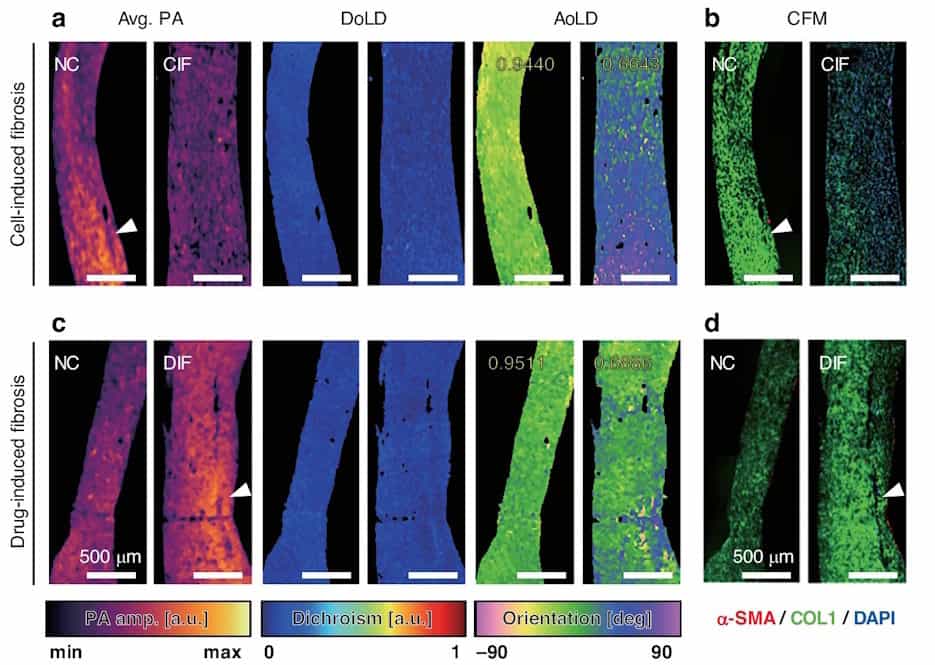
Imaging tissue fibrosis (a) Mid-infrared dichroism-sensitive photoacoustic microscopy (MIR-DS-PAM) images of cell-induced fibrosis (CIF) and normal control (NC) tissue; (c) MIR-DS-PAM images of drug-induced fibrosis (DIF) and NC tissue; (b) and (d) show the corresponding confocal fluorescence microscopy (CFM) images. Scale bars: 500 µm. (Courtesy: CC-BY 4.0/Light Sci. Appl. 10.1038/s41377-025-02117-0)

Many of the tissues in the human body rely upon highly organized microstructures to function effectively. If the collagen fibres in heart muscle become disordered, for instance, this can lead to or reflect disorders such as fibrosis and cancer. To image and analyse such structural changes, researchers at Pohang University of Science and Technology (POSTECH) in Korea have developed a new label-free microscopy technique and demonstrated its use in engineered heart tissue.

The ability to assess the alignment of microstructures such as protein fibres within tissue’s extracellular matrix provides a valuable tool for diagnosing disease, monitoring therapy response and evaluating tissue engineering models. Currently, however, this is achieved using histological imaging methods based on immunofluorescent staining, which can be labour-intensive and sensitive to the imaging conditions and antibodies used.

Instead, a team headed up by Chulhong Kim and Jinah Jang is investigating photoacoustic microscopy (PAM), a label-free imaging modality that relies on light absorption by endogenous tissue chromophores to reveal structural and functional information. In particular, PAM with mid-infrared (MIR) incident light provides bond-selective, high-contrast imaging of proteins, lipids and carbohydrates. The researchers also incorporated dichroism-sensitive (DS) functionality, resulting in a technique referred to as MIR-DS-PAM.

“Dichroism-sensitivity enables the quantitative assessment of fibre alignment by detecting the polarization-dependent absorption of anisotropic materials like collagen,” explains first author Eunwoo Park. “This adds a new contrast mechanism to conventional photoacoustic imaging, allowing simultaneous visualization of molecular content and microstructural organization without any labelling.”

Park and colleagues constructed a MIR-DS-PAM system using a pulsed quantum cascade laser as the light source. They tuned the laser to a centre wavelength of 6.0 µm to correspond with an absorption peak from the C=O stretching vibration in proteins. The laser beam was linearly polarized, modulated by a half-wave plate and used to illuminate the target tissue.

Tissue analysis

To validate the functionality of their MIR-DS-PAM technique, the researchers used it to image a formalin-fixed section of engineered heart tissue (EHT). They obtained images at four incident angles and used the acquired photoacoustic data to calculate the photoacoustic amplitude, which visualizes the protein content, as well as the degree of linear dichroism (DoLD) and the orientation angle of linear dichroism (AoLD), which reveal the extracellular matrix alignment.

“Cardiac tissue features highly aligned extracellular matrix with complex fibre orientation and layered architecture, which are critical to its mechanical and electrical function,” Park explains. “These properties make it an ideal model for demonstrating the ability of MIR-DS-PAM to detect physiologically relevant histostructural and fibrosis-related changes.”

The researchers also used MIR-DS-PAM to quantify the structural integrity of EHT during development, using specimens cultured for one to five days before fixing. Analysis of the label-free images revealed that as the tissue matured, the DoLD gradually increased, while the standard deviation of the AoLD decreased – indicating increased protein accumulation with more uniform fibre alignment over time. They note that these results agree with those from immunofluorescence-stained confocal fluorescence microscopy.

Next, they examined diseased EHT with two types of fibrosis: cell-induced fibrosis (CIF) and drug-induced fibrosis (DIF). In the CIF sample, the average photoacoustic amplitude and AoLD uniformity were both lower than found in normal EHT, indicating reduced protein density and disrupted fibre alignment. DIF exhibited a higher photoacoustic amplitude and lower AoLD uniformity than normal EHT, suggesting extensive extracellular matrix accumulation with disorganized orientation.

Both CIF and DIF showed a slight reduction in DoLD, again signifying a disorganized tissue structure, a common hallmark of fibrosis. The two fibrosis types, however, exhibited diverse biochemical profiles and different levels of mechanical dysfunction. The findings demonstrate the ability of MIR-DS-PAM to distinguish diseased from healthy tissue and identify different types of fibrosis. The researchers also imaged a tissue assembly containing both normal and fibrotic EHT to show that MIR-DS-PAM can capture features in a composite sample.

They conclude that MIR-DS-PAM enables label-free monitoring of both tissue development and fibrotic remodelling. As such, the technique shows potential for use within tissue engineering research, as well as providing a diagnostic tool for assessing tissue fibrosis or remodelling in biopsied samples. “Its ability to visualize both biochemical composition and structural alignment could aid in identifying pathological changes in cardiological, musculoskeletal or ocular tissues,” says Park.

“We are currently expanding the application of MIR-DS-PAM to disease contexts where extracellular matrix remodelling plays a central role,” he adds. “Our goal is to identify label-free histological biomarkers that capture both molecular and structural signatures of fibrosis and degeneration, enabling multiparametric analysis in pathological conditions.”


The post Polarization-sensitive photoacoustic microscopy reveals heart tissue health appeared first on Physics World.

Reçu hier — 18 janvier 2026 6.5 📰 Sciences English
Reçu — 17 janvier 2026 6.5 📰 Sciences English
Reçu — 16 janvier 2026 6.5 📰 Sciences English

Astronomer Daniel Jaffe named president of the Giant Magellan Telescope project

16 janvier 2026 à 16:30

Astronomer Daniel Jaffe has been appointed the next president of the Giant Magellan Telescope Corporation –  the international consortium building the $2.5bn Giant Magellan Telescope (GMT). He succeeds Robert Shelton, who announced his retirement last year after eight years in the role.

A former head of astronomy at the University of Texas at Austin from 2011 to 2015, Jaffe became vice president for research at the university from 2016 to 2025 where he also served as interim provost from 2020 to 2021.

Jaffe has sat on the board of directors of the Association of Universities for Research in Astronomy and the Gemini Observatory and played a role in establishing the University of Texas at Austin’s partnership in the GMT.

Under construction in Chile and expected to be complete in the 2030s, the GMT consists of seven mirrors to create a 25.4 m telescope. From the ground it will produce images 4-16 times sharper than the James Webb Space Telescope and will investigate the origins of the chemical elements, and search for signs of life on distant planets.

“I am honoured to lead the GMT at this exciting stage,” notes Jaffe. “[It] represents a profound leap in our ability to explore the universe and employ a host of new technologies to make fundamental discoveries.”

“[Jaffe] brings decades of leadership in research, astronomy instrumentation, public-private partnerships, and academia,” noted Taft Armandroff, board chair of the GMTO Corporation. “His deep understanding of the Giant Magellan Telescope, combined with his experience leading large research enterprises and cultivating a collaborative environment, make him exceptionally well suited to lead the observatory through its next phase of construction and toward operations.”

Jaffe joins the GMT at a pivotal time, as it aims to secure the funding necessary to complete the telescope with just over $1bn from private funds having been pledges so far. The collaboration recently added Northwestern University and the Massachusetts Institute of Technology to its international consortium taking the number of members to 16 universities and research institutions.

In June 2025 the GMT, which is already 40% completed, received NSF approval confirming that the observatory will advance into its “major facilities final design phase”, one of the final steps before becoming eligible for federal construction funding.

Yet it faces competition from another next-generation telescope – the Thirty Meter Telescope (TMT) that will use a segmented primary mirror consisting of 492 elements of zero-expansion glass for a 30 m-diameter primary mirror.

The TMT team chose Hawaii’s Mauna Kea peak as its location. However, protests by indigenous Hawaiians, who regard the site as sacred, have delayed the start of construction with officials identifying the island of La Palma, belonging to Spain’s Canary Islands, as an alternative site in 2019.

The post Astronomer Daniel Jaffe named president of the Giant Magellan Telescope project appeared first on Physics World.

The countdown to clean orbits has begun with ESA’s Zero Debris Charter

16 janvier 2026 à 15:00
An illustration showing GEO being crowded, as Earth is blanketed by an orbit of satellites and debris.

Space is rapidly becoming the world’s most congested frontier. What was once a domain of scientific exploration is now a crowded commercial arena, a global infrastructure layer critical to communications, navigation, climate monitoring and defense. Yet this dependence is threatened by a growing, largely invisible hazard: orbital debris. The European Space Agency’s Zero Debris Technical […]

The post The countdown to clean orbits has begun with ESA’s Zero Debris Charter appeared first on SpaceNews.

India turns to small modular nuclear reactors to meet climate targets

16 janvier 2026 à 13:30

India has been involved in nuclear energy and power for decades, but now the country is  turning to small modular nuclear reactors (SMRs) as part of a new, long-term push towards nuclear and renewable energy. In December 2025 the country’s parliament passed a bill that allows private companies for the first time to participate in India’s nuclear programme, which could see them involved in generating power, operating plants and making equipment.

Some commentators are unconvinced that the move will be enough to help meet India’s climate pledge to achieving 500 GW of non-fossil-fuel based energy generation by 2030. Interestingly, however, India has now joined other nations, such as Russia and China, in taking an interest in SMRs. They could help stem the overall decline in nuclear power, which now accounts for just 9% of electricity generated around the world – down from 17.5% in 1996.

Last year India’s finance minister Nirmala Sitharaman announced a nuclear energy mission funded with 200 billion Indian rupees ($2.2bn) to develop at least five indigenously designed and operational SMRs by 2033. Unlike huge, conventional nuclear plants, such as pressurized heavy-water reactors (PHWRs), most or all components of an SMR are manufactured in factories before being assembled at the reactor site.

SMRs, typically generate less than 300 MW of electrical power but – being modular – additional capacity can be brought on quickly and easily given their lower capital costs, shorter construction times, ability to work with lower-capacity grids and lower carbon emissions. Despite their promise, there are only two fully operating SMRs in the world – both in Russia – although two further high-temperature gas-cooled SMRs are currently being built in China. In June 2025 Rolls-Royce SMR was selected as the preferred bidder by Great British Nuclear to build the UK’s first fleet of SMRs, with plans to provide 470 MW of low-carbon electricity.

Cost benefit analysis

An official at the Department of Atomic Energy told Physics World that part of that mix of five new SMRs in India could be the 200 MW Bharat small modular reactor, which are based on pressurized water reactor technology and use slightly enriched uranium as a fuel. Other options are 55 MW small modular reactors and the Indian government also plans to partner with the private sector to deploy 220 MW Bharat small reactors.

Despite such moves, some are unconvinced that small nuclear reactors could help India scale its nuclear ambitions. “SMRs are still to demonstrate that they can supply electricity at scale,” says Karthik Ganesan, a fellow and director of partnerships at the Council on Energy, Environment and Water (CEEW), a non-profit policy research think-tank based in New Delhi. “SMRs are a great option for captive consumption, where large investment that will take time to start generating is at a premium.”

Ganesan, however, says it is too early to comment on the commercial viability of SMRs as cost reductions from SMRs depend on how much of the technology is produced in a factory and in what quantities. “We are yet to get to that point and any test reactors deployed would certainly not be the ones to benchmark their long-term competitiveness,” he says. “[But] even at a higher tariff, SMRs will still have a use case for industrial consumers who want certainty in long-term tariffs and reliable continuous supply in a world where carbon dioxide emissions will be much smaller than what we see from the power sector today.”

M V Ramana from the University of British Columbia, Vancouver, who works in international security and energy supply, is concerned over the cost efficiency of SMRs compared to their traditional counterparts. “Larger reactors are cheaper on a per-megawatt basis because their material and work requirements do not scale linearly with power capacity,” says Ramana.  This, according to Ramana, means that the electricity SMRs produce will be more expensive than nuclear energy from large reactors, which are already far more expensive than renewables such as solar and wind energy.

Clean or unclean?

Even if SMRs take over from PHWRs, there is still the question of what do with its nuclear waste. As Ramana points out, all activities linked to the nuclear fuel chain – from mining uranium to dealing with the radioactive wastes produced – have significant health and environmental impacts. “The nuclear fuel chain is polluting, albeit in a different way from that of fossil fuels,” he says, adding that those pollutants remain hazardous for hundreds of thousands of years. “There is no demonstrated solution to managing these radioactive wastes – nor can there be, given the challenge of trying to ensure that these materials do not come into contact with living beings,” says Ramana.

Ganesan, however, thinks that nuclear energy is still clean as it produces electricity with much a lower environmental footprint especially when it comes to so-called “criteria pollutants”: ozone; particulate matter; carbon monoxide; lead; sulphur dioxide; and nitrogen dioxide.  While nuclear waste still needs to be managed, Ganesan says the associated costs are already included in the price of setting up a reactor. “In due course, with technological development, the burn up will significantly higher and waste generated a lot lesser.”

The post India turns to small modular nuclear reactors to meet climate targets appeared first on Physics World.

❌