↩ Accueil

Vue normale

Reçu aujourd’hui — 23 janvier 2026 6.5 📰 Sciences English

Cosmic time capsules: the search for pristine comets

23 janvier 2026 à 14:40

In this episode of Physics World Stories, host Andrew Glester explores the fascinating hunt for pristine comets – icy bodies that preserve material from the solar system’s beginnings and even earlier. Unlike more familiar comets that repeatedly swing close to the Sun and transform, these frozen relics act as time capsules, offering unique insights into our cosmic history.

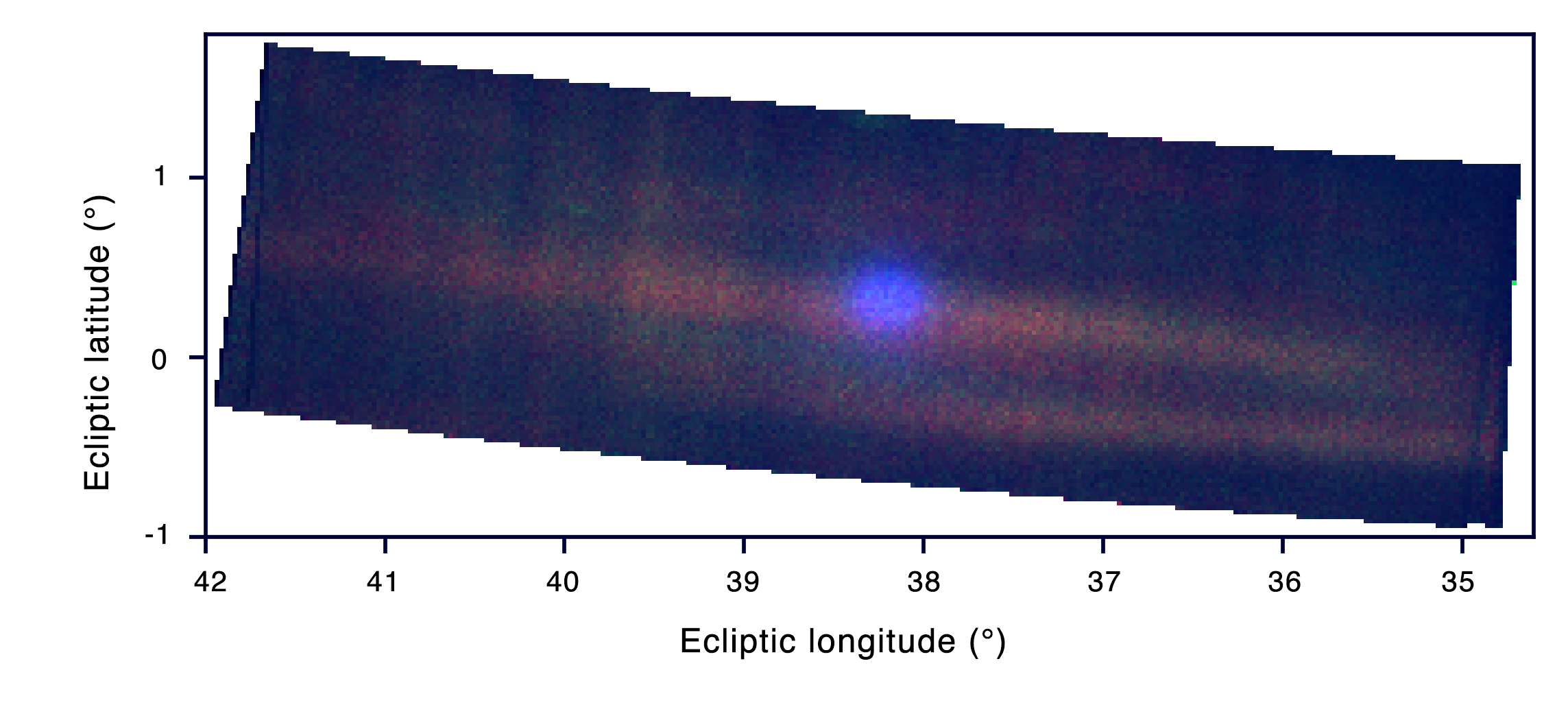
Pale blue circle against red streaks. composite image of interstellar comet 3I/ATLAS captured by the Europa Ultraviolet Spectrograph instrument on NASA’s Europa Clipper spacecraft
Interstellar comet 3I/ATLAS is seen in this composite image captured on 6 November 2025 by the Europa Ultraviolet Spectrograph instrument on NASA’s Europa Clipper spacecraft. (Courtesy: NASA/JPL-Caltech/SWRI)

The first guest is Tracy Becker, deputy principal investigator for the Ultraviolet Spectrograph on NASA’s Europa Clipper mission. Becker describes how the Jupiter-bound spacecraft recently turned its gaze to 3I/ATLAS, an interstellar visitor that appeared last July. Mission scientists quickly reacted to this unique opportunity, which also enabled them to test the mission’s instruments before it arrives at the icy world of Europa.

Michael Küppers then introduces the upcoming Comet Interceptor mission, set for launch in 2029. This joint ESA–JAXA mission will “park” in space until a suitable comet arrives from the outer reaches of the solar system. They will deploy two probes to study it from multiple angles – offering a first-ever close look at material untouched since the solar system’s birth.

From interstellar wanderers to carefully orchestrated intercepts, this episode blends pioneering missions and cosmic detective work. Keep up to date with all the latest space and astronomy developments in the dedicated section of the Physics World website.

The post Cosmic time capsules: the search for pristine comets appeared first on Physics World.

💾

Launch operators are the rocket fuel required to galvanize spaceports in Europe

23 janvier 2026 à 14:00
RFA ONE launch SaxaVord

Europe stands on the precipice of launching a satellite from the mainland. Until now, the Guiana Space Centre in South America has operated as Europe’s “gateway to space” but spaceports in SaxaVord and Andøya offer the tantalizing prospect of launches much closer to home. Yet infrastructure alone will not get us there. A launchpad is […]

The post Launch operators are the rocket fuel required to galvanize spaceports in Europe appeared first on SpaceNews.

Hot ancient galaxy cluster challenges current cosmological models

23 janvier 2026 à 12:30

As with people, age in cosmology does not always extrapolate. An early-career politician may be more likely to win a debate with a student than with a seasoned diplomat, but put all three in a room with a toddler and the toddler will almost certainly get their own way – they are following a different set of rules. A team of global collaborators noticed a similar phenomenon when peering at a cluster of developing galaxies from a time when the universe was just a tenth of its current age.

Cosmological theories suggest that such infant clusters should host much cooler and less abundant gas than more mature clusters. But what the researchers saw was at least five times hotter than expected – apparently not abiding by those rules.

“That’s a massive surprise and forces us to rethink how large structures actually form and evolve in the universe,” says first author Dazhi Zhou, a PhD candidate at the University of British Columbia.

Eyes on the past

Looking into distant outer space allows us to peer into the past. The protocluster of developing galaxies that Zhou and collaborators investigated – known as SPT2349–56 – is 12.4 billion light years away, so the light observed from it left home when the universe was just 1.4 billion years old. Light from so far away will be quite faint and hard to detect by the time it reaches us, so the researchers used the Atacama Large Millimeter/submillimeter Array (ALMA) to study SPT2349–56 using a special type of shadow.

As this type of protocluster develops, Zhou explains, the gas around its galaxies  becomes so hot that electrons in the gas interact with, and confer some of their energy upon, passing photons. This leaves light passing through the gas with more photons at the higher energy end of the spectrum and fewer at the lower end. When viewing the cosmic microwave background radiation – the “afterglow” left behind by the Big Bang – this results in a shadow at low energies. This energy shift, discovered by physicists Rashid Sunyaev and Yakov Zeldovich, not only reveals the presence of the protocluster, but the strength of this signature indicates the thermal energy of the gas in the protocluster.

The team’s observations were not easy. “This shadow is actually pretty tiny,” Zhou explains. In addition, there is thermal emission from the dust inside galaxies at radio wavelengths, originally estimated to be 20 times stronger than the Sunyaev–Zeldovich signature. “It really is like finding a needle in a haystack,” he adds. Nonetheless, the team did identify a definite Sunyaev–Zeldovich signature from SPT2349–56, with a thermal energy indicating that it was at least five times hotter than expected – thousands of times hotter than the surface of our Sun.

Time to upgrade?

SPT2349–56 has some quirks that may explain its high thermal energy, including three supermassive black holes shooting out jets of high-energy matter – a known but rare phenomenon for these supermassive black holes. However, simulations that take these outbursts into account as a heating mechanism that’s more efficient and occurs much earlier than heating from gravitational collapse (as current models suggest) still do not give the high temperatures observed, perhaps pointing to gaps in our knowledge of the underlying physics.

Eiichiro Komatsu from the Max-Planck-Institut für Astrophysik describes the work as “a wonderful  measurement”. Although not directly involved in this research, Komatsu has also looked at what the Sunyaev–Zeldovich effect can reveal about the cosmos. “The amount of thermal energy measured by the authors is staggering, yet its origin is a mystery,” he tells Physics World. He suggests these results will motivate further observations of other systems in the early universe.

“We need to be cautious rather than making any big claim,” adds Zhou. This is the first Sunyaev–Zeldovich detection of a protocluster from the first three billion years of the universe’s existence. Next, he aims to study similar protoclusters, and he hopes others will also work to corroborate the observations.

The research is reported in Nature.

The post Hot ancient galaxy cluster challenges current cosmological models appeared first on Physics World.

Reçu hier — 22 janvier 2026 6.5 📰 Sciences English

Open Cosmos advances broadband plans with spectrum once held by Rivada

22 janvier 2026 à 21:45

Open Cosmos deployed two satellites Jan. 22 to activate Ka-band spectrum filings reassigned by Liechtenstein last week, racing to meet deployment deadlines to bring the frequencies into use for sovereign and enterprise broadband.

The post Open Cosmos advances broadband plans with spectrum once held by Rivada appeared first on SpaceNews.

L3Harris to supply imager for Korean geostationary weather satellite

22 janvier 2026 à 18:30

TAHOE CITY, Calif. — L3Harris Technologies will provide the primary imagery for the Korean Meteorological Administration’s (KMA) next-generation geostationary weather satellite. The contract, awarded to L3Harris by Korean aerospace manufacturer […]

The post L3Harris to supply imager for Korean geostationary weather satellite appeared first on SpaceNews.

Laser fusion: Focused Energy charts a course to commercial viability

22 janvier 2026 à 16:01

This episode of the Physics World Weekly podcast features a conversation with the plasma physicist Debbie Callahan who is chief strategy officer at Focused Energy – a California and Germany based fusion-energy startup. Prior to that she spent 35 years working at the National Ignition Facility (NIF) at Lawrence Livermore National Laboratory in the US.

Focused Energy is developing a commercial system for generating energy from the laser-driven fusion of hydrogen isotopes. Callahan describes LightHouse, which is the company’s design for a laser-fusion power plant, and Pearl, which is the firm’s deuterium–tritium fuel capsule.

Callahan talks about the challenges and rewards of working in the fusion industry and also calls on early-career physicists to consider careers in this burgeoning sector.

The post Laser fusion: Focused Energy charts a course to commercial viability appeared first on Physics World.

❌