↩ Accueil

Vue normale

Reçu aujourd’hui — 27 janvier 2026 6.5 📰 Sciences English

Second Edition of Space Debris 2026 Conference Kicks Off with Participation from 75 Countries

27 janvier 2026 à 22:08
Saudi Space Agency logo

The second edition of the Space Debris 2026 Conference officially commenced today. Organized by the Saudi Space Agency (SSA), the conference is witnessing broad international participation representing 75 countries from […]

The post Second Edition of Space Debris 2026 Conference Kicks Off with Participation from 75 Countries appeared first on SpaceNews.

EBAD PRM Payload Release Module Family Demonstrates Scalable, Low-Shock Separation Capability on Falcon 9 Twilight Rideshare Mission

Ensign-Bickford Aerospace and Defense Company (EBAD) logo

SIMSBURY, Conn., January 26, 2026 – Ensign-Bickford Aerospace and Defense Company (EBAD) announced the successful flight and actuation of its Payload Release Module, PRM9103, during SpaceX’s Falcon 9 Twilight rideshare […]

The post EBAD PRM Payload Release Module Family Demonstrates Scalable, Low-Shock Separation Capability on Falcon 9 Twilight Rideshare Mission appeared first on SpaceNews.

European Space Agency unveils first images from Earth-observation ‘sounder’ satellite

27 janvier 2026 à 19:26

The European Space Agency has released the first images from the Meteosat Third Generation-Sounder (MTG-S) satellite. They show variations in temperature and humidity over Europe and northern Africa in unprecedented detail with further data from the mission set to improve weather-forecasting models and improve measurements of air quality over Europe.

Launched on 1 July 2025 from the Kennedy Space Center in Florida aboard a SpaceX Falcon 9 rocket, MTG-S operates from a geostationary orbit, about 36 000 km above Earth’s surface and is able to provide coverage of Europe and part of northern Africa on a 15-minute repeat cycle.

The satellite carries a hyperspectral sounding instrument that uses interferometry to capture data on temperature and humidity as well as being able to measure wind and trace gases in the atmosphere. It can scan nearly 2,000 thermal infrared wavelengths every 30 minutes.

The data will eventually be used to generate 3D maps of the atmosphere and help improve the accuracy of weather forecasting, especially for rapidly evolving storms.

The “temperature” image, above, was taken in November 2025 and shows heat (red) from the African continent, while a dark blue weather front covers Spain and Portugal.

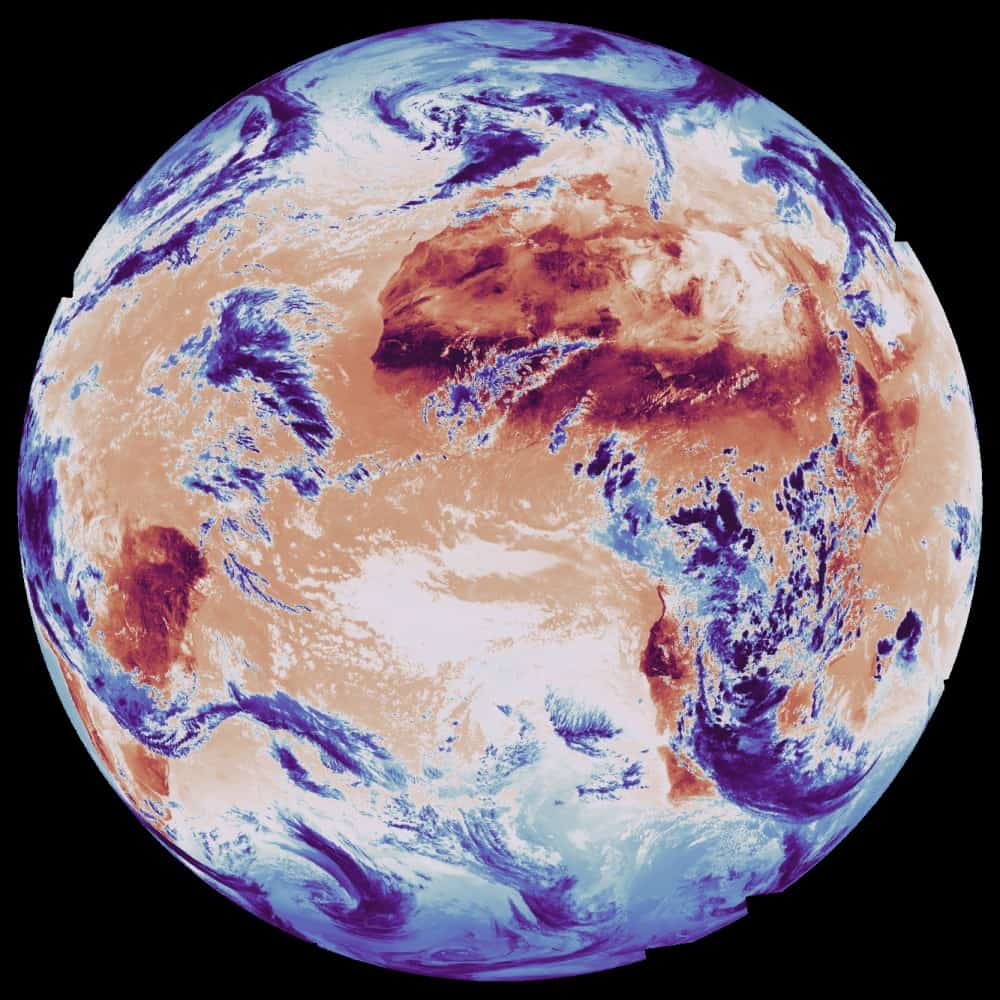
The “humidity” image, below, was captured using the sounder’s medium-wave infrared channel. Blue colours represent regions in the atmosphere with higher humidity, while red colours correspond to lower humidity.

Whole-Earth image showing cloud formation
(courtesy: EUMETSAT)

“Seeing the first infrared sounder images from MTG-S really brings this mission and its potential to life,” notes Simonetta Cheli, ESA’s director of earth observation programmes. “We expect data from this mission to change the way we forecast severe storms over Europe – and this is very exciting for communities and citizens, as well as for meteorologists and climatologists.”

ESA is expected to launch a second Meteosat Third Generation-Imaging satellite later this year following the launch of the first one – MTG-I1 – in December 2022.

The post European Space Agency unveils first images from Earth-observation ‘sounder’ satellite appeared first on Physics World.

The “Stealth” Strategy Pays Off: UARX Space Emerges as Europe’s High-Reliability Powerhouse

27 janvier 2026 à 16:00

NIGRÁN, Spain — While much of the European NewSpace ecosystem has spent the last five years in a cycle of public fundraising and prototype announcements, UARX Space took a different […]

The post The “Stealth” Strategy Pays Off: UARX Space Emerges as Europe’s High-Reliability Powerhouse appeared first on SpaceNews.

Uranus and Neptune may be more rocky than icy, say astrophysicists

27 janvier 2026 à 14:00

Our usual picture of Uranus and Neptune as “ice giant” planets may not be entirely correct. According to new work by scientists at the University of Zürich (UZH), Switzerland, the outermost planets in our solar system may in fact be rock-rich worlds with complex internal structures – something that could have major implications for our understanding of how these planets formed and evolved.

Within our solar system, planets fall into three categories based on their internal composition. Mercury, Venus, Earth and Mars are deemed terrestrial rocky planets; Jupiter and Saturn are gas giants; and Uranus and Neptune are ice giants.

An agnostic approach

The new work, which was led by PhD student Luca Morf in UZH’s astrophysics department, challenges this last categorization by numerically simulating the two planets’ interiors as a mixture of rock, water, hydrogen and helium. Morf explains that this modelling framework is initially “agnostic” – meaning unbiased – about what the density profiles of the planets’ interiors should be. “We then calculate the gravitational fields of the planets so that they match with observational measurements to infer a possible composition,” he says.

This process, Morf continues, is then repeated and refined to ensure that each model satisfies several criteria. The first criteria is that the planet should be in hydrostatic equilibrium, meaning that its internal pressure is enough to counteract its gravity and keep it stable. The second is that the planet should have the gravitational moments observed in spacecraft data. These moments describe the gravitational field of a planet, which is complex because planets are not perfect spheres.

The final criteria is that the modelled planets need to be thermodynamically and compositionally consistent with known physics. “For example, a simulation of the planets’ interiors must obey equations of state, which dictate how materials behave under given pressure and temperature conditions,” Morf explains.

After each iteration, the researchers adjust the density profile of each planet and test it to ensure that the model continues to adhere to the three criteria. “We wanted to bridge the gap between existing physics-based models that are overly constrained and empirical approaches that are too simplified,” Morf explains. Avoiding strict initial assumptions about composition, he says, “lets the physics and data guide the solution [and] allows us to probe a larger parameter space.”

A wide range of possible structures

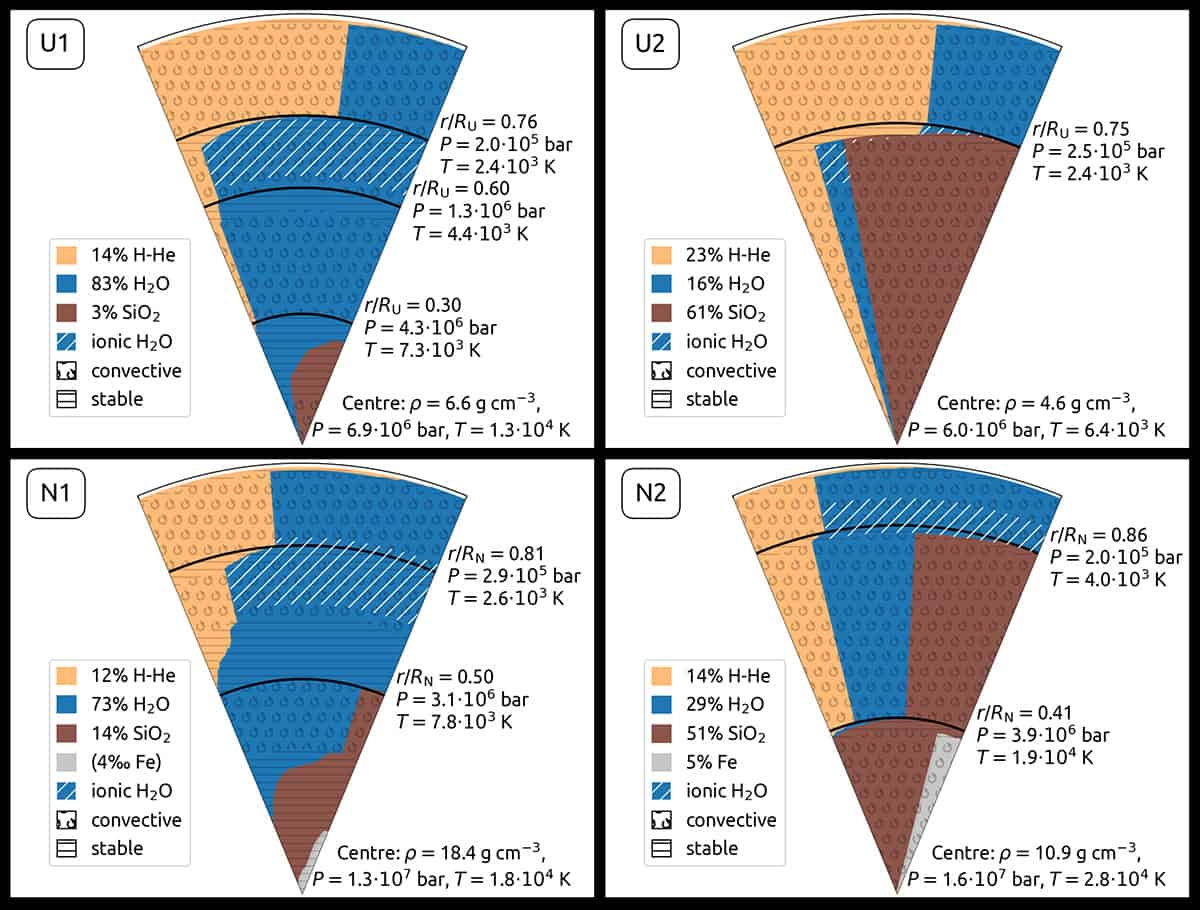
Based on their models, the UZH astrophysicists concluded that the interiors of Uranus and Neptune could have a wide range of possible structures, encompassing both water-rich and rock-rich configurations. More specifically, their calculations yield rock-to-water ratios of between 0.04-3.92 for Uranus and 0.20-1.78 for Neptune.

Diagrams showing possible "slices" of Uranus and Neptune. Four slices are shown, two for each planet. Each slice is filled with brown areas representing silicon dioxide rock and blue areas representing water ice, plus smaller areas of tan colouring for hydrogen-helium mixtures and (for Neptune only) grey areas representing iron. Two slices are mostly blue, while the other two contain large fractions of brown.
Slices of different pies: According to models developed with “agnostic” initial assumptions, Uranus (top) and Neptune (bottom) could be composed mainly of water ice (blue areas), but they could also contain substantial amounts of silicon dioxide rock (brown areas). (Courtesy: Luca Morf)

The models, which are detailed in Astronomy and Astrophysics, also contain convective regions with ionic water pockets. The presence of such pockets could explain the fact that Uranus and Neptune, unlike Earth, have more than two magnetic poles, as the pockets would generate their own local magnetic dynamos.

Traditional “ice giant” label may be too simple

Overall, the new findings suggest that the traditional “ice giant” label may oversimplify the true nature of Uranus of Neptune, Morf tells Physics World. Instead, these planets could have complex internal structures with compositional gradients and different heat transport mechanisms. Though much uncertainty remains, Morf stresses that Uranus and Neptune – and, by extension, similar intermediate-class planets that may exist in other solar systems – are so poorly understood that any new information about their internal structure is valuable.

A dedicated space mission to these outer planets would yield more accurate measurements of the planets’ gravitational and magnetic fields, enabling scientists to refine the limited existing observational data. In the meantime, the UZH researchers are looking for more solutions for the possible interiors of Uranus and Neptune and improving their models to account for additional constraints, such as atmospheric conditions. “Our work will also guide laboratory and theoretical studies on the way materials behave in general at high temperatures and pressures,” Morf says.

The post Uranus and Neptune may be more rocky than icy, say astrophysicists appeared first on Physics World.

String-theory concept boosts understanding of biological networks

27 janvier 2026 à 10:35

Many biological networks – including blood vessels and plant roots – are not organized to minimize total length, as long assumed. Instead, their geometry follows a principle of surface minimization, following a rule that is also prevalent in string theory. That is the conclusion of physicists in the US, who have created a unifying framework that explains structural features long seen in real networks but poorly captured by traditional mathematical models.

Biological transport and communication networks have fascinated scientists for decades. Neurons branch to form synapses, blood vessels split to supply tissues, and plant roots spread through soil. Since the mid-20th century, many researchers believed that evolution favours networks that minimize total length or volume.

“There is a longstanding hypothesis, going back to Cecil Murray from the 1940s, that many biological networks are optimized for their length and volume,” Albert-László Barabási of Northeastern University explains. “That is, biological networks, like the brain and the vascular systems, are built to achieve their goals with the minimal material needs.” Until recently, however, it had been difficult to characterize the complicated nature of biological networks.

Now, advances in imaging have given Barabási and colleagues a detailed 3D picture of real physical networks, from individual neurons to entire vascular systems. With these new data in hand, the researchers found that previous theories are unable to describe real networks in quantitative terms.

From graphs to surfaces

To remedy this, the team defined the problem in terms of physical networks, systems whose nodes and links have finite thickness and occupy space. Rather than treating them as abstract graphs made of idealized edges, the team models them as geometrical objects embedded in 3D space.

To do this, the researchers turned to an unexpected mathematical tool. “Our work relies on the framework of covariant closed string field theory, developed by Barton Zwiebach and others in the 1980s,” says team member Xiangyi Meng at Rensselaer Polytechnic Institute. This framework provides a correspondence between network-like graphs and smooth surfaces.

Unlike string theory, their approach is entirely classical. “These surfaces, obtained in the absence of quantum fluctuations, are precisely the minimal surfaces we seek,” Meng says. No quantum mechanics, supersymmetry, or exotic string-theory ingredients are required. “Those aspects were introduced mainly to make string theory quantum and thus do not apply to our current context.”

Using this framework, the team analysed a wide range of biological systems. “We studied human and fruit fly neurons, blood vessels, trees, corals, and plants like Arabidopsis,” says Meng. Across all these cases, a consistent pattern emerged: the geometry of the networks is better predicted by minimizing surface area rather than total length.

Complex junctions

One of the most striking outcomes of the surface-minimization framework is its ability to explain structural features that previous models cannot. Traditional length-based theories typically predict simple Y-shaped bifurcations, where one branch splits into two. Real networks, however, often display far richer geometries.

“While traditional models are limited to simple bifurcations, our framework predicts the existence of higher-order junctions and ‘orthogonal sprouts’,” explains Meng.

These include three- or four-way splits and perpendicular, dead-end offshoots. Under a surface-based principle, such features arise naturally and allow neurons to form synapses using less membrane material overall and enable plant roots to probe their environment more effectively.

Ginestra Bianconi of the UK’s Queen Mary University of London says that the key result of the new study is the demonstration that “physical networks such as the brain or vascular networks are not wired according to a principle of minimization of edge length, but rather that their geometry follows a principle of surface minimization.”

Bianconi, who was not involved in the study, also highlights the interdisciplinary leap of invoking ideas from string theory, “This is a beautiful demonstration of how basic research works”.

Interdisciplinary leap

The team emphasizes that their work is not immediately technological. “This is fundamental research, but we know that such research may one day lead to practical applications,” Barabási says. In the near term, he expects the strongest impact in neuroscience and vascular biology, where understanding wiring and morphology is essential.

Bianconi agrees that important questions remain. “The next step would be to understand whether this new principle can help us understand brain function or have an impact on our understanding of brain diseases,” she says. Surface optimization could, for example, offer new ways to interpret structural changes observed in neurological disorders.

Looking further ahead, the framework may influence the design of engineered systems. “Physical networks are also relevant for new materials systems, like metamaterials, who are also aiming to achieve functions at minimal cost,” Barabási notes. Meng points to network materials as a particularly promising area, where surface-based optimization could inspire new architectures with tailored mechanical or transport properties.

The research is described in Nature.

The post String-theory concept boosts understanding of biological networks appeared first on Physics World.

Reçu hier — 26 janvier 2026 6.5 📰 Sciences English
❌