Researchers have documented the births of nearly two dozen North Atlantic right whale calves this season. It’s an encouraging sign for a species whose population is estimated to be below 400.
IRVINE, CA – January 28, 2026 – Terran Orbital proudly announces the Mitsubishi Electric LEO Demo Mission, a state-of-the-art project in collaboration with Mitsubishi Electric Corporation and Mitsubishi Electric US. […]
Researchers at the ATLAS collaboration have been searching for signs of new particles in the dark sector of the universe, a hidden realm that could help explain dark matter. In some theories, this sector contains dark quarks (fundamental particles) that undergo a shower and hadronization process, forming long-lived dark mesons (dark quarks and antiquarks bound by a new dark strong force), which eventually decay into ordinary particles. These decays would appear in the detector as unusual “emerging jets”:bursts of particles originating from displaced vertices relative to the primary collision point.
Using 51.8 fb⁻¹ of proton–proton collision data at 13.6 TeV collected in 2022–2023, the ATLAS team looked for events containing two such emerging jets. They explored two possible production mechanisms, which are a vector mediator (Z′) produced in the s‑channel and a scalar mediator (Φ) exchanged in the t‑channel. The analysis combined two complementary strategies.A cut-based strategy relying on high-level jet observables, including track-, vertex-, and jet-substructure-based selections, enables a straightforward reinterpretation for alternative theoretical models. A machine learning approach employs a per-jet tagger using a transformer architecture trained on low-level tracking variables to discriminate emerging from Standard Model jets, maximizing sensitivity for the specific models studied.
No emerging‑jet signal excess was found, but the search set the first direct limits on emerging‑jet production via a Z′ mediator and the first constraints on t‑channel Φ production. Depending on the model assumptions, Z′ masses up to around 2.5 TeV and Φ masses up to about 1.35 TeV are excluded. These results significantly narrow the space in which dark sector particles could exist and form part of a broader ATLAS programme to probe dark quantum chromodynamics. The work sharpens future searches for dark matter and advances our understanding of how a dark sector might behave.
Active matter is matter composed of large numbers of active constituents, each of which consumes chemical energy in order to move or to exert mechanical forces.
This type of matter is commonly found in biology: swimming bacteria or migrating cells are both classic examples. In addition, a wide range of synthetic systems, such as active colloids or robotic swarms, can also fall into this umbrella.
Active matter has therefore been the focus of much research over the past decade, unveiling many surprising theoretical features and a suggesting a plethora of applications.
Perhaps most importantly, these systems’ ability to perform work leads to sustained non-equilibrium behaviour. This is distinctly different from that of relaxing equilibrium thermodynamic systems, commonly found in other areas of physics.
The concept of entropy production is often used to quantify this difference and to calculate how much useful work can be performed. If we want to harvest and utilise this work however, we need to understand the small-scale dynamics of the system. And it turns out this is rather complicated.
One way to calculate entropy production is through field theory, the workhorse of statistical mechanics. Traditional field theories simplify the system by smoothing out details, which works well for predicting densities and correlations. However, these approximations often ignore the individual particle nature, leading to incorrect results for entropy production.
The new paper details a substantial improvement on this method. By making use of Doi-Peliti field theory, they’re able to keep track of microscopic particle dynamics, including reactions and interactions.
The approach starts from the Fokker-Planck equation and provides a systematic way to calculate entropy production from first principles. It can be extended to include interactions between particles and produces general, compact formulas that work for a wide range of systems. These formulas are practical because they can be applied to both simulations and experiments.
The authors demonstrated their method with numerous examples, including systems of Active Brownian Particles, showing its broad usefulness. The big challenge going forward though is to extend their framework to non-Markovian systems, ones where future states depend on the present as well as past states.
Quantum mechanics famously limits how much information about a system can be accessed at once in a single experiment. The more precisely a particle’s path can be determined, the less visible its interference pattern becomes. This trade-off, known as Bohr’s complementarity principle, has shaped our understanding of quantum physics for nearly a century. Now, researchers in China have brought one of the most famous thought experiments surrounding this principle to the quantum limit, using a single atom as a movable slit.
The thought experiment dates back to the 1927 Solvay Conference, where Albert Einstein proposed a modification of the double-slit experiment in which one of the slits could recoil. He argued that if a photon caused the slit to recoil as it passed through, then measuring that recoil might reveal which path the photon had taken without destroying the interference pattern. Conversely, Niels Bohr argued that any such recoil would entangle the photon with the slit, washing out the interference fringes.
For decades, this debate remained largely philosophical. The challenge was not about adding a detector or a label to track a photon’s path. Instead, the question was whether the “which-path” information could be stored in the motion of the slit itself. Until now, however, no physical slit was sensitive enough to register the momentum kick from a single photon.
A slit that kicks back
To detect the recoil from a single photon, the slit’s momentum uncertainty must be comparable to the photon’s momentum. For any ordinary macroscopic slit, its quantum fluctuations are significantly larger than the recoil, washing out the which-path information. To give a sense of scale, the authors note that even a 1 g object modelled as a 100 kHz oscillator (for example, a mirror on a spring) would have a ground-state momentum uncertainty of about 10-16 kg m s-1, roughly 11 orders of magnitude larger than the momentum of an optical photon (approximately 10-27 kg m s-1).
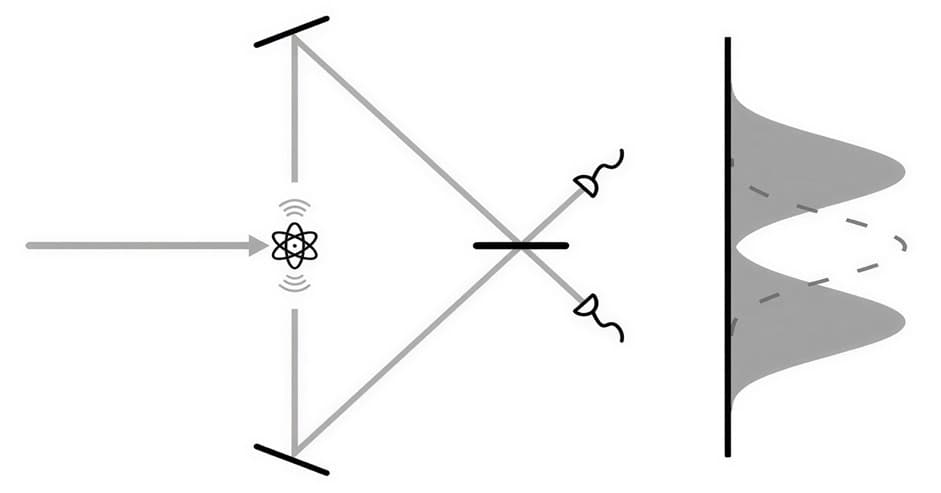
Experimental realization To perform Einstein’s thought experiment in the lab, the researchers used a single trapped atom as a movable slit. Photon paths become correlated with the atom’s motion, allowing researchers to probe the trade-off between interference and which-path information. (Courtesy: Y-C Zhang et al. Phys. Rev. Lett.135 230202)
In their study, published in Physical Review Letters, Yu-Chen Zhang and colleagues from the University of Science and Technology of China overcame this obstacle by replacing the movable slit with a single rubidium atom held in an optical tweezer and cooled to its three-dimensional motional ground state. In this regime, the atom’s momentum uncertainty reaches the quantum limit, making the recoil from a single photon directly measurable.
Rather than using a conventional double-slit geometry, the researchers built an optical interferometer in which photons scattered off the trapped atom. By tuning the depth of this optical trap, the researchers were able to precisely control the atom’s intrinsic momentum uncertainty, effectively adjusting how “movable” the slit was.
Watching interference fade
As the researchers decreased the atom’s momentum uncertainty, they observed a loss of interference in the scattered photons. Increasing the atom’s momentum uncertainty caused the interference to reappear.
This behaviour directly revealed the trade-off between interference and which-path information at the heart of the Einstein–Bohr debate. The researchers note that the loss of interference arose not from classical noise, but from entanglement between the photon and the atom’s motion.
“The main challenge was matching the slit’s momentum uncertainty to that of a single photon,” says corresponding author Jian-Wei Pan. “For macroscopic objects, momentum fluctuations are far too large – they completely hide the recoil. Using a single atom cooled to its motional ground state allows us to reach the fundamental quantum limit.”
Maintaining interferometric phase stability was equally demanding. The team used active phase stabilization with a reference laser to keep the optical path length stable to within a few nanometres (roughly 3 nm) for over 10 h.
Beyond settling a historical argument, the experiment offers a clean demonstration of how entanglement plays a key role in Bohr’s complementarity principle. As Pan explains, the results suggest that “entanglement in the momentum degree-of-freedom is the deeper reason behind the loss of interference when which-path information becomes available”.
This experiment opens the door to exploring quantum measurement in a new regime. By treating the slit itself as a quantum object, future studies could probe how entanglement emerges between light and matter. Additionally, the same set-up could be used to gradually increase the mass of the slit, providing a new way to study the transition from quantum to classical behaviour.
BRUSSELS — Exotrail, a French company specializing in multi-orbit satellite mobility and focused on LEO service vehicles, together with Astroscale France, the French subsidiary of the Japan-based on-orbit servicing company, announced Jan. 28 a partnership aimed at testing deorbiting capabilities in low Earth orbit. The mission itself has not yet been fully approved. “We are […]
SAN FRANCISCO — The National Oceanic and Atmospheric Administration’s latest space weather observatory has reached Lagrange point 1. The Space Weather Follow On — Lagrange 1 executed its final engine […]
SAN FRANCISCO – The National Oceanic and Atmospheric Administration is keeping close tabs on the cost of the next generation of geostationary weather satellites. The Geostationary and Extended Operations (GeoXO) […]
BRUSSELS — The European Union’s new government satellite communications program, GOVSATCOM, which pools capacity from eight already on-orbit geosynchronous satellites, began operations last week, European Commissioner for Defence and Space Andrius Kubilius said Jan. 27. The program is designed to provide secure communications capabilities to the EU and its member states and could expand by […]
For people who aren’t interested in total abstinence, cannabis-infused beverages may offer a way to reduce alcohol use while keeping familiar rituals intact.
The second edition of the Space Debris 2026 Conference officially commenced today. Organized by the Saudi Space Agency (SSA), the conference is witnessing broad international participation representing 75 countries from […]
Learn how artificial intelligence is helping reinterpret dinosaur footprints, including bird-like tracks that blur the line between dinosaurs and early birds.
SIMSBURY, Conn., January 26, 2026 – Ensign-Bickford Aerospace and Defense Company (EBAD) announced the successful flight and actuation of its Payload Release Module, PRM9103, during SpaceX’s Falcon 9 Twilight rideshare […]
The European Space Agency has released the first images from the Meteosat Third Generation-Sounder (MTG-S) satellite. They show variations in temperature and humidity over Europe and northern Africa in unprecedented detail with further data from the mission set to improve weather-forecasting models and improve measurements of air quality over Europe.
Launched on 1 July 2025 from the Kennedy Space Center in Florida aboard a SpaceX Falcon 9 rocket, MTG-S operates from a geostationary orbit, about 36 000 km above Earth’s surface and is able to provide coverage of Europe and part of northern Africa on a 15-minute repeat cycle.
The satellite carries a hyperspectral sounding instrument that uses interferometry to capture data on temperature and humidity as well as being able to measure wind and trace gases in the atmosphere. It can scan nearly 2,000 thermal infrared wavelengths every 30 minutes.
The data will eventually be used to generate 3D maps of the atmosphere and help improve the accuracy of weather forecasting, especially for rapidly evolving storms.
The “temperature” image, above, was taken in November 2025 and shows heat (red) from the African continent, while a dark blue weather front covers Spain and Portugal.
The “humidity” image, below, was captured using the sounder’s medium-wave infrared channel. Blue colours represent regions in the atmosphere with higher humidity, while red colours correspond to lower humidity.
(Courtesy: EUMETSAT)
“Seeing the first infrared sounder images from MTG-S really brings this mission and its potential to life,” notes Simonetta Cheli, ESA’s director of Earth observation programmes. “We expect data from this mission to change the way we forecast severe storms over Europe – and this is very exciting for communities and citizens, as well as for meteorologists and climatologists.”
ESA is expected to launch a second Meteosat Third Generation-Imaging satellite later this year following the launch of the first one – MTG-I1 – in December 2022.
NIGRÁN, Spain — While much of the European NewSpace ecosystem has spent the last five years in a cycle of public fundraising and prototype announcements, UARX Space took a different […]
 Connexion