Space investors and dealmakers anticipate SpaceX’s planned IPO this year will trigger a surge of capital across the industry, but not without the risk of pulling investor attention away from other companies in the run-up.
MILAN — United Kingdom-based launch company Orbex announced that its business is folding after multiple attempts to stay solvent fell through. The company announced Feb. 11 that it has filed a notice of intention to appoint administrators — a process in the U.K. that’s similar to declaring bankruptcy — after fundraising, merger and acquisition efforts […]
Meditation isn’t thinking about nothing. New research reinforces that it’s a mind-altering, dynamic state that promotes focus, learning, and well-being.
SEATTLE, Feb. 11, 2026 — Integrate, the developer of the world’s first ultra-secure project management platform for dynamic multi-entity execution, today announced a $17 million Series A raise led by FPV Ventures with participation from Fuse […]
MOUNTAIN VIEW, Calif. – At the recent World Economic Forum in Switzerland, much of the conversation revolved around the concerns of middle powers, nations with the wherewithal to influence international events that are not among the great powers. At the SmallSat Symposium in Mountain View, representatives of Earth-observation companies said middle powers that previously relied […]
MILAN — The French-German aerospace company The Exploration Company completed mock splashdown tests for its Nyx space capsule, a modular, reusable spacecraft designed to transport cargo and eventually crew to low Earth orbit and beyond. The company conducted water-impact tests on a mock capsule from Jan. 13 through 28. The testing campaign was not a […]
Join Leidos and SpaceNews on Thursday, Feb. 19 at 2 p.m. ET to hear how the U.S. Space Force is partnering with industry to accelerate new approaches for collapsing space kill chains through rapid commercial integration and unclassified technology cohorts.
Learn more about the science behind Yosemite’s Horsetail Fall, which glows like fire every February, and will return between Feb. 10 and Feb. 26, 2026.
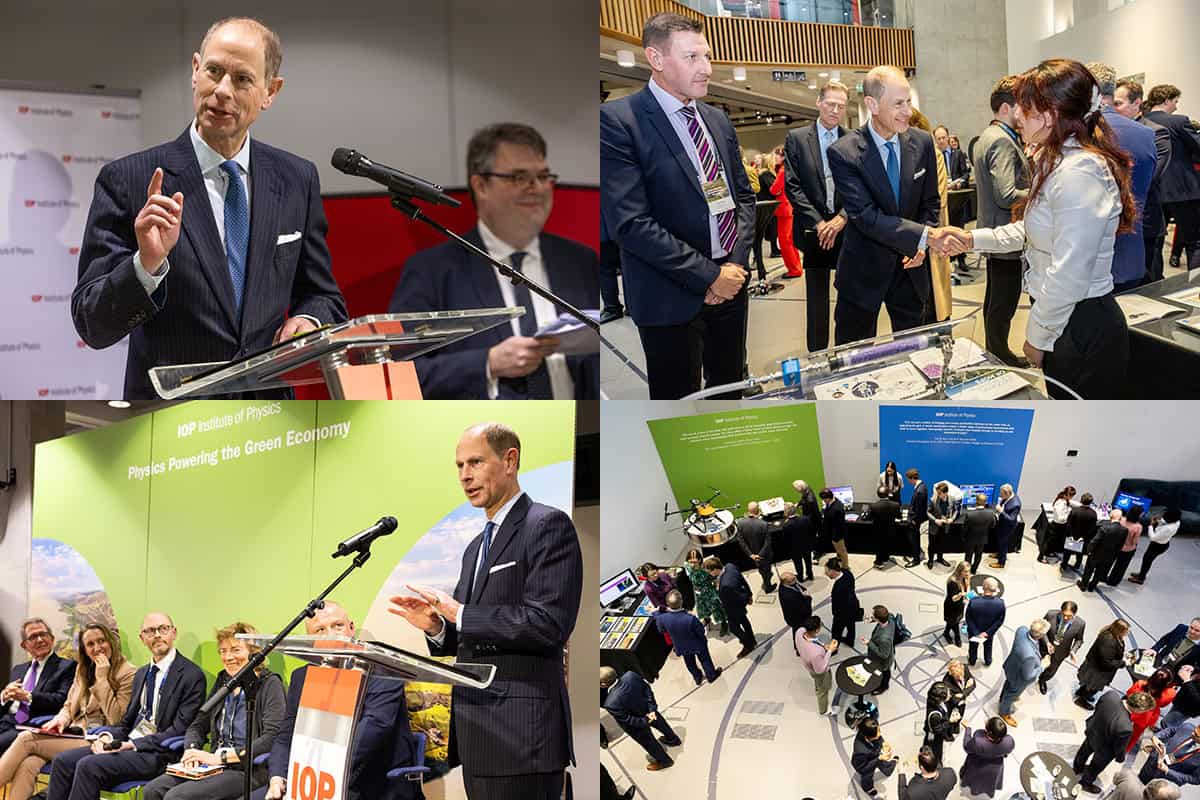
Royal approval (Clockwise from top left) The Duke of Edinburgh with IOP group chief executive Tom Grinyer; talking to Selina Ambrose from Promethean Particles; the exhibition he toured; and speaking after the panel debate. (Courtesy: Carmen Valino)
The Duke of Edinburgh visited the headquarters of the Institute of Physics (IOP) in central London on 5 February to learn about the role that physics plays in supporting the green economy.
The event was attended by about 100 business leaders, policy chiefs, senior physicists, and IOP and IOP Publishing staff. It highlighted how physics research is helping to deliver clean energy solutions and support economic growth.
A total of 12 companies took part in an exhibition that was visited by the duke. They included two carbon-capture firms – Nellie Technologies and Promethean Particles – as well as the fusion firm Tokamak Energy and Sunamp, which makes non-flammable “thermal batteries”.
The event included a panel debate chaired by Tara Shears, the IOP’s vice-president for science and innovation.
It featured ex-BP boss John Browne, who now works in green energy, along with Sizewell C energy-strategy director David Cole, Nellie Technologies founder Stephen Millburn, solar-cell physicist Jenny Nelson from Imperial College, and Emily Nurse from the UK’s Climate Change Committee.
After the debate, the duke said the event had showcased “some of the brilliant ideas that are trying to solve some really challenging issues through creativity and imagination”. He expressed particular delight that people are central to that mission.
“Our ability to evolve the right skills for the future has been well demonstrated here,” he said. “It comes down to creating the right climate to allow these ideas to flourish and come to market. We simply cannot drop this issue.”
Tom Grinyer, group chief executive of the IOP, reminded delegates that physics is fundamental to the UK economy. “We’re seeing how research is translating into real-world solutions that matter today, from clean power and climate intelligence, to advanced materials and future technologies,” he said.
But he warned that long-term investment in young people will be vital to create the physicists and business leaders who can tackle those challenges.
As SpaceX and other vertically integrated space giants expand their reach, questions are growing over just how much room other small satellite companies have to build scalable businesses.
Boulder, CO and Pasadena, CA — February 11, 2026 — Motiv Space Systems announced a contractual agreement with PickNik Robotics to support software development for NASA’s Fly Foundational Robotics (FFR) […]
Catalyst Campus is proud to welcome the fourth cohort of small businesses to the SDA TAP Lab – Catalyst Campus Mini Accelerator, a dynamic two-month program designed to prepare innovative […]
“When you have a fully reusable vehicle … you can send it anywhere … to the moon … past Mars” —Jared Isaacman, NASA Administrator. Imagine a future where thousands of people travel to space every year. Some stay a week. Some a month. Some never come back — they stay, build and live. Space is […]
Eutelsat has signed a 975 million euro ($1.2 billion) France-backed export credit agency financing package to help fund 440 replacement satellites for its OneWeb LEO broadband constellation.
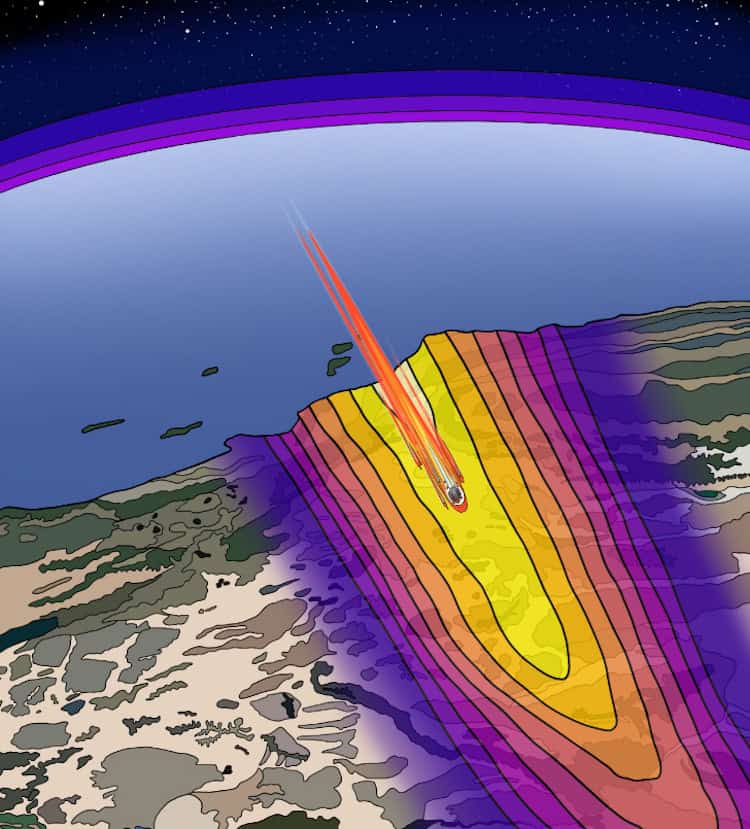
Re-entry of space debris. Courtesy: S Economon and B Fernando
When chunks of space debris make their fiery descent through the Earth’s atmosphere, they leave a trail of shock waves in their wake. Geophysicists have now found a way to exploit this phenomenon, using open-source seismic data from a network of earthquake sensors to monitor the waves produced by China’s Shenzhou-15 module as it fell to Earth in April 2024. The method is valuable, they say, because it makes it possible to follow debris – which can be hazardous to humans and animals – in near-real time as they travel towards the surface.
“We’re at the situation today where more and more spacecraft are re-entering the Earth’s atmosphere on a daily basis,” says team member Benjamin Fernando, a postdoctoral researcher at Johns Hopkins University in the US. “The problem is that we don’t necessarily know what happens to the fragments this space debris produces – whether they all break up in the atmosphere or if some of them reach the ground.”
Piggybacking on a network of earthquake sensors
As the Shenzhou-15 module re-entered the atmosphere, it began to disintegrate, producing debris that travelled at supersonic speeds (between Mach 25‒30) over the US cities of Santa Barbara, California and Las Vegas, Nevada. The resulting sonic booms produced vibrations strong enough to be picked up by a network of 125 seismic stations spread over Nevada and Southern California.
Fernando and his colleague Constantinos Charalambous at Imperial College London in the UK used freely available data from these stations to measure the arrival times of the largest sonic boom signals. Based on these data, they produced a contour map of the path the debris took and the direction in which it propagated. They also determined the altitude of the module as it travelled by using ratios of the speed of sound to the apparent speed of the incident wavefront its supersonic flight generated as it passed over the seismic stations. Finally, they used a best-fit seismic inversion model to estimate where remnants of the module may have landed and the speed at which they travelled over the ground.
The analyses revealed that the module travelled roughly 20-30 kilometres south of the trajectory that US Space Command had predicted based on measurements of the module’s orbit alone. The seismic data also showed that the module gradually disintegrated into smaller pieces rather than undergoing a single explosive disassembly.
Advantages of accurate tracking
To obtain an estimate of the object’s trajectory within seconds or minutes, the researchers had to simplify their calculations by ignoring the effects of wind and temperature variations in the lower troposphere (the lowest layer of the Earth’s atmosphere). This simplification also did away with the need to simulate the path of wave signals through the atmosphere, which was essential for previous techniques that relied on radar data to follow objects decaying in low Earth orbit. These older techniques, Fernando adds, produced predictions of the objects’ landing sites that could, in the worst cases, be out by thousands of kilometres.
The availability of accurate, near-real time debris tracking could be particularly helpful in cases where the debris is potentially harmful. As an example, Fernando cites an incident in 1996, when debris from the Russian Mars 96 spacecraft fell out of orbit. “People thought it burned up and [that] its radioactive power source landed intact in the ocean,” he says. “They tried to track it at the time, but its location was never confirmed. More recently, a group of scientists found artificial plutonium in a glacier in Chile that they believe is evidence the power source burst open during the descent and contaminated the area.”
Though Fernando emphasizes that it’s rare for debris to contain radioactive material, he argues “we’d benefit from having additional tracking tools” when it does.
Towards an automated algorithm for trajectory reconstruction
Fernando had previously used seismometers to track natural meteoroids, comets and asteroids on both Earth and Mars. In the latter case, he used data from InSight, a NASA Mars mission equipped with a seismometer.
“The meteoroids hitting the Red Planet were a really good seismic source for us,” he explains. “We detected the sonic booms from them breaking up and, occasionally, would actually detect the impact of them hitting the ground. We realized that we could actually apply those same techniques to studying space debris on Earth.
“This is an excellent example of a technique that we really perfected the expertise for a planetary science kind of pure science application. And then we were able to apply it to a really relevant, challenging problem here on Earth,” he tells Physics World.
The scientists say that in the longer term, they hope to develop an algorithm that automatically reconstructs the trajectory of an object. “At the moment, we’re having to find the sonic boons and analyse the data ‘by hand’,” Fernando says. “That’s obviously very slow, even though we’re getting better.”
A better solution, Fernando continues, would be to develop a machine learning tool that can find sonic booms in the data when a re-entry is expected, and then use those data to reconstruct the trajectory of an object. They are currently applying for funding to explore this option in a follow-up study.
Beyond that, there’s also the question of what to do with the data once they have it. “Who would we send the data to?” Fernando asks rhetorically. “Who needs to know about these events? If there’s a plane crash, hurricane, or similar, there are already good international frameworks in place for dealing with these events. It’s not clear to me, however, that such a framework for dealing with space debris has caught up with reality – either in terms of regulations or the response when such an event does happen.”
 Connexion