A new SpaceX initiative to provide space traffic coordination services has attracted attention and praise in part because of the conditions it places on users of it.
A long-awaited cap on liability for U.K. launch operators came into force Feb. 18, aiming to make the country’s fledgling rocket sector more competitive as it struggles to get off the ground.
Electronics made from certain atomically thin materials can survive harsh radiation environments up to 100 times longer than traditional silicon-based devices. This finding, which comes from researchers at Fudan University in Shanghai, China, could bring significant benefits for satellites and other spacecraft, which are prone to damage from intense cosmic radiation.
Cosmic radiation consists of a mixture of heavy ions and cosmic rays, which are high-energy protons, electrons and atomic nuclei. The Earth’s magnetic field protects us from 99.9% of this ionizing radiation, and our atmosphere significantly attenuates the rest. Space-based electronics, however, have no such protection, and this radiation can damage or even destroy them.
Adding radiation shielding to spacecraft mitigates these harmful effects, but the extra weight and power consumption increases the spacecraft’s costs. “This conflicts with the requirements of future spacecraft, which call for lightweight and cost-effective architectures,” says team leader Peng Zhou, a physicist in Fudan’s College of Integrated Circuits and Micro-Nano Electronics. “Implementing radiation tolerant electronic circuits is therefore an important challenge and if we can find materials that are intrinsically robust to this radiation, we could incorporate these directly into the design of onboard electronic circuits.”
Promising transition-metal dichalcogenides
Previous research had suggested that 2D materials might fit the bill, with transistors based on transition-metal dichalcogenides appearing particularly promising. Within this family of materials, 2D molybdenum disulphide (MoS2) proved especially robust to irradiation-induced defects, and Zhou points out that its electrical, mechanical and thermal properties are also highly attractive for space applications.
The studies that revealed these advantages were, however, largely limited to simulations and ground-based experiments. This meant they were unable to fully replicate the complex and dynamic radiation fields such circuits would encounter under real space conditions.
Better than NMOS transistors
In their work, Zhou and colleagues set out to fill this gap. After growing monolayer 2D MoS2 using chemical vapour deposition, they used this material to fabricate field-effect transistors. They then exposed these transistors to 10 Mrad of gamma-ray irradiation and looked for changes to their structure using several techniques, including cross-sectional transmission electron microscopy (TEM) imaging and corresponding energy-dispersive spectroscopy (EDS) mapping.
These measurements indicated that the 2D MoS2 in the transistors was about 0.7 nm thick (typical for a monolayer structure) and showed no obvious signs of defects or damage. Subsequent Raman characterization on five sites within the MoS2 film confirmed the devices’ structural integrity.
The researchers then turned their attention to the transistors’ electrical properties. They found that even after irradiation, the transistors’ on-off ratios remained ultra-high, at about 108. They note that this is considerably better than a similarly-sized Si N-channel metal–oxide–semiconductor (NMOS) transistors fabricated through a CMOS process, for which the on-off ratio decreased by a factor of more than 4000 after the same 10 Mrad irradiation.
The team also found that MoS2 system consumes only about 49.9 mW per channel, making its power requirement at least five times lower than the NMOS one. This is important owing to the strict energy limitations and stringent power budgets of spacecraft, Zhou says.
Surviving the space environment
In their final experiment, the researchers tested their MoS2 structures on a spacecraft orbiting at an altitude of 517 km, similar to the low-Earth orbit of many communication satellites. These tests showed that the bit-error rate in data transmitted from the structures remained below 10-8 even after nine months of operation, which Zhou says indicates significant radiation and long-term stability. Indeed, based on test data, electronic devices made from these 2D materials could operate for 271 years in geosynchronous orbit – 100 times longer than conventional silicon electronics.
“The discovery of intrinsic radiation tolerance in atomically thin 2D materials, and the successful on-orbit validation of the atomic-layer semiconductor-based spaceborne radio-frequency communication system have opened a uniquely promising pathway for space electronics leveraging 2D materials,” Zhou says. “And their exceptionally long operational lifetimes and ultra-low power consumption establishes the unique competitiveness of 2D electronic systems in frontier space missions, such as deep-space exploration, high-Earth-orbit satellites and even interplanetary communications.”
The researchers are now working to optimize these structures by employing advanced fabrication processes and circuit designs. Their goal is to improve certain key performance parameters of spaceborne radio-frequency chips employed in inter-satellite and satellite-to-ground communications. “We also plan to develop an atomic-layer semiconductor-based radiation-tolerant computing platform, providing core technological support for future orbital data centres, highly autonomous satellites and deep-space probes,” Zhou tells Physics World.
In this work, the researchers theoretically explore how quantum materials can transition continuously from one ordered state to another, for example, from a magnetic phase to a phase with crystalline or orientational order. Traditionally, such order‑to‑order transitions were thought to require fractionalisation, where particles effectively split into exotic components. Here, the team identifies a new route that avoids this complexity entirely.
Their mechanism relies on two renormalisation‑group fixed points in the system colliding and annihilating, which reshapes the flow of the system and removes the usual disordered phase. A separate critical fixed point, unaffected by this collision, then becomes the new quantum critical point linking the two ordered phases. This allows for a continuous, seamless transition without invoking fractionalised quasiparticles.
The authors show that this behaviour could occur in several real or realistic systems, including rare‑earth pyrochlore iridates, kagome quantum magnets, quantum impurity models and even certain versions of quantum chromodynamics. A striking prediction of the mechanism is a strong asymmetry in energy scales on the two sides of the transition, such as a much lower critical temperature and a smaller order parameter where the order emerges from fixed‑point annihilation.
This work reveals a previously unrecognised kind of quantum phase transition, expands the landscape beyond the usual Landau-Ginzburg-Wilson framework, which is the standard theory for phase transitions, and offers new ways to understand and test the behaviour of complex quantum systems.
Unlike crystals, whose atoms arrange themselves in tidy, repeating patterns, glass is a non‑equilibrium material. A glass is formed when a liquid is cooled so quickly that its atoms never settle into a regular pattern, instead forming a disordered, unstructured arrangement.
In this process, as temperature decreases, atoms move more and more slowly. Near a certain temperature –theglass transition temperature – the atoms move so slowly that the material effectively stops behaving like a liquid and becomes a glass.
This isn’t a sharp, well‑defined transition like water turning to ice. Instead, it’s a gradual slowdown: the structure appears solid long before the atoms would theoretically cease to rearrange.
This slowdown can be extrapolated and be used to predict the temperature at which the material’s internal rearrangement would take infinitely long. This hypothetical point is known as the ideal glass transition. It cannot be reached in practice, but it provides an important reference for understanding how glasses behave.
Despite years of research, it’s still not clear exactly how glass properties depend on how it was made – how fast it was cooled, how long it aged, or how it was mechanically disturbed. Each preparation route seems to give slightly different behaviour.
For decades, scientists have struggled to find a single measure that captures all these effects. How do you describe, in one number, how disordered a glass is?
Recent research has emerged that provides a compelling answer: a configurational distance metric. This is a way of measuring how far the internal structure of a piece of glass is from a well‑defined reference state.
When the researchers used this metric, they could neatly collapse data from many different experiments onto a single curve. In other words, they found a single physical parameter controlling the behaviour.
This worked across a wide range of conditions: glasses cooled at different rates, allowed to age for different times, or tested under different strengths and durations of mechanical probing.
As long as the experiments were conducted above the ideal glass transition temperature, the metric provided a unified description of how the material dissipates energy.
This insight is significant. It suggests that even though glass never fully reaches equilibrium, its behaviour is still governed by how close it is to this idealised transition point. In other words, the concept of the kinetic ideal glass transition isn’t just theoretical, it leaves a measurable imprint on real materials.
This research offers a powerful new way to understand and predict the mechanical behaviour of glasses in everyday technologies, from smartphone screens to industrial coatings.
The discovery of an antibiotic-resistant microbe locked in Romanian cave ice highlights both the risks of a warming world and an unexpected source of future medicines.
SAN FRANCISCO – After attracting cubesat customers, Belgium-based Simera Sense is developing higher-resolution optical payloads for larger satellites. To date, Simera Sense customers have sent more than 50 xScape100 and xScape200 cameras into orbit. Most have flown on cubesats ranging in size from 6u to 16u. For larger satellites, Simera Sense is developing standardized optical payloads […]
Chinese launch startup Space Epoch has secured B-round funding as the company moves towards a first orbital launch and recovery attempt late this year.
Electrochemical CO2 reduction converts CO2 to higher-value products using an electrocatalyst and could pave the way for electrification of the chemical industry. A key challenge for CO2 reduction is its poor selectivity (faradaic efficiency) due to competition with the hydrogen evolution reaction in aqueous electrolytes. Rotating ring-disk electrode (RRDE) experiments have become a popular method to quantify faradaic efficiencies, especially for gold electrocatalysts. However, such measurements suffer from poor inter-laboratory reproducibility. This work identifies the causes of variability in RRDE selectivity measurements by comparing protocols with different electrochemical methods, reagent purities, and glassware cleaning procedures. Electroplating of electrolyte impurities onto the disk and ring surfaces were identified as major contributors to electrocatalyst deactivation. These results highlight the need for standardized and cross-laboratory validation of CO2RR selectivity measurements using RRDE. Researchers implementing this technique for CO2RR selectivity measurements need to be cognizant of electrode deactivation and its potential impacts on faradaic efficiencies and overall conclusions of their work.
Maria Kelly
Maria Kelly is a Jill Hruby Postdoctoral Fellow at Sandia National Laboratories. She earned her PhD in Professor Wilson Smith’s research group at the University of Colorado Boulder and the National Renewable Energy Laboratory. Her doctoral work focused on characterization of carbon dioxide conversion interfaces using analytical electrochemical and in situ scanning probe methods. Her research interests broadly encompass advancing experimental measurement techniques to investigate the near-electrode environment during electrochemical reactions.
Earth observation startup SatVu said Feb. 17 it has raised $41 million in a funding round that included the NATO Innovation Fund, as commercial space-based thermal imagery gains traction with defense and intelligence agencies.
Space-Comm Expo is one of Europe’s premier space industry events and the largest event in the UK, taking place in just 2 weeks’ time 4-5 March, ExCeL London. Over 5,400 […]
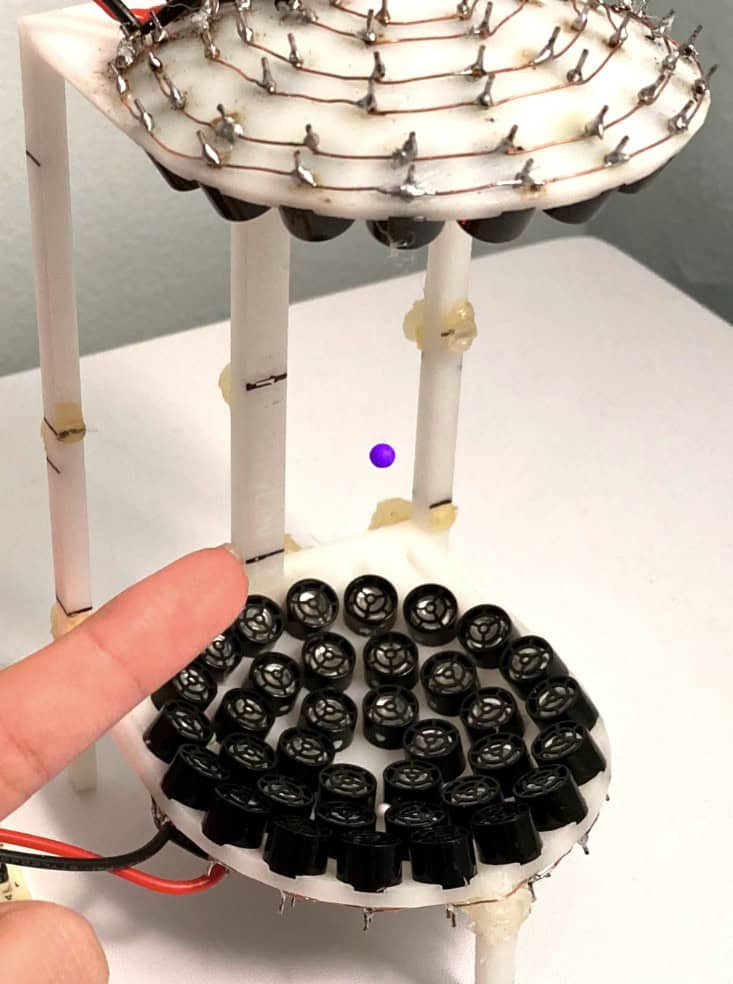
Acoustic tweezers A purple bead is suspended in mid-air by sound waves emanating from the black circular speakers. (Courtesy: NYU’s Center for Soft Matter Research)
Pairs of nonidentical particles trapped in adjacent nodes of a standing wave can harvest energy from the wave and spontaneously begin to oscillate, researchers in the US have shown. What is more, these interactions appear to violate Newton’s third law. The researchers believe their system, which is a simple example of a classical time crystal, could offer an easy way to measure mass with high precision. It might also, they hope, provide insights into emergent periodic phenomena in nature.
Acoustic tweezers use sound waves to create a potential-energy well that can hold an object in place – they are the acoustic analogue of optical tweezers. In the case of a single trapped object, this can be treated as a dissipationless process, in which the particle neither gains nor loses energy from the trapping wave.
In the new work, David Grier of New York University, together with graduate student Mia Morrell and undergraduate Leela Elliott, created an ultrasound standing wave in a cavity and levitated two objects (beads) in adjacent nodes.
“Ordinarily, you’d say ‘OK, they’re just going to sit there quietly and do nothing’,” says Grier; “And if the particles are identical, that’s exactly what’s going to happen.”
Breaking the law
If the two particles differ in size, material or any other property that affects acoustic scattering, they can spontaneously begin to oscillate. Even more surprisingly, this motion appears unconstrained by the requirement that momentum be conserved – Newton’s third law.
“Who ordered that?”, muses Grier.
The periodic oscillation, which has a frequency parametrized only by the properties of the particles and independent of the trapping frequency, forms a very simple type of emergent active matter called a time crystal.
The trio analysed the behaviour of adjacent particles trapped in this manner using the laws of classical mechanics, and discovered an important subtlety had been missed. When identical particles are trapped in nearby nodes, they interact by scattering waves, but the interactions are equal and opposite and therefore cancel.
“The part that had never been worked out before in detail is what happens when you have two particles with different properties interacting with each other,” says Grier. “And if you put in the hard work, which Mia and Leela did, what you find is that to the first approximation there’s nothing out of the ordinary.” At the second order, however, the expansion contains a nonreciprocal term. “That opens up all sorts of opportunities for new physics, and one of the most striking and surprising outcomes is this time crystal.”
Stealing energy
This nonreciprocity arises because, if one particle is more strongly affected by the mutual scattering than the other, it can be pushed farther away from the node of the standing wave and pick up potential energy, which can then be transferred through scattering to the other particle. “The unbalanced forces give the levitated particles the opportunity to steal some energy from the wave that they ordinarily wouldn’t have had access to,” explains Grier. The wave also carries away the missing momentum, resolving the apparent violation of Newton’s third law.
If it were acting in isolation, this energy input would make the oscillations unstable and throw the particles out of the nodes. However, energy is removed by viscosity: “If everything is absolutely right, the rate at which the particles consume energy exactly balances the rate at which they lose energy to viscous drag, and if you get that perfect, delicious balance, then the particles can jiggle in place forever, taking the fuel from the wave and dumping it back into the system as heat.” This can be stable indefinitely.
The researchers have filed a patent application for the use of the system to measure particle masses with microgram-scale precision from the oscillation frequency. Beyond this, they hope the phenomenon will offer insights into emergent periodic phenomena across timescales in nature: “Your neurons fire at kilohertz, but the pacemaker in your heart hopefully goes about once per second,” explains Grier.
“When I read this I got somehow surprised,” says Glauber Silva of The Federal University of Alagoas in Brazil; “The whole thing of how to get energy from the surrounding fields and produce motion of the coupled particles is something that the theoretical framework of this field didn’t spot before.”
“I’ve done some work in the past, both in simulations and in optical systems that are analogous to this, where similar things happen, but not nearly as well controlled as in this particular experiment,” says Dustin Kleckner of University of California, Merced. He believes this will open up a variety of further questions: “What happens if you have more than two? What are the rules? How do we understand what’s going on and can we do more interesting things with it?” he says.
It’s taking too long. It costs too much. Yet it’s not being talked about enough. It’s not historic enough. It’s not safe enough. I’m talking about Artemis. Or at least what a goodly portion of the space community is saying privately or online, replete with sensationalist interviews and even vomit emojis. Let’s take a breath, […]
Sateliot will launch two of its next-generation direct-to-device satellites on a PLD Space rocket in what is billed as the first fully private Spanish mission.
 Connexion