↩ Accueil

Vue normale

Reçu aujourd’hui — 10 mars 2026 6.5 📰 Sciences English

Mulugeta Bekele: the jailed and tortured scientist who kept Ethiopian physics alive

10 mars 2026 à 12:00

Mulugeta Bekele paid a heavy price for remaining in Ethiopia in the 1970s and 1980s. While many other academics had fled their homeland to avoid being targeted by its military rulers, Mulugeta did not. He stayed to teach physics, almost single-handedly keeping it alive in the country. But Mulugeta was arrested and brutally tortured by members of the Derg, Ethiopia’s ruling military junta. “I still have scars,” he says when we meet at his tiny, second-floor office at Addis Ababa University (AAU) in January 2026.

Gentle and softly-spoken, Mulugeta, 79, is formally retired but still active as a research physicist. In 2012 his efforts led to him being awarded the Sakharov prize by the American Physical Society (APS) “for his tireless efforts in defence of human rights and freedom of expression and education anywhere in the world, and for inspiring students, colleagues and others to do the same”.

Mulugeta was born in 1947 near Asela, a small town south of Ethiopia’s capital Addis Ababa. The district had only a single secondary school that depended on volunteer teachers from other countries. One was a US Peace Corps volunteer named Ronald Lee, who taught history, maths and science for two years. Mulugeta recalls Lee as a dramatic and inventive teacher, who would climb trees in physics classes to demonstrate the actions of pulleys and hold special after-school calculus classes for advanced students.

Mulugeta and other Asela students were entranced. So when he entered AAU – then called Haile Selassie 1 University – in 1965, Mulugeta declared he wanted to study both mathematics and physics. Impossible, he was informed; he could do one or the other but not both. “I told myself that if I choose mathematics I will miss physics,” Mulugeta says. “But if I do physics, I will be continually engaged with mathematics.” Physics it was.

At the end of his third year, Mulugeta’s studies appeared in doubt. The university’s only physics teacher was an American named Ennis Pilcher, who was about to return to Union College in Schenectady, New York, after spending a year in Addis on a fellowship from the Fulbright Program. Pilcher, though, managed to convince Union to support Mulugeta so he could travel to the US and study physics there for his final year.

As I talk to Mulugeta, he pulls a dusty book off his shelf. “This was given to me by Pilcher,” he says, pointing to Walter Meyerhof’s classic undergraduate textbook Elements of Nuclear Physics. Mulugeta turns to the inside of the front cover and proudly shows me the inscription: “Mulugeta Bekele, Union College. Schenectady, 1969–1970”.

When Mulugeta returned to AAU in the summer of 1970, he was awarded a BSc in physics. He then received a grant from the US Agency for International Development (USAID) to attend the University of Maryland for a master’s degree. After two more years in the US, Mulugeta returned to Addis Ababa in 1973. As an accomplished researcher and teacher, he was made department chair and began to expand the physics programme at the university.

In the firing line

It was a time when political turmoil was upending Ethiopia, as well as the lives of Mulugeta and many other academics. For centuries the country had been ruled by a dynasty whose present emperor was Haile Selassie. Having come to the throne in 1930, he had tried to reform Ethiopia by bringing it into the League of Nations, drawing up a constitution, and taking measures to abolish slavery.

When fascist Italy invaded Ethiopia in May 1935, Selassie left, spending six years in exile in the UK during the Italian occupation of the country. He returned as emperor in 1941 after British and Ethiopian forces recaptured Addis Ababa. But famine, unemployment and corruption, as well as a brief unsuccessful coup attempt, undermined his rule and made him unexpectedly vulnerable.

While in Maryland, Mulugeta and other Ethiopian students in the US started supporting the Ethiopian People’s Revolutionary Party (EPRP) – a pro-democracy group that sought to build popular momentum against the monarchy. In February 1974 Selassie was deposed by the Derg – a repressive military junta named after the word for “committee” in Amharic, the most widely spoken language in Ethiopia. Selassie was assassinated the following year.
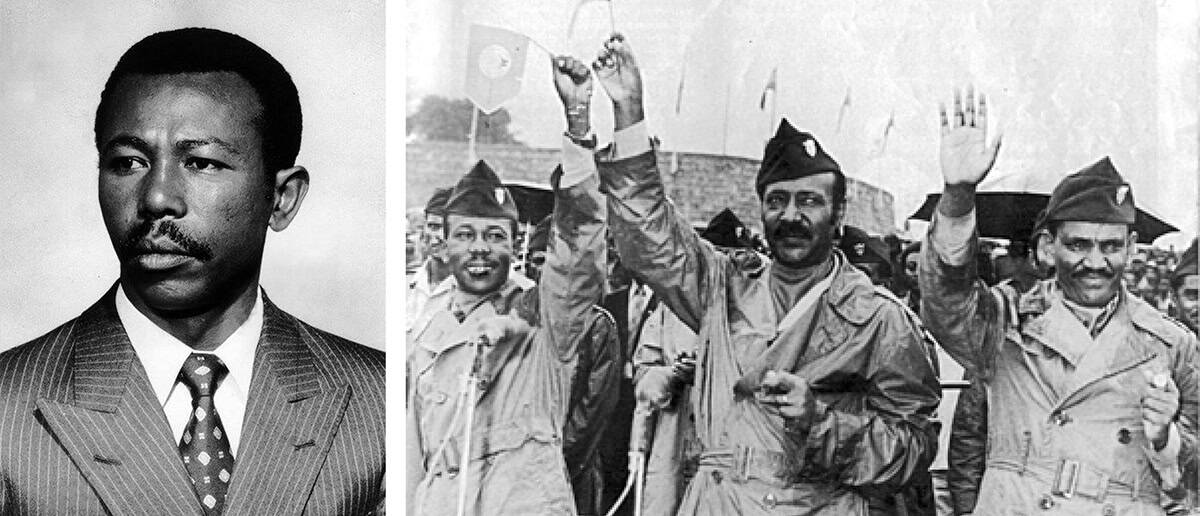
Mengistu Haile Mariam - official portrait plus leaders of the Derg
Ruthless ruler Mengistu Haile Mariam (left) was leader of the Derg military junta and communist dictator in Ethiopia between 1977 and 1991. Mengitsu is also shown (right) with two other senior members of the Derg: Tafari Benti (middle) and Atnafu Abate (right). (Images: Public Domain)

Led by an army officer named Mengistu Haile Mariam, the Derg’s radical totalitarianism was in sharp contrast to the student-led EPRP’s efforts and its agenda included seizing property from landowners. Mulugeta’s family lost all its land, and his father was killed fighting the Derg. “Land ownership was still inequitable,” Mulugeta remarks ruefully, “only the landlords changed.”

In September 1976 the EPRP tried, unsuccessfully, to assassinate Mengistu. The following February, on becoming chairman of Derg – and therefore head of state – Mengistu began ruthlessly to crush any opposition, particularly the EPRP, in what he himself called the “Red terror” campaign of political suppression. About half a million people in Ethiopia were killed.

“It was a police state,” recalls Solomon Bililign, Mulugeta’s then graduate assistant, now a professor of atomic and molecular physics at North Carolina Agricultural and Technical State University. “The police didn’t need any reason to arrest you. They would arrest people openly in the streets, break into homes, and left people dead in roads and parks. Many were tortured; others simply disappeared.”

Captured and tortured

Mulugeta himself was a target. In the summer of 1977, a policeman showed up at his office with an informant. Mulugeta was arrested and imprisoned for his role in helping to organize anti-Derg activities, as was Bililign. Mulugeta still recalls exactly how long he was jailed for: “Eight months and 20 days”.

After his release, Mulugeta knew it would be unsafe to stay in Addis and lived in hiding for several months. So he devised a plan to travel 500 km north to a holdout region not controlled by the Derg. However, while using a fake ID to pass through checkpoints to reach a compatriot, he was betrayed again, captured, and taken back to Addis.

Mulugeta was savagely tortured using a method that the Derg meted out on thousands of other prisoners.

En route to Addis, he managed to steal back the fake ID that he’d been using from the pocket of the policeman travelling with him. He then tore it up to shield the identity of his compatriot, and tossed the pieces into a toilet. But the policeman noticed and retrieved the pieces. Mulugeta was then savagely tortured using a method that the Derg meted out on thousands of other prisoners. His arms and legs were tied around a pole, and he was hung in the foetal position between two chairs, upside down. His feet were then beaten until he could no longer walk.

Mulugeta was sent to Maekelawi, an infamous jail in Addis, in which up to 70 prisoners could be jammed in rooms each barely four metres long and four metres wide. Inmates were tortured without warning, could not have visitors, never had trials, were denied books and paper, and at night heard screams from periodic executions. Mulugeta helped those who were beaten by tending to their wounds.

“People who knew him in prison told me that his mental strength helped all of them endure,” remembers Mesfin Tsige, an undergraduate student of Mulugeta at the time, who is now a polymer physicist at the University of Akron in Ohio. Despite the awful conditions, Mulugeta managed to continue working on physics by surreptitiously taking paper from the foil linings of cigarette packets to compose problems.

Mulugeta, Bililign and Mekonnen
Happier times Mulugeta Bekele (front centre in the white top), Solomon Bililign (next to him in the purple shirt) and Nebiy Mekonnen (back row, with the hat) pictured with their family and friends. All three were incarcerated together at the notorious Maekelawi prison.

Another prisoner was Nebiy Mekonnen, a chemistry student of Mulugeta. Later a gifted artist, translator and newspaper editor, Mekonnen began translating the US writer Margaret Mitchell’s classic 1936 book Gone with the Wind into Amharic. It was the one book that the Maekelawi prisoners had in their hands, having retrieved it from the possessions of someone who had been executed.

Surreptitiously writing his translation onto the foil linings of cigarette packets, Mekonnen would read passages to fellow prisoners in the evening for what passed for entertainment. Mekonnen’s translation of Mitchell’s almost 1000-page book was recorded onto 3000 of the linings, which were then smuggled out of the prison stuffed in tobacco pouches and published years later.

Gone with the Wind might seem a strange choice to translate, but as Mulugeta reminds me: “It was the only book we had at the time”. More smuggled books did eventually arrive at the prison, but Gone with the Wind, which describes life in a war-torn country, has several passages that resonated with prisoners. One was: “In the end what will happen will be what has happened whenever a civilization breaks up. The people with brains and courage come through and the ones who haven’t are winnowed out.”

Release and recapture

In 1982, Mulugeta was moved to Kerchele, another prison. There, as at Maekelawi, inmates were forced to listen to Mengistu’s pompous speeches on radio and TV. During one Mengistu pontificated that he would turn prisons into places of education. A clever inmate, knowing that the prison wardens were also cowering in terror, proposed that Kerchele establish a school with the prisoners as teachers.

The wardens found this a great idea, not least because it let them show off their loyalty to Mengistu. The Kerchele prisoners were promptly put to work erecting a schoolhouse of half a dozen rooms out of asbestos slabs. Unlike schools in the rest of Ethiopia, the Kerchele prison school was not short of teachers, as the prisoners included a wide range of professionals, such as architects, scientists and engineers.

Students included prison guards and their families, along with numerous inmates who had been jailed for non-political reasons. Mulugeta and Bililign taught physics. “It was therapy for us,” Bililign says – and the school was soon known as one of the best in Ethiopia.

When I ask Mulugeta how he maintained his interest in physics in jail, despite being locked up for so many years, he becomes animated.

When I ask Mulugeta how he maintained his interest in physics in jail, despite being locked up for so many years, he becomes animated. “In those days, prisons were full of ideas,” he smiles. “We were university students, university teachers. We had a cause. It was exciting. Intellectually, we flourished.”

In the summer of 1985 Mulugeta was released. Many colleagues were not. “They were given release papers and as they left the building, one by one, they were strangled. I had a tenth-grade student who was one of the best; he didn’t make it. There were plenty of stories like this.” Mulugeta pauses. “Somehow we survived. But not them.”

Mulugeta returned to the university, now renamed from Haile Selassie University to Addis Ababa University, and started teaching physics full time. As the Derg was in full control no opposition was possible except in outer regions of Ethiopia. In summer 1991, after Mulugeta had taught physics for another six years, political turmoil erupted yet again.

Mengistu was overthrown that May by a political coalition representing pro-democracy groups from five of Ethiopia’s ethnic regions, the Ethiopian People’s Revolutionary Democratic Front (EPRDF). But ethnic tensions rose and human rights violations continued. “Even though the Derg was overthrown,” Mulugeta recalls, “we knew we were entering another dark age.”

In the same year Mulugeta was put in touch with a Swedish programme seeking to build networks of scientists across countries in the southern hemisphere. Mulugeta knew a physicist from Bangalore, India, who had visited Addis twice as an examiner for his master’s programme and arranged to work with him for his PhD.

That July, Mulugeta married Malefia, who worked in the university’s registrar office, and the two left for Bangalore. As a wedding present, his student Mekonnen painted a picture of two hands coming together, each with a ring on a finger, against a black Sun in the background. “Two rings, in the time of a dark sun” Mekonnen’s caption read, “Happy marriage!” Mulugeta still has the painting.

Mulugeta thrived in Bangalore. Here, he was finally able to combine his two loves, physics and maths, studying statistical physics and stochastic processes and applying them to issues in non-equilibrium thermodynamics. He has worked in that field ever since. He received his PhD in 1998 from the Indian Institute of Science in Bangalore and returned to Addis once more to teach.

Shortly after Mulugeta’s return from Bangalore to Ethiopia in August 1998, some of his former students formed the Ethiopian Physical Society, electing him as its first president. Other students of his who had taken positions in the US created the Ethiopian Physical Society of North America (EPSNA), formally established in 2008. Bililign organized and convened its first meeting.

In 2007, Philip Taylor, a soft-condensed-matter physicist from Case Western Reserve University in the US, who had been Tsige’s PhD supervisor, heard the story of Mulugeta’s imprisonment. Astonished, he spearheaded the successful 2012 application for Mulugeta to receive the APS’s Sakharov prize, which is given every two years to physicists who have displayed “outstanding leadership and achievements of scientists in upholding human rights”.
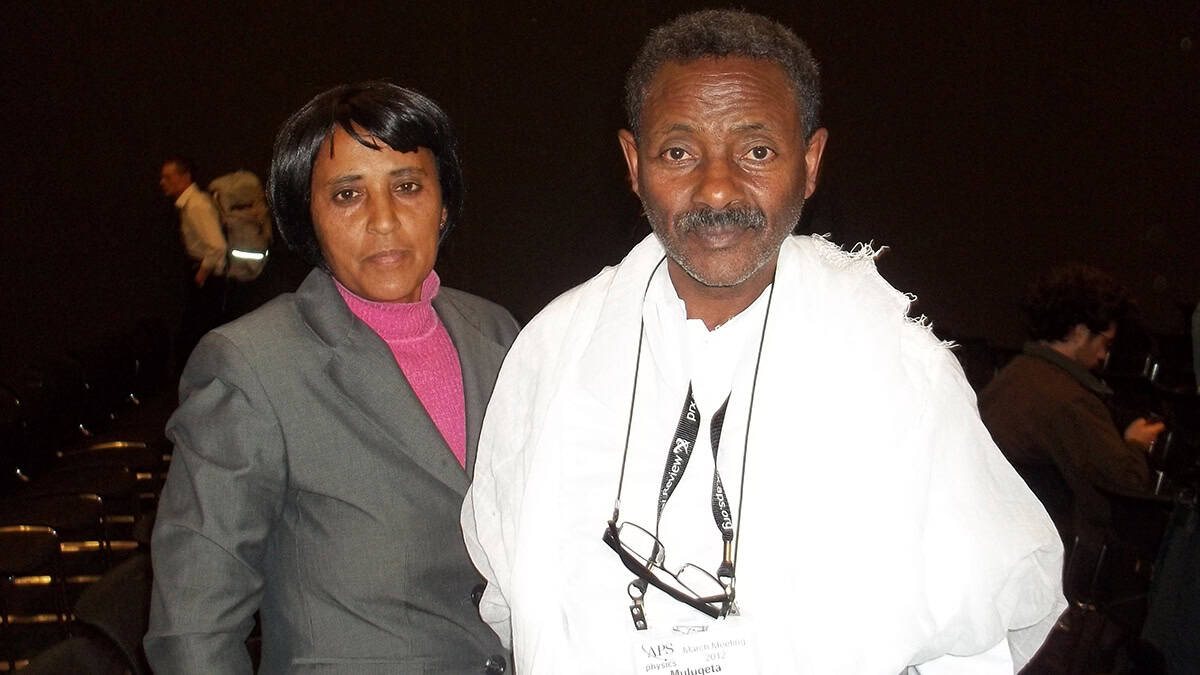
Mulugeta Bekele with his wife Malefia
Honoured figure Mulugeta Bekele with his wife Malefia at the March 2012 meeting of the American Physical Society in Boston, where he was awarded the Sakharov medal for his “tireless efforts in defence of human rights and freedom of expression”. (Courtesy: Solomon Bililign)

Unsure that he would receive travel funds to attend a special award ceremony at that year’s APS March meeting in Boston, the EPSNA raised money for Mulugeta and his wife to attend. Jetlagged, worn out by the cold, and somewhat overwhelmed by the attention, Mulugeta could not be found as the ceremony began. EPSNA members tracked him down to his hotel room, where he was dressing in traditional Ethiopian clothes for the occasion – all white from head to toe, including shoes.

Under a dark Sun

In recent years, Mulugeta has continued to teach and collaborate with students and former students, publishing in a wide range of journals, as well as helping out with the Ethiopian Physical Society. But while I was in Ethiopia to talk to Mulugeta at the start of 2026, the Trump administration curtailed immigrant visas from Ethiopia and almost half of all nations in Africa supposedly in an attempt to “protect the security of the United States”. A few months before, it had imposed a $100,000 fee on work visas, all but preventing US universities from hiring non-US citizens. It killed the USAID programme that had once sent Mulugeta to the US for his master’s degree.

The Trump administration has also withdrawn the US from international scientific organizations, conventions and panels, and has gutted the most important US scientific agencies. These and other measures are destroying the networks of international physics collaborations of the kind that Mulugeta both promoted and benefited from – networks that nurture education, careers and knowledge.

“We are not yet in good hands,” Mulugeta warns me as I start to leave. “We are,” he says, “still under the dark Sun.”

The post Mulugeta Bekele: the jailed and tortured scientist who kept Ethiopian physics alive appeared first on Physics World.

Meridian Space Diplomacy Forum & Executive Space Training – March 25 & 26

Par : Meridian
9 mars 2026 à 22:52

Washington, D.C. — Meridian International Center today announced the return of its Space Diplomacy Forum: Shared Horizons (https://diplomacyforum.meridian.org/space), a half-day forum dedicated to advancing cooperation in outer space at a […]

The post Meridian Space Diplomacy Forum & Executive Space Training – March 25 & 26 appeared first on SpaceNews.

Reçu hier — 9 mars 2026 6.5 📰 Sciences English

Condensed-matter physics pioneer and Nobel laureate Anthony Leggett dies aged 87

9 mars 2026 à 17:26

The British-American theoretical physicist Anthony Leggett died on 8 March at the age of 87. Leggett shared the 2003 Nobel Prize in Physics with Alexei Abrikosov and Vitaly Ginzburg for their “pioneering contributions to the theory of superconductors and superfluidity”.

Born on 26 March 1938 in London, UK, Leggett graduated in literae humaniores (classical languages and literature, philosophy and Greco-Roman history) at the University of Oxford in 1959.

While philosophy was Leggett’s strongest subject, he did not envisage a career as a philosopher because he felt that the subject depended more on turns of phrase than objective criteria.

As part of an experiment at Balliol College, Oxford, to see if it was possible to convert a classicist with minimal qualifications in maths and science into a physicist, Leggett was awarded a degree in physics in 1961.

Leggett then embarked on a DPhil in physics, which he completed at Oxford in 1964, followed by postdocs at the University of Illinois Urbana-Champaign in the US and Kyoto University, Japan.

In 1967 he moved back to the UK, spending the next 15 years at Sussex University. It was at Sussex that he carried out his Nobel-prize-winning work on the theory of superfluidity – the ability of a fluid to flow without viscosity.

Superfluidity in helium-4 was discovered in the 1930s, and in the 1960s several theorists predicted that helium-3 might also be a superfluid.

However, the two forms of helium are fundamentally different. Helium-4 atoms are bosons and can all condense into the same quantum ground state at low enough temperatures – an essential feature of both superfluidity and superconductivity.

Helium-3 atoms, on the other hand, are fermions and the Pauli exclusion principle prevents them from entering such a quantum state.

Electrons, which are also fermions, overcome this problem by forming Cooper pairs as described by the BCS theory of superconductivity that was developed in the mid-1950s by John Bardeen, Leon Cooper and Robert Schrieffer.

Theorists predicted that helium-3 atoms could do something similar and in 1972 superfluidity in helium-3 was finally observed at Cornell University – a feat that earned David Lee, Douglas Osheroff and Robert Richardson the 1996 Nobel Prize in Physics.

Yet many of the results puzzled theorists. In particular there were three different superfluid phases, and the results of nuclear magnetic resonance experiments on the samples could not be explained.

Leggett showed that these results could be explained by the spontaneous breaking of various symmetries in the superfluid and for the work he was awarded a third of the 2003 Nobel Prize in Physics, with Abrikosov and Ginzburg being honoured for their work on type-II superconductors.

A life in science

In 1983 Leggett moved to the University of Illinois at Urbana-Champaign where he remained for the rest of his career until retiring in 2019. There he focussed on problems in high-temperature superconductivity, superfluidity in quantum gases and the fundamentals of quantum mechanics.

In 1998 he was elected an Honorary Fellow of the Institute of Physics and in 2004 was appointed Knight Commander of the Order of the British Empire (KBE) “for services to physics”. In 2023 the Institute for Condensed Matter Theory at the University of Illinois at Urbana-Champaign was renamed the Sir Anthony Leggett Institute.

As well as the Nobel prize, Leggett won many other awards including the 2002 Wolf Prize for physics. He also published two books: The Problems of Physics (Oxford University Press, 1987) and Quantum Liquids (Oxford University Press, 2006).

Peter McClintock from Lancaster University, who has carried out work in superfluidity, says he is “very sad” to hear the news. “[Leggett] was a brilliant physicist whose genius was to comprehend underlying mechanisms and processes and explain their physical essence in comprehensible ways,” says McClintock. “My dominant memory is of the discovery of the superfluid phases of helium-3 and of the way in which [Leggett] was able to interpret each new item of experimental information and slot it into a nascent theoretical framework to build up a coherent picture of what was going on – while always enumerating the remaining loose ends and possible alternative explanations.”

In a statement, Makoto Gonokami, president of the RIKEN labs in Japan, also expressed that he is “deeply saddened” by the news and that Leggett had “provided warm support for researchers in Japan” through his many trips to the country.

“Leggett made pioneering contributions to our understanding of how quantum mechanics manifests itself in macroscopic matter [and] his theoretical work on superfluid helium-3 provided profound insights into quantum order in strongly interacting fermionic systems,” notes Gonokami. “His work significantly advanced the study of quantum condensed matter and macroscopic quantum coherence.”

The post Condensed-matter physics pioneer and Nobel laureate Anthony Leggett dies aged 87 appeared first on Physics World.

Physicists identify unexpected quantum advantage in a permutation parity task

9 mars 2026 à 17:14

Imagine all the different ways you can rearrange a list of labelled items. If you know only a tiny fraction of the labels describing the elements of the list, it’s easy to assume you have almost no information about the order of the list as a whole under permutations. After all, if you shuffle a large deck of cards and then hide most of the labels on the cards, how could anyone possibly tell what permutations you made?

Recent theoretical work by physicists at Universitat Autonoma de Barcelona (UAB), Spain, and Hunter College of the City University of New York (CUNY), US, reveals that this intuition can fail in surprising ways, hinting at deep links between information, symmetry and computation. Specifically, the UAB-CUNY team found that quantum mechanics plays a key role in preserving parity – a global property of a permutation – even when most local information is erased.

An impressive parity identification

Imagine a clever magician named Alice. She hands you a stack of n coloured disks in a known order and leaves the room while you shuffle them. When she returns, she asks: “Can I tell how you permuted the disks?”

If every disk has its own unique label, the answer is obviously “yes”. But if Alice removes some of the labels, she can pose a subtler challenge: “Can I at least tell whether your shuffle swapped the positions of the cards an even or odd number of times?”

Classically, the answer is “no”. With fewer labels than disks, some labels must be repeated. Swapping two disks with the same label leaves the observed configuration unchanged, yet flips the parity of the underlying permutation. As a result, determining parity with certainty requires one unique label per disk. Anything less, and the information is fundamentally lost.

Quantum mechanics changes this conclusion. In their paper, which is published in Physical Review Letters, UAB’s Arnau Diebra and colleagues showed that as long as there are at least √n labels, far fewer than the total number of disks, one can still determine the parity of any permutation applied to the system when the game follows the rules of quantum mechanics. The problem remains the same; the only difference is that we are now preparing our initial state as a quantum state. In other words, even when most of the detailed information about individual elements is erased, a global feature of the transformation survives and exploiting quantum features makes it possible to extract it with carefully chosen information. This is not sleight of hand: it is a genuine mathematical insight into how much information certain global properties retain under massive data reduction.

Quantum advantage

In the field of quantum science, it’s common to ask whether quantum systems can outperform classical ones at specific tasks, a phenomenon known as quantum advantage. Here, “advantage” does not necessarily mean doing everything faster, but rather the ability to solve carefully chosen problems using fewer resources such as time, memory or information. Notable examples include quantum algorithms that factor large numbers more efficiently than any known classical method, and quantum communication protocols that achieve tasks that would be impossible with classical correlations alone.

The parity-identification problem fits naturally into this landscape. Parity is a global property, insensitive to most local details. In this respect, it resembles many other quantities studied in quantum physics, from topological invariants to entanglement measures.

What makes quantum advantage possible in this problem is entanglement – and lots of it. A compound quantum system is said to be entangled when its subsystems are correlated in a nonclassical way. A simple example might be a pair of qubits (quantum bits) for which measuring the state of one qubit gives you information about the state of the other in a way that cannot be reproduced by any classical correlation. In their work, the UAB-CUNY physicists used a geometric measure of entanglement: the “distance” between the state of the system and a state in which all subsystems are separable (that is, not entangled). If this distance is too short, the protocol fails entirely.

The crucial point is that entanglement allows information about the permutation to be stored in genuinely nonlocal correlations among particles (the “cards” in the deck), rather than in properties of each particle/card individually. In effect, the “memory” needed to identify the parity is written into the joint quantum state. No single particle carries the answer, but the system as a whole does. This is precisely what classical systems cannot replicate: once local labels are lost, there is nowhere left for the information to hide.

Can one do better than √n ?

The fact that the threshold for quantum advantage scales with √n  is one of the most intriguing aspects of the work. At present, the reason for this remains an open question. While Diebra and colleagues emphasize that the scaling is provably optimal within quantum mechanics, they acknowledge that a more intuitive or fundamental explanation is still missing. Finding such an explanation could illuminate broader principles governing how quantum systems compress and protect global information.

While the parity-identification problem has no immediate known applications, understanding how properties can be inferred from limited information is also crucial when dealing with realistic quantum devices, where noise, decoherence and imperfect measurements severely restrict what information can be accessed. Results like this therefore suggest that some computational or informational tasks may remain feasible even when our view of the system is drastically incomplete.

Speaking more broadly, the conceptual implications of proving new examples quantum advantage are clear: even for extremely simple inference tasks, quantum strategies can outperform classical ones in unexpected and qualitative ways. The result therefore provides a clean testing ground for deeper questions about quantum resources, symmetry and information compression. Which specific features of entanglement are responsible for the advantage? Can similar thresholds be found for other groups or more complex symmetries? And does the square-root scaling reflect a universal principle?

For now, the work serves as a reminder that – even decades into the development of quantum information theory – basic questions about how information is stored, hidden, and revealed in quantum systems can still produce genuine surprises.

The post Physicists identify unexpected quantum advantage in a permutation parity task appeared first on Physics World.

GNSS resilience is an economic and security priority

9 mars 2026 à 14:00

Modern society has become profoundly reliant on Global Navigation Satellite Systems (GNSS). These systems support aviation safety, emergency services, finance, communications, energy networks and an expanding array of autonomous and industrial systems. Yet despite this reliance, GNSS remains inherently fragile: low‑power signals transmitted from medium Earth orbit are surprisingly easy to degrade, and the consequences […]

The post GNSS resilience is an economic and security priority appeared first on SpaceNews.

Long-distance quantum sensor network advances the search for dark matter

9 mars 2026 à 10:00

A new of way of searching for dark-matter candidate particles called axions has produced the tightest constraint yet on how they can interact with normal matter. Using a two-city network of quantum sensors based on nuclear spins, physicists in China narrowed the possible values of a parameter known as axion-nucleon coupling below a limit previously set by astrophysical observations. As well as insights on the nature of dark matter, the technique could aid investigations of other beyond-the-Standard-Model physics phenomena such as axion stars, axion strings and Q-balls.

Dark matter is thought to make up over 25% of the universe’s mass, but it has never been detected directly. Instead, we infer its existence from its gravitational interactions with visible matter and its effect on the large-scale structure of the universe.

While the Standard Model of particle physics does not incorporate dark matter, several physicists have proposed ideas for how to bring it into the fold. One of the most promising involves particles called axions. First hypothesized in the 1970s as a way of explaining unresolved questions about charge-parity violation, axions are chargeless and much less massive than electrons. This means they interact only weakly with matter and electromagnetic radiation.

According to theoretical calculations, the Big Bang should have produced axions in abundance. During phase transitions in the early universe, these axions would have formed topological defects – defects that study leader Xinhua Peng of the University of Science and Technology of China (USTC) says should, in principle, be detectable. “These defects are expected to interact with nuclear spins and induce signals as the Earth crosses them,” Peng explains.

A new axion search method

The problem, Peng continues, is that such signals are expected to be extremely weak and transient. She and her colleagues therefore developed an alternative axion search method that exploits a different predicted behaviour.

When fermions (particles with half-integer spin) interact, or couple, with axions, they should produce a pseudo-magnetic field. Peng and colleagues looked for evidence of this interaction using a network of five quantum sensors, four in Hefei and one in Hangzhou. These sensors combined a large ensemble of polarized rubidium-87 (87Rb) atoms with polarized xeon-129 (129Xe) nuclear spins.

“Using nuclear spins has many advantages,” Peng explains. “These include a higher energy resolution detection for topological dark matter (TDM) axions thanks to a much smaller gyromagnetic ratio of nuclear spins; substantial spin amplification owing to the high ensemble density of noble-gas spins; and efficient optimal filtering enabled by the long nuclear-spin coherence time.”

The USTC researchers’ setup also has other advantages over previous laboratory-based TDM searches, including the Global Network of Optical Magnetometers for Exotic physics searches (GNOME). While GNOME operates in a steady-state detection mode, the USTC researchers use a detection scheme that probes transient “free-decay oscillating” signals generated on spins after a TDM crossing. The USTC team also implemented a dual-phase optimal filtering algorithm to extract TDM signals with a signal-to-noise ratio at the theoretical maximum.

Peng tells Physics World that these advantages enabled the team to explore regions of TDM parameter space well beyond limits set by astrophysical searches. The transient-state detection scheme also enables sensitive searches for TDM in the region where the axion mass exceeds 100 peV – a region that GNOME cannot access.

Most stringent constraints

The researchers have not yet recorded a statistically significant topological crossing event using their setup, so the dark matter search is not over. However, they have set more stringent constraints on axion-nucleon coupling across a range of axion masses from 10 peV to 0.2 μeV. Notably, they calculated that the coupling strength must be greater than 4.1 x 10¹⁰ GeV at an axion mass of 84 peV. This limit is stricter than those obtained from astrophysical observations, though Peng notes that these rely on different assumptions.

Peng says the technique developed in this study, which is published in Nature, could lead to the development of even larger, more sensitive networks for detecting transient spin signals such as those from TDM. It also opens new avenues for investigating other physical phenomena beyond the Standard Model that have been theoretically proposed, but have so far lacked a pathway for experimental exploration.

The researchers now plan to increase the number of sensor stations in their network and extend their geographical baselines to intercontinental and even space-based scales. Peng explains that doing so will enhance the network’s detection sensitivity and boost signal confidence. “We also want to enhance the sensitivity of individual sensors via better spin polarization, longer coherence times and advanced quantum control techniques,” she says. Switching to a ³He–K system, she adds, could boost their current spin-rotation sensitivity by up to four orders of magnitude.

The post Long-distance quantum sensor network advances the search for dark matter appeared first on Physics World.

Reçu — 8 mars 2026 6.5 📰 Sciences English
❌