One thing I can say for sure that I got from working in academia is the ability to quickly read, summarize and internalize information from a bunch of sources. Journalism requires a lot of that. Being able to skim through papers – reading the abstract, reading the conclusion, picking the right bits from the middle and so on – that is a life skill.
In terms of other skills, I’m always considering who’s consuming what I’m doing rather than just thinking about how I’d like to say something. You have to think about how it’s going to be received – what’s the person on the street going to hear? Is this clear enough? If I were hearing this for the first time, would I understand it? Putting yourself in someone else’s shoes – be it the listener, reader or viewer – is a skill I employ every day.
What do you like best and least about your job?
The best thing is the variety. I ended up in this business and not in scientific research because of a desire for a greater breadth of experience. And boy, does this job have it. I get to talk to people around the world about what they’re up to, what they see, what it’s like, and how to understand it. And I think that makes me a much more informed person than I would be had I chosen to remain a scientist.
When I did research – and even when I was a science journalist – I thought “I don’t need to think about what’s going on in that part of the world so much because that’s not my area of expertise.” Now I have to, because I’m in this chair every day. I need to know about lots of stuff, and I like that feeling of being more informed.
I suppose what I like the least about my job is the relentlessness of it. It is a newsy time. It’s the flip side of being well informed, you’re forced to confront lots of bad things – the horrors that are going on in the world, the fact that in a lot of places the bad guys are winning.
What do you know today that you wish you knew when you were starting out in your career?
When I started in science journalism, I wasn’t a journalist – I was a scientist pretending to be one. So I was always trying to show off what I already knew as a sort of badge of legitimacy. I would call some professor on a topic that I wasn’t an expert in yet just to have a chat to get up to speed, and I would spend a bunch of time showing off, rabbiting on about what papers I’d read and what I knew, just to feel like I belonged in the room or on that call. And it’s a waste of time. You have to swallow your ego and embrace the idea that you may sound like you don’t know stuff even if you do. You might sound dumber, but that’s okay – you’ll learn more and faster, and you’ll probably annoy people less.
In journalism in particular, you don’t want to preload the question with all of the things that you already know because then the person you’re speaking to can fill in those blanks – and they’re probably going to talk about things you didn’t know you didn’t know, and take your conversation in a different direction.
It’s one of the interesting things about science in general. If you go into a situation with experts, and are open and comfortable about not knowing it all, you’re showing that you understand that nobody can know everything and that science is a learning process.
Physicists working on the Antihydrogen Laser Physics Apparatus (ALPHA) experiment at CERN have trapped and accumulated 15,000 antihydrogen atoms in less than 7 h. This accumulation rate is more than 20 times the previous record. Large ensembles of antihydrogen could be used to search for tiny, unexpected differences between matter and antimatter – which if discovered could point to physics beyond the Standard Model.
According to the Standard Model every particle has an antimatter counterpart – or antiparticle. It also says that roughly equal amounts of matter and antimatter were created in the Big Bang. But, today there is much more matter than antimatter in the visible universe, and the reason for this “baryon asymmetry” is one of the most important mysteries of physics.
The Standard Model predicts the properties of antiparticles. An antiproton, for example, has the same mass as a proton and the opposite charge. The Standard Model also predicts how antiparticles interact with matter and antimatter. If physicists could find discrepancies between the measured and predicted properties of antimatter, it could help explain the baryon asymmetry and point to other new physics beyond the Standard Model.
Powerful probe
Just as a hydrogen atom comprises a proton bound to an electron, an antihydrogen antiatom comprises an antiproton bound to an antielectron (positron). Antihydrogen offers physicists several powerful ways to probe antimatter at a fundamental level. Trapped antiatoms can be released in freefall to determine if they respond to gravity in the same way as atoms. Spectroscopy can be used to make precise measurements of how the electromagnetic force binds the antiproton and positron in antihydrogen with the aim of finding differences compared to hydrogen.
So far, antihydrogen’s gravitational and electromagnetic properties appear to be identical to hydrogen. However, these experiments were done using small numbers of antiatoms, and having access to much larger ensembles would improve the precision of such measurements and could reveal tiny discrepancies. However, creating and storing antihydrogen is very difficult.
Today, antihydrogen can only be made in significant quantities at CERN in Switzerland. There, a beam of protons is fired at a solid target, creating antiprotons that are then cooled and stored using electromagnetic fields. Meanwhile, positrons are gathered from the decay of radioactive nuclei and cooled and stored using electromagnetic fields. These antiprotons and positrons are then combined in a special electromagnetic trap to create antihydrogen.
This process works best when the antiprotons and positrons have very low kinetic energies (temperatures) when combined. If the energy is too high, many antiatoms will be escape the trap. So, it is crucial that the positrons and antiprotons to be as cold as possible.
Sympathetic cooling
Recently, ALPHA physicists have used a technique called sympathetic cooling on positrons, and in a new paper they describe their success. Sympathetic cooling has been used for several decades to cool atoms and ions. It originally involved mixing a hard-to-cool atomic species with atoms that are relatively easy to cool using lasers. Energy is transferred between the two species via the electromagnetic interaction, which chills the hard-to-cool atoms.
The ALPHA team used beryllium ions to sympathetically cool positrons to 10 K, which is five degrees colder than previously achieved using other techniques. These cold positrons boosted the efficiency of the creation and trapping of antihydrogen, allowing the team to accumulate 15,000 antihydrogen atoms in less than 7 h. This is more than a 20-fold improvement over their previous record of accumulating 2000 antiatoms in 24 h.
Science fiction
“These numbers would have been considered science fiction 10 years ago,” says ALPHA spokesperson Jeffrey Hangst, who is a Denmark’s Aarhus University.
Team member Maria Gonçalves, a PhD student at the UK’s Swansea University, says, “This result was the culmination of many years of hard work. The first successful attempt instantly improved the previous method by a factor of two, giving us 36 antihydrogen atoms”.
The effort was led by Niels Madsen of the UK’s Swansea University. He enthuses, “It’s more than a decade since I first realized that this was the way forward, so it’s incredibly gratifying to see the spectacular outcome that will lead to many new exciting measurements on antihydrogen”.
It is book week here at Physics World and over the course of three days we are presenting conversations with the authors of three fascinating and fun books about physics. Today, my guest is the physicist Daniel Whiteson, who along with the artist Andy Warner has created the delightful book Do Aliens Speak Physics?.
Is physics universal, or is it shaped by human perspective? This will be a very important question if and when we are visited by an advanced alien civilization. Would we recognize our visitors’ alien science – or indeed, could a technologically-advanced civilization have no science at all? And would we even be able to communicate about science with our alien guests?
Whiteson, who is a particle physicist at the University of California Irvine, tackles these profound questions and much more in this episode of the Physics World Weekly podcast.
This episode is supported by the APS Global Physics Summit, which takes place on 15–20 March, 2026, in Denver, Colorado, and online.
It is book week here at Physics World and over the course of three days we are presenting conversations with the authors of three fascinating and fun books about physics. First up is my Physics World colleague Michael Banks, whose book Physics Around the Clock: Adventures in the Science of Everyday Living starts with your morning coffee and ends with a formula for making your evening television viewing more satisfying.
As well as the rich physics of coffee, we chat about strategies for finding the best parking spot and the efficient boarding of aeroplanes. If you have ever wondered why a runner’s ponytail swings from side-to-side when they reach a certain speed – we have the answer for you.
Other daily mysteries that we explore include how a hard steel razor blade can be dulled by cutting relatively soft hairs and why quasiparticles called “jamitons” are helping physicists understand the spontaneous appearance of traffic jams. And a warning for squeamish listeners, we do talk about the amazing virus-spreading capabilities of a flushing toilet.
This episode is supported by the APS Global Physics Summit, which takes place on 15–20 March, 2026, in Denver, Colorado, and online.
“Global collaborations for European economic resilience” is the theme of SEMICON Europa 2025. The event is coming to Munich, Germany on 18–21 November and it will attract 25,000 semiconductor professionals who will enjoy presentations from over 200 speakers.
The TechARENA portion of the event will cover a wide range of technology-related issues including new materials, future computing paradigms and the development of hi-tech skills in the European workface. There will also be an Executive Forum, which will feature leaders in industry and government and will cover topics including silicon geopolitics and the use of artificial intelligence in semiconductor manufacturing.
SEMICON Europa will be held at the Messe München, where it will feature a huge exhibition with over 500 exhibitors from around the world. The exhibition is spread out over three halls and here are some of the companies and product innovations to look out for on the show floor.
Accelerating the future of electro-photonic integration with SmarAct
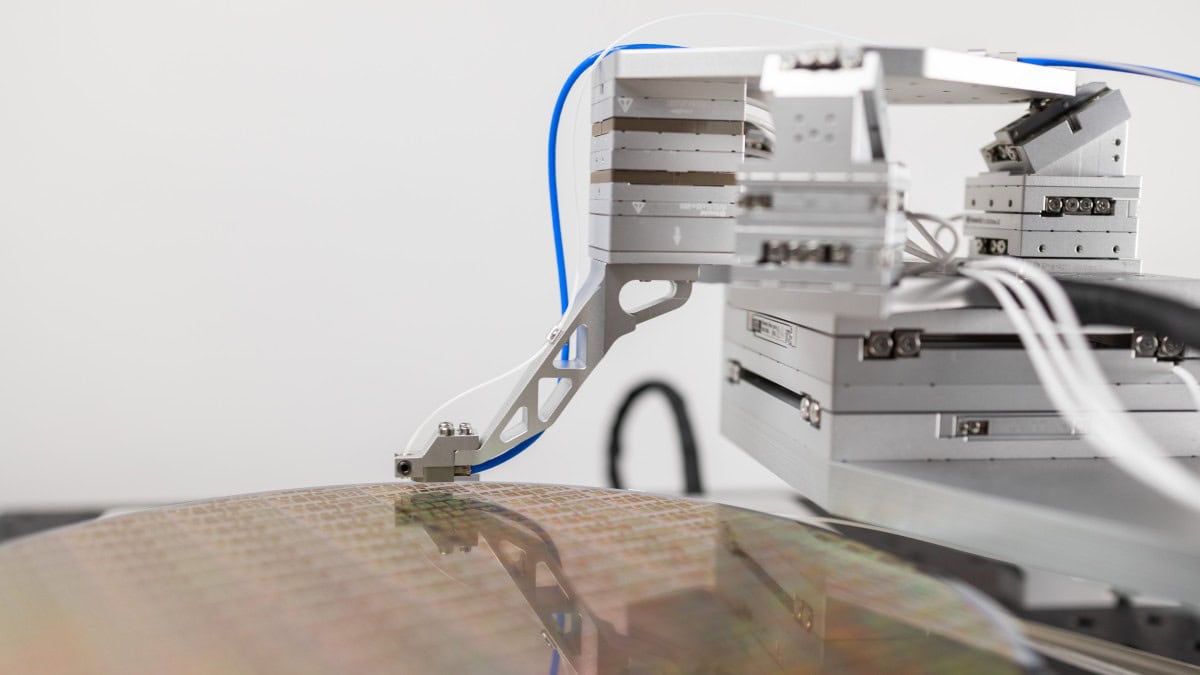
As the boundaries between electronic and photonic technologies continue to blur, the semiconductor industry faces a growing challenge: how to test and align increasingly complex electro-photonic chip architectures efficiently, precisely, and at scale. At SEMICON Europa 2025, SmarAct will address this challenge head-on with its latest innovation – Fast Scan Align. This is a high-speed and high-precision alignment solution that redefines the limits of testing and packaging for integrated photonics.
Fast Scan Align SmarAct’s high-speed and high-precision alignment solution redefines the limits of testing and packaging for integrated photonics. (Courtesy: SmarAct)
In the emerging era of heterogeneous integration, electronic and photonic components must be aligned and interconnected with sub-micrometre accuracy. Traditional positioning systems often struggle to deliver both speed and precision, especially when dealing with the delicate coupling between optical and electrical domains. SmarAct’s Fast Scan Align solution bridges this gap by combining modular motion platforms, real-time feedback control, and advanced metrology into one integrated system.
At its core, Fast Scan Align leverages SmarAct’s electromagnetic and piezo-driven positioning stages, which are capable of nanometre-resolution motion in multiple degrees of freedom. Fast Scan Align’s modular architecture allows users to configure systems tailored to their application – from wafer-level testing to fibre-to-chip alignment with active optical coupling. Integrated sensors and intelligent algorithms enable scanning and alignment routines that drastically reduce setup time while improving repeatability and process stability.
Fast Scan Align’s compact modules allow various measurement techniques to be integrated with unprecedented possibilities. This has become decisive for the increasing level of integration of complex electro-photonic chips.
Apart from the topics of wafer-level testing and packaging, wafer positioning with extreme precision is as crucial as never before for the highly integrated chips of the future. SmarAct’s PICOSCALE interferometer addresses the challenge of extreme position by delivering picometer-level displacement measurements directly at the point of interest.
When combined with SmarAct’s precision wafer stages, the PICOSCALE interferometer ensures highly accurate motion tracking and closed-loop control during dynamic alignment processes. This synergy between motion and metrology gives users unprecedented insight into the mechanical and optical behaviour of their devices – which is a critical advantage for high-yield testing of photonic and optoelectronic wafers.
Visitors to SEMICON Europa will also experience how all of SmarAct’s products – from motion and metrology components to modular systems and up to turn-key solutions – integrate seamlessly, offering intuitive operation, full automation capability, and compatibility with laboratory and production environments alike.
Optimized pressure monitoring: Efficient workflows with Thyracont’s VD800 digital compact vacuum meters
Thyracont Vacuum Instruments will be showcasing its precision vacuum metrology systems in exhibition hall C1. Made in Germany, the company’s broad portfolio combines diverse measurement technologies – including piezo, Pirani, capacitive, cold cathode, and hot cathode – to deliver reliable results across a pressure range from 2000 to 3e-11 mbar.
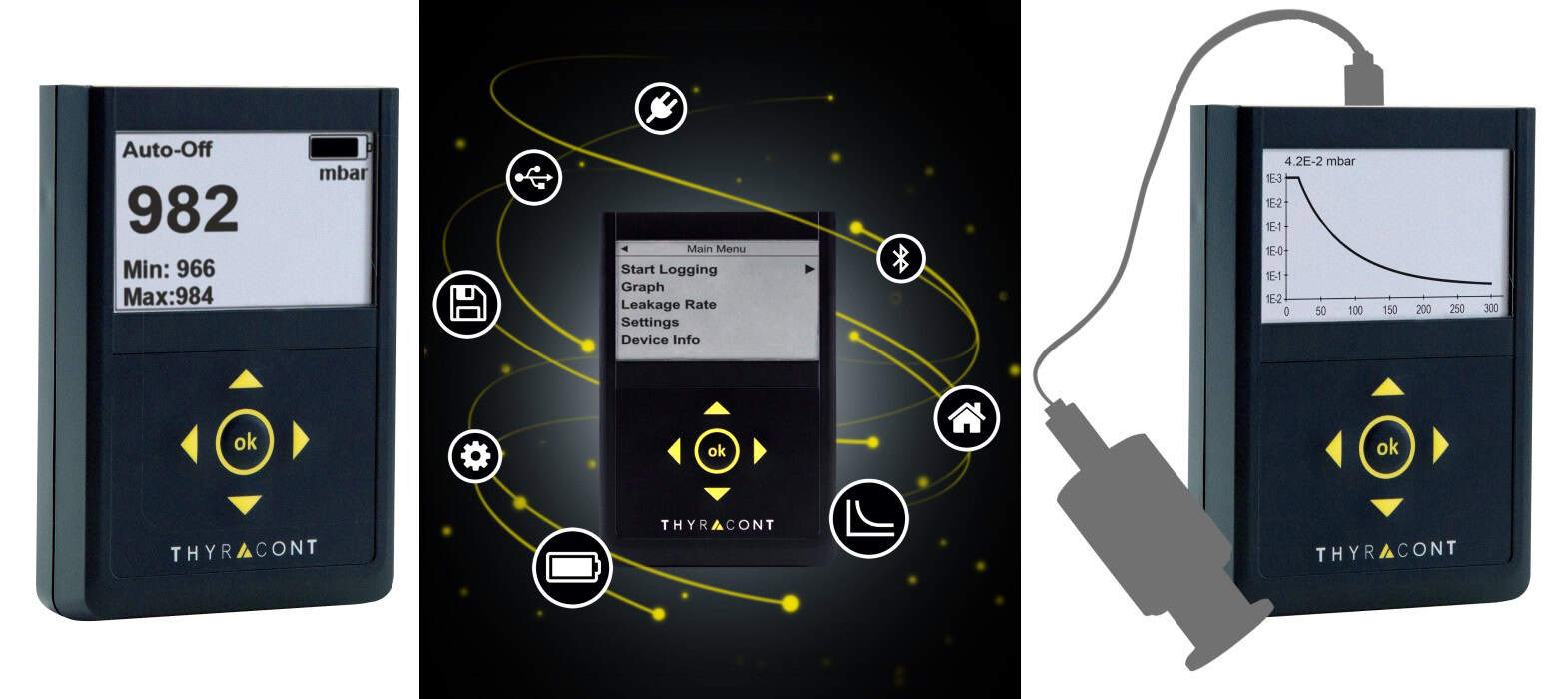
VD800 Thryracont’s series combines high accuracy with a highly intuitive user interface, defining the next generation of compact vacuum meters. (Courtesy: Thyracont)
Front-and-centre at SEMICON Europa will be Thyracont’s new series of VD800 compact vacuum meters. These instruments provide precise, on-site pressure monitoring in industrial and research environments. Featuring a direct pressure display and real-time pressure graphs, the VD800 series is ideal for service and maintenance tasks, laboratory applications, and test setups.
The VD800 series combines high accuracy with a highly intuitive user interface. This delivers real-time measurement values; pressure diagrams; and minimum and maximum pressure – all at a glance. The VD800’s 4+1 membrane keypad ensures quick access to all functions. USB-C and optional Bluetooth LE connectivity deliver seamless data readout and export. The VD800’s large internal data logger can store over 10 million measured values with their RTC data, with each measurement series saved as a separate file.
Data sampling rates can be set from 20 ms to 60 s to achieve dynamic pressure tracking or long-term measurements. Leak rates can be measured directly by monitoring the rise in pressure in the vacuum system. Intelligent energy management gives the meters extended battery life and longer operation times. Battery charging is done conveniently via USB-C.
The vacuum meters are available in several different sensor configurations, making them adaptable to a wide range of different uses. Model VD810 integrates a piezo ceramic sensor for making gas-type-independent measurements for rough vacuum applications. This sensor is insensitive to contamination, making it suitable for rough industrial environments. The VD810 measures absolute pressure from 2000 to 1 mbar and relative pressure from −1060 to +1200 mbar.
Model VD850 integrates a piezo/Pirani combination sensor, which delivers high resolution and accuracy in the rough and fine vacuum ranges. Optimized temperature compensation ensures stable measurements in the absolute pressure range from 1200 to 5e-5 mbar and in the relative pressure range from −1060 to +340 mbar.
The model VD800 is a standalone meter designed for use with Thyracont’s USB-C vacuum transducers, which are available in two models. The VSRUSB USB-C transducer is a piezo/Pirani combination sensor that measures absolute pressure in the 2000 to 5.0e-5 mbar range. The other is the VSCUSB USB-C transducer, which measures absolute pressures from 2000 down to 1 mbar and has a relative pressure range from -1060 to +1200 mbar. A USB-C cable connects the transducer to the VD800 for quick and easy data retrieval. The USB-C transducers are ideal for hard-to-reach areas of vacuum systems. The transducers can be activated while a process is running, enabling continuous monitoring and improved service diagnostics.
With its blend of precision, flexibility, and ease of use, the Thyracont VD800 series defines the next generation of compact vacuum meters. The devices’ intuitive interface, extensive data capabilities, and modern connectivity make them an indispensable tool for laboratories, service engineers, and industrial operators alike.
To experience the future of vacuum metrology in Munich, visit Thyracont at SEMICON Europa hall C1, booth 752. There you will discover how the VD800 series can optimize your pressure monitoring workflows.
This episode explores the scientific and technological significance of 2D materials such as graphene. My guest is Antonio Rossi, who is a researcher in 2D materials engineering at the Italian Institute of Technology in Genoa.
Rossi explains why 2D materials are fundamentally different than their 3D counterparts – and how these differences are driving scientific progress and the development of new and exciting technologies.
Graphene is the most famous 2D material and Rossi talks about today’s real-world applications of graphene in coatings. We also chat about the challenges facing scientists and engineers who are trying to exploit graphene’s unique electronic properties.
Rossi’s current research focuses on two other promising 2D materials – tungsten disulphide and hexagonal boron nitride. He explains why tungsten disulphide shows great technological promise because of its favourable electronic and optical properties; and why hexagonal boron nitride is emerging as an ideal substrate for creating 2D devices.
Artificial intelligence (AI) is becoming an important tool in developing new 2D materials. Rossi explains how his team is developing feedback loops that connect AI with the fabrication and characterization of new materials. Our conversation also touches on the use of 2D materials in quantum science and technology.
Earlier this year I met the Massachusetts-based steampunk artist Bruce Rosenbaum at the Global Physics Summit of the American Physical Society. He was exhibiting a beautiful sculpture of a “quantum engine” that was created in collaboration with physicists including NIST’s Nicole Yunger Halpern – who pioneered the scientific field of quantum steampunk.
I was so taken by the art and science of quantum steampunk that I promised Rosenbaum that I would chat with him and Yunger Halpern on the podcast – and here is that conversation. We begin by exploring the art of steampunk and how it is influenced by the technology of the 19th century. Then, we look at the physics of quantum steampunk, a field that weds modern concepts of quantum information with thermodynamics – which itself is a scientific triumph of the 19th century.
This podcast is supported by Atlas Technologies, specialists in custom aluminium and titanium vacuum chambers as well as bonded bimetal flanges and fittings used everywhere from physics labs to semiconductor fabs.
Obviously, I write: I wouldn’t be a very good science writer if I couldn’t. So communication skills are vital. Recently, for example, Qruise launched a new magnetic-resonance product for which I had to write a press release, create a new webpage and do social-media posts. That meant co-ordinating with lots of different people, finding out the key features to advertise, identifying the claims we wanted to make – and if we have the data to back those claims up. I’m not an expert in quantum computing or magnetic-resonance imagining or even marketing so I have to pick things up fast and then translate technically complex ideas from physics and software into simple messages for a broader audience. Thankfully, my colleagues are always happy to help. Science writing is a difficult task but I think I’m getting better at it.
What do you like best and least about your job?
I love the variety and the fact that I’m doing so many different things all the time. If there’s a day I feel I want something a little bit lighter, I can do some social media or the website, which is more creative. On the other hand, if I feel I could really focus in detail on something then I can write some documentation that is a little bit more technical. I also love the flexibility of remote working, but I do miss going to the office and socialising with my colleagues on a regular basis. You can’t get to know someone as well online, it’s nicer to have time with them in person.
What do you know today, that you wish you knew when you were starting out in your career?
That’s a hard one. It would be easy to say I wish I’d known earlier that I could combine science and writing and make a career out of that. On the other hand, if I’d known that, I might not have done my PhD – and if I’d gone into writing straight after my undergraduate degree, I perhaps wouldn’t be where I am now. My point is, it’s okay not to have a clear plan in life. As children, we’re always asked what we want to be – in my case, my dream from about the age of four was to be a vet. But then I did some work experience in a veterinary practice and I realized I’m really squeamish. It was only when I was 15 or 16 that I discovered I wanted to do physics because I liked it and was good at it. So just follow the things you love. You might end up doing something you never even thought was an option.
This episode of the Physics World Weekly podcast explores how quantum computing and artificial intelligence can be combined to help physicists search for rare interactions in data from an upgraded Large Hadron Collider.
My guest is Javier Toledo-Marín, and we spoke at the Perimeter Institute in Waterloo, Canada. As well as having an appointment at Perimeter, Toledo-Marín is also associated with the TRIUMF accelerator centre in Vancouver.
Low-energy electrons escape from some materials via distinct “doorway” states, according to a study done by physicists at Austria’s Vienna Institute of Technology. The team studied graphene-based materials and found that the nature of the doorway states depended on the number of graphene layers in the sample.
Low-energy electron (LEE) emission from solids is used across a range of materials analysis and processing applications including scanning electron microscopy and electron-beam induced deposition. However, the precise physics of the emission process is not well understood.
Electrons are ejected from a material when a beam of electrons is fired at its surface. Some of these incident electrons will impart energy to electrons residing in the material, causing some resident electrons to be emitted from the surface. In the simplest model, the minimum energy needed for this LEE emission is the electron binding energy of the material.
Frog in a box
In this new study, however, researchers have shown that exceeding the binding energy is not enough for LEE emission from graphene-based materials. Not only does the electron need this minimum energy, it must also be in a specific doorway state or it is unlikely to escape. The team compare this phenomenon to the predicament of a frog in a cardboard box with a window. Not only must the frog hop a certain height to escape the box, it must also begin its hop from a position that will result in it travelling through the hole (see figure).
For most materials, the energy spectrum of LEE electrons is featureless. However, it was known that graphite’s spectrum has an “X state” at about 3.3 eV, where emission is enhanced. This state could be related to doorway states.
To search for doorway states, the Vienna team studied LEE emission from graphite as well as from single-layer and bi-layer graphene. Graphene is a sheet of carbon just one atom thick. Sheets can stick together via the relatively weak Van der Waals force to create multilayer graphene – and ultimately graphite, which comprises a large number of layers.
Because electrons are mostly confined within the graphene layers, the electronic states of single-layer, bi-layer and multi-layer graphene are broadly similar. As a result, it was expected that these materials would have similar LEE emission spectra . However, the Vienna team found a surprising difference.
Emission and reflection
The team made their discovery by firing a beam of relatively low energy electrons (173 eV) incident at 60° to the surface of single-layer and bi-layer graphene as well as graphite. The scattered electrons are then detected at the same angle of reflection. Meanwhile, a second detector is pointed normal to the surface to capture any emitted electrons. In quantum mechanics electrons are indistinguishable, so the modifiers scattered and emitted are illustrative, rather than precise.
The team looked for coincident signals in both detectors and plotted their results as a function of energy in 2D “heat maps”. These plots revealed that bi-layer graphene and graphite each had doorway states – but at different energies. However, single-layer graphene did not appear to have any doorway states. By combining experiments with calculations, the team showed that doorway states emerge above a certain number of layers. As a result the researchers showed that graphite’s X state can be attributed in part to a doorway state that appears at about five layers of graphene.
“For the first time, we’ve shown that the shape of the electron spectrum depends not only on the material itself, but crucially on whether and where such resonant doorway states exist,” explains Anna Niggas at the Vienna Institute of Technology.
As well as providing important insights in how the electronic properties of graphene morph into the properties of graphite, the team says that their research could also shed light on the properties of other layered materials.
 Connexion