Chess is a seemingly simple game, but one that hides incredible complexity. In the standard game, the starting positions of the pieces are fixed so top players rely on memorizing a plethora of opening moves, which can sometimes result in boring, predictable games. It’s also the case that playing as white, and therefore going first, offers an advantage.
In the 1990s, former chess world champion Bobby Fischer proposed another way to play chess to encourage more creative play.
This form of the game – dubbed Chess960 – keeps the pawns in the same position but randomizes where the pieces at the back of the board – the knights, bishops, rooks, king and queen – are placed at the start while keeping the rest of the rules the same. It is named after the 960 starting positions that result from mixing it up at the back.
It was thought that Chess960 could allow for more permutations that would make the game fairer for both players. Yet research by physicist Marc Barthelemy at Paris-Saclay University suggests it’s not as simple as this.
Initial advantage
He used the open-source chess program called Stockfish to analyse each of the 960 starting positions and developed a statistical method to measure decision-making complexity by calculating how much “information” a player needs to identify the best moves.
He found that the standard game can be unfair, as players with black pieces who go second have to keep up with the moves from the player with white.
Yet regardless of starting positions at the back, Barthelemy discovered that white still has an advantage in almost all – 99.6% – of the 960 positions. He also found that the standard set-up – rook, knight, bishop, queen, king, bishop, knight, rook – is nothing special and is presumably an historical accident possibly as the starting positions are easy to remember, being visually symmetrical.
“Standard chess, despite centuries of cultural evolution, does not occupy an exceptional location in this landscape: it exhibits a typical initial advantage and moderate total complexity, while displaying above-average asymmetry in decision difficulty,” writes Barthelemy.
For a more fair and balanced match, Barthelemy suggests playing position #198, which has the starting positions as queen, knight, bishop, rook, king, bishop, knight and rook.
From cutting onions to a LEGO Jodrell Bank, physics has had its fair share of quirky stories this year. Here is our pick of the best, not in any particular order.
Flight of the nematode
Researchers in the US this year discovered that a tiny jumping worm uses static electricity to increase its chances of attaching to unsuspecting prey. The parasitic roundworm Steinernema carpocapsae can leap some 25 times its body length by curling into a loop and springing in the air. If the nematode lands successfully on a victim, it releases bacteria that kills the insect within a couple of days upon which the worm feasts and lays its eggs. To investigate whether static electricity aids their flight, a team at Emory University and the University of California, Berkeley, used high-speed microscopy to film the worms as they leapt onto a fruit fly that was tethered with a copper wire connected to a high-voltage power supply. The researchers found that a charge of a few hundred volts – similar to that generated in the wild by an insect’s wings rubbing against ions in the air – fosters a negative charge on the worm, creating an attractive force with the positively charged fly. They discovered that without any electrostatics, only 1 in 19 worm trajectories successfully reached their target. The greater the voltage, however, the greater the chance of landing with 880 V resulting in an 80% probability of success. “We’re helping to pioneer the emerging field of electrostatic ecology,” notes Emory physicist Ranjiangshang Ran.
Tear-jerking result
While it is known that volatile chemicals released from onions irritate the nerves in the cornea to produce tears, how such chemical-laden droplets reach the eyes and whether they are influenced by the knife or cutting technique remain less clear. To investigate, Sunghwan Jung from Cornell University and colleagues built a guillotine-like apparatus and used high-speed video to observe the droplets released from onions as they were cut by steel blades. They found that droplets, which can reach up to 60 cm high, were released in two stages – the first being a fast mist-like outburst that was followed by threads of liquid fragmenting into many droplets. The most energetic droplets were released during the initial contact between the blade and the onion’s skin. When they began varying the sharpness of the blade and the cutting speed, they discovered that a greater number of droplets were released by blunter blades and faster cutting speeds. “That was even more surprising,” notes Jung. “Blunter blades and faster cuts – up to 40 m/s – produced significantly more droplets with higher kinetic energy.” Another surprise was that refrigerating the onions prior to cutting also produced an increased number of droplets of similar velocity, compared to room-temperature vegetables.
LEGO telescope
Students at the University of Manchester in the UK created a 30 500-piece LEGO model of the iconic Lovell Telescope to mark the 80th anniversary of the Jodrell Bank Observatory, which was founded in December 1945. Built in 1957, the 76.2 m diameter telescope was the largest steerable dish radio telescope in the world at the time. The LEGO model has been designed by Manchester’s undergraduate physics society and is based on the telescope’s original engineering blueprints. Student James Ruxton spent six months perfecting the design, which even involved producing custom-designed LEGO bricks with a 3D printer. Ruxton and fellow students began construction in April and the end result is a model weighing 30 kg with 30500 pieces and a whopping 4000-page instruction manual. “It’s definitely the biggest and most challenging build I’ve ever done, but also the most fun,” says Ruxton. “I’ve been a big fan of LEGO since I was younger, and I’ve always loved creating my own models, so recreating something as iconic as the Lovell is like taking that to the next level!” The model has gone on display in a “specially modified cabinet” at the university’s Schuster building, taking pride of place alongside a decade-old LEGO model of CERN’s ATLAS detector.
Petal physics
The curves and curls of leaves and flower petals arise due to the interplay between their natural growth and geometry. Uneven growth in a flat sheet, in which the edges grow quicker than the interior, gives rise to strain and in plant leaves and petals, for example, this can result in a variety of shapes such as saddle and ripple shapes. Yet when it comes to rose petals, the sharply pointed cusps – a point where two curves meet – that form at the edge of the petals set it apart from soft, wavy patterns seen in many other plants.
To investigate this intriguing difference, researchers from the Hebrew University of Jerusalem carried out theoretical modelling and conducted a series of experiments with synthetic disc “petals”. They found that the pointed cusps that form at the edge of rose petals are due to a type of geometric frustration called a Mainardi–Codazzi–Peterson (MCP) incompatibility. This type of mechanism results in stress concentrating in a specific area, which goes on to form cusps to avoid tearing or forming unnatural folding. When the researchers suppressed the formation of cusps, they found that the discs revert to being smooth and concave. The researchers say that the findings could be used for applications in soft robotics and even in the deployment of spacecraft components.
Wild Card physics
The Wild Cards universe is a series of novels set largely during an alternate history of the US following the Second World War. The series follows events after an extraterrestrial virus, known as the Wild Card virus, has spread worldwide. It mutates human DNA causing profound changes in human physiology. The virus follows a fixed statistical distribution in that 90% of those infected die, 9% become physically mutated (referred to as “jokers”) and 1% gain superhuman abilities (known as “aces”). Such capabilities include the ability to fly as well as being able to move between dimensions. George R R Martin, the author who co-edits the Wild Cards series, co-authored a paper examining the complex dynamics of the Wild Card virus together with Los Alamos National Laboratory theoretical physicist Ian Tregillis, who is also a science-fiction author. The model takes into consideration the severity of the changes (for the 10% that don’t instantly die) and the mix of joker/ace traits. The result is a dynamical system in which a carrier’s state vector constantly evolves through the model space – until their “card” turns. At that point the state vector becomes fixed and its permanent location determines the fate of the carrier. “The fictional virus is really just an excuse to justify the world of Wild Cards, the characters who inhabit it, and the plot lines that spin out from their actions,” says Tregillis.
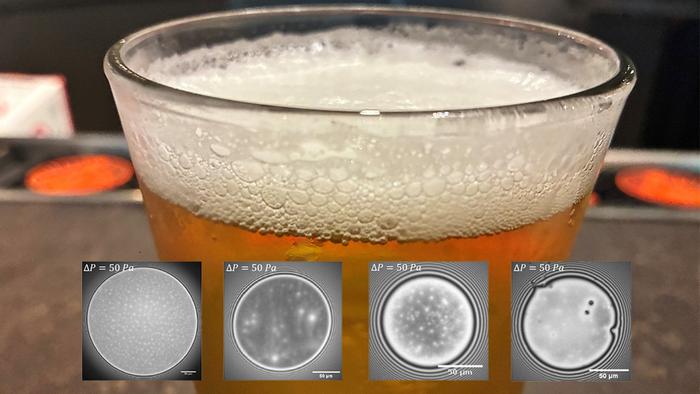
Bubble vision: researchers have discovered that triple-fermented beer feature the most stable beer foam heads (courtesy: AIP/Chatzigiannakis et al.)
Foamy top
And finally, a clear sign of a good brew is a big head of foam at the top of a poured glass. Beer foam is made of many small bubbles of air, separated from each other by thin films of liquid. These thin films must remain stable, or the bubbles will pop, and the foam will collapse. What holds these thin films together is not completely understood and is likely conglomerates of proteins, surface viscosity or the presence of surfactants – molecules that can reduce surface tension and are found in soaps and detergents. To find out more, researchers from ETH Zurich and Eindhoven University of Technology investigated beer-foam stability for different types of beers at varying stages of the fermentation process. They found that for single-fermentation beers, the foams are mostly held together with the surface viscosity of the beer. This is mostly influenced by the proteins in the beer – the more they contain, the more viscous the film and more stable the foam will be. However, for double-fermented beers, the proteins in the beer are slightly denatured by the yeast cells and come together to form a two-dimensional membrane that keeps the foam intact longer. The head was found to be even more stable for triple-fermented beers, which include Trappist beers. The team says that the work could be used to identify ways to increase or decrease the amount of foam so that everyone can pour a perfect glass of beer every time. Cheers!
You can be sure that 2026 will throw up its fair share of quirky stories from the world of physics. See you next year!
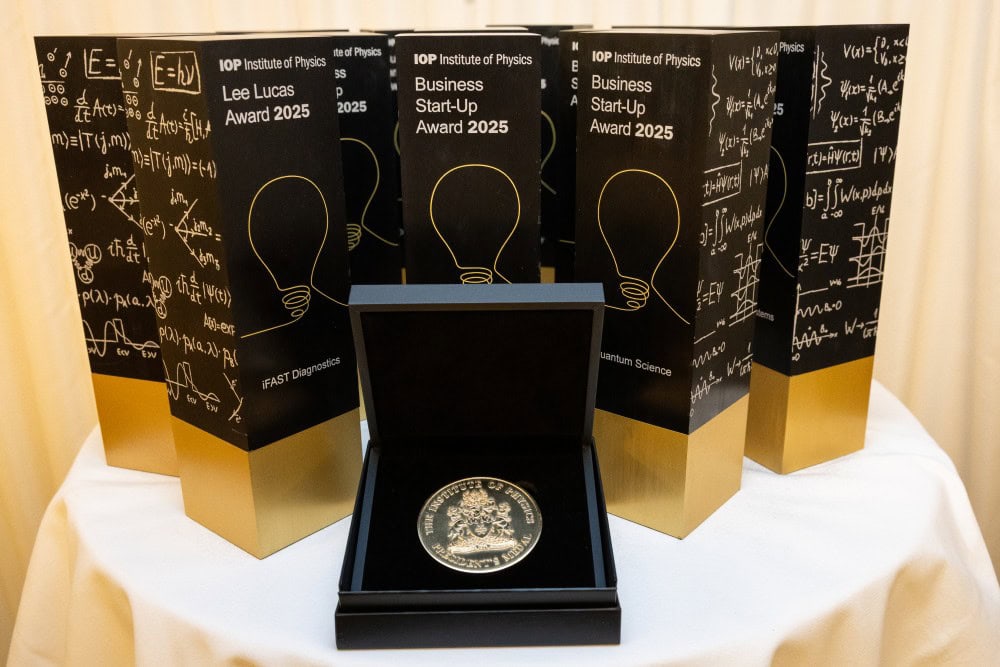
A total of 14 physics-based firms in sectors from quantum and energy to healthcare and aerospace have won 2025 Business Awards from the Institute of Physics (IOP), which publishes Physics World. The awards were presented at a reception in the Palace of Westminster yesterday attended by senior parliamentarians and policymakers as well as investors, funders and industry leaders.
The IOP Business Awards, which have been running since 2012, recognise the role that physics and physicists play in the economy, creating jobs and growth “by powering innovation to meet the challenges facing us today, ranging from climate change to better healthcare and food production”. More than 100 firms have now won Business Awards, with around 90% of those companies still commercially active.
The parliamentary event honouring the 2025 winners were hosted by Dave Robertson, the Labour MP for Lichfield, who spent 10 years as a physics teacher in Birmingham before working for teaching unions. There was also a speech from Baron Sharma, who studied applied physics before moving into finance and later becoming a Conservative MP, Cabinet minister and president of the COP-26 climate summit.
Seven firms were awarded 2025 IOP Business Innovation Awards, which recognize companies that have “delivered significant economic and/or societal impact through the application of physics”. They include Oxford-based Tokamak Energy, which has developed “compact, powerful, robust, quench-resilient” high-temperature superconducting magnets for commercial fusion energy and for propulsion systems, accelerators and scientific instruments.
(courtesy: Carmen Valino)
Oxford Instruments was honoured for developing a novel analytical technique for scanning electron microscopes, enabling new capabilities and accelerating time to results by at least an order of magnitude. Ionoptika, meanwhile, was recognized for developing Q-One, which is a new generation of focused ion-beam instrumentation, providing single atom through to high-dose nanoscale advanced materials engineering for photonic and quantum technologies.
The other four winners were: electronics firm FlexEnable for their organic transistor materials; Lynkeos Technology for the development of muonography in the nuclear industry; the renewable energy company Sunamp for their thermal storage system; and the defence and security giant Thales UK for the development of a solid-state laser for laser rangefinders.
Business potential
Six other companies have won an IOP Start-up Award, which celebrates young companies “with a great business idea founded on a physics invention, with the potential for business growth and significant societal impact”. They include Astron Systems for developing “long-lifetime turbomachinery to enable multi-reuse small rocket engines and bring about fully reusable small launch vehicles”, along with MirZyme Therapeutics for “pioneering diagnostics and therapeutics to eliminate preeclampsia and transform maternal health”.
The other four winners were: Celtic Terahertz Technology for a metamaterial filter technology; Nellie Technologies for a algae-based carbon removal technology; Quantum Science for their development of short-wave infrared quantum dot technology; and Wayland Additive for the development and commercialisation of charge-neutralised electron beam metal additive manufacturing.
James McKenzie, a former vice-president for business at the IOP, who was involved in judging the awards, says that all awardees are “worthy winners”. “It’s the passion, skill and enthusiasm that always impresses me,” McKenzie told Physics World.
iFAST Diagnostics were also awarded the IOP Lee Lucas Award that recognises early-stage companies taking innovative products into the medical and healthcare sector. The firm, which was spun out of the University of Southampton, develops blood tests that can test the treatment of bacterial infections in a matter of hours rather than days. They are expecting to have approval for testing next year.
“Especially inspiring was the team behind iFAST,” adds McKenzie, “who developed a method to test very rapid tests cutting time from 48 hours to three hours, so patients can be given the right antibiotics.”
“The award-winning businesses are all outstanding examples of what can be achieved when we build upon the strengths we have, and drive innovation off the back of our world-leading discovery science,” noted Tom Grinyer, IOP chief executive officer. “In the coming years, physics will continue to shape our lives, and we have some great strengths to build upon here in the UK, not only in specific sectors such as quantum, semiconductors and the green economy, but in our strong academic research and innovation base, our growing pipeline of spin-out and early-stage companies, our international collaborations and our growing venture capital community.”
Fermilab has officially opened a new building named after the particle physicist Helen Edwards. Officials from the lab and the US Department of Energy (DOE) opened the Helen Edwards Engineering Research Center at a ceremony held on 5 December. The new building is the lab’s largest purpose-built lab and office space since the lab’s iconic Wilson Hall, which was completed in 1974.
Construction of the Helen Edwards Engineering Research Center began in 2019 and was completed three years later. The centre is an 7500 m2 multi-story lab and office building that is adjacent and connected to Wilson Hall.
The new centre is designed as a collaborative lab where engineers, scientists and technicians design, build and test technologies across several areas of research such as neutrino science, particle detectors, quantum science and electronics.
The centre also features cleanrooms, vibration-sensitive labs and cryogenic facilities in which the components of the near detector for the Deep Underground Neutrino Experiment will be assembled and tested.
A pioneering spirit
With a PhD in experimental particle physics from Cornell University, Edwards was heavily involved with commissioning the university’s 10 GeV electron synchrotron. In 1970 Fermilab’s director Robert Wilson appointed Edwards as associate head of the lab’s booster section and she later became head of the accelerator division.
While at Fermilab, Edwards’ primary responsibility was designing, constructing, commissioning and operating the Tevatron, which led to the discoveries of the top quark in 1995 and the tau neutrino in 2000.
Edwards retired in the early 1990s but continued to work as guest scientists at Fermilab and officially switched the Tevatron off during a ceremony held on 30 September 2011. Edwards died in 2016.
Darío Gil, the undersecretary for science at the DOE says that Edwards’ scientific work “is a symbol of the pioneering spirit of US research”.
“Her contributions to the Tevatron and the lab helped the US become a world leader in the study of elementary particles,” notes Gil. “We honour her legacy by naming this research centre after her as Fermilab continues shaping the next generation of research using [artificial intelligence], [machine learning] and quantum physics.”
 Connexion