 Connexion
NASA greenlights two earth science missions, to researchers’ relief
9 février 2026 à 03:25
Orbiting satellites will monitor changes in the stratosphere and on the planet’s surface

Two African science journalists – Paul Adepoju and Mkhululi Chimoio – have won the “Quantum Pitch Competition”, organized by Physics World and Physics Magazine to mark the International Year of Quantum Science and Technology (IYQ).
The competition was launched at the 2025 World Conference of Science Journalists in Pretoria, South Africa, where delegates to a science-writing workshop were invited to submit story ideas on any aspect of quantum science and technology
Chimoio’s winning entry is an article covering the work of the South African physicist Lindiwe Khumalo, who carries out experiments on quantum sensors in a former gold mine 3 km underground.
Khmalo uses the natural shielding from 3 km of rock to test muon-based sensors and ultra-low-noise interferometric measurements, contributing to dark-matter detection, neutrino studies, and precision metrology.
“It’s a compelling human story about an African physicist working in an extreme environment usually associated with heavy industry, not quantum physics,” says Chimoio, whose article will be published in Physics World soon.
Chimoio is a Zimbabwean-born investigative journalist, now based in South Africa. He specializes in geopolitics, technology, security and socio-economic issues, with some of his writing appearing in Nature Africa and Africa Uncensored.
Adepoju’s winning piece – describing the discovery of large-scale galactic motion using the emission produced by tiny quantum “spin-flips” in hydrogen atoms – is published today in Physics Magazine.
Adepoju is a freelance journalist and podcaster based in Ibadan, Nigeria, whose has written for publications such as Nature, New Scientist, and Scientific American.
In his pitch-winning story, Adepoju describes the recent discovery of rotation within a galaxy-filled filament that stretches over 50 million light years. The cosmic winding, which had never been directly measured in a single filament, was found using hydrogen-emission data from the MeerKAT radio telescope in South Africa and could lead to a new way to probe dark matter.
IYQ 2025 ends this week at an official closing ceremony in Accra, Ghana, on 10 and 11 February, the full programme for which can be read here.
This article forms part of Physics World‘s contribution to the 2025 International Year of Quantum Science and Technology (IYQ), which aims to raise global awareness of quantum physics and its applications.
Stayed tuned to Physics World and our international partners throughout the year for more coverage of the IYQ.
Find out more on our quantum channel.
The post Winners of International Quantum Year science-journalism competition picked appeared first on Physics World.
Germany’s top intelligence officials made waves last year by calling for the creation of a European spy network to lessen Europe’s dependence on American intelligence. After Washington’s sudden freeze of American intelligence sharing with Ukraine in March, German officials — and their European counterparts — have grown increasingly attuned to deficiencies in key capabilities they […]
The post There’s a way forward for sovereign European space intel, but is there the will? appeared first on SpaceNews.
A major upgrade to the LHCb experiment at CERN is under threat after the UK cancelled its contribution towards it. The decision by the Science and Technology Facilities Council (STFC) to defund the project means that unless the decision if overturned, the experiment will now likely finish operation in 2033.
LHCb is one of the four large experiments based at the Large Hadron Collider (LHC) at CERN. It specializes in the measurements of the parameters of charge-parity (CP) violation in the interactions of b- and c-hadrons, studies of which help to explain the matter-antimatter asymmetry in the universe.
LHCb began recording its first data in 2009 when the LHC began operations and started its main research programme from 2010.
At the end of 2018 it was the shut down for upgrades, which were completed in 2022. That led to a vast increase in the amount of data the experiment could collect, allowing significant improvements in precision for many measurements.
The detector is expected to operate until 2033 by which time it would have reached the end of its lifetime after years of intense radiation damage.
LHCb is operated by the LHCb collaboration, which involves about 1700 scientists and technicians from over 100 institutions in 22 countries around the world with work on the machine having already resulted in over 800 publications.
The UK is one of the leading countries working on LHCb – four of the eight spokespeople for the experiment have come from the UK – and over the past decade physicists from the UK have been planning an upgrade to experiment dubbed LHCb upgrade II.
This would take advantage of the upgrade to the LHC – the High-Luminosity LHC (HL-LHC) – and offer an order of magnitude increase in luminosity over upgrade I.
The second upgrade would provide another boost in capability to answer questions such as whether all CP-violation phenomena are consistent with the Standard Model of particle physics or require an extended theory as well as how the strong interaction binds together the exotic tetraquark and pentaquark states that have been discovered by LHCb.
At a cost of about £150m with the construction phase beginning in 2027, the upgrade components would be installed by 2035 before collecting data for five to six years until the HL-LHC is shut down in 2040.
UK researchers submitted a proposal to the UKRI infrastructure fund in 2021 to begin work on the upgrade and was awarded £49.4m in 2022.
Some £5m has been spent on the pre-construction phase, in which agreements have been made with international partners on the scope and design of the improved detector.
Yet on 19 December researchers working on the project were sent a letter telling them that the remaining funding has “not been prioritised” and will now be cancelled.
“It was a complete shock,” says Tim Gershon from the University of Warwick, who is principal investigator for the project in the UK and is set to become spokesperson for the international collaboration in July.
The STFC’s core budget has been held relatively flat from £835m to £842m from 2026 to 2030. Yet the council said that projects would need to be cut given inflation, rising energy costs as well as “unfavourable movements in foreign exchange rates” that have increased STFC’s annual costs by over £50m a year.
The STFC has already said that it needs to reduce spending from the core budget by at least 30% over 2024/2025 levels at the same time it also announced that it will need to reduce the number of projects that are funded by its infrastructure fund.
It’s like paying to heat your house but then sitting outside in the cold
Tim Gershon
Four projects will now not be prioritised. They include two UK national facilities: the Relativistic Ultrafast Electron Diffraction and Imaging facility and a mass spectrometry centre dubbed C‑MASS.
The other two are international particle-physics projects: the upgrade to LHCb as well as a contribution to the Electron-Ion Collider at the Brookhaven National Laboratory that is currently being built by a collaboration of 40 countries.
“This is more terrible news for physics, for the UK and for global scientific progress. The withdrawal of funding in this abrupt way is incredibly damaging to our international reputation as a science superpower and could cause long-term damage to the UK economy,” notes Paul Howarth, president-elect of the Institute of Physics, which publishes Physics World. “But even more important is the harm this cut will cause to human understanding of the universe and human progress.”
Gershon adds that the LHCb collaboration were not asked for any input before the decision was made and since then they have trying to work out what it means.
“The UK pays the CERN subscription, which pays for the accelerator, but needs to also invest in experiments to obtain scientific return from this,” says Gershon. “It’s like paying to heat your house but then sitting outside in the cold.”
It might be possible to get funding from elsewhere in the short-term to cover the initial work on the upgrade, but Gershon sats that without investment from UKRI/STFC, the project will be dead as it would not be possible for international partners to go ahead without UK involvement on the timescale dictated by the LHC schedule.
That would mean the LHCb stops operating from 2033 and does not take advantage of the HL-LHC. “The move also goes against the European Strategy for Particle Physics roadmap, of which the top priority is fully exploiting the HL-LHC,” says Gershon. “Without LHCb upgrade, it won’t be possible to do that.”
Howarth adds there are “demonstrable impacts on UK growth and prosperity” for such research. “An earlier upgrade to the LHCb experiment generated about £15m in contracts for more than 80 UK companies,” he adds. “This funding cut means the upgrade is unlikely to go ahead, so all this business for UK innovators is lost. We urge the government to step back and consider how its new funding strategy will impact UK science.”
The post CERN upgrade to LHCb experiment threatened by UK funding cuts appeared first on Physics World.
Nothing stays static in today’s job market. Physicist Gabi Steinbach recalls that about five years ago, fresh physics PhDs could snag lucrative data-scientist positions in companies without job experience. “It was a really big boom,” says Steinbach, at the University of Maryland, US. Then, schools started formal data-science programmes that churned out job-ready candidates to compete with physicists. Now, the demand for physicists as data scientists “has already subsided,” she says.
Today, new graduates face an uncertain job market, as companies wrestle with the role of artificial intelligence (AI), and due to the funding cuts of science research agencies in the US. But those with physics degrees should stay optimistic, according to Matt Thompson, a physicist at Zap Energy, a fusion company based in Seattle, Washington.
“I don’t think the value of a physics education ever changes,” says Thompson, who has mentored many young physicists. “It is not a flash-in-the-pan major where the funding and jobs come from changes. The value of the discipline truly is evergreen.”
In particular, a physics degree prepares you for numerous technical roles in emerging industrial markets. Thompson’s company, for example, offers a number of technical roles that could fit physicists with a bachelor’s, master’s or PhD.
A good way to set yourself up for success is to begin your job hunt two years before you expect to graduate, says Steinbach, who guides young researchers in career development. “Many students underestimate the time it takes,” she says.
The early start should help with the “internal” work of job hunting, as Steinbach calls it, where students figure out their personal ambitions. “I always ask students or postdocs, what’s your ultimate goal?” she says. “What industry do you want to work in? Do you like teamwork? Do you want a highly technical job?”
Then, the external job hunt begins. Students can find formal job listings on Physics World Jobs, APS Physics Jobs and in the Physics World Careers and APS Careers guides, as well as companies’ websites or on LinkedIn. Another way to track opportunities is to read investment news, says Monica Volk, who has spent the last decade hiring for companies, including Silicon Valley start-ups. She follows “Term Sheet,” a Fortune newsletter, to see which companies have raised money. “If they just raised $20 million, they’re going to spend that money on hiring people,” she says.

Volk encourages applicants to tailor their résumé for each specific job. “Your résumé should tell a story, where the next chapter in the story is the job that you’re applying for,” she says.
Hiring managers want a CV to show that a candidate from academia can “hit deadlines, communicate clearly, collaborate and give feedback.” Applicants can show this capability by describing their work specifically. “Talk about different equipment you’ve used, or the applications your research has gone into,” says Carly Saxton, the VP of HR at Quantum Computing, Inc. (QCI), based in New Jersey, in the US. Thompson adds that describing your academic research with an emphasis on results – reports written, projects completed and the importance of a particular numerical finding – will give those in industry the confidence that you can get something done.
It’s also important to research the company you’re applying for. Generative AI can help with this, says Valentine Zatti, the HR director for Alice & Bob, a quantum computing start-up in France. For example, she has given ChatGPT a LinkedIn page and asked it to summarize the recent news about a company and list its main competitors. She is careful to verify the veracity of the summaries.
When writing a CV , it’s important to use the keywords from the job description. Many companies use applicant-tracking systems, which automatically filter out CV without those keywords. This may involve learning the jargon of the industry. For example, when Thompson looked for jobs in the defence sector, he found out they called cameras “EO/IR,” short for electro-optic infrared instruments. Once he started referring to his expertise using those words, “I got a lot better response,” he says.
Generative AI can also assist you in putting together a résumé. For example, it can make résumés, which should be one page long, more concise, or help you better match your language to the job description. But Steinbach cautions that you must stay vigilant. “If it’s writing things that don’t sound like you, or if you can’t remember what’s written on it, you will fail at your interview,” says Steinbach.
Companies fill job openings quickly, especially right now, so Thompson also recommends focusing on networking. “It’s fine to apply for jobs you see online, but that should be maybe 20 percent of your effort,” he says. “Eighty percent should be talking to people.” One effective approach is through company internships before graduation. “We jump at the opportunity to hire former interns,” says Saxton.
Thompson suggests arranging a half-hour call with someone whose job looks interesting to you. You can find people through your alumni networks, LinkedIn or APS’s Industry Mentoring for Physicists (IMPact) program, which connects students and early-career physicists from any country with industrial physicists worldwide for career guidance. You can also attend career fairs at your university and those
organized by the APS.
Once a company is interested in you, you can expect several rounds of interviews. The first will be about the logistics of the job – whether you’d need to relocate, for example. After that, for technical roles you can expect technical interviews. Recently, companies have encountered candidates secretively using AI to cheat during these interviews. They may eliminate the candidate for cheating. “If you don’t know how to do something, it’s better to be honest about it than to use AI to get through a test,” says Saxton. “Companies are willing to teach and develop core skills.”
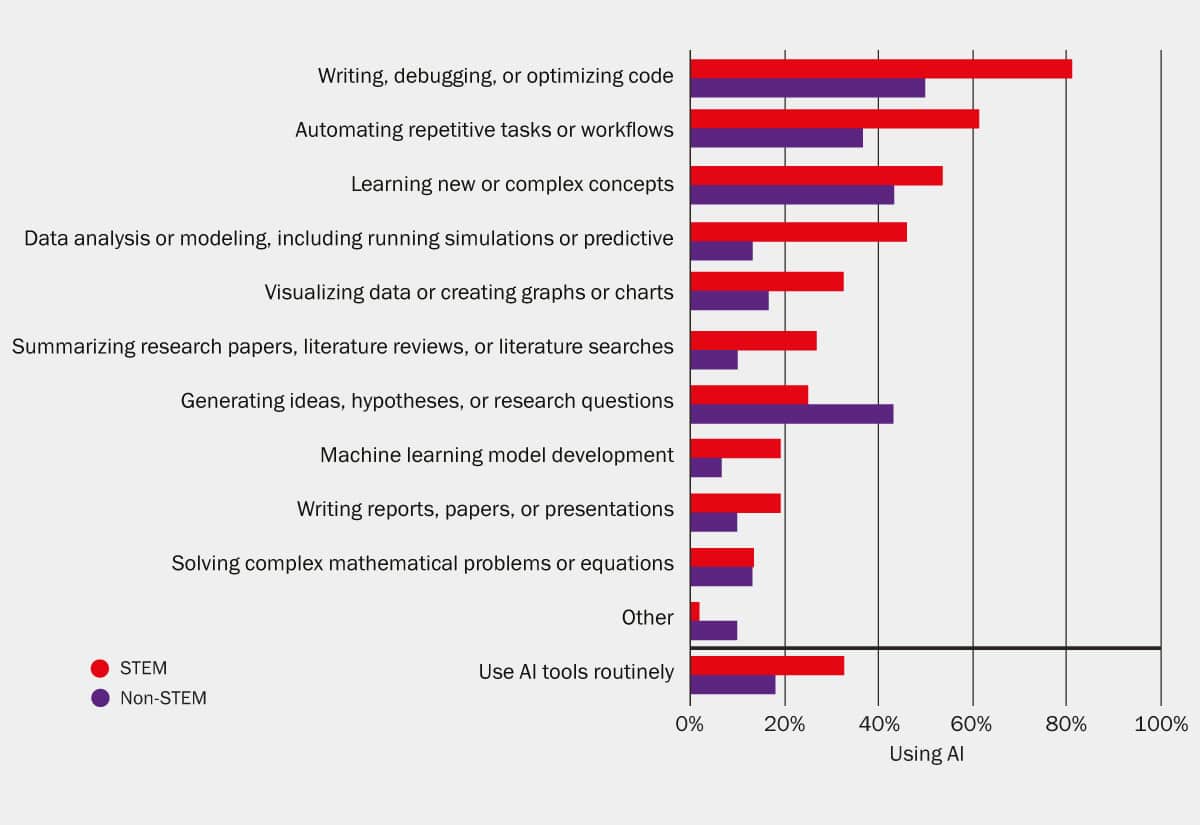
The “AI Use Among Physics Degree Recipients” report by the American Institute of Physics, published in August 2025, shows how recent physics degree recipients are engaging with AI, encompassing both its development and its application in daily professional activities. New bachelor’s graduates working in both STEM and non-STEM roles who received their degrees between 2023 and 2024 answered whether they routinely used AI tools in their day-to-day work in February 2025.
However, with transparency, showcasing AI skills could be a boon during job interviews. A 2025 survey from the American Institute of Physics found that around one in four students with a physics bachelor’s degree (see the graph) and two in five with physics PhDs routinely use AI for work. The report also found that one in 12 physics bachelor’s degree-earners and nearly one in five physics doctorate-earners who entered the workforce in 2024 have jobs in AI development.
The emerging quantum industry is also a promising job market for physicists. Globally, investors put nearly $2 billion in quantum technology in 2024, while public investments in quantum in early 2025 reached $10 billion. “You’ll have an opportunity to work for companies in their building stage, and you’re able to earn equity as part of that company,” says Saxton.
Alice & Bob are in the midst of hiring 100 new staff, 25 of whom are quantum physicists, including experimentalists and theorists, based in Paris. Zatti, in particular, wants to boost the number of women working in the field.
Currently, the pool of qualified candidates in quantum is small. Consequently, Alice & Bob can screen CVs manually, says Zatti. Both Alice & Bob and US-based QCI say they are willing to hire internationally. QCI is willing to pay legal fees for candidates to help them continue working in the US, says Saxton.
It’s important to stay flexible in today’s job market. “Don’t ignore current trends, but don’t get married to them either,” suggests Steinbach. Thompson agrees, adding that curiosity is key. “You just have to be creative. If you can open your aperture to all of private industry, there’s a lot of opportunity out there.”
The post Why a physics degree is so valuable in today’s uncertain job market appeared first on Physics World.
Green hydrogen is hydrogen gas produced by splitting water using electrolysis powered entirely by renewable electricity. It is important because it provides a clean fuel option for industries that are very difficult to decarbonise using other methods. Sectors such as steel, cement, glass, and chemicals require extremely high temperatures (1,000–1,600°C), which are hard to achieve reliably or cheaply with electricity alone, so they still rely heavily on fossil fuels.
In this work, the researchers examined whether using green hydrogen actually reduces emissions across different sectors, comparing it not only with fossil fuels but also with other low‑emission alternatives such as heat pumps, electric vehicles, and biofuels. They carried out a prospective life cycle assessment covering all stages of hydrogen (production, transport, and use) using projected 2030 conditions that include cleaner electricity grids, improved electrolyser efficiency, updated industrial processes, and expected hydrogen transport methods. They then compared green hydrogen to alternative technologies across eight applications: producing methanol, ammonia, steel, and aviation fuels; powering fuel‑cell passenger cars; providing low‑temperature domestic heat; supplying high‑temperature industrial heat; and balancing the electricity grid over long periods.
Across all eight applications, green hydrogen produced fewer emissions than fossil fuels, although often only marginally. However, when compared to other low‑emission technologies, green hydrogen often performed similarly or worse. This is because producing and transporting hydrogen still generates emissions, especially when the electricity used is not extremely low‑carbon, and because electrolysis itself is relatively inefficient. Green hydrogen only outperforms other clean options when it is produced using very low‑carbon electricity (such as wind power) and used on‑site without transport. Under these ideal conditions, it becomes the preferred option for ammonia and steel production, industrial and domestic heating, and long‑term grid balancing.
To maximise hydrogen’s climate benefit, emissions must be reduced across the entire supply chain, and hydrogen should be prioritised only in applications where it genuinely outperforms other clean alternatives. The authors propose a climate ladder to help rank and prioritise hydrogen use across sectors, guiding smarter policy and investment decisions.
Climate-optimal use of green hydrogen
Kiane de Kleijne et al 2025 Prog. Energy 7 034001
Research and development of hydrogen carrier based solutions for hydrogen compression and storage Martin Dornheim et al. (2022)
The post How green is green hydrogen? appeared first on Physics World.
An unusual signal initially picked up by the LIGO and Virgo gravitational wave detectors and subsequently by optical telescopes around the world may have been a “superkilonova” – that is, a kilonova that took place inside a supernova. According to a team led by astronomers at the California Institute of Technology (Caltech) in the US, the event in question happened in a galaxy 1.3 billion light years away and may have been the result of a merger between two or more neutron stars, including at least one that was less massive than our Sun. If confirmed, it would be the first superkilonova ever recorded – something that study leader Mansi Kasliwal says would advance our understanding of what happens to massive stars at the end of their lives.
A supernova is the explosion of a massive star that occurs either because the star no longer produces enough energy to prevent gravitational collapse, or because it suddenly acquires large amounts of matter from a disintegrating nearby object. Such explosions are an important source of heavy elements such as carbon and iron in the universe.
Kilonovae are slightly different. They occur when two neutron stars collide, producing heavier elements such as gold and uranium. Both types of events can be detected from the ripples they produce in spacetime – gravitational waves – and from the light they give off that propagates across the cosmos to Earth-based observers.
The first – and so far only – confirmed observation of a kilonova came in 2017 as a result of two neutron stars colliding. This event, known as GW170817, produced gravitational waves that were detected by the Laser Interferometer Gravitational-wave Observatory (LIGO), which is operated by the US National Science Foundation, and by its European partner Virgo. Several ground-based and space telescopes also observed light signals associated with GW170817, which enabled astronomers to build a clear picture of what happened.
Kasliwal and colleagues now believe they have evidence for a second kilonova with a very different cause. They say that this event, initially called ZTF 25abjmnps and then renamed AT2025ulz, could be a kilonova driven by a supernova – something that has never been observed before, although theorists predicted it was possible.
The gravitational waves from AT2025ulz reached Earth on 18 August 2025 and were picked up by the LIGO detectors in Louisiana and Washington and by Virgo in Italy. Scientists there quickly alerted colleagues to the signal, which appeared to be coming from a merger between two objects, one of which was unusually small. A few hours later, the Zwicky Transient Facility (ZTF) at California’s Palomar Observatory identified a rapidly fading red object 1.3 billion light-years away that appeared to be in the same location as the gravitational wave source.
Several other telescopes that were previously part of the Kasliwal-led GROWTH (Global Relay of Observatories Watching Transients Happen) programme, including the W M Keck Observatory in Hawaiʻi and the Fraunhofer telescope at the Wendelstein Observatory in Germany, picked up the event’s trail. Their observations confirmed that the light eruption had faded fast and glowed at red light wavelengths – exactly what was observed with GW170817.
A few days later, though, something changed. AT2025ulz grew brighter, and telescopes began to pick up hydrogen lines in its light spectra – a finding that suggested it was a Type IIb (stripped-envelope core-collapse) supernova, not a kilonova.
Kasliwal, however, remained puzzled. While she agrees that AT2025ulz does not resemble GW170817, she argues that it also doesn’t look like a run-of-the-mill supernova.
In her view, that leaves two possibilities. The first involves a process called fragmentation in which a rapidly spinning star explodes in a supernova and collects a disc of material around it as it collapses. This disc material subsequently aggregates into a tiny neutron star in much the same way as planets form. The second possibility is that a rapidly spinning massive star exploded as a supernova and then split into two tiny neutron stars, both much less massive than our Sun, which later merged. In other words, a supernova may have produced twin neutron stars that then merged to make a kilonova inside it – that is, a superkilonova.
“We have never seen any hints of anything like this before,” Kasliwal says. “It is amazing to me that nature may make tiny neutron stars smaller than a solar mass and more than one neutron star may be born inside a stripped-envelope supernova.”
While Kasliwal describes the data as “tantalizing”, she acknowledges that firm evidence for a superkilonova would require nebular infrared spectroscopy from either the W M Keck Observatory or the James Webb Space Telescope (JWST). On this occasion, that’s not going to be possible, as the event occurred outside JWST’s visibility window and was too far away for Keck to gather infrared spectra – though Kasliwal says the team did get “beautiful” optical spectra from Keck.
The only real way to test the superkilonova theory would be to find more events like AT2025ulz, and Kasliwal is hoping to do just that. “We will be keeping a close eye on any future events in which there are hints that the neutron star is sub-solar and look hard for a young stripped envelope supernova that could have exploded at the same time,” she tells Physics World. “Future superkilonova discoveries will open up this entirely new avenue into our understanding of what happens to massive stars.”
The study is detailed in The Astrophysical Journal Letters.
The post Unusual astronomical event might be a ‘superkilonova’ appeared first on Physics World.
A Falcon 9 launched a batch of Starlink satellites on Feb. 7 after SpaceX completed an investigation into an engine malfunction during the rocket’s previous launch five days earlier.
The post Falcon 9 returns to flight after upper stage engine investigation appeared first on SpaceNews.
An investor in two space companies that went public in the past year said an upcoming SpaceX IPO could generate new investor interest while also triggering a wave of consolidation.
The post SpaceX IPO could drive investor interest in other space companies appeared first on SpaceNews.
Starfish’s Otter spacecraft will support relocation and life extension of military satellites
The post Space Force awards $54.5 million contract to Starfish Space for GEO servicing vehicle appeared first on SpaceNews.
China launched its experimental reusable spacecraft for the fourth time late Friday, once again maintaining strict secrecy around the mission.
The post China launches reusable spaceplane on fourth secretive orbital mission appeared first on SpaceNews.
After losing about 20% of its civil servant workforce in the past year, NASA’s administrator says the agency plans to bring more expertise in-house and reduce its reliance on contractors.
The post NASA seeks to bolster workforce, reduce reliance on contractors appeared first on SpaceNews.
While Viasat has no plans to join the rush to deploy orbital data centers, the satellite operator sees a role providing the communications links needed to connect such systems with users on Earth and other spacecraft.
The post Viasat sees orbital data center partnership opportunity appeared first on SpaceNews.

