This episode of the Physics World Weekly podcast features Amanda Randles, who is a computer scientist and biomedical engineer at Duke University in the US. In a conversation with Physics World’s Margaret Harris, Randles explains how she uses physics-based, computationally intensive simulations to develop new ways to diagnose and treat human disease. She has also investigated how data from wearable devices such as smartwatches can be used identify signs of heart disease.
In 2024, the Association for Computing Machinery awarded Randles its ACM Prize in Computing for her groundbreaking work. Harris caught up with Randles at the 2025 Heidelberg Laureate Forum, which brings prizewinning researchers and early-career researchers in computer science and mathematics to Heidelberg, Germany for a week of talks and networking.
Randles began her career as a physicist and she explains why she was drawn to the multidisciplinary research that she does today. Randles talks about her enduring love of computer coding and also reflects on what she might have done differently when starting out in her career.
Condensed-matter physics and materials science have a silo problem. Although researchers in these fields have access to vast amounts of data – from experimental records of crystal structures and conditions for synthesizing specific materials to theoretical calculations of electron band structures and topological properties – these datasets are often fragmented. Integrating experimental and theoretical data is a particularly significant challenge.
Researchers at the Beijing National Laboratory for Condensed Matter Physics and the Institute of Physics (IOP) of the Chinese Academy of Sciences (CAS) recently decided to address this challenge. Their new platform, MaterialsGalaxy, unifies data from experiment, computation and scientific literature, making it easier for scientists to identify previously hidden relationships between a material’s structure and its properties. In the longer term, their goal is to establish a “closed loop” in which experimental results validate theory and theoretical calculations guide experiments, accelerating the discovery of new materials by leveraging modern artificial intelligence (AI) techniques.
Physics World spoke to team co-leader Quansheng Wu to learn more about this new tool and how it can benefit the materials research community.
How does MaterialsGalaxy work?
The platform works by taking the atomic structure of materials and mathematically mapping it into a vast, multidimensional vector space. To do this, every material – regardless of whether its structure is known from experiment, from a theoretical calculation or from simulation – must first be converted into a unique structural vector that acts like a “fingerprint” for the material.
Then, when a MaterialsGalaxy user focuses on a material, the system automatically identifies its nearest neighbors in this vector space. This allows users to align heterogeneous data – for example, linking a synthesized crystal in one database with its calculated topological properties in another – even when different data sources define the material slightly differently.
The vector-based approach also enables the system to recommend “nearest neighbour” materials (analogs) to fill knowledge gaps, effectively guiding researchers from known data into unexplored territories. It does this by performing real-time vector similarity searches to dynamically link relevant experimental records, theoretical calculations and literature information. The result is a comprehensive profile for the material.
Where does data for MaterialsGalaxy come from?
We aggregated data from three primary channels: public databases; our institute’s own high-quality internal experimental records (known as the MatElab platform); and the scientific literature. All data underwent rigorous standardization using tools such as the pymatgen (Python Materials Genomics) materials analysis code and the spglib crystal structure library to ensure consistent definitions for crystal structures and physical properties.
Who were your collaborators on this project?
This project is a multi-disciplinary effort involving a close-knit collaboration among several research groups at the IOP, CAS and other leading institutions. My colleague Hongming Weng and I supervised the core development and design under the strategic guidance of Zhong Fang, while Tiannian Zhu (the lead author of our Chinese Physics B paper about MaterialsGalaxy) led the development of the platform’s architecture and core algorithms, as well as its technical implementation.
We enhanced the platform’s capabilities by integrating several previously published AI-driven tools developed by other team members. For example, Caiyuan Ye contributed the Con-CDVAE model for advanced crystal structure generation, while Jiaxuan Liu contributed VASPilot, which automates and streamlines first-principles calculations. Meanwhile, Qi Li contributed PXRDGen, a tool for simulating and generating powder X-ray diffraction patterns.
Finally, much of the richness of MaterialsGalaxy stems from the high-quality data it contains. This came from numerous collaborators, including Weng (who contributed the comprehensive topological materials database, Materiae), Youguo Shi (single-crystal growth), Shifeng Jin (crystal structure and diffraction), Jinbo Pan (layered materials), Qingbo Yan (2D ferroelectric materials), Yong Xu (nonlinear optical materials), and Xingqiu Chen (topological phonons). My own contribution was a library of AI-generated crystal structures produced by the Con-CDVAE model.
What does MaterialsGalaxy enable scientists to do that they couldn’t do before?
One major benefit is that it prevents researchers from becoming stalled when data for a specific material is missing. By leveraging the tool’s “structural analogs” feature, they can look to the properties or growth paths of similar materials for insights – a capability not available in traditional, isolated databases.
We also hope that MaterialsGalaxy will offer a bridge between theory and experiment. Traditionally, experimentalists tend to consult the Inorganic Crystal Structure Database while theorists check the Materials Project. Now, they can view the entire lifecycle of a material – from how to grow a single crystal (experiment) to its topological invariants (theory) – on a single platform.
Beyond querying known materials, MaterialsGalaxy also allows researchers to use integrated generative AI models to create new structures. These can be immediately compared against the known database to assess synthesis feasibility and potential performance throughout the “vertical comparison” workflow.
What do you plan to do next?
We’re focusing on enhancing the depth and breadth of the tool’s data fusion. For example, we plan to develop representations based on graph neural networks (GNNs) to better handle experimental data that may contain defects or disorder, thereby improving matching accuracy.
We’re also interested in moving beyond crystal structure by introducing multi-modal anchors such as electronic band structures, X-ray diffraction (XRD) patterns and spectroscopic data. To do this, we plan to utilize technologies derived from computational linguistics and information processing (CLIP) to enable cross-modal retrieval, for example searching for theoretical band data by uploading an experimental XRD pattern.
Separately, we want to continue to expand our experimental data coverage, specifically targeting synthesis recipes and “failed” experimental records, which are crucial for training the next generation of “AI-enabled” scientists. Ultimately, we plan to connect an even wider array of databases, establishing robust links between them to realize a true Materials Galaxy of interconnected knowledge.
When the Titanic was built, her owners famously described her as “unsinkable”. A few days into her maiden voyage, an iceberg in the North Atlantic famously proved them wrong. But what if we could make ships that really are unsinkable? And what if we could predict exactly how long a hazardous iceberg will last before it melts?
These are the premises of two separate papers published independently this week by Chunlei Guo and colleagues at the University of Rochester, and by Daisuke Noto and Hugo N Ulloa of the University of Pennsylvania, both in the US. The Rochester group’s paper, which appears in Advanced Functional Materials, describes how applying a superhydrophobic coating to an open-ended metallic tube can make it literally unsinkable – a claim supported by extensive tests in a water tank. Noto and Ulloa’s research, which they describe in Science Advances, likewise involved a water tank. Theirs, however, was equipped with cameras, lasers and thermochromic liquid crystals that enabled them to track a freely floating miniature iceberg as it melted.
Imagine a spherical iceberg
Each study is surprising in its own way. For the iceberg paper, arguably the biggest surprise is that no-one had ever done such experiments before. After all, water and ice are readily available. Fancy tanks, lasers, cameras and temperature-sensitive crystals are less so, yet surely someone, somewhere, must have stuck some ice in a tank and monitored what happened to it?
Noto and Ulloa’s answer is, in effect, no. “Despite the relevance of melting of floating ice in calm and energetic environments…most experimental and numerical efforts to examine this process, even to date, have either fixed or tightly constrained the position and posture of ice,” they write. “Consequently, the relationships between ice dissolution rate and background fluid flow conditions inferred from these studies are meaningful only when a one-way interaction, from the liquid to the solid phase, dominates the melting dynamics.”
The problem, they continue, is that eliminating these approximations “introduces a significant technical challenge for both laboratory experiments and numerical simulations” thanks to a slew of interactions that would otherwise get swept under the rug. These interactions, in turn, lead to complex dynamics such as drifting, spinning and even flipping that must be incorporated into the model. Consequently, they write, “fundamental questions persist: ‘How long does an ice body last?’”
Tracking a melting iceberg: This side view of the experiment shows fluid motions as moving particles and temperature distributions as colours of the thermochromic liquid crystal particles. Meltplume (dark colour) formed beneath the floating ice plunges down, penetrating through the thermally stratified layer (red: cold, blue: warm). Note: this video has no sound. (Courtesy: Noto and Ulloa, Science Advances 12 5 DOI: 10.1126/sciadv.ady352)
To answer this question, Noto and Ulloa used their water-tank observations (see video) to develop a model that incorporates the thermodynamics of ice melting and mass balance conservation. Based on this model, they correctly predict both the melting rate and the lifespan of freely floating ice under self-driven convective flows that arise from interactions between the ice and the calm, fresh water surrounding it. Though the behaviour of ice in tempestuous salty seas is, they write, “beyond our scope”, their model nevertheless provides a useful upper bound on iceberg longevity, with applications for climate modelling as well as (presumably) shipping forecasts for otherwise-doomed ocean liners.
The tube that would not sink
In the unsinkable tube study, the big surprise is that a metal tube, divided in the middle but open at both ends, can continue to float after being submerged, corroded with salt, tossed about on a turbulent sea and peppered with holes. How is that even possible?
“The inside of the tube is superhydrophobic, so water can’t enter and wet the walls,” Guo explains. “As a result, air remains trapped inside, providing buoyancy.”
Importantly, this buoyancy persists even if the tube is damaged. “When the tube is punctured, you can think of it as becoming two, three, or more smaller sections,” Guo tells Physics World. “Each section will work in the same way of preventing water from entering inside, so no matter how many holes you punch into it, the tube will remain afloat.”
So, is there anything that could make these superhydrophobic structures sink? “I can’t think of any realistic real-world challenges more severe than what we have put them through experimentally,” he says.
We aren’t in unsinkable ship territory yet: the largest structure in the Rochester study was a decidedly un-Titanic-like raft a few centimetres across. But Guo doesn’t discount the possibility. He points out that tubes are made from ordinary aluminium, with a simple fabrication process. “If suitable applications call for it, I believe [human-scale versions] could become a reality within a decade,” he concludes.
When people think of wind energy, they usually think of windmill-like turbines dotted among hills or lined up on offshore platforms. But there is also another kind of wind energy, one that replaces stationary, earthbound generators with tethered kites that harvest energy as they soar through the sky.
This airborne form of wind energy, or AWE, is not as well-developed as the terrestrial version, but in principle it has several advantages. Power-generating kites are much less massive than ground-based turbines, which reduces both their production costs and their impact on the landscape. They are also far easier to install in areas that lack well-developed road infrastructure. Finally, and perhaps most importantly, wind speeds are many times greater at high altitudes than they are near the ground, significantly enhancing the power densities available for kites to harvest.
There is, however, one major technical challenge for AWE, and it can be summed up in a single word: control. AWE technology is operationally more complex than conventional turbines, and the traditional method of controlling kites (known as model-predictive control) struggles to adapt to turbulent wind conditions. At best, this reduces the efficiency of energy generation. At worst, it makes it challenging to keep devices safe, stable and airborne.
In a paper published in EPL,Antonio Celani and his colleagues Lorenzo Basile and Maria Grazia Berni of the University of Trieste, Italy, and the Abdus Salam International Centre for Theoretical Physics (ICTP) propose an alternative control method based on reinforcement learning. In this form of machine learning, an agent learns to make decisions by interacting with its environment and receiving feedback in the form of “rewards” for good performance. This form of control, they say, should be better at adapting to the variable and uncertain conditions that power-generating kites encounter while airborne.
What was your motivation for doing this work?
Our interest originated from some previous work where we studied a fascinating bird behaviour called thermal soaring. Many birds, from the humble seagull to birds of prey and frigatebirds, exploit atmospheric currents to rise in the sky without flapping their wings, and then glide or swoop down. They then repeat this cycle of ascent and descent for hours, or even for weeks if they are migratory birds. They’re able to do this because birds are very effective at extracting energy from the atmosphere to turn it into potential energy, even though the atmospheric flow is turbulent, hence very dynamic and unpredictable.
Antonio Celani. (Courtesy: Antonio Celani)
In those works, we showed that we could use reinforcement learning to train virtual birds and also real toy gliders to soar. That got us wondering whether this same approach could be exported to AWE.
When we started looking at the literature, we saw that in most cases, the goal was to control the kite to follow a predetermined path, irrespective of the changing wind conditions. These cases typically used only simple models of atmospheric flow, and almost invariably ignored turbulence.
This is very different from what we see in birds, which adapt their trajectories on the fly depending on the strength and direction of the fluctuating wind they experience. This led us to ask: can a reinforcement learning (RL) algorithm discover efficient, adaptive ways of controlling a kite in a turbulent environment to extract energy for human consumption?
What is the most important advance in the paper?
We offer a proof of principle that it is indeed possible to do this using a minimal set of sensor inputs and control variables, plus an appropriately designed reward/punishment structure that guides trial-and-error learning. The algorithm we deploy finds a way to manoeuvre the kite such that it generates net energy over one cycle of operation. Most importantly, this strategy autonomously adapts to the ever-fluctuating conditions induced by turbulence.
Lorenzo Basile. (Courtesy: Lorenzo Basile)
The main point of RL is that it can learn to control a system just by interacting with the environment, without requiring any a priori knowledge of the dynamical laws that rule its behaviour. This is extremely useful when the systems are very complex, like the turbulent atmosphere and the aerodynamics of a kite.
What are the barriers to implementing RL in real AWE kites, and how might these barriers be overcome?
The virtual environment that we use in our paper to train the kite controller is very simplified, and in general the gap between simulations and reality is wide. We therefore regard the present work mostly as a stimulus for the AWE community to look deeper into alternatives to model-predictive control, like RL.
On the physics side, we found that some phases of an AWE generating cycle are very difficult for our system to learn, and they require a painful fine-tuning of the reward structure. This is especially true when the kite is close to the ground, where winds are weaker and errors are the most punishing. In those cases, it might be a wise choice to use other heuristic, hard-wired control strategies rather than RL.
Finally, in a virtual environment like the one we used to do the RL training in this work, it is possible to perform many trials. In real power kites, this approach is not feasible – it would take too long. However, techniques like offline RL might resolve this issue by interleaving a few field experiments where data are collected with extensive off-line optimization of the strategy. We successfully used this approach in our previous work to train real gliders for soaring.
What do you plan to do next?
We would like to explore the use of offline RL to optimize energy production for a small, real AWE system. In our opinion, the application to low-power systems is particularly relevant in contexts where access to the power grid is limited or uncertain. A lightweight, easily portable device that can produce even small amounts of energy might make a big difference in the everyday life of remote, rural communities, and more generally in the global south.
Popularity isn’t everything. But it is something, so for the second year running, we’re finishing our trip around the Sun by looking back at the physics stories that got the most attention over the past 12 months. Here, in ascending order of popularity, are the 10 most-read stories published on the Physics World website in 2025.
We’ve had quantum science on our minds all year long, courtesy of 2025 being UNESCO’s International Year of Quantum Science and Technology. But according to theoretical work by Partha Ghose and Dimitris Pinotsis, it’s possible that the internal workings of our brains could also literally be driven by quantum processes.
Though neurons are generally regarded as too big to display quantum effects, Ghose and Pinotsis established that the equations describing the classical physics of brain responses are mathematically equivalent to the equations describing quantum mechanics. They also derived a Schrödinger-like equation specifically for neurons. So if you’re struggling to wrap your head around complex quantum concepts, take heart: it’s possible that your brain is ahead of you.
Testing times A toy model from Marco Pettini seeks to reconcile quantum entanglement with Einstein’s theory of relativity. (Courtesy: Shutterstock/Eugene Ivanov)
Einstein famously disliked the idea of quantum entanglement, dismissing its effects as “spooky action at a distance”. But would he have liked the idea of an extra time dimension any better? We’re not sure he would, but that is the solution proposed by theoretical physicist Marco Pettini, who suggests that wavefunction collapse could propagate through a second time dimension. Pettini got the idea from discussions with the Nobel laureate Roger Penrose and from reading old papers by David Bohm, but not everyone is impressed by these distinguished intellectual antecedents. In this article, Bohm’s former student and frequent collaborator Jeffrey Bub went on the record to say he “wouldn’t put any money on” Pettini’s theory being correct. Ouch.
Continuing the theme of intriguing, blue-sky theoretical research, the eighth-most-read article of 2025 describes how two theoretical physicists, Kaden Hazzard and Zhiyuan Wang, proposed a new class of quasiparticles called paraparticles. Based on their calculations, these paraparticles exhibit quantum properties that are fundamentally different from those of bosons and fermions. Notably, paraparticles strikes a balance between the exclusivity of fermions and the clustering tendency of bosons, with up to two paraparticles allowed to occupy the same quantum state (rather than zero for fermions or infinitely many for bosons). But do they really exist? No-one knows yet, but Hazzard and Wang say that experimental studies of ultracold atoms could hold the answer.
Capturing colour A still life taken by Lippmann using his method sometime between 1890 and 1910. By the latter part of this period, the method had fallen out of favour, superseded by the simpler Autochrome process. (Courtesy: Photo in public domain)
The list of early Nobel laureates in physics is full of famous names – Roentgen, Curie, Becquerel, Rayleigh and so on. But if you go down the list a little further, you’ll find that the 1908 prize went to a now mostly forgotten physicist by the name of Gabriel Lippmann, for a version of colour photography that almost nobody uses (though it’s rather beautiful, as the photo shows). This article tells the story of how and why this happened. A companion piece on the similarly obscure 1912 laureate, Gustaf Dalén, fell just outside this year’s top 10; if you’re a member of the Institute of Physics, you can read both of them together in the November issue of Physics World.
Why should physicists have all the fun of learning about the quantum world? This episode of the Physics World Weekly podcast focuses on the outreach work of Aleks Kissinger and Bob Coecke, who developed a picture-driven way of teaching quantum physics to a group of 15-17-year-old students. One of the students in the original pilot programme, Arjan Dhawan, is now studying mathematics at the University of Durham, and he joined his former mentors on the podcast to answer the crucial question: did it work?
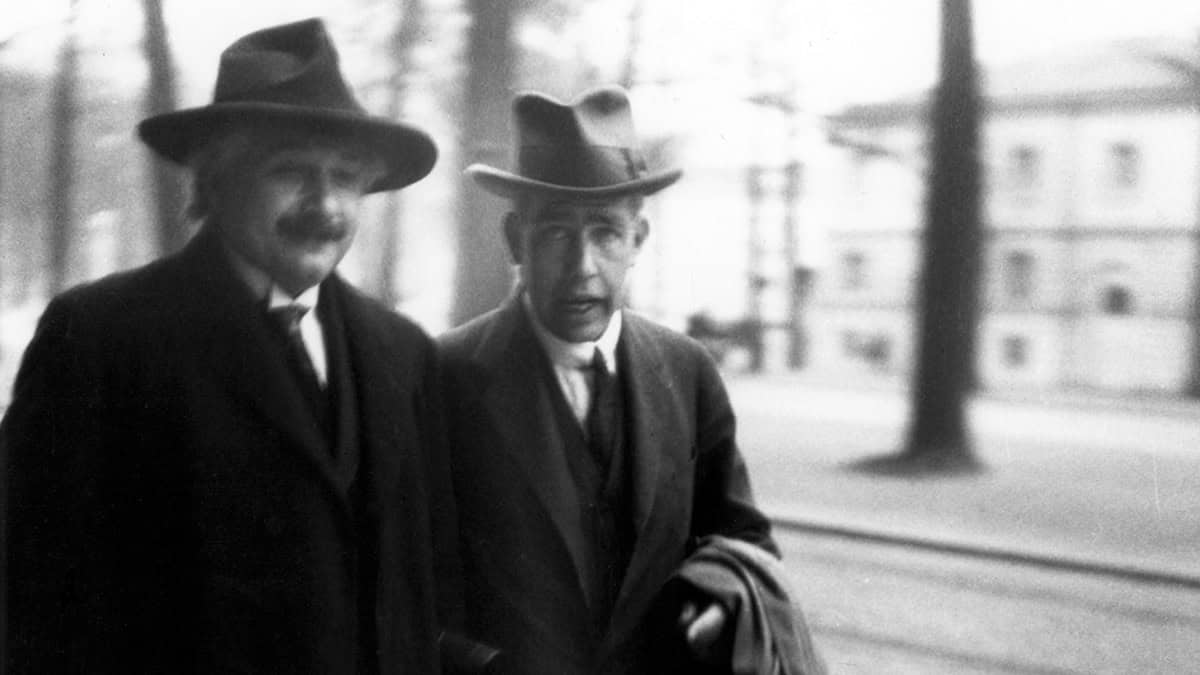
Conflicting views Stalwart physicists Albert Einstein and Niels Bohr had opposing views on quantum fundamentals from early on, which turned into a lifelong scientific argument between the two. (Paul Ehrenfest/Wikimedia Commons)
Niels Bohr had many good ideas in his long and distinguished career. But he also had a few that didn’t turn out so well, and this article by science writer Phil Ball focuses on one of them. Known as the Bohr-Kramers-Slater (BKS) theory, it was developed in 1923 with help from two of the assistants/students/acolytes who flocked to Bohr’s institute in Copenhagen. Several notable physicists hated it because it violated both causality and the conservation of energy, and within two years, experiments by Walther Boethe and Hans Geiger proved them right. The twist, though, is that Boethe went on to win a share of the 1954 Nobel Prize for Physics for this work – making Bohr surely one of the only scientists who won himself a Nobel Prize for his good ideas, and someone else a Nobel Prize for a bad one.
Black holes are fascinating objects in their own right. Who doesn’t love the idea of matter-swallowing cosmic maws floating through the universe? For some theoretical physicists, though, they’re also a way of exploring – and even extending – Einstein’s general theory of relativity. This article describes how thinking about black hole collisions inspired Jiaxi Wu, Siddharth Boyeneni and Elias Most to develop a new formulation of general relativity that mirrors the equations that describe electromagnetic interactions. According to this formulation, general relativity behaves the same way as the gravitational described by Isaac Newton more than 300 years ago, with the “gravito-electric” field fading with the inverse square of distance.
“Best of” lists are a real win-win. If you agree with the author’s selections, you go away feeling confirmed in your mutual wisdom. If you disagree, you get to have a good old moan about how foolish the author was for forgetting your favourites or including something you deem unworthy. Either way, it’s a success – as this very popular list of the top 5 Nobel Prizes for Physics awarded since the year 2000 (as chosen by Physics World editor-in-chief Matin Durrani) demonstrates.
We’re back to black holes again for the year’s second-most-read story, which focuses on a possible link between gravity and quantum information theory via the concept of entropy. Such a link could help explain the so-called black hole information paradox – the still-unresolved question of whether information that falls into a black hole is retained in some form or lost as the black hole evaporates via Hawking radiation. Fleshing out this connection could also shed light on quantum information theory itself, and the theorist who’s proposing it, Ginestra Bianconi, says that experimental measurements of the cosmological constant could one day verify or disprove it.
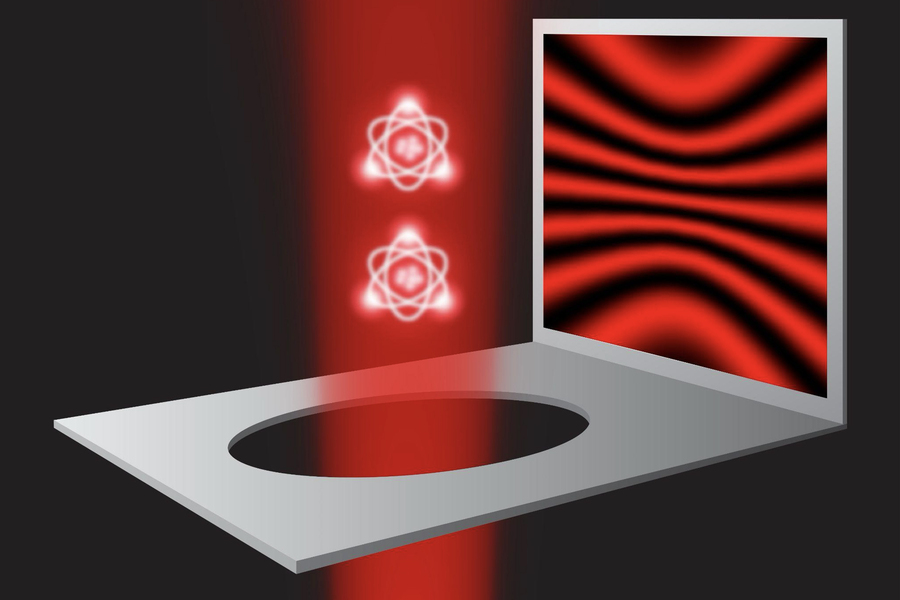
Experiment schematic Two single atoms floating in a vacuum chamber are illuminated by a laser beam and act as the two slits. The interference of the scattered light is recorded with a highly sensitive camera depicted as a screen. Incoherent light appears as background and implies that the photon has acted as a particle passing only through one slit. (Courtesy: Wolfgang Ketterle, Vitaly Fedoseev, Hanzhen Lin, Yu-Kun Lu, Yoo Kyung Lee and Jiahao Lyu)
Back in 2002, readers of Physics World voted Thomas Young’s electron double-slit experiment “the most beautiful experiment in physics”. More than 20 years later, it continues to fascinate the physics community, as this, the most widely read article of any that Physics World published in 2025, shows.
Young’s original experiment demonstrated the wave-like nature of electrons by sending them through a pair of slits and showing that they create an interference pattern on a screen even when they pass through the slits one-by-one. In this modern update, physicists at the Massachusetts Institute of Technology (MIT), US, stripped this back to the barest possible bones.
Using two single atoms as the slits, they inferred the path of photons by measuring subtle changes in the atoms’ properties after photon scattering. Their results matched the predictions of quantum theory: interference fringes when they didn’t observe the photons’ path, and two bright spots when they did.
It’s an elegant result, and the fact that the MIT team performed the experiment specifically to celebrate the International Year of Quantum Science and Technology 2025 makes its popularity with Physics World readers especially gratifying.
So here’s to another year full of elegant experiments and the theories that inspire them. Long may they both continue, and thank you, as always, for taking the time to read about them.
There’s only a few days left in the International Year of Quantum Science and Technology, but we’re still finding plenty to celebrate here at Physics World HQ thanks to a long list of groundbreaking work by quantum physicists in 2025. Here are a few of our favourite stories from the past 12 months.
By this point in 2025, “negative time” may sound like the answer to the question “How long have I got left to buy holiday presents for my loved ones?” Earlier in the year, though, physicists led by experimentalist Aephraim Steinberg of the University of Toronto, Canada and theorist Howard Wiseman of Griffith University in Australia showed that the concept can also describe the average amount of time a photon spends in an excited atomic state. While experts have cautioned against interpreting “negative time” too literally – we aren’t in time machine territory here – it does seem like there’s something interesting going on in this system of ultracold rubidium atoms.
It is a truth universally acknowledged that any sufficiently advanced technology must be in want of a simple system to operate it. In April, the quantum world passed this milestone thanks to Stephanie Wehner and colleagues at Delft University of Technology in the Netherlands. Their operating system is called QNodeOS, and they developed it with the aim of improving access to quantum computing for the 99.99999% percent of people who aren’t (and mostly don’t need to be) intimately familiar with how quantum information processors work. Another advantage of QNodeOS is that it makes it easier for classical and quantum machines (and quantum devices built with different qbit architectures) to communicate with each other.
How big does an object have to be before it stops being quantum and starts behaving like the billiard-ball-like solids familiar from introductory classical mechanics courses? It’s a question that featured in our annual “Breakthrough of the Year” back in 2021, when two independent teams demonstrated quantum entanglement in pairs of 10-micron drumheads, and we’re returning to it this year in a different system: levitated nanoparticles around 100 nm in diameter.
In one boundary-pushing experiment, Massimiliano Rossi and colleagues at ETH Zurich, Switzerland and the Institute of Photonic Sciences in Barcelona, Spain cooled silica nanoparticles enough to extend their wave-like behaviour to 73 pm. In another study, Kiyotaka Aikawa and colleagues at the University of Tokyo, Japan performed the first quantum mechanical squeezing on a nanoparticle, narrowing its velocity distribution at the expense of its momentum distribution. We may not know exactly where the quantum-classical boundary is yet, but the list of quantum behaviours we’ve observed in usually-not-quantum objects keeps getting longer.
What’s the best way to generate random numbers? In part, the answer depends on how random those numbers really need to be. For many applications, the pseudorandom numbers generated by classical computers, or the random-but-with-systematic-biases numbers found in, say, radio static, are good enough. But if you really, really need those numbers to be random, you need a quantum source – and thanks to work published this year by Scott Aaronson, Shi-Han Hung, Marco Pistoia and colleagues, that quantum source can now be a quantum computer. Which is a neat way of tying things together, don’t you think?
Quantum cats Left to right are UNSW researchers Benjamin Wilhelm, Xi Yu, Andrea Morello, Danielle Holmes. (Courtesy: UNSW Sydney)
Finally, we would be remiss not to mention the work of Andrea Morello and colleagues at the University of New South Wales, Australia. This year, they became the first to create quantum superpositions known as a Schrödinger’s cat states in a heavy atom, antimony, that has a large nuclear spin. They also created what is certainly the year’s best scientific team photo, posing with cats on their laps and deadpan expressions more usually associated with too-cool-for-school indie musicians.
So congratulations to them, and to all the other teams in this list, for setting the bar high in a year that offered plenty for the quantum community to celebrate. We hope you enjoyed the International Year of Quantum Science and Technology, and we look forward to many more exciting discoveries in 2026.
This episode of the Physics World Weekly podcast features Pat Hanrahan, who studied nuclear engineering and biophysics before becoming a founding employee of Pixar Animation Studios. As well as winning three Academy Awards for his work on computer animation, Hanrahan won the Association for Computing Machinery’s A M Turing Award for his contributions to 3D computer graphics, or CGI.
Earlier this year, Hanrahan spoke to Physics World’s Margaret Harris at the Heidelberg Laureate Forum in Germany. He explains how he was introduced to computer graphics by his need to visualize the results of computer simulations of nervous systems. That initial interest led him to Pixar and his development of physically-based rendering, which uses the principles of physics to create realistic images.
Hanrahan explains that light interacts with different materials in very different ways, making detailed animations very challenging. Indeed, he says that creating realistic looking skin is particularly difficult – comparing it to the quest for a grand unified theory in physics.
He also talks about how having a background in physics has helped his career – citing his physicist’s knack for creating good models and then using them to solve problems.
 Connexion