 Connexion
Institute of Physics celebrates 2025 Business Award winners at parliamentary event
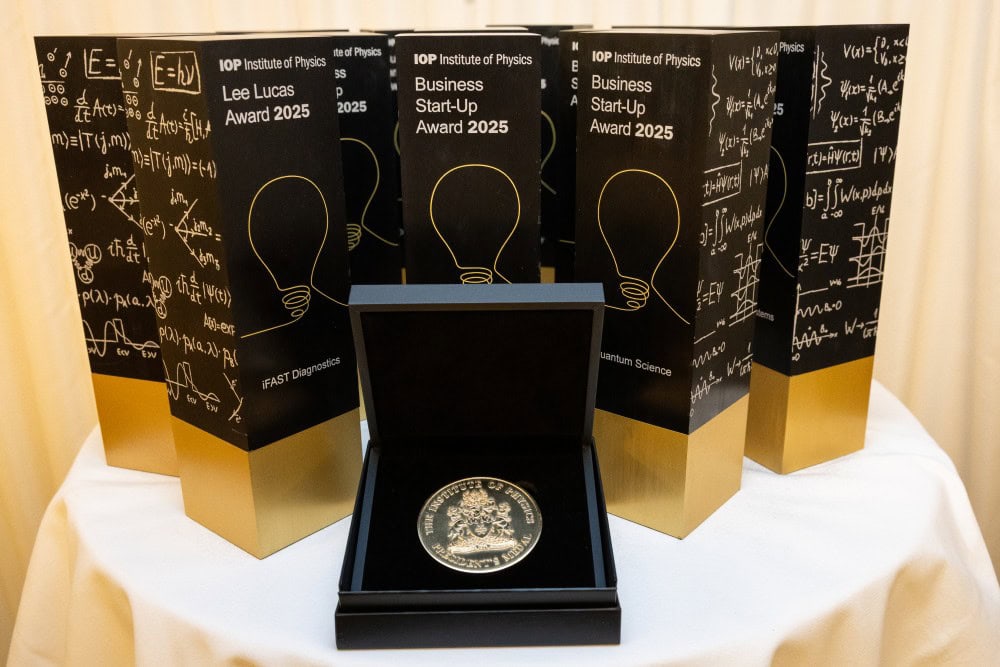
A total of 14 physics-based firms in sectors from quantum and energy to healthcare and aerospace have won 2025 Business Awards from the Institute of Physics (IOP), which publishes Physics World. The awards were presented at a reception in the Palace of Westminster yesterday attended by senior parliamentarians and policymakers as well as investors, funders and industry leaders.
The IOP Business Awards, which have been running since 2012, recognise the role that physics and physicists play in the economy, creating jobs and growth “by powering innovation to meet the challenges facing us today, ranging from climate change to better healthcare and food production”. More than 100 firms have now won Business Awards, with around 90% of those companies still commercially active.
The parliamentary event honouring the 2025 winners were hosted by Dave Robertson, the Labour MP for Lichfield, who spent 10 years as a physics teacher in Birmingham before working for teaching unions. There was also a speech from Baron Sharma, who studied applied physics before moving into finance and later becoming a Conservative MP, Cabinet minister and president of the COP-26 climate summit.
Seven firms were awarded 2025 IOP Business Innovation Awards, which recognize companies that have “delivered significant economic and/or societal impact through the application of physics”. They include Oxford-based Tokamak Energy, which has developed “compact, powerful, robust, quench-resilient” high-temperature superconducting magnets for commercial fusion energy and for propulsion systems, accelerators and scientific instruments.
Oxford Instruments was honoured for developing a novel analytical technique for scanning electron microscopes, enabling new capabilities and accelerating time to results by at least an order of magnitude. Ionoptika, meanwhile, was recognized for developing Q-One, which is a new generation of focused ion-beam instrumentation, providing single atom through to high-dose nanoscale advanced materials engineering for photonic and quantum technologies.
The other four winners were: electronics firm FlexEnable for their organic transistor materials; Lynkeos Technology for the development of muonography in the nuclear industry; the renewable energy company Sunamp for their thermal storage system; and the defence and security giant Thales UK for the development of a solid-state laser for laser rangefinders.
Business potential
Six other companies have won an IOP Start-up Award, which celebrates young companies “with a great business idea founded on a physics invention, with the potential for business growth and significant societal impact”. They include Astron Systems for developing “long-lifetime turbomachinery to enable multi-reuse small rocket engines and bring about fully reusable small launch vehicles”, along with MirZyme Therapeutics for “pioneering diagnostics and therapeutics to eliminate preeclampsia and transform maternal health”.
The other four winners were: Celtic Terahertz Technology for a metamaterial filter technology; Nellie Technologies for a algae-based carbon removal technology; Quantum Science for their development of short-wave infrared quantum dot technology; and Wayland Additive for the development and commercialisation of charge-neutralised electron beam metal additive manufacturing.
James McKenzie, a former vice-president for business at the IOP, who was involved in judging the awards, says that all awardees are “worthy winners”. “It’s the passion, skill and enthusiasm that always impresses me,” McKenzie told Physics World.
iFAST Diagnostics were also awarded the IOP Lee Lucas Award that recognises early-stage companies taking innovative products into the medical and healthcare sector. The firm, which was spun out of the University of Southampton, develops blood tests that can test the treatment of bacterial infections in a matter of hours rather than days. They are expecting to have approval for testing next year.
“Especially inspiring was the team behind iFAST,” adds McKenzie, “who developed a method to test very rapid tests cutting time from 48 hours to three hours, so patients can be given the right antibiotics.”
“The award-winning businesses are all outstanding examples of what can be achieved when we build upon the strengths we have, and drive innovation off the back of our world-leading discovery science,” noted Tom Grinyer, IOP chief executive officer. “In the coming years, physics will continue to shape our lives, and we have some great strengths to build upon here in the UK, not only in specific sectors such as quantum, semiconductors and the green economy, but in our strong academic research and innovation base, our growing pipeline of spin-out and early-stage companies, our international collaborations and our growing venture capital community.”
For the full list of winners, see here.
The post Institute of Physics celebrates 2025 Business Award winners at parliamentary event appeared first on Physics World.
