↩ Accueil

Vue normale

When heat moves sideways

7 janvier 2026 à 09:30

Heat travels across a metal by the movement of electrons. However, in an insulator there are no free charge carriers; instead, vibrations in the atoms (phonons) move the heat from hot regions to cool regions in a straight path. In some materials, when a magnetic field is applied, the phonons begin to move sideways, this is known as the Phonon Hall Effect. Quantised collective excitations of the spin structure, called magnons, can also do this via the Magnon Hall Effect. A combined effect occurs when magnons and phonons strongly interact and traverse sideways in the Magnon–Polaron Hall Effect.

Scientists understand the quantum mechanical property known as Berry curvature that causes this transverse heat flow. Yet in some materials, the effect is greater than what Berry curvature alone can explain. In this research, an exceptionally large thermal Hall effect is recorded in MnPS₃, an insulating antiferromagnetic material with strong magnetoelastic coupling and a spin-flop transition. The thermal Hall angle remains large down to 4 K and cannot be accounted for by standard Berry curvature-based models.

This work provides an in-depth analysis of the role of the spin-flop transition in MnPS₃’s thermal properties and highlights the need for new theoretical approaches to understand magnon–phonon coupling and scattering. Materials with large thermal Hall effects could be used to control heat in nanoscale devices such as thermal diodes and transistors.

Read the full article

Large thermal Hall effect in MnPS3

Mohamed Nawwar et al 2025 Rep. Prog. Phys. 88 080503

Do you want to learn more about this topic?

Quantum-Hall physics and three dimensions Johannes GoothStanislaw Galeski and Tobias Meng (2023)

The post When heat moves sideways appeared first on Physics World.
Symmetry‑preserving route to higher‑order insulators

7 janvier 2026 à 09:29

Topological insulators are materials that are insulating in the bulk within the bandgap, yet exhibit conductive states on their surface at frequencies within that same bandgap. These surface states are topologically protected, meaning they cannot be easily disrupted by local perturbations. In general, a material of n‑dimensions can host n‑1-dimensional topological boundary states. If the symmetry protecting these states is further broken, a bandgap can open between the n-1-dimensional states, enabling the emergence of n-2-dimensional topological states. For example, a 3D material can host 2D protected surface states, and breaking additional symmetry can create a bandgap between these surface states, allowing for protected 1D edge states. A material undergoing such a process is said to exhibit a phenomenon known as a higher-order topological insulator. In general, higher-order topological states appear in dimensions one lower than the parent topological phase due to the further unit-cell symmetry reduction. This requires at least a 2D lattice for second-order states, with the maximal order in 3D systems being three.

The researchers here introduce a new method for repeatedly opening the bandgap between topological states and generating new states within those gaps in an unbounded manner – without breaking symmetries or reducing dimensions. Their approach creates hierarchical topological insulators by repositioning domain walls between different topological regions. This process opens bandgaps between original topological states while preserving symmetry, enabling the formation of new hierarchical states within the gaps. Using one‑ and two‑dimensional Su–Schrieffer–Heeger models, they show that this procedure can be repeated to generate multiple, even infinite, hierarchical levels of topological states, exhibiting fractal-like behavior reminiscent of a Matryoshka doll. These higher-level states are characterized by a generalized winding number that extends conventional topological classification and maintains bulk-edge correspondence across hierarchies.

The researchers confirm the existence of second‑ and third-level domain‑wall and edge states and demonstrate that these states remain robust against perturbations. Their approach is scalable to higher dimensions and applicable not only to quantum systems but also to classical waves such as phononics. This broadens the definition of topological insulators and provides a flexible way to design complex networks of protected states. Such networks could enable advances in electronics, photonics, and phonon‑based quantum information processing, as well as engineered structures for vibration control. The ability to design complex, robust, and tunable hierarchical topological states could lead to new types of waveguides, sensors, and quantum devices that are more fault-tolerant and programmable.

Read the full article

Hierarchical topological states without dimension reduction

Joel R Pyfrom et al 2025 Rep. Prog. Phys. 88 118003

Do you want to learn more about this topic?

Interacting topological insulators: a review by Stephan Rachel (2018)

The post Symmetry‑preserving route to higher‑order insulators appeared first on Physics World.

Improving precision in muon g-2 calculations

17 décembre 2025 à 09:16

The gyromagnetic ratio is the ratio of a particle’s magnetic moment and its angular momentum. This value determines how a particle responds to a magnetic field. According to classical physics, muons should have a gyromagnetic ratio equal to 2. However, owing to quantum mechanics, there is a small difference between the expected gyromagnetic ratio and the observed value. This discrepancy is known as the anomalous magnetic moment.

The anomalous magnetic moment is incredibly sensitive to quantum fluctuations. It can be used to test the Standard Model of physics, and previous consistent experimental discrepancies have hinted at new physics beyond the Standard Model. The search for the anomalous magnetic moment is one of the most precise tests in modern physics.

To calculate the anomalous magnetic moment, experiments such as Fermilab’s Muon g-2 experiment have been set up where researchers measure the muon’s wobble frequency, which is caused by its magnetic moment. But effects such as hadronic vacuum polarization and hadronic light-by-light scattering cause uncertainty in the measurement. Unlike hadronic vacuum polarization, hadronic light-by-light cannot be directly extracted from experimental cross-section data, making it dependent on the model used and a significant computational challenge.

In this work, the researcher took a major step in resolving the anomalous magnetic moment of the muon. Their method calculated how the neutral pion contributes to hadronic light-by-light scattering, used domain wall fermions to preserve symmetry, employed eight different lattice configurations with variational pion masses, and introduced a pion structure function to find the key contributions in a model-independent method. The pion transition form factor was computed directly at arbitrary space-like photon momenta, and a Gegenbauer expansion was used to confirm that about 98% of the π⁰-pole contribution was determined in a model-independent way. The analysis also included finite-volume corrections and chiral and continuum extrapolations and yielded a value for the π⁰ decay width.

The development of a more accurate and model-independent anomalous magnetic moment for the muon has reduced major theoretical uncertainties and can make Standard Model precision tests more robust.

Do you want to learn more about this topic?

The muon Smasher’s guide Hind Al Ali et al (2022)

The post Improving precision in muon g-2 calculations appeared first on Physics World.

Diagnosing brain cancer without a biopsy

10 décembre 2025 à 10:19

Early diagnosis of primary central nervous system lymphoma (PCNSL) remains challenging because brain biopsies are invasive and imaging often lacks molecular specificity. A team led by researchers at Shenzhen University has now developed a minimally invasive fibre-optic plasmonic sensor capable of detecting PCNSL-associated microRNAs in the eye’s aqueous humor with attomolar sensitivity.

At the heart of the approach is a black phosphorus (BP)–engineered surface plasmon resonance (SPR) interface. An ultrathin BP layer is deposited on a gold-coated fiber tip. Because of the work-function difference between BP and gold, electrons transfer from BP into the Au film, creating a strongly enhanced local electric field at the metal–semiconductor interface. This BP–Au charge-transfer nano-interface amplifies refractive-index changes at the surface far more efficiently than conventional metal-only SPR chips, enabling the detection of molecular interactions that would otherwise be too subtle to resolve and pushing the limit of detection down to 21 attomolar without nucleic-acid amplification. The BP layer also provides a high-area, biocompatible surface for immobilizing RNA reporters.

To achieve sequence specificity, the researchers integrated CRISPR-Cas13a, an RNA-guided nuclease that becomes catalytically active only when its target sequence is perfectly matched to a designed CRISPR RNA (crRNA). When the target microRNA (miR-21) is present, activated Cas13a cleaves RNA reporters attached to the BP-modified fiber surface, releasing gold nanoparticles and reducing the local refractive index. The resulting optical shift is read out in real time through the SPR response of the BP-enhanced fiber probe, providing single-nucleotide-resolved detection directly on the plasmonic interface.

With this combined strategy, the sensor achieved a limit of detection of 21 attomolar in buffer and successfully distinguished single-base-mismatched microRNAs. In tests on aqueous-humor samples from patients with PCNSL, the CRISPR-BP-FOSPR assay produced results that closely matched clinical qPCR data, despite operating without any amplification steps.

Because aqueous-humor aspiration is a minimally invasive ophthalmic procedure, this BP-driven plasmonic platform may offer a practical route for early PCNSL screening, longitudinal monitoring, and potentially the diagnosis of other neurological diseases reflected in eye-fluid biomarkers. More broadly, the work showcases how black-phosphorus-based charge-transfer interfaces can be used to engineer next-generation, fibre-integrated biosensors that combine extreme sensitivity with molecular precision.

Do you want to learn more about this topic?

Theoretical and computational tools to model multistable gene regulatory networks by Federico BocciDongya JiaQing NieMohit Kumar Jolly and José Onuchic (2023)

The post Diagnosing brain cancer without a biopsy appeared first on Physics World.

5f electrons and the mystery of δ-plutonium

10 décembre 2025 à 10:18

Plutonium is considered a fascinating element. It was first chemically isolated in 1941 at the University of California, but its discovery was hidden until after the Second World War. There are six distinct allotropic phases of plutonium with very different properties. At ambient pressure, continuously increasing the temperature converts the room-temperature, simple monoclinic a phase through five phase transitions, the final one occurring at approximately 450°C.

The delta (δ) phase is perhaps the most interesting allotrope of plutonium. δ-plutonium is technologically important, has a very simple crystal structure, but its electronic structure has been debated for decades. Researchers have attempted to understand its anomalous behaviour and how the properties of δ-plutonium are connected to the 5f electrons.

The 5f electrons are found in the actinide group of elements which includes plutonium. Their behaviour is counterintuitive. They are sensitive to temperature, pressure and composition, and behave in both a localised manner, staying close to the nucleus and in a delocalised (itinerant) manner, more spread out and contributing to bonding. Both these states can support magnetism depending on actinide element. The 5f electrons contribute to δ-phase stability, anomalies in the material’s volume and bulk modulus, and to a negative thermal expansion where the δ-phase reduces in size when heated.

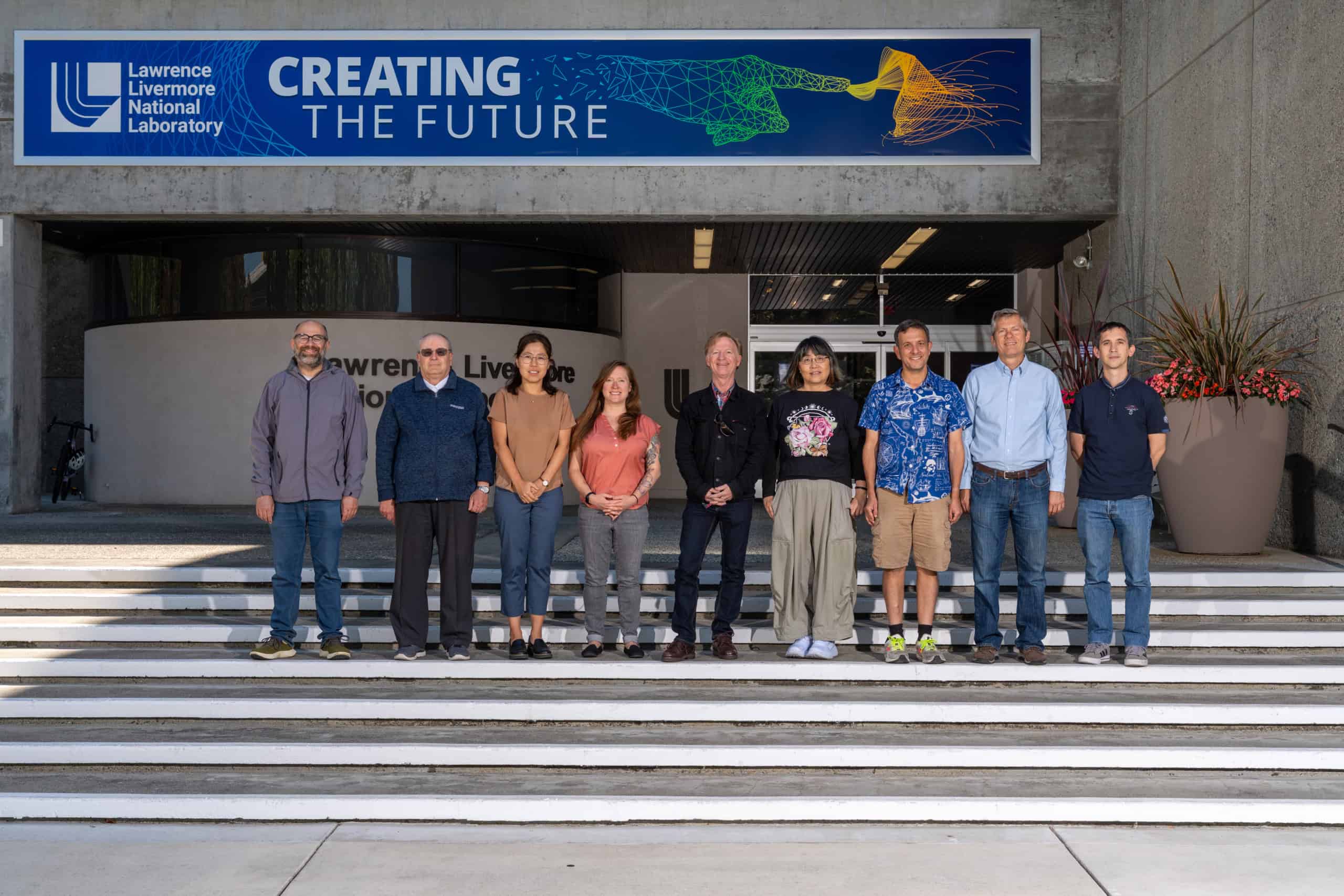
Research group from Lawrence Livermore National Laboratory
Research group from Lawrence Livermore National Laboratory. Left to right: Lorin Benedict, Alexander Landa, Kyoung Eun Kweon, Emily Moore, Per Söderlind, Christine Wu, Nir Goldman, Randolph Hood and Aurelien Perron. Not in image: Babak Sadigh and Lin Yang (Courtesy: Blaise Douros/Lawrence Livermore National Laboratory)

In this work, the researchers present a comprehensive model to predict the thermodynamic behaviour of δ-plutonium, which has a face-centred cubic structure. They use density functional theory, a computational technique that explores the overall electron density of the system and incorporate relativistic effects to capture the behaviour of fast-moving electrons and complex magnetic interactions. The model includes a parameter-free orbital polarization mechanism to account for orbital-orbital interactions, and incorporates anharmonic lattice vibrations and magnetic fluctuations, both transverse and longitudinal modes, driven by temperature-induced excitations. Importantly, it is shown that negative thermal expansion results from magnetic fluctuations.

This is the first model to integrate electronic effects, magnetic fluctuations, and lattice vibrations into a cohesive framework that aligns with experimental observations and semi-empirical models such as CALPHAD. It also accounts for fluctuating states beyond the ground state and explains how gallium composition influences thermal expansion. Additionally, the model captures the positive thermal expansion behaviour of the high-temperature epsilon phase, offering new insight into plutonium’s complex thermodynamics.

Read the full article

First principles free energy model with dynamic magnetism for δ-plutonium

Per Söderlind et al 2025 Rep. Prog. Phys. 88 078001

Do you want to learn more about this topic?

Pu 5f population: the case for n = 5.0 J G Tobin and M F Beaux II (2025)

The post 5f electrons and the mystery of δ-plutonium appeared first on Physics World.

❌