↩ Accueil

Vue normale

Quantum states that won’t entangle

4 février 2026 à 11:20

Quantum entanglement is a uniquely quantum link between particles that makes their properties inseparable. It underlies the power of many quantum technologies from secure communication to quantum computing, by enabling correlations impossible in classical physics.

Entanglement nevertheless remains poorly understood and is therefore the subject of a lot of research, both in the fields of quantum technologies as well as fundamental physics.

In this context, the idea of separability refers to a composite system that can be written as a simple product (or mixture of products) of the states of its individual parts. This implies there is no entanglement between them and to create entanglement, a global transformation is needed.

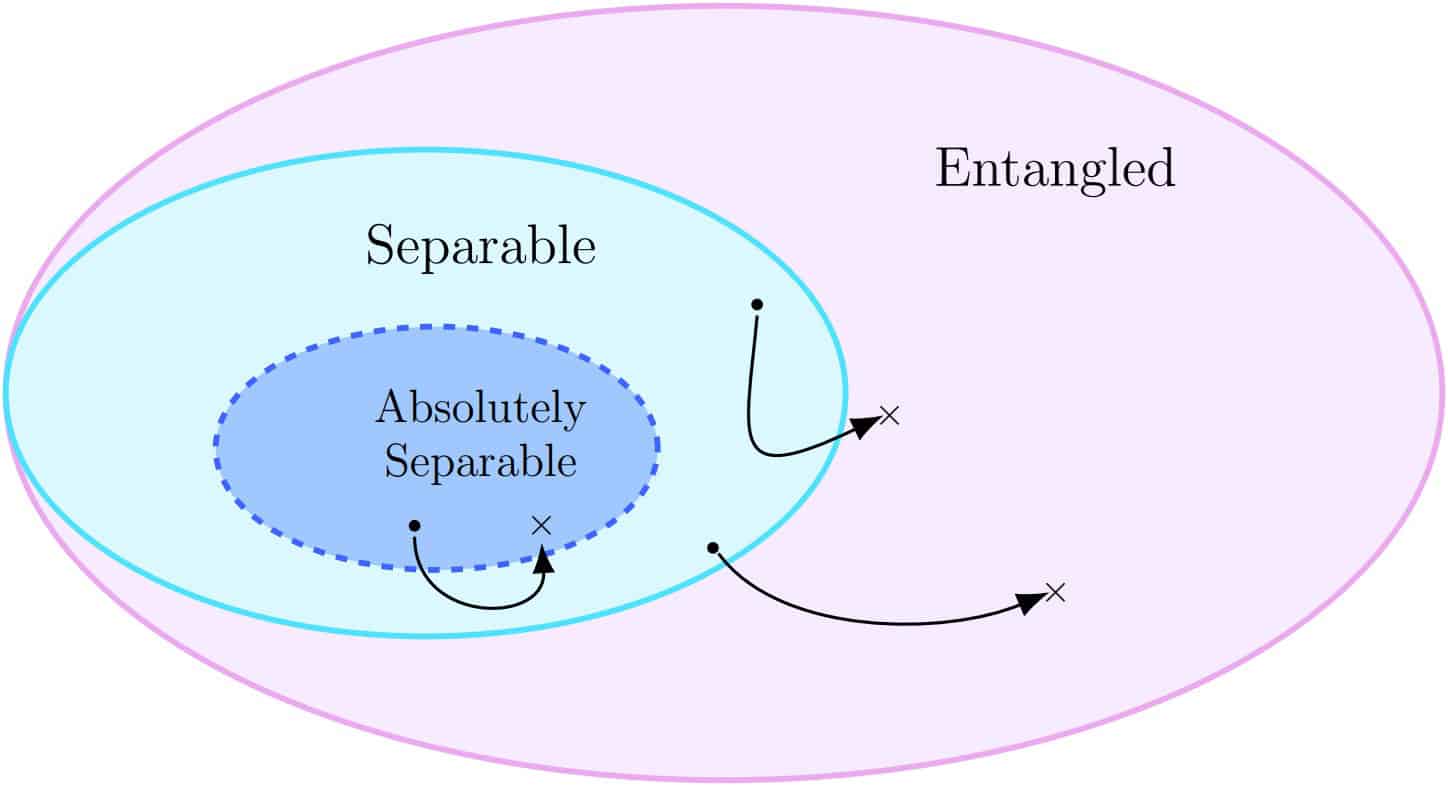
A system that remains completely free of entanglement, even after any possible global invertible transformation is applied, is called absolutely separable.  In other words, it can never become entangled under the action of quantum gates.
Absolutely separable
Separable, Absolutely Separable and Entangled sets: It is impossible to make absolutely separable states entangled with a global transformation (Courtesy J. Abellanet Vidal and A. Sanpera Trigueros)

Necessary and sufficient conditions to ensure separability exist only in the simplest cases or for highly restricted families of states. In fact, entanglement verification and quantification is known to be generically an NP-hard problem.

Recent research published by a team of researchers from Spain and Poland has tackled this problem head-on. By introducing new analytical tools such as linear maps and their inverses, they were able to identify when a quantum state is guaranteed to be absolutely separable.

These tools work in any number of dimensions and allow the authors to pinpoint specific states that are on the border of being absolutely separable or not (mathematically speaking, ones that lie on the boundary of the set). They also show how different criteria for absolute separability, which may not always agree with each other, can be combined and refined using convex geometry optimisation.

Being able to more easily and accurately determine whether a quantum state is absolutely separable will be invaluable in quantum computation and communication.

The team’s results for multipartite systems (systems with more than two parts) also reveal how little we currently understand about the entanglement properties of mixed, noisy states. This knowledge gap suggests that much more research is needed in this area.

Read the full article

Sufficient criteria for absolute separability in arbitrary dimensions via linear map inverses – IOPscience

J. Abellanet Vidal et al, 2025 Rep. Prog. Phys. 88 107601

The post Quantum states that won’t entangle appeared first on Physics World.

The secret limits governing quantum relaxation

4 février 2026 à 10:56

When we interact with everyday objects, we take for granted that physical systems naturally settle into stable, predictable states. A cup of coffee cools down. A playground swing slows down after being pushed.  Quantum systems, however, behave very differently.

These systems can exist in multiple states at once, and their evolution is governed by probabilities rather than certainties. Nevertheless, even these strange systems do eventually relax and settle down, losing information about their earlier state. The speed at which this happens is called the relaxation rate.

Relaxation rates tell us how fast a quantum system forgets its past, how quickly it thermalises, reaches equilibrium, decoheres, or dissipates energy. These rates are important not just for theorists but also for experimentalists, who can measure them directly in the lab.

Recently, researchers discovered that these rates obey a surprisingly universal rule. For a broad class of quantum processes (those described by what physicists call Markovian semigroups) the fastest possible relaxation rate cannot exceed a certain limit. Specifically, it must be no larger than the sum of all relaxation rates divided by the system’s dimension. This constraint, originally a conjecture, was first proven using tools from classical mathematics known as Lyapunov theory.

In a new paper published recently, an international team of researchers provided a new, more direct algebraic proof of this universal bound. There are a number of advantages of the new proof compared to the older one, and it can be generalised more easily, but that’s not all.

The very surprising outcome of their work is that the rule doesn’t require complete positivity. Instead, a weaker condition – two‑positivity is enough. The distinction between these two requirements is crucial.

Essentially, both are measures of how well-behaved a quantum system is, how it is protected from providing nonsensical results. The difference is that two-positivity is slightly less stringent but far more general, and hence very useful for many real-world applications.

The fact that the new proof only requires two-positivity means that it this new universal relaxation rate can actually be applied to a lot more scenarios.

What’s more, even when weakened even further, a slightly softer version of the universal constraint still holds. This shows that the structure behind these bounds is richer and more subtle than previously understood.

Read the full article

A universal constraint for relaxation rates for quantum Markov generators: complete positivity and beyond – IOPscience

D. Chruściński et al, 2025 Rep. Prog. Phys. 88 097602

The post The secret limits governing quantum relaxation appeared first on Physics World.

How do bacteria produce entropy?

28 janvier 2026 à 10:02

Active matter is matter composed of large numbers of active constituents, each of which consumes chemical energy in order to move or to exert mechanical forces.

This type of matter is commonly found in biology: swimming bacteria or migrating cells are both classic examples. In addition, a wide range of synthetic systems, such as active colloids or robotic swarms, can also fall into this umbrella.

Active matter has therefore been the focus of much research over the past decade, unveiling many surprising theoretical features and a suggesting a plethora of applications.

Perhaps most importantly, these systems’ ability to perform work leads to sustained non-equilibrium behaviour. This is distinctly different from that of relaxing equilibrium thermodynamic systems, commonly found in other areas of physics.

The concept of entropy production is often used to quantify this difference and to calculate how much useful work can be performed. If we want to harvest and utilise this work however, we need to understand the small-scale dynamics of the system. And it turns out this is rather complicated.

One way to calculate entropy production is through field theory, the workhorse of statistical mechanics. Traditional field theories simplify the system by smoothing out details, which works well for predicting densities and correlations. However, these approximations often ignore the individual particle nature, leading to incorrect results for entropy production.

The new paper details a substantial improvement on this method. By making use of Doi-Peliti field theory, they’re able to keep track of microscopic particle dynamics, including reactions and interactions.

The approach starts from the Fokker-Planck equation and provides a systematic way to calculate entropy production from first principles. It can be extended to include interactions between particles and produces general, compact formulas that work for a wide range of systems. These formulas are practical because they can be applied to both simulations and experiments.

The authors demonstrated their method with numerous examples, including systems of Active Brownian Particles, showing its broad usefulness. The big challenge going forward though is to extend their framework to non-Markovian systems, ones where future states depend on the present as well as past states.

Read the full article

Field theories of active particle systems and their entropy production – IOPscience

G. Pruessner and R. Garcia-Millan, 2025 Rep. Prog. Phys. 88 097601

The post How do bacteria produce entropy? appeared first on Physics World.

Non-Abelian anyons: anything but easy

21 janvier 2026 à 08:42

Topological quantum computing is a proposed approach to building quantum computers that aims to solve one of the biggest challenges in quantum technology: error correction.

In conventional quantum systems, qubits are extremely sensitive to their environment and even tiny disturbances can cause errors. Topological quantum computing addresses this by encoding information in the global properties of a system: the topology of certain quantum states.

These systems rely on the use of non-Abelian anyons, exotic quasiparticles that can exist in two-dimensional materials under special conditions.

The main challenge faced by this approach to quantum computing is the creation and control of these quasiparticles.

One possible source of non-Abelian anyons is the fractional quantum Hall state (FQH): an exotic state of matter which can exist at very low temperatures and high magnetic fields.

These states come in two forms: even-denominator and odd-denominator. Here, we’re interested in the even-denominator states – the more interesting but less well understood of the two.

In this latest work, researchers have observed this exotic state in gallium arsenide (GaAs) two-dimensional hole systems.

Typically, FQH states are isotropic, showing no preferred direction. Here, however, the team found states that are strongly anisotropic, suggesting that the system spontaneously breaks rotational symmetry.

This means that it forms a nematic phase – similar to liquid crystals – where molecules align along a direction without forming a rigid structure.

This spontaneous symmetry breaking adds complexity to the state and can influence how quasiparticles behave, interact, and move.

The observation of the existence of spontaneous nematicity in an even-denominator fractional quantum Hall state is the first of its kind.

Although there are many questions left to be answered, the properties of this system could be hugely important for topological quantum computers as well as other novel quantum technologies.

Read the full article

Even-denominator fractional quantum Hall states with spontaneously broken rotational symmetry – IOPscience

C. Wang et al 2025 Rep. Prog. Phys. 88 100501

The post Non-Abelian anyons: anything but easy appeared first on Physics World.

How does quantum entanglement move between different particles?

17 décembre 2025 à 09:16

Entanglement is a phenomenon where two or more particles become linked in such a way that a measurement on one of the particles instantly influences the state of the other, no matter how far apart they are. It is a defining property of quantum mechanics, which is key to all quantum technologies and remains a serious challenge to realize in large systems.

However, a team of researchers from Sweden and Spain has recently made a large step forward in the field of ultrafast entanglement. Here, pairs of extreme ultraviolet pulses are used to exert quantum control on the attosecond timescale (a few quintillionths of a second).

Specifically, they studied ultrafast photoionisation. In this process, a high-energy light pulse hits an atom, ejecting an electron and leaving behind an ion.

This process can create entanglement between the electron and the ion in a controlled way. However, the entanglement is fragile and can be disrupted or transferred as the system evolves.

For instance, as the newly-created ion emits a photon to release energy, the entanglement shifts from the electron – ion pair to the electron–photon pair. This transfer process takes a considerable amount of time, on the scale of 10s of nanoseconds. This means that the ion-electron pair is macroscopically separated, on the centimetre scale.

The team found that during this transition, all three particles – electron, ion, and photon – are entangled together in a multipartite state.

They did this by using a mathematical tool called von Neumann entropy to track how much information is shared between all three particles.

Although this work was purely theoretical, they also proposed an experimental method to study entanglement transfer. The setup would use two synchronised free-electron laser pulses, with attosecond precision, to measure the electron’s energy and to detect if a photon was emitted. By measuring both particles in coincidence, entanglement can be detected.

The results could be generalised to other scenarios and will help us understand how quantum information can move between different particles.  This brings us one small step closer to future technologies like quantum communication and computing.

Read the full article

Entanglement transfer in a composite electron–ion–photon system – IOPscience

A. Stenquist et al 2025 Rep. Prog. Phys. 88 080502


The post How does quantum entanglement move between different particles? appeared first on Physics World.

❌