↩ Accueil

Vue normale

The secret life of TiO₂ in foams

26 janvier 2026 à 17:31

Porous carbon foams are an exciting area of research because they are lightweight, electrically conductive, and have extremely high surface areas. Coating these foams with TiO₂ makes them chemically active, enabling their use in energy storage devices, fuel cells, hydrogen production, CO₂‑reduction catalysts, photocatalysis, and thermal management systems. While many studies have examined the outer surfaces of coated foams, much less is known about how TiO₂ coatings behave deep inside the foam structure.

In this study, researchers deposited TiO₂ thin films onto carbon foams using magnetron sputtering and applied different bias voltages to control ion energy, which in turn affects coating density, crystal structure, thickness, and adhesion. They analysed both the outer surface and the interior of the foam using microscopy, particle‑transport simulations, and X‑ray techniques.

They found that the TiO₂ coating on the outer surface is dense, correctly composed, and crystalline (mainly anatase with a small amount of rutile) ideal for catalytic and energy applications. They also discovered that although fewer particles reach deep inside the foam, those do retain the same energy, meaning particle quantity decreases with depth but particle energy does not. Because devices like batteries and supercapacitors rely on uniform coatings, variations in thickness or structure inside the foam can lead to poorer performance and faster degradation.

Overall, this research provides a much clearer understanding of how TiO₂ coatings grow inside complex 3D foams, showing how thickness, density, and crystal structure evolve with depth and how bias voltage can be used to tune these properties. By revealing how plasma particles move through the foam and validating models that predict coating behaviour, it enables the design of more reliable, higher‑performing foam‑based devices for energy and catalytic applications.

Read the full article

A comprehensive multi-scale study on the growth mechanisms of magnetron sputtered coatings on open-cell 3D foams

Loris Chavée et al 2026 Prog. Energy 8 015002

Do you want to learn more about this topic?

Advances in thermal conductivity for energy applications: a review Qiye Zheng et al. (2021)

The post The secret life of TiO₂ in foams appeared first on Physics World.

Laser processed thin NiO powder coating for durable anode-free batteries

26 janvier 2026 à 17:30

Traditional lithium‑ion batteries use a thick graphite anode, where lithium ions move in and out of the graphite during charging and discharging. In an anode‑free lithium metal battery, there is no anode material at the start, only a copper foil. During the first charge, lithium leaves the cathode and deposits onto the copper as pure lithium metal, effectively forming the anode. Removing the anode increases energy density dramatically by reducing weight, and it also simplifies and lowers the cost of manufacturing. Because of this, anode‑free batteries are considered to have major potential for next‑generation energy storage. However, a key challenge is that lithium deposits unevenly on bare copper, forming long needle‑like dendrites that can pierce the separator and cause short circuits. This uneven growth also leads to rapid capacity loss, so anode‑free batteries typically fail after only a few hundred cycles.

In this research, the scientists coated the copper foil with NiO powder and used a CO₂ laser (l = 10.6 mm) to rapidly heat the same in a rapid scanning mode to transform it. The laser‑treated NiO becomes porous and strongly adherent to the copper, helping lithium spread out more evenly. The process is fast, energy‑efficient, and can be done in air. As a result, lithium ions diffuse or move more easily across the surface, reducing dendrite formation. The exchange current density also doubled compared to bare copper, indicating better charge‑transfer behaviour. Overall, battery performance improved dramatically. The modified cells lasted 400 cycles at room temperature and 700 cycles at 40°C, compared with only 150 cycles for uncoated copper.

This simple, rapid, and scalable technique offers a powerful way to improve anode‑free lithium metal batteries, one of the most promising next‑generation battery technologies.

Read the full article

Microgradient patterned NiO coating on copper current collector for anode-free lithium metal battery

Supriya Kadam et al 2025 Prog. Energy 7 045003

Do you want to learn more about this topic?

Lithium aluminum alloy anodes in Li-ion rechargeable batteries: past developments, recent progress, and future prospects by Tianye Zheng and Steven T Boles (2023)

The post Laser processed thin NiO powder coating for durable anode-free batteries appeared first on Physics World.

Planning a sustainable water future in the United States

26 janvier 2026 à 17:28

Within 45 years, water demand in the United States is predicted to double, while climate change is expected to worsen freshwater supplies, with 44% of the country already experiencing some form of drought. One way to expand water resources is desalination, where salt is removed from seawater or brackish groundwater to make clean, usable water. Brackish groundwater contains far less salt than seawater, making it much easier and cheaper to treat, and the United States has vast reserves of it in deep aquifers. The challenge is that desalination traditionally requires a lot of energy and produces a concentrated brine waste stream that is difficult and costly to dispose of. As a result, desalination currently provides only about 1% of the nation’s water supply, even though it is a major source of drinking water in regions such as the Middle East and North Africa.

Researchers Vasilis Fthenakis (left) and Zhuoran Zhang (right) from Columbia University taken at Nassau Point in Long Island
Researchers Vasilis Fthenakis (left) and Zhuoran Zhang (right) from Columbia University taken at Nassau Point in Long Island (Courtesy: Zhuoran Zhang, Columbia University)

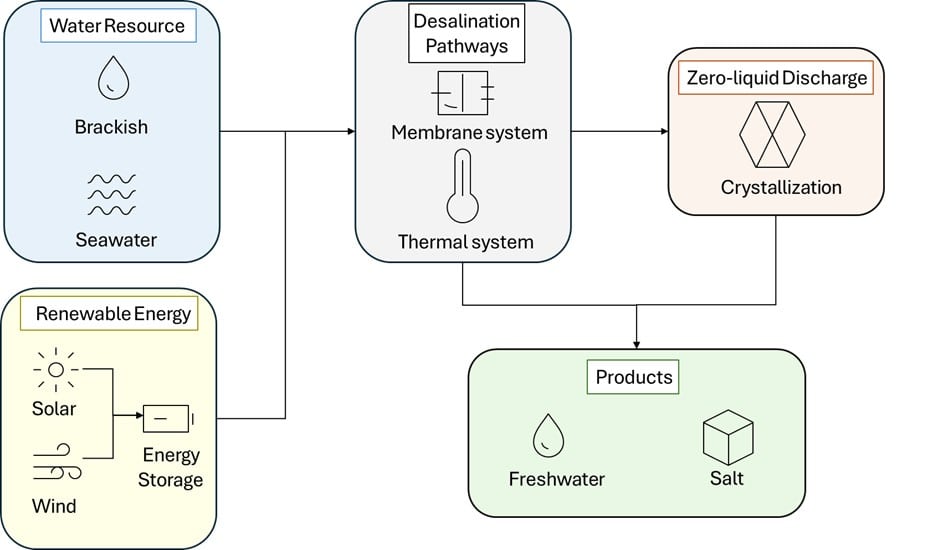
In this work, the researchers show how desalination of brackish groundwater can be made genuinely sustainable and economically viable for addressing the United States’ looming water shortages. A key part of the solution is zero‑liquid‑discharge, which avoids brine disposal by extracting more freshwater and recovering salts such as sodium, calcium, and magnesium for reuse. Crucially, the study demonstrates that when desalination is powered by low‑cost solar and wind energy, the overall process becomes far more affordable. By 2040, solar photovoltaics paired with optimised battery storage are projected to produce electricity at lower cost than the grid in the states facing the largest water deficits, making renewable‑powered desalination a competitive option.

The researchers also show that advanced technologies, such as high‑recovery reverse osmosis and crystallisation, can achieve zero‑liquid‑discharge without increasing costs, because the extra water and salt recovery offsets the expense of brine management. Their modelling indicates that a full renewable‑powered zero‑liquid‑discharge pathway can produce freshwater at an affordable cost, while reducing environmental impacts and avoiding brine disposal altogether. Taken together, this work outlines a realistic, sustainable pathway for large‑scale desalination in the United States, offering a credible strategy for securing future water supplies in increasingly water‑stressed regions.

Progress diagram adapted from article
Progress diagram adapted from article (Courtesy: Zhuoran Zhang, Columbia University)

Do you want to learn more about this topic?

Review of solar-enabled desalination and implications for zero-liquid-discharge applications by Vasilis Fthenakis et al. (2024)


The post Planning a sustainable water future in the United States appeared first on Physics World.

❌