Connexion
Joined-up thinking in quantum metrology: why collaboration is the secret of success
The UNESCO International Year of Quantum Science and Technology (IYQ) ends on an exotic flourish this month, with the official closing ceremony – which will be live-streamed from Accra, Ghana – looking back on what’s been a global celebration “observed through activities at all levels aimed at increasing public awareness of the importance of quantum science and applications”.
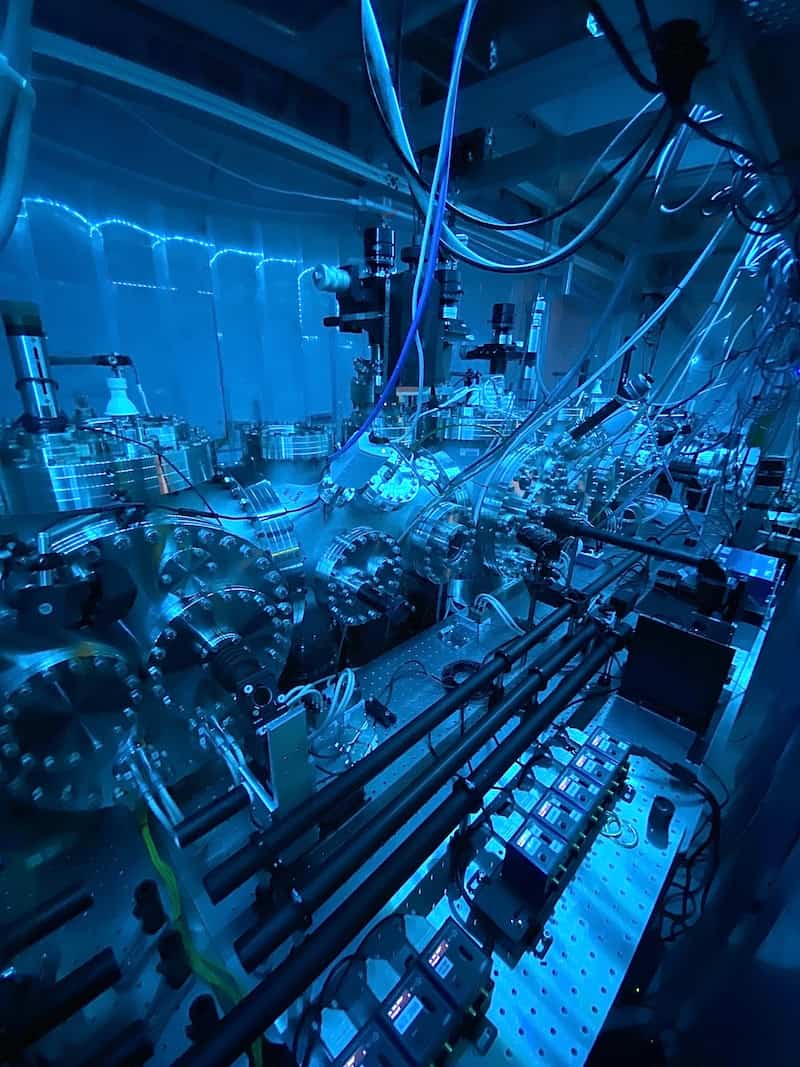
The timing of IYQ has proved apposite, mirroring as it does a notable inflection point within the quantum technology sector. Advances in fundamental quantum science and applied R&D are accelerating on a global scale, harnessing the exotic properties of quantum mechanics – entanglement, tunnelling, superposition and the like – to underpin practical applications in quantum computing and quantum communications.
Quantum metrology, meanwhile, has progressed from its roots in fundamental physics to become a cornerstone of technology innovation, yielding breakthroughs in fields such as precision timing, navigation, cryptography and advanced imaging – and that’s just for starters.
Collaborate to accelerate
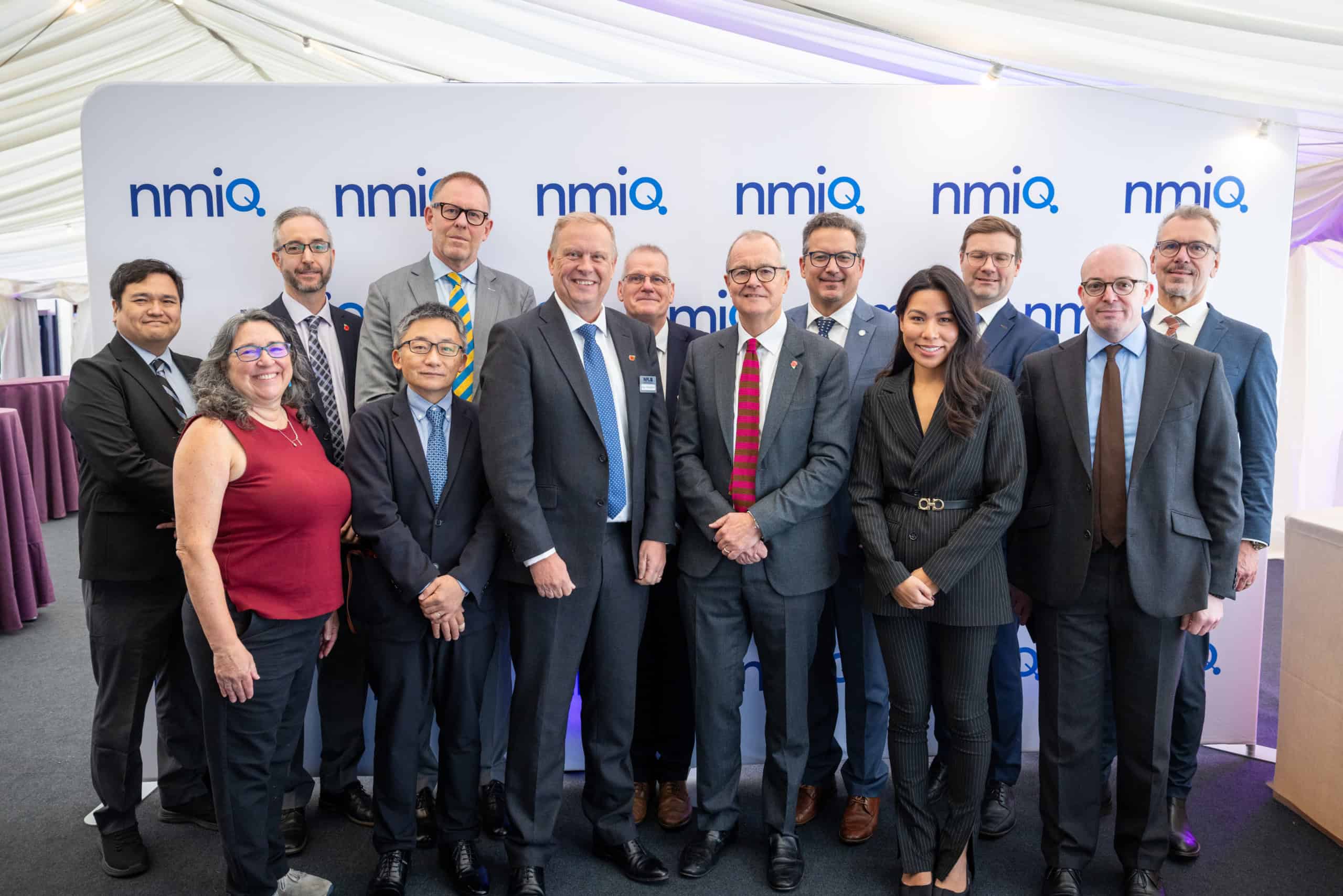
Notwithstanding all this forward motion, IYQ has also highlighted significant challenges when it comes to scaling quantum systems, achieving fault tolerance and ensuring reproducible performance. Enter NMI-Q, an international initiative that leverages the combined expertise of the world’s leading National Metrology Institutes (NMIs) – from the G7 countries and Australia – to accelerate the adoption of foundational hardware and software technologies for quantum computing systems and the quantum internet.

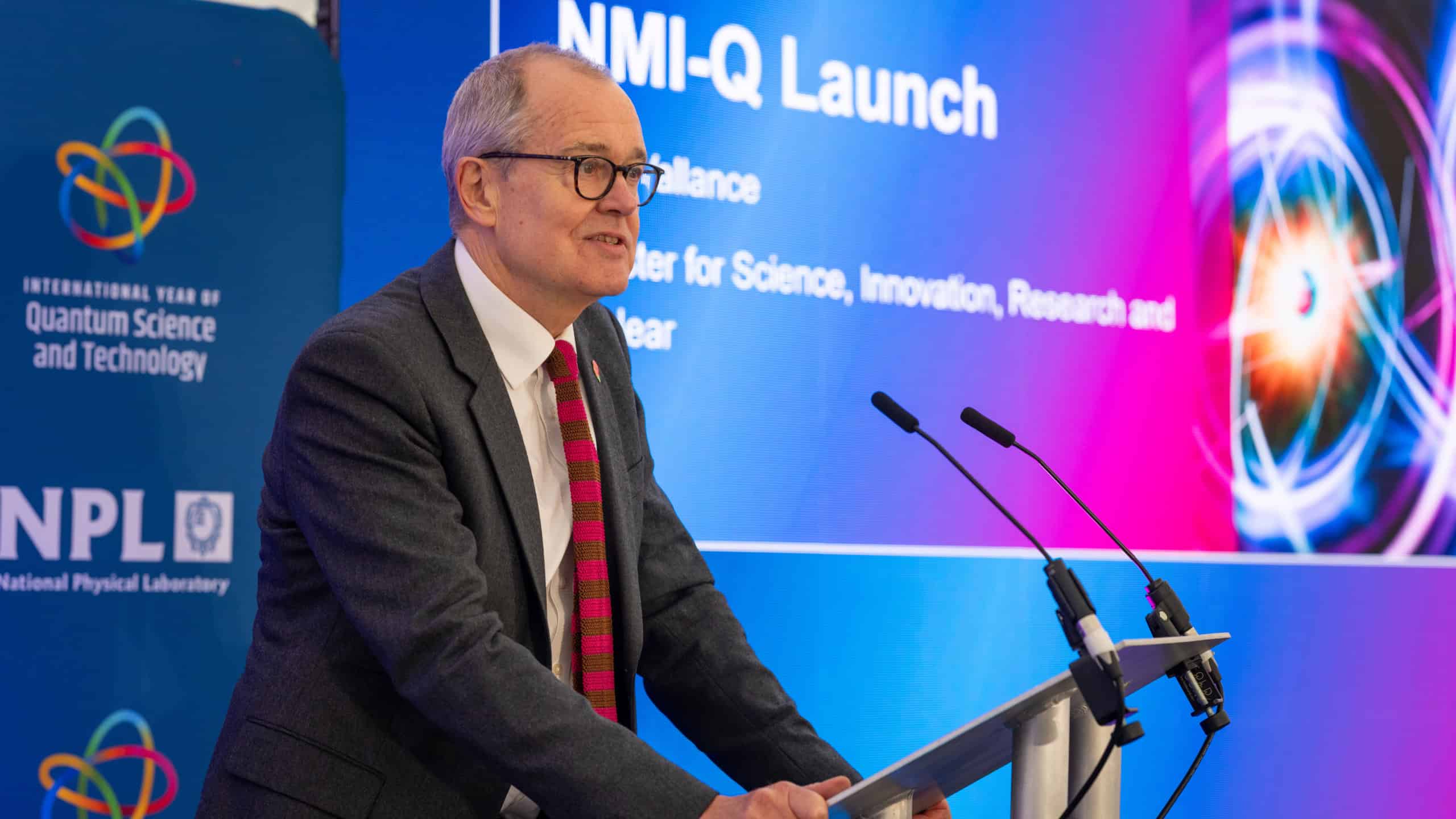
The NMI-Q partnership was officially launched in November last year at the IYQ conference “Quantum Metrology: From Foundations to the Future”, an event hosted by NPL. Together, the respective NMIs will conduct collaborative pre-standardization research; develop a set of “best measurement practices” needed by industry to fast-track quantum innovation; and, ultimately, shape the global standardization effort in quantum technologies.
“NMI-Q has an ambitious and broad-scope brief, but it’s very much a joined-up effort when it comes to the division of labour,” says Cyrus Larijani, NPL’s head of quantum programme. The rationale being that no one country can do it all when it comes to the performance metrics, benchmarks and standards needed to take quantum breakthroughs out of the laboratory and into the commercial mainstream.
Post-launch, NMI-Q has received a collective “uptick” from the quantum community, with the establishment of internationally recognized standards and trusted benchmarks seen as core building blocks for the at-scale uptake and interoperability of quantum technologies. “What’s more,” adds Larijani, “there’s a clear consensus for collaboration over competition [between the NMIs], supported by shared development roadmaps and open-access platforms to avoid fragmentation and geopolitical barriers.”
Follow the money
In terms of technology push, the scale of investment – both public and private sector – in all things quantum means that the nascent supply chain is evolving at pace, linking component manufacturers, subsystem developers and full-stack quantum computing companies. That’s reinforced by plenty of downstream pull: all sorts of industries – from finance to healthcare, telecoms to energy generation – are seeking to understand the commercial upsides of quantum technologies, but don’t yet have the necessary domain knowledge and skill sets to take full advantage of the opportunities.
Given that context, the onus is on NMI-Q to pool its world-leading expertise in quantum metrology to inform evidence-based decision-making among key stakeholders in the “quantum ecosystem”: investors, policy-makers, manufacturers and, ultimately, the end-users of quantum applications. “Our task is to make sure that quantum technologies are built on reliable, scalable and interoperable foundations,” notes Larijani. “That’s the crux of where we’re going with NMI-Q.”
Right now, NPL and its partner NMIs are busy shaping NMI-Q’s work programme and deliverables for 2026 and beyond, with the benchmarking of quantum computers very much front-and-centre. Their challenge lies in the diversity of quantum hardware platforms in the mix; also the emergence of two different approaches to quantum computing – one being a gate-based framework for universal quantum computation, the other an analogue approach tailored to outperforming classical computers on specific tasks.
“In this start-up phase, it’s all about bringing everyone together to define and assign the granular NMI-Q work packages and associated timelines,” says Larijani. Operational and strategic alignment is also mandatory across the member NMIs, so that each laboratory (and its parent government) is fully on board with the collaboration’s desired outcomes. “It’s going very well so far in terms of aligning members’ national interests versus NMI-Q’s direction of travel,” adds Larijani. “This emphasis on ‘science diplomacy’, if you like, will remain crucial to our success.”
Long term, NMI-Q’s development of widely applicable performance metrics, benchmarks and standards will, it is hoped, enable the quantum technology industry to achieve critical mass on the supply side, with those economies of scale driving down prices and increasing demand.
“Ultimately, though, we want NMI-Q to blossom into something much bigger than the individual NMIs, spanning out to engage the supply chains of member countries,” says Larijani. “It’s really important for NPL and the NMI-Q partners to help quantum companies scale their offerings, advance their technology readiness level and, sooner than later, get innovative products and services into the market.”
That systematic support for innovation and technology translation is evident on the domestic front as well. The UK Quantum Standards Network Pilot – which is being led by NPL – brings together representatives from industry (developers and end-users), academia and government to work on all aspects of standards development and ensure that UK quantum technology companies have access to global supply chains and markets.
Quantum impact
So what does success look like for Larijani in 2026? “We’re really motivated to work with as many quantum companies as we can – to help these organizations launch new quantum products and applications,” he explains. Another aspiration is to encourage industry partners to co-locate their R&D and innovation activities within NPL’s Institute for Quantum Standards and Technology.
“There are moves to establish a quantum technology cluster at NPL to enable UK and overseas companies to access our specialist know-how and unique measurement capability,” Larijani concludes. “Equally, as a centre-of-excellence in quantum science, we can help to scale the UK quantum workforce as well as encourage our own spin-out ventures in quantum metrology.”
Quantum futures: inclusive, ethical, sustainable
“Quantum Metrology: From Foundations to the Future” was held at NPL as part of UNESCO’s IYQ global celebrations. Organized by a steering committee of NMI-Q members, the conference explored quantum metrology and standards as enablers of technology innovation; also their role as “a cornerstone for trust, interoperability, and societal benefit in quantum innovation and adoption”.
The commitments below – articulated as formal recommendations for UNESCO – reflect the collective vision of conference delegates for an inclusive, ethical and sustainable quantum future…
- Governance and ethics: attendees emphasized the need for robust governance and ethical oversight in quantum technologies. They called for the establishment of neutral international bodies, ideally under UN leadership, to ensure fair and transparent governance. Inclusivity was highlighted as essential, with a strong focus on extending benefits to developing nations and maintaining open dialogue. Concerns were raised about risks linked to scalability, security and potential misuse by non-state actors, underscoring the importance of proactive monitoring.
- Standards and infrastructure: participants advocated for sustained funding to develop international standards and benchmarking frameworks. They also stressed the value of shared fabrication facilities and testbeds to democratize access and accelerate innovation globally.
- Education and talent: education and talent development emerged as a priority, with recommendations to launch fully funded MSc programmes, practical placements and mentoring networks. Strengthening links between industry and academia, alongside outreach to schools, are seen as vital for early engagement and long-term skills development.
- Societal impact: delegates urged that societal impact remain central to quantum initiatives. Applications in healthcare, climate modelling and sustainability should be a priority; also arts and cultural integration efforts to foster public understanding and ethical reflection.
Further reading
- Performance metrics and benchmarks point the way to practical quantum advantage
- Why quantum metrology is the driving force for best practice in quantum standardization
- Podcast – Quantum metrology at NPL: we explore the challenges and opportunities
NPL retains copyright on this article.
The post Joined-up thinking in quantum metrology: why collaboration is the secret of success appeared first on Physics World.