↩ Accueil

Vue normale

PowerColor Radeon RX 9070 XT Reva Review

Par :W1zzard
28 novembre 2025 à 21:40
The PowerColor RX 9070 XT Reva is the company's latest character-driven GPU model. In our testing, it delivered impressively low noise levels, making it the quietest RX 9070 XT we've ever reviewed. It also includes a small factory overclock, dual BIOS, and RGB lighting with a dedicated off switch.

La danse des télescopes et des rayons gamma

28 novembre 2025 à 15:04

L’installation de télescopes de grande taille aux Canaries pousse des astronomes à jouer les alpinistes. Objectif de ces instruments : étudier des objets et des événements très lointains tels que les sursauts gamma et les noyaux actifs de galaxies. Un reportage en partenariat avec Le Monde.

G-Wolves Fenrir Asym 8K Review

Par :pzogel
28 novembre 2025 à 16:21
Alongside the Fenrir Max 8K, G-Wolves also offers the Fenrir Asym 8K, which too is designed for fingertip grip, but is more ergonomically shaped. At a weight of 21 g, the Fenrir Max Asym comes with PixArt's PAW3950 sensor, Huano main button switches, and 8000 Hz wireless polling, configurable through a web driver.

Heat engine captures energy as Earth cools at night

28 novembre 2025 à 15:45

A new heat engine driven by the temperature difference between Earth’s surface and outer space has been developed by Tristan Deppe and Jeremy Munday at the University of California Davis. In an outdoor trial, the duo showed how their engine could offer a reliable source of renewable energy at night.

While solar cells do a great job of converting the Sun’s energy into electricity, they have one major drawback, as Munday explains: “Lack of power generation at night means that we either need storage, which is expensive, or other forms of energy, which often come from fossil fuel sources.”

One solution is to exploit the fact that the Earth’s surface absorbs heat from the Sun during the day and then radiates some of that energy into space at night. While space has a temperature of around −270° C, the average temperature of Earth’s surface is a balmy 15° C. Together, these two heat reservoirs provide the essential ingredients of a heat engine, which is a device that extracts mechanical work as thermal energy flows from a heat source to a heat sink.

Coupling to space

“At first glance, these two entities appear too far apart to be connected through an engine. However, by radiatively coupling one side of the engine to space, we can achieve the needed temperature difference to drive the engine,” Munday explains.

For the concept to work, the engine must radiate the energy it extracts from the Earth within the atmospheric transparency window. This is a narrow band of infrared wavelengths that pass directly into outer space without being absorbed by the atmosphere.

To demonstrate this concept, Deppe and Munday created a Stirling engine, which operates through the cyclical expansion and contraction of an enclosed gas as it moves between hot and cold ends. In their setup, the ends were aligned vertically, with a pair of plates connecting each end to the corresponding heat reservoir.

For the hot end, an aluminium mount was pressed into soil, transferring the Earth’s ambient heat to the engine’s bottom plate. At the cold end, the researchers attached a black-coated plate that emitted an upward stream of infrared radiation within the transparency window.

Outdoor experiments

In a series of outdoor experiments performed throughout the year, this setup maintained a temperature difference greater than 10° C between the two plates during most months. This was enough to extract more than 400 mW per square metre of mechanical power throughout the night.

“We were able to generate enough power to run a mechanical fan, which could be used for air circulation in greenhouses or residential buildings,” Munday describes. “We also configured the device to produce both mechanical and electrical power simultaneously, which adds to the flexibility of its operation.”

With this promising early demonstration, the researchers now predict that future improvements could enable the system to extract as much as 6 W per square metre under the same conditions. If rolled out commercially, the heat engine could help reduce the reliance of solar power on night-time energy storage – potentially opening a new route to cutting carbon emissions.

The research has described in Science Advances.

The post Heat engine captures energy as Earth cools at night appeared first on Physics World.

Microscale ‘wave-on-a-chip’ device sheds light on nonlinear hydrodynamics

28 novembre 2025 à 10:40

A new microscale version of the flumes that are commonly used to reproduce wave behaviour in the laboratory will make it far easier to study nonlinear hydrodynamics. The device consists of a layer of superfluid helium just a few atoms thick on a silicon chip, and its developers at the University of Queensland, Australia, say it could help us better understand phenomena ranging from oceans and hurricanes to weather and climate.

“The physics of nonlinear hydrodynamics is extremely hard to model because of instabilities that ultimately grow into turbulence,” explains study leader Warwick Bowen of Queensland’s Quantum Optics Laboratory. “It is also very hard to study in experiments since these often require hundreds-of-metre-long wave flumes.”

While such flumes are good for studying shallow-water dynamics like tsunamis and rogue waves, Bowen notes that they struggle to access many of the complex wave behaviours, such as turbulence, found in nature.

Amplifying the nonlinearities in complex behaviours

The team say that the geometrical structure of the new wave-on-a-chip device can be designed at will using lithographic techniques and built in a matter of days. Superfluid helium placed on its surface can then be controlled optomechanically. Thanks to these innovations, the researchers were able to experimentally measure nonlinear hydrodynamics millions of times faster than would be possible using traditional flumes. They could also “amplify” the nonlinearities of complex behaviours, making them orders of magnitude stronger than is possible in even the largest wave flumes.

“This promises to change the way we do nonlinear hydrodynamics, with the potential to discover new equations that better explain the complex physics behind it,” Bowen says. “Such a technique could be used widely to improve our ability to predict both natural and engineered hydrodynamic behaviours.”

So far, the team has measured several effects, including wave steepening, shock fronts and solitary wave fission thanks to the chip. While these nonlinear behaviours had been predicted in superfluids, they had never been directly observed there until now.

Waves can be generated in a very shallow depth

The Quantum Optics Laboratory researchers have been studying superfluid helium for over a decade. A key feature of this quantum liquid is that it flows without resistance, similar to the way electrons move without resistance in a superconductor. “We realized that this behaviour could be exploited in experimental studies of nonlinear hydrodynamics because it allows waves to be generated in a very shallow depth – even down to just a few atoms deep,” Bowen explains.

In conventional fluids, Bowen continues, resistance to motion becomes hugely important at small scales, and ultimately limits the nonlinear strengths accessible in traditional flume-based testing rigs. “Moving from the tens-of-centimetre depths of these flumes to tens-of-nanometres, we realized that superfluid helium could allow us to achieve many orders of magnitude stronger nonlinearities – comparable to the largest flows in the ocean – while also greatly increasing measurement speeds. It was this potential that attracted us to the project.”

The experiments were far from simple, however. To do them, the researchers needed to cryogenically cool the system to near absolute zero temperatures. They also needed to fabricate exceptionally thin superfluid helium films that interact very weakly with light, as well as optical devices with structures smaller than a micron. Combining all these components required what Bowen describes as “something of a hero experiment”, with important contributions coming from the team’s co-leader, Christopher Baker, and Walter Wasserman, who was then a PhD student in the group. The wave dynamics themselves, Bowen adds, were “exceptionally complex” and were analysed by Matthew Reeves, the first author of a Science paper describing the device.

As well as the applications areas mentioned earlier, the team say the new work, which is supported by the US Defense Advanced Research Project Agency’s APAQuS Program, could also advance our understanding of strongly-interacting quantum structures that are difficult to model theoretically. “Superfluid helium is a classic example of such a system,” explains Bowen, “and our measurements represent the most precise measurements of wave physics in these. Other applications may be found in quantum technologies, where the flow of superfluid helium could – somewhat speculatively – replace superconducting electron flow in future quantum computing architectures.”

The researchers now plan to use the device and machine learning techniques to search for new hydrodynamics equations.

The post Microscale ‘wave-on-a-chip’ device sheds light on nonlinear hydrodynamics appeared first on Physics World.

Test – Aspirateur laveur FloorShine 880 de Eureka

28 novembre 2025 à 00:46

Que vaut l’aspirateur laveur FloorShine 880 de Eureka ?

Vous le savez, depuis le temps, mais chez Vonguru, on adore se faciliter la vie et on adore quand le ménage du quotidien est vite fait, certes, mais surtout bien fait ! On passe pour certain un temps fou à réaliser notre ménage au sein de nos foyers et les constructeurs ont bien compris que notre temps était précieux, d’où la démocratisation plus ou moins récente des aspirateurs laveurs. Aujourd’hui, on s’attaque au FloorShine 880 de la marque Eureka, qui n’est autre que la nouveauté annoncée à l’IFA 2025.

Ce dernier est vendu 579 € hors promotion. Place au test !


Unboxing

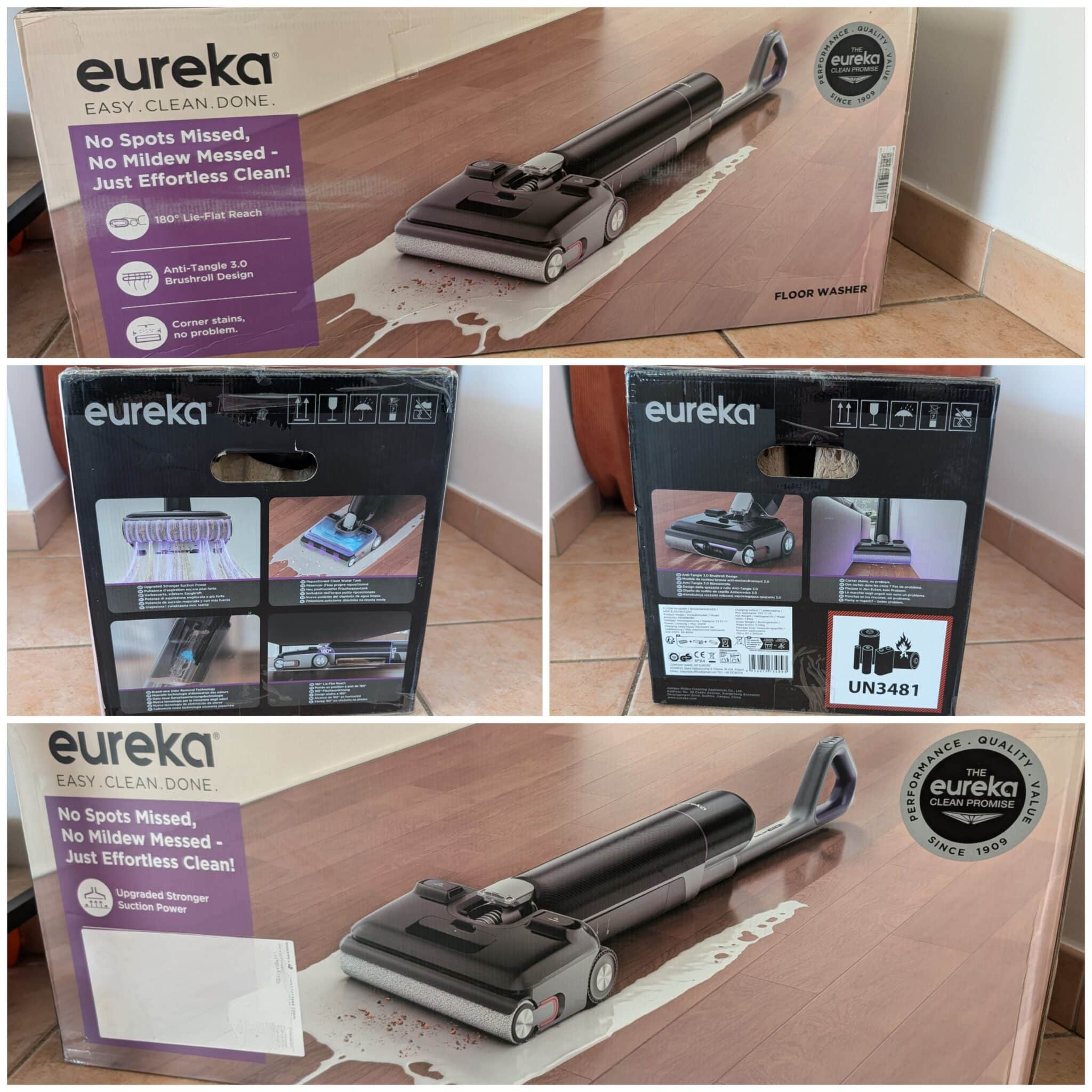
Sur la face avant comme sur la face arrière, on découvrira une grande photo de l’appareil en pleine action, en train d’aspirer et de laver une flaque. Le slogan est clair : « No spots missed, no mildew messed – Just effortless clean! ». À côté, un encadré violet rappelle les points forts : la tête qui peut se coucher complètement à 180°, la brosse anti-emmêlement, et la capacité à gérer les coins sans effort. Le tout, en anglais. On retrouve aussi le sceau rond Eureka Clean Promise.

En tournant la boîte, que ce soit à droite ou à gauche, on découvrira plus de détails techniques. On y voit plusieurs images montrant la brosse, l’appareil en situation réelle, et sa capacité à se glisser presque à plat sous les meubles.


Caractéristiques techniques

  • Puissance d’aspiration : 24 000 Pa

  • Vitesse de rotation de la brosse : 450 tours / minute (rpm)

  • Pression vers le sol : ~ 45 N (force exercée vers le bas par la brosse / le réservoir d’eau)

  • Température d’auto-lavage : 100 °C pour l’eau

  • Température de séchage : 75 °C d’air chaud

  • Direction de nettoyage des bords : triple — gauche, droite, avant

  • Propulsion : assistance électrique avant + arrière

  • Disponibilité : Europe

  • Prix conseillé : 579 €


Fonctionnalités

  • Nettoyage wet & dry : peut aspirer la poussière et laver le sol en même temps

  • Technologie de propulsion double direction : assistance électrique quand on pousse et quand on tire

  • Conception plate à 180° : permet de passer sous les meubles facilement

  • Brosse à nettoyage de bord trois côtés : gauche, droite, avant — pour bien nettoyer les bords et les plinthes

  • Auto-nettoyage : système d’auto-entretien pour la brosse et les composants

  • Lavage automatique de la brosse avec eau chauffée à 100 °C : pour éliminer la graisse et les saletés incrustées

  • Séchage à l’air chaud à 75 °C : pour éviter les odeurs et la moisissure

  • Module désodorisant dans le réservoir d’eaux usées : permet de limiter les mauvaises odeurs

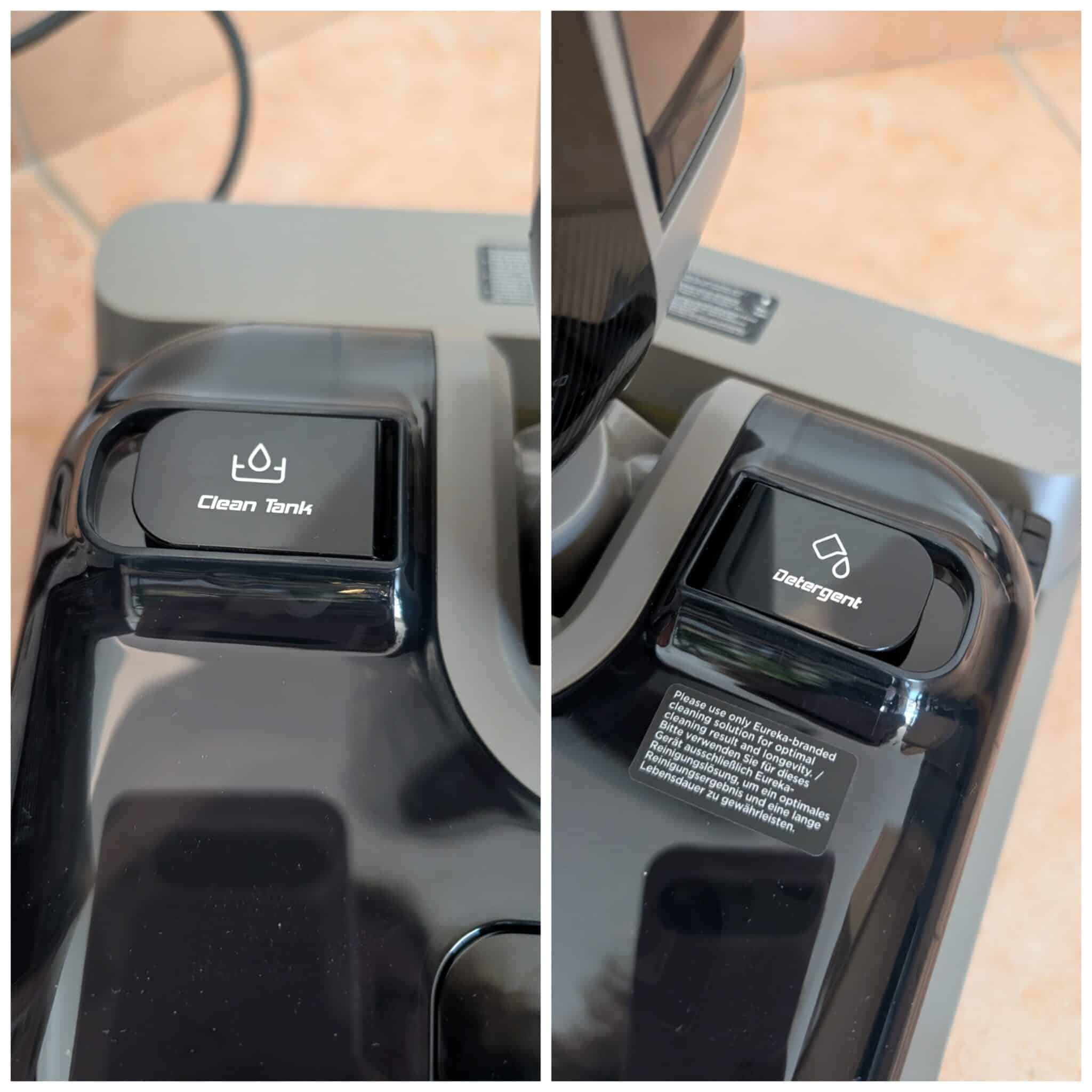
  • Réservoir d’eau propre positionné au-dessus de la brosse : pour un bon transfert de la pression vers le sol.


Contenu

  • L’aspirateur laveur FloorShine 880
  • Son manche
  • Sa base
  • Produit de nettoyage
  • Brosse de nettoyage
  • Filtre supplémentaire
  • Notice


Test 

Présenté en grande pompe à l’IFA 2025, le Eureka FloorShine 880 fait partie de ces produits qui semblent vouloir réconcilier tout le monde avec le ménage. Un pari audacieux, certes, mais Eureka se présente avec des arguments suffisamment solides pour attirer notre attention ici et en plus, vous savez qu’on adore tous les types d’aspiration… Au programme : puissance annoncée impressionnante, fonctions d’auto-entretien très poussées et volonté claire de se démarquer d’une concurrence devenue vraiment, vraiment féroce. Après avoir décortiqué ses caractéristiques, il est temps de voir si ce FloorShine 880 mérite sa place parmi les appareils premium de nettoyage domestique.

Dès les premières prises en main, on sent que Eureka a voulu proposer quelque chose de sérieux. Le FloorShine 880 est un aspirateur-laveur « wet & dry », un appareil capable de gérer aussi bien la poussière quotidienne que les taches les plus coriaces. Il n’est pas simplement là pour ramasser quelques miettes : il ambitionne de récurer vos sols avec une efficacité que l’on attend plutôt d’un matériel semi-professionnel. Et la fiche technique donne le ton : une aspiration culminant à 24 000 Pa, un rouleau qui tourne à 450 tours/minutes, et surtout une pression verticale annoncée à 45 N pour gratter le sol sans faiblir. Sur le papier, c’est costaud, et en pratique ?

Mais au-delà des chiffres, c’est l’approche globale du nettoyage qui intrigue. Le 880 est pensé comme un appareil autonome, ou du moins semi-autonome, dans le sens où il s’occupe aussi… de lui-même. Eureka a intégré un système complet d’auto-nettoyage, capable de laver son rouleau à 100 °C, puis de le sécher à 75 °C afin d’éviter les mauvaises odeurs et la formation de moisissures. Ceux qui ont déjà possédé un appareil de ce type savent que c’est précisément le point noir des balais laveurs classiques : ça finit toujours par sentir l’aquarium abandonné. Ici, tout est fait pour éviter ça, et c’est franchement appréciable. En revanche, je précise qu’idéalement, il faut vider et rincer le bac à eau sale après chaque utilisation car l’odeur arrive tout de même assez vite.

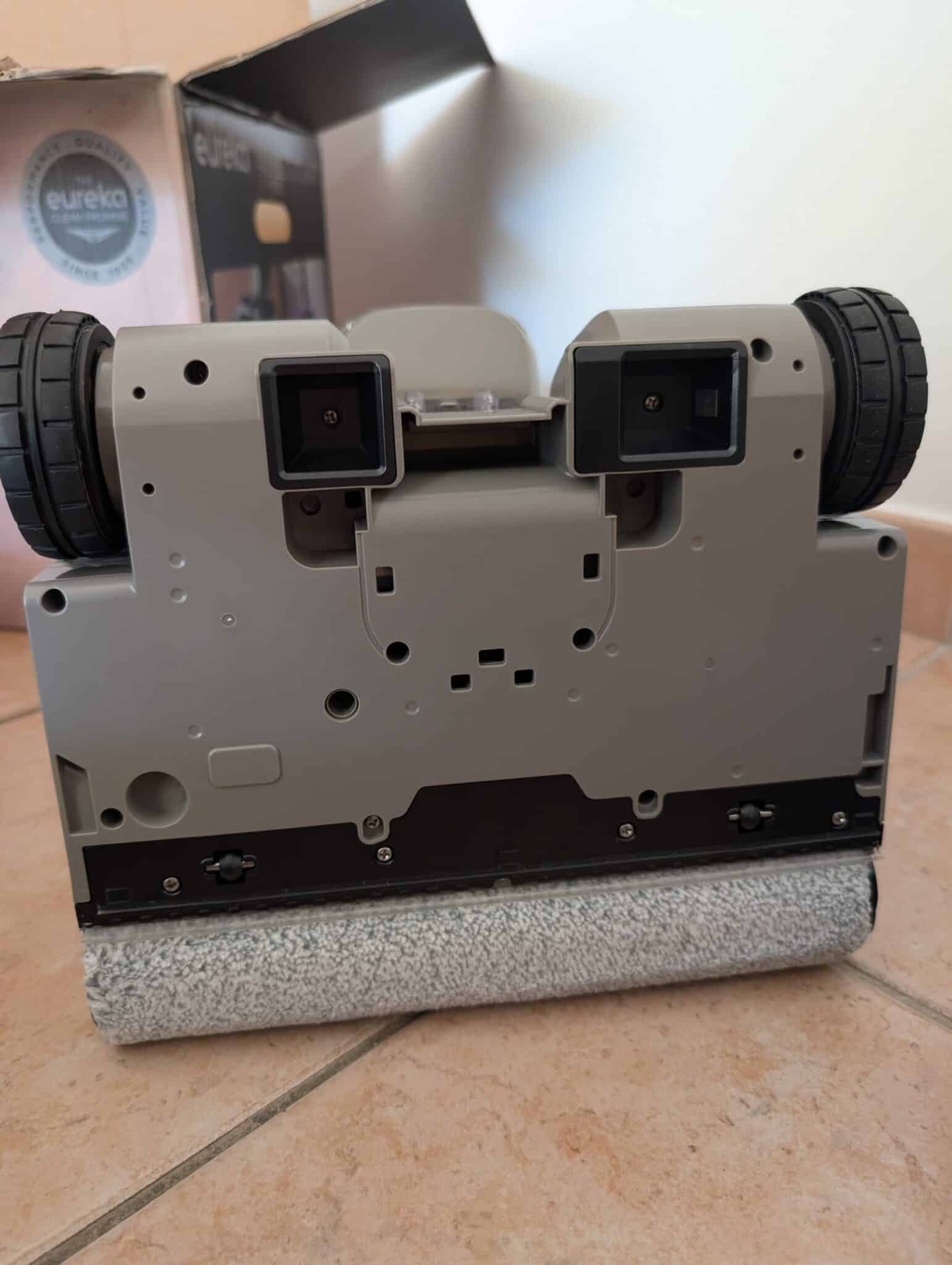
Le design, lui, reste très étudié. La tête fine et plate, capable de pivoter à 180°, permet de passer sous les meubles bas sans acrobaties. L’appareil bénéficie également d’une propulsion assistée dans les deux sens, ce qui offre une sensation de fluidité étonnamment agréable. Terminé l’époque où il fallait pousser comme un tapis de 30 kg ou tirer un aspirateur qui s’accrochait dans chaque coin de meuble : là, tout glisse, ça suit, ça répond, et c’est clairement l’un des gros points forts du FloorShine 880. Eureka a aussi ajouté un système de brosse permettant de nettoyer efficacement les bords et les plinthes, un détail qui fait souvent toute la différence dans les pièces comme la cuisine.

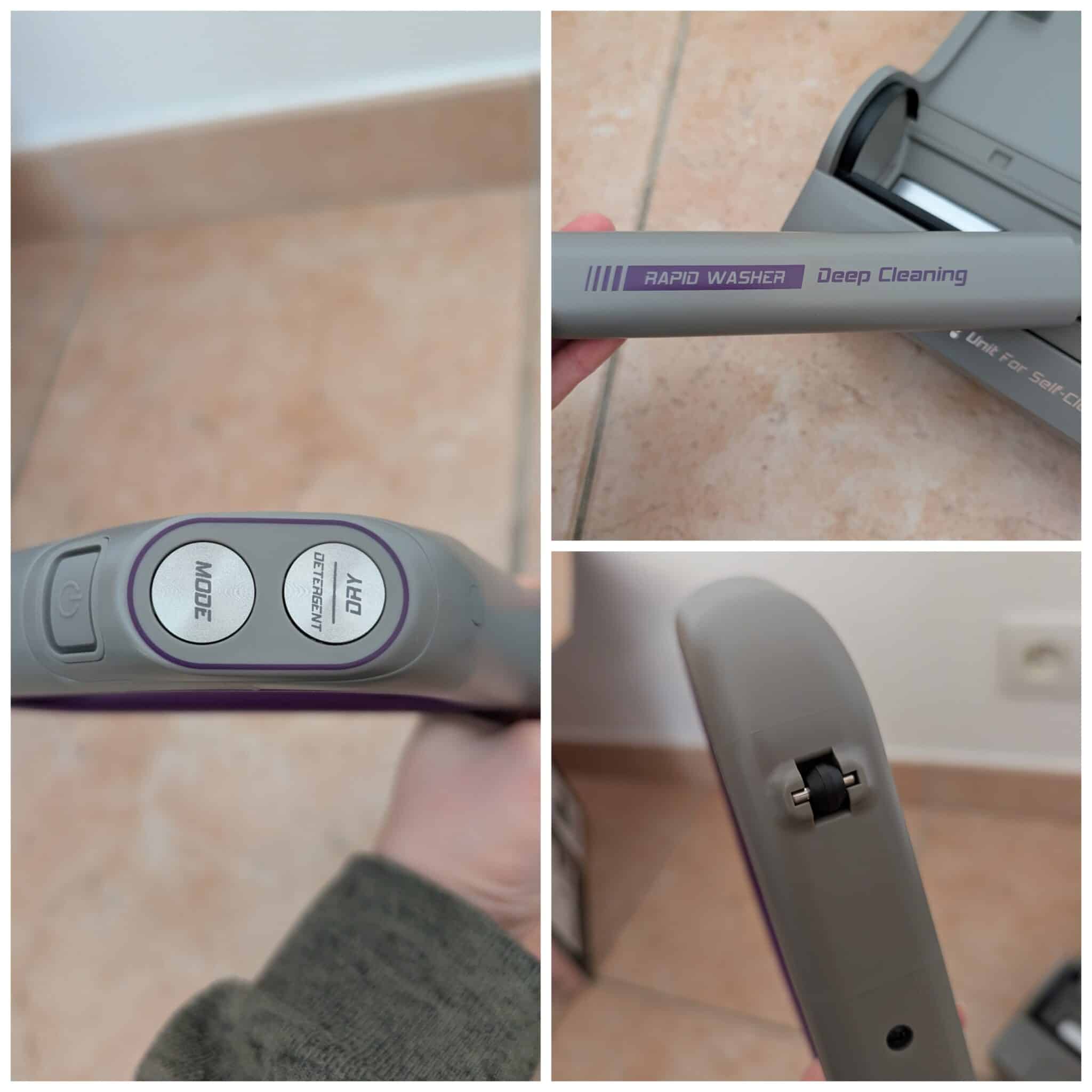
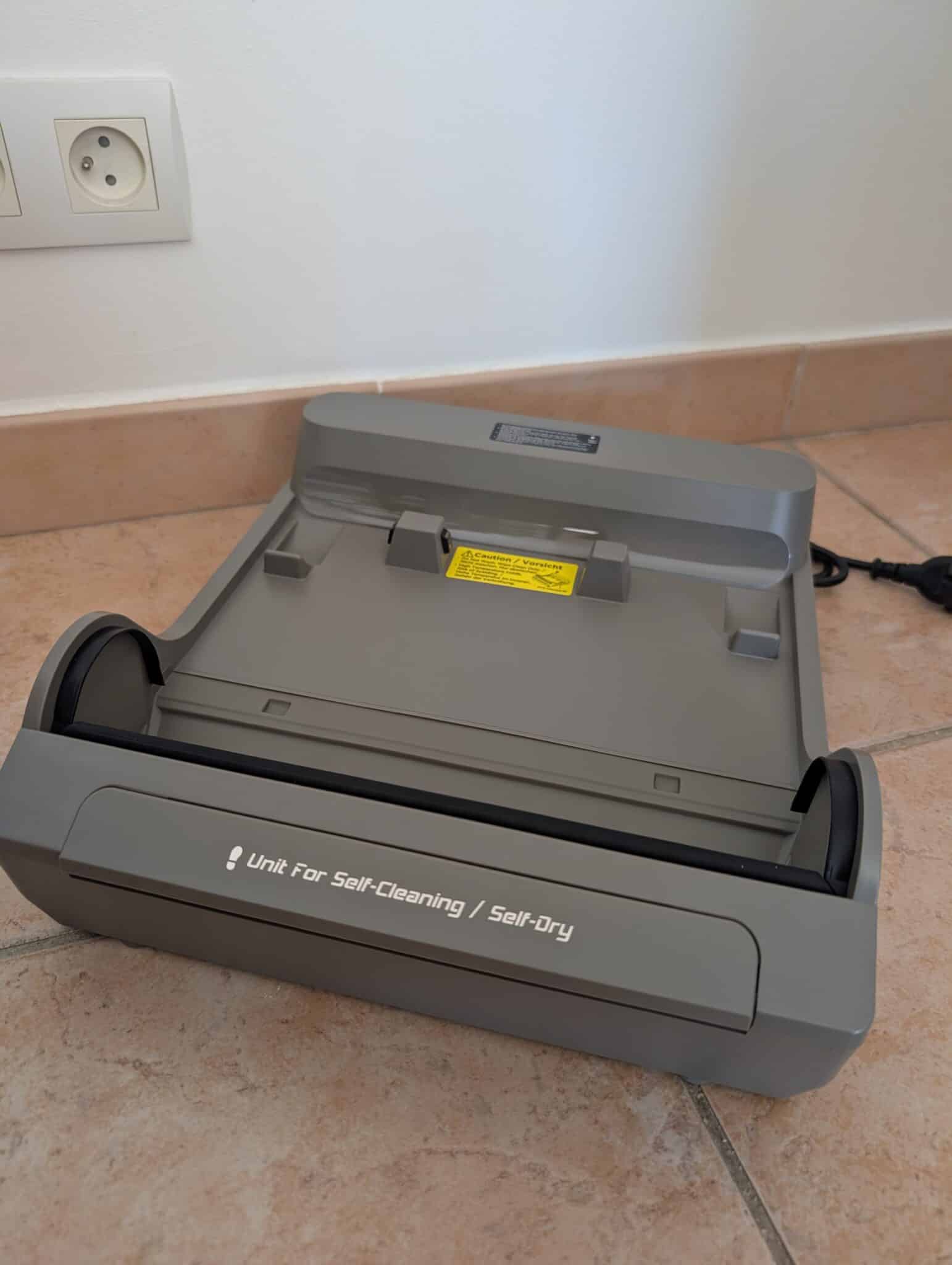
Pour lancer le nettoyage, il suffit d’appuyer sur la base et ça on adore ! C’est super pratique et très intuitif. En parlant de la base justement, elle arbore un design un peu retro futuriste assez drôle, mais qui n’ira pas forcément dans tous les intérieurs.

Au quotidien, le FloorShine 880 se destine clairement aux foyers qui ont besoin d’un nettoyage régulier et plutôt intense. Il sera parfaitement à l’aise sur carrelage, lino, sol composite ou parquet scellé, et s’adressera sans la moindre hésitation aux familles avec enfants, animaux ou simplement aux personnes qui veulent un intérieur impeccablement propre sans y consacrer un temps infini. La capacité du réservoir reste correcte sans être gigantesque, ce qui impose parfois quelques pauses sur les grandes surfaces. Mais cela reste dans la moyenne des appareils de ce type.

Bien sûr, notre appareil du jour à quelques défauts. Comme souvent avec les aspirateurs-laveurs du genre, la consommation électrique devra être observée de près : chauffer de l’eau à 100 °C puis sécher à 75 °C n’est pas anodin. Le FloorShine 880 est aussi un appareil assez volumineux, ce qui demandera un vrai espace de rangement. On notera également que son prix n’est pas forcément à la portée de toutes les bourses, bien que le rapport qualité/prix soit indéniable selon moi. Il manque également selon moi un rouleau supplémentaire dans le colis.

Conclusion 

L’heure est à la conclusion. Le FloorShine 880 est clairement ambitieux et cherche à se faire une place sur le marché avec une approche haut de gamme assumée. Si vous cherchez un appareil capable de nettoyer en profondeur sans trop d’efforts et avec un entretien réduit, il mérite une place sur votre shortlist. Et même si son prix peut faire hésiter, ses capacités et son confort d’usage pourraient bien justifier chaque euro investi. Tout dépend donc de vos besoins et de votre budget.

Pour rappel, vous le retrouverez hors promotion au prix de 579 € directement sur le site de la marque.

Argent Award Vonguru


Test – Aspirateur laveur FloorShine 880 de Eureka a lire sur Vonguru.

Electrical charge on objects in optical tweezers can be controlled precisely

27 novembre 2025 à 17:21

An effect first observed decades ago by Nobel laureate Arthur Ashkin has been used to fine tune the electrical charge on objects held in optical tweezers. Developed by an international team led by Scott Waitukaitis of the Institute of Science and Technology Austria, the new technique could improve our understanding of aerosols and clouds.

Optical tweezers use focused laser beams to trap and manipulate small objects about 100 nm to 1 micron in size. Their precision and versatility have made them a staple across fields from quantum optics to biochemistry.

Ashkin shared the 2018 Nobel prize for inventing optical tweezers and in the 1970s he noticed that trapped objects can be electrically charged by the laser light. “However, his paper didn’t get much attention, and the observation has essentially gone ignored,” explains Waitukaitis.

Waitukaitis’ team rediscovered the effect while using optical tweezers to study how charges build up in the ice crystals accumulating inside clouds. In their experiment, micron-sized silica spheres stood in for the ice, but Ashkin’s charging effect got in their way.

Bummed out

“Our goal has always been to study charged particles in air in the context of atmospheric physics – in lightning initiation or aerosols, for example,” Waitukaitis recalls. “We never intended for the laser to charge the particle, and at first we were a bit bummed out that it did so.”

Their next thought was that they had discovered a new and potentially useful phenomenon. “Out of due diligence we of course did a deep dive into the literature to be sure that no one had seen it, and that’s when we found the old paper from Ashkin, “ says Waitukaitis.

In 1976, Ashkin described how optically trapped objects become charged through a nonlinear process whereby electrons absorb two photons simultaneously. These electrons can acquire enough energy to escape the object, leaving it with a positive charge.

Yet beyond this insight, Ashkin “wasn’t able to make much sense of the effect,” Waitukaitis explains. “I have the feeling he found it an interesting curiosity and then moved on.”

Shaking and scattering

To study the effect in more detail, the team modified their optical tweezers setup so its two copper lens holders doubled as electrodes, allowing them to apply an electric field along the axis of the confining, opposite-facing laser beams. If the silica sphere became charged, this field would cause it to shake, scattering a portion of the laser light back towards each lens.

The researchers picked off this portion of the scattered light using a beam splitter, then diverted it to a photodiode, allowing them to track the sphere’s position. Finally, they converted the measured amplitude of the shaking particle into a real-time charge measurement. This allowed them to track the relationship between the sphere’s charge and the laser’s tuneable intensity.

Their measurements confirmed Ashkin’s 1976 hypothesis that electrons on optically-trapped objects undergo two-photon absorption, allowing them to escape. Waitukaitis and colleagues improved on this model and showed how the charge on a trapped object can be controlled precisely by simply adjusting the laser’s intensity.

As for the team’s original research goal, the effect has actually been very useful for studying the behaviour of charged aerosols.

“We can get [an object] so charged that it shoots off little ‘microdischarges’ from its surface due to breakdown of the air around it, involving just a few or tens of electron charges at a time,” Waitukaitis says. “This is going to be really cool for studying electrostatic phenomena in the context of particles in the atmosphere.“

The study is described in Physical Review Letters.

The post Electrical charge on objects in optical tweezers can be controlled precisely appeared first on Physics World.

Quantum gravity: we explore spin foams and other potential solutions to this enduring challenge

27 novembre 2025 à 16:00

Earlier this autumn I had the pleasure of visiting the Perimeter Institute for Theoretical Physics in Waterloo Canada – where I interviewed four physicists about their research. This is the second of those conversations to appear on the podcast – and it is with Bianca Dittrich, whose research focuses on quantum gravity.

Albert Einstein’s general theory of relativity does a great job at explaining gravity but it is thought to be incomplete because it is incompatible with quantum mechanics. This is an important shortcoming because quantum mechanics is widely considered to be one of science’s most successful theories.

Developing a theory of quantum gravity is a crucial goal in physics, but it is proving to be extremely difficult. In this episode, Dittrich explains some of the challenges and talks about ways forward – including her current research on spin foams. We also chat about the intersection of quantum gravity and condensed matter physics; and the difficulties of testing theories against observational data.

IOP Publishing’s new Progress In Series: Research Highlights website offers quick, accessible summaries of top papers from leading journals like Reports on Progress in Physics and Progress in Energy. Whether you’re short on time or just want the essentials, these highlights help you expand your knowledge of leading topics.

The post Quantum gravity: we explore spin foams and other potential solutions to this enduring challenge appeared first on Physics World.

Einarex Vertex 360 Review

27 novembre 2025 à 15:04
Einarex aims to make its mark in the PC cooling world with the Vertex 360, a cooler that pairs solid thermal performance with a bold, distinctive look. With ARGB fans and a striking infinity-mirror pump design, it stands out as an appealing choice for builders who want something fresh and eye-catching without stretching their budget.

L'iPhone Air n'a pas le vent en poupe

27 novembre 2025 à 13:56

En sortant l'iPhone Air, Apple voulait démontrer son savoir faire dans un volume inédit pour un smartphone de cette taille.
Il semble toutefois que les ventes se soient avérées bien en deçà des attentes (les autres iPhone se vendent très bien). La production de ce modèle aurait déjà été arrêtée sans prévisions de la relancer, Foxconn ayant démantelé les chaînes de production et les sous-traitant cessé de produire les composants.
Cet échec aurait conduit les concurrents d'Apple chinois qui voulaient suivre cet exemple à cesser leurs efforts pour produire des appareils très fins.

Tout n'est toutefois pas terminé car Apple n'a pas abandonné l'idée d'en sortir une seconde version en 2026. Elle devrait tirer partie de ce qui n'a pas été apprécié dans le premier modèle, à commencer par la présence d'un unique capteur photo.

Nous pensons qu'une des choses qui a participé à cet échec est liée à la politique commerciale d'Apple. Lancer en même temps que le l'iPhone Air une batterie additionnelle lui enlevant tout intérêt n'a fait que montrer que son autonomie était trop faible pour les standards actuels.
Rendez-vous courant 2026 pour voir si la seconde mouture attirera plus de monde.

Can fast qubits also be robust?

27 novembre 2025 à 11:32
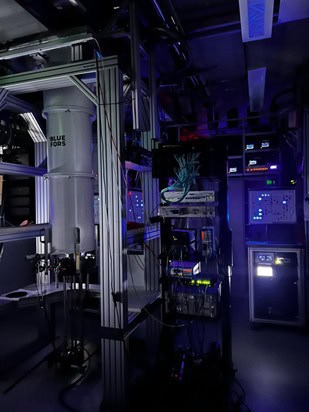
National center of competence in research spin
Qubit central: This work was carried out as part of the National Center of Competence in Research SPIN (NCCR SPIN), which is led by the University of Basel, Switzerland. NCCR SPIN focuses on creating scalable spin qubits in semiconductor nanostructures made of silicon and germanium, with the aim of developing small, fast qubits for a universal quantum computer. (Courtesy: A Efimov)

Qubits – the building blocks of quantum computers – are plagued with a seemingly unsurmountable dilemma. If they’re fast, they aren’t robust. And if they’re robust, they aren’t fast. Both qualities are important, because all potentially useful quantum algorithms rely on being able to perform many manipulations on a qubit before its state decays. But whereas faster qubits are typically realized by strongly coupling them to the external environment, enabling them to interact more strongly with the driving field, robust qubits with long coherence times are typically achieved by isolating them from their environment.

These seemingly contradictory requirements made simultaneously fast and robust qubits an unsolved challenge – until now. In an article published in Nature Communications, a team of physicists led by Dominik Zumbühl from the University of Basel, Switzerland show that it is, in fact, possible to increase both the coherence time and operational speed of a qubit, demonstrating a pathway out of this long-standing impasse.

The magic ingredient

The key ingredient driving this discovery is something called the direct Rashba spin-orbit interaction. The best-known example of spin-orbit interaction comes from atomic physics. Consider a hydrogen atom, in which a single electron revolves around a single proton in the nucleus. During this orbital motion, the electron interacts with the static electric field generated by the positively charged nucleus. The electron in turn experiences an effective magnetic field that couples to the electron’s intrinsic magnetic moment, or spin. This coupling of the electron’s orbital motion to its spin is called spin-orbit (SO) interaction.

Aided by collaborators at the University of Oxford, UK and TU Eindhoven in the Netherlands, Zumbühl and colleagues chose to replace this simple SO interaction with a far more complex landscape of electrostatic potential generated by a 10-nanometer-thick germanium wire coated with a thin silicon shell. By removing a single electron from this wire, they create states known as holes that can be used as qubits, with quantum information being encoded in the hole’s spin.

Importantly, the underlying crystal structure of the silicon-coated germanium wire constrains these holes to discrete energy levels called bands. “If you were to mathematically model a low-level hole residing in one of these bands using perturbation theory – a commonly applied method in which more remote bands are treated as corrections to the ground state – you would find a term that looks structurally similar to the spin–orbit interaction known from atomic physics,” explains Miguel Carballido, who conducted the work during his PhD at Basel, and is now a senior research associate at the University of New South Wales’ School of Electrical Engineering and Telecommunications in Sydney, Australia.

By encoding the quantum states in these energy levels, the spin-orbit interaction can be used to drive the hole-qubit between its two spin states. What makes this interaction special is that it can be tuned using an external electric field. Thus, by applying a stronger electric field, the interaction can be strengthened – resulting in faster qubit manipulation.

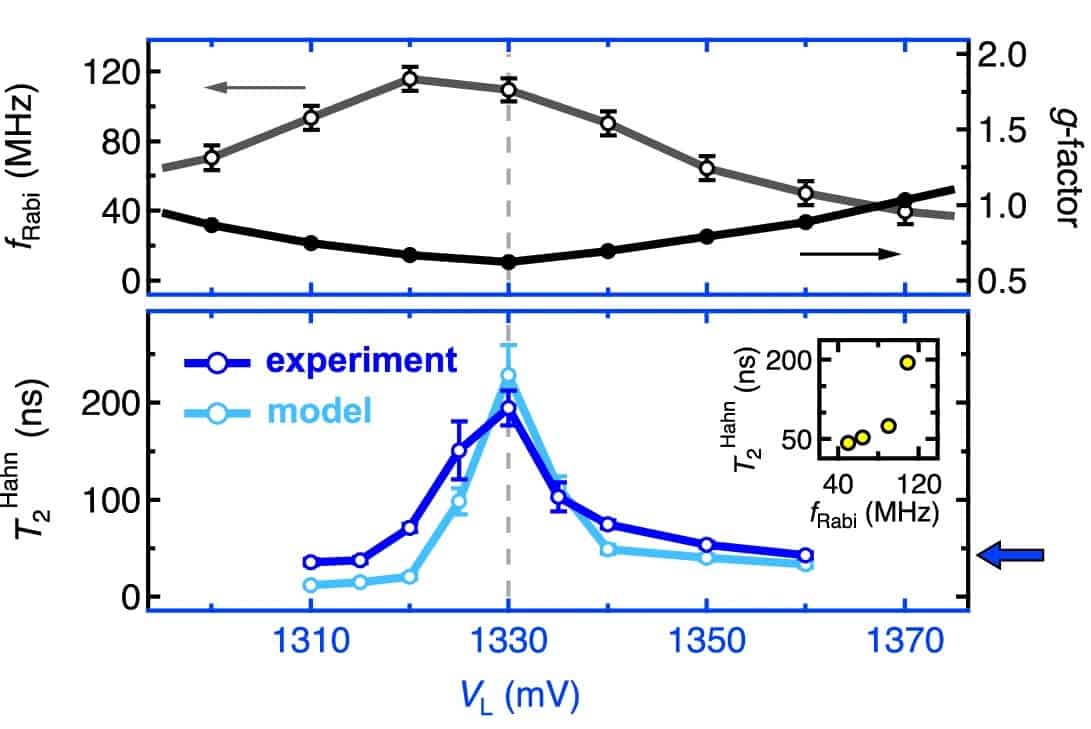
Comparison of graphs of qubit speed and qubit coherence times, showing showing qubit speed plateauing (top panel) and qubit coherence times peaking (bottom) at an applied electric field around 1330 mV
Uncompromising performance: Results showing qubit speed plateauing (top panel) and qubit coherence times peaking (bottom) at an applied electric field around 1330 mV, showing that qubit speed and coherence times can be simultaneously optimized. (CC BY ND 4.0 MJ Carballido et al. “Compromise-free scaling of qubit speed and coherence” 2025 Nat. Commun. 16 7616)

Reaching a plateau

This ability to make a qubit faster by tuning an external parameter isn’t new. The difference is that whereas in other approaches, a stronger interaction also means higher sensitivity to fluctuations in the driving field, the Basel researchers found a way around this problem. As they increase the electric field, the spin-orbit interaction increases up to a certain point. Beyond this point, any further increase in the electric field will cause the hole to remain stuck within a low energy band. This restricts the hole’s ability to interact with other bands to change its spin, causing the SO interaction strength to drop.

By tuning the electric field to this peak, they can therefore operate in a “plateau” region where the SO interaction is the strongest, but the sensitivity to noise is the lowest. This leads to high coherence times (see figure), meaning that the qubit remains in the desired quantum state for longer. By reaching this plateau, where the qubit is both fast and robust, the researchers demonstrate the ability to operate their device in the “compromise-free” regime.

So, is quantum computing now a solved problem? The researchers’ answer is “not yet”, as there are still many challenges to overcome. “A lot of the heavy lifting is being done by the quasi 1D system provided by the nanowire,” remarks Carballido, “but this also limits scalability.” He also notes that the success of the experiment depends on being able to fabricate each qubit device very precisely, and doing this reproducibly remains a challenge.

The post Can fast qubits also be robust? appeared first on Physics World.

Quelques nouveautés Michel Lafon/Sikku pour les fêtes !

27 novembre 2025 à 00:28

Quelques nouveautés Michel Lafon/Sikku pour les fêtes !

Avec les fêtes de fin d’année qui arrivent, voyons ensemble quelques nouveautés chez le fameux éditeur Michel Lafon/Sikku.

Coffret starter Nina du Royaume aux étoiles

LE PACK DÉCOUVERTE REGROUPANT LES 3 PREMIERS TOMES DE LA SÉRIE NINA DU ROYAUME AUX ÉTOILES.

Nina, jeune orpheline aux yeux d’un bleu profond, est enlevée et emmenée au palais royal pour remplacer la princesse Alisha, disparue dans un accident. Destinée à épouser le prince héritier du royaume de Galgada, elle a trois mois pour apprendre à se comporter comme une véritable princesse, tout en trompant l’ensemble des nobles de la cour.

Le premier starter pack de la série Nina du Royaume aux étoiles, best-seller shojo en librairie, Prix Kodansha et adulée dans sa version animée.

Nouveautés Michel Lafon / Sikku Nouveautés Michel Lafon / Sikku Nouveautés Michel Lafon / Sikku

Disponible pour 19,95 depuis le 20 novembre.

Nina du Royaume aux étoiles – édition collector du tome 16

La version collector contient une jaquette réversible avec dorure, un calendrier perpétuel aux pages détachables pour devenir des ex-libris, une cale carton imprimée, dans un coffret pouvant accueillir 3 volumes de la série.

Nina est prête à tout pour fuir le palais royal de Lindrum. Traquée par Asta et Ulvur, les princes jumeaux bien décidés à la forcer à exaucer leurs voeux, elle n’a d’autre choix que de s’échapper, au péril de sa vie. Dans sa fuite, Nina croise la route d’un allié inattendu, porteur de vérités troublantes sur ses pouvoirs… et sur les mystères de son passé.

Quand les destins de Nina, Alisha et la déesse des étoiles s’entremêlent…

Nouveautés Michel Lafon / Sikku Nouveautés Michel Lafon / Sikku Nouveautés Michel Lafon / Sikku

Disponible pour 14,95 € depuis le 20 novembre.

Ki & Hi, une édition collector du tome 1

L’ÉDITION COLLECTOR DU PREMIER TOME DE KI & HI, LA SÉRIE BEST-SELLER DE KEVIN TRAN1 jaquette pantone or avec une illustration exclusive et inédite
5 cartes postales à colorier
1 planche de stickers  » Hi « 
1 planche de stickers métallisés  » Ki « 

Ki et Hi sont deux frères complètement barrés. Le premier est gros, feignant et dominateur, le second est petit, maigrichon et fourbe comme pas deux. Avatars de papier de Kevin et Henry, ils se mettent comme eux dans des situations improbables. Comment gagner un match de basket contre un crocodile ? Peut-on vraiment vider un restaurant de sushis  » à volonté  » ? Est-il encore possible de partir à la conquête de YouTube ? Autant de questions auxquelles Ki et Hi vont répondre bien malgré eux !

Nouveautés Michel Lafon / Sikku Nouveautés Michel Lafon / Sikku

Disponible pour 14,95 € depuis le 29 octobre.

Marry my husband, une édition collector du tome 1

Une édition collector inédite avec une jaquette alternative du tome 1 et un décorama exclusif pour sa bibliothèque.

Atteinte d’un cancer incurable, Jiwon Kang, 37 ans, n’a plus que quelques mois à vivre. Délaissée par un mari violent et infidèle, elle finit par succomber sous ses coups. Mais un miracle a lieu : elle se réveille dix ans plus tôt et va tenter d’inverser le cours de son destin.
Cette fois, les choses seront différentes car Jiwon compte bien se venger ! Son plan ? Faire en sorte que celui qui aurait dû devenir son mari épouse celle qui a causé sa perte…

Nouveautés Michel Lafon / Sikku Nouveautés Michel Lafon / Sikku

Disponible pour 16,95 € depuis le 6 novembre.

Quelques nouveautés Michel Lafon/Sikku pour les fêtes ! a lire sur Vonguru.

Qualcomm Snapdragon X2 : le retour de la vengeance ?

27 novembre 2025 à 00:06

On se souvient des décevants Snapdragon X [1] de 2024, que Qualcomm voulait comparer au M2 de base. Même pas au M2 Pro ou M2 Max. Puis au M3 au fur et à mesure que sa date de sortie était repoussée.

Qualcomm comparait son haut-de-gamme avec l'entrée-de-gamme Apple : ça dit tout sur le manque de performances. La GPU du Snapdragon X [1] était aussi décevante, ils ont convaincu les youtubeurs de la tester sur des jeux en 720p, pas en 1080p...

Voilà la seconde génération, Snapdragon X2, avec laquelle Qualcomm ne recommence pas ce genre de comparaison hautement fumeuse.

J'ai des réserves sur la micro-architecture des cœurs CPU, mais cela est largement compensé par des fréquences en hausse (5,0 GHz), et par la pléthore de cœurs, 12 rapides et 6 économiques. 12 cœurs en entrée-de-gamme et 18 cœurs dès le milieu-de-gamme !

La GPU en revanche ne présage rien de vraiment bon, faute de bande-passante mémoire, ça n'est pas la force de Qualcomm, et au mieux elle peut viser un M4 Pro.
Du progrès quand-même, ce coup-ci, au moins en haut-de-gamme, on pourra enfin jouer en 1080p...

Mais, on pourrait être surpris coté CPU, quoique le M4 Pro 14 cœurs soit bien velu !
Voilà le PDF de présentation des Qualcomm Snapdragon X2 (en Anglais)

En ce moment, profitez du Black Friday : soutenez MacBidouille et partagez vos trouvailles

Corsair MP700 Pro XT 2 TB Review

Par :W1zzard
26 novembre 2025 à 15:37
The Corsair MP700 Pro XT is built using the new Phison E28 controller. It achieves record-breaking energy-efficiency that brings the drive down to Gen 4 power levels, which means it can operate without a large heatsink. Real-life performance is also outstanding, making it the fastest SSD we ever tested.

Did cannibal stars and boson stars populate the early universe?

26 novembre 2025 à 14:52

In the early universe, moments after the Big Bang and cosmic inflation, clusters of exotic, massive particles could have collapsed to form bizarre objects called cannibal stars and boson stars. In turn, these could have then collapsed to form primordial black holes – all before the first elements were able to form.

This curious chain of events is predicted by a new model proposed by a trio of scientists at SISSA, the International School for Advanced Studies in Trieste, Italy.

Their proposal involves a hypothetical moment in the early universe called the early matter-dominated (EMD) epoch. This would have lasted only a few seconds after the Big Bang, but could have been dominated by exotic particles, such as the massive, supersymmetric particles predicted by string theory.

“There are no observations that hint at the existence of an EMD epoch – yet!” says SISSA’s Pranjal Ralegankar. “But many cosmologists are hoping that an EMD phase occurred because it is quite natural in many models.”

Some models of the early universe predict the formation of primordial black holes from quantum fluctuations in the inflationary field. Now, Ralegankar and his colleagues, Daniele Perri and Takeshi Kobayashi propose a new and more natural pathway for forming primordial holes via an EMD epoch.

They postulate that in the first second of existence when the universe was small and incredibly hot, exotic massive particles emerged and clustered in dense haloes. The SISSA physicists propose that the haloes then collapsed into hypothetical objects called cannibal stars and boson stars.

Cannibal stars are powered by particles annihilating each other, which would have allowed the objects to resist further gravitational collapse for a few seconds. However, they would not have produced light like normal stars.

“The particles in a cannibal star can only talk to each other, which is why they are forced to annihilate each other to counter the immense pressure from gravity,” Ralegankar tells Physics World. “They are immensely hot, simply because the particles that we consider are so massive. The temperature of our cannibal stars can range from a few GeV to on the order of 1010 GeV. For comparison, the Sun is on the order of keV.”

Boson stars, meanwhile, would be made from pure a Bose–Einstein condensate, which is a state of matter whereby the individual particles quantum mechanically act as one.

Both the cannibal stars and boson stars would exist within larger haloes that would quickly collapse to form primordial black holes with masses about the same as asteroids (about 1014–1019 kg). All of this could have taken place just 10 s after the Big Bang.

Dark matter possibility

Ralegankar, Perri and Kobayashi point out that the total mass of primordial black holes that their model produces matches the amount of dark matter in the universe.

“Current observations rule out black holes to be dark matter, except in the asteroid-mass range,” says Ralegankar. “We showed that our models can produce black holes in that mass range.”

Richard Massey, who is a dark-matter researcher at Durham University in the UK, agrees that microlensing observations by projects such as the Optical Gravitational Lensing Experiment (OGLE) have ruled out a population of black holes with planetary masses, but not asteroid masses. However, Massey is doubtful that these black holes could make up dark matter.

“It would be pretty contrived for them to make up a large fraction of what we call dark matter,” he says. “It’s possible that dark matter could be these primordial black holes, but they’d need to have been created with the same mass no matter where they were and whatever environment they were in, and that mass would have to be tuned to evade current experimental evidence.”

In the coming years, upgrades to OGLE and the launch of NASA’s Roman Space Telescope should finally provide sensitivity to microlensing events produced by objects in the asteroid mass range, allowing researchers to settle the matter.

It is also possible that cannibal and boson stars exist today, produced by collapsing haloes of dark matter. But unlike those proposed for the early universe, modern cannibal and boson stars would be stable and long-lasting.

“Much work has already been done for boson stars from dark matter, and we are simply suggesting that future studies should also think about the possibility of cannibal stars from dark matter,” explains Ralegankar. “Gravitational lensing would be one way to search for them, and depending on models, maybe also gamma rays from dark-matter annihilation.”

The research is described in Physical Review D.

The post Did cannibal stars and boson stars populate the early universe? appeared first on Physics World.

Avec les femmes du « made in China »

26 novembre 2025 à 12:05
En suivant le trajet d’un soutien-gorge glissé dans une valise, la sociologue Beatrice Zani révèle les trajectoires de jeunes femmes migrantes entre la Chine et Taïwan. Et brise l’image d’un capitalisme géré par la seule « haute finance ».

Academic assassinations are a threat to global science

26 novembre 2025 à 12:00

The deliberate targeting of scientists in recent years has become one of the most disturbing, and overlooked, developments in modern conflict. In particular, Iranian physicists and engineers have been singled out for almost two decades, with sometimes fatal consequences. In 2007 Ardeshir Hosseinpour, a nuclear physicist at Shiraz University, died in mysterious circumstances that were widely attributed to poisoning or radioactive exposure.

Over the following years, at least five more Iranian researchers have been killed. They include particle physicist Masoud Ali-Mohammadi, who was Iran’s representative at the Synchrotron-light for Experimental Science and Applications in the Middle East project. Known as SESAME, it is the only scientific project in the Middle East where Iran and Israel collaborate.

Others to have died include nuclear engineer Majid Shahriari, another Iranian representative at SESAME, and nuclear physicist Mohsen Fakhrizadeh, who were both killed by bombing or gunfire in Tehran. These attacks were never formally acknowledged, nor were they condemned by international scientific institutions. The message, however, was implicit: scientists in politically sensitive fields could be treated as strategic targets, even far from battlefields.

What began as covert killings of individual researchers has now escalated, dangerously, into open military strikes on academic communities. Israeli airstrikes on residential areas in Tehran and Isfahan during the 12-day conflict between the two countries in June led to at least 14 Iranian scientists and engineers and members of their family being killed. The scientists worked in areas such as materials science, aerospace engineering and laser physics. I believe this shift, from covert assassinations to mass casualties, crossed a line. It treats scientists as enemy combatants simply because of their expertise.

The assassinations of scientists are not just isolated tragedies; they are a direct assault on the global commons of knowledge, corroding both international law and international science. Unless the world responds, I believe the precedent being set will endanger scientists everywhere and undermine the principle that knowledge belongs to humanity, not the battlefield.

Drawing a red line

International humanitarian law is clear: civilians, including academics, must be protected. Targeting scientists based solely on their professional expertise undermines the Geneva Convention and erodes the civilian–military distinction at the heart of international law.

Iran, whatever its politics, remains a member of the Nuclear Non-Proliferation Treaty and the International Atomic Energy Agency. Its scientists are entitled under international law to conduct peaceful research in medicine, energy and industry. Their work is no more inherently criminal than research that other countries carry out in artificial intelligence (AI), quantum technology or genetics.

If we normalize the preemptive assassination of scientists, what stops global rivals from targeting, say, AI researchers in Silicon Valley, quantum physicists in Beijing or geneticists in Berlin? Once knowledge itself becomes a liability, no researcher is safe. Equally troubling is the silence of the international scientific community with organizations such as the UN, UNESCO and the European Research Council as well as leading national academies having not condemned these killings, past or present.

Silence is not neutral. It legitimizes the treatment of scientists as military assets. It discourages international collaboration in sensitive but essential research and it creates fear among younger researchers, who may abandon high-impact fields to avoid risk. Science is built on openness and exchange, and when researchers are murdered for their expertise, the very idea of science as a shared human enterprise is undermined.

The assassinations are not solely Iran’s loss. The scientists killed were part of a global community; collaborators and colleagues in the pursuit of knowledge. Their deaths should alarm every nation and every institution that depends on research to confront global challenges, from climate change to pandemics.

I believe that international scientific organizations should act. At a minimum, they should publicly condemn the assassination of scientists and their families; support independent investigations under international law; as well as advocate for explicit protections for scientists and academic facilities in conflict zones.

Importantly, voices within Israel’s own scientific community can play a critical role too. Israeli academics, deeply committed to collaboration and academic freedom, understand the costs of blurring the boundary between science and war. Solidarity cannot be selective.

Recent events are a test case for the future of global science. If the international community tolerates the targeting of scientists, it sets a dangerous precedent that others will follow. What appears today as a regional assault on scientists from the Global South could tomorrow endanger researchers in China, Europe, Russia or the US.

Science without borders can only exist if scientists are recognized and protected as civilians without borders. That principle is now under direct threat and the world must draw a red line – killing scientists for their expertise is unacceptable. To ignore these attacks is to invite a future in which knowledge itself becomes a weapon, and the people who create it expendable. That is a world no-one should accept.

The post Academic assassinations are a threat to global science appeared first on Physics World.

DNA as a molecular architect

26 novembre 2025 à 09:39

DNA is a fascinating macromolecule that guides protein production and enables cell replication. It has also found applications in nanoscience and materials design.

Colloidal crystals are ordered structures made from tiny particles suspended in fluid that can bond to other particles and add functionalisation to materials. By controlling colloidal particles, we can build advanced nanomaterials using a bottom-up approach. There are several ways to control colloidal particle design, ranging from experimental conditions such as pH and temperature to external controls like light and magnetic fields.

An exciting approach is to use DNA-mediated processes. DNA binds to colloidal surfaces and regulates how the colloids organize, providing molecular-level control. These connections are reversible and can be broken using standard experimental conditions (e.g., temperature), allowing for dynamic and adaptable systems. One important motivation is their good biocompatibility, which has enabled applications in biomedicine such as drug delivery, biosensing, and immunotherapy.

Programmable Atom Equivalents (PAEs) are large colloidal particles whose surfaces are functionalized with single-stranded DNA, while separate, much smaller DNA-coated linkers, called Electron Equivalents (EEs), roam in solution and mediate bonds between PAEs. In typical PAE-EE systems, the EEs carry multiple identical DNA ends that can all bind the same type of PAE, which limits the complexity of the assemblies and makes it harder to program highly specific connections between different PAE types.

In this study, the researchers investigate how EEs with arbitrary valency, carrying many DNA arms, regulate interactions in a binary mixture of two types of PAEs. Each EE has multiple single-stranded DNA ends of two different types, each complementary to the DNA on one of the PAE species. The team develops a statistical mechanical model to predict how EEs distribute between the PAEs and to calculate the effective interaction, a measure of how strongly the PAEs attract each other, which in turn controls the structures that can form.

Using this model, they inform Monte Carlo simulations to predict system behaviour under different conditions. The model shows quantitative agreement with simulation results and reveals an anomalous dependence of PAE-PAE interactions on EE valency, with interactions converging at high valency. Importantly, the researchers identify an optimal valency that maximizes selectivity between targeted and non-targeted binding pairs. This groundbreaking research provides design principles for programmable self-assembly and offers a framework that can be integrated into DNA nanoscience.

Read the full article

Designed self-assembly of programmable colloidal atom-electron equivalents

Xiuyang Xia et al 2025 Rep. Prog. Phys. 88 078101

Do you want to learn more about this topic?

Assembly of colloidal particles in solution by Kun Zhao and Thomas G Mason (2018)

The post DNA as a molecular architect appeared first on Physics World.

The link between protein evolution and statistical physics

26 novembre 2025 à 09:37

Proteins are made up of a sequence of building blocks called amino acids. Understanding these sequences is crucial for studying how proteins work, how they interact with other molecules, and how changes (mutations) can lead to diseases.

These mutations happen over vastly different time periods and are not completely random but strongly correlated, both in space (distinct sites along the sequences) and in time (subsequent mutations of the same site).

It turns out that these correlations are very reminiscent of disordered physical systems, notably glasses, emulsions, and foams.

A team of researchers from Italy and France have now used this similarity to build a new statistical model to simulate protein evolution.  They went on to study the role of different factors causing these mutations.

They found that the initial (ancestral) protein sequence has a significant influence on the evolution process, especially in the short term. This means that information from the ancestral sequence can be traced back over a certain period and is not completely lost.

The strength of interactions between different amino acids within the protein affects how long this information persists.

Although ultimately the team did find differences between the evolution of physical systems and that of protein sequences, this kind of insight would not have been possible without using the language of statistical physics, i.e. space-time correlations.

The researchers expect that their results will soon be tested in the lab thanks to upcoming advances in experimental techniques.

Read the full article

Fluctuations and the limit of predictability in protein evolution – IOPscience

S. Rossi et al, 2025 Rep. Prog. Phys. 88 078102

The post The link between protein evolution and statistical physics appeared first on Physics World.

Test – Caméra de surveillance eufyCam S3 Pro

26 novembre 2025 à 00:07

Que vaut la caméra d’extérieur solaire eufyCam S3 Pro de eufy ? 

Vous le savez chez Vonguru, on adore tout ce qui est domotique et chez eufy, on a toujours le choix de ce côté-là ! Aujourd’hui, c’est la sécurité qui est mise en avant avec la caméra eufyCam S3 Pro ! Elle viendra compléter notre installation existante et rejoindra notre réseau HomeBase 3 !

Son prix oscille pas mal en ce moment, passant de 279 € hors promotion à 179 € au prix où ses lignes sont écrites, alors soyez vigilants ! Place au test !


Unboxing 

Sur la face avant arborant le fond bleu bien caractéristique de la marque eufy, on retrouvera le nom de la marque, le modèle ainsi 3 principaux arguments marketing, un visuel de la caméra et on nous rappellera également ici qu’il n’y a pas d’abonnement à payer en supplément. À gauche, c’est cette même information qui nous sera détaillé en détails, et ce en anglais.

eufyCam S3 Pro

À droite, la marque a décidé de mettre en avant son application gratuite avec deux visuels, à nouveaux une liste non exhaustive des principales fonctionnalités de notre caméra du jour ainsi que les divers compatibilités et lien pour télécharger ladite app. À l’arrière bien sûr et comme toujours, c’est là que nous ferons le plein d’infos avec non seulement le contenu de la boîte mais également à nouveau les principaux arguments de notre S3 Pro, cette fois en 8 langues différentes.


Caractéristiques techniques

Marque eufy Security
Nom de modèle T8162
Technologie de connectivité Wi-Fi
Caractéristique spéciale Résolution 4K améliorée couleur vision nocturne système de détection de mouvement Technologie SolarPlus 2.0 Sécurité locale, pas de frais mensuels, compatible avec Apple Home, Alexa et Google Assistant
Utilisation intérieure/extérieure Extérieure
Source d’alimentation Alimenté par batterie
Protocole de connectivité Wi-Fi
Type de fixation Montage arbre
Résolution d’enregistrement vidéo 4k


Fonctionnalités

  • Transforme la nuit en jour : exploitez la puissance d’une caméra 4K associée à la technologie MaxColor Vision. La eufyCam S3 Pro capture des images de surveillance détaillées et aussi claires que le jour, même en cas de très faible luminosité et sans projecteur.
  • Système solaire fiable : vivez l’esprit tranquille tout au long de l’année grâce à un système de sécurité continu et fiable alimenté par la technologie SolarPlus 2.0. Choisissez le panneau intégré pour une efficacité optimale ou ajoutez un panneau externe pour étendre la couverture énergétique. Ce système vous offre des options de montage polyvalentes et une alimentation fiable pour une sécurité continue. (Panneau solaire inclus).
  • La détection radar vous avertit uniquement en cas d’évènements majeurs : le double système de détection de mouvement, combinant le radar et l’infrarouge passif (PIR), identifie avec précision les mouvements humains et réduit le nombre de fausses alertes de 99 %. Vous ne serez donc averti qu’en cas d’événements majeurs dans les zones spécifiées.
  • Sécurité locale, aucuns frais mensuels : vous disposez de 16 Go de stockage sur l’appareil, extensible jusqu’à 16 To sans frais mensuels. La HomeBase S380 équipe vos appareils d’une IA auto-apprenante pour une gestion intelligente et vous permet de contrôler sans effort les paramètres groupés pour que vous gardiez le contrôle sur votre vie privé.
  • Compatible avec Apple Home, Alexa et l’Assistant Google. (La séquence vidéo sera d’une résolution de 1080P lorsque HomeKit est utilisé.)

eufyCam S3 Pro


Contenu

  • Caméra S3 Pro
  • Câble USB de rechargement
  • Kit de montage mural
  • Visserie
  • Stickers de positionnement
  • Guide d’installation rapide

eufyCam S3 Pro


Installation

Ici, tout s’installe comme le kit 4 caméras solaire eufyCam S330, mais nous allons reprendre pour ceux qui n’auraient pas suivi.

Software

Vous aurez dans la boîte la marche à suivre pour réaliser la configuration de la HomeBase 3. Commencez par installer votre disque dur si jamais vous en avez un. Si ce n’est pas le cas, sachez que notre produit du jour embarque 16Go de base. Branchez ce dernier à votre box internet ou à votre routeur et alimentez-le à une prise secteur. Ensuite, téléchargez l’application eufy security que vous retrouverez sur Android et iOS.

Ensuite, suivez le guide pas à pas. Il n’y a rien de compliqué, tout est intuitif. Vous aurez également à effectuer une mise à jour lors de votre première utilisation.

L’ajout de la caméra est tout aussi enfantin. N’oubliez pas de la recharger. Ici, c’est l’USB-C qui est de la partie, sans surprise. Vous pouvez donc réaliser leur recharge directement via le pro USB de la HomeBase ou bien sur n’importe quel autre chargeur.

eufyCam S3 Pro


Hardware

Il vous faudra une perceuse adaptée pour percer vos murs extérieurs, bien sûr. Sinon, les vis et chevilles sont fournies dans le bundle. Ce n’est donc pas très compliqué à installer, si tant est que vous avez le bon matériel.

Ici encore, plus de câbles, deux vis, deux chevilles et le tour est joué. Bien sûr, il vous faudra une exposition au soleil, minimum deux heures par jour, mais grâce à cette technologie, on s’évite bien des tracas ! Et puis en cas de problèmes de recharge, ne sait-on jamais, il suffira de dévisser la caméra et d’aller la recharger via un câble USB-C, directement sur sa HomeBase ou bien sur n’importe quel chargeur.

Nous avons donc mis notre nouvelle caméra au niveau de notre abri à bois et notre composte, avec une vue sur l’abri à vélo.

L’installation est propre, rapide et esthétique. Nos caméras ne jurent pas sur nos façades et on adore !

eufyCam S3 Pro


Test & Application

Eufy revient avec une nouvelle caméra extérieure haut de gamme, la eufyCam S3 Pro, pensée pour ceux qui veulent la tranquillité d’esprit sans l’abonnement mensuel qui vient habituellement avec. Une caméra 4K, totalement sans fil, profitant de l’énergie solaire qui ne manque pas dans le Var pour tourner en continu, le tout adossé à l’écosystème HomeBase 3. Sur le papier, un cocktail de modernité et d’efficacité. Sur le terrain, une solution qui cherche clairement à s’imposer comme référence parmi les caméras extérieures premium. On a testé tout ça pour vous.

Dès le déballage, la S3 Pro donne le ton. Le design est dans la droite lignée de ce que propose Eufy depuis quelques années et nous rappelle bien sûr nos S330 : une coque blanc mat, arrondie, qui n’a rien d’un gadget et s’intègre facilement sur une façade, un portail ou un abri. Le panneau solaire intégré est presque invisible, parfaitement fondu dans la silhouette du produit.

La grande promesse, évidemment, c’est la surveillance 4K. Et sur ce point, la S3 Pro ne déçoit pas. Les images sont nettes, les couleurs fidèles, les détails suffisamment précis pour identifier un visage, une plaque d’immatriculation ou un colis posé devant votre portail. Le capteur 1/1.8 s’en sort très bien en pleine journée, mais c’est surtout la vision nocturne couleur qui marque des points. Grâce à la technologie maison MaxColor, la caméra peut restituer la scène de nuit en conservant un rendu naturel, sans vous obliger à activer un projecteur blafard. Même dans des environnements mal éclairés, la lisibilité reste excellente, un vrai confort pour la consultation des alertes. On notera cependant que la caméra peut avoir du mal à rendre une image nette la nuit par temps très humide ou quand il gèle.

eufyCam S3 Pro

La détection est un autre pilier de cette S3 Pro. Eufy ajoute ici un radar en plus du classique capteur PIR, permettant une identification plus précise des mouvements. Résultat : moins d’alertes inutiles, moins de « vent dans les feuilles », plus de vrais événements. L’IA embarquée peut distinguer un humain, un véhicule ou un simple mouvement ambiant, et les notifications arrivent rapidement, avec un résumé clair de ce qui est détecté. Le micro offre une captation propre, et l’audio bidirectionnel permet de répondre à un livreur ou de faire fuir quelqu’un en quelques secondes.

La partie solaire est évidemment au centre du concept. Sur le terrain, le principe fonctionne si la caméra est correctement exposée. Une bonne heure d’ensoleillement quotidien suffit en théorie à maintenir la batterie, mais dans la pratique, tout dépendra de l’emplacement, de l’orientation et du nombre d’événements enregistrés. Bien positionnée, la S3 Pro peut tourner des semaines sans broncher. Dans une zone plus ombragée ou très sollicitée, la batterie aura tendance à descendre un peu plus vite, mais l’autonomie reste largement supérieure à la majorité des caméras sans fil traditionnelles.

eufyCam S3 Pro

La présence obligatoire de la HomeBase 3 est un point central. C’est elle qui stocke les vidéos localement, évitant le passage par un abonnement cloud. L’ensemble est cohérent, simple à consulter et très réactif. L’écosystème Eufy reste l’un des plus agréables à utiliser du marché : interface claire, timeline fluide, options facilement accessibles et réglages fins de détection ou de zones d’activité.

eufyCam S3 Pro

Au quotidien, la caméra se comporte de manière stable, avec une connexion rapide et une consultation en direct assez fluide, même en 4K. La sirène intégrée est suffisamment puissante pour dissuader, sans être assourdissante. L’ensemble respire le sérieux et la volonté de proposer une alternative vraiment premium à des modèles concurrents souvent enfermés derrière des abonnements mensuels. Côté longévité, on espère que ce modèle aura une aussi bonne durée de vie que ses aînées.

Conclusion 

La eufyCam S3 Pro se place donc comme une excellente solution pour ceux qui disposent déjà d’une HomeBase et qui veulent une caméra extérieure puissante, autonome et vraiment complète. Entre la 4K impeccable, la vision nocturne couleur, la détection radar et le solaire intégré, Eufy propose une caméra qui coche presque toutes les cases. Elle demande toutefois un emplacement bien réfléchi pour exploiter pleinement la recharge solaire, et l’obligation de passer par la HomeBase 3 augmente légèrement la facture finale (sauf si vous l’avez déjà). Mais une fois l’installation optimisée, difficile de ne pas apprécier le confort d’un système sans fil, sans abonnement et sans compromis sur la qualité d’image.

En résumé, une caméra premium qui assume son ambition et s’adresse clairement à ceux qui veulent équiper leur extérieur sérieusement, avec une solution durable, élégante et performante.

On rappellera que son prix oscille pas mal en ce moment, passant de 279 € hors promotion à 179 € au prix où ses lignes sont écrites, alors soyez vigilants !

Test – Caméra de surveillance eufyCam S3 Pro a lire sur Vonguru.

Ugreen NASync DH2300 Review

25 novembre 2025 à 20:00
The DH2300 is the first two-bay NAS we've tested since 2022, and Ugreen's first low-cost NAS built around an 8-core Arm chip from Rockchip. It's the most power efficient NAS we've tested, and can stream high definition HDR content too, but how does it stack up in terms of performance?

Quoi de neuf dans les prochains drivers NVIDIA GeForce R590 ?

25 novembre 2025 à 18:33
Nous vous parlons sur TLD des drivers graphiques GeForce R590 depuis plusieurs mois et pour cause, NVIDIA travaille sur cette future branche depuis fort longtemps et a même déjà publié plusieurs versions preview de ces pilotes à destination des développeurs (590.10, 590.26...) mais que l'on peut ret...

❌