“Surround sound for biological cells,” is how Luke Cox describes the ultrasound technology that Impulsonics has developed to solve the “unsticking problem” in biomedical science. Cox is co-founder and chief executive of UK-based Impulsonics, which spun-out of the University of Bristol in 2023.
He is also my guest in this episode of the Physics World Weekly podcast. He explains why living cells grown in a petri dish tend to stick together, and why this can be a barrier to scientific research and the development of new medical treatments.
The system uses an array of ultrasound transducers to focus sound so that it frees-up and manipulates cells in a way that does not alter their biological properties. This is unlike chemical unsticking processes, which can change cells and impact research results.
We also chat about Cox’s career arc from PhD student to chief executive and explore opportunities for physicists in the biomedical industry.
The following articles are mentioned in the podcast:
Fusion adopter Debbie Callahan is chief strategy officer at Focused Energy. (Courtesy: Focused Energy)
With the world’s energy demands increasing, and our impact on the climate becoming ever clearer, the search is on for greener, cleaner energy production. That’s why research into fusion energy is undergoing something of a renaissance.
Construction of the International Thermonuclear Experimental Reactor (ITER) in France – the world’s largest fusion experiment – is currently under way, while there are numerous other large-scale facilities and academic research projects too. There has also been a rise in the number of smaller commercial companies joining the race.
One person at the forefront of fusion research is Debbie Callahan – a plasma physicist who spent 35 years working at the National Ignition Facility (NIF) at Lawrence Livermore National Laboratory in the US. She is now chief strategy officer at Focused Energy, a laser-fusion firm based in Germany and California, which is trying to generate energy from the laser-driven fusion of hydrogen isotopes.
Callahan recently talked to Physics World online editor Hamish Johnston about working in the fusion sector, Focused Energy’s research and technology, and the career opportunities available. The following is an edited extract of their conversation, which you can hear in full on the Physics World Weekly podcast.
How does NIF’s approach to fusion differ from that taken by magnetic confinement facilities such as ITER?
To get fusion to happen, you need three elements that we sometimes call the triple product. You need a certain amount of density in your plasma, you need temperature, and you need time. The product of those has to be over a certain value.
Magnetic fusion and inertial fusion are kind of the opposite of each other. In a magnetic fusion system like ITER, you have a low-density plasma, but you hold it for a long time. You do that by using magnetic fields that trap the plasma and keep it from escaping.
In inertial fusion – like at NIF – it’s the opposite. You don’t hold the plasma together at all, it’s only held by its own inertia, and you have a very high density for a short time. In both cases, you can make fusion happen.
What is the current state of the art at NIF, in terms of how much energy you have to put in to achieve fusion versus how much you get out?
To date, the best shot at NIF – by which I mean an individual, high-energy laser bombardment of the target capsule – occurred during an experiment in April 2025, which had a target gain of about 4.1. That means that they got out 4.1 times the amount of energy that they put in. The incident laser energy for those shots is around two megajoules, so they got out about eight megajoules.
This is a tremendous accomplishment that’s taken decades to get to. But to make inertial fusion energy successful and use it in a power plant, we need significantly higher gains of more like 50 to 100.
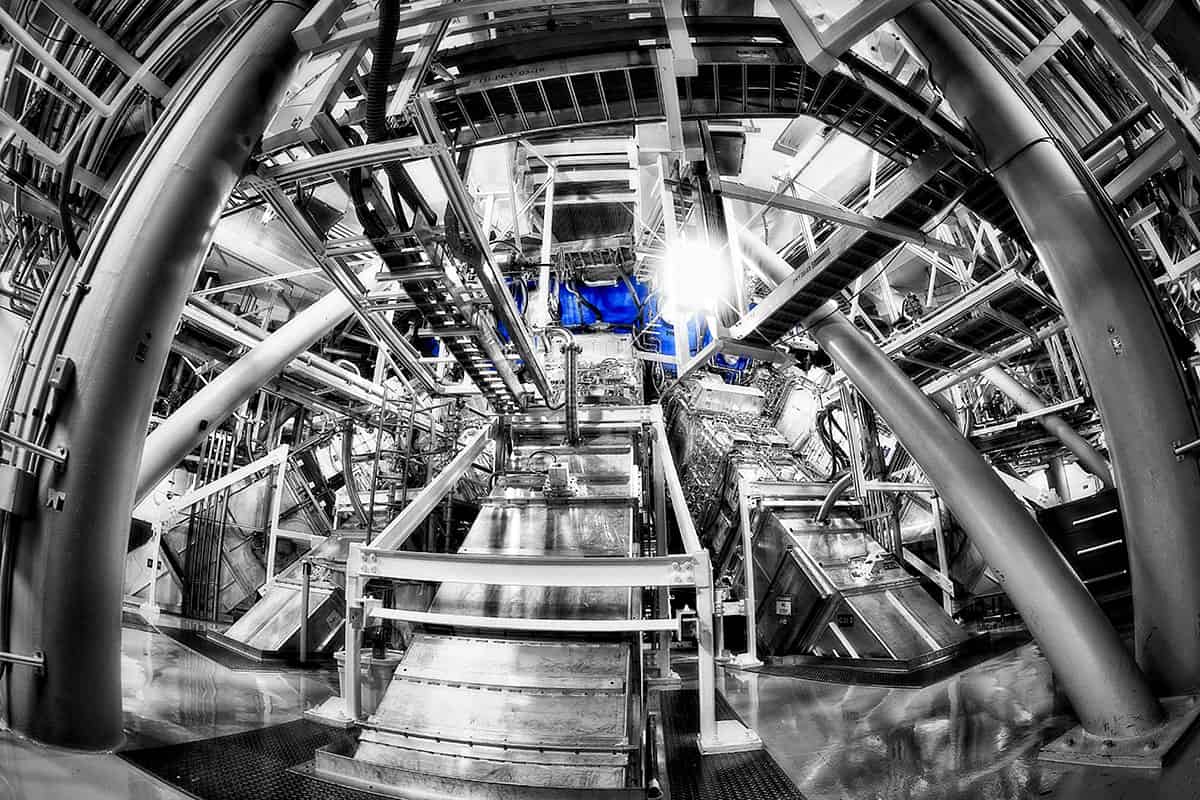
Captured beams The target chamber of the National Ignition Facility (NIF) at Lawrence Livermore National Laboratory. NIF has demonstrated that inertial fusion can work with deuterium–tritium fuel, but it is a research facility not a commercial endeavour. (Courtesy: Lawrence Livermore National Laboratory/Damien Jemison)
Can you explain Focused Energy’s approach to fusion?
Focused Energy was founded in July 2021, and has offices in the US and Germany. Just a month later, we achieved fusion ignition, which is when the fusion fuel becomes hot enough for the reactions to sustain themselves through their own internal heating (it is not the same as gain).
At NIF lasers are fired into a small cylinder of gold or depleted uranium and the energy is converted into X-rays, which then drive the capsule. It’s what’s called laser indirect drive. At Focused Energy, however, we’re directly driving the capsule. The laser energy is put directly on the capsule, with no intermediate X-rays.
The advantage of this approach is that converting laser energy to X-rays is not very efficient. It makes it much harder to get the high target gains that we need. At Focused Energy, we believe that direct drive is the best option for fusion energy to get us to a gain of over 50.
So is boosting efficiency one of your key goals to make fusion practical at an industrial level?
Yes, exactly. You have to remember that NIF was funded for national security purposes, not for fusion energy. It wasn’t designed to be a power plant – the goal was just to generate fusion energy for the first time.
In particular, the laser at NIF is less than 1% efficient but we believe that for fusion power generation, the laser needs to be about 10% efficient.
So one of the big thrusts for our company is to develop more efficient lasers that are driven by diodes – called diode pump solid state lasers.
Can you tell us about Focused Energy’s two technologies called LightHouse and Pearl Fuel?
LightHouse is our fusion pilot plant. When operational, it will be the first power plant to produce engineering gain greater than one, meaning it will produce more energy than it took to drive it. In other words, we’ll be producing net electricity.
For NIF, in contrast, gain is the amount of energy out relative to the amount of laser energy in. But the laser is very inefficient, so the amount of electricity they had to put in to produce that eight megajoules of fusion energy is a lot.
Meanwhile, Pearl is the capsule the laser is aimed at in our direct drive system. It’s filled with deuterium–tritium fuel derived from sea water and lithium.
Rejuvenating nuclear A rendering of Focused Energy’s proposed fusion power plant at the Biblis fission power plant in Germany, which was shut down in 2011. (Courtesy: Focused Energy)
How do you develop the capsule to absorb the laser energy and give as much of it to the fuel as possible?
The development of the capsule for a fusion power plant is quite complicated. First, we need it to be a perfect sphere so it compresses spherically. The materials also need to efficiently absorb the laser light so you can minimize the size of that laser.
You have to be able to cheaply and quickly mass produce these targets too. While NIF does 400 shots per year, we will need to do about 900,000 shots a day – about 10 per second. We’ll also have to efficiently remove the exploded target material from the reactor chamber so that it can be cleared for the next shot.
It’s a very complicated design that needs to bring together all the pieces of the power plant in a consistent way.
When you are designing these elements, what plays a bigger role – computer simulations or experiments?
Computer simulations play a large part in developing these designs. But one of the lessons that I learned from NIF was that, although the simulation codes are state of the art, you need very precise answers, and the codes are not quite good enough – experimental data play a huge role in optimizing the design. I expect the same will be true at Focused Energy.
A third factor that’s developing is artificial intelligence (AI) and machine learning. In fact, at Livermore, a project working on AI contributed to achieving gain for the first time in December 2022. I only see AI’s role in fusion getting bigger, especially once we are able to do higher repetition rate experiments, which will provide more training data.
What intellectual property (IP) does Focused Energy have in addition to that for the design of the Pearl target and the LightHouse plant?
We also have IP in the design of the lasers – they are not the same lasers as used at NIF. And I think there’ll be a lot of IP around how we fabricate the targets. After all, it’s pretty complicated to figure out how to build 900,000 targets a day at a reasonable cost.
We’ll see a lot of IP coming out of this project in those areas, but there’s also the act of putting it all together. How we integrate these things in order to make a successful plant is important.
What are the challenges of working with deuterium and tritium as materials for fusion?
We chose deuterium and tritium because they are the easiest elements to fuse, and have been successfully demonstrated as fusion fuel by NIF.
Deuterium can be found naturally in sea water, but getting tritium – which is radioactive – is more complicated. We breed it from lithium. Our reactor designs have lithium in them, and the neutrons from the fusion reactions breed the tritium.
Making sure that we have enough tritium, and figuring out how to extract that material to use it for future shots, is a big task. We have to be able to breed enough tritium to keep the plant going.
To work on this, we have a collaboration funded by the US Department of Energy to work with Savannah River National Lab in South Carolina. They have a lot of expertise in designing these tritium-extraction systems.
How will you capture the heat from the deuterium–tritium fusion reaction?
We will use a conventional steam cycle to convert the heat into electricity. It’s funny – we’ll have this very hi-tech way of producing heat, but at the end of the day, we will use a traditional system to produce the electricity from that heat.
So what’s the timeline on development?
Our plan is to have a pilot plant up by the end of the 2030s. It’s a fairly aggressive timeline given the things that we have to do. But that’s part of being a start-up – we have to take some risks and try to move quickly to achieve our goal.
To help that we have, in my view, a superpower – we have one foot in Europe and one foot in the US. There are a lot of opportunities between the two continents to partner with other companies, universities and governments. I think that makes us strong because we have access to some of the best talent from around the world.
How does working at Focused Energy compare with life as an academic at Lawrence Livermore?
There are a lot of similarities. My role now is to bring the knowledge and skills I learned at NIF to Focused Energy, so it’s been a natural transition.
In fact, there was a lot of pressure working at NIF. We were trying to move very quickly, so it’s actually very similar to working in a start-up like Focused Energy.
One of the big differences is the level of bureaucracy. Working for a government-funded lab meant there were lots of rules and paperwork, which takes up your time and you don’t always see the value in it.
In contrast, working for a small start-up means we can move more quickly because we don’t have as many of those kinds of constraints. Personally, I find that great because it leaves more time for the fun and interesting things – like trying to get fusion on the grid.
Are you still involved in academic research in any way?
As a firm, we are still out there collaborating with academics. Last year, for example, we gave four separate presentations at the American Physical Society Division of Plasma Physics meeting.
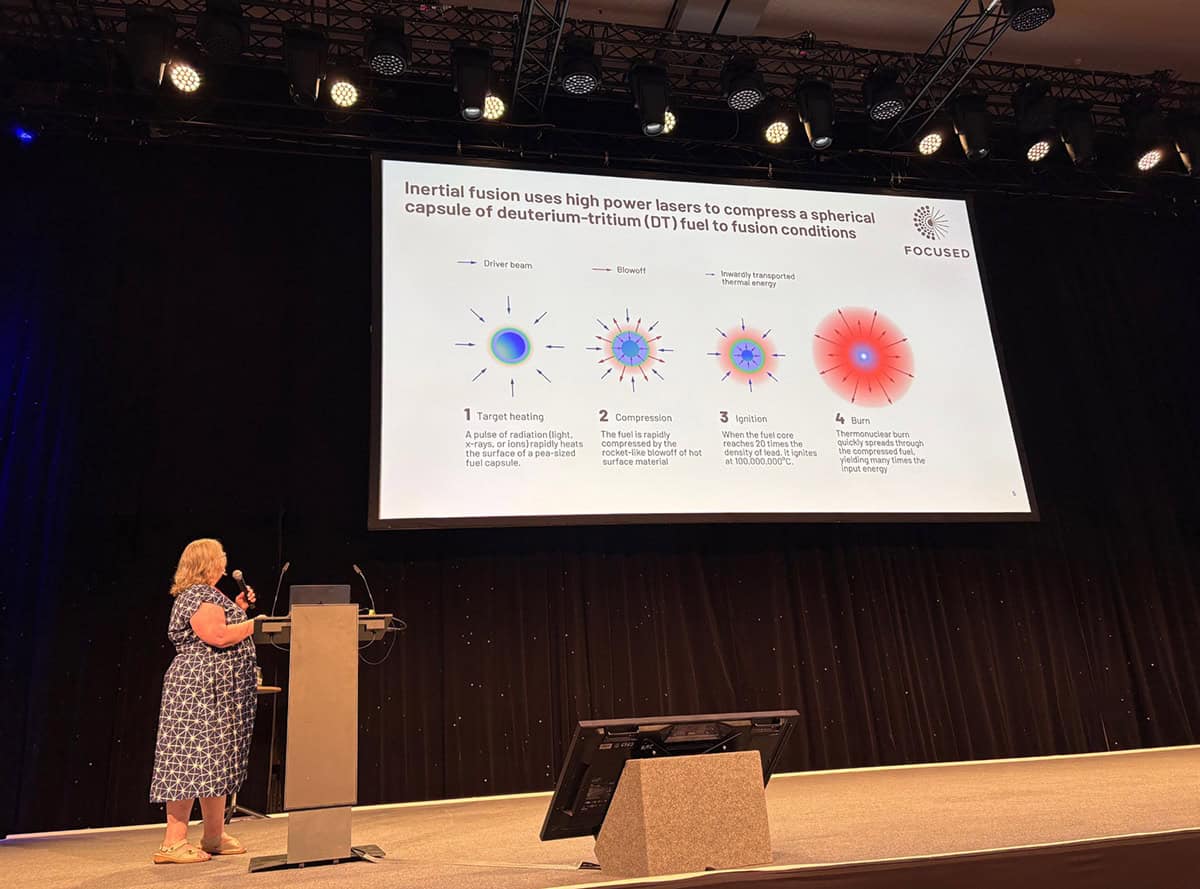
Active collaboration Debbie Callahan presenting the work of Focused Energy at the IEEE Pulsed Power and Plasma Science Conference in Berlin in June 2025. (Courtesy: Focused Energy)
I feel very strongly about peer review. Of course, publishing isn’t our number one priority, but we need feedback from others. We’re trying to do something that no-one’s done before, so it’s important to have our colleagues give us feedback on what we’re doing, point out mistakes we’re making or things we’re forgetting.
Working with universities and national labs in both Europe and the US is vital. Communicating with others in the field is important for us to get to where we want to go.
And of course, being an active part of the fusion community is good for recruitment too. We regularly give presentations at conferences that students attend. We meet those students and they learn about our work – and they might be future employees for our company.
What’s your advice for early-career physicists keen on joining the fusion industry?
There are so many opportunities right now, especially compared to the start of my career when the work was mainly just at universities or national labs. Nowadays, there are a lot of companies in the sector. Not all of them will survive because there’s only so much money, but there are still lots of opportunities. If you’re interested in fusion energy, go for it.
The field is always developing. There’s new stuff happening every day – and new problems. So if you like problem-solving, it’s great, especially if you want to do something good for the world.
There are also opportunities for people who are not plasma physicists. At Focused Energy we have people across so many fields – those who work on lasers, others who work on reactor design, some developing the AI and machine learning, and those who work on target physics, like me. To achieve fusion energy, we need physicists, engineers, mathematicians and computer scientists. We need researchers, technicians and operators. There’s going to be tremendous growth in this sector.
This winter in Bristol has been even gloomier than usual – so I was really looking forward to the Bristol Light Festival 2026. We went on the last evening of the event (28 February) and we were blessed with dry weather and warmish temperatures.
The festival featured 10 illuminated installations that were scattered throughout Bristol and the crowds were out in force to enjoy them. I wasn’t expecting to be thinking about physics as I wandered through town, but that’s exactly what I found myself doing at an installation called The Midnight Ballet by the British sculptor Will Budgett. Rather appropriately, it was located next to the HH Wills Physics Laboratory at the University of Bristol.
The display comprises seven sculptures that are illuminated from two different directions. The result is two very different images of ballerinas projected onto two screens (see image).
Art and science
So, why was I thinking about physics while admiring the work? To me the pieces embody – in a purely artistic way – the idea of superposition and measurement in quantum mechanics. A sculpture is capable of producing two different images (a superposition of states), but neither of these images is observable until a sculpture is illuminated from specific directions (the measurements).
Now, I know that this analogy is far from perfect. Measurements can be made simultaneously in two orthogonal planes, for example. But, Budgett’s beautiful artworks really made me think about quantum physics. Given the exhibit’s close proximity to the university’s physics department, I suspect I am not the only one.
An international team of researchers has shown that superconductivity can be modified by coupling a superconductor to a dark electromagnetic cavity. The research opens the door to the control of a material’s properties by modifying its electromagnetic environment.
Electronic structure defines many material properties – and this means that some properties can be changed by applying electromagnetic fields. The destruction of superconductivity by a magnetic field and the use of electric fields to control currents in semiconductors are two familiar examples.
There is growing interest in how electronic properties could be controlled by placing a material in a dark electromagnetic cavity that resonates with an electronic transition in that material. In this scenario, an external field is not applied to the material. Rather, interactions occur via quantum vacuum fluctuations within the cavity.
Holy Grail
“The Holy Grail of cavity materials research is to alter the properties of complex materials by engineering the electromagnetic environment,” explains the team – which includes Itai Keren, Tatiana Webb and Dmitri Basov at Columbia University in the US.
They created an optical cavity from a small slab of hexagonal boron nitride. This was interfaced with a slab of κ-ET, which is an organic low-temperature superconductor. The cavity was designed to resonate with an infrared transition in κ-ET involving the vibrational stretching of carbon–carbon bonds.
Hexagonal boron nitride was chosen because it is a hyperbolic van der Waals material. Van der Waals materials are stacks of atomically-thin layers. Atoms are strongly bound within each layer, but the layers are only weakly bound to each other by the van der Waals force. The gaps between layers can act as waveguides, confining light that bounces back and forth within the slab. As a result the slab behaves like an optical cavity with an isofrequency surface that is a hyperboloid in momentum space. Such a cavity supports a large number of modes and vacuum fluctuations, which enhances interactions with the superconductor.
Superfluid suppression
The researchers found that the presence of the cavity caused a strong suppression of superfluid density in κ-ET (a superconductor can be thought of as a superfluid of charged particles). The team mapped the superfluid density using magnetic force microscopy. This involved placing a tiny magnetic tip near to the surface of the superconductor. The magnetic field of the tip cannot penetrate into the superconductor (the Meissner effect) and this results in a force on the tip that is related to the superfluid density. They found that the density dropped by as much as 50% near the cavity interface.
The team also investigated the optical properties of the cavity using scattering-type scanning near-field optical microscope (s-SNOM). This involves firing tightly-focused laser light at an atomic force microscope (AFM) tip that is tapping on the surface of the cavity. The scattered light is processed to reveal the near-field component of light from just the region of the cavity below the tip .
The tapping tip creates phonon polaritons in the cavity, which are particle-like excitations that couple lattice vibrations to light. Analysing the near-field light across the cavity confirmed that the carbon stretching mode of κ-ET is coupled to the cavity. Calculations done by the team suggest that cavity coupling reduces the amplitude of the stretching mode vibrations.
Physicists know that superconductivity can arise from interactions between electrons and phonons (lattice vibrations), So, it is possible that the reduction in superfluid density is related to the suppression of stretching-mode vibrations. This, however, is not certain because κ-ET is an unconventional superconductor, which means that physicists do not understand the mechanism that causes its superconductivity. Further experiments could therefore shed light on the mysteries of unconventional superconductors.
“We are confident that our experiments will prompt further theoretical pursuits,” the team tells Physics World. The researchers also believe that practical applications could be possible. “Our work shows a new path towards the manipulation of superconducting properties.”
Later this year, CERN’s Large Hadron Collider (LHC) and its huge experiments will shutdown for the High Luminosity upgrade. When complete in 2030, the particle-collision rate in the LHC will be increased by a factor of 10 and the experiments will be upgraded so that they can better capture and analyse the results of these collisions. This will allow physicists to study particle interactions at unprecedented precision and could even reveal new physics beyond the Standard Model.
Earlier this year, however, the UK government announced that it will no longer fund the upgrade of the LHCb experiment on the LHC, which is run by a collaboration of more than 1700 physicists worldwide. The UK had promised to contribute about £50 million to the upgrade – which is a significant chunk of the overall cost.
In this episode of the Physics World Weekly podcast I am in conversation with the particle physicist Tim Gershon, who is based at the UK’s University of Warwick. Gershon is spokesperson-elect for the LHCb collaboration and is playing a leading role in the upgrade.
Gershon explains that UK participation and leadership has been crucial for the success of LHCb and cautions that the future of the experiment and the future of UK particle physics have been imperilled by the funding cut.
We also chat about recent discoveries made by LHCb and look forward to what new physics the experiment could find after the upgrade.
Here at Physics World we are always on the look out for physicists with extraordinary talents outside of science. In 2023, for example we were in awe of Harvard University’s Jenny Hoffman who ran across the US in 47 days, 12 hours and 35 minutes – shattering the previous record by one week.
Now, coverage of the Winter Olympics in Italy has revealed that the Chinese freestyle skier Eileen Gu had studied physics at Stanford University. The most decorated female Olympic freestyle skier in history, US-born Gu bagged two gold medals and a silver at the 2022 Beijing games and added three silvers at Milano Cortina.
Gu has subsequently switched majors to international relations at Stanford, but we can still celebrate her as an honorary physicist.
Physics-rich event
Indeed, freestyle skiing is quite possibly the most physics-rich of all Olympic events. Athletes must consider friction, gravity and the conservation of momentum and angular momentum to perfect their skiing.
Now, I’m not suggesting that studying free-body diagrams of freestyle manoeuvres is essential for Olympic success, but I live in hope that an understanding of classical mechanics can improve one’s skiing. (I’m not sure why I believe this, because a PhD and decades of writing about physics certainly hasn’t improved my skiing!).
As well as being lauded for her prowess on the snow, Gu has found herself at the centre of an international furore regarding her choice of competing for China rather than for the US. So, international relations combined with physics seems like a very good course of study!
Article has been updated to include Gu’s third silver medal at Milano Cortina.
A new way of extracting energy from ocean waves has been proposed by a researcher in Japan. The system couples a gyroscope to an electrical generator and could be fine tuned to extract energy from a wide range of wave conditions. A prototype of the design is currently being built for testing in a wave tank. If successful, the system could be used to generate electricity onboard ships.
Ocean waves contain huge amounts of energy and humans have tried to harness this energy for centuries. But, despite the development of myriad technologies and a number of trials, the widespread commercial conversion of wave energy remains an elusive goal. One important problem is that most generation schemes only work within a narrow range of wave conditions – and the ocean can be a very messy place.
Now, Takahito Iida at the University of Osaka has proposed a new energy-harvesting technology that uses gyroscopic flywheel system that can be tuned to absorb energy efficiently over a broad range of wave frequencies.
“Wave energy devices often struggle because ocean conditions are constantly changing,” says Iida. “However, a gyroscopic system can be controlled in a way that maintains high energy absorption, even as wave frequencies vary.”
Wobbling top
At the heart of the technology is gyroscopic precession, whereby a torque on a rotating object causes the object’s axis of rotation to trace out a circle. This is familiar to anyone who has played with a spinning top, which will wobble (precess) when perturbed.
Iida’s device is called a gyroscopic wave energy converter and comprises a spinning flywheel mounted on a floating platform (see figure). On calm seas, the gyroscope’s axis of rotation points in a fixed direction thanks to the conservation of angular momentum. However, waves will cause the platform to pitch from side-to-side, exerting torques on the gyroscope and causing it to precess. It is this precession that drives a generator to deliver electrical power.
To design the system, Iida used linear wave theory to model the coupled interactions between waves, the platform, the gyroscope and the generator. This allowed him to devise a scheme for tuning the gyroscope frequency and generator parameters so that an energy conversion efficiency of 50% is achieved for a variety of wave conditions.
The effect of the generator was modelled as a spring-damper. This is a system that responds to a torque by storing and then returning some energy to the gyroscope (the spring), and removing some energy by converting it to electricity (the damper). Iida discovered that a maximum conversion of 50% occurs when the spring coefficient of the generator is adjusted such that the gyroscope’s resonant frequency matches the resonant frequency of the floating platform.
Fundamental constraint
Iida explains that 50% is the maximum efficiency that can be achieved. “This efficiency limit is a fundamental constraint in wave energy theory. What is exciting is that we now know that it can be reached across broadband frequencies, not just at a single resonant condition.”
Iida tells Physics World that a small prototype (approximately 50 cm3 in size) is being built and will be tested in a 100 m-long tank.
The next step will be the development of a system with a generating capacity of about 5 kW. Iida says that the ultimate goal is a 300 kW generator.
Iida also explains that the gyroscopic wave energy converter is designed to operate untethered to the seabed. As a result he says the system would be ideal for use as an auxiliary power system for a ship. “The target output of 300 kW is based on the assumed auxiliary power demand of a typical commercial vessel,” says Iida.
Developing practical technologies for quantum information systems requires the cooperation of academic researchers, national laboratories and industry. That is the mission of the Quantum Systems Accelerator (QSA), which is based at the Lawrence Berkeley National Laboratory in the US.
The QSA’s director Bert de Jong is my guest in this episode of the Physics World Weekly podcast. His academic research focuses on computational chemistry and he explains how this led him to realise that quantum phenomena can be used to develop technologies for solving scientific problems.
In our conversation, de Jong explains why the QSA is developing a range of qubit platforms − including neutral atoms, trapped ions, and superconducting qubits – rather than focusing on a single architecture. He champions the co-development of quantum hardware and software to ensure that quantum computing is effective at solving a wide range of problems from particle physics to chemistry.
We also chat about the QSA’s strong links to industry and de Jong reveals his wish list of scientific problems that he would solve if he had access today to a powerful quantum computer.
Machine-learning could help us use cosmic muons to peer inside large objects such as nuclear reactors. Developed by researchers in China, the technique is capable of identifying target materials such as uranium even if they are coated with other materials.
The muon is a subatomic particle that is essentially a heavier version of the electron. Huge numbers of cosmic muons are created in Earth’s atmosphere when cosmic rays collide with gas molecules. Thousands of cosmic muons per second rain down on every square metre of Earth’s surface and these particles can penetrate tens to hundreds of metres through solid materials.
As a result, cosmic muons are used to peer inside large objects such as nuclear reactors, volcanoes and ancient pyramids. This involves placing detectors next to an object and detecting muons that have passed through or scattered within the object. Detector data are then processed using a tomography algorithm to create a 3D image of the object’s interior.
Illicit nuclear materials
Muons tend to scatter more from high-atomic-number materials, so the technique is particularly sensitive to the presence of materials such as uranium. As a result, it has been used to create systems for the detection of illicit nuclear materials hidden in freight containers.
Muon tomography is relatively straightforward when the object is of simple construction – such as a pyramid built of stone and containing voids. Producing useful images of more complex target – such as a freight container full of unknown objects – is much more difficult. The conventional computational approach is to calculate the muon-scattering physics of many different materials and combine these data with muon-tracking algorithms. This, however, tends to require huge computational resources.
Supervised machine learning has been used to reduce the computational overhead, but this requires prior knowledge of the target materials – limiting efficacy when imaging unknown and concealed materials. What is more, many materials in complex objects are coated with other materials and these coatings can affect muon scattering.
Now, Liangwen Chen at the Institute of Modern Physics of the Chinese Academy of Sciences and colleagues have used a technique called transfer learning to improve cosmic muon tomography of objects that contain coated materials. The idea of transfer learning is to begin with knowledge of the muon-scattering parameters of bare, uncoated materials and use machine learning to predict the parameters of coated materials. Chen and colleagues believe that this is the first application of transfer learning to muon tomography.
Monte Carlo simulations
The team began by creating a database describing how cosmic muons interact with representative materials with a wide range of atomic numbers. This was done by using Geant4 to do Monte Carlo simulations of how muons interact as they pass through materials. Geant4 is the most recent incarnation of the GEANT series of computer simulations, which have been used for over 50 years to design particle detectors and interpret the data that they produce.
Chen and colleagues used Geant4 to calculate how muons are scattered within nine materials ranging from magnesium (atomic number 12) to uranium (atomic number 92). These included common elements such as aluminium, copper and iron. The geometry of the scattering involves incoming cosmic muons with energies of 1 GeV and incident angles that are typical of cosmic muons. After scattering from a material target, the simulation assumes that the muons travel though two successive detectors, which measures the scattering angles. Data were generated for bare targets of the nine materials, as well as the nine materials coated with aluminium and polyethylene. Each simulation involved 500,000 muons passing through a target.
These data were then sampled using an inverse cumulative distribution function, as well as integration and interpolation. This is done to convert the data to a form that is optimal for training a neural network.
To use these data, the team created two lightweight neural-network frameworks for transfer learning: one based on fine tuning; and the other a domain-adversarial neural network. According to the team, both frameworks were able to identify correlations between muon scattering-angle distributions and different target materials. Crucially, this was the case even when the target materials were coated in aluminium or polyethylene.
Chen explains, “Transfer learning allows us to preserve the fundamental physical characteristics of muon scattering while efficiently adapting to unknown environments under shielding”.
Chen and colleagues are now trying to apply their process to more complicated scattering geometries. The also plan to include detector effects and targets made of several materials.
“By integrating simulation, physics, and data-driven learning, this research opens new pathways for applying artificial intelligence to nuclear science and security technologies,” says Chen.
Science fiction became science fact in 2022 when NASA’s DART mission took the first steps towards creating a planetary defence system that could someday protect Earth from a catastrophic asteroid collision. However, much more work on asteroid deflection is needed from the latest generation of researchers – including Rahil Makadia, who has just completed a PhD in aerospace engineering at University of Illinois at Urbana-Champaign.
In this episode of the Physics World Weekly podcast, Makadia talks about his work on how we could deflect asteroids away from Earth. We also chat about the potential threats posed by near-Earth asteroids – from shattered windows to global destruction.
Makadia’s stresses the importance of getting a deflection right the first time, because his calculations reveal that a poorly deflected asteroid could return to Earth someday. In November, he published a paper that explored how a bad deflection could send an asteroid into a “keyhole” that guarantees its return.
But it is not all gloom and doom, Makadia points out that our current understanding of near-Earth asteroids suggests that no major collision will occur for at least 100 years. So even if there is a threat on the horizon, we have lots of time to develop deflection strategies and technologies.
A passive vacuum pump that uses 3D-printed surfaces to better absorb gas molecules has been unveiled by researchers in the UK. It removes gas nearly four-times faster than a similar system with a flat surface. The pump could make it easier to design quantum sensors that require high-vacuum conditions.
Cold atoms are at the heart of many quantum-sensing technologies. For example, atom interferometry is used to measure tiny deviations in local gravity – which can be used to map underground infrastructure.
Cold-atom systems must operate at high vacuum and most vacuum pumps are mechanical or electrical in nature. The size of these active pumps and the energy that they consume makes it difficult to operate sensors in remote or mobile scenarios – particularly on satellites. As a result, researchers who are designing quantum sensors are keen on reducing or even eliminating their reliance on active pumps.
One solution is the use of passive pumps, which have surfaces made from materials that absorb large numbers of gas molecules. Now, Lucia Hackermueller and colleagues at the University of Nottingham, Torr Scientific and Metamorphic Additive Manufacturing have created two new textured surfaces that accelerate passive pumping.
Bounce optimization
One of their surfaces is a hexagonal array of tapered pockets that resembles a honeycomb. The other surface is a hexagonal array of conical protrusions. They chose their designs after doing Monte Carlo computer simulations of how gas molecules behave near textured surfaces. When a molecule collides with a flat surface it will either be absorbed or bounce off the surface and escape. However, if the surface has 3D structures on it, a molecule may ricochet back and forth several times between structures before it escapes. Each collision increases the chance that the molecule will be absorbed by the surface. So, the researchers sought to optimize the number of bounces in their simulations.
They then used the 3D printing of a titanium alloy to create the two promising designs on hockey-puck sized flanges that could be installed in a conventional high-vacuum system (see figure). The final step in the fabrication process was to coat the surfaces with a nonevaporable getter, which is a material designed specifically to absorb gas molecules in a vacuum system.
The team found that their hexagonal-pocket design pumped gas 3.8 times faster than a flat surface – and the hexagonal-protrusion design achieved a performance that is nearly as good.
Team member Ben Hopton at the University of Nottingham says, “What’s exciting about this work is that relatively simple surface engineering can have a surprisingly large effect. By shifting some of the burden from active pumping to passive surface-based pumping, this approach has the potential to significantly reduce, or even remove, the need for bulky pumps in some vacuum systems, allowing quantum technologies to be far more portable.”
Physicists in Germany have created a new type of X-ray laser that uses a resonator cavity to improve the output of a conventional X-ray free electron laser (XFEL). Their proof-of-concept design delivers X-ray pulses that are more monochromatic and coherent than those from existing XFELs.
In recent decades, XFELs have delivered pulses of monochromatic and coherent X-rays for a wide range of science including physics, chemistry, biology and materials science.
Despite their name, XFELs do not work like conventional lasers. In particular, there is no gain medium or resonator cavity. Instead, XFELs rely on the fact that when a free electron is accelerated, it will emit electromagnetic radiation. In an XFEL, pulses of high-energy electrons are sent through an undulator, which deflects the electrons back and forth. These wiggling electrons radiate X-rays at a specific energy. As the X-rays and electrons travel along the undulator, they interact in such a way that the emitted X-ray pulse has a high degree of coherence.
While these XFELs have proven very useful, they do not deliver radiation that is as monochromatic or as coherent as radiation from conventional lasers. One reason why conventional lasers perform better is that the radiation is reflected back and forth many times in a mirrored cavity that is tuned to resonate at a specific frequency – whereas XFEL radiation only makes one pass through an undulator.
Practical X-ray cavities, however, are difficult to create. This is because X-rays penetrate deep into materials, where they are usually absorbed – making reflection with conventional mirrors impossible.
Crucial overlap
Now, researchers working at the European XFEL at DESY in Germany have created a proof-of-concept hybrid system that places an undulator within a mirrored resonator cavity. X-ray pulses that are created in the undulator are directed at a downstream mirror and reflected back to a mirror upstream of the undulator. The X-ray pulses are then reflected back downstream through the undulator. Crucially, a returning X-ray pulse overlaps with a subsequent electron pulse in the undulator, amplifying the X-ray pulse. As a result, the X-ray pulses circulating within the cavity quickly become more monochromatic and more coherent than pulses created by an undulator alone.
The team solved the mirror challenge by using diamond crystals that achieve the Bragg reflection of X-rays with a specific frequency. These are used at either end of the cavity in conjunction with Kirkpatrick–Baez mirrors, which help focus the reflected X-rays back into the cavity.
Some of the X-ray radiation circulating in the cavity is allowed to escape downstream, providing a beam of monochromatic and coherent X-ray pulses. They have called their system X-ray Free-Electron Laser Oscillator (XFELO). The cavity is about 66 m long.
Narrow frequency range
DESY accelerator scientist Patrick Rauer explains, “With every round trip, the noise in the X-ray pulse gets less and the concentrated light more defined”. Rauer pioneered the design of the cavity in his PhD work and is now the DESY lead on its implementation. “It gets more stable and you start to see this single, clear frequency – this spike.” Indeed, the frequency width of XFELO X-ray pulses is about 1% that of pulses that are created by the undulators alone
Ensuring the overlap of electron and X-pulses within the cavity was also a significant challenge. This required a high degree of stability within the accelerator that provides electron pulses to XFELO. “It took years to bring the accelerator to that state, which is now unique in the world of high-repetition-rate accelerators”, explains Rauer.
Team member Harald Sinn says, “The successful demonstration shows that the resonator principle is practical to implement”. Sinn is head of European XFEL’s instrumentation department and he adds, “In comparison with methods used up to now, it delivers X-ray pulses with a very narrow wavelength as well as a much higher stability and coherence.”
The team will now work towards improving the stability of XFELO so that in the future it can be used to do experiments by European XFEL’s research community.
This episode of the Physics World Weekly podcast features Todd McNutt, who is a medical physicist at Johns Hopkins University and the founder of Oncospace. In a conversation with Physics World’s Tami Freeman, McNutt explains how an artificial intelligence-based tool called Plan AI can help improve the quality of radiation therapy plans for cancer treatments.
As well as discussing the benefits that Plan AI brings to radiotherapy patients and cancer treatment centres, they examine its evolution from an idea developed by an academic collaboration to a clinical product offered today by Sun Nuclear, a US manufacturer of radiation equipment and software.
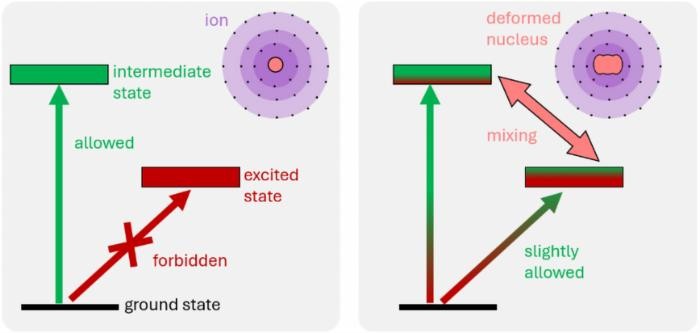
Nuclear effect The deformed shape of the ytterbium-173 nucleus (right) makes it possible to excite the clock transition with a relatively low-power laser. The same transition is forbidden (left) if the nucleus is not deformed. (Courtesy: Physikalisch-Technische Bundesanstalt (PTB))
An atomic transition in ytterbium-173 could be used to create an optical multi-ion clock that is both precise and stable. That is the conclusion of researchers in Germany and Thailand who have characterized a clock transition that is enhanced by the non-spherical shape of the ytterbium-173 nucleus. As well as applications in timekeeping, the transition could be used in quantum computing. Furthermore, the interplay between atomic and nuclear effects in the transition could provide insights into the physics of deformed nuclei.
The ticking of an atomic clock is defined by the frequency of the electromagnetic radiation that is absorbed and emitted by a specific transition between atomic energy levels. These clocks play crucial roles in technologies that require precision timing – such as global navigation satellite systems and communications networks. Currently, the international definition of the second is given by the frequency of caesium-based clocks, which deliver microwave time signals.
Today’s best clocks, however, work at higher optical frequencies and are therefore much more precise than microwave clocks. Indeed, at some point in the future metrologists will redefine the second in terms of an optical transition – but the international metrology community has yet to decide which transition will be used.
Broadly speaking, there are two types of optical clock. One uses an ensemble of atoms that are trapped and cooled to ultralow temperatures using lasers; the other involves a single atomic ion (or a few ions) held in an electromagnetic trap. Clocks that use one ion are extremely precise, but lack stability; whereas clocks that use many atoms are very stable, but sacrifice precision.
Optimizing performance
As a result, some physicists are developing clocks that use multiple ions with the aim of creating a clock that optimizes precision and stability.
Now, researchers at PTB and NIMT (the national metrology institutes of Germany and Thailand respectively) have characterized a clock transition in ions of ytterbium-173, and have shown that the transition could be used to create a multi-ion clock.
“This isotope has a particularly interesting transition,” explains PTB’s Tanja Mehlstäubler – who is a pioneer in the development of multi-ion clocks.
The ytterbium-173 nucleus is highly deformed with a shape that resembles a rugby ball. This deformation affects the electronic properties of the ion, which should make it much easier to use a laser to excite a specific transition that would be very useful for creating a multi-ion clock.
Stark effect
This clock transition can also be excited in ytterbium-171 and has already been used to create a single-ion clock. However, excitation in a ytterbium-171 clock requires an intense laser pulse, which creates a strong electric field that shifts the clock frequency (called the AC Stark effect). This is a particular problem for multi-ion clocks because the intensity of the laser (and hence the clock frequency) can vary across the region in which the ions are trapped.
To show that a much lower laser intensity can be used to excite the clock transition in ytterbium-173, the team studied a “Coulomb crystal” in which three ions were trapped in a line and separated by about 10 micron. They illuminated the ions with laser light that was not uniform in intensity across the crystal. They were able to excite the transition at a relatively low laser intensity, which resulted in very small AC Stark shifts between the frequencies of the three ions.
According to the team, this means that as many as 100 trapped ytterbium-173 ions could be used to create a clock that could be used as a time standard; to redefine the second; and also to make very precise measurements of the Earth’s gravitational field.
As well as being useful for creating an optical ion clock, this multi-ion capability could also be exploited to create quantum-computing architectures based on multiple trapped ions. And because the observed effect is a result of the shape of the ytterbium-173 nucleus, further studies could provide insights into nuclear physics.
This episode of the Physics World Weekly podcast features a conversation with the plasma physicist Debbie Callahan who is chief strategy officer at Focused Energy – a California and Germany based fusion-energy startup. Prior to that she spent 35 years working at the National Ignition Facility (NIF) at Lawrence Livermore National Laboratory in the US.
Focused Energy is developing a commercial system for generating energy from the laser-driven fusion of hydrogen isotopes. Callahan describes LightHouse, which is the company’s design for a laser-fusion power plant, and Pearl, which is the firm’s deuterium–tritium fuel capsule.
Callahan talks about the challenges and rewards of working in the fusion industry and also calls on early-career physicists to consider careers in this burgeoning sector.
A miniature version of an atomic fountain clock has been unveiled by researchers at the UK’s National Physical Laboratory (NPL). Their timekeeper occupies just 5% of the volume of a conventional atomic fountain clock while delivering a time signal with a stability that is on par with a full-sized system. The team is now honing its design to create compact fountain clocks that could be used in portable systems and remote locations.
The ticking of an atomic clock is defined by the frequency of the electromagnetic radiation that is absorbed and emitted by a specific transition between atomic energy levels. Today, the second is defined using a transition in caesium atoms that involves microwave radiation. Caesium atoms are placed in a microwave cavity and a measurement-and-feedback mechanism is used to tune the frequency of the cavity radiation to the atomic transition – creating a source of microwaves with a very narrow frequency range centred at the clock frequency.
The first atomic clocks sent a fast-moving beam of atoms through a microwave cavity. The precision of such a beam clock is limited by the relatively short time that individual atoms spend in the cavity. Also, the speed of the atoms means that the measured frequency peak is shifted and broadened by the Doppler effect.
Launching atoms
These problems were addressed by the development of the fountain clock, in which the atoms are cooled (slowed down) by laser light, which also launches the atoms upwards. The atoms pass through a microwave cavity on the way up, and again as they fall back down. The atoms travel at much slower speeds than in a beam clock. The atoms spend much more time in the cavity and therefore the time signal from an atomic clock is much more precise than a beam clock. However, long times result in greater thermal spread of the atomic beam – which degrades clock performance. Trading-off measurement time with thermal spread means that the caesium fountain clocks that currently define the second have drops of about 30 cm.
Other components are also needed to operate fountain clocks – including a vacuum system and laser and microwave instrumentation. This pushes the height of a typical clock to about 2 m, and makes it a complex and expensive instrument that cannot be easily transported.
Now, Sam Walby and colleagues at NPL have shrunk the overall height of a rubidium-based fountain clock to 80 cm, while retaining the 30 cm drop. The result is an instrument that is 5% the volume of one of NPL’s conventional caesium atomic fountain clocks.
Precise yet portable
“That’s taking it from barely being able to fit though a doorway, to something one could pick up and carry with one arm,” says Walby.
Despite the miniaturization, the mini-fountain achieved a stability of one part in 1015 after several days of operation – which NPL says is comparable to full-sized clocks.
Walby told Physics World that the NPL team achieved miniaturization by eliminating two conventional components from their clock design. One is a dedicated chamber used to measure the quantum states of the atoms. Instead, this measurement is make within the clock’s cooling chamber. Also eliminated is a dedicated state-selection microwave cavity, which puts the atoms into the quantum state from which the clock transition occurs.
“The mini-fountain also does this [state] selection,” explains Walby, “but instead of using a dedicated cavity, we use a coax-to-waveguide adapter that is directed into the cooling chamber, which creates a travelling wave of microwaves at the correct frequency.”
The NPL team also reduced the amount of magnetic shielding used, which meant that the edge-effects of the magnetic field had to be more carefully considered. The optics system of the clock was greatly simplified and the use of commercial components mean that the clock is low maintenance and easy to operate – according to NPL.
Radical simplification
“By radically simplifying and shrinking the atomic fountain, we’re making ultra-precise timing technology available beyond national labs,” said Walby. “This opens new possibilities for resilient infrastructure and next-generation navigation.”
According to Walby, one potential use of a miniature atomic fountain clock is as a holdover clock. These are devices that produce a very stable time signal when not synchronized with other atomic clocks. This is important for creating resilience in infrastructure that relies on precision timing – such as communications networks, global navigation satellite systems (including GPS) and power grids. Synchronization is usually done using GNSS signals but these can be jammed or spoofed to disrupt timing systems.
Holdover clocks require time errors of just a few nanoseconds over a month, which the new NPL clock can deliver. The miniature atomic clock could also be used as a secondary frequency standard for the SI second.
The small size of the clock also lends itself to portable and even mobile applications, according to Walby: “The adaptation of the mini-fountain technology to mobile platforms will be subject of further developments”.
However, the mini-clock is large when compared to more compact or chip-based clocks – which do not perform as well. Therefore, he believes that the technology is more likely to be implemented on ships or ground vehicles than aircraft.
“At a minimum, it should be easily transportable compared to the current solutions of similar performance,” he says.
“Highly innovative”
Atomic-clock expert Elizabeth Donley tells Physics World, “NPL has been highly innovative in recent years in standardizing fountain clock designs and even supplying caesium fountains to other national standards labs and organizations around the world for timekeeping purposes. This new compact rubidium fountain is a continuation of this work and can provide a smaller frequency standard with comparable performance to the larger fountains based on caesium.”
Donley spent more than two decades developing atomic clocks at the US National Institute of Standards and Technology (NIST) and now works as a consultant in the field. She agrees that miniature fountain clocks would be useful for holding-over timing information when time signals are interrupted.
She adds, “Once the international community decides to redefine the second to be based on an optical transition, it won’t matter if you use rubidium or caesium. So I see this work as more of a practical achievement than a ground-breaking one. Practical achievements are what drives progress most of the time.”
This episode of the Physics World Weekly podcast features a conversation with Tim Prior and John Devaney of the National Physical Laboratory (NPL), which is the UK’s national metrology institute.
Prior is NPL’s quantum programme manager and Devaney is its quantum standards manager. They talk about NPL’s central role in the recent launch of NMI-Q, which brings together some of the world’s leading national metrology institutes to accelerate the development and adoption of quantum technologies.
Prior and Devaney describe the challenges and opportunities of developing metrology and standards for rapidly evolving technologies including quantum sensors, quantum computing and quantum cryptography. They talk about the importance of NPL’s collaborations with industry and academia and explore the diverse career opportunities for physicists at NPL. Prior and Devaney also talk about their own careers and share their enthusiasm for working in the cutting-edge and fast-paced field of quantum metrology.
This podcast is sponsored by the National Physical Laboratory.
This episode of the Physics World Weekly podcast features Alex May, whose research explores the intersection of quantum gravity and quantum information theory. Based at Canada’s Perimeter Institute for Theoretical Physics, May explains how ideas being developed in the burgeoning field of quantum information theory could help solve one of the most enduring mysteries in physics – how to reconcile quantum mechanics with Einstein’s general theory of relativity, creating a viable theory of quantum gravity.
This interview was recorded in autumn 2025 when I had the pleasure of visiting the Perimeter Institute and speaking to four physicists about their research. This is the last of those conversations to appear on the podcast.
 Connexion