↩ Accueil

Vue normale

Pockets and pillars capture ricocheting molecules in vacuum pump

6 février 2026 à 13:30

A passive vacuum pump that uses 3D-printed surfaces to better absorb gas molecules has been unveiled by researchers in the UK. It removes gas nearly four-times faster than a similar system with a flat surface. The pump could make it easier to design quantum sensors that require high-vacuum conditions.

Cold atoms are at the heart of many quantum-sensing technologies. For example, atom interferometry is used to measure tiny deviations in local gravity – which can be used to map underground infrastructure.

Cold-atom systems must operate at high vacuum and most vacuum pumps are mechanical or electrical in nature. The size of these active pumps and the energy that they consume makes it difficult to operate sensors in remote or mobile scenarios – particularly on satellites. As a result, researchers who are designing quantum sensors are keen on reducing or even eliminating their reliance on active pumps.

One solution is the use of passive pumps, which have surfaces made from materials that absorb large numbers of gas molecules. Now, Lucia Hackermueller and colleagues at the University of Nottingham, Torr Scientific and Metamorphic Additive Manufacturing have created two new textured surfaces that accelerate passive pumping.

Bounce optimization

One of their surfaces is a hexagonal array of tapered pockets that resembles a honeycomb. The other surface is a hexagonal array of conical protrusions.  They chose their designs after doing Monte Carlo computer simulations of how gas molecules behave near textured surfaces. When a molecule collides with a flat surface it will either be absorbed or bounce off the surface and escape. However, if the surface has 3D structures on it, a molecule may ricochet back and forth several times between structures before it escapes. Each collision increases the chance that the molecule will be absorbed by the surface. So, the researchers sought to optimize the number of bounces in their simulations.

They then used the 3D printing of a titanium alloy to create the two promising designs on hockey-puck sized flanges that could be installed in a conventional high-vacuum system (see figure). The final step in the fabrication process was to coat the surfaces with a nonevaporable getter, which is a material designed specifically to absorb gas molecules in a vacuum system.

The team found that their hexagonal-pocket design pumped gas 3.8 times faster than a flat surface – and the hexagonal-protrusion design achieved a performance that is nearly as good.

Team member Ben Hopton at the University of Nottingham says, “What’s exciting about this work is that relatively simple surface engineering can have a surprisingly large effect. By shifting some of the burden from active pumping to passive surface-based pumping, this approach has the potential to significantly reduce, or even remove, the need for bulky pumps in some vacuum systems, allowing quantum technologies to be far more portable.”

The research is described in Physical Review Applied.

The post Pockets and pillars capture ricocheting molecules in vacuum pump appeared first on Physics World.

Cavity-based X-ray laser delivers high-quality pulses

31 janvier 2026 à 16:00

Physicists in Germany have created a new type of X-ray laser that uses a resonator cavity to improve the output of a conventional X-ray free electron laser (XFEL). Their proof-of-concept design delivers X-ray pulses that are more monochromatic and coherent than those from existing XFELs.

In recent decades, XFELs have delivered pulses of monochromatic and coherent X-rays for a wide range of science including physics, chemistry, biology and materials science.

Despite their name, XFELs do not work like conventional lasers. In particular, there is no gain medium or resonator cavity. Instead, XFELs rely on the fact that when a free electron is accelerated, it will emit electromagnetic radiation. In an XFEL, pulses of high-energy electrons are sent through an undulator, which deflects the electrons back and forth. These wiggling electrons radiate X-rays at a specific energy. As the X-rays and electrons travel along the undulator, they interact in such a way that the emitted X-ray pulse has a high degree of coherence.

While these XFELs have proven very useful, they do not deliver radiation that is as monochromatic or as coherent as radiation from conventional lasers. One reason why conventional lasers perform better is that the radiation is reflected back and forth many times in a mirrored cavity that is tuned to resonate at a specific frequency – whereas XFEL radiation only makes one pass through an undulator.

Practical X-ray cavities, however, are difficult to create. This is because X-rays penetrate deep into materials, where they are usually absorbed – making reflection with conventional mirrors impossible.

Crucial overlap

Now, researchers working at the European XFEL at DESY in Germany have created a proof-of-concept hybrid system that places an undulator within a mirrored resonator cavity. X-ray pulses that are created in the undulator are directed at a downstream mirror and reflected back to a mirror upstream of the undulator. The X-ray pulses are then reflected back downstream through the undulator. Crucially, a returning X-ray pulse overlaps with a subsequent electron pulse in the undulator, amplifying the X-ray pulse. As a result, the X-ray pulses circulating within the cavity quickly become more monochromatic and more coherent than pulses created by an undulator alone.

The team solved the mirror challenge by using diamond crystals that achieve the Bragg reflection of X-rays with a specific frequency. These are used at either end of the cavity in conjunction with Kirkpatrick–Baez mirrors, which help focus the reflected X-rays back into the cavity.

Some of the X-ray radiation circulating in the cavity is allowed to escape downstream, providing a beam of monochromatic and coherent X-ray pulses. They have called their system X-ray Free-Electron Laser Oscillator (XFELO). The cavity is about 66 m long.

Narrow frequency range

DESY accelerator scientist Patrick Rauer explains, “With every round trip, the noise in the X-ray pulse gets less and the concentrated light more defined”. Rauer pioneered the design of the cavity in his PhD work and is now the DESY lead on its implementation. “It gets more stable and you start to see this single, clear frequency – this spike.” Indeed, the frequency width of XFELO X-ray pulses is about 1% that of pulses that are created by the undulators alone

Ensuring the overlap of electron and X-pulses within the cavity was also a significant challenge. This required a high degree of stability within the accelerator that provides electron pulses to XFELO. “It took years to bring the accelerator to that state, which is now unique in the world of high-repetition-rate accelerators”, explains Rauer.

Team member Harald Sinn says, “The successful demonstration shows that the resonator principle is practical to implement”. Sinn is head of  European XFEL’s instrumentation department and he adds, “In comparison with methods used up to now, it delivers X-ray pulses with a very narrow wavelength as well as a much higher stability and coherence.”

The team will now work towards improving the stability of XFELO so that in the future it can be used to do experiments by European XFEL’s research community.

XFELO is described in Nature.

The post Cavity-based X-ray laser delivers high-quality pulses appeared first on Physics World.

AI-based tool improves the quality of radiation therapy plans for cancer treatment

29 janvier 2026 à 14:36

This episode of the Physics World Weekly podcast features Todd McNutt, who is a medical physicist at Johns Hopkins University and the founder of Oncospace. In a conversation with Physics World’s Tami Freeman, McNutt explains how an artificial intelligence-based tool called Plan AI can help improve the quality of radiation therapy plans for cancer treatments.

As well as discussing the benefits that Plan AI brings to radiotherapy patients and cancer treatment centres, they examine its evolution from an idea developed by an academic collaboration to a clinical product offered today by Sun Nuclear, a US manufacturer of radiation equipment and software.

This podcast is sponsored by Sun Nuclear.

The post AI-based tool improves the quality of radiation therapy plans for cancer treatment appeared first on Physics World.

Ion-clock transition could benefit quantum computing and nuclear physics

28 janvier 2026 à 16:07
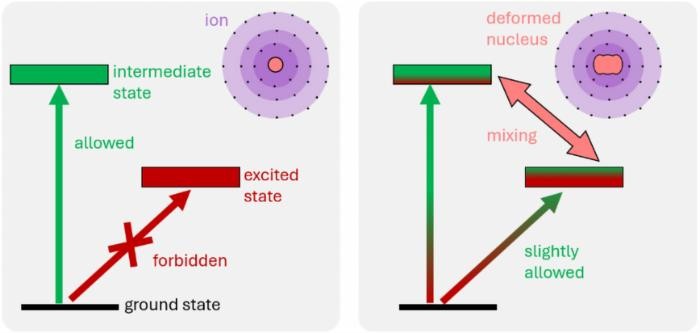
Schematic showing how the shape of ytterbium-173 nucleus affects the clock transition
Nuclear effect The deformed shape of the ytterbium-173 nucleus (right) makes it possible to excite the clock transition with a relatively low-power laser. The same transition is forbidden (left) if the nucleus is not deformed. (Courtesy: Physikalisch-Technische Bundesanstalt (PTB))

An atomic transition in ytterbium-173 could be used to create an optical multi-ion clock that is both precise and stable. That is the conclusion of researchers in Germany and Thailand who have characterized a clock transition that is enhanced by the non-spherical shape of the ytterbium-173 nucleus. As well as applications in timekeeping, the transition could be used in quantum computing. Furthermore, the interplay between atomic and nuclear effects in the transition could provide insights into the physics of deformed nuclei.

The ticking of an atomic clock is defined by the frequency of the electromagnetic radiation that is absorbed and emitted by a specific transition between atomic energy levels. These clocks play crucial roles in technologies that require precision timing – such as global navigation satellite systems and communications networks. Currently, the international definition of the second is given by the frequency of caesium-based clocks, which deliver microwave time signals.

Today’s best clocks, however, work at higher optical frequencies and are therefore much more precise than microwave clocks. Indeed, at some point in the future metrologists will redefine the second in terms of an optical transition – but the international metrology community has yet to decide which transition will be used.

Broadly speaking, there are two types of optical clock. One uses an ensemble of atoms that are trapped and cooled to ultralow temperatures using lasers; the other involves a single atomic ion (or a few ions) held in an electromagnetic trap. Clocks that use one ion are extremely precise, but lack stability; whereas clocks that use many atoms are very stable, but sacrifice precision.

Optimizing performance

As a result, some physicists are developing clocks that use multiple ions with the aim of creating a clock that optimizes precision and stability.

Now, researchers at PTB and NIMT (the national metrology institutes of Germany and Thailand respectively) have characterized a clock transition in ions of ytterbium-173, and have shown that the transition could be used to create a multi-ion clock.

“This isotope has a particularly interesting transition,” explains PTB’s Tanja Mehlstäubler – who is a pioneer in the development of multi-ion clocks.

The ytterbium-173 nucleus is highly deformed with a shape that resembles a rugby ball. This deformation affects the electronic properties of the ion, which should make it much easier to use a laser to excite a specific transition that would be very useful for creating a multi-ion clock.

Stark effect

This clock transition can also be excited in ytterbium-171 and has already been used to create a single-ion clock. However, excitation in a ytterbium-171 clock requires an intense laser pulse, which creates a strong electric field that shifts the clock frequency (called the AC Stark effect). This is a particular problem for multi-ion clocks because the intensity of the laser (and hence the clock frequency) can vary across the region in which the ions are trapped.

To show that a much lower laser intensity can be used to excite the clock transition in ytterbium-173, the team studied a “Coulomb crystal” in which three ions were trapped in a line and separated by about 10 micron. They illuminated the ions with laser light that was not uniform in intensity across the crystal. They were able to excite the transition at a relatively low laser intensity, which resulted in very small AC Stark shifts between the frequencies of the three ions.

According to the team, this means that as many as 100 trapped ytterbium-173 ions could be used to create a clock that could be used as a time standard; to redefine the second; and also to make very precise measurements of the Earth’s gravitational field.

As well as being useful for creating an optical ion clock, this multi-ion capability could also be exploited to create quantum-computing architectures based on multiple trapped ions. And because the observed effect is a result of the shape of the ytterbium-173 nucleus, further studies could provide insights into nuclear physics.

The research is described in Physical Review Letters.


The post Ion-clock transition could benefit quantum computing and nuclear physics appeared first on Physics World.

Laser fusion: Focused Energy charts a course to commercial viability

22 janvier 2026 à 16:01

This episode of the Physics World Weekly podcast features a conversation with the plasma physicist Debbie Callahan who is chief strategy officer at Focused Energy – a California and Germany based fusion-energy startup. Prior to that she spent 35 years working at the National Ignition Facility (NIF) at Lawrence Livermore National Laboratory in the US.

Focused Energy is developing a commercial system for generating energy from the laser-driven fusion of hydrogen isotopes. Callahan describes LightHouse, which is the company’s design for a laser-fusion power plant, and Pearl, which is the firm’s deuterium–tritium fuel capsule.

Callahan talks about the challenges and rewards of working in the fusion industry and also calls on early-career physicists to consider careers in this burgeoning sector.

The post Laser fusion: Focused Energy charts a course to commercial viability appeared first on Physics World.

NPL unveils miniature atomic fountain clock  

21 janvier 2026 à 18:23

A miniature version of an atomic fountain clock has been unveiled by researchers at the UK’s National Physical Laboratory (NPL). Their timekeeper occupies just 5% of the volume of a conventional atomic fountain clock while delivering a time signal with a stability that is on par with a full-sized system. The team is now honing its design to create compact fountain clocks that could be used in portable systems and remote locations.

The ticking of an atomic clock is defined by the frequency of the electromagnetic radiation that is absorbed and emitted by a specific transition between atomic energy levels. Today, the second is defined using a transition in caesium atoms that involves microwave radiation. Caesium atoms are placed in a microwave cavity and a measurement-and-feedback mechanism is used to tune the frequency of the cavity radiation to the atomic transition – creating a source of microwaves with a very narrow frequency range centred at the clock frequency.

The first atomic clocks sent a fast-moving beam of atoms through a microwave cavity. The precision of such a beam clock is limited by the relatively short time that individual atoms spend in the cavity. Also, the speed of the atoms means that the measured frequency peak is shifted and broadened by the Doppler effect.

Launching atoms

These problems were addressed by the development of the fountain clock, in which the atoms are cooled (slowed down) by laser light, which also launches the atoms upwards. The atoms pass through a microwave cavity on the way up, and again as they fall back down. The atoms travel at much slower speeds than in a beam clock. The atoms spend much more time in the cavity and therefore the time signal from an atomic clock is much more precise than a beam clock. However, long times result in greater thermal spread of the atomic beam – which degrades clock performance. Trading-off measurement time with thermal spread means that the caesium fountain clocks that currently define the second have drops of about 30 cm.

Other components are also needed to operate fountain clocks – including a vacuum system and laser and microwave instrumentation. This pushes the height of a typical clock to about 2 m, and makes it a complex and expensive instrument that cannot be easily transported.

Now, Sam Walby and colleagues at NPL have shrunk the overall height of a rubidium-based fountain clock to 80 cm, while retaining the 30 cm drop. The result is an instrument that is 5% the volume of one of NPL’s conventional caesium atomic fountain clocks.

Precise yet portable

“That’s taking it from barely being able to fit though a doorway, to something one could pick up and carry with one arm,” says Walby.

Despite the miniaturization, the mini-fountain achieved a stability of one part in 1015 after several days of operation – which NPL says is comparable to full-sized clocks.

Walby told Physics World that the NPL team achieved miniaturization by eliminating two conventional components from their clock design. One is a dedicated chamber used to measure the quantum states of the atoms. Instead, this measurement is make within the clock’s cooling chamber. Also eliminated is a dedicated state-selection microwave cavity, which puts the atoms into the quantum state from which the clock transition occurs.

“The mini-fountain also does this [state] selection,” explains Walby, “but instead of using a dedicated cavity, we use a coax-to-waveguide adapter that is directed into the cooling chamber, which creates a travelling wave of microwaves at the correct frequency.”

The NPL team also reduced the amount of magnetic shielding used, which meant that the edge-effects of the magnetic field had to be more carefully considered. The optics system of the clock was greatly simplified and the use of commercial components mean that the clock is low maintenance and easy to operate – according to NPL.

Radical simplification

“By radically simplifying and shrinking the atomic fountain, we’re making ultra-precise timing technology available beyond national labs,” said Walby. “This opens new possibilities for resilient infrastructure and next-generation navigation.”

According to Walby, one potential use of a miniature atomic fountain clock is as a holdover clock. These are devices that produce a very stable time signal when not synchronized with other atomic clocks. This is important for creating resilience in infrastructure that relies on precision timing – such as communications networks, global navigation satellite systems (including GPS) and power grids. Synchronization is usually done using GNSS signals but these can be jammed or spoofed to disrupt timing systems.

Holdover clocks require time errors of just a few nanoseconds over a month, which the new NPL clock can deliver. The miniature atomic clock could also be used as a secondary frequency standard for the SI second.

The small size of the clock also lends itself to portable and even mobile applications, according to Walby: “The adaptation of the mini-fountain technology to mobile platforms will be subject of further developments”.

However, the mini-clock is large when compared to more compact or chip-based clocks – which do not perform as well. Therefore, he believes that the technology is more likely to be implemented on ships or ground vehicles than aircraft.

“At a minimum, it should be easily transportable compared to the current solutions of similar performance,” he says.

“Highly innovative”

Atomic-clock expert Elizabeth Donley tells Physics World, “NPL has been highly innovative in recent years in standardizing fountain clock designs and even supplying caesium fountains to other national standards labs and organizations around the world for timekeeping purposes. This new compact rubidium fountain is a continuation of this work and can provide a smaller frequency standard with comparable performance to the larger fountains based on caesium.”

Donley spent more than two decades developing atomic clocks at the US National Institute of Standards and Technology (NIST) and now works as a consultant in the field. She agrees that miniature fountain clocks would be useful for holding-over timing information when time signals are interrupted.

She adds, “Once the international community decides to redefine the second to be based on an optical transition, it won’t matter if you use rubidium or caesium. So I see this work as more of a practical achievement than a ground-breaking one. Practical achievements are what drives progress most of the time.”

The new clock is described in Applied Physics Letters.

The post NPL unveils miniature atomic fountain clock   appeared first on Physics World.

Quantum metrology at NPL: we explore the challenges and opportunities

14 janvier 2026 à 15:02

This episode of the Physics World Weekly podcast features a conversation with Tim Prior and John Devaney of the National Physical Laboratory (NPL), which is the UK’s national metrology institute.

Prior is NPL’s quantum programme manager and Devaney is its quantum standards manager. They talk about NPL’s central role in the recent launch of NMI-Q, which brings together some of the world’s leading national metrology institutes to accelerate the development and adoption of quantum technologies.

Prior and Devaney describe the challenges and opportunities of developing metrology and standards for rapidly evolving technologies including quantum sensors, quantum computing and quantum cryptography. They talk about the importance of NPL’s collaborations with industry and academia and explore the diverse career opportunities for physicists at NPL. Prior and Devaney also talk about their own careers and share their enthusiasm for working in the cutting-edge and fast-paced field of quantum metrology.

This podcast is sponsored by the National Physical Laboratory.

Further reading

Why quantum metrology is the driving force for best practice in quantum standardization

Performance metrics and benchmarks point the way to practical quantum advantage

End note: NPL retains copyright on this article.

The post Quantum metrology at NPL: we explore the challenges and opportunities appeared first on Physics World.

Quantum information theory sheds light on quantum gravity

8 janvier 2026 à 15:34

This episode of the Physics World Weekly podcast features Alex May, whose research explores the intersection of quantum gravity and quantum information theory. Based at Canada’s Perimeter Institute for Theoretical Physics, May explains how ideas being developed in the burgeoning field of quantum information theory could help solve one of the most enduring mysteries in physics – how to reconcile quantum mechanics with Einstein’s general theory of relativity, creating a viable theory of quantum gravity.

This interview was recorded in autumn 2025 when I had the pleasure of visiting the Perimeter Institute and speaking to four physicists about their research. This is the last of those conversations to appear on the podcast.

The first interview in this series from the Perimeter Institute was with Javier Toledo-Marín, “Quantum computing and AI join forces for particle physics”; the second was with Bianca Dittrich, “Quantum gravity: we explore spin foams and other potential solutions to this enduring challenge“; and the third was with Tim Hsieh, “Building a quantum future using topological phases of matter and error correction”.

APS logo


This episode is supported by the APS Global Physics Summit, which takes place on 15–20 March 2026 in Denver, Colorado, and online.

The post Quantum information theory sheds light on quantum gravity appeared first on Physics World.

❌