↩ Accueil

Vue normale

Is Donald Trump conducting a ‘blitzkrieg’ on science?

10 novembre 2025 à 16:00

“Drain the swamp!”

In the intense first few months of his second US presidency, Donald Trump has been enacting his old campaign promise with a vengeance. He’s ridding all the muck from the American federal bureaucracy, he claims, and finally bringing it back under control.

Scientific projects and institutions are particular targets of his, with one recent casualty being the High Energy Physics Advisory Panel (HEPAP). Outsiders might shrug their shoulders at a panel of scientists being axed. Panels come and go. Also, any development in Washington these days is accompanied by confusion, uncertainty, and the possibility of reversal.

But HEPAP’s dissolution is different. Set up in 1967, it’s been a valuable and long-standing advisory committee of the Office of Science at the US Department of Energy (DOE). HEPAP has a distinguished track record of developing, supporting and reviewing high-energy physics programmes, setting priorities and balancing different areas. Many scientists are horrified by its axing.

The terminator

Since taking office in January 2025, Trump has issued a flurry of executive orders – presidential decrees that do not need Congressional approval, legislative review or public debate. One order, which he signed in February, was entitled “Commencing the Reduction of the Federal Bureaucracy”.

It sought to reduce parts of the government “that the President has determined are unnecessary”, seeking to eliminate “waste and abuse, reduce inflation, and promote American freedom and innovation”. While supporters see those as laudable goals, opponents believe the order is driving a stake into the heart of US science.

Hugely valuable, long-standing scientific advisory committees have been axed at key federal agencies, including NASA, the National Science Foundation, the Environmental Protection Agency, the National Oceanic and Atmospheric Administration, the US Geological Service, the National Institute of Health, the Food and Drug Administration, and the Centers for Disease Control and Prevention.

What’s more, the committees were terminated without warning or debate, eliminating load-bearing pillars of the US science infrastructure. It was, as the Columbia University sociologist Gil Eyal put it in a recent talk, the “Trump 2.0 Blitzkrieg”.

Then, on 30 September, Trump’s enablers took aim at advisory committees at the DOE Office of Science. According to the DOE’s website, a new Office of Science Advisory Committee (SCAC) will take over functions of the six former discretionary (non-legislatively mandated) Office of Science advisory committees.

“Any current charged responsibilities of these former committees will be transferred to the SCAC,” the website states matter-of-factly. The committee will provide “independent, consensus advice regarding complex scientific and technical issues” to the entire Office of Science. Its members will be appointed by under secretary for science Dario Gil – a political appointee.

Apart from HEPAP, others axed without warning were the Nuclear Science Advisory Committee, the Basic Energy Sciences Advisory Committee, the Fusion Energy Sciences Advisory Committee, the Advanced Scientific Computing Advisory Committee, and the Biological and Environmental Research Advisory Committee.

Over the years, each committee served a different community and was represented by prominent research scientists who were closely in touch with other researchers. Each committee could therefore assemble the awareness of – and technical knowledge about – emerging promising initiatives and identify the less promising ones.

Many committee members only learned of the changes when they received letters or e-mails out of the blue informing them that their committee had been dissolved, that a new committee had replaced them, and that they were not on it. No explanation was given.

Closing HEPAP and the other Office of Science committees will hamper both the technical support and community input that it has relied on to promote the efficient, effective and robust growth of physics

Physicists whom I have spoken to are appalled for two main reasons. One is that closing HEPAP and the other Office of Science committees will hamper both the technical support and community input that it has relied on to promote the efficient, effective and robust growth of physics.

“Speaking just for high-energy physics, HEPAP gave feedback on the DOE and NSF funding strategies and priorities for the high-energy physics experiments,” says Kay Kinoshita from the University of Cincinnati, a former HEPAP member. “The panel system provided a conduit for information between the agencies and the community, so the community felt heard and the agencies were (mostly) aligned with the community consensus”.

As Kinoshita continued: “There are complex questions that each panel has to deal with. even within the topical area. It’s hard to see how a broader panel is going to make better strategic decisions, ‘better’ meaning in terms of scientific advancement. In terms of community buy-in I expect it will be worse.”

Other physicists cite a second reason for alarm. The elimination of the advisory committees spreads the expertise so thinly as to increase the likelihood of political pressure on decisions. “If you have one committee you are not going to get the right kind of fine detail,” says Michael Lubell, a physicist and science-policy expert at the City College of New York, who has sat in on meetings of most of the Office of Science advisory committees.

“You’ll get opinions from people outside that area and you won’t be able to get information that you need as a policy maker to decide how the resources are to be allocated,” he adds. “A condensed-matter physicist for example, would probably have insufficient knowledge to advise DOE on particle physics. Instead, new committee members would be expected to vet programs based on ideological conformity to what the Administration wants.”

The critical point

At the end of the Second World War, the US began to construct an ambitious long-range plan to promote science that began with the establishment of the National Science Foundation in 1950 and developed and extended ever since. The plan aimed to incorporate both the ability of elected politicians to direct science towards social needs and the independence of scientists to explore what is possible.

US presidents have, of course, had pet scientific projects: the War on Cancer (Nixon), the Moon Shot (Kennedy), promoting renewable energy (Carter), to mention a few. But it is one thing for a president to set science to producing a socially desirable product and another to manipulate the scientific process itself.

“This is another sad day for American science,” says Lubell. “If I were a young person just embarking on a career, I would get the hell out of the country. I would not want to waste the most creative years of my life waiting for things to turn around, if they ever do. What a way to destroy a legacy!”

The end of HEPAP is not draining a swamp but creating one.

The post Is Donald Trump conducting a ‘blitzkrieg’ on science? appeared first on Physics World.
Delft Circuits, Bluefors: the engine-room driving joined-up quantum innovation

10 novembre 2025 à 10:48
delft-circuits-cri/oflex cabling technology
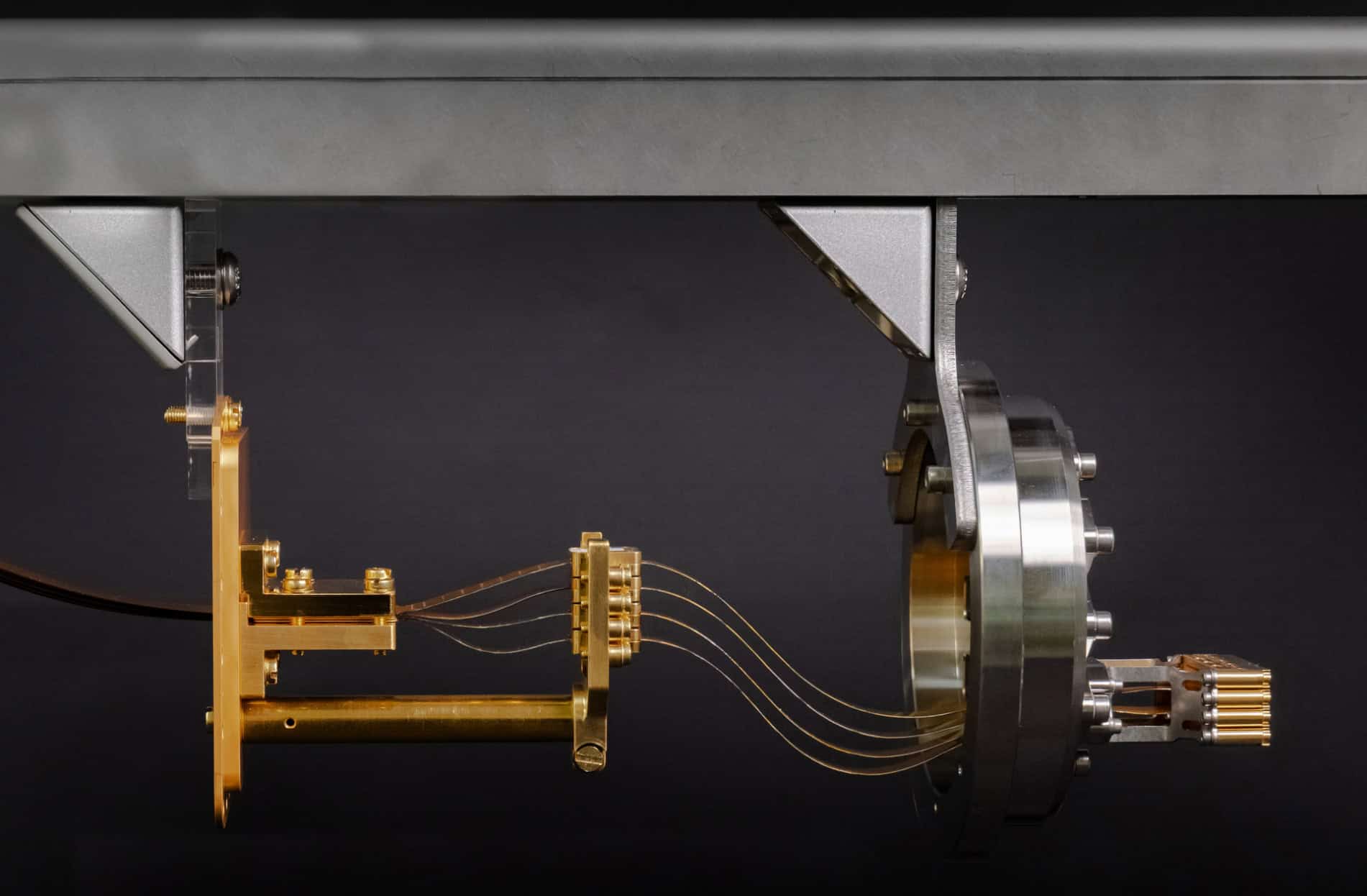
At-scale quantum By integrating Delft Circuits’ Cri/oFlex® cabling technology (above) into Bluefors’ dilution refrigerators, the vendors’ combined customer base will benefit from an industrially proven and fully scalable I/O solution for their quantum systems. Cri/oFlex® cabling combines fully integrated filtering with a compact footprint and low heatload. (Courtesy: Delft Circuits)

Better together. That’s the headline take on a newly inked technology partnership between Bluefors, a heavyweight Finnish supplier of cryogenic measurement systems, and Delft Circuits, a Dutch manufacturer of specialist I/O cabling solutions designed for the scale-up and industrial deployment of next-generation quantum computers.

The drivers behind the tie-up are clear: as quantum systems evolve – think vastly increased qubit counts plus ever-more exacting requirements on gate fidelity – developers in research and industry will reach a point where current coax cabling technology doesn’t cut it anymore. The answer? Collaboration, joined-up thinking and product innovation.

In short, by integrating Delft Circuits’ Cri/oFlex® cabling technology into Bluefors’ dilution refrigerators, the vendors’ combined customer base will benefit from a complete, industrially proven and fully scalable I/O solution for their quantum systems. The end-game: to overcome the quantum tech industry’s biggest bottleneck, forging a development pathway from quantum computing systems with hundreds of qubits today to tens of thousands of qubits by 2030.

Joined-up thinking

For context, Cri/oFlex® cryogenic RF cables comprise a stripline (a type of transmission line) based on planar microwave circuitry – essentially a conducting strip encapsulated in dielectric material and sandwiched between two conducting ground planes. The use of the polyimide Kapton® as the dielectric ensures Cri/oFlex® cables remain flexible in cryogenic environments (which are necessary to generate quantum states, manipulate them and read them out), with silver or superconducting NbTi providing the conductive strip and ground layer. The standard product comes as a multichannel flex (eight channels per flex) with a range of I/O channel configurations tailored to the customer’s application needs, including flux bias lines, microwave drive lines, signal lines or read-out lines.

Robby Ferdinandus of Delft Circuits
“Together with Bluefors, we will accelerate the journey to quantum advantage,” says Robby Ferdinandus of Delft Circuits. (Courtesy: Delft Circuits)

“Reliability is a given with Cri/oFlex®,” says Robby Ferdinandus, global chief commercial officer for Delft Circuits and a driving force behind the partnership with Bluefors. “By integrating components such as attenuators and filters directly into the flex,” he adds, “we eliminate extra parts and reduce points of failure. Combined with fast thermalization at every temperature stage, our technology ensures stable performance across thousands of channels, unmatched by any other I/O solution.”

Technology aside, the new partnership is informed by a “one-stop shop” mindset, offering the high-density Cri/oFlex® solution pre-installed and fully tested in Bluefors cryogenic measurement systems. For the end-user, think turnkey efficiency: streamlined installation, commissioning, acceptance and, ultimately, enhanced system uptime.

Scalability is front-and-centre too, thanks to Delft Circuits’ pre-assembled and tested side-loading systems. The high-density I/O cabling solution delivers up to 50% more channels per side-loading port to Bluefors’ (current) High Density Wiring, providing a total of 1536 input or control lines to an XLDsl cryostat. In addition, more wiring lines can be added to multiple KF ports as a custom option.

Doubling up for growth

Reetta Kaila of Bluefors
“Our market position in cryogenics is strong, so we have the ‘muscle’ and specialist know-how to integrate innovative technologies like Cri/oFlex®,” says Reetta Kaila of Bluefors. (Courtesy: Bluefors)

Reciprocally, there’s significant commercial upside to this partnership. Bluefors is the quantum industry’s leading cryogenic systems OEM and, by extension, Delft Circuits now has access to the former’s established global customer base, amplifying its channels to market by orders of magnitude. “We have stepped into the big league here and, working together, we will ensure that Cri/oFlex® becomes a core enabling technology on the journey to quantum advantage,” notes Ferdinandus.

That view is amplified by Reetta Kaila, director for global technical sales and new products at Bluefors (and, alongside Ferdinandus, a main-mover behind the partnership). “Our market position in cryogenics is strong, so we have the ‘muscle’ and specialist know-how to integrate innovative technologies like Cri/oFlex® into our dilution refrigerators,” she explains.

A win-win, it seems, along several coordinates. “The Bluefors sales teams are excited to add Cri/oFlex® into the product portfolio,” Kaila adds. “It’s worth noting, though, that the collaboration extends across multiple functions – technical and commercial – and will therefore ensure close alignment of our respective innovation roadmaps.”

Scalable I/O will accelerate quantum innovation

Deconstructed, Delft Circuits’ value proposition is all about enabling, from an I/O perspective, the transition of quantum technologies out of the R&D lab into at-scale practical applications. More specifically: Cri/oFlex® technology allows quantum scientists and engineers to increase the I/O cabling density of their systems easily – and by a lot – while guaranteeing high gate fidelities (minimizing noise and heating) as well as market-leading uptime and reliability.

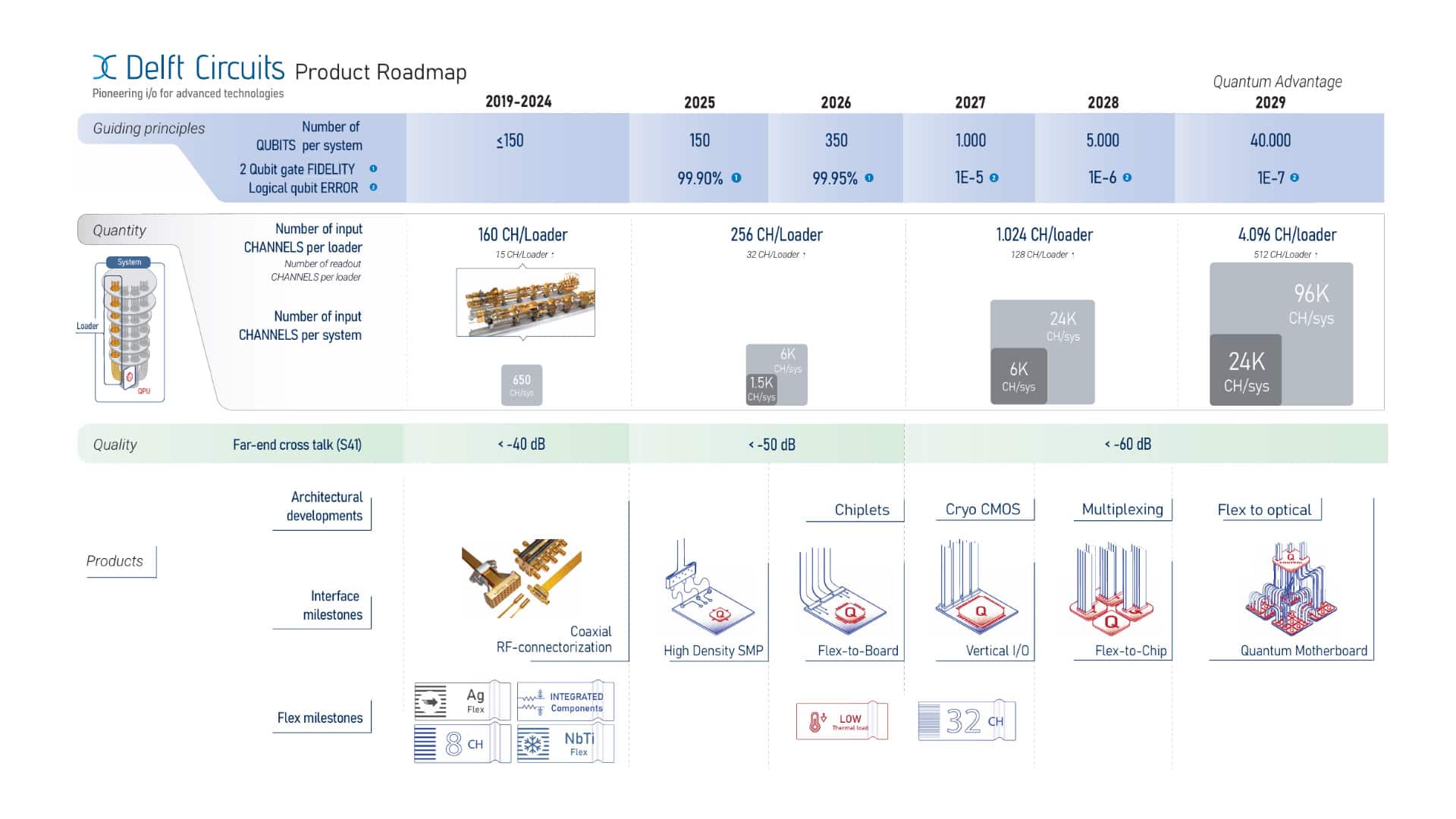
To put some hard-and-fast performance milestones against that claim, the company has published a granular product development roadmap that aligns Cri/oFlex® cabling specifications against the anticipated evolution of quantum computing systems –  from 150+ qubits today out to 40,000 qubits and beyond in 2029 (see figure below, “Quantum alignment”).

The resulting milestones are based on a study of the development roadmaps of more than 10 full-stack quantum computing vendors – a consolidated view that will ensure the “guiding principles” of Delft Circuits’ innovation roadmap align versus the aggregate quantity and quality of qubits targeted by the system developers over time.

delft circuits roadmap
Quantum alignment The new product development roadmap from Delft Circuits starts with the guiding principles, highlighting performance milestones to be achieved by the quantum computing industry over the next five years – specifically, the number of physical qubits per system and gate fidelities. By extension, cabling metrics in the Delft Circuits roadmap focus on “quantity”: the number of I/O channels per loader (i.e. the wiring trees that insert into a cryostat, with typical cryostats having between 6–24 slots for loaders) and the number of channels per cryostat (summing across all loaders); also on “quality” (the crosstalk in the cabling flex). To complete the picture, the roadmap outlines product introductions at a conceptual level to enable both the quantity and quality timelines. (Courtesy: Delft Circuits)

The post Delft Circuits, Bluefors: the engine-room driving joined-up quantum innovation appeared first on Physics World.

Microbubbles power soft, programmable artificial muscles

10 novembre 2025 à 10:30
Ultrasound-powered soft surgical robot
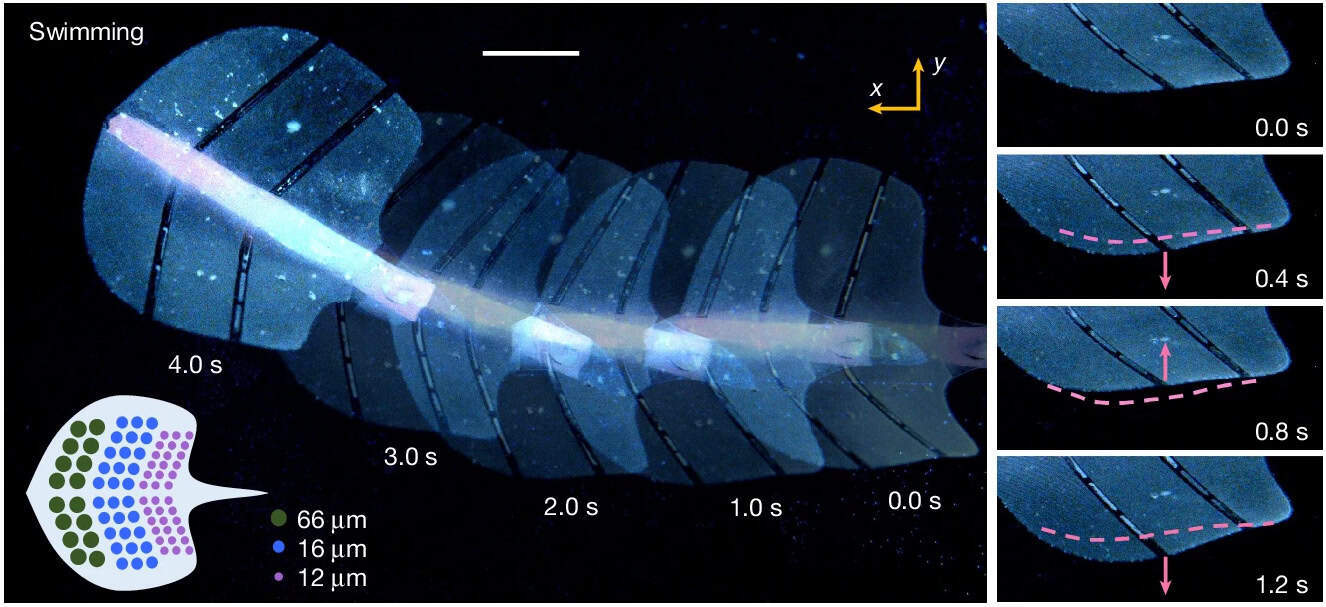
Ultrasound-powered stingraybot A bioinspired soft surgical robot with artificial muscles made from microbubble arrays swims forward under swept-frequency ultrasound excitation. Right panels: motion of the microbubble-array fins during swimming. Lower inset: schematic of the patterned microbubble arrays. Scale bar: 1 cm. (Courtesy: CC BY 4.0/Nature 10.1038/s41586-025-09650-3)

Artificial muscles that offer flexible functionality could prove invaluable for a range of applications, from soft robotics and wearables to biomedical instrumentation and minimally invasive surgery. Current designs, however, are limited by complex actuation mechanisms and challenges in miniaturization. Aiming to overcome these obstacles, a research team headed up at the Acoustic Robotics Systems Lab (ETH Zürich) in Switzerland is using microbubbles to create soft, programmable artificial muscles that can be wirelessly controlled via targeted ultrasound activation.

Gas-filled microbubbles can concentrate acoustic energy, providing a means to initiate movement with rapid response times and high spatial accuracy. In this study, reported in Nature, team leader Daniel Ahmed and colleagues built a synthetic muscle from a thin flexible membrane containing arrays of more than 10,000 microbubbles. When acoustically activated, the microbubbles generate thrust and cause the membrane to deform. And as different sized microbubbles resonate at different ultrasound frequencies, the arrays can be designed to provide programmable motion.

“Ultrasound is safe, non-invasive, can penetrate deep into the body and can generate large forces. However, without microbubbles, a much higher force is needed to deform the muscle, and selective activation is difficult,” Ahmed explains. “To overcome this limitation, we use microbubbles, which amplify force generation at specific sites and act as resonant systems. As a result, we can activate the artificial muscle at safe ultrasound power levels and generate complex motion.”

The team created the artificial muscles from a thin silicone membrane patterned with an array of cylindrical microcavities with the dimensions of the desired microbubbles. Submerging this membrane in a water-filled acoustic chamber trapped tens of thousands of gas bubbles within the cavities (one per cavity). The final device contains around 3000 microbubbles per mm2 and weighs just 0.047 mg/mm2.

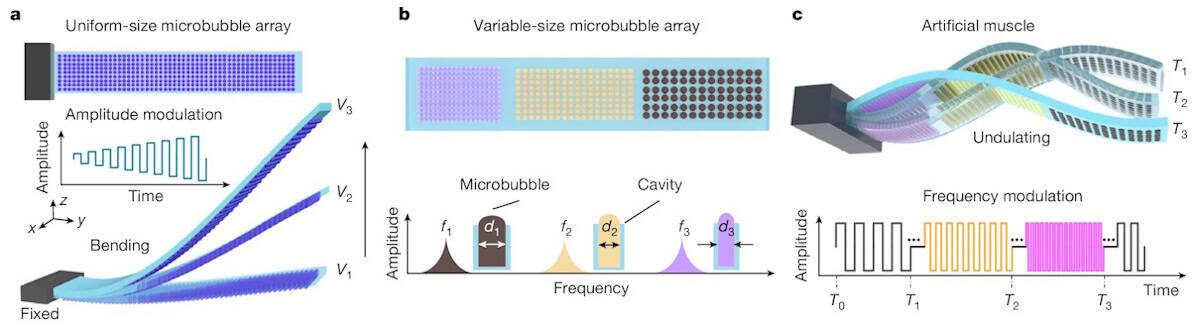
To demonstrate acoustic activation, the researchers fabricated an artificial muscle containing uniform-sized microbubbles on one surface. They fixed one end of the muscle and exposed it to resonant frequency ultrasound, simultaneously exciting the entire microbubble array. The resulting oscillations generated acoustic streaming and radiation forces, causing the muscle to flex upward, with an amplitude dependent upon the ultrasound excitation voltage.

Next, the team designed an 80 µm-thick, 3 x 0.5 cm artificial muscle containing arrays of three different sized microbubbles. Stimulation at 96.5, 82.3 and 33.2 kHz induced deformations in regions containing bubbles with diameters of 12, 16 and 66 µm, respectively. Exposure to swept-frequency ultrasound covering the three resonant frequencies sequentially activated the different arrays, resulting in an undulatory motion.

Microbubble-array artificial muscles
Microbubble muscles (a) Artificial muscle with thousands of microbubbles on its lower surface bends upwards when excited by ultrasound. (b) Artificial muscle containing arrays of microbubbles with three different diameters, each corresponding to a distinct natural frequency, exhibits undulatory motion (c) under swept-frequency ultrasound excitation. (Courtesy: CC BY 4.0/Nature 10.1038/s41586-025-09650-3)

A multitude of functions

Ahmed and colleagues showcased a range of applications for the artificial muscle by integrating microbubble arrays into functional devices, such as a miniature soft gripper for trapping and manipulating fragile live animals. The gripper comprises six to ten microbubble array-based “tentacles” that, when subjected to ultrasound, gently gripped a zebrafish larva with sub-100 ms response time. When the ultrasound was switched off, the tentacles opened and the larva swam away with no adverse effects.

The artificial muscle can function as a conformable robotic skin that sticks and imparts motion to a stationary object, which the team demonstrated by attaching it to the surface of an excised pig heart. It can also be employed for targeted drug delivery – shown by the use of a microbubble-array robotic patch for ultrasound-enhanced delivery of dye into an agar block.

The researchers also built an ultrasound-powered “stingraybot”, a soft surgical robot with artificial muscles (arrays of differently sized microbubbles) on either side to mimic the pectoral fins of a stingray. Exposure to swept-frequency ultrasound induced an undulatory motion that wirelessly propelled the 4 cm-long robot forward at a speed of about 0.8 body lengths per second.

To demonstrate future practical biomedical applications, such as supporting minimally invasive surgery or site-specific drug release within the gastrointestinal tract, the researchers encapsulated a rolled up stingraybot within a 27 x 12 mm edible capsule. Once released into the stomach, the robot could be propelled on demand under ultrasound actuation. They also pre-folded a linear artificial muscle into a wheel shape and showed that swept ultrasound frequencies could propel it along the complex mucosal surfaces of the stomach and intestine.

“Through the strategic use of microbubble configurations and voltage and frequency as ultrasound excitation parameters, we engineered a diverse range of preprogrammed movements and demonstrated their applicability across various robotic platforms,” the researchers write. “Looking ahead, these artificial muscles hold transformative potential across cutting-edge fields such as soft robotics, haptic medical devices and minimally invasive surgery.”

Ahmed says that the team is currently developing soft patches that can conform to biological surfaces for drug delivery inside the bladder. “We are also designing soft, flexible robots that can wrap around a tumour and release drugs directly at the target site,” he tells Physics World. “Basically, we’re creating mobile conformable drug-delivery patches.”

The post Microbubbles power soft, programmable artificial muscles appeared first on Physics World.

Le succès grandissant de la start-up française EVA, entre laser gamer et réalité virtuelle

5 septembre 2024 à 11:00
Principalement implantées en France, mais aussi de plus en plus en Europe, au Moyen-Orient et aux Etats-Unis, les salles estampillées Esports Virtual Arenas (EVA) tentent de lier effort physique et réalité virtuelle.

© EVA

Les casques VR utilisés par EVA lisent des QR codes disposés sur le pourtour de ses « arènes » afin de situer dans l’espace les joueurs qui les portent.

Natixis s’immerge dans la formation virtuelle

19 mars 2023 à 17:30
Les collaborateurs de la Banque populaire Caisse d’épargne ont bénéficié d’une première expérimentation immersive à grande échelle.

© LOU BENOIST/AFP

Un journaliste s’entraîne avec un casque VR dans l’école de formation de l’usine de retraitement Orano la Hague, à La Hague (Manche), le 14 décembre 2022.

Derrière le flop du métavers, la réussite de la réalité virtuelle

19 mars 2023 à 17:00
Alors que le métavers a été éclipsé par le boom de l’intelligence artificielle, la réalité virtuelle, base des univers parallèles, se démocratise. Transports, arts, industrie, immobilier, jeux vidéo… Elle investit progressivement tous les secteurs.

© THOMAS MUKOYA/REUTERS

A Nyeri (Kenya), le 2 juin 2022, un adolescent utilise un casque de réalité virtuelle Oculus pour visiter le palais de Buckingham, lors de la célébration du jubilé de platine de la reine Elizabeth II.

On a passé un week-end à visiter des musées virtuels

12 décembre 2021 à 11:00
Formes mouvantes qui se laissent pénétrer, univers façon BD à explorer… malgré des défis techniques encore à relever, certaines initiatives comme le Museum of Other Realities offrent de convaincantes expériences d’œuvres d’art en réalité virtuelle.

© MOR - KEVIN MACK

« Blort », de Kevin Mack (2017). Les contours mouvants de cette œuvre en 3D se recomposent en permanence.

« C’est le moment où je me libère » : dans les mondes virtuels de Roblox, les avatars aident les ados à s’affirmer

13 novembre 2021 à 01:14
Roméo, Kiara, Ruben, Nathan, Lucie… Au début ou à la fin de l’adolescence, ces jeunes ont pour point commun de s’inventer une autre identité sur la plate-forme de jeu vidéo Roblox. Souvent dans le but de se construire une meilleure image de soi.

© ROBLOX

Le monde foisonnant d’avatars de Roblox.

On a testé… Horizon Workrooms, la nouvelle application de réalité virtuelle de Facebook

19 août 2021 à 11:39
Le nouvel outil développé par Facebook Reality Labs permet de créer des réunions de travail en totale immersion. A l’occasion de sa sortie en Beta sur Oculus Quest 2, jeudi 19 août, nous avons participé à une conférence de presse virtuelle.

© FACEBOOK REALITY LABS

Des journalistes ont assisté, virtuellement, à une présentation de Horizon Workrooms, appli de réalité virtuelle de Facebook, le 17 août.

Top Noël : sélection calendrier de l’Avent 2025

10 novembre 2025 à 00:13

Découvrez notre sélection de calendriers de l’Avent 2025 pour attendre Noël

Petits et grands, nous aimons tous (ou presque) Noël, même à différents degrés. L’hiver, le froid, les premières neiges, les décorations de Noël, les rassemblements de famille, les feux de cheminée pour les plus chanceux d’entre nous, mais aussi la joie et le bonheur de recevoir et surtout de donner aux autres. Noël, c’est tout de même un symbole d’amour. C’est pour cela que tout au long des mois de novembre et décembre, vous pourrez découvrir un article ayant Noël pour thème, et aujourd’hui, comme chaque année, on commence avec notre sélection de calendriers de l’Avent 2025 !

Partons à la découverte de notre sélection des calendriers de l’Avent ! Mais avant ça, faisons un point histoire avec l’origine de cette tradition.


Le calendrier de l’Avent, toute une histoire

Tous les enfants sont impatients d’être enfin à Noël et cela ne date pas d’hier. Le calendrier de l’Avent est une tradition germanique qui visait et vise toujours d’ailleurs à pallier l’attente de la naissance du petit Jésus, dans la nuit du 24 au 25 décembre. C’est donc en Allemagne dans le courant du XIXe siècle que cette coutume est apparue. Les parents donnaient alors aux enfants des images, mais ce n’est qu’en 1908 qu’un certain éditeur de livres médicaux de Munich, Gehard Lang, a commercialisé le tout premier calendrier, qui était à l’époque rempli de dessins apposés sur un carton.

Plus tard, en 1920, le calendrier de l’Avent prend la forme qu’on lui connaît à présent sous forme de cases à ouvrir. Il faudra néanmoins attendre 1958 pour voir apparaître les premiers chocolats à l’intérieur de ces fameuses petites cases.

Place maintenant à notre sélection, en commençant par les plus originaux du jour !

Calendrier de l'Avent Wasgij et Jan Han Haasteren

Jan van Haasteren

Calendrier de l'Avent Jan Han Haasteren Calendrier de l'Avent Jan Han Haasteren

Cette année, Jan Van Haasteren propose de patienter jusqu’à Noël et de collecter les 24 puzzles du calendrier de l’Avent en ouvrant chaque jour une nouvelle case contenant un puzzle drôle et inédit de 54 pièces ! Mêlant ainsi plaisir et détente au décompte quotidien. Un calendrier original ou l’on retrouve la marque de fabrique du célèbre illustrateurs hollandais avec ses nombreux détails et personnages haut en couleurs !

Calendrier de l'Avent Jan Han Haasteren

Vous le retrouverez au prix de 34,99 €.


Wasgij

Calendrier de l'Avent Wasgij Calendrier de l'Avent Wasgij

Le calendrier de l’Avent Wasgij Christmas propose 24 puzzles de 54 pièces. Chaque nouveau jour dévoilera un nouveau puzzle à assembler tout au long de l’Avent. Une bonne imagination combinée aux indices fournis permettra de les assembles et de deviner ce que les personnages présents dans chaque fenêtre sont entrain de voir. Un calendrier parfait pour patienter jusqu’à Noël avec humeur, curiosité et une bonne dose de fun. Idéal pour les adultes ou les ados qui aiment réfléchir sans se prendre trop la tête !

Calendrier de l'Avent Wasgij

Vous le retrouverez au prix de 27,75 €.


Junior & Tinti, Playmobil pour les tout petits 

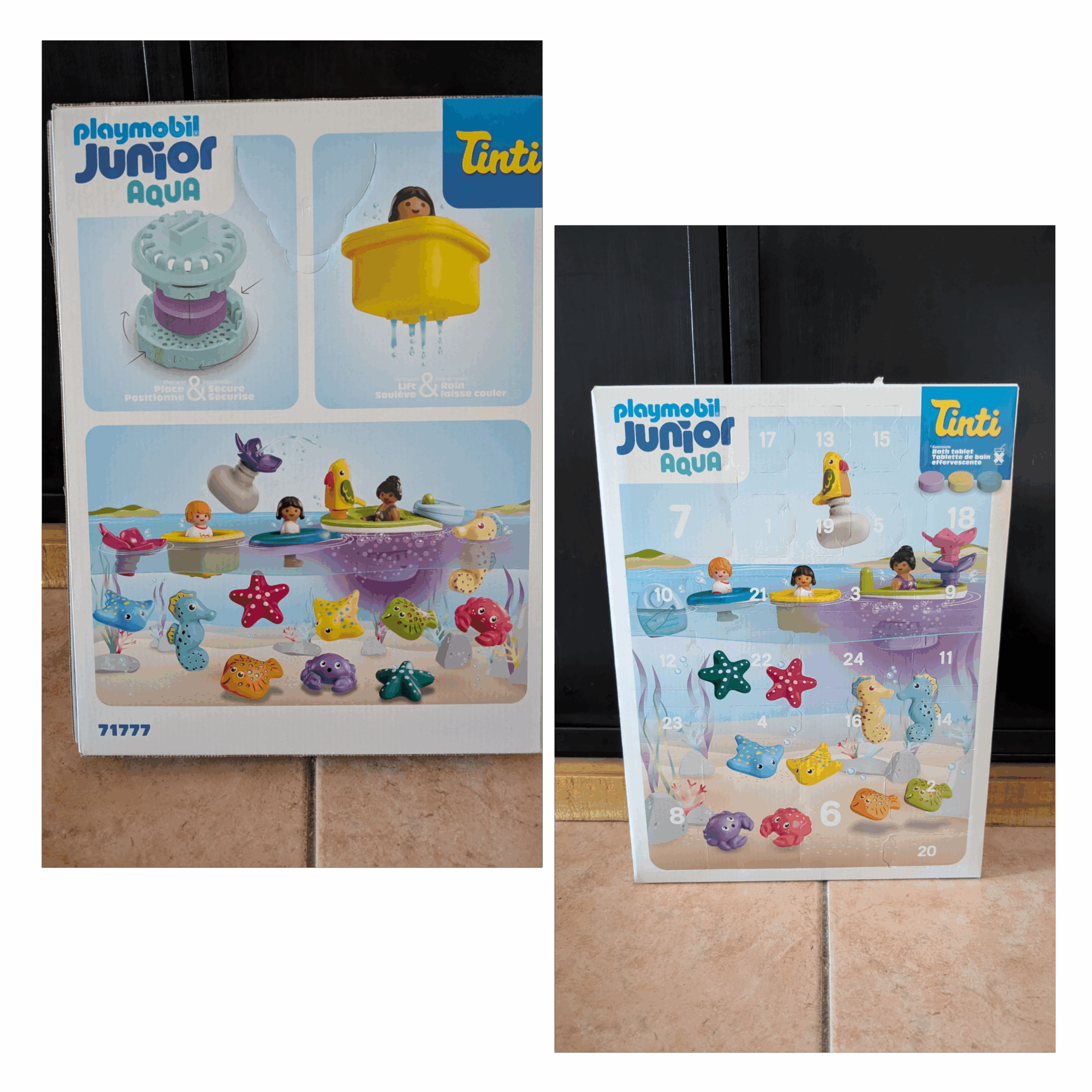
Chaque jour, une nouvelle surprise à découvrir pour jouer dans le bain avec des personnages, mais aussi des animaux marins rigolos et des tablettes Tinti qui colorent l’eau et émerveillent les tout-petits parce que oui, eux aussi ont le droit à leur calendrier de l’Avent ! Pensé pour les petites mains, ce calendrier transforme le rituel du bain en moment de jeu sensoriel et de complicité à partager en famille. Des jeux que l’on pourra réutiliser tout au long de l’année et ça, on adore ! Autre bon point, les plus jeunes de nos enfants ont ENFIN un calendrier pour eux, mais nous en avons un autre à vous proposer un peu plus bas également.

Calendrier de l'Avent 2025 Playmobil Calendrier de l'Avent 2025 Playmobil

Vous le retrouverez au prix de 34,99 €.


Playmobil pâtisserie de Noël 

À Noël en général, on cuisine, notamment des pâtisseries ! Et c’est notamment une douce odeur qui flotte dans l’air tout au long du mois de décembre dans notre cuisine. Avec ses biscuits à préparer, ses animaux à soigner et sa déco festive, ce calendrier playmobil plonge les enfants dans la magie de Noël. Four qui s’ouvre, emporte pièce en forme de cheval, accessoires de saison : tout est réunion pour inventer de délicieuses histoires de fin d’années. On adore l’idée que l’on trouve très originale !

Calendrier de l'Avent 2025 Playmobil Calendrier de l'Avent 2025 Playmobil

Vous le retrouverez au prix de 29,99 €.


Harry Potter

Calendrier de l'Avent 2024 Harry Potter

Définitivement pour tous les fans d’Harry Potter ayant le budget. Chaque jour, ouvrez une nouvelle case de notre calendrier de l’avent pour découvrir un cadeau Harry Potter.

Vous le retrouverez au prix de 97 €.


HABA

Calendrier de l'Avent HABA Calendrier de l'Avent HABA

Nous en avions parlé une année, il revient dans une nouvelle édition ! Découvrez ces jolis personnages en bois, à partir de 2 ans !

Vous le retrouverez au prix de 34,90 €.


Bonne Maman

bonne maman


Vous aimez la confiture, eh bien nous aussi ! Offrez un cadeau unique avec ce coffret de 23 plaisirs gourmands (confitures et pâtes à tartiner) + 1 surprise exclusive au programme.

Vous le retrouverez au prix de 34,90 €.


LEGO Star Wars 

calendrier lego star wars

Construisez les temps forts de l’histoire des sets LEGO Star Wars dans l’ordre chronologique de 1999 à 2024 avec ce calendrier de l’Avent festif à collectionner, dès 6 ans.

Vous le retrouverez au prix de 24,72 € avec la promotion en cours au moment où ses lignes sont écrites.

Top Noël : sélection calendrier de l’Avent 2025 a lire sur Vonguru.

❌