 Connexion
La plus ancienne preuve de maîtrise du feu découverte au Royaume-Uni
10 décembre 2025 à 21:08
Un foyer datant de 400 000 ans près du village de Barnham, dans le Suffolk, au nord-est de Londres.

Un foyer datant de 400 000 ans près du village de Barnham, dans le Suffolk, au nord-est de Londres.
The Thrill of the Fight 2 with career mode is available now on Quest headsets, so I put on my boxing gloves to throw some punches.
As a fan of the original The Thrill of the Fight, I had high hopes for the sequel coming into this, buying The Thrill of the Fight 2 in early access to try its multiplayer mode. I encountered arm-flailing multiplayer matches that saw spam fighters rack up damage, so I put it down and decided to wait for the more fleshed-out full release, which arrived several weeks ago.
The Thrill of the Fight 2 welcomes you with a main menu presented on a small tablet held in your gloved hands. After it calibrates your height and arm length, you hold a stylus to choose multiplayer, career, or training mode. Training mode practices with a dummy or spars with a bot fighter. There are also settings for customizing your fighter to make them look reasonably unique.
The Thrill of the Fight 2 is intended as a standing game that engages your body in physical exertion. That said, there aren't many comfort options to speak of. If you don't have much room in your physical space to play, there is an optional standing mode. Analog stick-based turning can be assigned to either the left or right hand. Health warnings are present when the game starts, and users must agree to those before proceeding to play.
I chose Career mode first and find myself inside a ring for my first fight. Coming from the first Thrill of the Fight, the updated difficulty is an immediate shock. Following on from the previous game, I wasn't expecting the AI to be this intense.
I throw out jabs it sees coming and deftly dodges, infuriating me. I lean in and get called for a foul. Occasionally the bot will clip directly into me while throwing punches and a foul gets called on my behalf instead. The game repeatedly fails to detect how much space I have around me to fight in “roomscale” mode, forcing me to smaller confines for standing mode during fights. This contributed to the problem of stepping outside of bounds while the AI fighter is still sending punches my way. Whenever the fighting gets intense, I can see flashes of my room boundary as the fists fly.
Coach yells directions at you during the fight, and the jeers of the crowd can be heard too. Outside the ring, they realistically move in their seats, craning their necks for a better view. I saw solid performance across each stage with strong immersion throughout.
I backed on up to training mode and tried sparring. Sparring mode provided a better onboarding experience with practice for proper fighting form. Training with a dummy gives instruction via tutorial videos on how to punch with drill exercises to perfect different moves. Still, I can't land punches as well as I want to because of my scores.
Testing the dummy in training mode
The numbers next to the training dummy show how much force is applied to each move you make, including how much “body effort” is included. Body effort is a way for The Thrill of the Fight 2 to grade punches with the aim of stopping players from cheating during matches. The problem is it doesn't record the effort in my punches properly most of the time.
You can see how the camera moves as I swing; I'm not sitting there and flailing my arms. I'm not being sufficiently graded for my efforts, and it cuts into the fun. Difficulty is never a dealbreaker for me, but the system needs a few fixes. Is head movement calculated as part of the attack? How does it impact the sensitivity of the movement detection? Currently, the fighting system feels like pillows – not gloves – have been put on my hands.
At the end of each training session, there are points for attack and defense added to my profile. The numbers for these didn't make much sense; they change depending on the training session type you choose.
Career mode provides a certain amount of fights to win in order to qualify for a tournament. If you miss out, you can skip to the next year to continue training and fighting. Although I'm happy to win after training so much, my desire to keep fighting in career mode eventually evaporated. I opted to switch to multiplayer mode to experience facing off against other players instead.
A good multiplayer fight
Multiplayer is greatly improved in the full release for The Thrill of the Fight 2. You can either fight players to rank on a global list, or you can pick a round of casual sparring. I matched up in a casual round with a player who paused and evaluated where I was throwing punches before he moved in. Within a few swings, I'm knocked out.
Despite the swift loss, I laughed because I'm still having a good time. The other player was sportsmanlike, and we made sure to touch gloves as a sign of respect. While I can't guarantee everyone you face in multiplayer will be as polite, I'm impressed by the game mode improvements. I hope to never meet another flailing toddler in the ring again.
The Thrill of the Fight 2 is a bit of a departure from the first game and might surprise anyone expecting more of the same. You should instead look forward to improving your boxing form and working more seriously toward beating the challenges in this installment. The damage system needs further work to detect when you put your body into a punch, and the bot should not clip into you during fighting.
What's working for this title are beautiful graphics and a great choice in how you choose to play the game. You can spend time in multiplayer exclusively, try to conquer career mode, or enjoy both. My muscles may be sore from playing this sequel, but I'm not complaining there. This game can eventually be an all-timer with some improvements, just like the first installment is.
UploadVR uses a 5-Star rating system for our game reviews – you can read a breakdown of each star rating in our review guidelines.
When UploadVR visited Valve headquarters to try Steam Frame, we heard comments echoing the strategies at Google and Apple.
There's an APK for that in Galaxy XR and thousands of iPad apps available day one on Apple Vision Pro. Meanwhile, the verified program for Steam Frame is poised to bring the value of Steam to your face wherever it is. Today, the only constant companion for most VR headsets is a Windows PC, but the time is coming when a Steam Deck, iPhone, iPad or Nintendo Switch may become an even more useful companion in VR.
Valve's trade-offs in Steam Frame's modular design have many prospective buyers fretting over the details. Developers are still reeling from the shift from Quest to Horizon – as Meta shifts strategies yet again – releasing games like Civilization VII and Vampire Survivors in VR along the way. Developers exploring Android XR and visionOS are figuring out what they can build in the space between fully immersive VR apps and traditional flatscreen content.
When it comes to Valve, we asked them about ideas like "spatial computing" and "mixed reality" being pursued elsewhere. Neither concept is really present in Valve's initial Steam Frame with black and white passthrough, though there's a lot of potential for sensing add-ons through the nose port.
Here's how Valve's Jeremy Selan replied about the focus of their first headset to carry the Steam name:
"As a strong Index user, someone who worked on it and has spent major portions of my adult life working on that and the Vive, when I think about playing VR, I have to make an intentional choice. So I'll be like, you know what? I want to go do VR. So I go to the room that has my PC and has my base stations installed. And I start playing that. But then sometimes, if I'm in another room and I'm like, well, maybe I should just take out my Deck and I start playing those games. And that choice I personally think is one of the highest friction bits remaining."
"Sure you can expect that when you put it on because it's SteamOS you hit the power button and you're fast into your game without the base station setup. Yeah, you can do [that] in any environment, but the ability to put on the headset and to see your Steam catalog in front of you where you can just choose a VR game or choose a non-VR game – it makes me play VR more. And it really reduces the impediment or the friction of even having to think about that distinction."
"We see the lines between VR and non-VR content really being blurred because they should just be games and you should be able to have devices that let you enjoy them. And this is our first stab at that."
We expect to have a review of Steam Frame in 2026 and will always bring you the latest. For more, you can dive into our nearly three-hour discussion from the day of the headset's announcement.
Two major experiments have found no evidence for sterile neutrinos – hypothetical particles that could help explain some puzzling observations in particle physics. The KATRIN experiment searched for sterile neutrinos that could be produced during the radioactive decay of tritium; whereas the MicroBooNE experiment looked for the effect of sterile neutrinos on the transformation of muon neutrinos into electron neutrinos.
Neutrinos are low-mass subatomic particles with zero electric charge that interact with matter only via the weak nuclear force and gravity. This makes neutrinos difficult to detect, despite the fact that the particles are produced in copious numbers by the Sun, nuclear reactors and collisions in particle accelerators.
Neutrinos were first proposed in 1930 to explain the apparent missing momentum, spin and energy in the radioactive beta decay of nuclei. The they were first observed in 1956 and by 1975 physicists were confident that three types (flavours) of neutrino existed – electron, muon and tau – along with their respective antiparticles. At the same time, however, it was becoming apparent that something was amiss with the Standard Model description of neutrinos because the observed neutrino flux from sources like the Sun did not tally with theoretical predictions.
Then in the late 1990s experiments in Canada and Japan revealed that neutrinos of one flavour transform into other flavours as then propagate through space. This quantum phenomenon is called neutrino oscillation and requires that neutrinos have both flavour and mass. Takaaki Kajita and Art McDonald shared the 2015 Nobel Prize for Physics for this discovery – but that is not the end of the story.
One gaping hole in our knowledge is that physicists do not know the neutrino masses – having only measured upper limits for the three flavours. Furthermore, there is some experimental evidence that the current Standard-Model description of neutrino oscillation is not quite right. This includes lower-than-expected neutrino fluxes from some beta-decaying nuclei and some anomalous oscillations in neutrino beams.
One possible explanation for these oscillation anomalies is the existence of a fourth type of neutrino. Because we have yet to detect this particle, the assumption is that it does not interact via the weak interaction – which is why these hypothetical particles are called sterile neutrinos.
Now, two very different neutrino experiments have both reported no evidence of sterile neutrinos. One is KATRIN, which is located at the Karlsruhe Institute of Technology (KIT) in Germany. It has the prime mission of making a very precise measurement of the mass of the electron antineutrino. The idea is to measure the energy spectrum of electrons emitted in the beta decay of tritium and infer an upper limit on the mass of the electron antineutrino from the shape of the curve.
If sterile neutrinos exist, then they could sometimes be emitted in place of electron antineutrinos during beta decay. This would change the electron energy spectrum – but this was not observed at KATRIN.
“In the measurement campaigns underlying this analysis, we recorded over 36 million electrons and compared the measured spectrum with theoretical models. We found no indication of sterile neutrinos,” says Kathrin Valerius of the Institute for Astroparticle Physics at KIT and co-spokesperson of the KATRIN collaboration.
Meanwhile, physicists on the MicroBooNE experiment at Fermilab in the US have looked for evidence for sterile neutrinos in how muon neutrinos oscillate into electron neutrinos. Beams of muon neutrinos are created by firing a proton beam at a solid target. The neutrinos at Fermilab then travel several hundred metres (in part through solid ground) to MicroBooNE’s liquid-argon time projection chamber. This detects electron neutrinos with high spatial and energy resolution, allowing detailed studies of neutrino oscillations.
If sterile neutrinos exist, they would be involved in the oscillation process and would therefore affect the number of electron neutrinos detected by MicroBooNE. Neutrino beams from two different sources were used in the experiments, but no evidence for sterile neutrinos was found.
Together, these two experiments rule out sterile neutrinos as an explanation for some – but not all – previously observed oscillation anomalies. So more work is needed to fully understand neutrino physics. Indeed, current and future neutrino experiments are well placed to discover physics beyond the Standard Model, which could lead to solutions to some of the greatest mysteries of physics.
“Any time you rule out one place where physics beyond the Standard Model could be, that makes you look in other places,” says Justin Evans at the UK’s University of Manchester, who is co-spokesperson for MicroBooNE. “This is a result that is going to really spur a creative push in the neutrino physics community to come up with yet more exciting ways of looking for new physics.”
Both groups report their results in papers in Nature: Katrin paper; MicroBooNE paper.
The post Sterile neutrinos: KATRIN and MicroBooNE come up empty handed appeared first on Physics World.
Ubuntu 26.04 will be a long-term support release, but not all of its official flavours will be as 2 of the 10 official Ubuntu flavours have not applied for LTS status.
You're reading Two Ubuntu Flavours Won’t Be LTS Releases Next Year, a blog post from OMG! Ubuntu. Do not reproduce elsewhere without permission.
iFixit vient de lancer une nouvelle application, et elle est accompagnée d'une surprise : FixBot, un bot de discussion alimenté par l'IA pour un dépannage personnalisé et des guides de réparation visuels étape par étape. Devenez un pro de la réparation grâce à ce nouvel outil ultra-performant !
Der Beitrag Devenez un expert de la réparation grâce à cette application erschien zuerst auf nextpit.
Google met les bouchées doubles sur Android XR avec une mise à jour majeure et de nouveaux plans. Les nouvelles fonctionnalités indiquent comment XR pourrait s'intégrer dans les appareils de tous les jours, faisant de la plateforme une rivale plus convaincante d'Apple ou de Meta.
Der Beitrag Les appareils Android XR de Google commencent à décoiffer sérieusement ! erschien zuerst auf nextpit.
Votre Pixel 9 Pro affiche une ligne verticale ou des intermittences d'affichage ? Vous pouvez alors peut-être bénéficier du programme de réparation étendu de Google. L'entreprise couvre ces défauts avec des réparations gratuites pour les modèles éligibles achetés neufs. Voici comment procéder.
Der Beitrag Les dysfonctionnements se multiplient pour cette marque, et les réparations s’étendent. erschien zuerst auf nextpit.
Beat Saber gets a Coldplay Music Pack next week, and the band's hosting a free concert event on Meta Horizon later this month.
Revealed earlier today, Meta confirmed it's partnering with iHeartMedia to bring Coldplay's worldwide concert tour, Music of the Spheres, to Meta Horizon with a free immersive experience. Kicking off on December 30 at 11am PT, it's using stereoscopic 180-degree VR and that's based on the band's stint at Wembley Stadium.
While the full track list hasn't been revealed yet for Music of the Spheres: An Immersive Experience, Meta confirmed that featured songs include 'Yellow', 'Fix You', 'Viva La Vida', 'A Sky Full Of Stars', and 'feelslikeimfallinginlove'. Free Coldplay avatar merchandise has also been promised, and that's now available via the Avatar editor in VR or the concert pages on iOS and Android.
As for Beat Saber, today's blog post also revealed that the rhythm game's receiving a Coldplay Music Pack on December 18. This includes 12 new songs for $14.99 or $1.99 for individual tracks.
While this introduces a new environment “inspired by the band’s live shows,” it's unclear whether this shares the same track list from the upcoming immersive experience or uses different songs.
Finally, following its original appearance in 2022, Coldplay is also returning to fitness app Supernatural in the US and Canada with three new workouts. Starting on December 29, this includes two multi-intensity Boxing and Flow workouts, which Meta states will blend older singles like 'Fix You' and 'Viva La Vida' with more recent releases like 'feelslikeimfallinginlove' and 'WE PRAY'.
As the world population ages and the incidence of cancer and cardiac disease grows alongside, there’s an ever-increasing need for reliable and effective diagnostics and treatments. Medical physics plays a central role in both of these areas – from the development of a suite of advanced diagnostic imaging modalities to the ongoing evolution of high-precision radiotherapy techniques.
But access to medical physics resources – whether equipment and infrastructure, education and training programmes, or the medical physicists themselves – is massively imbalanced around the world. In low- and middle-income countries (LMICs), fewer than 50% of patients have access to radiotherapy, with similar shortfalls in the availability of medical imaging equipment. Lower-income countries also have the least number of medical physicists per capita.
This disparity has led to an increasing interest in global health initiatives, with professional organizations looking to provide support to medical physicists in lower income regions. Alongside, medical physicists and other healthcare professionals seek to collaborate internationally in clinical, educational and research settings.
Successful multicultural collaborations, however, can be hindered by cultural, language and ethical barriers, as well as issues such as poor access to the internet and the latest technology advances. And medical physicists trained in high-income contexts may not always understand the circumstances and limitations of those working within lower income environments.
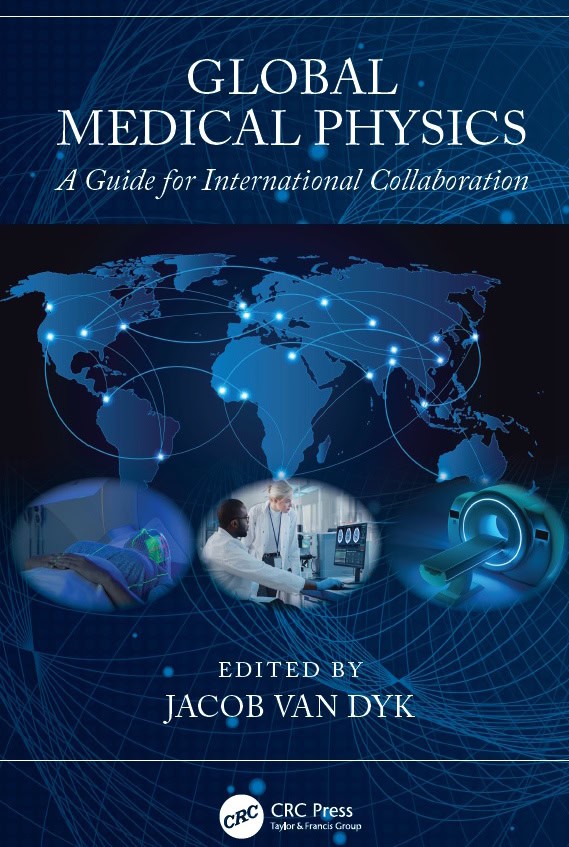
Aiming to overcome these obstacles, a new book entitled Global Medical Physics: A Guide for International Collaboration provides essential guidance for those looking to participate in such initiatives. The text addresses the various complexities of partnering with colleagues in different countries and working within diverse healthcare environments, encompassing clinical and educational medical physics circles, as well as research and academic environments.
“I have been involved in providing support to medical physicists in lower income contexts for a number of years, especially through the International Atomic Energy Agency (IAEA), but also through professional organizations like the American Association of Physicists in Medicine (AAPM),” explains the book’s editor Jacob Van Dyk, emeritus professor at Western University in Canada. “It is out of these experiences that I felt it might be appropriate and helpful to provide some educational materials that address these issues. The outcome was this book, with input from those with these collaborative experiences.”
The book brings together contributions from 34 authors across 21 countries, including both high- and low-resource settings. The authors – selected for their expertise and experience in global health and medical physics activities – provide guidelines for success, as well as noting potential barriers and concerns, on a wide range of themes targeted at multiple levels of expertise.
This guidance includes, for example: advice on how medical physicists can contribute to educational, clinical and research-based global collaborations and the associated challenges; recommendations on building global inter-institutional collaborations, covering administrative, clinical and technical challenges and ethical issues; and a case study on the Radiation Planning Assistant project, which aims to use automated contouring and treatment planning to assist radiation oncologists in LMICs.
In another chapter, the author describes the various career paths available to medical physicists, highlighting how they can help address the disparity in healthcare resources through their careers. There’s also a chapter focusing on CERN as an example of a successful collaboration engaging a worldwide community, including a discussion of CERN’s involvement in collaborative medical physics projects.
With the rapid emergence of artificial intelligence (AI) in healthcare, the book takes a look at the role of information and communication technologies and AI within global collaborations. Elsewhere, authors highlight the need for data sharing in medical physics, describing example data sharing applications and technologies.
Other chapters consider the benefits of cross-sector collaborations with industry, sustainability within global collaborations, the development of effective mentoring programmes – including a look at challenges faced by LMICs in providing effective medical physics education and training – and equity, diversity and inclusion and ethical considerations in the context of global medical physics.
The book rounds off by summarizing the key topics discussed in the earlier chapters. This information is divided into six categories: personal factors, collaboration details, project preparation, planning and execution, and post-project considerations.
“Hopefully, the book will provide an awareness of factors to consider when involved in global international collaborations, not only from a high-income perspective but also from a resource-constrained perspective,” says Van Dyk. “It was for this reason that when I invited authors to develop chapters on specific topics, they were encouraged to invite a co-author from another part of the world, so that it would broaden the depth of experience.”
The post Bridging borders in medical physics: guidance, challenges and opportunities appeared first on Physics World.
The US has turned Trofim Lysenko into a hero.
Born in 1898, Lysenko was a Ukrainian plant breeder, who in 1927 found he could make pea and grain plants develop at different rates by applying the right temperatures to their seeds. The Soviet news organ Pravda was enthusiastic, saying his discovery could make crops grow in winter, turn barren fields green, feed starving cattle and end famine.
Despite having trained as a horticulturist, Lysenko rejected the then-emerging science of genetics in favour of Lamarckism, according to which organisms can pass on acquired traits to offspring. This meshed well with the Soviet philosophy of “dialectical materialism”, which sees both the natural and human worlds as evolving not through mechanisms but environment.
Stalin took note of Lysenko’s activities and had him installed as head of key Soviet science agencies. Once in power, Lysenko dismissed scientists who opposed his views, cancelled their meetings, funded studies of discredited theories, and stocked committees with loyalists. Although Lysenko had lost his influence by the time Stalin died in 1953 – with even Pravda having turned against him – Soviet agricultural science had been destroyed.
Lysenko’s views and actions have a resonance today when considering the activities of Robert F Kennedy Jr, who was appointed by Donald Trump as secretary of the US Department of Health and Human Services in February 2025. Of course, Trump has repeatedly sought to impose his own agenda on US science, with his destructive impact outlined in a detailed report published by the Union of Concerned Scientists in July 2025.
Last May Trump signed executive order 14303, “Restoring Gold Standard Science”, which blasts scientists for not acting “in the best interests of the public”. He has withdrawn the US from the World Health Organization (WHO), ordered that Federal-sponsored research fund his own priorities, redefined the hazards of global warming, and cancelled the US National Climate Assessment (NSA), which had been running since 2000.
But after Trump appointed Kennedy, the assault on science continued into US medicine, health and human services. In what might be called a philosophy of “political materialism”, Kennedy fired all 17 members of the Advisory Committee on Immunization Practices of the US Centers for Disease Control and Prevention (CDC), cancelled nearly $500m in mRNA vaccine contracts, hired a vaccine sceptic to study its connection with autism despite numerous studies that show no connection, and ordered the CDC to revise its website to reflect his own views on the cause of autism.
In his 2021 book The Real Anthony Fauci: Bill Gates, Big Pharma, and the Global War on Democracy and Public Health, Kennedy promotes not germ theory but what he calls “miasma theory”, according to which diseases are prevented by nutrition and lifestyle.
Of course, there are fundamental differences between the 1930s Soviet Union and the 2020s United States. Stalin murdered and imprisoned his opponents, while the US administration only defunds and fires them. Stalin and Lysenko were not voted in, while Trump came democratically to power, with elected representatives confirming Kennedy. Kennedy has also apologized for his most inflammatory remarks, though Stalin and Lysenko never did (nor does Trump for that matter).
What’s more, Stalin’s and Lysenko’s actions were more grounded in apparent scientific realities and social vision than Trump’s or Kennedy’s. Stalin substantially built up much of the Soviet science and technology infrastructure, whose dramatic successes include launching the first Earth satellite Sputnik in 1957. Though it strains credulity to praise Stalin, his vision to expand Soviet agricultural production during a famine was at least plausible and its intention could be portrayed as humanitarian. Lysenko was a scientist, Kennedy is not.
As for Lysenko, his findings seemed to carry on those of his scientific predecessors. Experimentally, he expanded the work of Russian botanist Ivan Michurin, who bred new kinds of plants able to grow in different regions. Theoretically, his work connected not only with dialectical materialism but also with that of the French naturalist Jean-Baptiste Lamarck, who claimed that acquired traits can be inherited.
Trump and Kennedy are off-the-wall by comparison. Trump has called climate change a con job and hoax and seeks to stop research that says otherwise. In 2019 he falsely stated that Hurricane Dorian was predicted to hit Alabama, then ordered the National Oceanic and Atmospheric Administration to issue a statement supporting him. Trump has said he wants the US birth rate to rise and that he will be the “fertilization president”, but later fired fertility and IVF researchers at the CDC.
As for Kennedy, he has said that COVID-19 “is targeted to attack Caucasians and Black people” and that Ashkenazi Jews and Chinese are the most immune (he disputed the remark, but it’s on video). He has also sought to retract a 2025 vaccine study from the Annals of Internal Medicine (178 1369) that directly refuted his views on autism.
US Presidents often have pet scientific projects. Harry Truman created the National Science Foundation, Dwight D Eisenhower set up NASA, John F Kennedy started the Apollo programme, while Richard Nixon launched the Environmental Protection Agency (EPA) and the War on Cancer. But it’s one thing to support science that might promote a political agenda and another to quash science that will not.
One ought to be able to take comfort in the fact that if you fight nature, you lose – except that the rest of us lose as well. Thanks to Lysenko’s actions, the Soviet Union lost millions of tons of grain and hundreds of herds of cattle. The promise of his work evaporated and Stalin’s dreams vanished.
Lysenko, at least, was motivated by seeming scientific promise and social vision; the US has none. Trump has damaged the most important US scientific agencies, destroyed databases and eliminated the EPA’s research arm, while Kennedy has replaced health advisory committees with party loyalists.
While Kennedy may not last his term – most Trump Cabinet officials don’t – the paths he has sent science policy on surely will. For Trump and Kennedy, the policy seems to consist only of supporting pet projects. Meanwhile, cases of measles in the US have reached their highest level in three decades, the seas continue to rise and the climate is changing. It is hard to imagine how enemy agents could damage US science more effectively.
The post Can we compare Donald Trump’s health chief to Soviet science boss Trofim Lysenko? appeared first on Physics World.
Early diagnosis of primary central nervous system lymphoma (PCNSL) remains challenging because brain biopsies are invasive and imaging often lacks molecular specificity. A team led by researchers at Shenzhen University has now developed a minimally invasive fibre-optic plasmonic sensor capable of detecting PCNSL-associated microRNAs in the eye’s aqueous humor with attomolar sensitivity.
At the heart of the approach is a black phosphorus (BP)–engineered surface plasmon resonance (SPR) interface. An ultrathin BP layer is deposited on a gold-coated fiber tip. Because of the work-function difference between BP and gold, electrons transfer from BP into the Au film, creating a strongly enhanced local electric field at the metal–semiconductor interface. This BP–Au charge-transfer nano-interface amplifies refractive-index changes at the surface far more efficiently than conventional metal-only SPR chips, enabling the detection of molecular interactions that would otherwise be too subtle to resolve and pushing the limit of detection down to 21 attomolar without nucleic-acid amplification. The BP layer also provides a high-area, biocompatible surface for immobilizing RNA reporters.
To achieve sequence specificity, the researchers integrated CRISPR-Cas13a, an RNA-guided nuclease that becomes catalytically active only when its target sequence is perfectly matched to a designed CRISPR RNA (crRNA). When the target microRNA (miR-21) is present, activated Cas13a cleaves RNA reporters attached to the BP-modified fiber surface, releasing gold nanoparticles and reducing the local refractive index. The resulting optical shift is read out in real time through the SPR response of the BP-enhanced fiber probe, providing single-nucleotide-resolved detection directly on the plasmonic interface.
With this combined strategy, the sensor achieved a limit of detection of 21 attomolar in buffer and successfully distinguished single-base-mismatched microRNAs. In tests on aqueous-humor samples from patients with PCNSL, the CRISPR-BP-FOSPR assay produced results that closely matched clinical qPCR data, despite operating without any amplification steps.
Because aqueous-humor aspiration is a minimally invasive ophthalmic procedure, this BP-driven plasmonic platform may offer a practical route for early PCNSL screening, longitudinal monitoring, and potentially the diagnosis of other neurological diseases reflected in eye-fluid biomarkers. More broadly, the work showcases how black-phosphorus-based charge-transfer interfaces can be used to engineer next-generation, fibre-integrated biosensors that combine extreme sensitivity with molecular precision.
Yanqi Ge et al 2025 Rep. Prog. Phys. 88 070502
Theoretical and computational tools to model multistable gene regulatory networks by Federico Bocci, Dongya Jia, Qing Nie, Mohit Kumar Jolly and José Onuchic (2023)
The post Diagnosing brain cancer without a biopsy appeared first on Physics World.
Plutonium is considered a fascinating element. It was first chemically isolated in 1941 at the University of California, but its discovery was hidden until after the Second World War. There are six distinct allotropic phases of plutonium with very different properties. At ambient pressure, continuously increasing the temperature converts the room-temperature, simple monoclinic a phase through five phase transitions, the final one occurring at approximately 450°C.
The delta (δ) phase is perhaps the most interesting allotrope of plutonium. δ-plutonium is technologically important, has a very simple crystal structure, but its electronic structure has been debated for decades. Researchers have attempted to understand its anomalous behaviour and how the properties of δ-plutonium are connected to the 5f electrons.
The 5f electrons are found in the actinide group of elements which includes plutonium. Their behaviour is counterintuitive. They are sensitive to temperature, pressure and composition, and behave in both a localised manner, staying close to the nucleus and in a delocalised (itinerant) manner, more spread out and contributing to bonding. Both these states can support magnetism depending on actinide element. The 5f electrons contribute to δ-phase stability, anomalies in the material’s volume and bulk modulus, and to a negative thermal expansion where the δ-phase reduces in size when heated.
In this work, the researchers present a comprehensive model to predict the thermodynamic behaviour of δ-plutonium, which has a face-centred cubic structure. They use density functional theory, a computational technique that explores the overall electron density of the system and incorporate relativistic effects to capture the behaviour of fast-moving electrons and complex magnetic interactions. The model includes a parameter-free orbital polarization mechanism to account for orbital-orbital interactions, and incorporates anharmonic lattice vibrations and magnetic fluctuations, both transverse and longitudinal modes, driven by temperature-induced excitations. Importantly, it is shown that negative thermal expansion results from magnetic fluctuations.
This is the first model to integrate electronic effects, magnetic fluctuations, and lattice vibrations into a cohesive framework that aligns with experimental observations and semi-empirical models such as CALPHAD. It also accounts for fluctuating states beyond the ground state and explains how gallium composition influences thermal expansion. Additionally, the model captures the positive thermal expansion behaviour of the high-temperature epsilon phase, offering new insight into plutonium’s complex thermodynamics.
First principles free energy model with dynamic magnetism for δ-plutonium
Per Söderlind et al 2025 Rep. Prog. Phys. 88 078001
Pu 5f population: the case for n = 5.0 J G Tobin and M F Beaux II (2025)
The post 5f electrons and the mystery of δ-plutonium appeared first on Physics World.
Silver iodide crystals have long been used to “seed” clouds and trigger precipitation, but scientists have never been entirely sure why the material works so well for that purpose. Researchers at TU Wien in Austria are now a step closer to solving the mystery thanks to a new study that characterized surfaces of the material in atomic-scale detail.
“Silver iodide has been used in atmospheric weather modification programs around the world for several decades,” explains Jan Balajka from TU Wien’s Institute of Applied Physics, who led this research. “In fact, it was chosen for this purpose as far back as the 1940s because of its atomic crystal structure, which is nearly identical to that of ice – it has the same hexagonal symmetry and very similar distances between atoms in its lattice structure.”
The basic idea, Balajka continues, originated with the 20th-century American atmospheric scientist Bernard Vonnegut, who suggested in 1947 that introducing small silver iodide (AgI) crystals into a cloud could provide nuclei for ice to grow on. But while Vonnegut’s proposal worked (and helped to inspire his brother Kurt’s novel Cat’s Cradle), this simple picture is not entirely accurate. The stumbling block is that nucleation occurs at the surface of a crystal, not inside it, and the atomic structure of an AgI surface differs significantly from its interior.
To investigate further, Balajka and colleagues used high-resolution atomic force microscopy (AFM) and advanced computer simulations to study the atomic structure of 2‒3 nm diameter AgI crystals when they are broken into two pieces. The team’s measurements revealed that the surfaces of both freshly cleaved structures differed from those found inside the crystal.
More specifically, team member Johanna Hütner, who performed the experiments, explains that when an AgI crystal is cleaved, the silver atoms end up on one side while the iodine atoms appear on the other. This has implications for ice growth, because while the silver side maintains a hexagonal arrangement that provides an ideal template for the growth of ice layers, the iodine side reconstructs into a rectangular pattern that no longer lattice-matches the hexagonal symmetry of ice crystals. The iodine side is therefore incompatible with the epitaxial growth of hexagonal ice.
“Our works solves this decades-long controversy of the surface vs bulk structure of AgI, and shows that structural compatibility does matter,” Balajka says.
According to Balajka, the team’s experiments were far from easy. Many experimental methods for studying the structure and properties of material surfaces are based on interactions with charged particles such as electrons or ions, but AgI is an electrical insulator, which “excludes most of the tools available,” he explains. Using AFM enabled them to overcome this problem, he adds, because this technique detects interatomic forces between a sharp tip and the surface and does not require a conductive sample.
Another problem is that AgI is photosensitive and decomposes when exposed to visible light. While this property is useful in other contexts – AgI was a common ingredient in early photographic plates – it created complications for the TU Wien team. “Conventional AFM setups make use of optical laser detection to map the topography of a sample,” Balajka notes.
To avoid destroying their sample while studying it, the researchers therefore had to use a non-contact AFM based on a piezoelectric sensor that detects electrical signals and does not require optical readout. They also adapted their setup to operate in near-darkness, using only red light while manipulating the Ag to ensure that stray light did not degrade the samples.
The computational modelling part of the work introduced yet another hurdle to overcome. “Both Ag and I are atoms with a high number of electrons in their electron shells and are thus highly polarizable,” Balajka explains. “The interaction between such atoms cannot be accurately described by standard computational modelling methods such as density functional theory (DFT), so we had to employ highly accurate random-phase approximation (RPA) calculations to obtain reliable results.”
The researchers acknowledge that their study, which is detailed in Science Advances, was conducted under highly controlled conditions – ultrahigh vacuum, low pressure and temperature and a dark environment – that are very different from those that prevail inside real clouds. “The next logical step for us is therefore to confirm whether our findings hold under more representative conditions,” Balajka says. “We would like to find out whether the structure of AgI surfaces is the same in air and water, and if not, why.”
The researchers would also like to better understand the atomic arrangement of the rectangular reconstruction of the iodine surface. “This would complete the picture for the use of AgI in ice nucleation, as well as our understanding of AgI as a material overall,” Balajka says.
The post Scientists explain why ‘seeding’ clouds with silver iodide is so efficient appeared first on Physics World.
[MàJ] L'Europe vient de s'attribuer le mérite de cette annonce, considérant que les deux sociétés ont été obligées de mettre en place cette interopérabilité pour se conformer à ses lois.
Google et Apple travaillent conjointement à une offre logicielle permettant une bascule d'Android vers et iOS et inversement de manière plus aisée.
Android Canari 2512 compatible avec les smartphone Pixels contient déjà un premier jet du fruit de cette collaboration. Il arrivera prochainement sous iOS 26.
Le but est en cas de changement de smartphone, de pouvoir récupérer un maximum de données de manières aisée et transparente.
Bien entendu on peut s'étonner d'une telle ouverture, surtout de la part d'Apple (et nous ne sommes pas un premier avril). Il est probable que chaque fabricant espère récupérer une partie des clients de l'autre. Il est aussi probable que ce geste d'ouverture serve à prouver aux régulateurs que ces deux géants ne sont plus aussi protecteurs de leurs écosystèmes ce qui a son importance.
Canonical will package AMD ROCm directly in the Ubuntu 26.04 LTS repos, making it much easier to get GPU-accelerated workloads running on the distro.
You're reading Canonical is Bringing AMD ROCm to Ubuntu 26.04 Repos, a blog post from OMG! Ubuntu. Do not reproduce elsewhere without permission.
Aujourd’hui, on découvre le le coussin de siège chauffant Mellow de Duux. Avec ses dimensions de 40 x 110 et sa belle couleur grise, voyons ensemble ce qu’il vaut, à qui il se destine et comment il s’utilise. Vous l’aurez compris, Duux veut nous mettre au chaud cet hiver ! Si vous l’avez raté, nous vous proposons de découvrir notre test complet de la sur-couverture chauffante Yentl dont nous vous avons parlé en détails le mois dernier.
Ce dernier est vendu au prix de 99,99 € directement sur le site de la marque que l’on ne présente plus, mais a été vu lors du Black Friday à 69,99 €. Place au test !
Duux joue une nouvelle fois la carte de la sobriété : un large visuel du coussin chauffant Mellow en coloris gris, posé sur une chaise design, donne immédiatement le ton. On voit d’un coup d’œil qu’on est sur un produit pensé pour l’intérieur moderne. Les icônes en bas annoncent la couleur : chauffe rapide, tissu doux, sécurité intégrée. La mention 40 x 110 cm est également présente.
À l’arrière, Duux donne plus de détails : photos rapprochées, mise en situation dans un intérieur lumineux, et surtout une liste de caractéristiques bien mise en page, mais nous y reviendrons plus en détails après. Enfin, le côté droit propose une petite phrase qui résume parfaitement l’ambition du produit : « Keep your seat warm and mellow, all season long.»

Une chaleur rapide et homogène – L’élément chauffant avancé en graphène se réchauffe très rapidement et distribue la chaleur uniformément sur l’ensemble du siège. Avec 3 réglages de chaleur, vous déterminez facilement la quantité de chaleur dont vous avez besoin. D’une lueur subtile à une chaleur intense : c’est vous qui décidez de l’intensité !
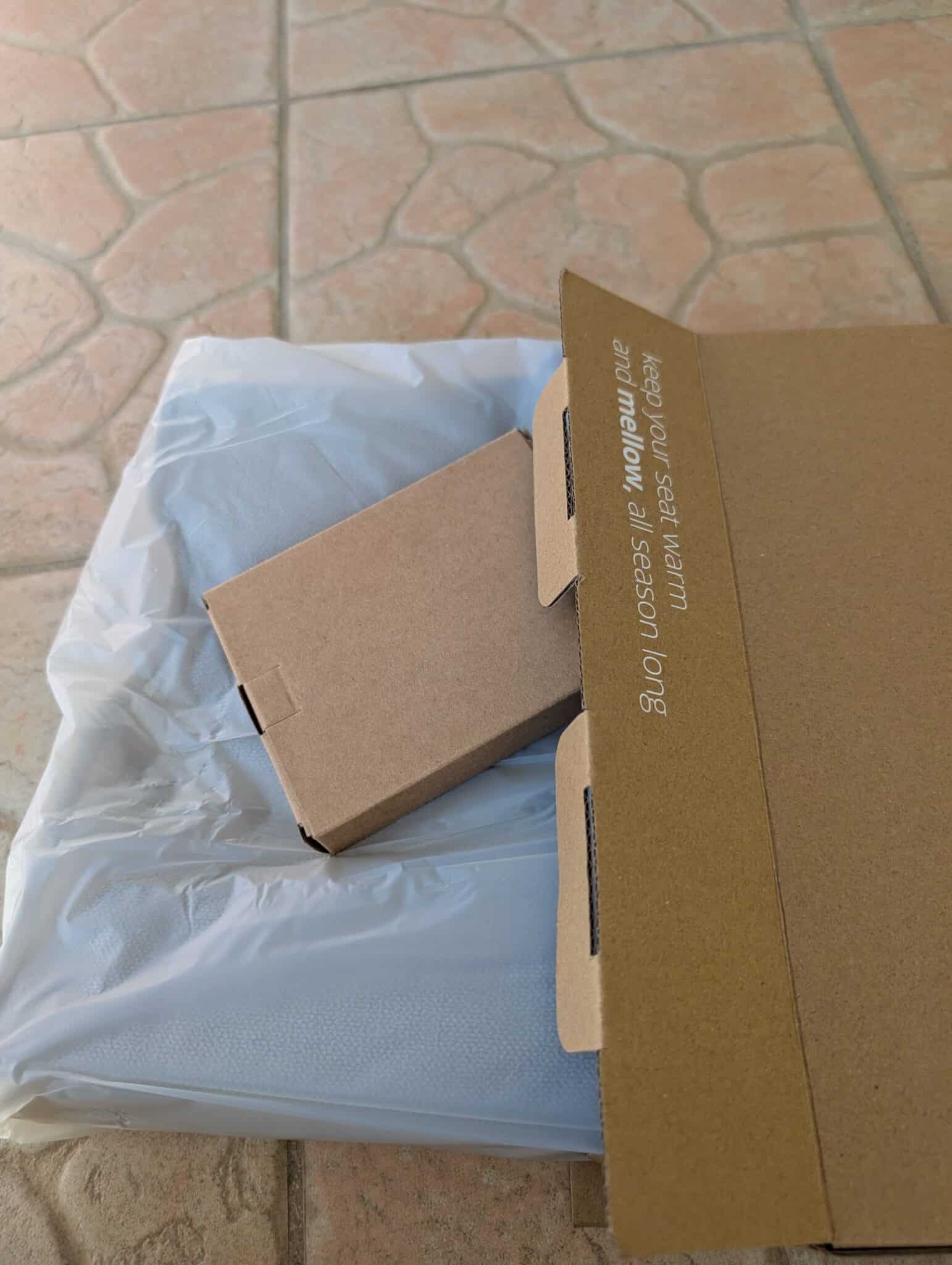
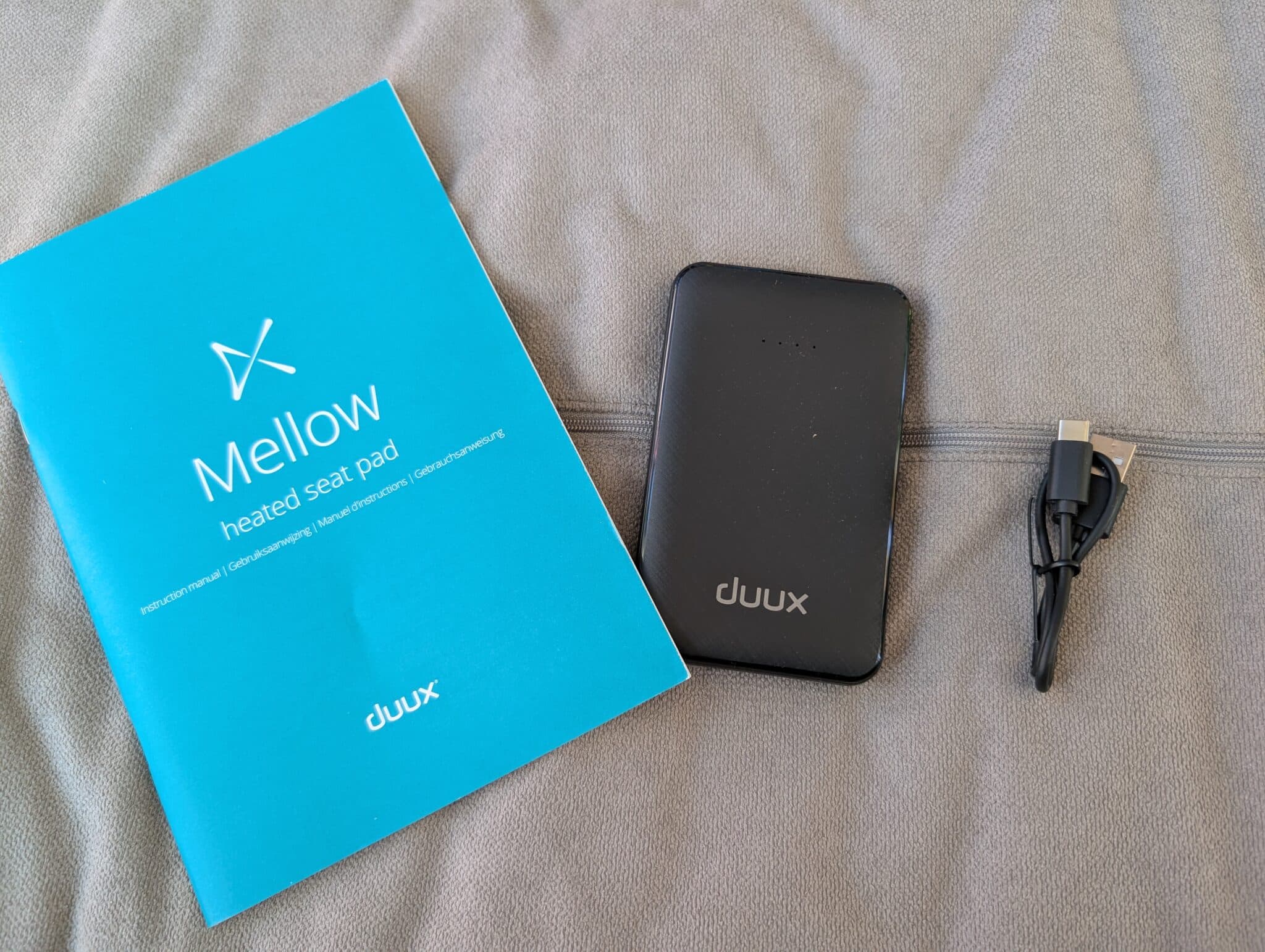
Quand les premières fraîcheurs s’installent, on cherche tous ces petites solutions malines qui apportent du confort sans exploser la facture de chauffage. C’est exactement ce que propose Duux avec son coussin de siège chauffant Mellow, un modèle pensé pour s’adapter à n’importe quel fauteuil, chaise de bureau ou chaise de terrasse, grâce à un format généreux en 40 × 110 cm et une mise en route ultra simple. À la sortie du carton, le Mellow renvoie immédiatement une sensation de qualité, comme toujours avec Duux, soyons honnête.
Sa housse façon polaire grise est douce au toucher et très sobre visuellement. On n’est pas sur un accessoire cheap mais bien sur un objet qui semble pensé pour durer : épaisseur bien dosée, coutures propres, matériaux qui inspirent confiance. Le format long permet de couvrir à la fois l’assise et le dossier, ce qui est un vrai plus pour envelopper tout le corps dans une chaleur cohérente. Enfin, cela dépend de votre chaise. Ma NeueChair est un peu grande pour les dimensions de notre produit du jour. Je dois donc bien le mettre avant de m’asseoir, sous peine de faire glisser la batterie ce qui n’est pas forcément très agréable, surtout au niveau de la tête.
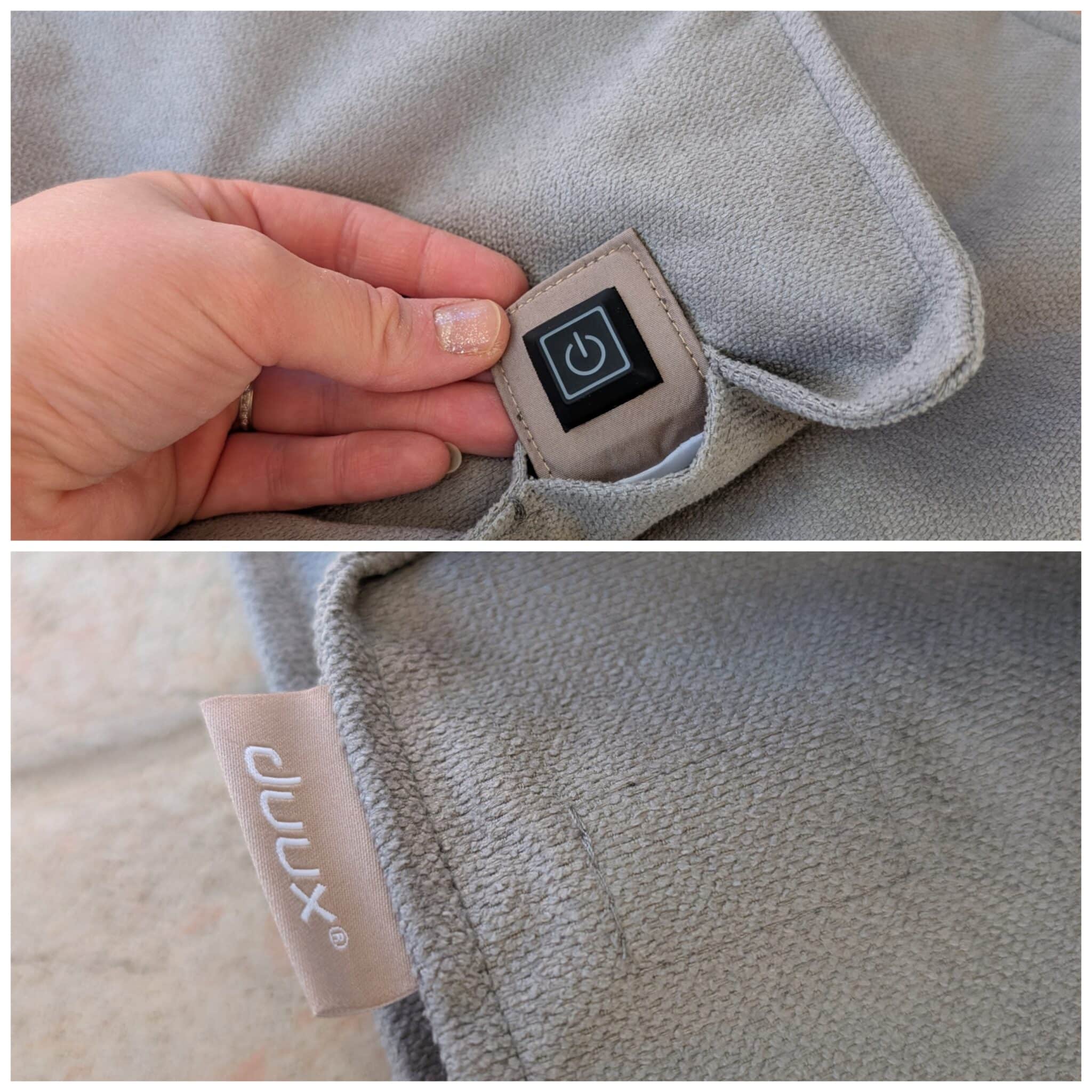
Ici, Duux ne s’est pas contenté d’intégrer une simple résistance chauffante. Le Mellow utilise une technologie à élément chauffant en graphène, ce qui permet une diffusion de chaleur rapide, mais surtout uniforme sur toute la surface. Nous aurons ici de belles fonctionnalités, à commencer par les trois niveaux de chauffe pour ajuster l’intensité selon son besoin. On aura ici un chauffage homogène du bas du dos jusqu’aux cuisses, idéal en télétravail ou lors d’un repas qui s’éternise, mais aussi une belle autonomie pouvant atteindre 6h grâce à la batterie 10 000 mAh fournie. Le tout est sans fil, contrairement à la sur-couverture chauffante Yentl, donc utilisable partout.
En pratique, on obtient une chaleur douce mais constante — pas brûlante, pas agressive, juste ce qu’il faut pour rester bien sans transpirer. Exactement le genre de confort que l’on aime en hiver. Et qu’est-ce que c’est agréable pour le bas du dos ! Surtout pendant une certaine période du mois.
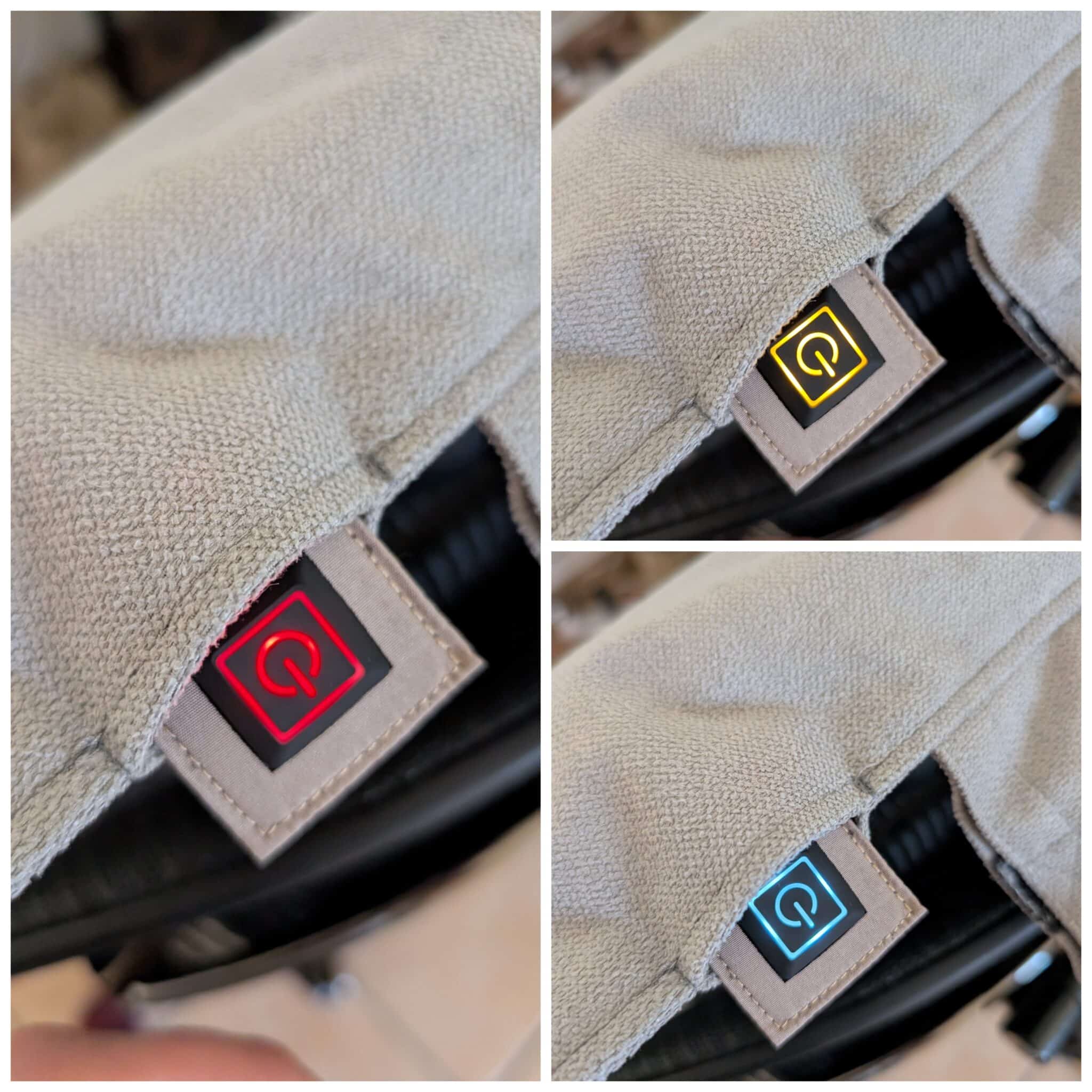
Le Mellow fonctionne très bien en intérieur, que ce soit sur une chaise de bureau, un fauteuil de lecture ou une chaise de cuisine un peu froide. Mais son atout majeur, c’est aussi sa capacité à être utilisé en extérieur abrité grâce à sa housse déperlante. Sur une terrasse couverte, un balcon ou même lors d’un pique-nique en demi-saison, il apporte ce petit supplément de chaleur qui change tout. On n’a plus besoin de se coller au radiateur ou de superposer trois plaids : le confort vient à vous ET il est nomade. De mon côté, je l’ai utilisé pour travailler et j’ai réellement adoré.
Bien sûr, aucun produit n’est parfait, et pour le Mellow, ce sont surtout des détails. Par exemple, les 6 heures d’autonomie sont respectables, mais lors d’une longue soirée d’extérieur, on peut arriver au bout assez vite. Il faudra aussi penser à recharger la batterie portable. La housse est lavable uniquement à la main, ce qui demande un minimum de délicatesse, pas de machine ici contrairement à la Yentl. Ce n’est pas un chauffage d’appoint : il réchauffe vous, pas la pièce, mais ça vous l’aurez sûrement compris.
Le Duux Mellow 40 × 110 est un coussin chauffant, certes, mais c’est aussi un véritable accessoire de confort, pensé pour accompagner les moments de détente comme les longues sessions de télétravail. Son design sobre, son autonomie correcte, sa vraie mobilité et son chauffage doux en font un allié parfait pour traverser l’hiver sereinement.
Si vous cherchez une solution discrète, efficace et agréable pour vous réchauffer sans monter le chauffage, le Mellow fait partie de ces produits qui améliorent vraiment le quotidien. Un petit luxe qui aura tout de même un prix, 99,99 €.

Test – Coussin de siège chauffant Mellow de Duux a lire sur Vonguru.
Ubuntu's Yaru theme will closely follow the vanilla GNOME Shell design in the upcoming 26.04 release, as its developers aim to reduce the maintenance burden.
You're reading Ubuntu 26.04 Will Look More Like Vanilla GNOME Shell, a blog post from OMG! Ubuntu. Do not reproduce elsewhere without permission.
