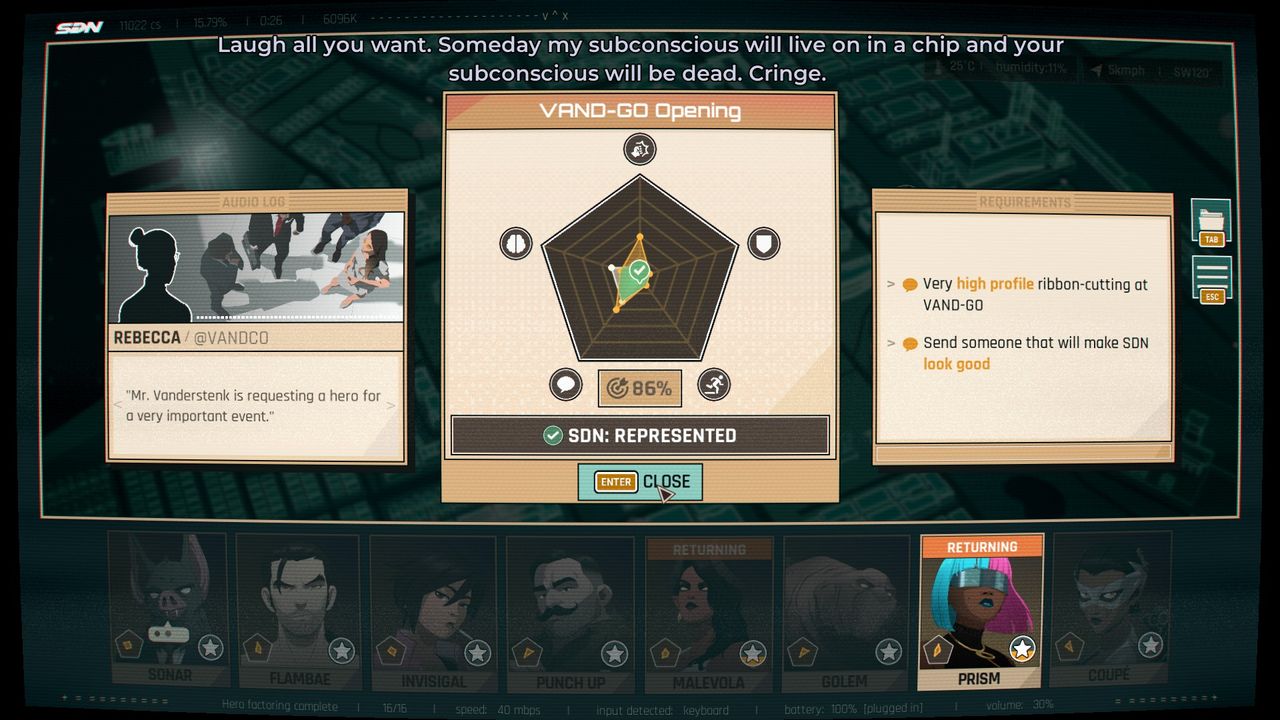
Just like XCOM, superhero comedy Dispatch cheats random percentages of success in the player's favor: 'anything that had over a 76% success chance would automatically succeed'

[Editor’s Note: Minishoot' Adventures was first released on PC in 2024, but we did not review it at that time, so we have taken its recent port to Nintendo Switch 2 as an opportunity to do so now.]
Minishoot’ Adventures answers a question I never would have thought to ask in a thousand years: What if you mixed classic Zelda with a twin-stick shooter? Developer SoulGame Studio’s take on that combination is an absolute delight. Between the silky smooth controls, your spaceship-shaped hero’s growing repertoire of abilities, and a top-down world that opens up at a satisfying pace, I loved all 10 hours it took me to roll credits. That felt like a perfect length, even though I would’ve gladly kept playing if it had offered more.
SoulGame Studio makes absolutely no effort to hide Minishoot’ Adventures’ Hyrulean inspiration. Just like Zelda, the overworld is populated with enemies, caves, trees, waterways, and areas you can see but can’t reach until you unlock a new ability. Your health is displayed as a row of hearts in the upper corner of the screen, and you can add more by finding heart pieces hidden around the world. If that’s not proof enough, just travel one screen down from your home base and you’ll find an exact replica of the starting screen from The Legend of Zelda on NES. While an uncharitable interpretation might consider this stealing from Nintendo, it all comes off as a loving homage. The developers have used familiar ingredients to create a new, twin-stick shooting-infused dish that’s different enough to stand on its own.
Instead of an elfin boy, you play as Minishoot’, a small beige ship that exhibits a surprising amount of personality thanks to the cartoonish art and animation. That odd apostrophe in the ship’s name is actually to abbreviate “Minimalist Shooter Adventure,” and that minimalism extends to the story, which gets maybe a minute of total screen time. Basically, you and your fellow sentient ships are enjoying your lives together when an invading force comes in with guns blazing to break up the party, flinging ships to all corners of the map and encasing them in crystals. Your job, once you break free of your own gemstone prison, is to find your Shipling friends and “restore balance to the Great Crystal,” whatever that means. It’s not Shakespeare, but it sets you off on a fun adventure.
If you’ve played top-down Zelda games before, then you know exactly what to expect here: You’ll poke around the overworld, delving into caves, fighting enemies, and solving light puzzles. This is all extremely pleasant, thanks in no small part to the controls. Minishoot’ glides along so smoothly that simply moving across the screen feels satisfying.
Some areas are blocked off by obstacles like pits and water, but you can explore these regions later, once you obtain the right equipment. For instance, you unlock a surf ability that lets you glide over water, and a boost that lets you use ramps to leap over pits. These upgrades are a joy, both because the controls are so good and because they let you explore further into the map. This is a tried-and-true formula, and it works particularly great in Minishoot’ because of how frequently the upgrades are handed out during the adventure. The pacing feels just right, so I never felt like my progress had stalled.
The only major aspect that’s not inspired by Zelda is the twin-stick combat, which (if you’re using a gamepad, as is highly recommended) has you move around with the left stick while firing bullets in any direction with the right. This addition is incorporated so seamlessly into the otherwise recognizable framework that you might wonder if Link should’ve been a little ship all along.
Your starting weapon is as weak as a peashooter, but as you take down enemies and blast through gemstones scattered throughout the world, you level up, earning points you can feed into 11 different enhancements — things like fire rate, damage, range, and bullet speed. Each of these enhancements can be upgraded numerous times, making any single upgrade feel a little too incremental, which is somewhat disappointing. Worse, the cost of the upgrades increases as your enhancements become stronger. That means, for instance, you need to spend three levels’ worth of currency to gain the second damage upgrade.
Thankfully, you’re also picking up new abilities as you bolster your damage output, so I always felt like I was making progress regardless. And your attack upgrades do eventually add up; by the time I confronted the final boss, I could unleash a bullet hell barrage of my own.
Unlike Zelda, the enemy designs are largely forgettable in Minishoot’ Adventures, at least when it comes to their looks. Like the Shipling protagonists, the bad guys you’re blowing up are all mechanical constructs. Most are beige ships that come in different geometric shapes – this one’s a circle! Here’s a triangle! Lynels and moblins these are not.
On the other hand, these enemies do have a nice variety of attack styles, and they’re strategically placed around the environment to pose different kinds of challenges, making them far more interesting to fight than they are to look at. For instance, stationary turrets might snipe at you from a distance while a cluster of small enemies swarms your way, giving you plenty to consider as you try to kill the cluster while avoiding the incoming bullets. Many rooms lock you inside while spawning increasingly difficult waves of enemies. (There are even a handful of races for you to compete in, complete with a starting block and finish line.)
Bosses are also mechanically interesting, big and challenging battles divided into phases – and it’s here that this twin-stick shooter veers into bullet hell territory. You usually have to thread your way through a maze of projectiles, all while directing your own stream of bullets at the boss. It’s a blast. I died a lot in these fights, but just like in top-down Zelda games, the dungeons are designed to give you a short route back to the boss room from your respawn point, so I was always excited to try again rather than getting frustrated.
Every inch of Minishoot’ Adventures is packed with smart little details, like hidden paths hinted at by gentle indents in the walls, or how enemies gradually turn redder as they take damage so you can tell when they’re about to die. There are plenty of collectables to seek out, from red coins and heart pieces to chunks of the overworld map. As you progress, various symbols start to appear in unexplored regions to point you toward new areas of interest, so I never felt aimless or lost.
It’s all set to a charming and engrossing electronic soundtrack. The sound effects are full of little bloops and plooks and ASMR-friendly tinkles, as well. Combine that soundscape with surprisingly cute animations (an especially impressive feat for a game about faceless ships) and you get a cozy vibe, even when you’re sweating through an onslaught of bullets.

Disneyland President Thomas Mazloum is officially replacing Josh D'Amaro, the incoming CEO of The Walt Disney Company, as Chairman of Disney Experiences, which includes Disney's theme parks, cruise ships, resort hotels, expeditions and adventures, consumer products, and Walt Disney Imagineering.
Disney announced the news today, alongside confirming that Jill Estorino will be replacing Mazloum as Disneyland President, Tasia Filippatos will become President of Disney Parks International, and Lisa Baldzicki will take on the role of President of Disney Consumer Products.

Mazloum, Estorino, Filippatos, and Baldzicki will all start their new roles on March 18, the same day D'Amaro will leave his position as Chairman of Disney Experiences and become the company's CEO.
Last year, we were so honored to have the exclusive first national interview with Mazloum when he was still new to the role of Disneyland President, and we learned a lot about his history and vision for the future.
Mazloum first joined The Walt Disney Company in 1998 as a hotel director for Disney Cruise Line, and he also served various senior roles at both Disneyland and Walt Disney World before leading all of Disney Signature Experiences. He also left Disney for a time to work at Crystal Cruises, where he was "known for driving service excellence, transforming organizational cultures, and successfully launching new travel ventures."
“Thomas Mazloum is an exceptional leader with a genuine appreciation for our cast members and a proven track record of delivering growth,” said D’Amaro. “His focus on service excellence, broad international leadership, and strong connection to the creativity that brings our stories to life make him the right leader to guide Disney Experiences into its next chapter.”
Estorino has been with The Walt Disney Company for 35 years and has held multiple leadership roles, including Executive Vice President of Global Marketing and Sales for Disney Parks, Experiences and Products, where she was instrumental in opening Shanghai Disney Resort. Most recently, she was the President of Disney Parks International.
Filippatos is currently serving as President of Disney Consumer Products, and Baldzicki was head of Parks Product Development & Retail for Disney Consumer Products.
“As we look ahead, I have tremendous confidence in Thomas and in the leaders stepping into these roles — Jill, Tasia, and Lisa — along with the incredible leadership team across Disney Experiences,” said D’Amaro. “Together, they will continue to build on our momentum around the world, delivering the service, creativity and one-of-a-kind experiences that define Disney.”
For more on what these four will help continue to build see what else is on its way to Walt Disney World, Disneyland Paris, and Disneyland.
Adam Bankhurst is a writer for IGN. You can follow him on X/Twitter @AdamBankhurst, Instagram, and TikTok, and listen to his show, Talking Disney Magic.

Dell currently has the best price I can find currently for an RTX 5070 Ti equipped prebuilt gaming PC. The Dell Tower Plus can be configured with an Intel Core Ultra 7 265F CPU and GeForce RTX 5070 Ti 16GB GPU for just $1,719.99 with free delivery. This desktop's aesthetic doesn't scream "gamer PC" like most of the other computers I write about, but that processor and graphics card combo is powerful enough to run just about any game at up to 4K resolution.
The $1,719.99 configuration includes an Intel Core Ultra 7 265 CPU, GeForce RTX 5070 Ti 16GB GPU, 16GB of DDR5-5200MHz RAM, and a 1TB SSD. The 750W power supply gives you a fair amount of headroom for future upgrades. Note that the Intel Core Ultra 7 265 CPU comes with "standard CPU cooling" which consists of a pretty basic and low-profile top-down heatsink fan combo. If you upgrade to the Core Ultra 7 265K for an extra $100, you also get the "advanced CPU cooling" option which includes a much more robust tower heatsink fan that compares to aftermarket solutions. It would be a worthwhile upgrade if you plan on sustained high-demand gaming with this rig.
The RTX 5070 Ti offers the best bang for your buck in terms of 4K gaming performance. It performs neck-and-neck with the previous generation RTX 4080 Super and pulls ahead in any game that supports multi-frame generation, especially with the recent DLSS 4.5 update. It is fully capable of running any game in 4K at 60fps. It also has 16GB of VRAM like the RTX 5080, making it viable for AI work. Since RTX 5070 Ti GPUs are pretty much non-existent as a standalone card, the only way to get one without paying a ridiculous markup is by getting an equipped prebuilt computer.
Eric Song is the IGN commerce manager in charge of finding the best gaming and tech deals every day. When Eric isn't hunting for deals for other people at work, he's hunting for deals for himself during his free time.

If you're interested in dipping your toes in the world of 3D printing, you can't do much better than to start with Flashforge's extremely popular and affordable Adventure series as your first printer. Then you can't get much better than Flashforge's extremely popular Adventure series. For a limited time, AliExpress is offering the Flashforge Adventure 5M 3D Printer for just $176.63 with free delivery after you apply coupon code "25USAFFS". Make sure you're signed into your account to see the shipping options. The exact same printer sells for $299 on Amazon, but it officially retails for $399. The Adventure 5M offers great performance at at outstanding budget price.
Note: Sign into your account and then refresh the page to see the shipping options.
You're buying it from FlashForge's official store on AliExpress. It ships free locally from the United States and arrives within 1 to 2 weeks. The Adventurer 5M is considered by many to be one of the best 3D printers priced below $200. It is easy to setup, it produces great 3D prints with minimal fiddling, and there are plenty of mods available including an official kit that fully encloses the chamber and another that adds a camera, all at a super affordable price point.
The Adventurer 5M is Flashforge's least expensive CoreXY printer across its entire product lineup. In fact, you'd be hard pressed to find another CoreXY printer from any well-regarded brand. In a CoreXY printer, only the print head moves while the motors are fixed in place. Since the motors are often the heaviest component, this improves print speed and precision.
The Adventurer 5M features an open bed design with a build volume measuring approximately 8.7" cubed. For those of you who are looking to enclose the chamber in order to create a more stable environment for your prints, you can purchase the official kit for $39.99 that can turn it into a closed chamber setup. Alternatively, you can just build yourself a big box that you can place over the entire printer, probably for an even cheaper price.
The Adventurer 5M boasts a print speed of up to 600mm/s with 20,000mm/s² acceleration and can print a benchy in 14 minutes. The high-flow 32mm³/s nozzle with 280°C direct extruder can warm up to 200°C in as fast as 35 seconds for smooth and stable filament dispensing. Other features including solid build quality (all structural components are made of metal), a 4.3" color touchscreen control panel, auto leveling, and vibration compensation. Assembly is quick and easy and you should be able to make your first test print in a matter of minutes. No camera is included but there's an add-on kit.
TL;DR:
Eric Song is the IGN commerce manager in charge of finding the best gaming and tech deals every day. When Eric isn't hunting for deals for other people at work, he's hunting for deals for himself during his free time.

From portable gaming handhelds to smartphones, our lives rely on portable, untethered electronics, and it can't hurt to always have a charger on hand. Amazon is currently offering a Baseus Picogo AE21 100W 3-port USB Type-C wall charger for just $29.99 after you apply coupon code "8O3OICC2". You actually do not need to be an Amazon Prime member to get this deal. This diminutive adapter can fast charge even the most power hungry handheld gaming PCs like the ROG Xbox Ally X and features a handy digital display.
Amazon Prime membership not needed
This charger is part of Baseus' compact Picogo lineup and measures a compact 2.6" x 1.3" x 2.1". Despite the diminutive size, it's still able to pack in three charging ports: two 100W USB Type-C and one 33W USB Type-A. Note that the maximum output for all three ports is 100W, so if you used both USB-C ports at time same time, you would pull 67W + 33W. This model also has a digital display that provides a detailed view of charging status, temperature, and port output.
The 100W of USB-C Power Delivery is higher than what I typically see at this price point. This charger has a higher output than the stock adapters that come packaged with power hungry handheld gaming PCs like the Xbox Ally X, ROG Ally X, Legion Go S, and Legion Go 2; even though these handhelds support up to 100W charging rates, they're supplied with 60W max charging adapters. It's also compatible with devices like the Steam Deck and Switch 2 that can only accept a lower rate, since the charger only delivers as much power as the device allows. This is also a great charger for the Apple iPhone 17 Pro Max or Samsung Galaxy S26 Ultra, which cap out at 40W and 60W, respectively.
Eric Song is the IGN commerce manager in charge of finding the best gaming and tech deals every day. When Eric isn't hunting for deals for other people at work, he's hunting for deals for himself during his free time.

Universal Pictures is starting to pluck away at a Bon Jovi biopic that will explore the early days of the band behind songs such as "Livin’ on a Prayer" and "Wanted Dead or Alive".
Deadline reports the studio officially hit the road in its pursuit to help bring the movie to life after winning a bidding war. The site says the film will chart the New Jersey rock outfit’s “formative years” as frontman and Rock & Roll Hall of Fame legend Jon Bon Jovi (real name John Bongiovi) helped establish it throughout the 1980s.
Cody Brother, who has scripted Drudge and Killing Satoshi, will write the script for the Bon Jovi movie. Kevin J. Walsh (Manchester by the Sea, Napoleon) and Gotham Chopra (Thank You, Goodnight: Bon Jovi Story) will produce. Variety reports that Universal director of production Jacqueline Garell will oversee the biopic for the studio.
Participation from Jon Bon Jovi himself is said to have been included in Universal’s deal, as is access to the Bon Jovi library. Additional information such as the cast and a release date have yet to be announced.
Bon Jovi first truly hit the music scene with its self-titled debut record, which had instant classics like "Runaway" and "Shot Through the Heart", in 1984. It followed up with 7800 Fahrenheit and singles like "In and Out of Love" in 1985 before Slippery When Wet introduced the world to "Livin’ on a Prayer", "You Give Love a Bad Name", "Wanted Dead or Alive", and more in 1986.
The band is still active today, with its most recent album, Forever, released in 2024.
While we wait for Universal to put its Bon Jovi movie together, you can read about a set of upcoming biopics focused on the four members of The Beatles. You can also check out what we thought about other recent music biopics like Springsteen: Deliver Me From Nowhere, Elvis, and A Complete Unknown.
Photo by Jeff Spicer/Getty Images.
Michael Cripe is a freelance writer with IGN. He's best known for his work at sites like The Pitch, The Escapist, and OnlySP. Be sure to give him a follow on Bluesky (@mikecripe.bsky.social) and Twitter (@MikeCripe).
CD Projekt RED has confirmed that The Witcher 4 will support Path Tracing on PC. Moreover, the game will take advantage of NVIDIA’s RTX Mega Geometry. As Cezary Bella, rendering engineer at CDPR, said in NVIDIA’s latest video. “We are collaborating with both Epic Games and NVIDIA to streamline the implementation of Path Tracing into … Continue reading The Witcher 4 will support Path Tracing & RTX Mega Geometry on PC →
The post The Witcher 4 will support Path Tracing & RTX Mega Geometry on PC appeared first on DSOGaming.

B&H Photo has one of the best deals right now on a 4K-ready gaming PC. The Lenovo Legion Tower 5 RTX 5070 Ti gaming PC drops to just $1,899 with free delivery after an $700 discount. Most RTX 5070 Ti prebuilts cost above $2,000 these days, so this is one of the lowest prices I've seen. The RTX 5070 Ti is our best reviewed Nvidia GeForce Blackwell card and has the chops to run games in glorious 4K at 60+fps.
The Lenovo Legion Tower 5 Gen 10 gaming PC is equipped with an Intel Core Ultra 7 265F desktop processor, GeForce RTX 5070 Ti graphics card, 32GB of DDR5-5600MHz RAM, and a 2TB M.2 SSD. The Core Ultra 7 265F is part of Intel's newest Arrow Lake-S lineup released earlier this year and boasts a max turbo frequency of 5.3GHz with 20 cores and a 36MB L2 cache. This is a solid all-around CPU for gaming, multi-tasking, and general workstation performance. It doesn't have as many cores as a Core Ultra 9 processor, but that doesn't matter for gaming since the vast majority of games will not be able to utilize more than 20 cores.
The RTX 5070 Ti offers the best bang for your buck in terms of 4K gaming performance. It performs neck-and-neck with the previous generation RTX 4080 Super and pulls ahead in any game that supports multi-frame generation, especially with the recent DLSS 4.5 update. It is fully capable of running any game in 4K at 60fps. It also has 16GB of VRAM like the RTX 5080, making it viable for AI work. Since RTX 5070 Ti GPUs are pretty much non-existent as a standalone card, the only way to get one without paying a ridiculous markup is by getting an equipped prebuilt computer.
Eric Song is the IGN commerce manager in charge of finding the best gaming and tech deals every day. When Eric isn't hunting for deals for other people at work, he's hunting for deals for himself during his free time.

The Alienware Area-51 16 is Dell's highest-end 16" gaming laptop. Much like every gaming laptop on the market, prices have gone up in 2026 due to the increased demand for RTX 50 series GPUs and DDR5 RAM, but fortunately there's still a reliable way to get a good deal if you know where to look.
Dell Outlet - Dell's official site for Dell and Alienware refurbished, scratch and dent, and clearance PCs - just recently restocked its inventory of Alienware Area-51 16 laptops equipped with RTX 5070 Ti, RTX 5080, and RTX 5090 GPUs. These have been factory inspected and certified to work and look brand new and even include the same warranty as buying a retail product. Like a retail product, you also have the option to extend the base warranty up to three years if desired.
Although the Alienware Area-51 can be equipped with an RTX 5060 or 5070 GPU, at its price tier you really shouldn't be targeting gaming performance lower than an RTX 5070 Ti. The RTX 5070 Ti 12GB GPU is the least expensive card in Nvidia's mobile RTX 50 series lineup that I'd recommend for running most games smoothly on the display's 2560x1600 resolution. It performs about 15%-20% better than the RTX 5070. Compared to the previous generation, it's comparable in performance to the RTX 4080 and pulls ahead of it in games that support DLSS 4.5 and multi-frame generation. Compared to desktop GPUs, it's similar in performance to the RTX 5060 Ti 16GB model.
The RTX 5080 is a 15%-20% uplift in performance over the RTX 5070 Ti. It also has more VRAM (16GB vs 12GB) which gives it the edge in higher resolution gaming, ray tracing performance, and AI applications. In fact, it's slightly more powerful than the RTX 4090, which was the previous generation's flagship card. Compared to desktop GPUs, it's similar in performance to the RTX 5070. This is the GPU I'd recommend for most people who want to run just about any game out there at 2560x1600 and 60fps with minimal tweaking. Obviously the RTX 5090 is better, but it's way pricier.
The Nvidia GeForce RTX 5090 is the most powerful mobile graphics card on the market, performing about 15% better than the RTX 5080. It also has a lot more VRAM (24GB vs 16GB), which can come in handy when playing games at higher resolutions (like on an attached 4K monitor) or if you're planning to use this as a mobile creator or AI workstation. Compared to desktop GPUs, it's similar in performance to the RTX 5070 Ti. If you want to run any game out there with all of the bells and whistles enabled, including ray tracing, then this configuration will get it done.
The Alienware Area-51 is a considerable upgrade compared to the previous generation's Alienware m16. For starters, it's clad in anodized aluminum for both the lid and bottom chassis and features a unique iridescent finish that sparkles in direct lighting. The frame is made of a durable and lightweight magnesium alloy. Cooling has been upgraded with generous amounts of copper and a new thermal interface. Dell claims that it can handle up to 240W TDP without raising acoustics.
Design-wise, the Area 51 has a sleeker, more contoured shape compared to previous models, with rounded edges and soft corners replacing the traditional squared off design. The hinges are internally positioned so that they're near invisible. There's a transparent window on the undercarriage to show off the internal components. There's also plenty of RGB illumination, although most of it can be turned off if you don't like that sort of thing.
Eric Song is the IGN commerce manager in charge of finding the best gaming and tech deals every day. When Eric isn't hunting for deals for other people at work, he's hunting for deals for himself during his free time.