LOTemplate est un générateur de documents sous licence AGPL v3 qui permet de générer des documents (ODT, DOCX, ODS, XLSX, PDF, …) à partir d'un document modèle avec des variables et d'un fichier json pour les données.
Comment faire faire à LibreOffice (headless, sans interface graphique) ce que l’on ne peut pas faire avec LibreOffice (GUI, avec interface graphique) ?
Et comme c’est Noël nous avons ajouté un meilleur système de log en cadeau.
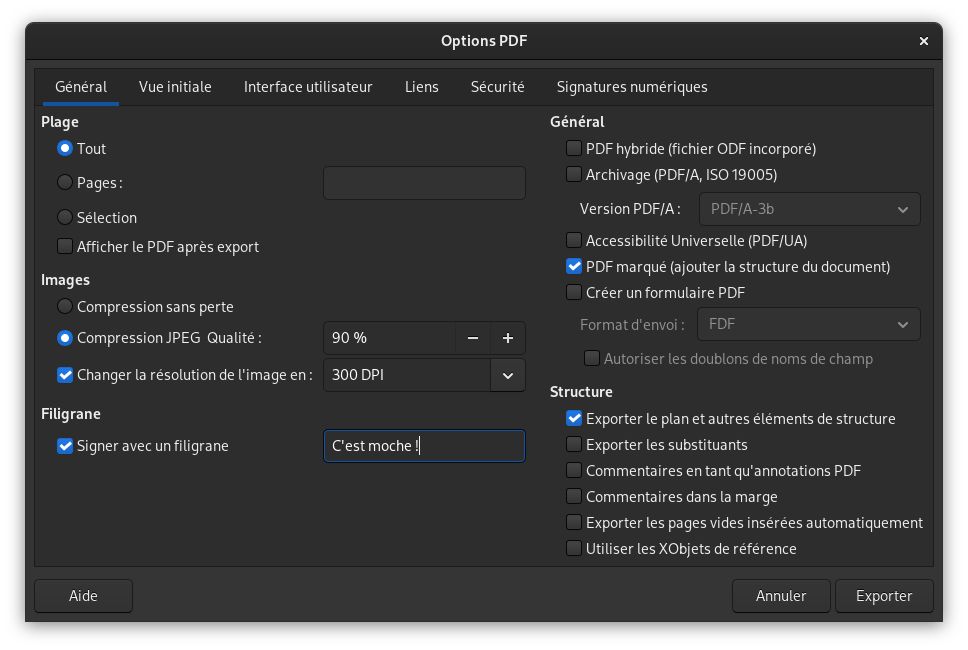
Dans la version 2.2 de LOTemplate, nous avons ajouté la possibilité d’exporter des PDF en y ajoutant un filigrane de son choix avec comme paramètres :
- Texte de filigrane
- Couleur de filigrane
- Police
- Taille de police
- Le nombre de répétition sur la page
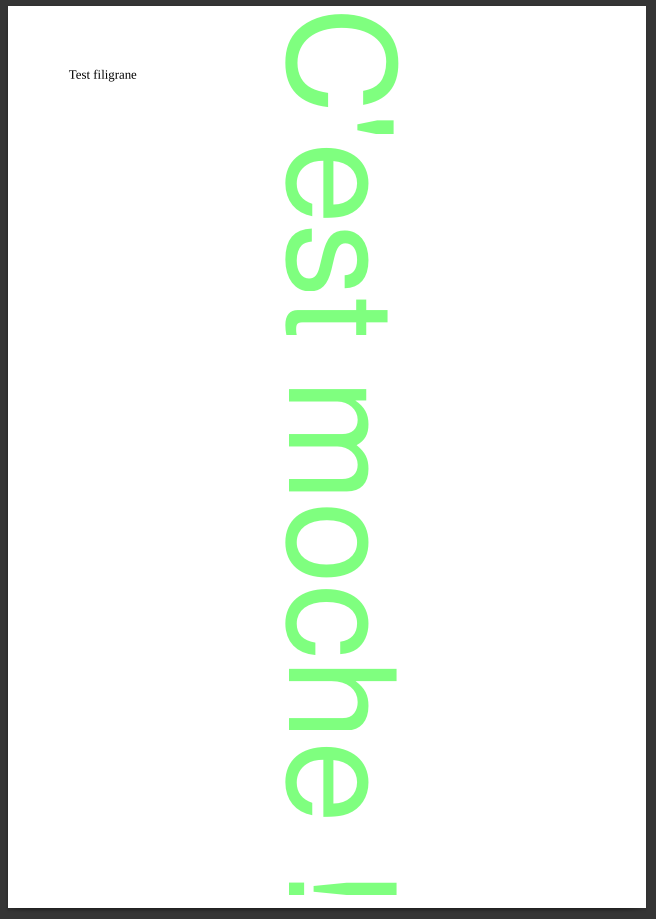
Pour cela, nous utilisons l’API uno de LibreOffice, qui expose plus de paramètres que l’interface graphique de LibreOffice. En effet, si l’on cherche a faire cela dans l’interface graphique de LibreOffice, on ne peut choisir que le texte. Le filigrane apparaît ensuite en vert et à la verticale.
Mais en cherchant dans l’aide de LibreOffice, on trouve sur la page d’aide de l’outil d’export PDF en ligne de commande qu’il existe les options suivantes :
- Watermark
- WatermarkColor
- WatermarkFontHeight
- WatermarkRotateAngle
- WatermarkFontName
- TiledWatermark
C’est donc possible, LibreOffice peut le faire mais uniquement avec l’API uno. Pour faire court, rien ne l’indique dans la doc de l’API uno. Toutefois on retrouve cette page (EN) en date de décembre 2022 qui explique l’amélioration qui permet cela.
En suivant un des liens de la page on arrive à cette page (EN).
Et là on peut lire : Fix the problem by only adding the option at an UNO API level for now, this relaxes the hardcoded color without cluttering the UI.
Super, c’est possible !
Ce ne sont que des propriétés de l’export PDF. La solution a donc été simple à implémenter, avec un peu de recherche.
En résumé, savoir chercher sur internet et lire la doc reste encore utile !
Commentaires :
voir le flux Atom
ouvrir dans le navigateur
 Connexion
 KDE neon is a Ubuntu-based Linux distribution and live DVD featuring the latest KDE Plasma desktop and other KDE community software. Besides the installable DVD image, the project provides a rapidly-evolving software repository with all the latest KDE software. Two editions of the product are available - a "User" edition, designed for those interested in checking out the latest KDE software as it gets released, and a "Developer's" edition, created as a platform for testing cutting-edge KDE applications.
  ALT Linux was founded in 2001 by a merge of two large Russian free software projects. By the year 2008 it became a large organization developing and deploying free software, writing documentation and technical literature, supporting users, and developing custom products. ALT Linux produces different types of distributions for various purposes. There are desktop distributions for home and office computers and for corporate servers, universal distributions that include a wide variety of development tools and documentation, certified products, distributions specialized for educational institutions, and distributions for low-powered computers. ALT Linux has its own development infrastructure and repository called Sisyphus, which provides the base for all the different editions of ALT Linux.
 GuideOS is a beginner-friendly German Linux distribution based on Debian's "Stable" branch. It is created in collaboration with LinuxGuides.de, a German-language project offering comprehensive documentation, courses and support for Linux and open-source software. GuideOS deploys the user-friendly Cinnamon desktop, develops a well-designed Welcome screen, and provides a collection of popular software applications, all localised into German.
  OmegaLinux is an Lubuntu-based distribution featuring the lightweight LXDE desktop, suitable for installation on older computers. The developers attempt to reduce Lubuntu's size and footprint by removing all Qt libraries and dependent software, office suites and snap packages, while using lighter alternatives wherever possible.
  AUSTRUMI (Austrum Latvijas Linukss) is a bootable live Linux distribution based on Slackware Linux. It requires limited system resources and can run on any Intel-compatible system with a CD-ROM installed. The entire operating system and all of the applications run from RAM, making AUSTRUMI a fast system and allowing the boot medium to be removed after the operating system starts.
  DragonOS is a Lubuntu-based desktop distribution which is focused on software defined radio (SDR). The distribution provides a pre-installed suite of the most powerful and accessible open source SDR software. DragonOS has verified support for a range of inexpensive and powerful SDR hardware, including RTL-SDR, HackRF One, LimeSDR, BladeRF, and others.
  .
. .
. extrox is a spin of MX Linux by a member of the MX Linux development team, featuring custom art and theme, careful application selection, various user-friendly improvements, and an audio filter (developed in-house) for enhanced sound quality in music playback and streaming. The distribution uses the Xfce desktop with the Compiz compositing window manager.
  CentOS as a group is a community of open source contributors and users which started in 2003 and has been sponsored by Red Hat since 2014. CentOS Linux versions up to CentOS Linux 8 are 100% compatible rebuilds of Red Hat Enterprise Linux, in full compliance with Red Hat's redistribution requirements. In 2020 it was announced CentOS Linux is being discontinued and replaced with CentOS Stream, a developer-focused distribution which acts as a middle-stream between Fedora and Red Hat Enterprise Linux.