↩ Accueil

Vue lecture

Make GNOME App Grid Scroll Vertically (Like it Used to)

GNOME logo on a laptop with a puzzle piece floating over it to denote extensions.A new GNOME Shell extension rethinks the app grid (aka the app picker, app drawer, launcher screen – what do you call it?) by making it scroll vertically instead of horizontally. Y’know, the way it did before GNOME 40 changed it. GNOME 40’s switch to horizontal app grid scrolling in 2021 irked a few of its mice-favouring aficionados. Their main gripe? A vertical mouse scroll wheel to move horizontally feels off. The app grid does have clickable buttons (and supports swipe gestures and keyboard arrow keys too). But GNOME Shell is malleable; the way it is out of the box […]

You're reading Make GNOME App Grid Scroll Vertically (Like it Used to), a blog post from OMG! Ubuntu. Do not reproduce elsewhere without permission.

  •  

The Performance Of Arch Linux Powered CachyOS On AMD EPYC Servers

One of the more interesting announcements over the holiday period thus far is that moving into 2026, CachyOS is looking to develop a server edition for their Arch Linux based operating system. CachyOS has garnered quite a following among Linux enthusiasts and gamers for its competitive out-of-the-box performance, employing some of the optimizations by Intel's now defunct Clear Linux distribution, and pulling in all of the goodness from upstream Arch Linux. It will be very interesting to see how CachyOS Server Edition takes shape and whether it will develop a foothold in any prominent enterprise environments. While CachyOS Server Edition isn't yet released and still in its early stages, over the holidays I decided to see how CachyOS in its current form currently looks for AMD EPYC servers.
  •  

NTFSPLUS Linux Driver Renamed To Just "NTFS" With Latest Code Restructuring

One of the unexpected Linux kernel surprises of 2025 was NTFSPLUS being announced as a new driver for Microsoft's NTFS file-system with better performance and more features compared to the classic read-only NTFS driver or the "NTFS3" kernel driver that Paragon Software submitted upstream. That NTFSPLUS driver has continued expanding its feature set and robustness and sent out today was the third iteration of the patches. Now this driver is simply being called "NTFS" with no longer going by the NTFSPLUS name...
  •  

Linux's Cache Aware Scheduling On AMD Ryzen 9 9950X3D 3D V-Cache

One of the many interesting Linux kernel innovations I have closely been following this year has been the proposed Cache Aware Scheduling support. I have shown the Cache Aware Scheduling performance on AMD EPYC as well as the Intel Xeon 6 Granite Rapids performance, but what about desktops? In this article is a quick look at Cache Aware Scheduling with the Ryzen 9 9950X3D...
  •  

SuperTux 0.7 Reaches Beta For Reviving An Open-Source Classic

Longtime Linux users likely have fond memories of SuperTux as the open-source jump-n-run game that used to be included on some early Linux live CD/DVDs for this Super Mario Bros inspired game. There hasn't been a new release of SuperTux in over four years but out today is the beta of SuperTux 0.7 as a major overhaul to the free software, family-friendly game title...
  •  

Green 22.3.0

Green Linux is a Russian distribution based on Linux Mint. It features primarily the Cinnamon desktop, although the project also provides an occasional release that uses the Xfce desktop environment. The distribution comes with the OnlyOffice office suite, the Yandex web browser, the ability to run native Windows executables files (such .exe ore .msi), and various other beginner-friendly enhancements.
  •  

StormOS January Point 1

StormOS is a desktop-oriented Linux distribution based on Arch Linux. The project's goal is to build an operating system which is easy-to-install, beginner-friendly and usable out of the box in order to attract new users over to the world of Arch Linux.

  •  

KDE Plasma's Wayland Transition "Nears Completion" In Ending Out 2025

In addition to today's blog post calling out the need for others to takeover the This Week In Plasma series, KDE developer Nate Graham also published another blog post to highlight the successes of the Plasma desktop over 2025. In particular, the KDE Plasma Wayland transition "nears completion" as it works to become Wayland-only in early 2027...
  •  

Ancestris en v13 stable

Pour mémoire, Ancestris est un logiciel de généalogie. Il est développé en Java et disponible sous licence GPLv3

Logo

C'est officiel depuis le 30 novembre 2025 :

  • La version stable est Ancestris v13 ;
  • La version journalière est nommée Ancestris v14.

La v13 en quelques chiffres :

  • Plus de 1200 commits ;
  • 18 mois de développement ;
  • Fonctionne sur tous les systèmes d'exploitation qui permettent d'installer Java de la version 17 à la version 25.

Nouveautés :

  • Refonte de l'ensemble des rapports ;
  • Unification et amélioration des options de rapports ;
  • Ajout de look and feel sombres ;
  • Refonte du module de relevé ;
  • Ajout d'une fonction de transcription d'acte basée sur l'IA Mistral ;
  • Fonction pour modifier tous les noms en majuscules ;
  • Refonte du module de fusion de doublons ;
  • Ajout d'un bloc-note de recherche ;
  • Ajout de la possibilité d'appeler les rapports par un bouton dans la barre de menu ;
  • Ajout d'un rapport de chronologie verticale ;
  • Ajout d'un rapport circulaire descendant ;
  • Ajout d'un rapport de professions au cours du temps ;
  • Ajout d'un rapport d'arbre en étoile ;
  • Ajout d'un générateur d'étiquettes ;
  • Ajout d'un visualiseur de rapport SVG.

Évolutions et corrections :

  • Améliorations de Cygnus ;
  • Améliorations d'Ariès ;
  • Amélioration de l'éditeur GEDCOM ;
  • GedArt ajouts de fonctions pour exporter plus de données ;
  • Améliorations du modules de groupes familiaux ;
  • Corrections de la table des entités ;
  • Améliorations du module de vérification des anomalies ;
  • Améliorations du livre web ;
  • Amélioration du module de site web ;
  • Améliorations du module d'ancêtres communs ;
  • Améliorations du module de suppressions de tags ;
  • Améliorations de l'export Geneanet ;
  • Améliorations du module graphe ;
  • Améliorations de l'arbre graphique ;
  • Améliorations de l'import Geneatique ;
  • Améliorations de l'import Aldfaer.

Mise à jour des traductions :

  • Allemand ;
  • Anglais ;
  • Catalan ;
  • Danois ;
  • Espagnol ;
  • Français ;
  • Hongrois ;
  • Néerlandais ;
  • Polonais ;
  • Portugais ;
  • Russe ;
  • Tchèque ;
  • Turc.

Merci à tous les traducteurs pour leur travail constant, si important pour l'ensemble de la communauté.

Pour conclure, merci à toute la communauté par vos remarques, vos demandes, vos remontées d'anomalies, vous permettez de faire vivre et embellir ce logiciel.
On compte sur vous dans la suite pour nous créer du buzz, des tutoriels, des idées et de l'enthousiasme.

Commentaires : voir le flux Atom ouvrir dans le navigateur

  •  

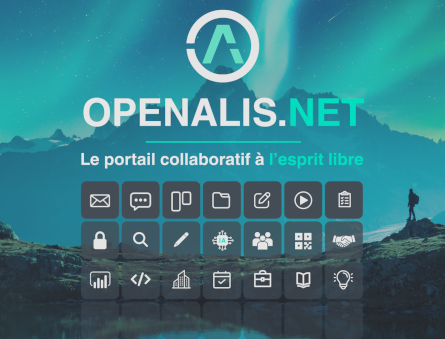
OPENALIS.NET un projet ambitieux pour apporter des alternatives dans le paysage numérique FR

Et si nous développions un portail collaboratif communautaire ?

OPENALIS.NET est un projet 100% open source en recherche d'un coup de boost pour arriver sur le marché FR très prochainement.

Un premier tour de table sera mené à partir de la fin du premier trimestre 2026 en fonction des retours de potentiels investisseurs afin de créer une nouvelle structure proposant LE portail collaboratif libre FR à la fois pour les particuliers et les entreprises.
(NdM.: LE ça semble ambitieux pour un nouveau projet avec Cozy/Twake, Nextcloud, Yunohost, etc. en libre sur des secteurs similaires)

Un accès simple pour tout le monde et une plateforme crédible pour les entreprises.

(Le nom du projet est voué à changer par la suite.)

portail-openalis-net

Au programme :

  • plus de 50 applications open source pour couvrir tous nos besoins numériques
  • un accès simple (login + mdp) s'adressant à toutes et tous
  • des offres pour particuliers et entreprises
  • un premier niveau gratuit avec l'essentiel (email, chat, partage de fichiers…)
  • des garanties fortes pour les entreprises (ISO 27001, SecNumCloud…)
  • une équipe FR dédiée à la maintenance et l'évolution de la plate-forme

Une campagne participative est lancée sur Ulule : https://fr.ulule.com/openalis-net/

Les informations du projet sont disponibles sur : https://openalis.net

Lors du dernier salon de l'OSXP sur Paris, OPENALIS.NET a reçu un accueil très chaleureux.

Avec plusieurs centaines de participants à cette campagne nous pourrions changer définitivement la donne en termes d'alternative souveraine sur notre sol et partout ailleurs.

Commentaires : voir le flux Atom ouvrir dans le navigateur

  •  

D7VK 1.1 Released With An Experimental Direct3D 6 Frontend

Between the DXVK and VKD3D(-Proton) projects there is good support for Direct3D 8 through Direct3D 12 implementations atop the Vulkan API for Linux gaming usage. For those preferring more retro classic gaming, D7VK came about more recently for Direct3D 7 as a DXVK fork. Out today is D7VK 1.1 and besides delivering fixes for its D3D7 implementation has also now tacked on an experimental D3D6 front-end...
  •  

Intel Xe vs. i915 Driver Performance On Linux 6.19 For Arc Alchemist GPUs

Similar to AMD GCN 1.0/1.1 GPUs where there was product overlap between the Radeon and AMDGPU kernel drivers (and now using AMDGPU by default for those aging Radeon GPUs with Linux 6.19), the Intel Arc A-Series "Alchenist" graphics cards are in a similar boat. By default the Alchemist and Meteor Lake graphics use the i915 kernel driver by default but they can optionally use the Xe kernel driver instead as what is Intel's modern open-source kernel graphics driver. As part of our various year end 2025 benchmarks, today is a look at the current i915 vs. Xe driver performance for the Intel Arc Graphics A580.
  •  

Ultimate 2025.12.28

Ultimate Edition, first released in December 2006, was a fork of Ubuntu and Linux Mint though recent versions (starting in 2024) have been based on Arch Linux. The goal of the project is to create a complete, seamlessly integrated, visually stimulating, and easy-to-install operating system. Single-button upgrade is one of several special characteristics of this distribution. Other main features include custom desktop and theme with 3D effects, support for a wide range of networking options, including WiFi and Bluetooth, and integration of many extra applications and package repositories.
  •  

SliTaz 20251228

SliTaz GNU/Linux is a mini distribution and live CD designed to run speedily on hardware with 256 MB of RAM. SliTaz uses BusyBox, a recent Linux kernel and GNU software. It boots with Syslinux and provides more than 200 Linux commands, the lighttpd web server, SQLite database, rescue tools, IRC client, SSH client and server powered by Dropbear, X window system, JWM (Joe's Window Manager), gFTP, Geany IDE, Mozilla Firefox, AlsaPlayer, GParted, a sound file editor and more. The SliTaz ISO image fits on a less than 30 MB media and takes just 80 MB of hard disk space.
  •  

New Patches Bring Linux Driver Support To 25+ SteelSeries Arctis Gaming Headsets

Within the mainline Linux kernel already is the SteelSeries HID driver for supporting basic battery monitoring on the Arctis 1 and Arctis 9 gaming headsets. But a new patch series posted this morning to the Linux kernel mailing list overhaul this SteelSeries HID driver support. The patches take the support to 25+ different Arctis headset models and provide more comprehensive driver support...
  •  

KDE's "This Week In Plasma" Will Become Less Frequent Without New Volunteers

The This Week In Plasma series written by KDE developer Nate Graham has been a great way to keep-up with all of the interesting KDE Plasma desktop developments over the past eight years. This Week In Plasma is regularly featured on Phoronix and always provides an interesting weekend look at the very newest innovations to land in Plasma. Unfortunately, This Week In Plasma will become less frequent or even go on hiatus without new volunteer contributors...
  •  

Projets Libres : de OpenAI à Open Source AI, entre propriété commerciale et ouverture collaborative

Pour cette dernière parution de l'année, Projets Libres vous propose la diffusion d'une conférence de Raphaël Semeteys, co-animateur du podcast à Devoxx France en avril 2025 :

Explorons l'évolution de l'IA générative en examinant la dynamique entre intérêts commerciaux, éthique et collaboration ouverte.

En se basant sur une analyse approfondie des niveaux d'ouverture de différent modèles d'IA générative (LLM), illustrons les (changements de) positionnements de certains acteurs commerciaux (OpenAI, Google, Meta, Mistral, Apple…) comme communautaires et collaboratifs.

Navigons à travers les eaux complexes de la propriété intellectuelle et des licences pour clarifier, via des exemples concrets, les notions de modèles Open ou Open Source .

Enfin, imaginons ensemble comment la (dé)centralisation de la puissance informatique et de la technologie pourrait façonner l'avenir de l'IA.

Bonne fin d'année à toutes et tous.

Commentaires : voir le flux Atom ouvrir dans le navigateur

  •