Connexion
MSI RTX 5090 Lightning Z: Costs 5K, Pulls Over 1000W

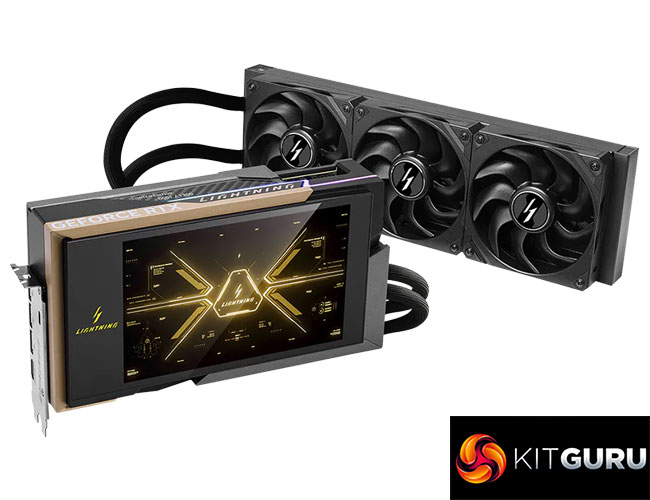
Today we are checking out what is undoubtedly the most insane graphics card to pass through the KitGuru labs – MSI’s RTX 5090 Lightning Z. Not only is it cooled with a 360mm AIO, but MSI says it's the world's first graphics card with an 8in LCD screen, while it also offers an Extreme BIOS that is rated for up to 1000W. That’s only scratching the surface of what this card has up its sleeve, though, so let’s dive in and take a closer look at this beast of a GPU.
Timestamps:
00:00 Intro
00:44 Pricing and key info
01:34 Unboxing and first impressions
02:20 Design features
03:32 PCB and cooler details
04:38 Screen close-up
05:39 Test setup
06:13 Clock speed and game benchmarks
07:01 Thermals + acoustics
08:27 Power draw – we hit 1076W!
10:27 Current readings + thermal imaging
11:04 Manual overclocking
11:40 Closing thoughts
First things first, we are not calling this article a ‘review', simply because it is impossible to offer buying advice for a graphics card like this. Not only is it Limited Edition, with only 1300 units manufactured worldwide, but we were also told only 30 of those are coming to the UK retail channel. And what’s more, the MSRP is an eye-watering £4999, so basically five grand. That alone is absolutely absurd, especially when considering the fact you could build a whole system with an air-cooled 5090 for less money…
Nonetheless, it’s an extremely interesting GPU to analyse from a technical perspective, even if basically no one will be able to buy one, so let's see what it can do…
| RTX 5090 | RTX 5080 | RTX 4090 | RTX 4080 Super | RTX 4080 | |
| Process | TSMC N4 | TSMC N4 | TSMC N4 | TSMC N4 | TSMC N4 |
| SMs | 170 | 84 | 128 | 80 | 76 |
| CUDA Cores | 21760 | 10752 | 16384 | 10240 | 9728 |
| Tensor Cores | 680 | 336 | 512 | 320 | 304 |
| RT Cores | 170 | 84 | 128 | 80 | 76 |
| Texture Units | 680 | 336 | 512 | 320 | 304 |
| ROPs | 176 | 112 | 176 | 112 | 112 |
| GPU Boost Clock | 2407 MHz | 2617 MHz | 2520 MHz | 2550 MHz | 2505 MHz |
| Memory Data Rate | 28 Gbps | 30 Gbps | 21 Gbps | 23 Gbps | 22.4 Gbps |
| L2 Cache | 98304 KB | 65536 KB | 73729 KB | 65536 KB | 65536 KB |
| Total Video Memory | 32GB GDDR7 | 16GB GDDR7 | 24GB GDDR6X | 16GB GDDR6X | 16GB GDDR6X |
| Memory Interface | 512-bit | 256-bit | 384-bit | 256-bit | 256-bit |
| Memory Bandwidth | 1792 GB/Sec | 960 GB/Sec | 1008 GB/Sec | 736 GB/Sec | 716.8 GB/Sec |
| TGP | 575W | 360W | 450W | 320W | 320W |
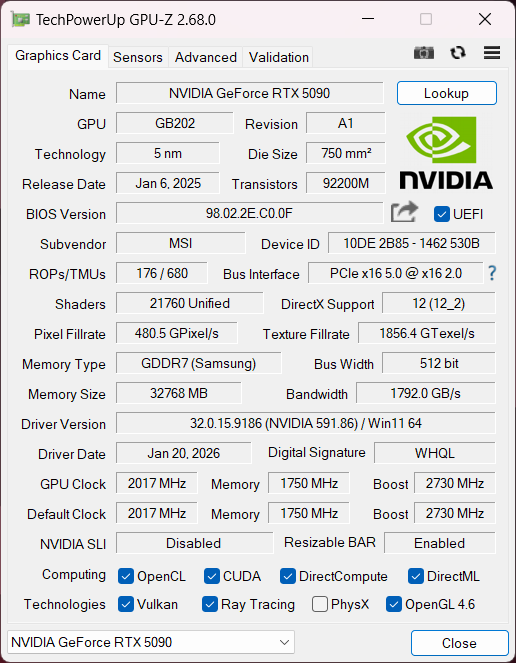
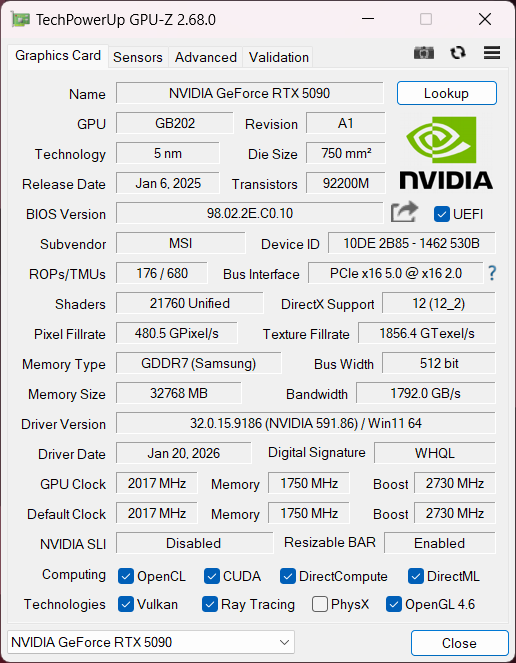
OC BIOS, left, Extreme BIOS, right
First, a quick spec recap. The RTX 5090 is built on the new GB202 die, measuring 750mm2, though it's not quite a full implementation of the silicon. Instead we find a total of 11 Graphics Processing Clusters (GPCs), each holding up to eight Texture Processing Clusters (TPCs), for a total of 85. Each TPC is home to two Streaming Multiprocessors (SMs), giving us 170, and each SM still holds 128 CUDA Cores, meaning the RTX 5090 has an eye-watering total of 21760 shaders. We also find 170 RT cores, 680 Tensor cores, 680 Texture Units, and 176 ROPs.
This time around, however, there's no node-shrink, and GB202 remains fabricated on TSMC's N4 node, as per the RTX 40-series. As such, rated clock speed is not increased this generation and is actually touted slightly below that of the RTX 4090, with the RTX 5090 delivering a rated 2407MHz boost clock, compared to its predecessor's 2520MHz boost.
The memory configuration has seen significant upgrades, though. The RTX 5090 now comes equipped with a super-wide 512-bit memory interface, paired with 32GB GDDR7 memory running at 28Gbps, and that puts total memory bandwidth at a staggering 1792 GB/s. L2 cache is also increased to 98MB, up from the 74MB of the RTX 4090.
Considering the large increases to die size and core count, but with no node shrink, it's perhaps unsurprising to see power draw has increased, this time boasting a 575W TGP. This is something we focus on closely in this article, using our enhanced GPU power testing methodology, so read on for our most detailed power and efficiency testing yet.
The post MSI RTX 5090 Lightning Z: Costs 5K, Pulls Over 1000W first appeared on KitGuru.