The current global political situation increasingly resembles a poorly rehearsed stage play in which Europe is still present on stage but no longer plays a meaningful role. Caught between the fronts of old and new autocracies, we are being reduced to mere extras, regardless of whether the focus is on Asia, Russia, or the United […]
Intel has hired long-time graphics architect Eric Demers. The former developer at Qualcomm and AMD confirmed his move in a public post on LinkedIn. The move comes against the backdrop of a strategic realignment of the company’s graphics and AI division. Demers has decades of experience in the design of modern graphics processors. At AMD, […]
With the January 2026 security updates, the new Windows 11 Start menu is reaching the masses for the first time. Formally, it has been available since the November update, but in practice it remained a feature for a limited group of users for a long time. Now it’s here, and the reaction is as expected: […]
The Predator spyware from the Intellexa Alliance is once again the focus of security analyses. Previous investigations, including those conducted by the Google Threat Intelligence Group, had already provided in-depth insight into the structure and functionality of this surveillance tool. However, new findings from the Threat Lab of Apple security company Jamf show that these […]
The narrative is convenient and politically appealing: artificial intelligence takes over boring routine tasks, while humans take care of the demanding, creative, and strategic tasks. A new study by Anthropic now dismantles this narrative with remarkable sobriety. And the result is uncomfortable for many companies. Because in practice, the opposite is happening. AI is used […]
What happened here has nothing to do with everyday life, gaming, or sensible product use. And that’s exactly why it’s so interesting from a technical standpoint. An extreme overclocker quickly added a second 12V 2×6 power connector to a Geforce RTX 5090, pushing the card to a power consumption that would make even workstation power […]
A malvertising campaign that has been active since at least June 2025, internally known as TamperedChef, uses paid search ads to distribute manipulated PDF software. According to available analyses, this is a large-scale wave of infections in which Windows systems are compromised with an infostealer. The malware disguises itself as a legitimate PDF editor and […]
In 2014, Mark Zuckerberg bought Oculus VR for a couple billion dollars with the premise virtual reality was to become the foundation of personal computing.
In 2026, virtual reality is really starting to dig its roots into those foundations with OpenXR and Flatpaks. Operating systems based around VR headsets with eye tracking as a key feature are now receiving updates from Google, Valve and Apple.
New walled gardens are building up fast even as old ones fall down. Valve is coming for gaming, Google is relying on Android APKs, and Apple is building out a new kind of live sports and TV experience, all of it with VR as the display for the entire landscape.
Earlier this week many hundreds of people lost their jobs as Meta announced the most dramatic course-correction to its strategy yet. Even though VR's future has never been brighter, the weight of Meta's shift might lead some to believe "Oculus VR" here was a "grand misadventure" and virtual reality is dead, again.
That couldn't be further from reality. If you care about the future you should have been reading UploadVR yesterday.
As I look across the last 10 years and try to piece together a picture of how Meta ended up here, I find one key technology conspicuously absent from almost all their headset and glasses designs, save for the failed Quest Pro.
Here's a look at why the absence of eye tracking limits VR's scale and Zuckerberg's ambition for a new social network clouded the Oculus vision.
Eye Tracking In 2017
In 2017 I attended a pair of eye tracking demos at GDC, one of them inside Valve's booth. From these demos I started to realize "just how empowering eye tracking will be for VR software designers."
"The additional information [eye tracking] provides will allow creators to make games that are fundamentally different from the current generation," I wrote. "It was like I had been suddenly handed a superpower and I naturally started using it as such — because it was fun. It is up to designers to figure out how much skill will be involved in achieving a particular task when the game knows exactly what you’re interested in at any given moment."
Architecting an entire VR platform over a decade without a solid plan for default implementation of eye tracking is a study in long-term vision meeting short-term execution.
"Apple's eye tracking is really nice," Zuckerberg noted on Instagram in 2024 after saying he tried Apple's headset. "We actually had those sensors back in Quest Pro. We took them out for Quest 3, and we're gonna bring them back in the future."
0:00
/3:36
You could see this tiny comment as one of the first public acknowledgments in which he is starting to realize something is deeply wrong with his current strategy.
When Facebook stopped selling Oculus Go it acknowledged the company wouldn't ever make another 3dof headset. The same thing should have happened after the Quest Pro launched in 2022 with eye tracking. It didn't. By the time Meta will ship a second VR headset with eye tracking, roughly five years will have passed from the first. The company is probably all in on full-body codec avatars being their prize for drawing you into their vision of the metaverse now, after Apple stole their initial thunder with FaceTime and Personas powered by good eye tracking.
I believe we now have evidence that VR headsets that can't see what you want by following the intent of your eyes aren't serious contenders as platform plays. Valve, Google, and Apple are all centered on the technology in their latest headsets for slightly different reasons. When you pull back far, you can see that Steam Frame's DK1 was the HTC Vive in 2016 and Valve Index was its DK2 from 2019.
Valve decided SteamOS in VR is ready for prime time in 2026 with Steam Frame's consumer release, following Apple deciding 2024 was the time to launch Vision Pro. Both use eye tracking to do key things for users.
From Rift To Quest
For Zuckerberg's organization, the ramping investments over the last decade would build the necessary technologies for a complete computing platform, starting with just a few billion to acquire the development team behind the Oculus Rift. Michael Abrash left Valve to found a modern Xerox PARC within Zuckerberg's larger organization, drawn by the commitment to invest in costly long-term research and development.
Meta built those technologies in a fairly public way by showing work as it went, both in sharing research and selling products. Solid ideas like Oculus Medium during this early period were spun out and continued at places like Adobe.
Starting in 2020, Facebook tried forcing the linking of its accounts to the use of Quest headsets and, in early 2021, it tried advertising in virtual reality. VR users quickly rejected both efforts.
Facebook's executives embarked on a rebranding effort to Meta alongside a new accounts system developed as a fresh start for Zuckerberg's new computing platform in headsets and glasses. By the end of 2021, Facebook was Meta.
Quest 2 was selling well. There was a well-curated store, their hand tracking was quickly approaching state of the art, and there was no credible competition in the United States shipping a standalone VR headset. Any stink associated with Facebook was being put behind Meta with Zuckerberg's bold new vision of the "Metaverse."
And a high-end Quest Pro with eye tracking was still coming in late 2022.
A Grand Misadventure?
"Setting out to build the metaverse is not actually the best way to wind up with the metaverse," warned technical guide John Carmack in 2021. "The metaverse is a honeypot trap for architecture astronauts... Mark Zuckerberg has decided now is the time to build the metaverse....my worry is we could spend years and thousands of people possibly and wind up with things that didn't contribute all that much to the ways that people are actually using the devices and hardware today...we need to concentrate on actual products rather than technology, architecture, or initiatives."
In 2022 Carmack left Meta as he "wearied of the fight" and, four years later, thousands have departed as leadership reshaped the company in the form of VR and AR technologies. Until the layoffs in 2026, Meta's leadership and design failures didn't reek of the failure Carmack specifically warned about. Now they do.
After laying off the vast majority of the game developers Meta hired and tasking the rest to "Horizon" initiatives, do we see Beat Saber and Population: One become a last ditch effort to keep Horizon Worlds alive? Meta's latest move in December, as some of the first Steam Frame kits arrived with devs, was to delist Population: One from the Steam store, noting that it was a move to stop "unfair play" by cheaters using the openness of a PC to break the multiplayer experience.
The grand misadventure here was the entire Horizon Worlds effort, attempting to force a social network by brute force onto the wrong technology at the wrong time in the wrong way. 2026 represents a reset of Meta's efforts, certainly, but the question is exactly how far back in this timeline Meta needs to go to figure out what went wrong, and which structural changes need to take place to fix it?
Gaming Studios Instead Of Eye Tracking
Meta acquired Beat Saber in November of 2019 and, over the next several years, doubled down multiple times by hiring dozens of developers skilled in the use of Oculus Touch controllers. Some of these decisions were set against unusual behavior patterns due to a generationally significant pandemic keeping people home near their headsets.
During the 2016-2018 period, NextVR streamed NBA games live to VR headsets, a startup called Spaces opened a walk around Terminator VR attraction, and the first decent eye tracking was demonstrated in consumer VR hardware. Apple released a headset that combined all those technologies mentioned from 2017 in a 2024 product.
At Meta, someone made decisions to ship headsets without eye tracking after shipping a single headset that tracks eyes. They have their reasons, but whatever they are may be the cause of Meta losing some of the lead in VR that was bought with Oculus in 2014. Whatever is going on with Meta's decision-making process, leadership tried to rectify it by the end of 2025 with the hiring of a key executive from Apple.
Now Meta faces a world where it might increase production for its non-VR glasses products. Meanwhile, Apple, Google, Samsung, and Valve ship or plan to ship VR headsets with eye tracking.
From Real To Virtual And Virtual To Real
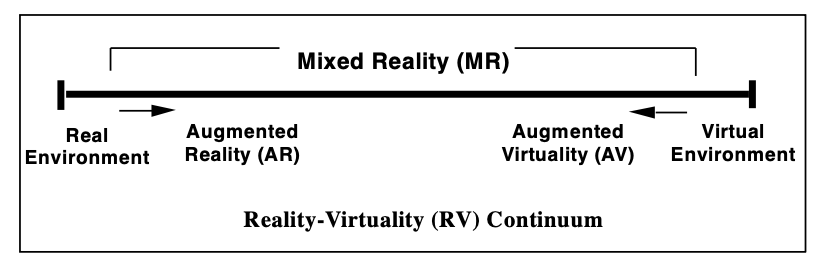
30 years from this chart's appearance in research literature to Apple making a dial to move what you see across the entire Reality-Virtuality Continuum.
Imagine two types of eyewear at opposite ends of this particular continuum from Paul Milgram's seminal 1994 paper. One at the right is a relatively heavy VR headset that is essentially all display. The other at left is a pair of ultra lightweight frames with no display. Today Meta ships Quest 3, 3S, and Ray-Ban glasses in each of these categories, and they all lack eye tracking.
Apple ships only the Vision Pro with eye tracking today and it is a $3,500 device not many people have tried. The headset does a little magic trick with this chart. It is rooted at the right edge of the chart, but software defaults to starting you at the left side. Turn the dial on the headset and the world can shift from your environment being fully "real" to fully "virtual" across the whole continuum.
Apple is surely readying something to secure the left side of the chart. When they launch, what features will they focus on and how might Apple and Meta eyewear differ?
Pointing Cameras In The Wrong Directions
If Vision Pro is a spatial computer I want Apple's answer to the Meta Ray-Ban glasses to function more like a spatial mouse. No display and all input.
Apple could take the sensors for tracking hand movements and eye movements from Vision Pro and put that technology into slim frames with Bluetooth and battery. Thin clear glasses can gather the same eye and finger input as a big enclosed VR headset. It's difficult, surely, but it's more useful than putting in a display system for one eye. The differentiating feature would be a universal remote for everything that's so impossibly advanced it could feel like magic almost everywhere.
You should be able to operate an iPad or Apple TV, and maybe other Apple devices, the same way you do the menu of a Vision Pro. Just pinch and drag in the open air. Ex: While washing the dishes with your hands and watching a movie on your iPad, you look over and pause a movie without touching the tablet with your dirty hands.
You should be able to run your finger along any flat surface as a virtual trackpad for any computer you're looking at.
You should be able to touch type on any surface.
Google told me touch typing on any surface would be a solved problem in a couple of years at the end of 2024. In such a focused design, Apple could conceivably replace the mouse, trackpad and keyboard with eyewear at the opposite end of the spectrum from Vision Pro. I mean that literally because display-free means you only ever see the real environment through a pair of frames, and yet the glasses still track your eye movements the same as they do in Vision Pro.
In Apple Vision Pro, eye tracking is used to target what you're looking at so that when you "mouse click" by pinching your fingers together the whole system responds to exactly what you want in that moment. It's also used to drive the included Persona avatars and even the outward-facing display system showing recreated eyeballs to external viewers. That's a lot of technology, weight and expense Apple introduced in Vision Pro to fully enclose a person in a focused virtual location represented as an Apple home environment, and then anywhere else along the mixed reality spectrum using a dial and software.
None of that seems like a mass market need unless you had an experience in 2017 that instantly made you feel like a superhero in a VR headset. Why do VR headsets need eye tracking? For the same reason a computer needs a mouse. It is how you tell the computer what you want in a graphical user interface, even if you still need something else to select what you're looking at.
The camera Meta placed in multiple generations of glasses faces outward for photo capture, rather than inward at the eyes for intent detection. Meta moved fast, but it made the wrong decisions in the wrong order.
When I leave the house, I could grab a pair of glasses to listen to music, take calls through my phone, and control all my other computers more easily on the go. And when I get home, or I need to do real work, I enter my Apple Vision Pro (or future Meta headset or Steam Frame).
Apple doesn't need to make camera glasses. It doesn't need a social network. And it could kill the mouse and keyboard while fulfilling the exact words Michael Abrash at Meta said to me in 2022.
Meta is likely aiming to get back on track with an ultralight headset that does what Apple Vision Pro does with avatars, eye tracking, focus and movies. As Meta looks to the future and figures out which brands to leave in the past I have just one suggestion.
There is one brand in Meta's arsenal with a very close association to both eyes and headsets that gamers love.
Every episode this year just keeps getting better, try it, you'll see. This food podcast brought to by the tech news! Also, 9850X3D this month, welcome back 8GB GPUs, and 2026 will…
Taiwan and the United States have announced what's being described as a $500 billion commitment aimed at expanding semiconductor manufacturing in the U.S., a striking figure that reflects how strategically important chip production has become. Despite the bombastic headlines, though, the structure of the deal is more layered than the big number
There's a link on Reddit aging like fine wine. It carries the timestamp January 28, 2014 at 7:54:33 PM EST.
"So no way to confirm this, but my friend works in the same building as Oculus, and he ran into Mark Zuckerberg taking the elevator to Oculus' floor," Threewolfmtn posted. "Do you think he was just checking it out? Or is there somethign more devious going on?"
With whole teams shown the door from inside Meta's VR and AR efforts in January 2026, you can put that time stamp in your mind relative to the one UploadVR published over half a decade ago. The important time stamp for the words we're republishing from John Carmack to Oculus VR leaders is February 16, 2015.
Before you get to those words, in full below, here he is speaking directly to the public in 2021 before he "wearied of the fight" and exited near the end of 2022:
I reached out to Carmack earlier this week to invite fresh comment of any length. You can find it on UploadVR.com if he replies.
From: John Carmack
Date: February 16, 2015
Subject: Oculus Strategy (LONG)
In preparation for the executive retreat this week, I have tried to clarify some of my thoughts about the state and direction of Oculus. This is long, but I would appreciate it if everyone took the time to read it and consider the points for discussion. Are there people attending the meeting that aren’t on the ExecHQ list that I should forward this to?
Some of this reads as much more certain that I actually am; I recognize a lot of uncertainty in all the predictions, but I will defend them in more depth as needed.
Things are going OK. I am fairly happy with the current directions, and I think we are on a path that can succeed.
There are a number of things that I have been concerned about that seem to have worked out, but I remain a little wary of some of them metastasizing.
Oculus Box. Selling the world’s most expensive console would have both failed commercially and offended our PC base. Building it would have stolen resources from more important projects. Note that my objection is based on a high-end PC spec system. At some point in the future (or for some level of experiences), you start considering cheap, mobile based hardware, which is a different calculation.
Oculus OS. The argument goes something like “All important platforms have had their own OS. We want VR to be an important platform, therefore we need our own OS.” That is both confusing correlation with causation, and just wrong – Facebook is an important platform that doesn’t have its own OS. When you push hard enough, the question of “What, specifically, would we do with our own kernel that we can’t get from an existing platform?” turns out to be “Not much”. Supporting even a basic Linux distribution would be a huge albatross around our neck.
Indefinite innovator editions for Gear VR. We have been over this enough; I am happy with the resolution.
Major staff-up to “build the Metaverse”. Throw fifty new developers together and tell them to build a completely hand-wavey and abstract application. That was not going to go well. Oculus needs to learn how to deliver decent quality VR apps at a small scale before getting overly ambitious. I understand this choice wasn’t made willingly, but I am still happy with the outcome.
Write all new apps for CV1 in UE4. Would have been a recipe for failure this year, and would have unnecessarily divided efforts between mobile and PC. I recognize that my contention that we can build the current apps for both PC and mobile has not yet been demonstrated, and is in fact running quite a bit behind expectations.
Acceptance of non-interactive media. This is still grudging, as noted by the “interactive” bullet point in our official strategy presentation at the town hall, and Brendan’s derisive use of “viewmaster” when talking about Cardboard, but most now agree it has an important place. People like photos and video. You could go so far as to say it drives the consumer internet, and I think Oculus still underestimates this, which is why I am happy that Douglas Purdy’s VR Video team is outside the Oculus chain of command.
While it isn’t something I am directly involved in, I think the decision to push CV1 without controllers at a cheaper price point is a good one. Waiting for perfect is the wrong thing to do, and I am much less convinced of the necessity of novel controllers for VR’s success.
On to things with more room for improvement:
Platform under-delivery
I suspect that this was not given the focus it deserved because many people thought Gear VR wasn’t going to be “real”, so it may have felt like there was a whole year of cushion before CV1 was going to need a platform. Launching Gear VR without commerce sucked. Some steps have been taken here, but there are still hazards. I won’t argue passionately about platform strategy, because it really isn’t my field, but I have opinions based on general software development with some relevance.
We still have definitional problems with what exactly “platform” is, and who is responsible for what. I would like to see this made very clear. I am unsure about having the Apps team responsible for the client side interfaces. It may be pragmatic right now, but it doesn’t feel right.
I have heard Holtman explain how we couldn’t just use Facebook commerce infra because it wouldn’t allow us to do some things like region specific pricing that are important factors for Steam, but I remain unconvinced that it is sufficient reason to make our development more challenging. There is so much value in Facebook’s infra that I feel we should bend our strategies around using it as much as possible. A good strategy on world class infra has a very good chance of beating out an ideal strategy on virgin infra.
We should be a really damn good app/media store and IAP platform before we start working on providing gaming services. App positioning, auto updates / update notification, featured lists, recommendations, media rentals, etc.
When we do get around to providing gaming services, we should incrementally clone Steamworks as needed to satisfy key developers, rather than trying to design something theoretically improved that developers will have to adapt to.
The near term social VR push should be based strictly on the Facebook social graph. We can prove out our interaction models and experiences without waiting for the platform team to make an anonymized parallel implementation…
Consumer software culture
We need to become a consumer software shop.
The Oculus founders came from a tool company background, which has given us an “SDK and demos” development style that I don’t think best suits our goals. Oculus also plays to the press, rather than to the customers that have bought things from us, and it is going to be an adjustment to get there. Having an entire research division that is explicitly tasked with staying away from products is also challenging, and is probably going to get more so as product people crunch.
Talk of software at Oculus has been largely aspirational rather than practical. “What we want” versus “what we can deliver”. I was exasperated at the talk about “Oculus Quality”, as if it was a real thing instead of a vague goal. I do have concerns that at the top of the software chain of command, Nate and Brendan haven’t shipped consumer software.
Everyone knows that we aren’t going to run out of money and be laid off in a few months. That gives us the freedom to experiment and explore, looking for “compelling experiences”, and discarding things that don’t seem to be working out. In theory, that sounds ideal. In practice, it means we have a lot of people working on things that are never going to contribute any value to our customers.
Most people, given the choice, will continue to take the path that avoids being judged. Calling our products “developer kits”, “innovator editions”, and “beta” has been an explicit strategy along those lines. To avoid being judged on our software, we largely just don’t ship it.
For example, I am unhappy with Nate’s decision to not commit to any kind of social component for the consumer launch this year. I’m going to try to do something anyway, but it means swimming against the tide.
I would like to see us behave more like a scrappy web / mobile developer. Demos become products, and if they suck, people take responsibility. Move fast, watch our numbers, and react quickly. “What’s new” on our website should report new features added and bugs fixed on a weekly basis, not just the interviews we have given.
Get better value from partner companies
The most effective way to add value to our platform is to leverage the work of other successful companies, even if that means doing all the work for them and letting them take all the money. I contend that adding value to our platform to make more happy users is much more important at this point than maximizing revenue from a tiny pool. I think win-first, then optimize monetization, is an effective way to take advantage of our relatively safe position inside Facebook.
It is fine to shotgun dev kits out to lots of prominent developers, but the conversion rate to shipping products from top tier companies isn’t very good. A focused effort will yield better results.
My pursuit of Minecraft has been an explicitly strategic operation. We will benefit hugely if it exists on our platform, and if we close the deal on it, the time I spent coding on it will have been among the most valuable of my contributions.
We need a big video library streaming service, and I would be similarly willing to personally write a bunch of code to make sure it turned out great. Ideally it would be Netflix, but even a third tier company like M-Go would be far better than doing it ourselves. There is an argument along the lines of “We don’t need Netflix, we’ll cut our own content deals and be better off in the long run.” That makes the conscious (sometimes defensible) choice to suck in the near term for a long term advantage, but it also grossly underestimates the amount of work that all those companies have done. I have low confidence that a little ad-hoc team inside Oculus is going to deliver a better, or even comparable, movie / TV show watching system than the established players.
I know I don’t have broad buy-in on the value, but I feel strongly enough about the merits of demonstrating a “VR Store” that I think it is worth basically writing the app for Comixology. I look at it as a free compelling dataset for us, rather than us doing free work for them.
What other applications could be platform-defining for us with a modest VR reinterpretation?
Picking winners like this does clearly sacrifice platform impartiality, but I think it is a cost worth paying.
Even amongst the general application pool, we should be actively fixing 3rd party apps, and letting them drive the shape of SDK development. I am bothered by a lot of the text aliasing in VR apps, so I need to finish up my Unity-GUI-in-overlay-plane work and provide it to developers.
Abandon “Made for VR or go away” attitude
The iPhone was a phone. Many people would say it wasn’t actually a great phone, but it subsumed the functionality of something that everyone had and used, and that was important for adoption. If it had been delivered as the iPod Touch first, it would have been far less successful, and, one step farther, if it wasn’t also an iPod, it would have been another obscure PDA.
Oculus’ position has been hostile to apps that aren’t specifically designed for VR, and I think that is a mistake. We do not have a flood of AAA, or even A level content, and I don’t think it will magically appear as soon as we yell CV1 at the top of our lungs. The economics are just not very compelling to big studios, and developing to the solid 90 fps stereo CV1 spec is very challenging.
There are a number of things that can help:
Encourage limited VR modes for existing games. Even simple viewer or tourist modes, or mini-games that aren’t representative of the real gameplay would be of some value to VR users. Do we have a head mount sensor on CV1? We win if we can get our customers to think that when you put on your HMD, a good game should do SOMETHING.
Embrace Asynchronous Time Warp on PC, so developers have a fighting chance to get a decent VR experience out of their existing codebases. We are going to be forced to make this work eventually, but we have strategically squandered six months of lead time. This is directly attributable to Atman’s strong opinions on the issue.
We should make first class support for running conventional 2D apps in VR, and we should support net application streaming on mobile. It is going to be a long time before we have high quality VR applications for everything that people want to do; 2D applications floating in VR will fill a valuable role, especially as we move towards switching between multiple resident applications.
Even driver intercept applications 3D/VR-ifying naïve applications may eventually have a place. It is technically feasible to deliver the full comfortable-VR experience from a naïve application in some cases.
Abandon “Comfortable VR” as a dominant priority
Even aside from this almost killing Gear VR, our positioning on PC has been somewhat inconsistent. We talk about how critical SteamWorks-like functionality is to our platform, because Steam gamers are our (PC) user base, but the intersection of stationary viewpoint game experiences and the games people play on Steam is actually quite small.
We should not support developers “doing it wrong”, like using an incorrect FOV for rending, but “doing uncomfortable things”, like moving the viewpoint or playing panoramic video that can’t be positioned, are value decisions that will often be net positive. In fact, I believe that they will constitute the natural majority of hours spent in VR, and we do a disservice to our users by attempting to push against that natural position.
We have a problem here – It would be hard for the CEO of a sailboat company to be enthusiastic and genuine if they always got seasick whenever they went out, but Brendan is in exactly that position.
My Minecraft work is a good example. By its very nature, it is terrible from a comfort position — not only does it have navigation, but there is a lot of parabolic bounding up and down. Regardless, I have played more hours in it than any other VR experience except Cinema.
Brendan suggested there might be a better “Made for VR Minecraft” that was stationary and third person, like the HoloLens demo. This was frightening to hear, because it showed just how wide the gulf was between our views of what a great VR game should be. Playing with lego blocks can be fun, but running for your life while lost underground is moving.
Mobile expansion plan
It will not be that long until Note 4 class performance is available in much cheaper phones. Notably, being quad core (or octa-core on Exynos) does almost nothing for our VR performance, and neither does being able to burst to 2.5 GHz, both due to thermal reasons. A dual core Snapdragon that was only binned for 1.7 GHz CPU and 400 MHz GPU could run all the existing applications, and DK2 would argue that 1080p screens can still “Do VR”. This is still the most exciting vision for me – when everyone picks up a cheap Oculus headset holder for their phone when they walk out of the carrier store, just like grabbing a phone case.
I would rather push for cost reduction and model range expansion across all Samsung’s lines before going out to other vendors, but we are doing the right thing with Shaheen working towards building our own Android extensions to run Gear VR apps, so we have them on hand when we do need them.
The other major technical necessity is to engage with LCD panel manufacturers to see what the best non-OLD VR display can be, either with overclocked memory interfaces and global backlight controls, or custom building rolling portrait backlights. Once we have apps running on the custom dev kits with Shaheen’s work, we should be able to do experiments with this.
I am less enthusiastic about the dedicated LG headset that plugs into phones. It will require all the Android software engineering effort that Gear VR did for each headset it will be compatible with, as well as significant new hardware engineering, and the attach rate would be guaranteed to be a fraction of Gear VR due to a much higher price. It seems much more sensible to just make sure that CV2 is mobile friendly, rather than building a CV1.5 Mobile Edition. If you certify a phone for VR, you might as well have a drop-in holder for it as well as the plug in option; there would be little difference in the software, and the tradeoff between cost, position tracking, refresh rate, and resolution would be evaluated by the market.
If we want to allow mobile developers to prepare for eventual position tracking support, we could make a butchered DK2 / CV1 LED faceplate that attaches to a Gear VR so a PC could do the tracking and communicate positions back to the Gear VR over WiFi. I don’t feel any real urgency to do this, I doubt the apps people are developing today are going to be the killer apps of a somewhat distant position tracked mobile system.
A new study suggests that "high-frequency gamers" are more prone to poor eating habits and sleep deprivation compared to low-frequency gamers. Led by Curtin University and published in Nutrition, the cross-sectional study focused on 317 Western Australian university students and their gaming habits, diet quality, physical activity, sleep quality,
ASUS has confirmed that it tweaked the design of its Q-Release PCIe mechanism on every new Neo motherboard coming out this year, including both high-end models with more premium designs and entry-level options. The official reason for the redesign, however, is not because of reported issues with the previous design leaving scratch marks on
We're more than a month removed from all those Black Friday and Cyber Monday deals that closed out last year, but we spotted a discount on an Alienware gaming display that brings its price back down to its deepest discount ever. It has quite a few bells and whistles too, not the least of which is an OLED panel with quantum dot technology.
Alienware
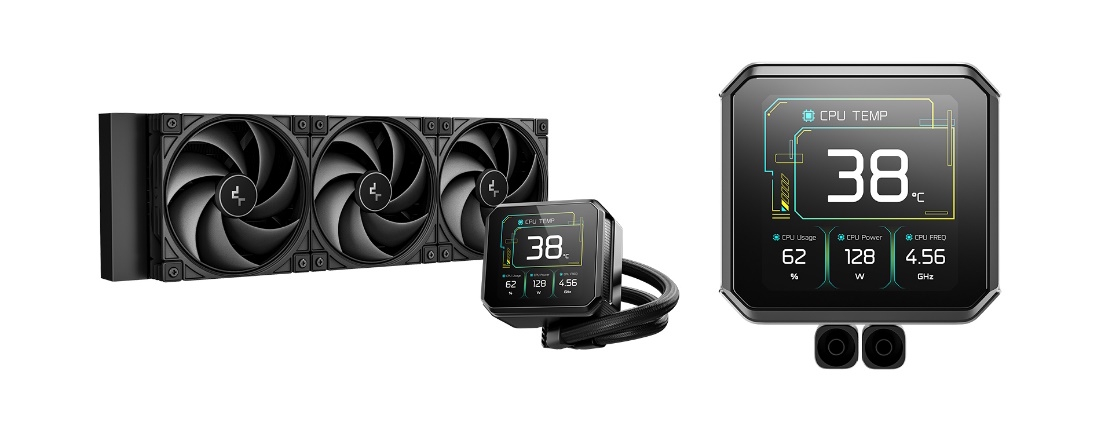
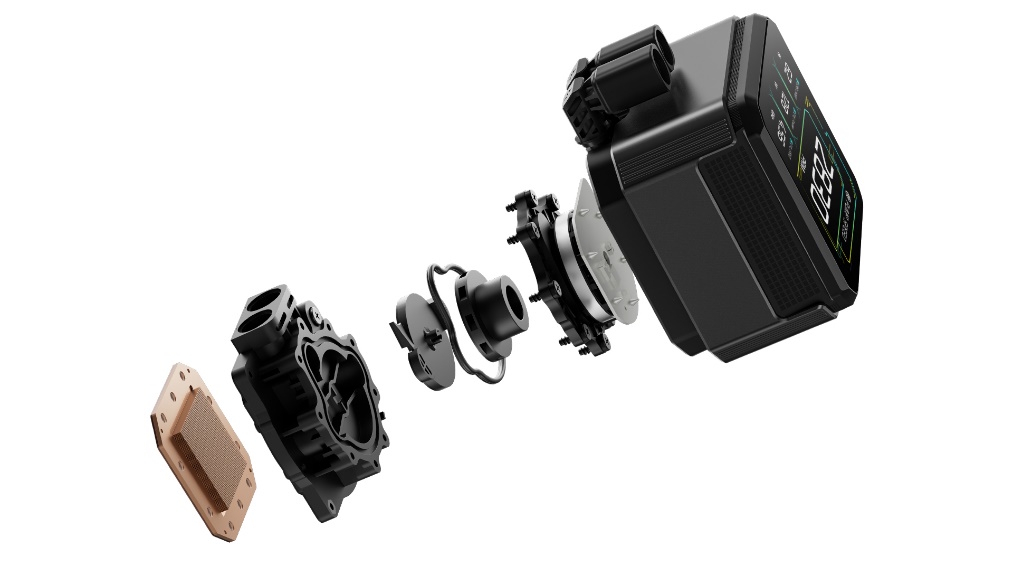
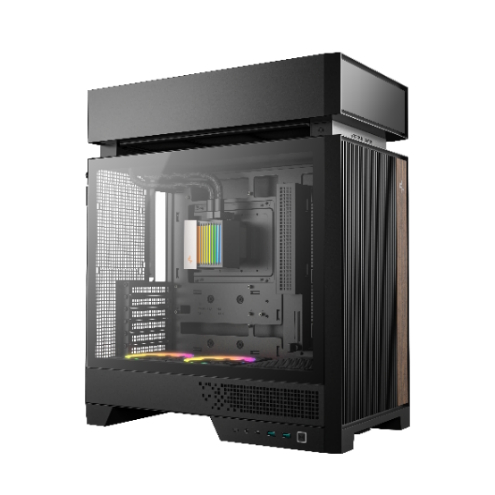
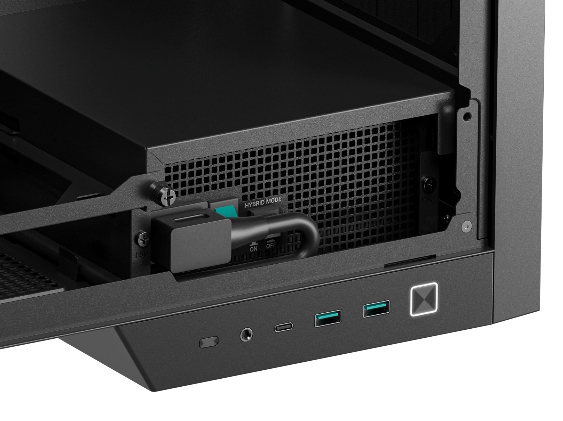
DeepCool has officially unveiled a pair of new flagship thermal solutions for the market, led by the Spartacus 360 all-in-one liquid cooler and the innovative CL6600 HyperSplit chassis.
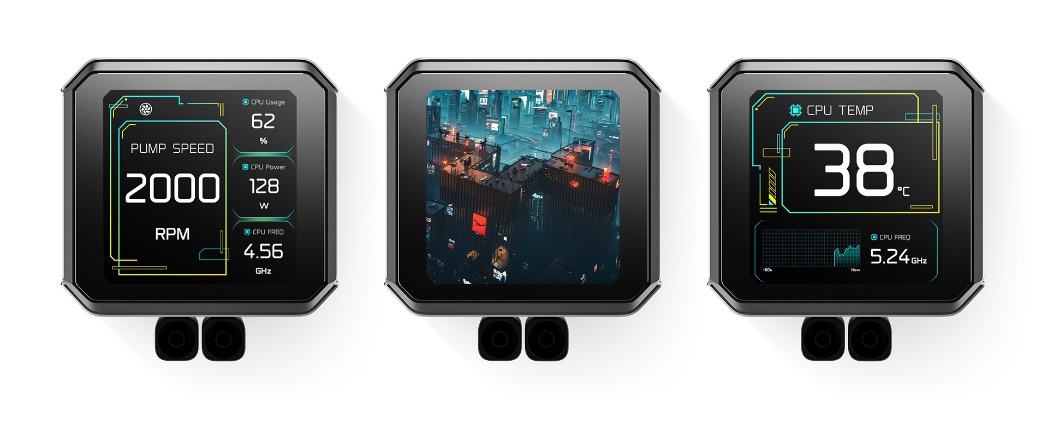
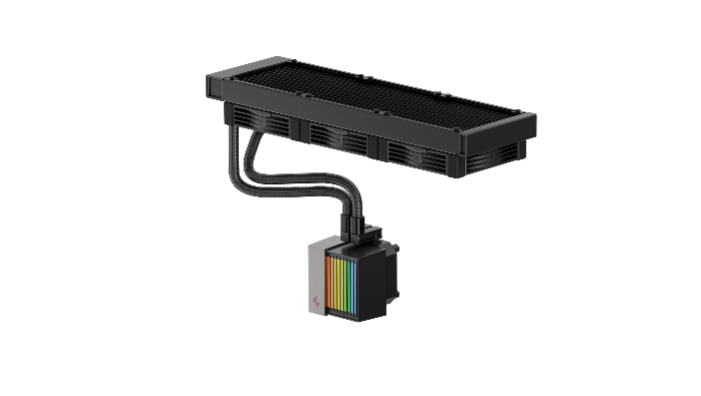
The Spartacus 360 is designed to be a premium cooling solution, using 3x 120 mm fans and a pump powered by a three-phase, four-pole motor that operates between 2,500 and 3,400 RPM. This pump is paired with a 3.4-inch IPS LCD with 750 nits of brightness and a 480×480 resolution. Through the DeepCreative software, users can display system telemetry, custom videos, or performance trends in modular block layouts. The software also introduces AI-driven environmental modes, such as Sleep, Gaming, and Overclocking, that automatically balance acoustics.
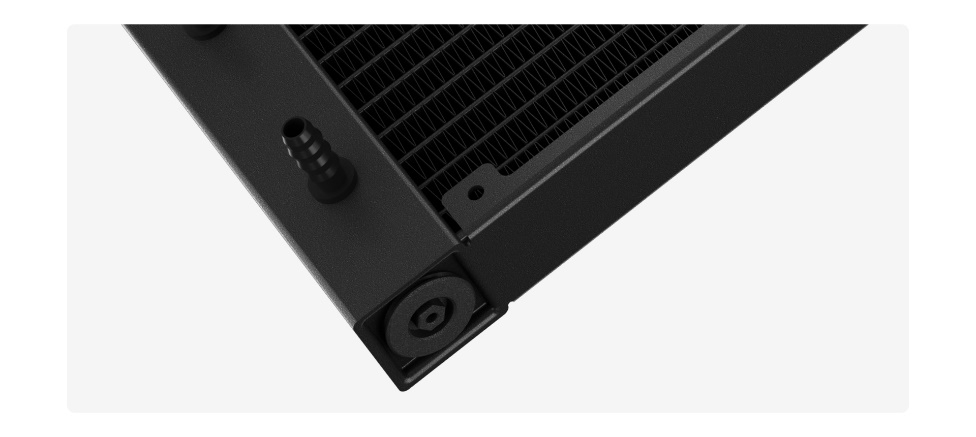
Rated for up to 320W TDP, the Spartacus 360 features a newly designed offset mounting bracket specifically for Intel LGA1851 processors. By shifting the cold plate to better align with the hotspots on 20- and 24-core CPUs, DeepCool claims a core temperature reduction of up to 3°C. Installation is made easier and more secure by a rear-mounted locking system that allows front-side assembly without exposed screws. At the same time, a single 10-pin cable handles both power and data for the pump and display, minimising clutter. Reliability is improved by the inclusion of patented Anti-Leak technology, which regulates internal pressure to extend the cooler's lifespan and protect high-value components.
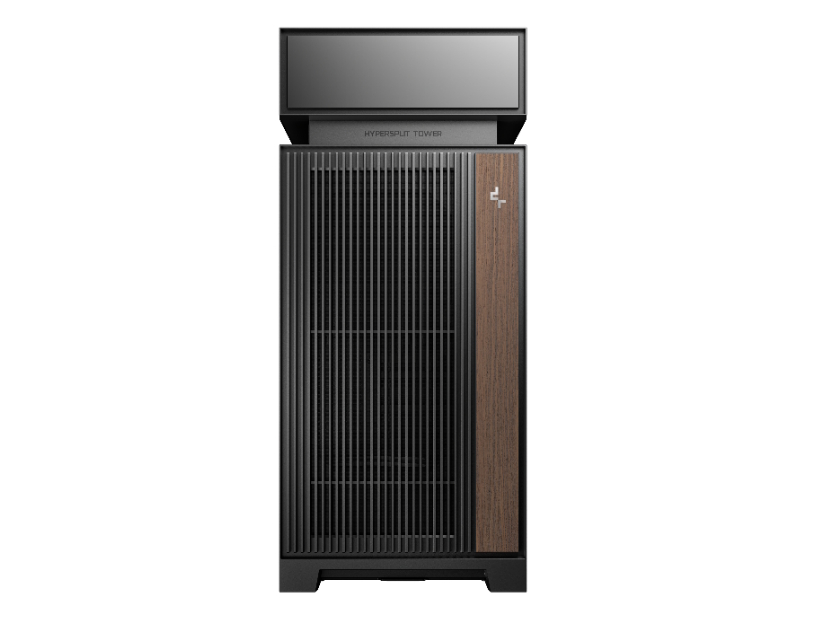
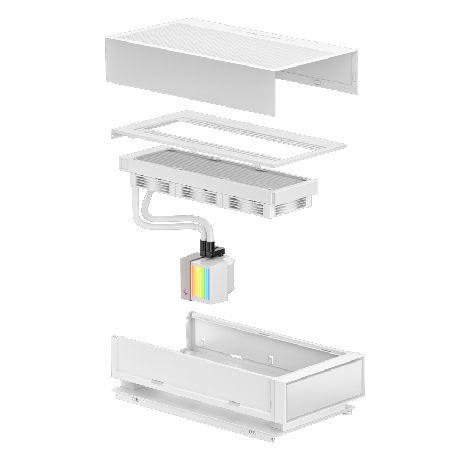
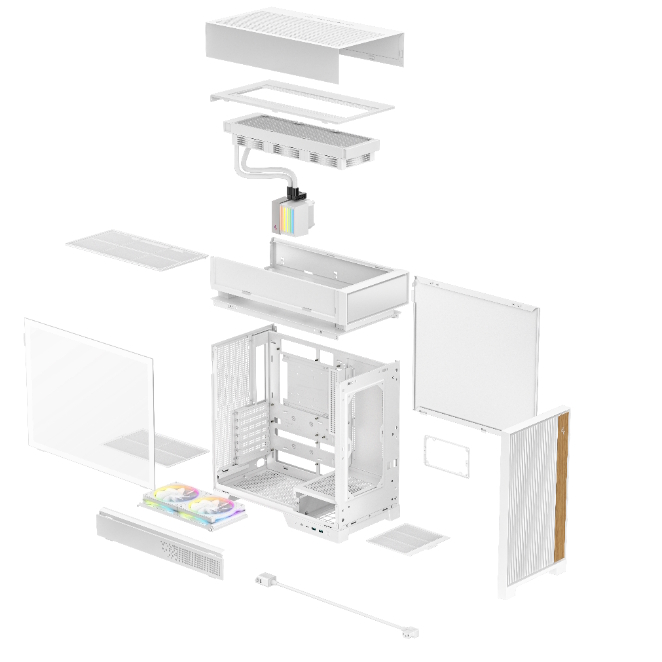
Alongside the new cooler, DeepCool is also launching the CL6600 HyperSplit case, which features a dual-chamber layout that physically separates the CPU's radiator from the rest of the system. By placing the included 360mm radiator in its own independent upper chamber, the CL6600 theoretically eliminates thermal crossover between the CPU and the GPU, which should allow both to operate at their full potential without competing for air. The case features a front-mounted PSU layout (up to 160 mm long) and supports the latest back-connect motherboards, such as Asus BTF or MSI Project Zero, providing a clean interior view through its tempered glass side panel. The aesthetic is rounded out with a full-height grille front panel featuring a real-wood accent and a pop-out headset hook.
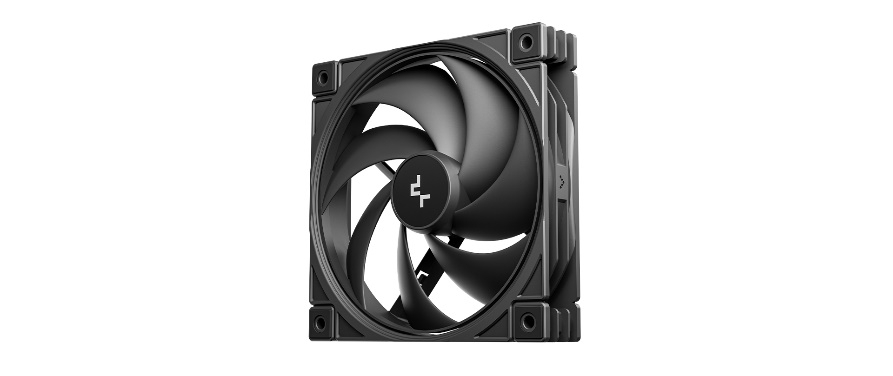
Included with the CL6600 are two pre-installed reverse-blade FL12 SE fans on the bottom. The chassis accommodates graphics cards up to 413 mm in length, air coolers up to 175 mm in height, and up to 8x fans, including three on the AIO cooler division to create a push-pull configuration. Maintenance is simplified through tool-free panel removal and pull-out dust filters. The Spartacus 360 is currently priced at an MSRP of €184.99, while the CL6600 is available in black for €199.99 and white for €209.99.
We will have reviews of both units in the coming weeks, so stay tuned for those!
KitGuru says: Do you think other brands should follow DeepCool's idea and do more cases like the CL6600?
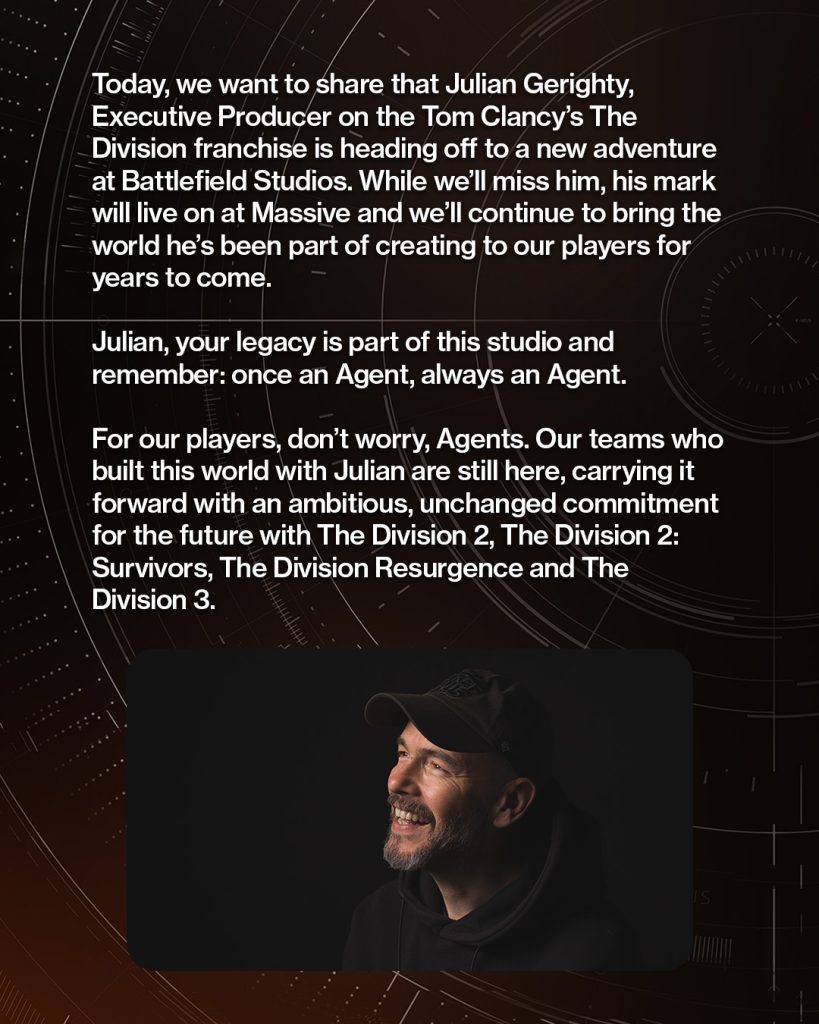
Julian Gerighty, the creative director and executive producer of Tom Clancy's The Division franchise, has officially resigned from Ubisoft to join Electronic Arts' Battlefield Studios. Massive Entertainment confirmed the news this week, marking the end of Gerighty's extensive tenure at the studio, where he was a key figure shaping the first two Division games and leading the creative direction for Star Wars Outlaws.
While Gerighty recently teased that The Division 3 was “shaping up to be a monster”, his departure means he will no longer be at the helm to see the project through to its completion. Instead, he will transition to a leadership role within EA's Battlefield team, though his specific title has not yet been confirmed. Ubisoft's leadership has moved quickly to reassure fans and investors that the series remains in capable hands. The publisher emphasised that the vision for the franchise remains unchanged despite the loss of its primary creative face. Massive Entertainment's statement on the topic can be found below:
Gerighty himself also shared a message to the community on X, expressing confidence in the franchise's future and noting that it was simply time for “another grand adventure” after over 27 years at the company.
This move comes at a juncture for both gaming giants. Ubisoft has been grappling with a prolonged slump that led to its stock being temporarily halted on Euronext in late 2025. While Assassin's Creed Shadows provided a much-needed commercial boost last year, the group has faced significant layoffs and studio closures as part of a major internal restructuring. On the other side of the industry, EA's Battlefield Studios is still navigating the tragic loss of Vince Zampella, who passed away following a car accident in December 2025. Bringing in a veteran with Gerighty's expertise could be just what EA needs as it looks to expand the Battlefield franchise and fill the leadership gap left by one of the industry's most influential figures.
KitGuru says: Losing Julian Gerighty is a heavy blow for Ubisoft. However, for EA and the Battlefield franchise, this could be a massive win. Gerighty's experience with shooters and large-scale IP management is precisely what EA needs to maintain the momentum of the successful Battlefield 6.
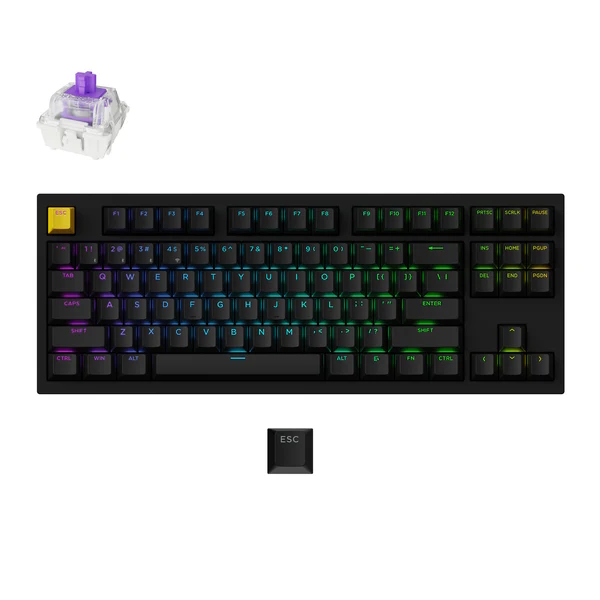
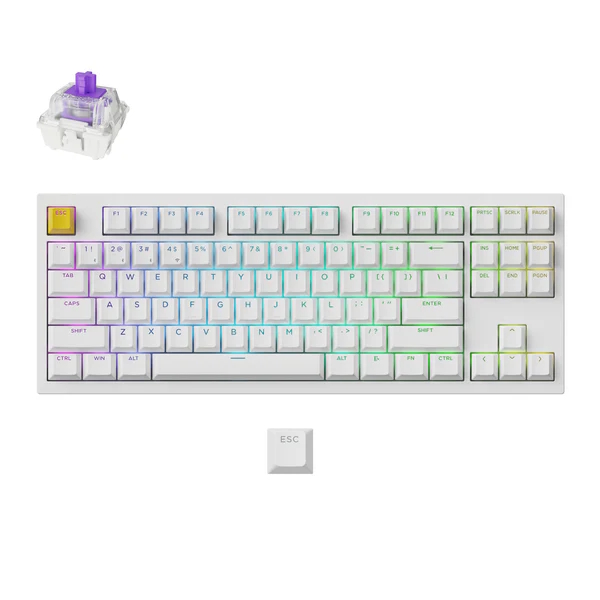
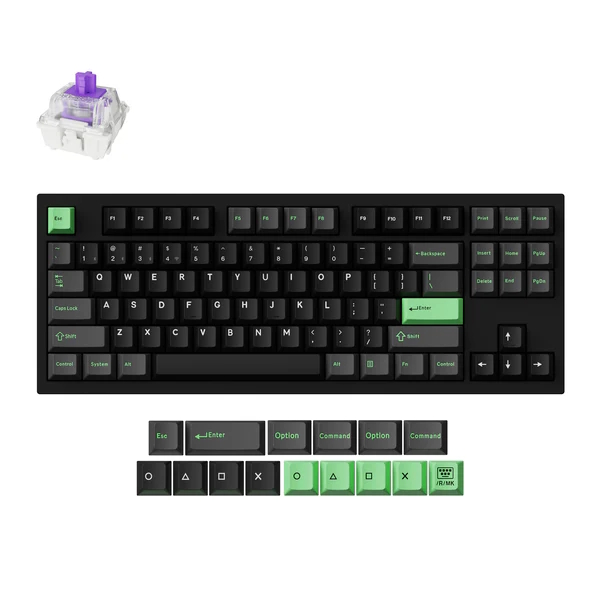
Keychron has expanded its gaming sub-brand, Lemokey, with the launch of the P3 HE, a tenkeyless (TKL) gaming keyboard that pairs magnetic switch technology with a toolless casing.Unlike the Keychron Q-series flagships, which often command a premium, the P3 HE is launching at a slightly lower price. That said, it's still relatively expensive compared to its Chinese counterparts.
Despite the lower cost of $169.99 (versus Keychron's Q-series that can fetch well over $200), the P3 HE (via TechPowerUP) maintains a premium build, featuring a full aluminium case finished with an electrophoretic coating and a toolless disassembly system. This screwless design uses magnetic latches to allow the top case to be removed in seconds for cleaning or internal modifications, a feature currently absent from the more expensive Keychron models.
Available in black and white, the P3 HE is built with a focus on both performance and acoustics, using a silicone-bean gasket mount system that isolates the aluminium plate from the case, effectively cutting out metallic reverberation and “ping”. The interior is further dampened with multiple layers of IXPE and sound-absorbing foam, resulting in a deeper, more refined sound profile. Under the hood, the keyboard relies on Gateron Double-Rail Magnetic Nebula switches, which use the Gateron KS-37 mounting standard, though be aware this limits switch compatibility with other KS-37 magnetic switches.
On the software side, the P3 HE is fully supported by the Lemokey Launcher web app, providing access to a suite of competitive features enabled by its Hall Effect sensors. Users can customise actuation points from 0.2 mm to 3.8 mm with 0.1 mm precision, and enable features such as Rapid Trigger and SOCD (Last Keystroke Prioritisation). The keyboard also supports Dynamic Keystroke (DKS), allowing up to four actions per key based on press depth, and an Analog Mode that mimics a controller's variable input for racing or flight simulations. Connectivity is handled via a tri-mode system, offering 1,000 Hz polling over wired and 2.4 GHz wireless connections, alongside Bluetooth 5.2 for multi-device pairing. Moreover, the P3 HE features north-facing RGB LEDs and comes standard with Cherry profile double-shot PBT keycaps, available in both shine-through and non-shine-through variants.
KitGuru says: Are you interested in the Lemokey's P3 HE feature set?
CD Projekt Red's joint CEO Michał Nowakowski has provided an update on the performance of the Witcher franchise, confirming that every mainline entry in the series has now surpassed 10 million copies sold. This announcement offers insight into the long-term commercial success of the earlier titles, which have often been overshadowed by the monumental success of the third instalment.
The sales figures were shared during a session on X, where Nowakowski (via Polonizacje) responded to a list of the most successful Polish video games curated by Michał Król. This list included The Witcher 3 in first place with 60 million units sold, followed by Cyberpunk 2077 on 35 million and Dying Light with 20 million.
According to the latest figures, the original Witcher game has sold 10 million units, while its sequel, The Witcher 2: Assassins of Kings, has sold 15 million. When added to the staggering 60 million copies achieved by The Witcher 3: Wild Hunt, the core trilogy now accounts for over 85 million sales worldwide.
By providing these numbers, it's clear that the franchise's popularity isn't concentrated solely in the final chapter. While the company did not specify an exact total for each spin-off in the series, such as Gwent or Thronebreaker, the combined performance of the mainline games puts the entire Witcher franchise within striking distance of the 100 million-unit mark. This renewed momentum comes as the studio continues development on the next Witcher trilogy and a remake of the first game, alongside a rumoured fourth DLC for The Witcher 3…
KitGuru says: The commercial endurance of the first two Witcher games is particularly impressive given their age and platform limitations at launch. Seeing the first game hit 10 million and the second hit 15 million proves that there is a massive audience still discovering the roots of the series.
Calendar week 3 showed once again that the real damage caused by many incidents does not occur when data is leaked, but rather when organizations lose their ability to function or can no longer guarantee the integrity of their processes. What was striking was the simultaneity of classic forms of attack, such as forced IT […]
The recently announced agreement between Apple and Google to integrate Google’s Gemini series AI models into Apple’s Siri voice assistant is estimated by external market observers to be significantly more extensive financially than previously assumed. According to a recent assessment by Deepwater Asset Management, the total economic value of the cooperation for Google could be […]
Thermaltake has announced two new RGB fan series, the TS120 EX RGB and TS140 EX RGB, which are available in black and white versions. Both models are aimed at PC DIY users and system integrators who value a combination of cooling performance, ease of installation, and lighting integration. The key feature of the new series […]
The developers of the PlayStation 3 emulator RPCS3 have released native builds for Windows on ARM64. This allows the emulator to run on Windows-on-ARM systems for the first time without emulation or translation layers. The move extends existing support for x64 and ARM64 architectures on Windows, Linux, and macOS and represents one of the most […]
By now, it’s safe to assume that almost everyone is aware of the current DRAM crisis. Nearly all technical devices are affected, from the RAM in PCs, smartphones, and laptops to the sharp rise in prices for graphics cards. In an interview with Gizmodo, Ryzen Vice President David McAfee explained that the company is trying […]
The “Just the Browser” project addresses a development that has been observed in major desktop web browsers for years. Google Chrome, Microsoft Edge, and Mozilla Firefox are increasingly integrating additional features that go beyond the classic purpose of a web browser. These include AI-based assistants, shopping functions, home pages with editorial or advertising content, default […]
 Connexion