↩ Accueil

Vue lecture

Apple Vision Pro's Retrocade Is The Nostalgic Virtual Arcade We've Been Waiting For

Retrocade on Apple Vision Pro is the nostalgic virtual 1980s arcade experience VR gamers have been waiting for, and arguably the best visionOS title yet, though multiplayer is sorely missing.

One of the first ideas anyone with any interest in retro gaming has when they first try VR is a faithful recreation of a 1980s video game arcade. Earlier this month, Resolution Games released the best version of this idea we've seen yet, exclusively on Apple Vision Pro's $7/month aptly-named Apple Arcade game subscription service.

The Facts

What is it?: A virtual 1980s arcade with 10 iconic games
Platforms: Apple Vision Pro
Developer: Resolution Games
Price: Available via the $7/month Apple Arcade subscription

Retrocade was developed by Resolution Games, the veteran XR game studio behind dozens of top titles across all major headsets. Chances are, if you're a VR gamer, you've seen their logo pop up before a game you love. Apple contracted Resolution to build Game Room for Vision Pro's launch and the Gears & Goo tower defense game that released last year, both also on Apple Arcade. Resolution also ported its flagship cross-platform title Demeo to visionOS.

Retrocade is also available as a flatscreen game on iPhone and iPad, and if you're a mobile gamer I'm sure you'd have fun with it. But where it really shines is in its native visionOS version, with realistic true-scale cabinets placed in either your physical space or a nostalgic depiction of a typical 1989 American arcade.

0:00
/1:31

UploadVR-captured footage in VR mode. Would you believe me if I told you I intentionally sucked at Pac-Man to keep the footage short enough for all our social platforms?

In this virtual arcade you'll find the following 10 licensed games cabinets:

  • Breakout (1976 - Atari)
  • Space Invaders (1978 - Taito)
  • Asteroids (1979 - Atari)
  • Pac-Man (1980 - Namco)
  • Centipede (1981 - Atari)
  • Frogger (1981 - Konami)
  • Track & Field (1983 - Konami)
  • Galaga (1981 - Namco)
  • Bubble Bobble (1986 - Taito)
  • Haunted Castle (1988 - Konami)

While the virtual cabinets are impressively realistic, and the control elements like joysticks and buttons are animated, I should note that you don't actually directly interact with them using your hands. Instead, the game requires a Bluetooth gamepad, such as a PlayStation DualShock controller, the controls of which map to those of the cabinets.

Pressing the Select button on your controller inserts a virtual coin into the cabinet, and Start remotely presses its 1 Player mode button. From here, the action buttons (eg, AB/XY) map to the cabinet's action buttons and you can use either of the sticks, or the D-Pad, to move the joystick.
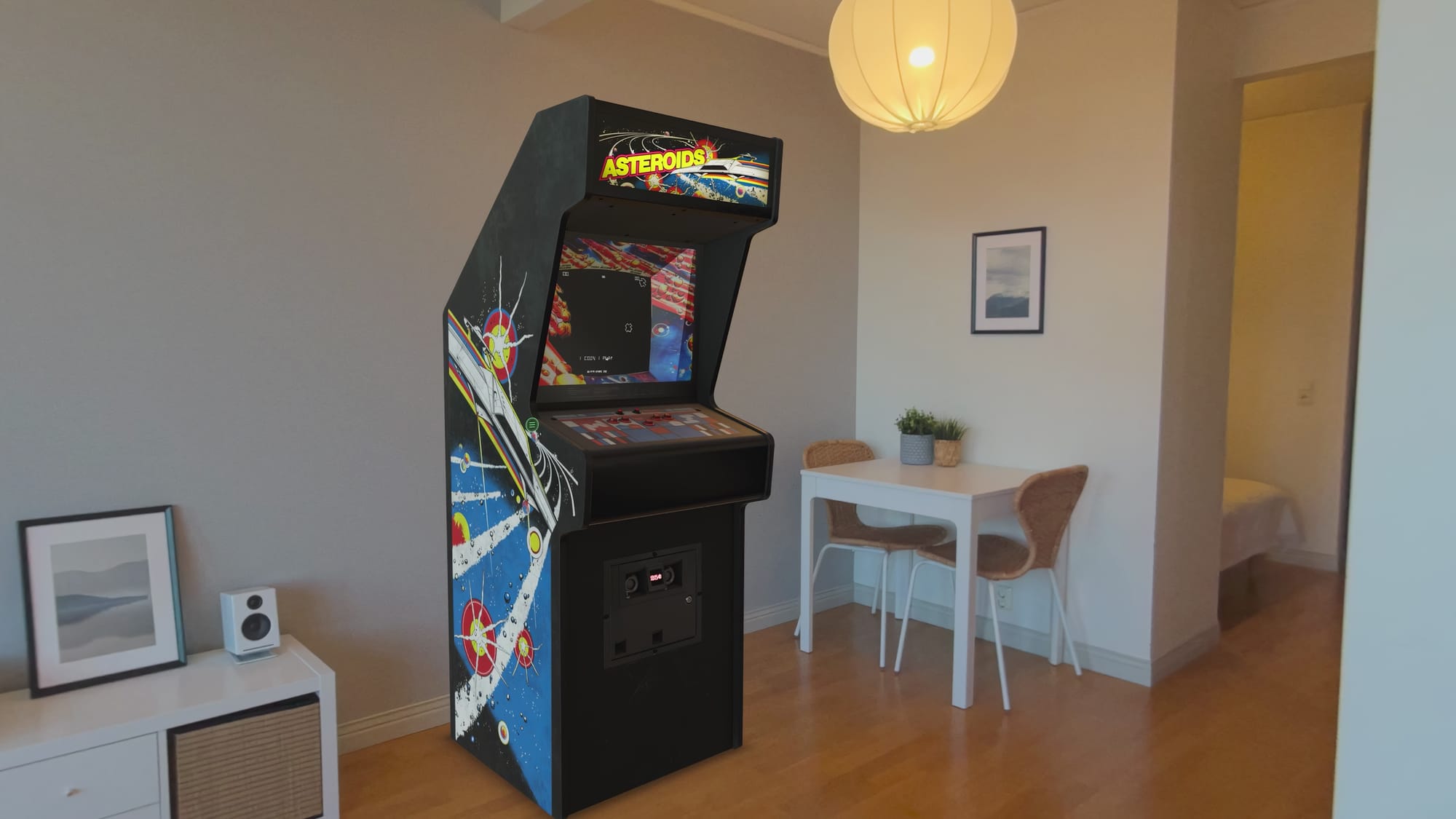
Asteroids in the mixed reality mode (at Resolution Games).

The virtual coins inserted into the cabinets are unlimited, by the way. There are no microtransactions in Retrocade, though that might be an interesting monetization option for people unwilling to pay the subscription fee for Apple Arcade.

When playing any of the games, you can switch between being inside the virtual arcade, with all the other cabinets visible around you, or to have only the cabinet you're playing in your physical space. Retrocade can be a VR or mixed reality game, whichever you prefer.

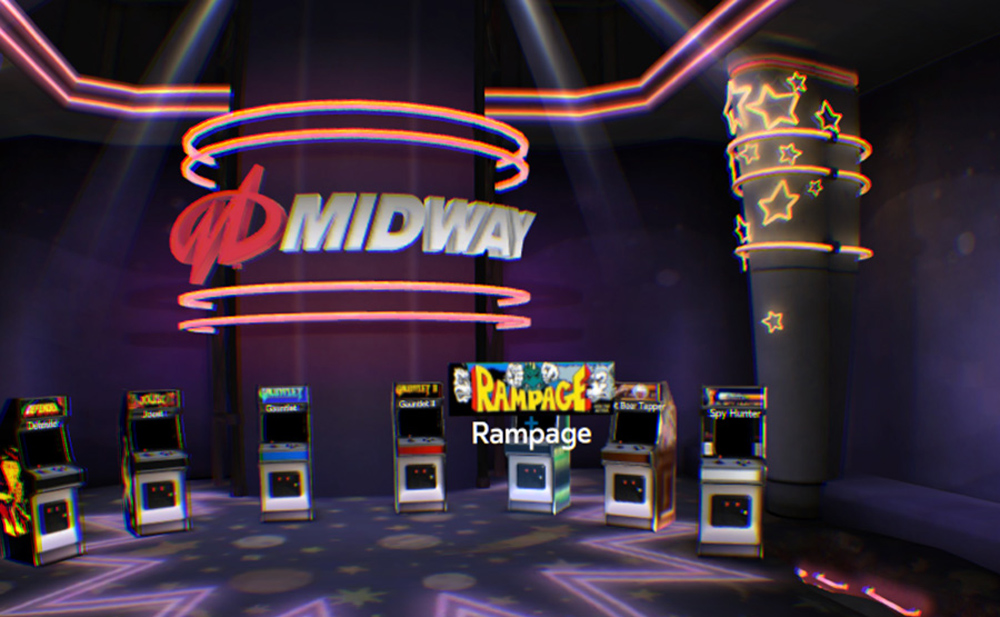
Oculus launches Arcade along with several new VR games
The launch today of pre-orders for the redesigned $100 Gear VR is accompanied by the availability of Arcade, offering “more than 20 classic games like Pac-Man, Sonic the Hedgehog, and Gauntlet” all playable in a virtual arcade. The app is available as a beta release from the Oculus Store. Prices
UploadVRIan Hamilton
0:00
/0:00

There have been other official attempts in the past to bring a retro arcade to VR, such as the discontinued Oculus Arcade for the Samsung Gear VR phone-holder headset and Oculus Go. But both headsets were 3DoF, rotation tracking only, meaning you couldn't lean around and appreciate the cabinet as an object in space.

A decade later, Retrocade on Apple Vision Pro is the same idea but done right – mostly. The combination of the powerful M-series chipset, high-resolution micro-OLED displays, rock-solid positional tracking and hard work of Resolution Games delivers a feeling that the cabinet is truly there in front of you, and the virtual arcade environment induces a deep feeling of immersive nostalgia.

Bubble Bobble in VR mode.

The smallest details of each cabinet are faithfully recreated in real-time, and the on-by-default CRT filter, to my eyes at least, looks identical to what you'd get from a real display of the era. Retrocade would be a delight to look at if it were just a non-interactive passive environment. And yet what you get here is 10 fully-playable, true-to-original games too – some of the most iconic of all time.

All this is not to say that Retrocade is perfect.

I understand why Resolution chose to require a controller, as it's far more precise and reliable than hand tracking input would have been. Though I do wish hand tracking input was an experimental option, or at least supported for pressing buttons. There's something a little jarring about having such a realistic cabinet not respond to poking at the buttons.

Another issue is that the mixed reality mode operates as a Full Space, so it doesn't support visionOS Shared Space multitasking. You can't put on a movie or YouTube video in the background, if that's your thing, and nor could you have an instant messaging or security camera app open. If you absolutely need multitasking, you can play Retrocade in a 2D window, where it essentially acts like the iPad app. But this entirely removes the magic of having a virtual cabinet.

The more pressing problem with Retrocade, though, is that you might feel lonely. The magic of the real arcade was not just the cabinets, but the people there beside you. The real Bubble Bobble and Track & Field supported simultaneous multiplayer, while the other games supported alternating turns. What I really want here is SharePlay – to see friends as Personas standing beside me, able to interact with the cabinet too. The only social layer in Retrocade is that the game sends your stats to Apple Game Center, so you can asynchronously compete with friends, but this just isn't the same thing as feeling together.

0:00
/0:52

UploadVR-captured footage in mixed reality mode, showing how the cabinet truly feels as if in your physical environment.

Retrocade - The Final Verdict

If you accept it as a singleplayer experience, Retrocade is a beautifully polished rendition of the virtual 1980s arcade VR gamers have dreamed of. It's a shame that it's exclusive to a $3500 headset, but it seems Apple paid for the development of the game. Hopefully other VR platforms get something similar, perhaps from another arcade game company like Sega, in the near future.

You can find Retrocade on the visionOS App Store via the Apple Arcade subscription.


UploadVR uses a 5-Star rating system for our game reviews – you can read a breakdown of each star rating in our review guidelines.

  •  

Quest's Horizon+ Reaches 1 Million Active Subscribers

Horizon+ crossed over 1 million "active subscribers" in 2025, according to Meta.

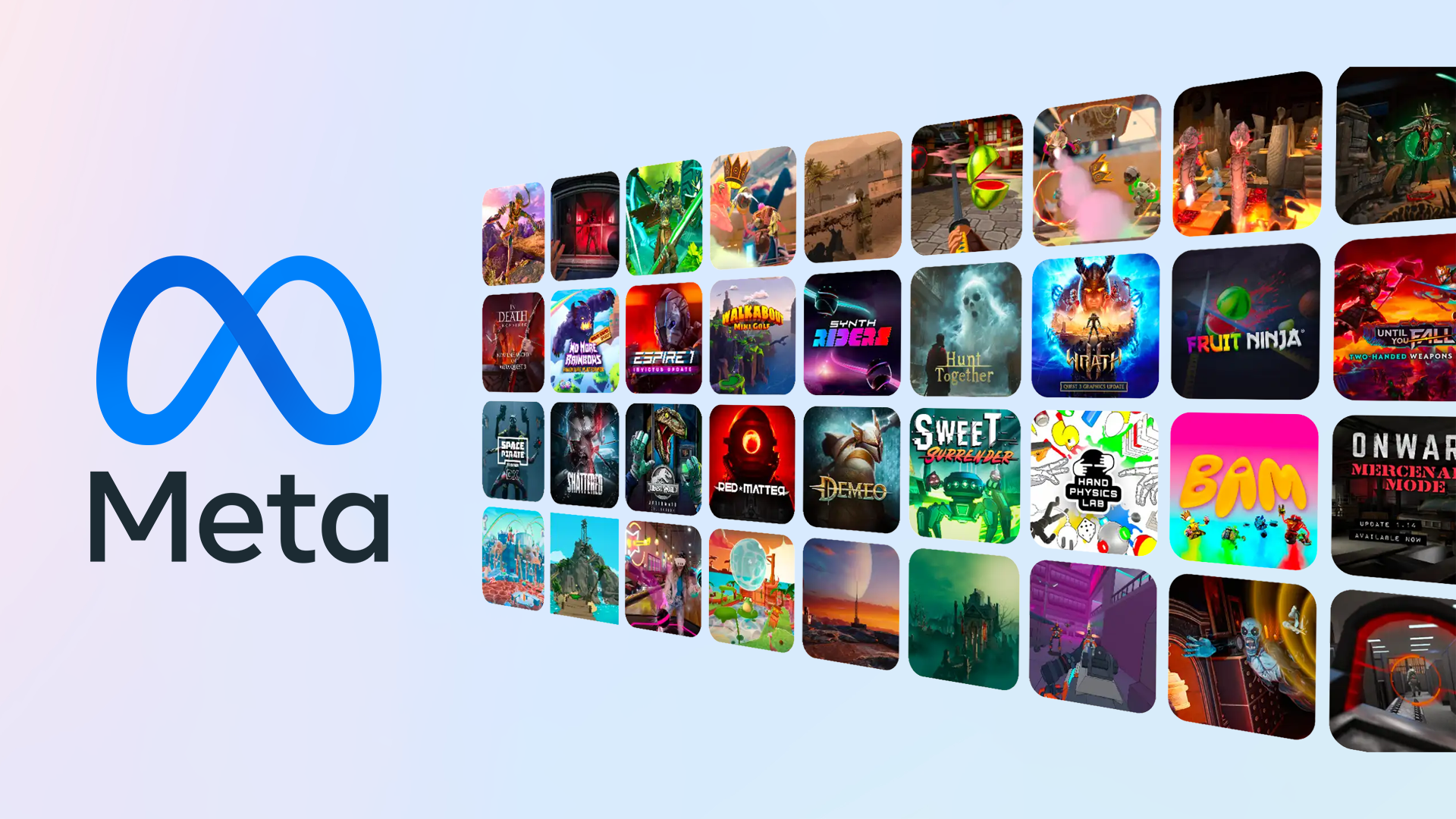
If you're unaware, Horizon+ is Meta's $8/month game subscription service for Quest headset owners. Subscribers get access to a Games Catalog of around 50 major VR titles, as well as an Indie Catalog of around 50 smaller titles, for a total of around 100 games.
The Games Catalog has grown to include some of the biggest and best VR games of all time, including Asgard’s Wrath 2, Assassin’s Creed Nexus VR, Cubism, Demeo, Dungeons of Eternity, Eleven Table Tennis, Ghosts of Tabor, Into the Radius, Job Simulator, Kingspray Graffiti, Les Mills Bodycombat, Maestro, Moss, Pistol Whip, Puzzling Places, Real VR Fishing, Red Matter 1 & 2, Synth Riders, The Climb 2, and The Thrill of the Fight.

Subscribers are also offered two specific games each month, pre-selected by Meta. Redeeming them lets you play them while you remain subscribed, or when you resubscribe in future.

Glassbreakers: Champions of Moss & Clay Hunt VR Are Quest’s Horizon+ Monthly Games This February
Here are the Meta Horizon+ Monthly Games for February 2026, including one of the best strategy games on the market, Glassbreakers: Champions of Moss.
UploadVRJames Tocchio

One million subscribers would represent just under $100 million revenue per year, assuming they stick around that long.
All new Quest 3 and Quest 3S purchases come with 3 months of Horizon+. While these new users presumably aren't included in Meta's 1 million figure, we've reached out to the company to explicitly ask.

On a purely financial basis, assuming you're not fundamentally against the idea of a subscription, Horizon+ offers excellent value, and so reaching 1 million subscribers isn't particularly surprising.

Back in October, Meta opened enrollment in the Horizon+ Games Catalog and Indie Catalog to any interested developer, providing they meet the strict requirements.

Horizon+ Now Has An Indie Catalog, And Quest Games Can Apply To Be Included
Quest developers can now apply to have their game be part of the Horizon+ subscription, and Meta is beta testing a new Indie Catalog for smaller titles.
UploadVRDavid Heaney

Horizon+ represents a gradual but significant shift in the way many VR headset owners access premium titles since the launch of the original Oculus Quest almost seven years ago. It could have significant upsides for developers enrolled in the program, while bringing reduced spending for those not.

Apple too takes a similar approach on Vision Pro with the $7/month Apple Arcade subscription, but goes further, not offering the ability to outright buy many of the platform's top games.

  •  

Meta "Explicitly Separating" Horizon Worlds From Quest

Meta published a blog post for developers wherein it lays out its new strategy for the Quest ecosystem and Horizon Worlds, taking the two in separate directions.

Titled 'Our Renewed Focus in 2026' and written by the VP of Content at Meta Reality Labs, Samantha Ryan, much of the post repeats what CTO Andrew Bosworth has already said in a series of public interviews and Instagram "ask me anything" sessions in recent weeks.

Meta CTO Explains Layoffs & Strategy Shift: “VR Is Growing Less Quickly Than We Hoped”
In a series of interviews at Davos, Meta CTO Andrew Bosworth explained why the company is reducing its investment in VR.
UploadVRDavid Heaney

The gist of Meta's new VR and metaverse strategy, according to its executives, is that Horizon Worlds will become "almost exclusively mobile", and the platform will no longer be pushed on Quest owners. Meanwhile, on the VR side, Meta will focus on funding and supporting the third-party developer ecosystem instead of putting out its own blockbuster VR games to compete with them.

Meta is removing individual Horizon Worlds destinations from the in-VR store on Quest, Ryan writes, and "separating worlds from the Store" in the smartphone app.

"We heard your feedback loud and clear, and after a year of collecting data and running experiments, we agree. We’re removing individual worlds from our store shelves in VR, and we’re separating worlds from the Store in our mobile app. This change should result in more impressions for apps on the store."

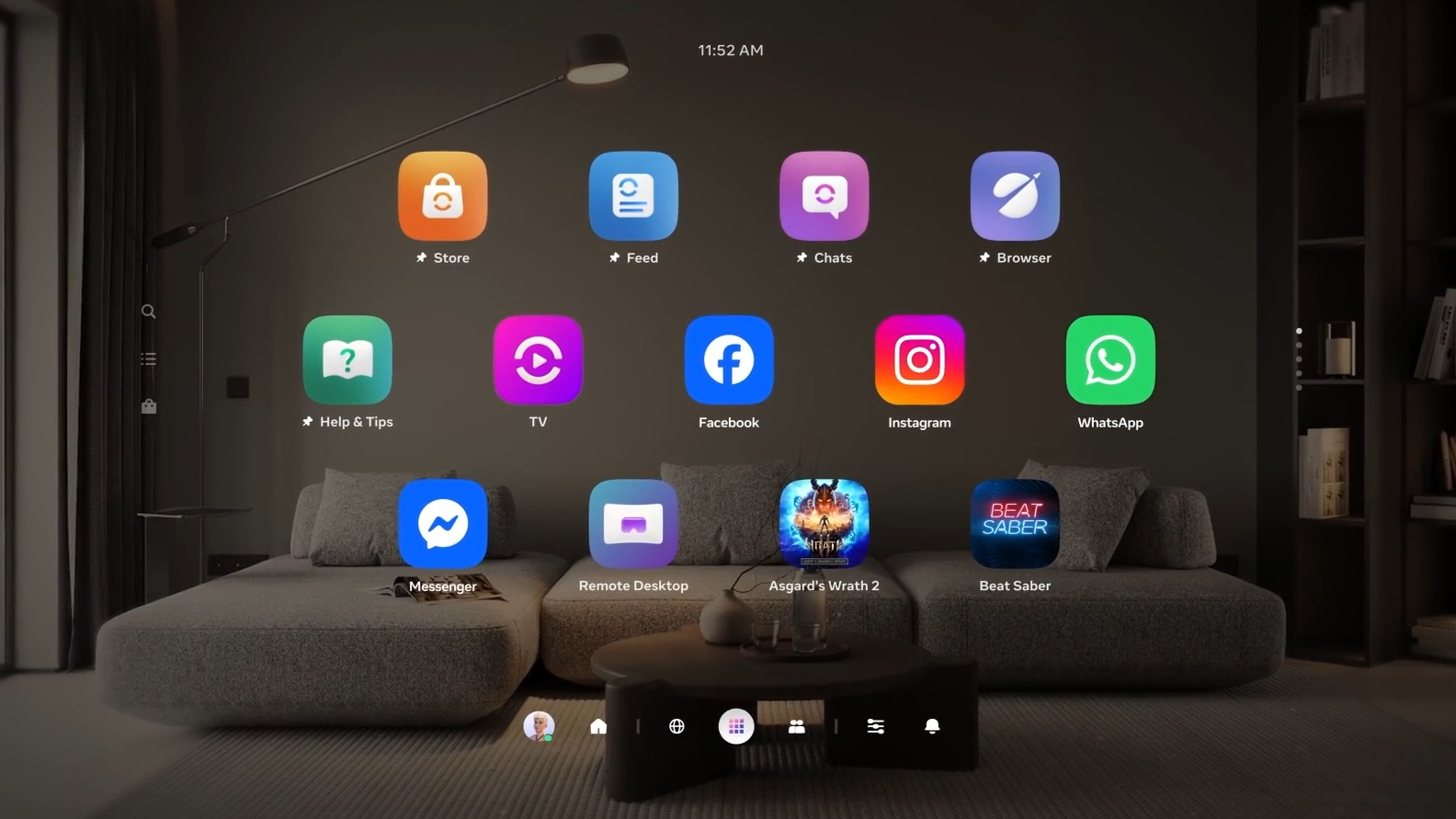
Last month, Meta also announced that Quest's new 'Navigator' UI will soon become the default and the Horizon Feed will be removed, meaning the headset will boot to a grid of your installed apps. Some Quest owners on the Public Test Channel (PTC) have also received a refreshed Navigator that lacks the 'Worlds' button.

Quest’s New ‘Navigator’ UI Becoming Default As Horizon Feed To Be Removed
“Starting” in Quest v85, the new ‘Navigator’ UI is becoming the default, and the Horizon Feed will be “gradually” removed from Horizon OS.
UploadVRDavid Heaney

The post also seems to take aim at the gloom and doom discourse around the future of the Quest platform that followed Meta's shutdown of three of its acquired VR game studios, significant layoffs at a fourth, cancelation of the Batman: Arkham Shadow sequel, and deprecation of Horizon Workrooms and Quest headsets for business offering.

As well as noting that Meta has "a robust roadmap of future VR headsets", echoing comments from the CFO and CTO, Ryan claims that VR "is still growing", and that Quest had "a tremendous holiday season that was on par with our 2024 results".

"Total payment volume on the platform remained similar year-over-year in 2025", Ryan writes, also noting that Quest headset sales remain "far ahead of all competitors" while Meta remains "the single biggest investor in the VR industry".

Quest 4 Is Still On The Roadmap, Meta CTO Seemingly Confirms
In an interview with Alex Heath, Meta CTO Andrew Bosworth seemed to confirm the leak that a gaming-focused Quest 4 is still on the roadmap.
UploadVRDavid Heaney

In what seems to be an attempt to reassure developers, Ryan claims Meta is "focused on supporting the third-party developer community" through "strategic partnerships and targeted investments".

Last year multiple new VR games earned millions of dollars of revenue on the platform, Ryan claims, including UG, Hard Bullet and The Thrill of the Fight 2.

"While we’re proud of the world-class work from Oculus Studios over the years, among 1P and 3P apps, 86% of the effective time people spend in their VR headsets is with third-party apps", Ryan notes.

Ryan also claims that in 2025 Meta invested "nearly $150 million in VR developer programs".

Meta CTO: We’re Still Investing More In VR Content Than Anyone Else
Meta CTO Andrew Bosworth claims that even after the cuts, the company is still investing more in VR content than anyone else, and more than it was 4 years ago.
UploadVRDavid Heaney

Of course, words are cheap, and since acquiring Oculus almost twelve years ago, Meta's VR strategy has constantly shifted under developers' feet. Many will be weary of this instability, and UploadVR will keep a close eye on the Quest platform in the wake of Meta's latest change of direction.

  •  

Pico To Detail visionOS Competitor For New Headset Next Month

ByteDance's Pico will detail its competitor to visionOS, which will include a shared-space for 2D and spatial apps to run together, set to debut in its next headset.

We first heard that the owner of TikTok's VR platform Pico was working on a high-end headset over two years ago, when The Information reported that Pico 5 had been canceled in favor of a short-term Pico 4 refresh and a longer-term Apple Vision Pro competitor called Project Swan.

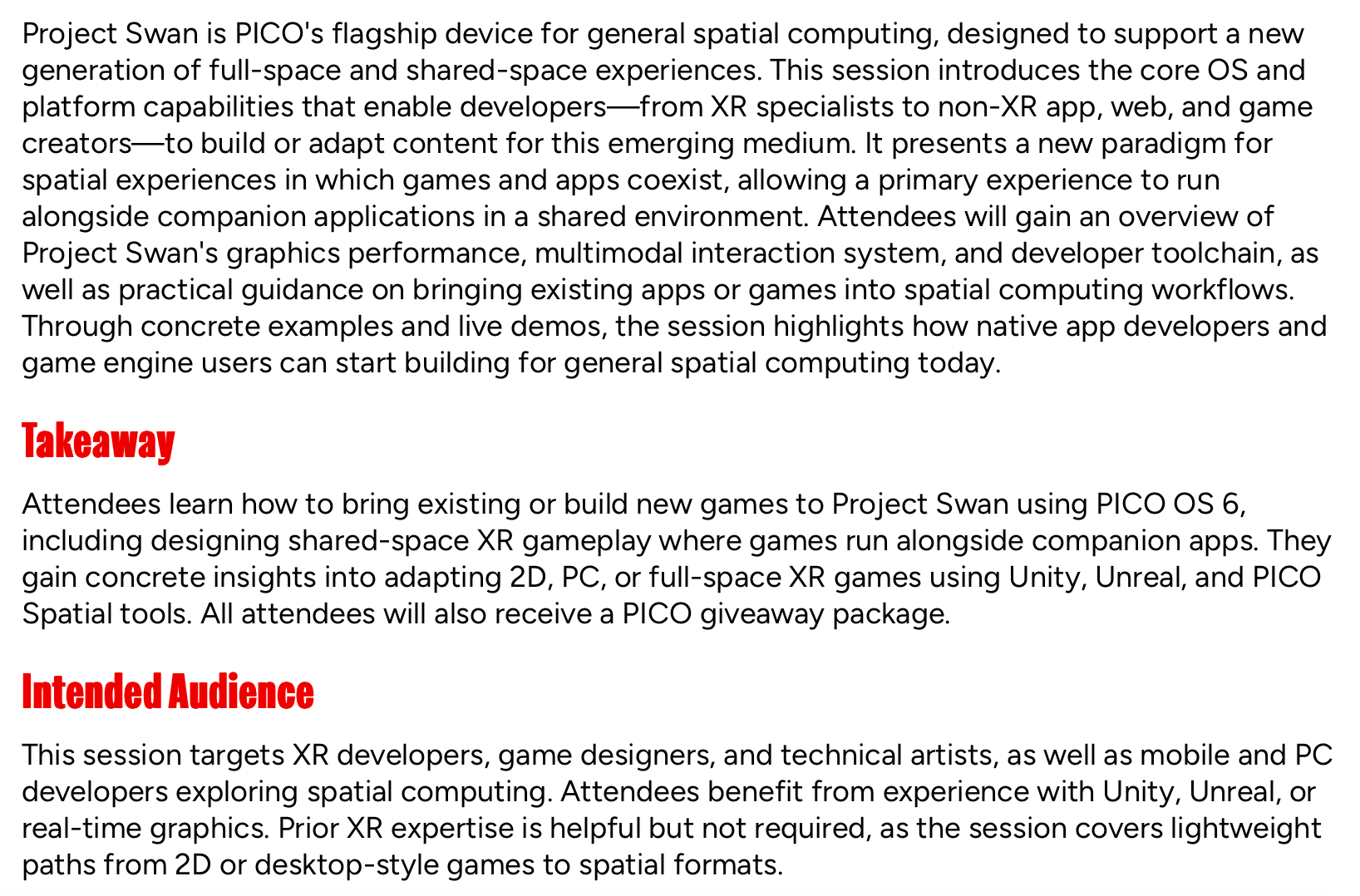
Now, Pico has listed a GDC 2026 talk titled 'Bring Your Apps and Games to General Spatial Computing with Project Swan', set to take place on March 12.

The GDC 2026 talk description.

The listing says the talk will guide developers through building or porting games to its upcoming "flagship device for general spatial computing", running "Pico OS 6".

Notably, the listing mentions that Pico OS 6 supports "a new paradigm for spatial experiences in which games and apps coexist, allowing a primary experience to run alongside companion applications in a shared environment". Currently, only Apple Vision Pro's visionOS supports this concept of an XR shared space, with both 2D windows and 3D volumes, while Meta's Horizon OS and Google's Android XR are limited to running one spatial experience at a time.

While the listing describes Pico OS 6, it doesn't say anything about the upcoming headset itself, other than calling it a "flagship device". What exactly will it be?

Pico’s 2026 Headset To Have 4K Micro-OLED Displays & R1-Style Chip
Pico’s 2026 headset will have 4K micro-OLED displays and a dedicated R1-style passthrough chip, a ByteDance executive reportedly said.
UploadVRDavid Heaney

Back in July, The Information reported that Pico was working on an ultralight headset resembling a pair of goggles, with an onboard dedicated image coprocessor and a tethered compute puck, similar to Meta's next headset.

Then, in November, a Chinese news outlet reported that ByteDance's Vice President of Technology said that Pico's 2026 headset will have 4K micro-OLED displays and a dedicated R1-style passthrough chip.

UploadVR's Mike Johnson and Kyle Riesenbeck will be in attendance at GDC 2026, and we've reached out to ByteDance in hopes of going hands-on with Project Swan. We'll let you know if we get a response.

  •  

Could A Binocular Meta Ray-Ban Display Successor Launch This Year?

Meta is accelerating its plans for a Meta Ray-Ban Display successor, hoping to launch later this year, The Information reports.

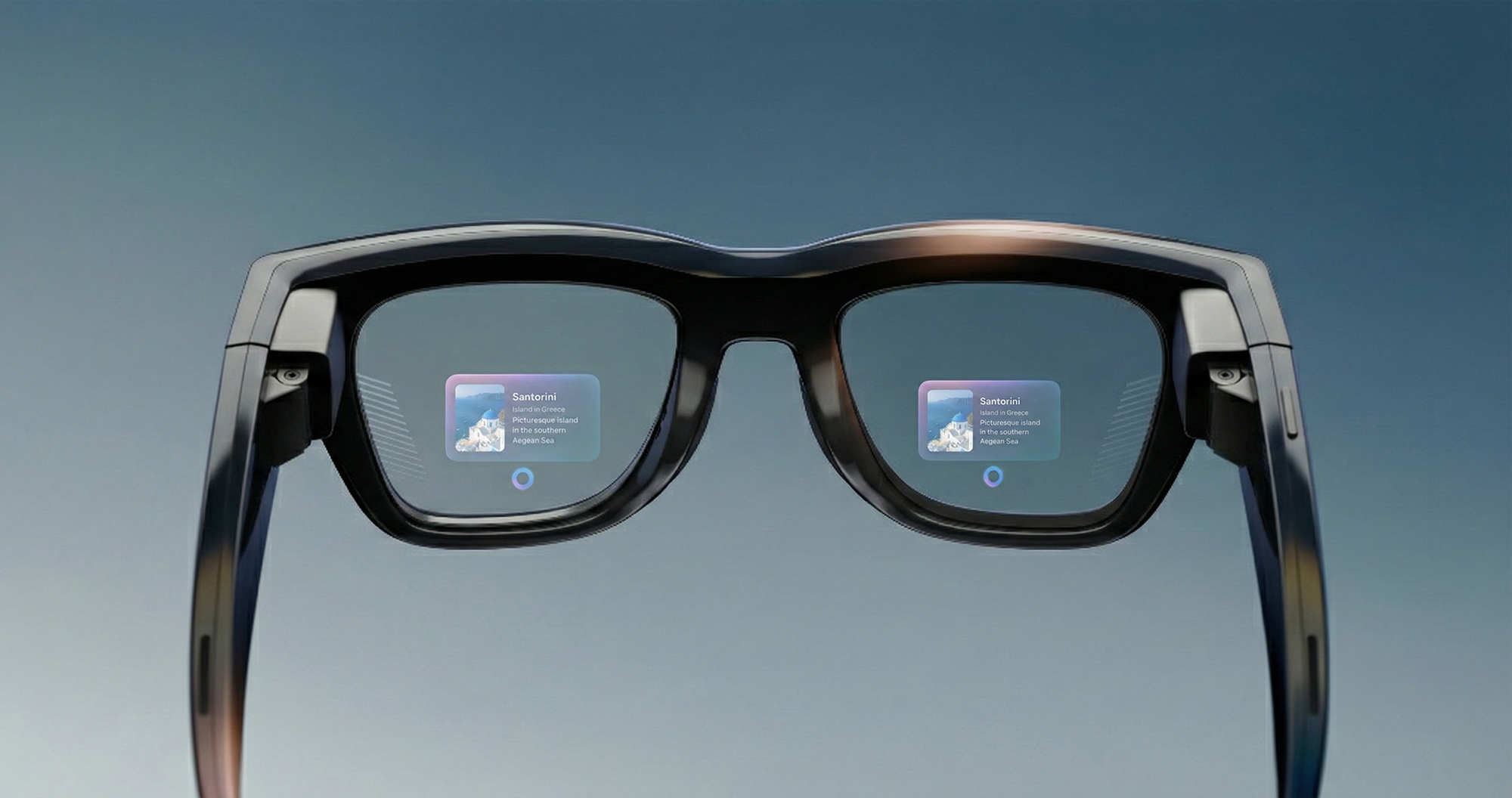
The current Meta Ray-Ban Display, exclusively available in the US for just under five months now, is a monocular device. It has a small display in the right lens, while your left eye sees nothing. In our review, we described how this "just feels wrong", inducing a constant minor feeling of eyestrain when the display is active for more than a few seconds.

The reason that Meta Ray-Ban Display is monocular is that, as Meta's CTO pointed out in the weeks before the device's launch, the components for a binocular device would cost more than twice as much, since it also requires implementing disparity correction. It would also drive up the bulk and weight, harming social acceptability even further than it already is.

But the cost of in-lens waveguides and miniature light engines should decrease with scale, and Meta executives have described the demand for Meta Ray-Ban Display as significantly higher than expected, leading to the delay of the plan to launch the product internationally.

Meta Ray-Ban Display Review: First Generation Heads-Up Mobile Computing
Meta Ray-Ban Display is an early glimpse of a future where mobile computing doesn’t mean looking down and taking something out of your pocket.
UploadVRDavid Heaney

During development, Meta Ray-Ban Display was internally codenamed Hypernova. Last year, Bloomberg's Mark Gurman reported that Meta plans to release a successor, codenamed Hypernova 2, in 2027. Hypernova 2 would include a display in both eyes, he wrote at the time.

This timeline was corroborated by supply-chain analyst Ming-Chi Kuo, who also said Meta would replace the first-generation product with a successor in 2027.

Now, though, The Information's Jyoti Mann reports that Hypernova 2 will launch this year, not in 2027. While the report doesn't go into much detail, Mann describes Meta executives as being "concerned that launching too many devices in quick succession could confuse customers".

Given that Meta plans to launch its ultralight Horizon OS headset in early 2027, and that multiple sources point towards the company aiming to launch its first true AR glasses in the second half of 2027, shipping binocular HUD glasses this year may make for a less confusing release sequence.

Mann's report says Meta has also revived plans to launch a smartwatch, hoping to release that later this year too.

With the binocular HUD glasses, Meta could be hoping to get ahead of Apple's upcoming smart glasses, widely believed to be launching in early 2027. With Apple's first glasses lacking a display at all, Mark Zuckerberg could be hoping to present Meta as the technology leader in the smart glasses space.

Apple Glasses Could Have 2 Cameras & Launch In 2027
Apple’s smart glasses will have two cameras, one for capture and the other for computer vision, and launch in early 2027, Bloomberg’s Mark Gurman reports.
UploadVRDavid Heaney

Keep in mind that Meta's hardware roadmap is constantly shifting, and the company frequently spins up and cancels headsets and glasses before they ship.

It's possible that Meta no longer plans for Hypernova 2 to be binocular, or that the sources previously suggesting that it would be binocular were mistaken.

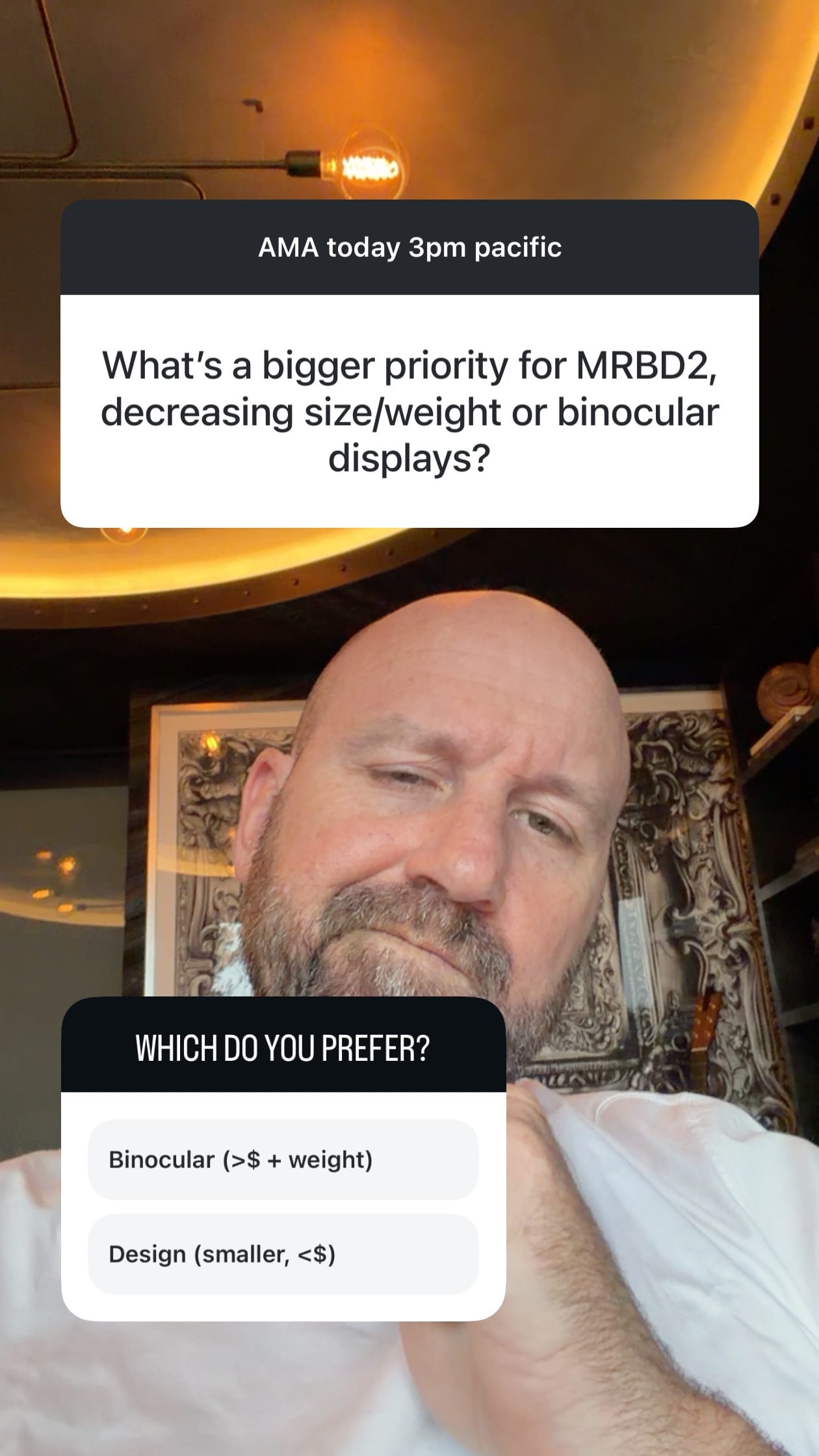
Poll posted by Meta CTO Andrew Bosworth on Instagram in response to a question.

Last month, Meta CTO Andrew Bosworth was asked on Instagram whether decreasing size and weight or adding another display is the company's priority for the next-generation device.

Bosworth didn't give an answer, but instead posted a poll asking the community for their preference. In the poll, he labeled the options as
"Binocular (>$ + weight)" and "Design (smaller, <$)". The wording choices there may hint at Meta's thinking, and thus it's just as possible that later this year we see a sleeker, lighter Meta Ray-Ban Display Gen 2 without the anticipated left-lens display.

  •  

Apple Vision Pro &amp; Samsung Galaxy XR Get PC VR Foveated Streaming

Apple Vision Pro is officially getting PC VR foveated streaming, and Samsung Galaxy XR now has the feature via Guy Godin's Virtual Desktop.

Before you continue reading, note that foveated streaming is not the same as foveated rendering, though the two techniques can be used alongside each other. As the names suggest, while foveated rendering involves the host device actually rendering the area of each frame you're currently looking at with higher resolution, foveated streaming refers to sending that area to the headset with higher image quality than the rest of the frame.

It's a term you may have heard in the context of Valve's Steam Frame, where it's a fundamental always-on feature of its PC VR streaming offering, delivered via the USB PC wireless adapter by default.

0:00
/0:05

Valve's depiction of foveated streaming.

Given that the video decoders in headsets have a limited maximum resolution and bitrate, foveated streaming helps prioritize resolution and compression quality where you're currently looking.

Apple Vision Pro: visionOS 26.4

visionOS 26.4 will bring foveated streaming to Apple Vision Pro, enabling higher-quality wireless VR remote rendering from a local or cloud PC.

Unlike the macOS Spatial Rendering introduced in the main visionOS 26 release last year, which is a relatively high-level system that only supports a local Mac as a host, Apple's developer documentation describes the new Foveated Streaming as a low-level host-agnostic framework.

The documentation highlights Nvidia's CloudXR SDK as an example host, while noting that it should also work with local PCs. Apple even has a Windows OpenXR sample available on GitHub, which to our knowledge is the first and only time the company has even mentioned the industry-standard XR API, never mind actually using it.

ALVR For Apple Vision Pro Brings PS VR2 Controllers To SteamVR
ALVR for Apple Vision Pro, the open-source wireless SteamVR tool, now supports the PS VR2 Sense controllers in its TestFlight build for visionOS 26.
UploadVRDavid Heaney

The lead developer of the visionOS port of the PC VR streaming app ALVR, Max Thomas, tells UploadVR that he's currently looking into adding support for foveated streaming, but that it will likely be "a lot of work".

Because of how the feature works, Apple's foveated streaming might even enable foveated rendering for tools like ALVR.

Normally, visionOS does not provide developers with any information about where the user is looking – Apple says this is in order to preserve privacy. Instead, developers only receive events, such as which element the user was looking at as they performed the pinch gesture. But crucial to foveated streaming working, the API tells the developer the "rough" region of the frame the user is looking at.

This should allow the host to render at higher resolution in this region too, not just stream it in higher resolution. As always, this will require the specific VR game to support foveated rendering, or to support tools that inject foveated rendering.

0:00
/0:24

Clip from Apple's visionOS foveated streaming sample app.

Interestingly, Apple's documentation also states that visionOS supports displaying both rendered-on-device and remote content simultaneously. The company gives the example of rendering the interior of a car or aircraft on the headset while streaming the highly detailed external world on a powerful cloud PC, which would be preferable from a perceived latency and stability perspective to rendering everything in the cloud.

We'll keep an eye on the visionOS developer community in the coming months, especially the enterprise space, for any interesting uses of Apple's foveated streaming framework in practice.

Samsung Galaxy XR: Virtual Desktop

Meanwhile, Samsung Galaxy XR is getting foveated streaming via Guy Godin's Virtual Desktop, a $25 third-party app available on Google Play.

Virtual Desktop's latest update also brings foveated streaming to Meta Quest Pro and Play For Dream MR, though this is less notable as those headsets could already achieve foveated streaming through Valve's Steam Link.

Virtual Desktop without foveated streaming (left) and with it (right).

The feature should also work on any future eye-tracked headset where Virtual Desktop is available, Guy Godin tells UploadVR.

Here's the full changelog for Virtual Desktop 1.34.16:

• Added Foveated streaming with eye tracked headsets (Quest Pro, PFD & Galaxy XR)
This uses eye tracking to improve the quality of the image where you are looking.

• Improved color gradients and color accuracy with all codecs by using the full RGB color range instead of limited range (for desktop and PCVR)

• Added 96 fps and 100 fps support on Quest 2, 3/3S (only available on Quest v85 PTC)

• Added Gamepad vibration support (also for controllers when emulating gamepad)

• Added adaptive quantization support with AMD GPUs using H.264/H.264+

• Improved initial connection reliability (for real this time)

• Added 21:9 resolutions for virtual monitor on macOS

• Improved thumbstick scroll on macOS and now it respects the natural scrolling option

• Fixed distorted image with some laptop monitor resolutions
• Fixed rare black flash issue when playing some PCVR games
• Fixed hand joints offsets and interference with other drivers in SteamVR
• Fixed compatibility with Roblox anti-cheat
• Fixed more issues with AndroidXR invalid controller poses
• Fixed button support for some recent UE5 games
• Fixed reprojection stutters with some Unity (OVRPlugin) games

  •  

Apple Glasses Could Have 2 Cameras &amp; Launch In Early 2027

Apple's smart glasses will have two cameras, one for capture and the other for computer vision, and launch in early 2027, Bloomberg's Mark Gurman reports.

Gurman, who has a strong track record of reporting on Apple products in advance of an official reveal, has been tracking the company's plans to launch a Ray-Ban Meta competitor for well over a year now.

His previous reports described the company's first glasses as lacking a display, having cameras, microphones and speakers, and being powered by a new Apple-designed chipset, based on the highly efficient S-series chips used in Apple Watch. The product would be used for phone calls, music playback, live translations, turn-by-turn directions, and multimodal AI, which Apple calls Visual Intelligence.

His new report explains how Apple plans to distinguish its hardware from Meta's: "build quality and camera technology".

According to Gurman, the device will use "high-end materials" including acrylic elements and have two cameras, one for high-quality image and video capture, and the other for computer vision.

UploadVR's take on that is that a dedicated computer vision sensor could draw significantly less power than a sensor designed for imaging, and thus be sampled continually for advanced use cases like spatially-aware pedestrian navigation. "Turn left just past that red Honda", instead of "In 200 meters, turn left". It might also enable hand gestures without the need for a wristband – though you would need to raise your arm.

Apple is targeting December for mass production of the glasses, Gurman writes, for a launch in early 2027.

Unlike Meta and Google, which are working with established fashionable glasses brands, Apple will be designing its own frames, Gurman claims, with a variety of colors and sizes set to be offered.

His report also claims Apple is working on AirPods with cameras, and a wearable pendant, as part of a suite of AI-focused hardware.

Next-Gen Ray-Ban Meta Glasses Could Recognize Faces In 2026
Next-gen Ray-Ban Meta glasses set for 2026 could recognize faces and run continuous AI sessions for “hours”, The Information reports.
UploadVRDavid Heaney

The competition won't be standing still, though. Last year The Information reported that Meta and EssilorLuxottica plan to launch next-generation Ray-Ban Meta glasses with a facial recognition feature and the ability to run continuous AI sessions for "hours".

Meanwhile, Google is set to launch its Gemini-powered smart glasses platform this year, partnering with eyewear companies Gentle Monster and Warby Parker, as well as Samsung, to bring it to market.

The industry is set to see a fierce three-way battle between Meta, Apple, and Google to own the software platform on the glasses the companies hope you'll wear all day. Is there room for three players, or will it narrow to a two-horse race over time?

  •  

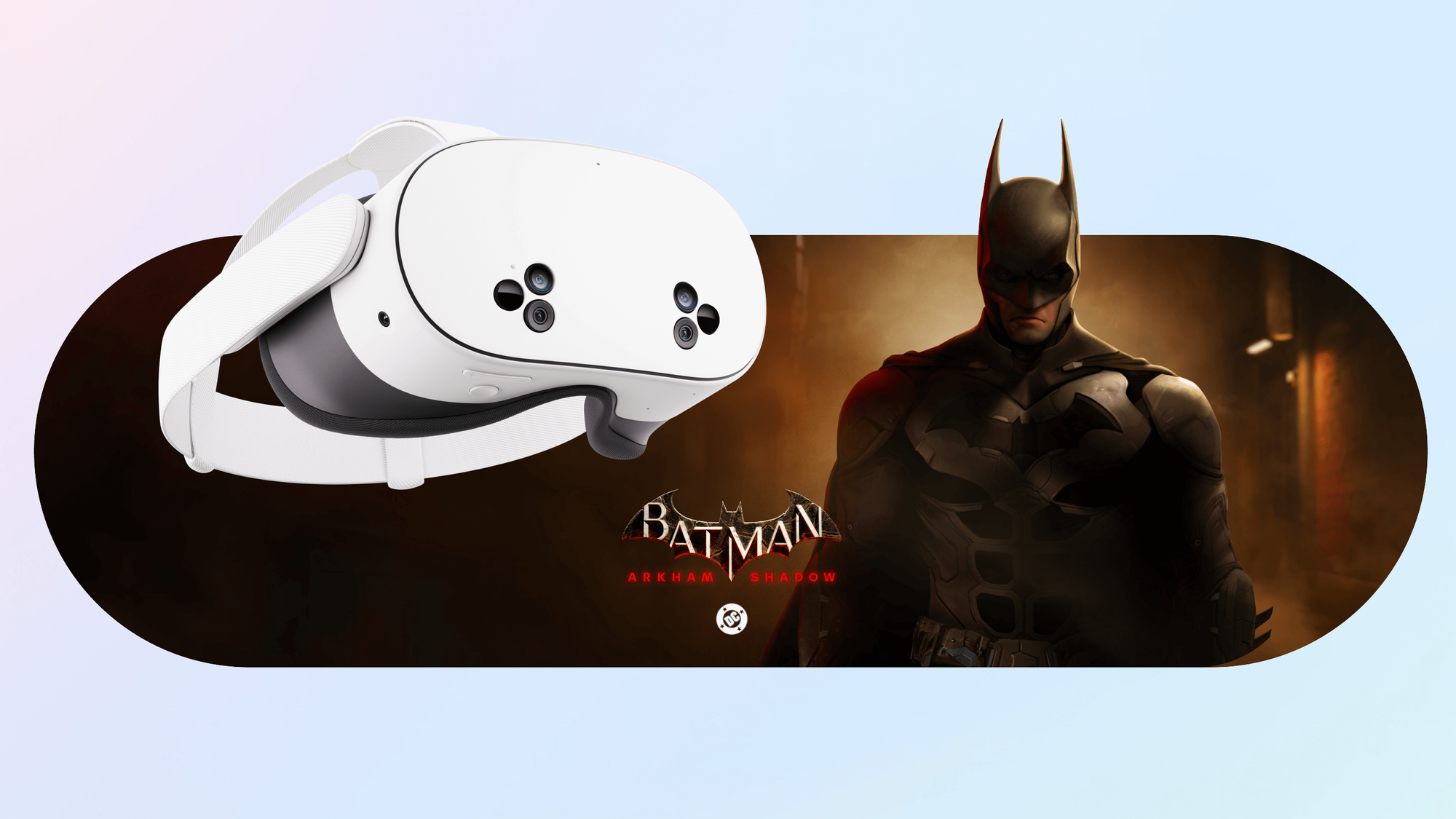
Quest 3S On Sale For $250 With Batman: Arkham Shadow Again At Walmart

Walmart is offering Quest 3S for $250 again, $50 off, and it comes with the $50 VR blockbuster Batman: Arkham Shadow.

That's the price for the 128GB base model, and the 256GB storage model is also on sale for $50 off, bringing it down to $350.

As well as including Batman: Arkham Shadow, the offering comes with 3 months of the Horizon+ games subscription, as with all new Quest headset purchases.

Arkham Shadow was officially included with all Quest 3S purchases for the headset's first seven months on the market, though this was effectively extended during multiple sales and honored for any SKUs with the game's logo on the box. The game, which Meta recently canceled the sequel for, earned a 4.5-star rating in our review, and it's a rare example of a truly made-for-VR AAA title.

Batman: Arkham Shadow Review - A Triumphant Return
Batman: Arkham Shadow is a brilliant return for the Dark Knight, and it expertly adapts the series for VR on Quest 3 and Quest 3S.
UploadVRHenry Stockdale

This is far from the only time we've seen Quest 3S on sale for $250, and over the holidays it even dropped to as low as $200 for Costco members. But it still remains immense value – a fully standalone and wireless VR headset with tracked controllers, hand tracking, and mixed reality for less than the price of a traditional games console.

One consideration you may want to make if you're considering jumping into VR with this deal, however, is whether the higher-end Quest 3 or Valve's upcoming Steam Frame might better suit your needs.

While Quest 3S can run all the same content as Quest 3, and has the same fundamental capabilities (including the same XR2 Gen 2 chipset and 8GB RAM), Quest 3 features Meta's advanced pancake lenses which are clearer and sharper over a wider area, have a wider field of view, and have precise separation adjustment, making them suitable for essentially everyone's eyes. Meanwhile, Steam Frame has a significantly more comfortable design and promises to make wireless PC VR seamless.

But Quest 3 costs twice as much as Quest 3S on sale, and Steam Frame is likely to cost around three times as much. If you're looking to jump into VR on a budget, or gift a friend or loved one, it's impossible to beat the raw value of Quest 3S.

You can find the deal at Walmart.com.

  •  

YouTube Launches Official Apple Vision Pro App

Google's YouTube has launched an official visionOS app.

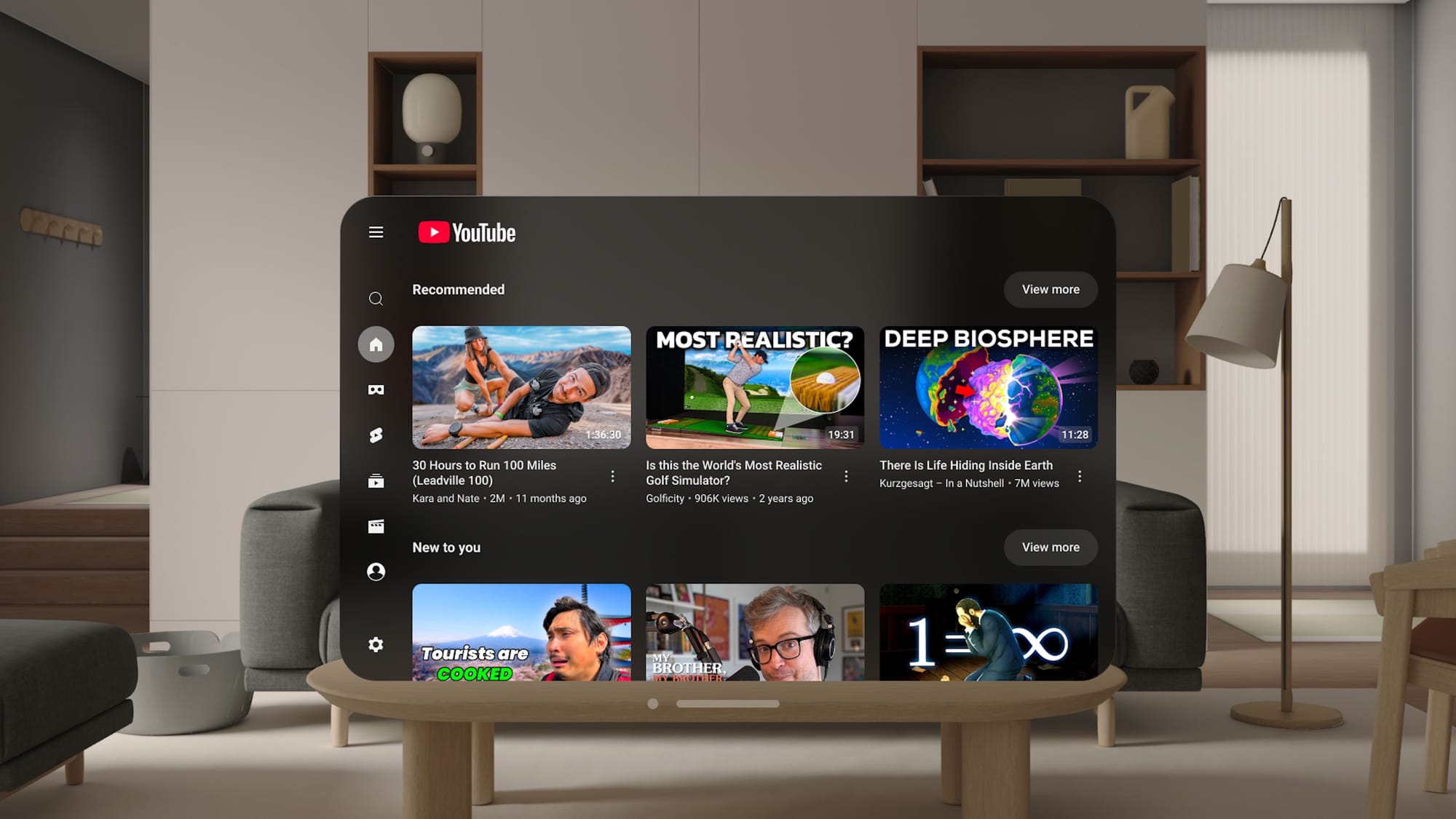
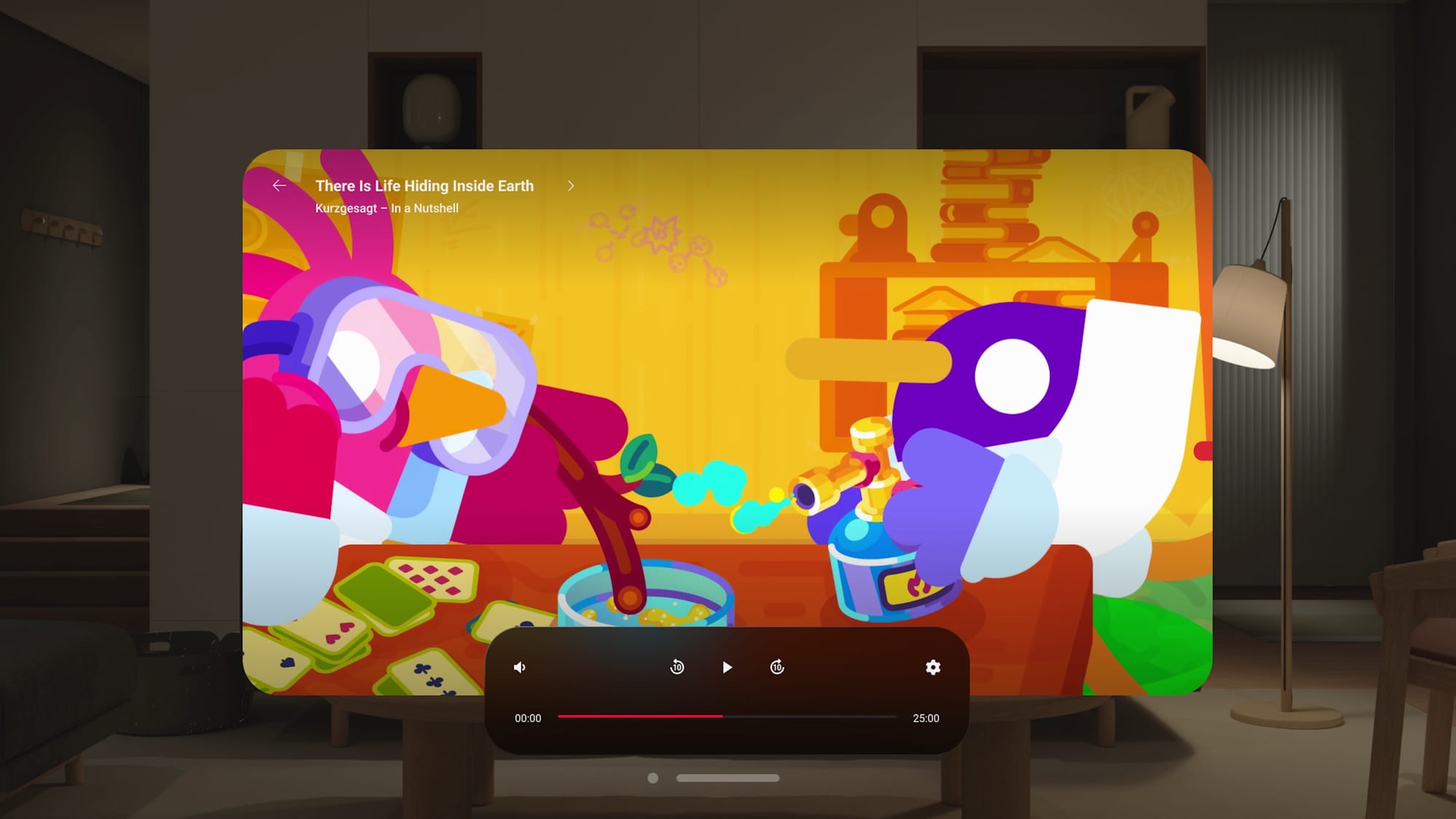
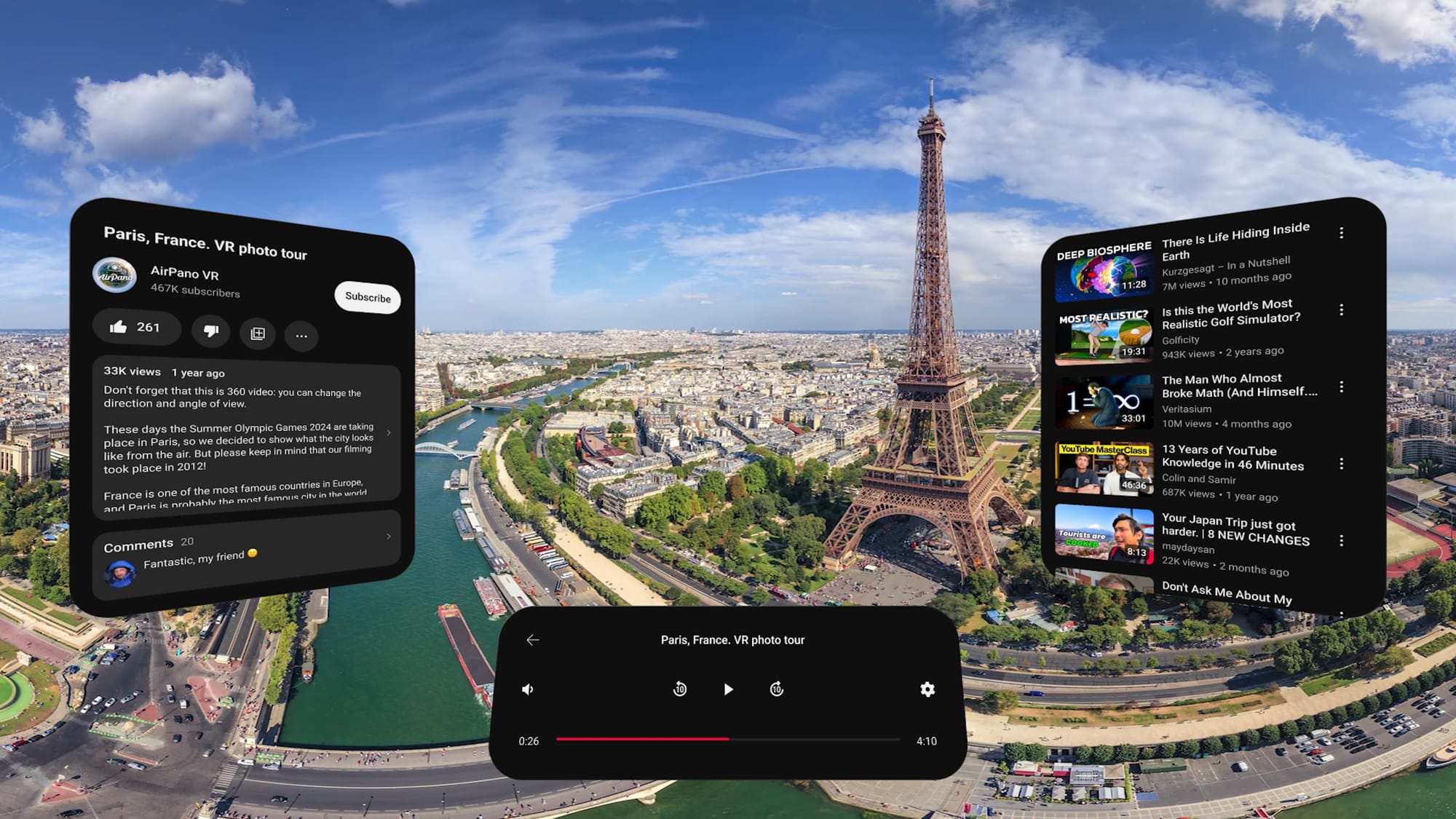
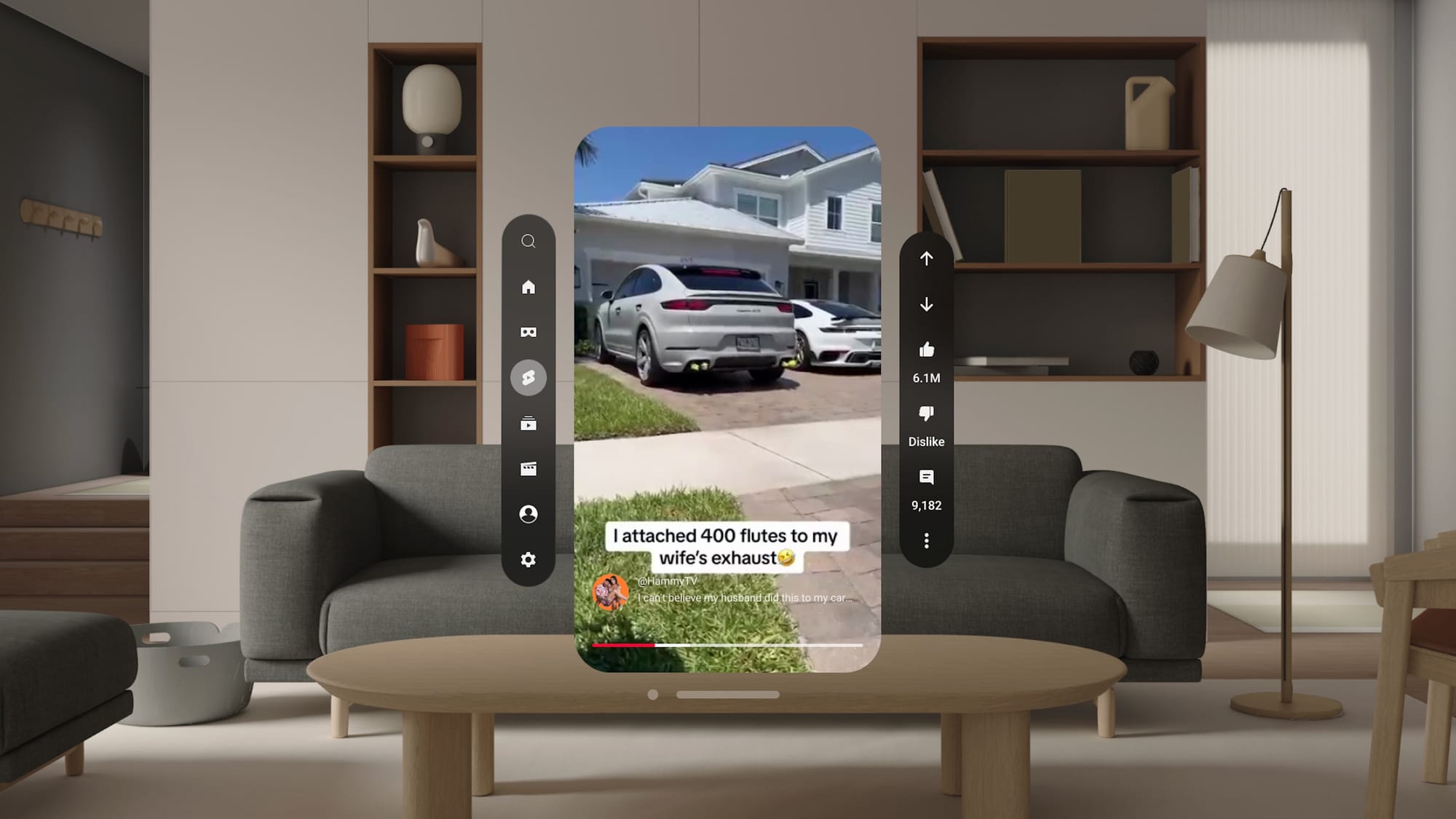
While it was already possible to access YouTube on Apple Vision Pro headsets through the Safari web browser, the new official app offers a streamlined native-feeling interface, support for watching 180° and 360° immersive video (including 3D), and, for YouTube Premium subscribers, the ability to download videos for offline viewing.

The official YouTube visionOS app on Apple Vision Pro.

The player also adapts to the varying aspect ratios of videos on YouTube, avoiding the black-bars problem and revealing more of your real or virtual environment.

On the M5 Apple Vision Pro, the app supports up to 8K, while the original M2 Vision Pro is limited to 4K.

The official YouTube visionOS app on Apple Vision Pro.

YouTube first announced that it planned to build a visionOS app just days after the original headset's launch.

In the two years since, multiple third-party apps have emerged to fill the gap, including firstly and most prominently the $5 app Juno, built by the same developer as the Apollo phone app for Reddit. But in late 2024 YouTube forced Juno off the visionOS App Store.

Other third-party offerings include Tubular Pro, which has advanced features including SponsorBlock integration and its own theater environments.

The official YouTube visionOS app on Apple Vision Pro.

The official YouTube app for Apple Vision Pro is available for free on the visionOS App Store, with offline downloads enabled by a YouTube Premium subscription.

While its arrival on visionOS could be considered surprising by some because of Google's competing Android XR, YouTube operates somewhat independently from Google, and Google has offered iOS versions of its most popular services for almost two decades now.

YouTube is also available on Meta's Horizon OS, including with co-watching support, but the app on Quest is visually less polished compared to visionOS and Android XR.

Official YouTube Co-Watching On Quest Finally Arrives In Beta
Official YouTube co-watching in the Horizon OS home space has finally arrived as a beta.
UploadVRDavid Heaney

  •  

Meta &amp; EssilorLuxottica Sold 7 Million Smart Glasses In 2025

Meta and EssilorLuxottica sold more than 7 million smart glasses in 2025, and they were the "dominant driver" of the Ray-Ban owner's wholesale growth in H2.

Exactly one year ago, EssilorLuxottica told its investors that the Ray-Ban Meta glasses had sold 2 million units so far, a period spanning from the launch in October 2023 until February 2025.

Now, during its Q4 2025 earnings report, the company announced that it sold 7 million units of Ray-Ban and Oakley smart glasses in 2025 alone – meaning more than triple that of 2024. This suggests that around 9 million have been sold to date since the launch of Ray-Ban Meta two and a half years ago.

For comparison, Quest 2 sold an estimated 20 million units in two and a half years, while Steam Deck sold around 4 million units over the same timespan.

EssilorLuxottica says smart glasses drove significant growth for both its wholesale and retail business, describing the former in North America as "exponential".

What Is EssilorLuxottica?

The French-Italian giant EssilorLuxottica is the largest eyewear company in the world by far. It owns iconic brands like Ray-Ban, Oakley, Oliver Peoples, and Persol, and has exclusive licenses with major fashion companies like Prada, Armani, Burberry, and Chanel. It also owns Sunglass Hut, and has almost 18,000 retail stores in total worldwide.

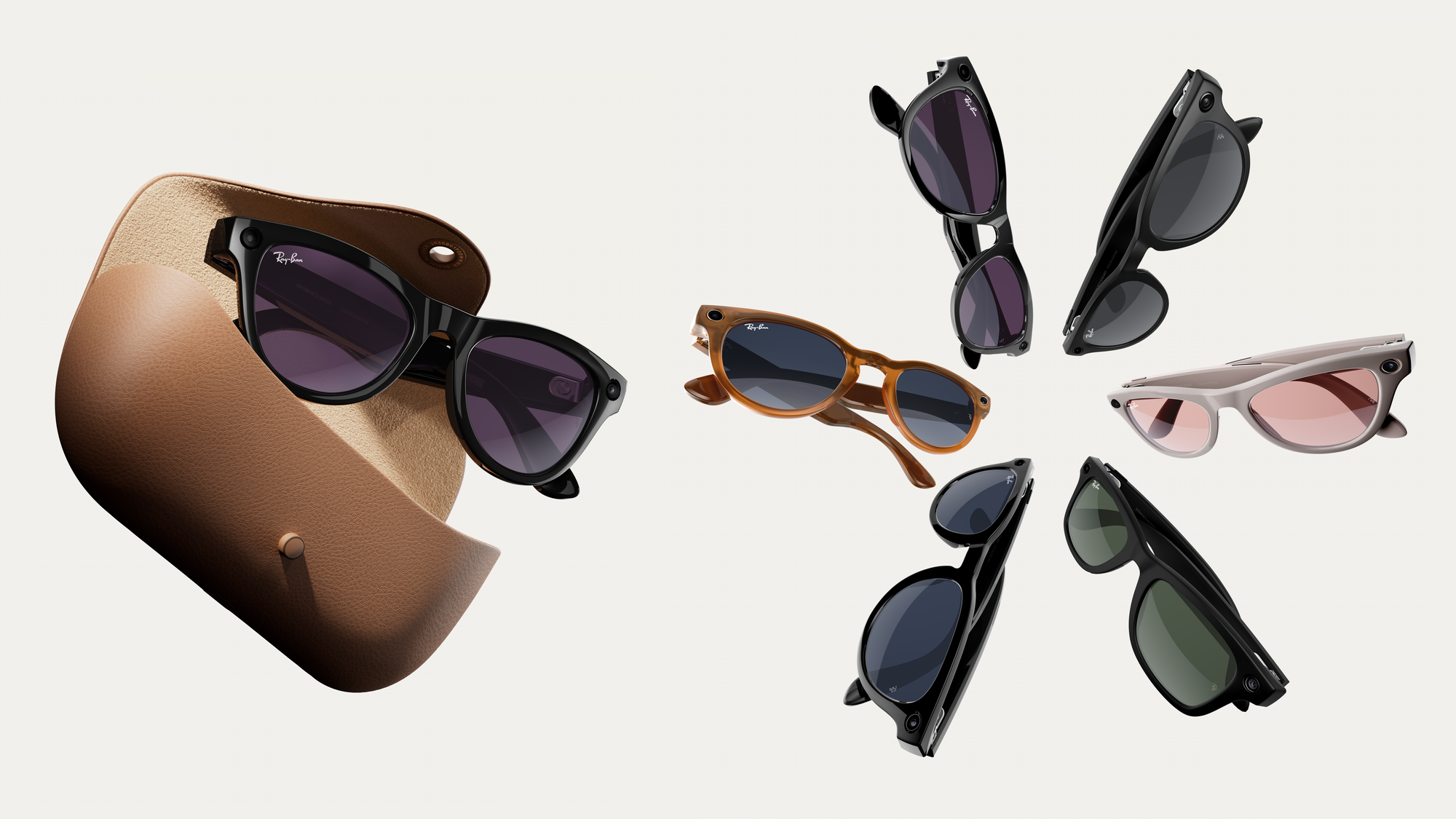
Meta has so far partnered with EssilorLuxottica for six smart glasses products:

The sales figure comes one month after Bloomberg reported that Meta and EssilorLuxottica were discussing doubling or even tripling smart glasses production capacity.

When announcing the 2 million sales mark a year ago, EssilorLuxottica told investors that it planned to increase annual production capacity to 10 million units by the end of 2026, citing the "great success" of the product. Bloomberg's report suggests that target is being increased to 20 or 30 million.

It's undeniable at this point that smart glasses are an appealing consumer product. The question now is whether Meta will maintain its lead once serious competition from Apple and Google arrives.

Google has repeatedly teased smart glasses with a HUD at events like TED and I/O, and announced last year that it's working with the eyewear companies Gentle Monster and Warby Parker on Gemini smart glasses, and will work with Kering Eyewear in the future. Multiple South Korean news outlets have reported that Samsung plans to launch a Meta Ray-Ban Display competitor this year, powered by Google software, a similar strategy to the Galaxy XR headset.

Meanwhile, in October Bloomberg reported that Apple moved staff off the cheaper and lighter Vision headset project to prioritize shipping smart glasses sooner. Apple's first glasses could be revealed as soon as this year ahead of a release in 2027, the report claimed.

  •  

Meta CTO: We&#x27;ll Learn From Steam Frame If It&#x27;s Successful

Meta CTO Andrew Bosworth says that, as with all new headsets, the company will "learn from" Steam Frame if it's successful.

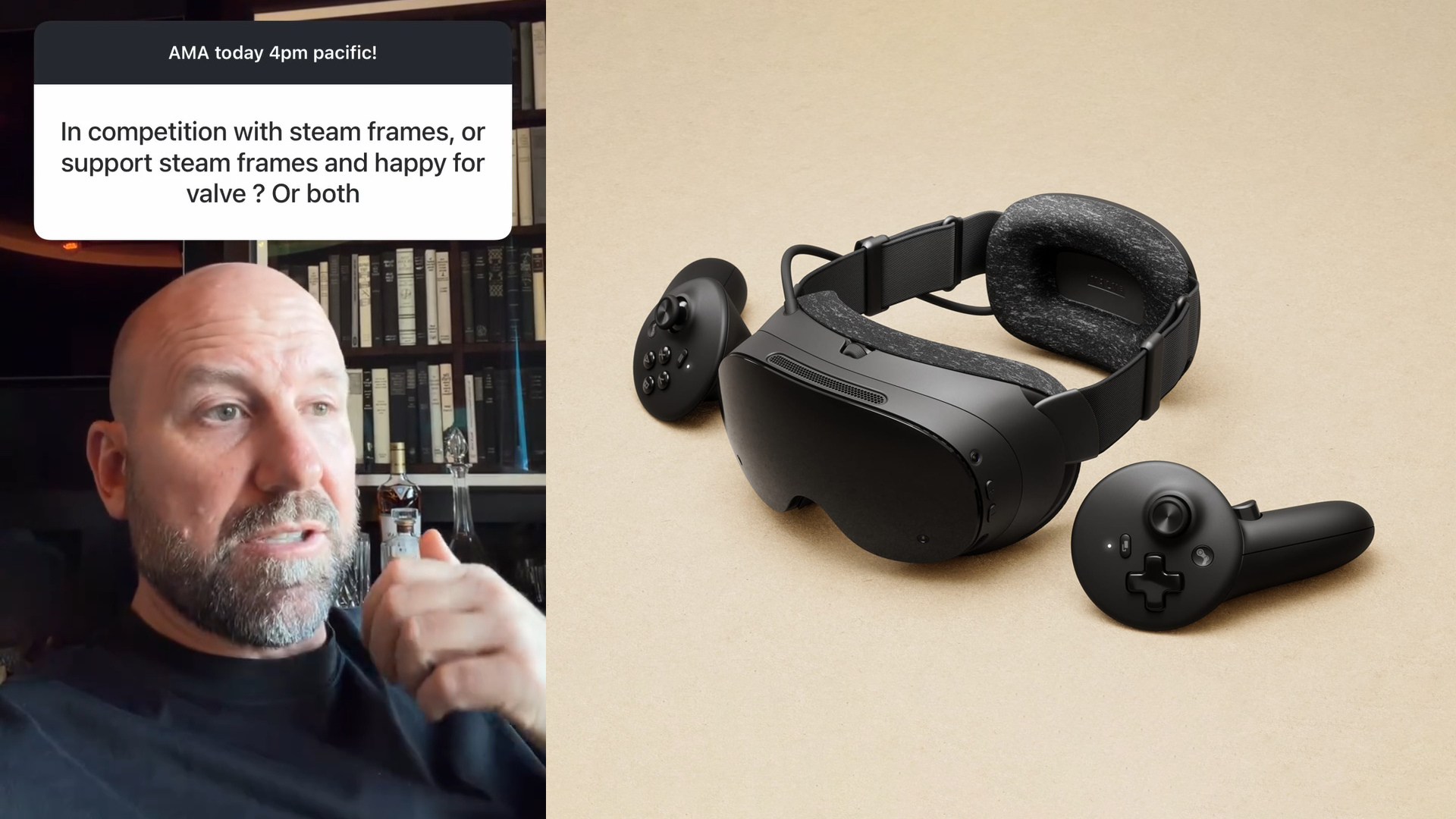
During an "ask my anything" session on his Instagram page, when asked whether Meta will be in competition with Steam Frame or "support" it, Meta CTO Andrew Bosworth replied by saying that it's "a little bit of both".

0:00
/0:59
"It is a little bit of both. I have said this before—and I will say it again, because it is really true—every time there is a new headset, we learn from it. We learn how consumers respond to the decisions made regarding architecture, resolution, and cameras. For example, with the Steam Frame, it looks like they included a wireless dongle. We experimented with a dongle many times to make a wireless link work, but we decided it was just too much hassle. They chose to go that route. If consumers love it, maybe there is a bigger market there than we realized.

Every time someone launches something new, it is an experiment that costs me nothing, which is great. Obviously, we do compete with them. Quite a few people use Quest specifically because it is not just standalone, but also capable of PC gaming. I think that is a strong value proposition: being able to use the device both with a PC and without one. However, Steam is trying to build an entire ecosystem, including portable PCs. So, ultimately, it is a little bit of both."

Bosworth has given a relatively similar answer for past VR headsets and accessories, suggesting that Meta will assess it based on how consumers respond, i.e. how well it sells. For example, he once claimed that if the Pico Trackers sold exceptionally well, Meta would "have to" make an equivalent.

"Every time someone launches something new, it is an experiment that costs me nothing, which is great", Bosworth quips in the Steam Frame response.

D-Link VR Air Bridge No Longer Works In Windows 11 24H2
D-Link’s VR Air Bridge wireless PC VR dongle, made in partnership with Meta, no longer works after Windows 11’s 24H2 update, the same update that made Windows MR headsets no longer function.
UploadVRDavid Heaney

The Meta CTO specifically points out Steam Frame's included wireless dongle as something his company tried in the past but "decided it was just too much hassle".

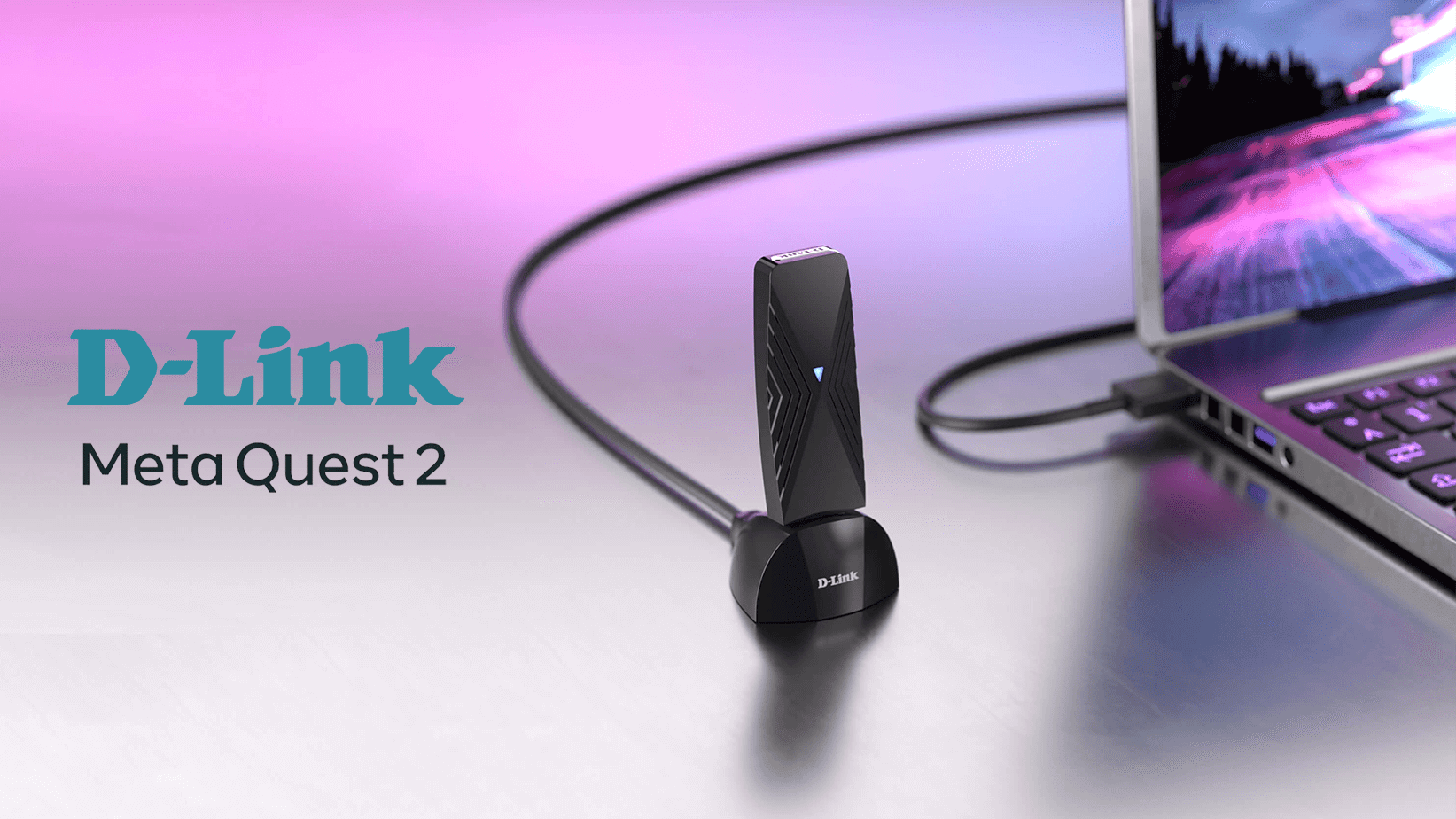
In late 2022, Meta partnered with D-Link to ship VR Air Bridge, a $100 official accessory for gaming PCs to directly connect to Quest 2 for Air Link, a somewhat similar concept. But whereas Steam Frame itself creates the hotspot that its dongle seamlessly connects to, and the headset has a dedicated 6 GHz radio for this, VR Air Bridge was a decidedly lower-effort approach, a traditional 5 GHz hotspot with a somewhat clunky setup process.

Is Bosworth right that a dongle is "too much hassle", or as with Quest Pro, is this another example of Meta deciding that a general idea is bad because its specific implementation was poor?

  •  

Meta CTO: We&#x27;re Still Investing More In VR Content Than Anyone Else

Meta CTO Andrew Bosworth claims that even after the cuts, the company is still investing more in VR content than anyone else, and more than it was 4 years ago.

If you somehow missed it: last month Meta shut down three of its acquired VR game studios, conducted significant layoffs at a fourth, canceled the Batman: Arkham Shadow sequel, and announced the shutdown of Horizon Workrooms and its Quest headsets for business offering. These actions came a month after the company officially confirmed "shifting some of our investment from Metaverse toward AI glasses and Wearables".

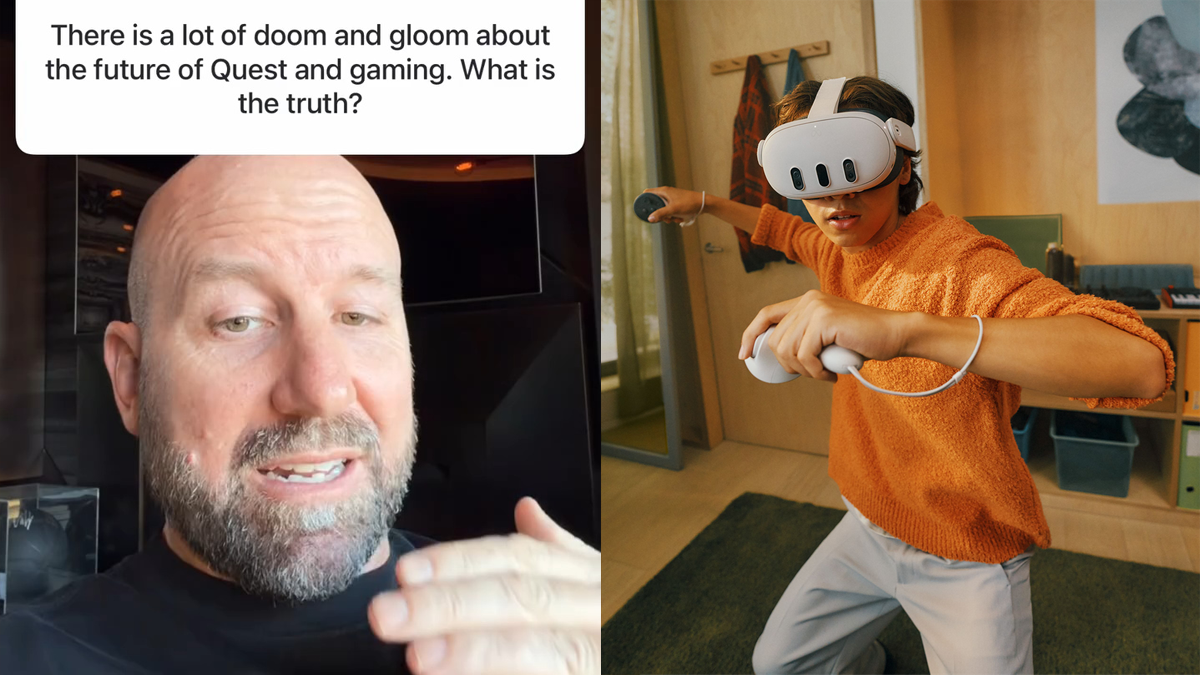
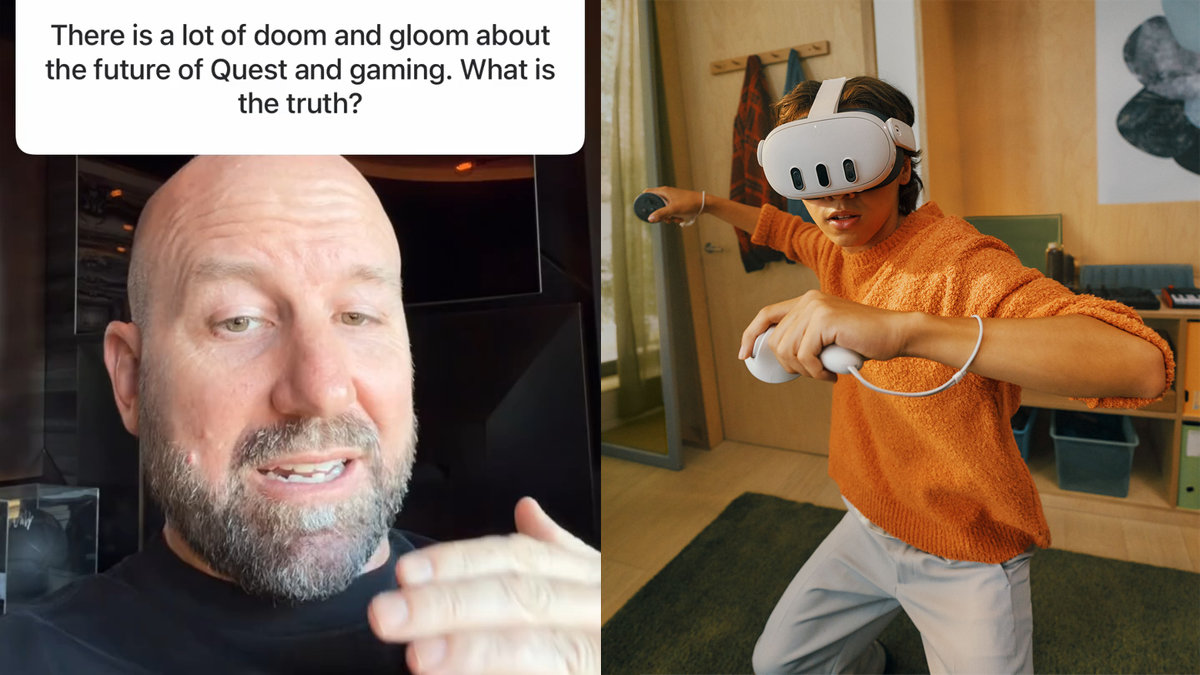
Despite this, when asked to provide "the truth" about "doom and gloom" for Quest during an "ask me anything" session on his Instagram page, Bosworth responded by claiming that Meta is still investing more in VR content than any other company – and more than it was in 2022, at the height of the Quest 2 era.

0:00
/2:37
"There is a lot of doom and gloom about it—mostly overwrought, but I understand why it exists. Emotionally, we have to navigate two realities. First, there is a real cause for sadness. We had people doing work we were excited about, whether at the OS layer or great studios delivering great titles. Ultimately, we realized that the integrated vision we were pursuing with Horizon and VR was overwrought, and the investment we put in was larger than the growth of the ecosystem allowed. That is a real loss, and we are allowed to feel sad about those things.

On the other side, Meta remains extremely bullish on VR. Adjusting our investment profile was done specifically so that we could continue to invest. We are still investing more in content than anyone else, and more than we were four years ago. While we have receded from the "high water mark," we are still very much a net positive investor in the ecosystem. Furthermore, these internal changes unblock roadmaps for us on hardware; the next two devices we are looking at are very exciting.

I don't want to take away from the sadness regarding cancelled projects like another Arkham, though I wish there was more appreciation for the fact that we got the first one. Regarding community accountability and my December AMA comments about wearables versus VR: I noted then that these areas are separate and we can do both. That remains true. If VR were growing at the rate we wished, we likely wouldn't have made these changes, but we cannot invest infinitely. Our investment must match the size of the growth. The ecosystem is growing—just more slowly than we hoped—and we are still investing. That is the story."
Meta CTO Explains Layoffs & Strategy Shift: “VR Is Growing Less Quickly Than We Hoped”
In a series of interviews at Davos, Meta CTO Andrew Bosworth explained why the company is reducing its investment in VR.
UploadVRDavid Heaney

Oculus and Anduril founder Palmer Luckey made a similar claim last month, but Bosworth saying it serves as an official proclamation from Meta itself.

Still, with most of its acquired VR gaming studios now closed, that "content" investment will not be arriving in the form of first-party blockbusters. Instead, Bosworth is likely referring to investment in third-party VR content.

In an interview with Axios last month, Bosworth said that Meta will now
"focus a lot more on the third-party content library, the ecosystem that's developed there".

Whether or not Meta will follow through on this suggestion of continuing to fund third-party VR content remains to be seen.

  •  

Meta CTO Seems To Confirm Quest 4 Is Still On The Roadmap

In an interview with Alex Heath, Meta CTO Andrew Bosworth seemed to confirm the leak that a Quest 4 is still on the roadmap.

Back in June, UploadVR reported that the 2026 candidates for a Quest 4 series, codenamed Pismo Low and Pismo High, had been canceled. Then, in December, internal Meta memos leaked that revealed the company is working on a gaming-focused headset set to be a "large upgrade" over Quest 3, but without subsidization, suggesting a notably higher price.

This, to be clear, is in addition to the widely reported ultralight mixed reality headset with a tethered puck that the memo suggested should launch in the first half of 2027.

Meta CFO: We’re “Building Future Headsets” & Still “Have Optimism” In VR
Meta CFO Susan Li says the company still has “optimism in the future of VR”, and confirmed that it’s still “building future headsets”.
UploadVRDavid Heaney

Given Meta's recent announcement of "shifting some of our investment from Metaverse toward AI glasses and Wearables", which was followed by the shutdown of three of its acquired VR game studios, significant layoffs at a fourth, the cancelation of the Batman: Arkham Shadow sequel, and the deprecation of Horizon Workrooms and its Quest headsets for business offering, many in the industry have speculated that the new Quest 4 candidate may have already been canceled.

Last month, Meta's CFO Susan Li told investors that the company still has "optimism in the future of VR", and that it's still "building future headsets". While this did spark hope of a Quest 4 still in the works, nothing in the statement confirmed what kind of headsets these were. But a recent statement from Meta's CTO Andrew Bosworth seems to.

When asked during his Davos interview with veteran tech journalist Alex Heath, which you should go watch in full, whether "the metaverse is over", Bosworth's reply included "I think it's officially leaked we've got two devices on the roadmap that we're super excited about coming out over the course of a period of time".

The "leak" Bosworth mentions is clearly the December memos – and by bringing this up now and speaking in the present tense, it strongly suggests that the gaming-focused Quest 4 candidate has not been canceled.

0:00
/0:29

Bosworth's comment from the interview with Alex Heath.

As to when we might expect these future Meta headsets, Bosworth stays tight-lipped. When pressed by Heath on what "a period of time" meant, he simply replied "a period of time - it could be anything, could be tomorrow".

Based on the leaked memos and conversations with sources back in December, UploadVR's understanding is that the ultralight headset should arrive in the first half of 2027, and the more traditional Quest 4 no earlier than the second half of 2027.

Additionally, Horizon OS firmware sleuth Luna reports that one codename floating around for the new Quest 4 is "Griffin".

One codename floating around for Meta Quest 4 is Project "Griffin"

— Luna (@Lunayian) February 5, 2026

Meanwhile, names for candidates for the ultralight headset with tethered puck have included "Puffin", "Loma", and "Phoenix".

The ultralight headset will be primarily focused on spawning virtual screens for productivity and entertainment, while the Quest 4 would continue the traditional Quest focus on immersive gaming.

Possible Name "Quest Air" "Quest 4"
Codenames Phoenix/Loma/Puffin Griffin
Form Factor Tethered Puck All-In-One
Focus Virtual Screens Immersive Gaming
Release H1 2027 Sometime Later

Keep in mind that Meta's hardware roadmap is constantly shifting, and the company frequently spins up and cancels headsets before they ship. When a specific product gets close to shipping, we'll bring you any reliable rumors of its imminent arrival. Until then, be ready for anything planned to get canceled or delayed.

  •  

Valve To &quot;Revisit&quot; Steam Frame Shipping Schedule &amp; Pricing

Valve says it needs to "revisit our exact shipping schedule and pricing" for Steam Frame and Steam Machine amid the global memory and storage shortage.

When announcing the headset and consolized PC back in November, Valve said they would ship in "early 2026". For pricing, it told UploadVR it was "aiming" to sell Steam Frame for less than the $1000 Index full-kit, and suggested that the Steam Machine would be competitive with building a PC with similar parts.

Valve Officially Announces Steam Frame, A “Streaming-First” Standalone VR Headset
Steam Frame has an included wireless adapter, and is launching “early 2026”. Read the full specs, features, and details here.
UploadVRDavid Heaney

Now, in a blog post on Steam, Valve says that while it had originally planned to share prices and release dates by now, the "limited availability and growing prices" of memory and storage mean it "must revisit" its plan for both.

"When we announced these products in November, we planned on being able to share specific pricing and launch dates by now. But the memory and storage shortages you've likely heard about across the industry have rapidly increased since then.  The limited availability and growing prices of these critical components mean we must revisit our exact shipping schedule and pricing (especially around Steam Machine and Steam Frame).

Our goal of shipping all three products in the first half of the year has not changed. But we have work to do to land on concrete pricing and launch dates that we can confidently announce, being mindful of how quickly the circumstances around both of those things can change. We will keep you updated as much as we can as we finalize those plans as soon as possible."

The company says its goal is still to ship in the first half of this year, but notes that it has "work to do" to "land on" concrete prices and launch dates.

"We will keep you updated as much as we can as we finalize those plans as soon as possible", Valve promises.

Steam Frame Hands-On: UploadVR’s Impressions Of Valve’s New Headset
UploadVR’s David Heaney and Ian Hamilton went hands-on with Steam Frame at Valve HQ, trying both standalone use and PC VR.
UploadVRDavid Heaney

If you missed it at the time, make sure to read our hands-on impressions of Steam Frame from Valve HQ in November.

  •  

Snap Spins Out AR Specs Into Its Own Subsidiary

Snap spun its Specs AR glasses into its own subsidiary, and reconfirmed that it plans to launch the consumer product this year.

"Establishing Specs Inc. as a wholly-owned subsidiary provides greater operational focus and alignment, enables new partnerships and capital flexibility including the potential for minority investment, allows us to grow a distinct brand, and supports clearer valuation of the business as we work towards the public launch of Specs later this year", the company behind Snapchat says.

The new Specs Inc subsidiary is currently hiring for nearly 100 open roles globally, it says, in preparation for the launch.

What Are Snap Spectacles & Snap Specs?

The current Snap Spectacles are $99/month AR glasses for developers ($50/month if they're students), intended to let them develop apps for the Specs consumer product the company intends to ship this year.

Spectacles have a 46° diagonal field of view, angular resolution comparable to Apple Vision Pro, relatively limited computing power, and a built-in battery life of just 45 minutes. They're also the bulkiest AR device in "glasses" form factor we've seen yet, weighing 226 grams. That's almost 5 times as heavy as Ray-Ban Meta glasses, for an admittedly entirely unfair comparison.

But Snap CEO Evan Spiegel claims that the consumer Specs will have "a much smaller form factor, at a fraction of the weight, with a ton more capability", while running all the same apps developed so far.

As such, what's been more important to keep track of, to date, is Snap OS, not the developer kit hardware.

Snap OS is relatively unique. While on an underlying level it's Android-based, you can't install APKs on it, and thus developers can't run native code or use third-party engines like Unity. Instead, they build sandboxed "Lenses", the company's name for apps, using the Lens Studio software for Windows and macOS.

In Lens Studio, developers use JavaScript or TypeScript to interact with high-level APIs, while the operating system itself handles the low-level core tech like rendering and core interactions. This has many of the same advantages as the Shared Space of Apple's visionOS: near-instant app launches, interaction consistency, and easy implementation of shared multi-user experiences without friction. It even allows the Spectacles mobile app to be used as a spectator view for almost any Lens.

Snap OS doesn't support multitasking, but this is more likely a limitation of the current hardware than the operating system itself.

Snap OS 2.0 Brings The AR Glasses Closer To Consumer-Ready
Snap OS 2.0 is out now, adding and improving first-party apps like Browser, Gallery, and Spotlight to bring the AR platform closer to being ready for consumers.
UploadVRDavid Heaney

Since releasing Snap OS in the latest Spectacles kit in late 2024, Snap has repeatedly added new capabilities for developers building Lenses, and late last year launched Snap OS 2.0, adding and improving first-party apps like Browser, Gallery, and Spotlight to bring the AR platform closer to being ready for consumers.

  •  
❌