The Starlab commercial space station has fully booked its commercial payload space as the joint venture developing it awaits the next phase of a NASA program.
The head of NOAA’s satellite division, on administrative leave for more than half a year, warned that workforce reductions and cuts to science programs have “lobotomized” the federal government.
Learn how ALMA observations revealed unusually high levels of methanol in interstellar comet 3I/ATLAS and what the molecule’s chemistry may reveal about how icy bodies form around other stars.
Learn how ancient DNA and isotope analysis revealed that Amazon parrots were transported alive across the Andes to coastal Peru in a pre-Inca trade network.
When a satellite travels through orbit at up to 17,500 mph, a fraction of a second can determine whether a course correction is successful, as even minor trajectory deviations can […]
When I started my physics degree, I knew it could open the door to a range of career opportunities, but I wasn’t sure what path it would take me down. In the end, it was the optional modules that encouraged my interest in nuclear energy physics, steering me towards my current job as a nuclear safety engineer.
When I was looking at university degrees, I thought about studying chemical engineering, but my A-level physics teacher inspired me to consider physics instead. I’d always been fascinated with the subject, and enjoyed maths (and a challenge) too, so I thought why not give it a go.
I went on to study physics at the University of Liverpool, graduating in 2021. I absolutely loved the city and would highly recommend it to anyone considering physics – or any degree, for that matter. The campus is fantastic and Liverpool is an amazing place to be a student.
My undergraduate experience was incredibly rewarding. I met some of my closest friends and had countless memorable adventures. While the course was challenging at times, I have no regrets about choosing physics. I particularly enjoyed being able to pick specialist optional modules as it meant I could follow my interest in applied physics with topics such as nuclear power and medical physics.
Making a difference
In my final year, I started doing the obligatory job applications for those wanting to go into industry. But after receiving some rejections, I decided to explore an opportunity outside of science and ended up working for nearly a year in the charity sector as a Climate Action intern. There I undertook research projects related to decolonization in international development, and anti-racism and social justice, supporting the delivery of international development programmes.
While my time at Climate Action was rewarding and worthwhile, I wanted to move back into science and use my degree. Nuclear physics had been an area of interest for me since school, and my modules at university had encouraged that, so I turned my attention to the nuclear energy sector. Having worked for a charity, I was keen to find an organization whose values aligned with mine. Employee-owned engineering, management and development consultancy, Mott MacDonald, caught my eye, with its commitment to net zero, social outcomes and the UN’s Sustainable Development Goals.
I joined the the company’s three-year graduate scheme and, although I didn’t have any direct experience in safety, was offered a graduate nuclear safety position. It is a great role that ties in skills from my degree and my interest in nuclear while still presenting challenges and an opportunity to learn.
After two years at Mott MacDonald, I won Graduate of the Year at the UK Nuclear Skills Awards 2024. My colleagues had kindly nominated me, recognizing my dedication and drive, and the contribution I’d made to the organization. This opportunity was highly valuable for me and elevated my profile not only at Mott MacDonald but also within the sector. Then, after only two and half years in the graduate scheme, I was promoted to my current position of nuclear safety engineer.
My role focuses on developing nuclear safety cases – comprehensive sets of documents that assess and demonstrate the safety of nuclear facilities. With support from our wider team, the work involves analysing potential hazards and risks, outlining safety measures, and presenting a structured, evidence-based argument that the facility is safe for operation. I’ve worked on a variety of different projects including small modular reactors, nuclear medicine and flood alleviation schemes.
A typical day for me involves project meetings, writing safety reports, conducting hazard identification studies, and reviewing documents. A key aspect of the work is identifying, assessing and effectively controlling all project-related risks.
Wealth of opportunity Natasha Khan believes that now is a great time to join the nuclear industry. (Courtesy: US Nuclear Regulatory Commission)
Beyond my technical role at Mott MacDonald, I am the programme director for our internal Women in Nuclear Network, and co-vice chair of the company’s Advancing Race and Culture Network. These positions allow me to contribute to a range of equality, diversity and inclusion (EDI) initiatives. Creating an inclusive environment is important to allow people the space to be authentically themselves, share and bring diverse perspectives and feel psychologically safe. This is a big driver for me – by supporting equity and equal opportunities, I am helping ensure others like me have role models in the sector.
A nuclear skillset
Physics plays a crucial role in nuclear safety by providing the fundamental principles underlying nuclear processes. Studying nuclear physics at university has helped me understand and analyse reactor behaviour, radiation effects and potential hazards. This knowledge forms the basis for designing nuclear facility safety systems, for the protection of the workforce, environment and general public.
Throughout my degree, I also developed transferable skills such as analytical thinking, logical problem-solving and teamwork, all of which I apply daily in my role. As a safety-case engineer, I work as part of a team, and collaborate with specialists across fields, including process engineering, mechanical engineering and radioactive waste management. My ability to work effectively in teams and maintain strong interpersonal relationships has been key to success in my role.
I would encourage other physics students to explore a career in the nuclear industry
Applying my research and scientific report writing skills I developed at university, I can identify relevant information for safety-case updates, and present safety claims, arguments and evidence in a way that is understandable to a broad, non-specialist audience.
I also mentor and support more junior colleagues with various project and non-project related issues. Skills like critical thinking and the ability to tailor my communication style directly influence how I approach my work and support others.
I would encourage other physics students to explore a career in the nuclear industry. It offers a broad range of career paths, and the opportunity to contribute to some of the most diverse, exciting and challenging projects within the energy sector. You don’t need an engineering background to have a career in nuclear – there are many ways to contribute including beyond the technical route. As physicists we have a wide range of transferable skills, often more than we realize, making us highly adaptable and valuable in this sector.
It’s an incredible time to join the nuclear industry. With advancements like Sizewell C, small modular reactors, and cutting-edge medical nuclear-research facilities, there’s a wealth of diverse projects happening right now to get involved in. I hadn’t planned on a career in nuclear safety, but honestly, I’m really glad my path led this way. I am passionate about driving innovative nuclear solutions, and support progress towards reduced emissions and the global transition to net zero.
While I may be early on in my nuclear career, I have already worked on some interesting projects and met fantastic people. Now, I’m going through a structured training programme at Mott MacDonald to help me achieve chartership status with the Institute of Physics. I look forward to seeing what the future has to offer.
Particle therapy is an incredibly powerful cancer treatment. But it is also an incredibly expensive option that relies on massive, bulky accelerator systems. As such, in 2025 there were only 137 proton and carbon-ion therapy facilities in operation worldwide. So how can more people benefit?
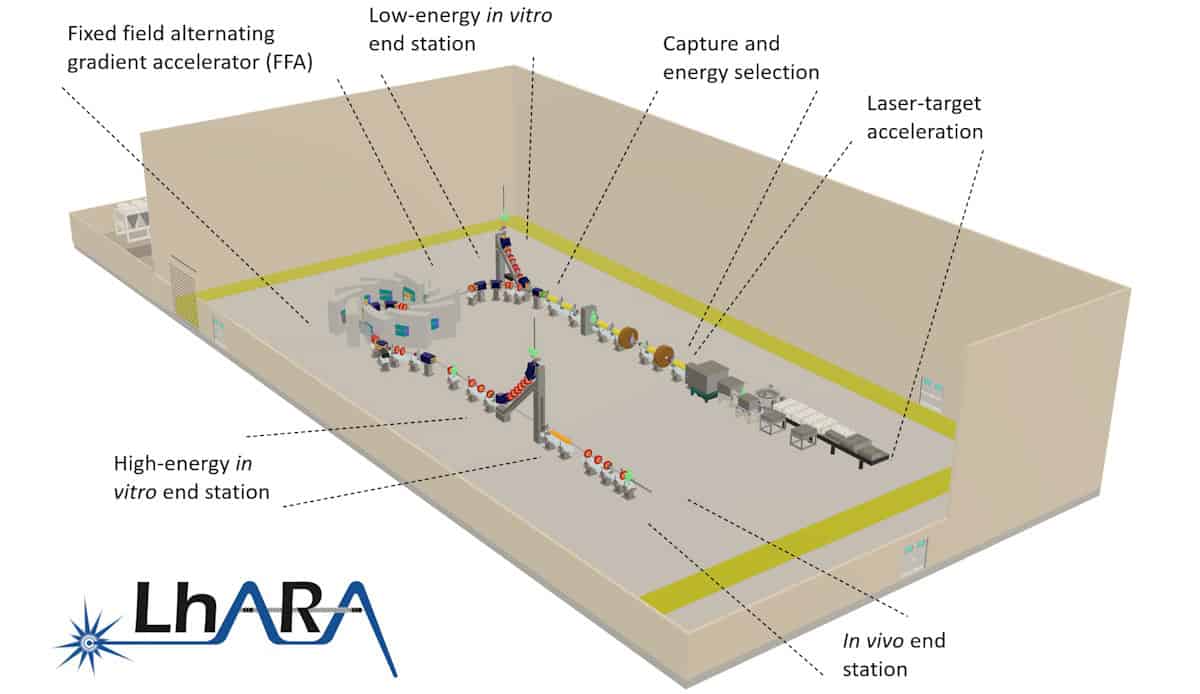
Hoping to resolve this challenge, the LhARA collaboration is investigating a new take on particle therapy delivery: a laser-hybrid accelerator for radiobiological applications. The idea is to use laser-driven proton and ion beams to create a compact, high-throughput treatment facility to advance our understanding of cancer and its response to radiation (see: “A novel hybrid design”).
Last month, in the first of a series of CP4CT workshops, experts in the field came together at Imperial College London to discuss the potential advantages of laser-driven charged particles. The workshop aimed to examine the current status of particle therapy technology, assess how the unique properties of laser-driven beams could revolutionize particle therapy, and identify the key research needed to develop personalized cancer therapy with laser-driven ions.
“We want to lay the foundation for the transformation of ion beam therapy,” said Kenneth Long (Imperial College London/STFC), who co-organized the event together with Richard Amos (University College London). “We are aiming to engage with the communities that we will target when the technology is mature.”
A novel hybrid design
LhARA uses a high-power, fast-pulsed laser to create high-flux proton and ion beams with arbitrary spatial and time structures, such as bunches as short as 10 to 40 ns. The beams are captured and focused by a novel electron-plasma lens, and then accelerated using a fixed-field alternating gradient accelerator, to energies of 15–127 MeV for protons and 5–34 MeV/u for ion beams.
Courtesy: LhARA collaboration
The LhARA team recently completed its conceptual design report for the proposed new accelerator facility and is now running radiobiology programmes to prove the feasibility of laser-driven hybrid acceleration, for both radiation biology and clinical studies.
Particle therapy today
The day’s first speaker, Alejandro Mazal (Centro de Protonterapia Quirónsalud) pointed out that despite huge clinical potential, only about 400,000 patients have been treated with proton therapy to date (and 65,000 with carbon ions), with a typical saturation of about 250 patients per year per treatment room. To increase this throughput, factors such as image guidance, adaptive tools, uptime and modularity for upgrades could prove vital.
Mazal cited some development priorities to address, including cost control, vendor robustness, system reliability and throughput optimization. It’s also vital to consider biological modulation techniques, integration into hospitals and generation of clinical evidence. “We used to say that randomized trials are not ethical with particle therapy but this is not always true, evidence must guide expansion,” he said.
Mazal emphasized that technology itself is not the endpoint, but that specifications must be driven by clinical benefit. “The goal is to be transformative, but only when we can measure a clinical value,” he explained.
Sandro Rossi (CNAO) then presented an update on the latest developments at the National Centre of Oncological Hadronotherapy (CNAO) in Italy. Since starting clinical treatments in 2011, the facility has now treated over 6000 patients – roughly half with protons and half with carbon ions. He noted that for some of the most challenging tumours, CNAO’s particle therapy delivered considerably better local tumour control than achieved by conventional X-ray treatments.
CNAO is also a research facility, currently hosting 17 funded research projects and seven active clinical trials. Looking forward, an expansion project will see the centre commission an additional proton therapy gantry, introduce boron neutron capture therapy (BNCT) and install an upright positioning system (from Leo Cancer Care) in one of the treatment rooms.
The killer biological questions
In parallel with the development of laser-based accelerators, researchers are investigating various radiobiological modulation strategies that could enhance the impact of particle therapy. The workshop examined three such options: proton minibeams, FLASH irradiation and combination with immunotherapies.
Minibeam therapy uses an array of submillimetre-sized radiation beams to deliver a pattern of alternating high-dose peaks and low-dose valleys. This spatially fractionated dose greatly reduces treatment toxicity while providing excellent tumour control, as demonstrated in extensive preclinical experiments.
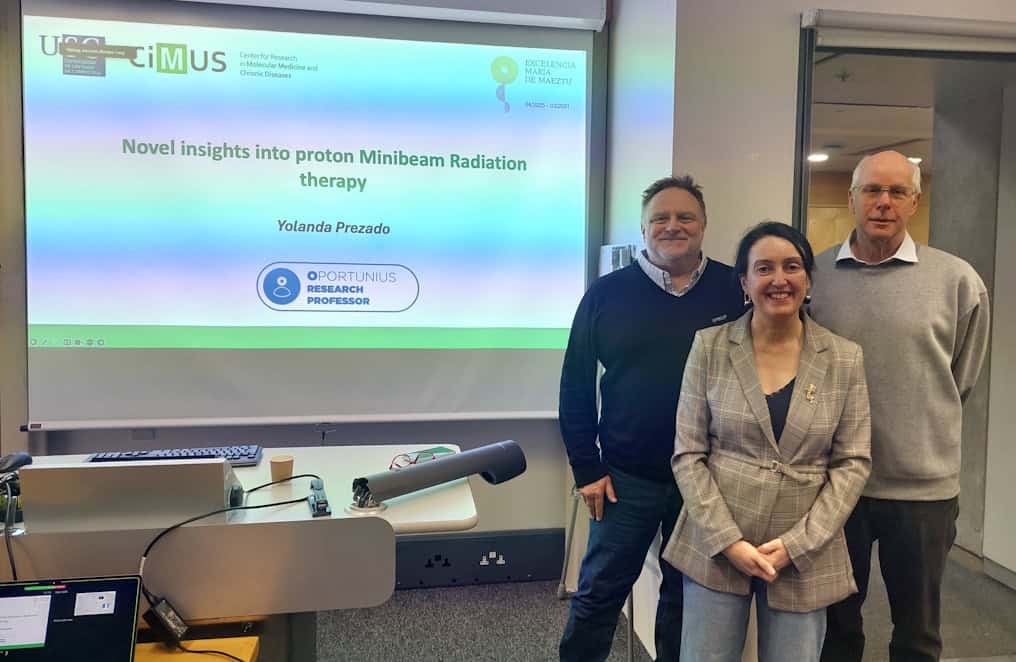
Strategic discussions Left to right: Richard Amos, Yolanda Prezado and Kenneth Long. (Courtesy: Tami Freeman)
The first patient treatments (using X-ray minibeams) took place in 2024, and clinical investigations on proton minibeams are just starting, explained Yolanda Prezado (CiMUS). Recent studies revealed that minibeams induce a favourable immune response, with high T cell infiltration, vascular renormalization and reduced hypoxia dependence. Further evaluation is essential to explore the underlying radiobiological mechanisms, but Prezado noted that existing accelerators are limited in their ability to modulate treatment beams.
“It would be really interesting to have a system where we can flexibly vary all of the parameters to understand all of these techniques; LhARA could be a very interesting facility for this,” she suggested.
As for the second option, FLASH therapy, this is an emerging treatment approach in which radiation delivery at ultrahigh dose rates reduces normal tissue damage while effectively killing cancer cells. But how the FLASH effect works, and how to optimize this approach, remain key questions.
Joao Seco (DKFZ) presented a novel interpretation of FLASH, focusing on radiation chemistry and emphasizing the role of H2O2 generation in the FLASH process. Production of H2O2, a key molecule in cell damage, depends on the activity of a particular enzyme called superoxide dismutase 1 (SOD1). Seco hypothesized that inhibiting SOD1 could control H2O2 production and thus control cellular damage, effectively mimicking the FLASH effect.
“Forget radiation biology, we are missing a key component: redox chemistry,” he said. “If we know the redox chemistry, we can predict the response before we give radiotherapy.”
Marco Durante (GSI) suggested that the most urgent challenge for radiotherapy may be to combine it with immunotherapy, noting that charged particle beams offer both physical and biological advantages to achieve this. Citing various trials of combined immunotherapy and X-ray-based radiotherapy for cancer treatment, he showed some impressive examples of the benefit of the combination, but also cases with negative results.
“The question to understand is why doesn’t it always work,” he explained, suggesting that this may be due to the timing and sequencing of the two therapies, the fractionation scheme or biological factors. But perhaps a more promising approach would be to combine immunotherapy with particle therapy, he said, sharing examples where immunotherapy plus carbon-ions had better clinical outcomes than combinations with X-ray radiotherapy.
This superior outcome may arise from the various biological advantages of high-LET irradiation. Alongside, the lower integral dose from particle therapy compared with X-rays results in less lymphopenia (a low level of white blood cells), which is indicative of improved prognosis.
“Pre-clinical studies are essential to address timing and sequencing,” he concluded. “We also need more clinical trials to determine the impact of physical and biological properties of charged particles in radioimmunotherapy.”
Democratizing access
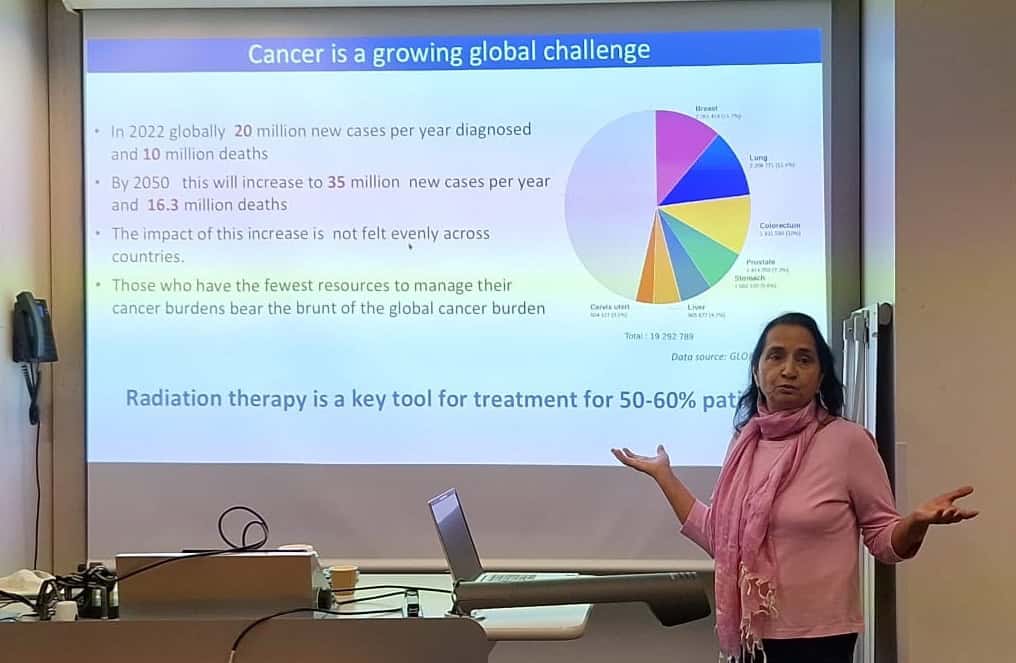
Manjit Dosanjh (University of Oxford) discussed the continuing need to increase global access to radiotherapy, noting that while radiotherapy is a key tool for over 50% of cancer patients, not all countries have access to sufficient treatment systems, nor to the expert personnel needed to run them.
Across Africa, for instance, there is just one linac per 3.5 million people, in stark contrast to the one per 86, 000 people in the US. Many European countries also lack sufficient quality or quantity of radiotherapy facilities – a disparity that’s mirrored in terms of access to CT scanners, oncologists and medical physicists, which must be addressed in tandem. “If we could improve imaging, treatments and care quality, we could prevent 9.6 million deaths per year worldwide,” Dosanjh said.
Addressing global disparity Manjit Dosanjh emphasized the importance of collaborations in improving access to cancer therapy. (Courtesy: Alex Gerbershagen)
She described some initiatives designed to encourage collaboration and increase access, including ENLIGHT, the European Network for Light Ion Hadron Therapy. Launched in 2002 at CERN, ENLIGHT brings together clinicians, physicists, biologists and engineers working within particle therapy to develop new technologies and provide training, education and access to beams to move the field forward.
More recently, the STELLA (smart technologies to extend lives with linear accelerators) project was established to create a cost-effective, robust radiotherapy linac with lower staff requirements and maximal uptime. A global collaboration, STELLA aims to expand access to high-quality cancer treatment for all patients via innovative transformation of the treatment system, as well as providing training, education and mentoring.
Dosanjh also introduced SAPPHIRE, a UK-led initiative that partners with institutions in Ghana and South Africa to strengthen radiotherapy services across Africa. She stressed that improving access to radiotherapy is a big challenge that can only be achieved by building really good collaborations. “Collaboration is the invisible force that makes the impossible possible,” she said.
Konrad Nesteruk (Harvard) continued the theme of democratizing particle therapy, noting that advancement of beam technologies calls for innovations in space (the facility size), time (both irradiation and total treatment time) and dose (via techniques such as FLASH, proton arc and minibeams). All of these factors interact to create a multidimensional optimization problem, he explained.
The final speaker in this session, Rock Mackie (University of Wisconsin) examined how to translate innovative radiotherapy technology into clinical practice. Academia is the source of breakthrough ideas, he said, but most R&D is funded and refined by companies. And forming a company involves a series of key tasks: identifying an important problem; developing a technical solution; patenting it; customer testing; and procuring investment. If this final stage doesn’t happen, Mackie remarked, it wasn’t an important enough problem.
In particle therapy, the main problems are size and cost limiting patient access, a lack of effective imaging solutions and the fact that the gain in therapeutic ratio does not compensate for increased costs. Aiming to solve these problems, Mackie co-founded Leo Cancer Care in 2018 to commercialize an upright patient positioning system and CT scanner. This approach enables a proton therapy machine to fit into a photon vault, as well as easing patient positioning, thus reducing installation costs while simultaneously increasing throughput.
Mackie applied this startup scenario to LhARA. Here, the problem to solve is achieving high-energy, multi-ion, high-intensity beams for radiotherapy, FLASH, spatial fractionation and proton imaging. The solution is the development of a low-cost particle accelerator that meets all of these needs and fits in a single-storey vault. He also emphasized the importance of consulting with as many potential customers as time permits before defining specifications.
“The most important problem is finding a big enough problem to solve,” he concluded. “It will find a market if the product is less costly, works better and is easier to use.”
Development roadmap
Alexander Gerbershagen (PARTREC) told delegates about PARTREC, the particle therapy research centre at the University Medical Center Groningen. The facility’s superconducting accelerator, AGOR, provides protons with energies up to 190 MeV, as well as ion beams of all elements up to xenon. Ongoing projects at PARTREC include: developing glioblastoma treatments using boron proton capture therapy (NuCapCure); production of terbium isotopes for theranostics; image-guided pharmacotherapy using photon-activated drugs; and real-time in vivo verification of proton therapy dose.
The day closed with a look at the potential of LhARA as an international research facility. Kenneth Long emphasized the importance of investigating how ionizing radiation interacts with tissue, in vivo and in vitro, while considering all of the factors that may impact outcome. This includes time and space domains, different ion species and energies, and combinations with chemo- and immunotherapy. “If one flexible beam facility can do all that, it’s a substantial opportunity for a step change in understanding,” he said.
Long presented some initial cell irradiations using laser-driven beams at the SCAPA research centre in Strathclyde, and noted that component optimization is also underway in Swansea. He also shared designs for the envisaged research facility, with various in vivo and in vitro end-stations and robotic automation to move experiments around. “We have written a mission statement, now our business is to execute that programme,” he concluded.
NASA’s Commercial Crew Program was supposed to be the template: services-based procurement, private ownership of hardware and competition between providers. Yet NASA has now formally designated Boeing’s 2024 Starliner crewed test flight as a Type A mishap — its most serious category — and leadership has been explicit that the most troubling failure was not […]
Denver-based Lux Aeterna has secured $10 million in seed funding to develop a reusable satellite designed to survive atmospheric reentry and fly again with new payloads, starting with a demonstration flight slated for early 2027.
Chinese launch startup Landspace says it has completed a long-duration full-system hot-fire test of its new 220-ton-class methane rocket engine for new-generation launchers.
 Connexion