A proposed European Union space law could cost both European and American space companies hundreds of millions of euros in lost revenue annually, according to a new study.
NASA has extended an agreement with a nonprofit organization to manage the portion of the International Space Station designated as a national laboratory, likely for the final time.
As a physicist in industry, I spend my days developing new types of photovoltaic (PV) panels. But I’m also keen to do something for the transition to green energy outside work, which is why I recently installed two PV panels on the balcony of my flat in Munich. Fitting them was great fun – and I can now enjoy sunny days even more knowing that each panel is generating electricity.
However, the panels, which each have a peak power of 440 W, don’t cover all my electricity needs, which prompted me to take an interest in a plan to build six wind turbines in a forest near me on the outskirts of Munich. Curious about the project, I particularly wanted to find out when the turbines will start generating electricity for the grid. So when I heard that a weekend cycle tour of the site was being organized to showcase it to local residents, I grabbed my bike and joined in.
As we cycle, I discover that the project – located in Forstenrieder Park – is the joint effort of four local councils and two “citizen-energy” groups, who’ve worked together for the last five years to plan and start building the six turbines. Each tower will be 166 m high and the rotor blades will be 80 m long, with the plan being for them to start operating in 2027.
I’ve never thought of Munich as a particularly windy city, but at the height at which the blades operate, there’s always a steady, reliable flow of wind.
I’ve never thought of Munich as a particularly windy city. But tour leader Dieter Maier, who’s a climate adviser to Neuried council, explains that at the height at which the blades operate, there’s always a steady, reliable flow of wind. In fact, each turbine has a designed power output of 6.5 MW and will deliver a total of 10 GWh in energy over the course of a year.
Practical questions
Cycling around, I’m excited to think that a single turbine could end up providing the entire electricity demand for Neuried. But installing wind turbines involves much more than just the technicalities of generating electricity. How do you connect the turbines to the grid? How do you ensure planes don’t fly into the turbines? What about wildlife conservation and biodiversity?
At one point of our tour, we cycle round a 90-degree bend in the forest and I wonder how a huge, 80 m-long blade will be transported round that kind of tight angle? Trees will almost certainly have to be felled to get the blade in place, which sounds questionable for a supposedly green project. Fortunately, project leaders have been working with the local forest manager and conservationists, finding ways to help improve the local biodiversity despite the loss of trees.
As a representative of BUND (one of Germany’s biggest conservation charities) explains on the tour, a natural, or “unmanaged”, forest consists of a mix of areas with a higher or lower density of trees. But Forstenrieder Park has been a managed forest for well over a century and is mostly thick with trees. Clearing trees for the turbines will therefore allow conservationists to grow more of the bushes and plants that currently struggle to find space to flourish.
Cut and cover Trees in Forstenrieder Park have had to be chopped down to provide room for new wind turbines to be installed, but the open space will let conservationists grow plants and bushes to boost biodiversity. (Courtesy: Janina Moereke)
To avoid endangering birds and bats native to this forest, meanwhile, the turbines will be turned off when the animals are most active, which coincidentally corresponds to low wind periods in Munich. Insurance costs have to be factored in too. Thankfully, it’s quite unlikely that a turbine will burn down or get ice all over its blades, which means liability insurance costs are low. But vandalism is an ever-present worry.
In fact, at the end of our bike tour, we’re taken to a local wind turbine that is already up and running about 13 km further south of Forstenrieder Park. This turbine, I’m disappointed to discover, was vandalized back in 2024, which led to it being fenced off and video surveillance cameras being installed.
But for all the difficulties, I’m excited by the prospect of the wind turbines supporting the local energy needs. I can’t wait for the day when I’m on my balcony, solar panels at my side, sipping a cup of tea made with water boiled by electricity generated by the rotor blades I can see turning round and round on the horizon.
A House hearing on the rise of China’s space program turned into a broader critique of U.S. space policy, including NASA’s current approach to returning astronauts to the moon.
Learn how a unique combination of anatomical traits and CT-scan data led researchers to classify Chromeornis as a new dinosaur species — and reconstruct the behavior behind its unusual death.
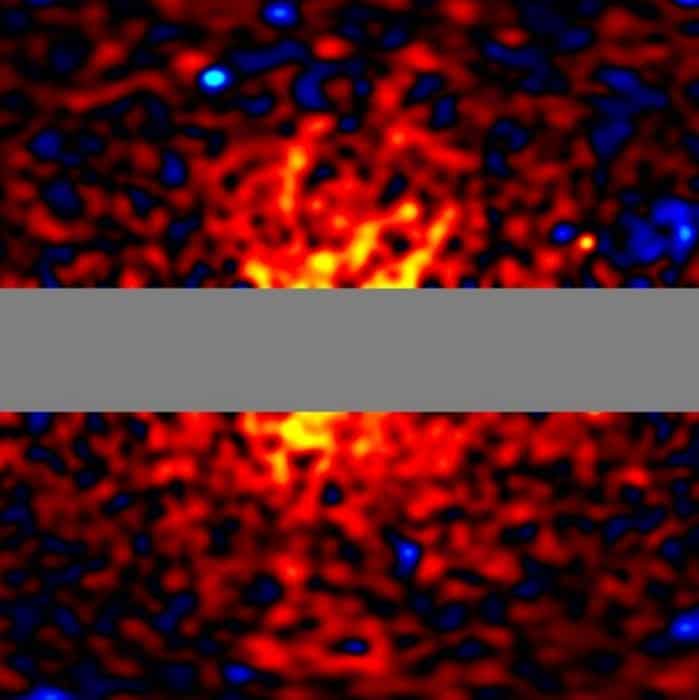
Excess radiation Gamma-ray intensity map excluding components other than the halo, spanning approximately 100° in the direction of the centre of the Milky Way. The blank horizontal bar is the galactic plane area, which was excluded from the analysis to avoid strong astrophysical radiation. (Courtesy: Tomonori Totani/The University of Tokyo)
Gamma rays emitted from the halo of the Milky Way could be produced by hypothetical dark-matter particles. That is the conclusion of an astronomer in Japan who has analysed data from NASA’s Fermi Gamma-ray Space Telescope. The energy spectrum of the emission is what would be expected from the annihilation of particles called WIMPs. If this can be verified, it would mark the first observation of dark matter via electromagnetic radiation.
Since the 1930s astronomers have known that there is something odd about galaxies, galaxy clusters and larger structures in the universe. The problem is that there is not nearly enough visible matter in these objects to explain their dynamics and structure. A rotating galaxy, for example, should be flinging out its stars because it does not have enough self-gravitation to hold itself together.
Today, the most popular solution to this conundrum is the existence of a hypothetical substance called dark matter. Dark-matter particles would have mass and interact with each other and normal matter via the gravitational force, gluing rotating galaxies together. However, the fact that we have never observed dark matter directly means that the particles must rarely, if ever, interact via the other three forces.
Annihilating WIMPs
The weakly interacting massive particle (WIMP) is a dark-matter candidate that interacts via the weak nuclear force (or a similarly weak force). As a result of this interaction, pairs of WIMPs are expected to occasionally annihilate to create high-energy gamma rays and other particles. If this is true, dense areas of the universe such as galaxies should be sources of these gamma rays.
Now, Tomonori Totani of the University of Tokyo has analysed data from the Fermi telescope and identified an excess of gamma rays emanating from the halo of the Milky Way. What is more, Totani’s analysis suggests that the energy spectrum of the excess radiation (from about 10−100 GeV) is consistent with hypothetical WIMP annihilation processes.
“If this is correct, to the extent of my knowledge, it would mark the first time humanity has ‘seen’ dark matter,” says Totani. “This signifies a major development in astronomy and physics,” he adds.
While Totani is confident of his analysis, his conclusion must be verified independently. Furthermore, work will be needed to rule out conventional astrophysical sources of the excess radiation.
Catherine Heymans, who is Astronomer Royal for Scotland told Physics World, “I think it’s a really nice piece of work, and exactly what should be happening with the Fermi data”. The research is described in Journal of Cosmology and Astroparticle Physics. Heymans describes Totani’s paper as “well written and thorough”.
Orbex received far less funding than the other four ESA European Launcher Challenge companies after the U.K. deferred a decision on funding allocations.
China could be without emergency launch capability to Tiangong space station for months, leaving no rapid-response option for any new crisis following the Shenzhou-20 incident.
At next year’s World Radiocommunications Conference (WRC-25), governments will face a choice that goes to the heart of how we monitor our warming planet. Some regulators are wondering whether to […]
Projections for the booming space economy often come with trillion-dollar headlines, but the lion’s share of near-term revenue looks destined for just a handful of massive constellations with the funds to invest in vertical integration. It’s relatively slim pickings for the many other manufacturers, launch providers and technology suppliers hoping to ride the wave. Manufacturing […]
 Connexion