↩ Accueil

Vue lecture

The “Stealth” Strategy Pays Off: UARX Space Emerges as Europe’s High-Reliability Powerhouse

NIGRÁN, Spain — While much of the European NewSpace ecosystem has spent the last five years in a cycle of public fundraising and prototype announcements, UARX Space took a different […]

The post The “Stealth” Strategy Pays Off: UARX Space Emerges as Europe’s High-Reliability Powerhouse appeared first on SpaceNews.

  •  

Uranus and Neptune may be more rocky than icy, say astrophysicists

Our usual picture of Uranus and Neptune as “ice giant” planets may not be entirely correct. According to new work by scientists at the University of Zürich (UZH), Switzerland, the outermost planets in our solar system may in fact be rock-rich worlds with complex internal structures – something that could have major implications for our understanding of how these planets formed and evolved.

Within our solar system, planets fall into three categories based on their internal composition. Mercury, Venus, Earth and Mars are deemed terrestrial rocky planets; Jupiter and Saturn are gas giants; and Uranus and Neptune are ice giants.

An agnostic approach

The new work, which was led by PhD student Luca Morf in UZH’s astrophysics department, challenges this last categorization by numerically simulating the two planets’ interiors as a mixture of rock, water, hydrogen and helium. Morf explains that this modelling framework is initially “agnostic” – meaning unbiased – about what the density profiles of the planets’ interiors should be. “We then calculate the gravitational fields of the planets so that they match with observational measurements to infer a possible composition,” he says.

This process, Morf continues, is then repeated and refined to ensure that each model satisfies several criteria. The first criteria is that the planet should be in hydrostatic equilibrium, meaning that its internal pressure is enough to counteract its gravity and keep it stable. The second is that the planet should have the gravitational moments observed in spacecraft data. These moments describe the gravitational field of a planet, which is complex because planets are not perfect spheres.

The final criteria is that the modelled planets need to be thermodynamically and compositionally consistent with known physics. “For example, a simulation of the planets’ interiors must obey equations of state, which dictate how materials behave under given pressure and temperature conditions,” Morf explains.

After each iteration, the researchers adjust the density profile of each planet and test it to ensure that the model continues to adhere to the three criteria. “We wanted to bridge the gap between existing physics-based models that are overly constrained and empirical approaches that are too simplified,” Morf explains. Avoiding strict initial assumptions about composition, he says, “lets the physics and data guide the solution [and] allows us to probe a larger parameter space.”

A wide range of possible structures

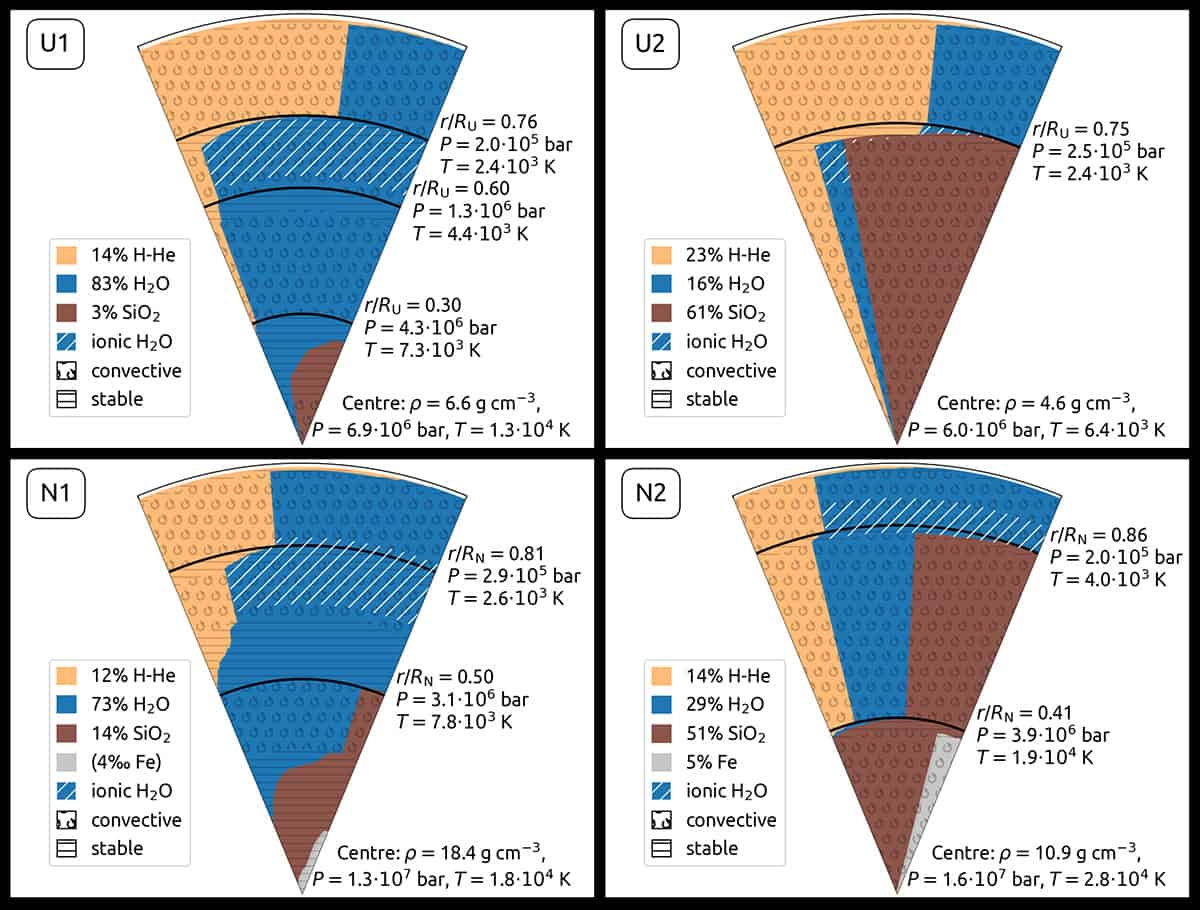
Based on their models, the UZH astrophysicists concluded that the interiors of Uranus and Neptune could have a wide range of possible structures, encompassing both water-rich and rock-rich configurations. More specifically, their calculations yield rock-to-water ratios of between 0.04-3.92 for Uranus and 0.20-1.78 for Neptune.

Diagrams showing possible "slices" of Uranus and Neptune. Four slices are shown, two for each planet. Each slice is filled with brown areas representing silicon dioxide rock and blue areas representing water ice, plus smaller areas of tan colouring for hydrogen-helium mixtures and (for Neptune only) grey areas representing iron. Two slices are mostly blue, while the other two contain large fractions of brown.
Slices of different pies: According to models developed with “agnostic” initial assumptions, Uranus (top) and Neptune (bottom) could be composed mainly of water ice (blue areas), but they could also contain substantial amounts of silicon dioxide rock (brown areas). (Courtesy: Luca Morf)

The models, which are detailed in Astronomy and Astrophysics, also contain convective regions with ionic water pockets. The presence of such pockets could explain the fact that Uranus and Neptune, unlike Earth, have more than two magnetic poles, as the pockets would generate their own local magnetic dynamos.

Traditional “ice giant” label may be too simple

Overall, the new findings suggest that the traditional “ice giant” label may oversimplify the true nature of Uranus of Neptune, Morf tells Physics World. Instead, these planets could have complex internal structures with compositional gradients and different heat transport mechanisms. Though much uncertainty remains, Morf stresses that Uranus and Neptune – and, by extension, similar intermediate-class planets that may exist in other solar systems – are so poorly understood that any new information about their internal structure is valuable.

A dedicated space mission to these outer planets would yield more accurate measurements of the planets’ gravitational and magnetic fields, enabling scientists to refine the limited existing observational data. In the meantime, the UZH researchers are looking for more solutions for the possible interiors of Uranus and Neptune and improving their models to account for additional constraints, such as atmospheric conditions. “Our work will also guide laboratory and theoretical studies on the way materials behave in general at high temperatures and pressures,” Morf says.

The post Uranus and Neptune may be more rocky than icy, say astrophysicists appeared first on Physics World.

  •  

String-theory concept boosts understanding of biological networks

Many biological networks – including blood vessels and plant roots – are not organized to minimize total length, as long assumed. Instead, their geometry follows a principle of surface minimization, following a rule that is also prevalent in string theory. That is the conclusion of physicists in the US, who have created a unifying framework that explains structural features long seen in real networks but poorly captured by traditional mathematical models.

Biological transport and communication networks have fascinated scientists for decades. Neurons branch to form synapses, blood vessels split to supply tissues, and plant roots spread through soil. Since the mid-20th century, many researchers believed that evolution favours networks that minimize total length or volume.

“There is a longstanding hypothesis, going back to Cecil Murray from the 1940s, that many biological networks are optimized for their length and volume,” Albert-László Barabási of Northeastern University explains. “That is, biological networks, like the brain and the vascular systems, are built to achieve their goals with the minimal material needs.” Until recently, however, it had been difficult to characterize the complicated nature of biological networks.

Now, advances in imaging have given Barabási and colleagues a detailed 3D picture of real physical networks, from individual neurons to entire vascular systems. With these new data in hand, the researchers found that previous theories are unable to describe real networks in quantitative terms.

From graphs to surfaces

To remedy this, the team defined the problem in terms of physical networks, systems whose nodes and links have finite thickness and occupy space. Rather than treating them as abstract graphs made of idealized edges, the team models them as geometrical objects embedded in 3D space.

To do this, the researchers turned to an unexpected mathematical tool. “Our work relies on the framework of covariant closed string field theory, developed by Barton Zwiebach and others in the 1980s,” says team member Xiangyi Meng at Rensselaer Polytechnic Institute. This framework provides a correspondence between network-like graphs and smooth surfaces.

Unlike string theory, their approach is entirely classical. “These surfaces, obtained in the absence of quantum fluctuations, are precisely the minimal surfaces we seek,” Meng says. No quantum mechanics, supersymmetry, or exotic string-theory ingredients are required. “Those aspects were introduced mainly to make string theory quantum and thus do not apply to our current context.”

Using this framework, the team analysed a wide range of biological systems. “We studied human and fruit fly neurons, blood vessels, trees, corals, and plants like Arabidopsis,” says Meng. Across all these cases, a consistent pattern emerged: the geometry of the networks is better predicted by minimizing surface area rather than total length.

Complex junctions

One of the most striking outcomes of the surface-minimization framework is its ability to explain structural features that previous models cannot. Traditional length-based theories typically predict simple Y-shaped bifurcations, where one branch splits into two. Real networks, however, often display far richer geometries.

“While traditional models are limited to simple bifurcations, our framework predicts the existence of higher-order junctions and ‘orthogonal sprouts’,” explains Meng.

These include three- or four-way splits and perpendicular, dead-end offshoots. Under a surface-based principle, such features arise naturally and allow neurons to form synapses using less membrane material overall and enable plant roots to probe their environment more effectively.

Ginestra Bianconi of the UK’s Queen Mary University of London says that the key result of the new study is the demonstration that “physical networks such as the brain or vascular networks are not wired according to a principle of minimization of edge length, but rather that their geometry follows a principle of surface minimization.”

Bianconi, who was not involved in the study, also highlights the interdisciplinary leap of invoking ideas from string theory, “This is a beautiful demonstration of how basic research works”.

Interdisciplinary leap

The team emphasizes that their work is not immediately technological. “This is fundamental research, but we know that such research may one day lead to practical applications,” Barabási says. In the near term, he expects the strongest impact in neuroscience and vascular biology, where understanding wiring and morphology is essential.

Bianconi agrees that important questions remain. “The next step would be to understand whether this new principle can help us understand brain function or have an impact on our understanding of brain diseases,” she says. Surface optimization could, for example, offer new ways to interpret structural changes observed in neurological disorders.

Looking further ahead, the framework may influence the design of engineered systems. “Physical networks are also relevant for new materials systems, like metamaterials, who are also aiming to achieve functions at minimal cost,” Barabási notes. Meng points to network materials as a particularly promising area, where surface-based optimization could inspire new architectures with tailored mechanical or transport properties.

The research is described in Nature.

The post String-theory concept boosts understanding of biological networks appeared first on Physics World.

  •  

The secret life of TiO₂ in foams

Porous carbon foams are an exciting area of research because they are lightweight, electrically conductive, and have extremely high surface areas. Coating these foams with TiO₂ makes them chemically active, enabling their use in energy storage devices, fuel cells, hydrogen production, CO₂‑reduction catalysts, photocatalysis, and thermal management systems. While many studies have examined the outer surfaces of coated foams, much less is known about how TiO₂ coatings behave deep inside the foam structure.

In this study, researchers deposited TiO₂ thin films onto carbon foams using magnetron sputtering and applied different bias voltages to control ion energy, which in turn affects coating density, crystal structure, thickness, and adhesion. They analysed both the outer surface and the interior of the foam using microscopy, particle‑transport simulations, and X‑ray techniques.

They found that the TiO₂ coating on the outer surface is dense, correctly composed, and crystalline (mainly anatase with a small amount of rutile) ideal for catalytic and energy applications. They also discovered that although fewer particles reach deep inside the foam, those do retain the same energy, meaning particle quantity decreases with depth but particle energy does not. Because devices like batteries and supercapacitors rely on uniform coatings, variations in thickness or structure inside the foam can lead to poorer performance and faster degradation.

Overall, this research provides a much clearer understanding of how TiO₂ coatings grow inside complex 3D foams, showing how thickness, density, and crystal structure evolve with depth and how bias voltage can be used to tune these properties. By revealing how plasma particles move through the foam and validating models that predict coating behaviour, it enables the design of more reliable, higher‑performing foam‑based devices for energy and catalytic applications.

Read the full article

A comprehensive multi-scale study on the growth mechanisms of magnetron sputtered coatings on open-cell 3D foams

Loris Chavée et al 2026 Prog. Energy 8 015002

Do you want to learn more about this topic?

Advances in thermal conductivity for energy applications: a review Qiye Zheng et al. (2021)

The post The secret life of TiO₂ in foams appeared first on Physics World.

  •  

Laser processed thin NiO powder coating for durable anode-free batteries

Traditional lithium‑ion batteries use a thick graphite anode, where lithium ions move in and out of the graphite during charging and discharging. In an anode‑free lithium metal battery, there is no anode material at the start, only a copper foil. During the first charge, lithium leaves the cathode and deposits onto the copper as pure lithium metal, effectively forming the anode. Removing the anode increases energy density dramatically by reducing weight, and it also simplifies and lowers the cost of manufacturing. Because of this, anode‑free batteries are considered to have major potential for next‑generation energy storage. However, a key challenge is that lithium deposits unevenly on bare copper, forming long needle‑like dendrites that can pierce the separator and cause short circuits. This uneven growth also leads to rapid capacity loss, so anode‑free batteries typically fail after only a few hundred cycles.

In this research, the scientists coated the copper foil with NiO powder and used a CO₂ laser (l = 10.6 mm) to rapidly heat the same in a rapid scanning mode to transform it. The laser‑treated NiO becomes porous and strongly adherent to the copper, helping lithium spread out more evenly. The process is fast, energy‑efficient, and can be done in air. As a result, lithium ions diffuse or move more easily across the surface, reducing dendrite formation. The exchange current density also doubled compared to bare copper, indicating better charge‑transfer behaviour. Overall, battery performance improved dramatically. The modified cells lasted 400 cycles at room temperature and 700 cycles at 40°C, compared with only 150 cycles for uncoated copper.

This simple, rapid, and scalable technique offers a powerful way to improve anode‑free lithium metal batteries, one of the most promising next‑generation battery technologies.

Read the full article

Microgradient patterned NiO coating on copper current collector for anode-free lithium metal battery

Supriya Kadam et al 2025 Prog. Energy 7 045003

Do you want to learn more about this topic?

Lithium aluminum alloy anodes in Li-ion rechargeable batteries: past developments, recent progress, and future prospects by Tianye Zheng and Steven T Boles (2023)

The post Laser processed thin NiO powder coating for durable anode-free batteries appeared first on Physics World.

  •  

Planning a sustainable water future in the United States

Within 45 years, water demand in the United States is predicted to double, while climate change is expected to worsen freshwater supplies, with 44% of the country already experiencing some form of drought. One way to expand water resources is desalination, where salt is removed from seawater or brackish groundwater to make clean, usable water. Brackish groundwater contains far less salt than seawater, making it much easier and cheaper to treat, and the United States has vast reserves of it in deep aquifers. The challenge is that desalination traditionally requires a lot of energy and produces a concentrated brine waste stream that is difficult and costly to dispose of. As a result, desalination currently provides only about 1% of the nation’s water supply, even though it is a major source of drinking water in regions such as the Middle East and North Africa.

Researchers Vasilis Fthenakis (left) and Zhuoran Zhang (right) from Columbia University taken at Nassau Point in Long Island
Researchers Vasilis Fthenakis (left) and Zhuoran Zhang (right) from Columbia University taken at Nassau Point in Long Island (Courtesy: Zhuoran Zhang, Columbia University)

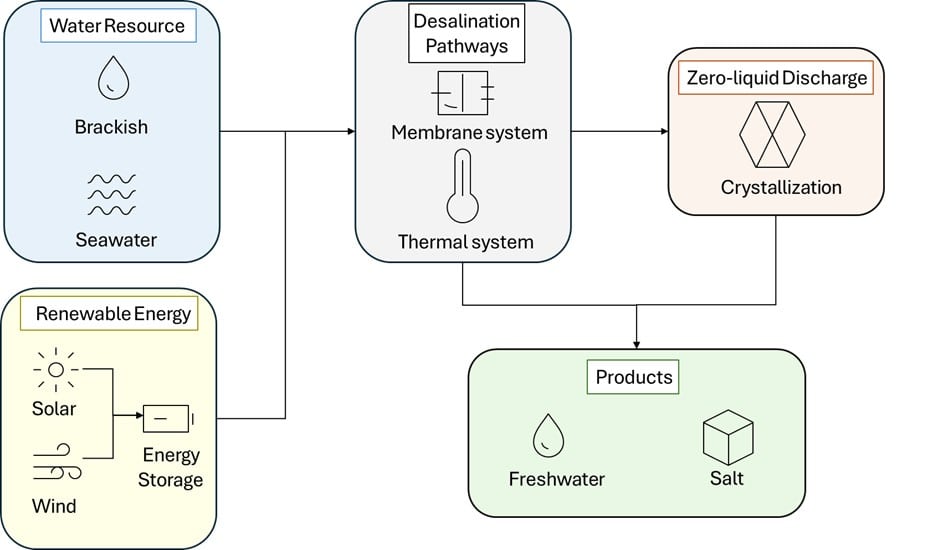
In this work, the researchers show how desalination of brackish groundwater can be made genuinely sustainable and economically viable for addressing the United States’ looming water shortages. A key part of the solution is zero‑liquid‑discharge, which avoids brine disposal by extracting more freshwater and recovering salts such as sodium, calcium, and magnesium for reuse. Crucially, the study demonstrates that when desalination is powered by low‑cost solar and wind energy, the overall process becomes far more affordable. By 2040, solar photovoltaics paired with optimised battery storage are projected to produce electricity at lower cost than the grid in the states facing the largest water deficits, making renewable‑powered desalination a competitive option.

The researchers also show that advanced technologies, such as high‑recovery reverse osmosis and crystallisation, can achieve zero‑liquid‑discharge without increasing costs, because the extra water and salt recovery offsets the expense of brine management. Their modelling indicates that a full renewable‑powered zero‑liquid‑discharge pathway can produce freshwater at an affordable cost, while reducing environmental impacts and avoiding brine disposal altogether. Taken together, this work outlines a realistic, sustainable pathway for large‑scale desalination in the United States, offering a credible strategy for securing future water supplies in increasingly water‑stressed regions.

Progress diagram adapted from article
Progress diagram adapted from article (Courtesy: Zhuoran Zhang, Columbia University)

Do you want to learn more about this topic?

Review of solar-enabled desalination and implications for zero-liquid-discharge applications by Vasilis Fthenakis et al. (2024)


The post Planning a sustainable water future in the United States appeared first on Physics World.

  •  
❌