↩ Accueil

Vue lecture

The Future Circular Collider is unduly risky – CERN needs a ‘Plan B’

Last November I visited the CERN particle-physics lab near Geneva to attend the 4th International Symposium on the History of Particle Physics, which focused on advances in particle physics during the 1980s and 1990s. As usual, it was a refreshing, intellectually invigorating visit. I’m always inspired by the great diversity of scientists at CERN – complemented this time by historians, philosophers and other scholars of science.

As noted by historian John Krige in his opening keynote address, “CERN is a European laboratory with a global footprint. Yet for all its success it now faces a turning point.” During the period under examination at the symposium, CERN essentially achieved the “world laboratory” status that various leaders of particle physics had dreamt of for decades.

By building the Large Electron Positron (LEP) collider and then the Large Hadron Collider (LHC), the latter with contributions from Canada, China, India, Japan, Russia, the US and other non-European nations, CERN has attracted researchers from six continents. And as the Cold War ended in 1989–1991, two prescient CERN staff members developed the World Wide Web, helping knit this sprawling international scientific community together and enable extensive global collaboration.

The LHC was funded and built during a unique period of growing globalization and democratization that emerged in the wake of the Cold War’s end. After the US terminated the Superconducting Super Collider in 1993, CERN was the only game in town if one wanted to pursue particle physics at the multi-TeV energy frontier. And many particle physicists wanted to be involved in the search for the Higgs boson, which by the mid-1990s looked as if it should show up at accessible LHC energies.

Having discovered this long-sought particle at the LHC in 2012, CERN is now contemplating an ambitious construction project, the Future Circular Collider (FCC). Over three times larger than the LHC, it would study this all-important, mass-generating boson in greater detail using an electron–positron collider dubbed FCC-ee, estimated to cost $18bn and start operations by 2050.

Later in the century, the FCC-hh, a proton–proton collider, would go in the same tunnel to see what, if anything, may lie at much higher energies. That collider, the cost of which is currently educated guesswork, would not come online until the mid 2070s.

But the steadily worsening geopolitics of a fragmenting world order could make funding and building these colliders dicey affairs. After Russia’s expulsion from CERN, little in the way of its contributions can be expected. Chinese physicists had hoped to build an equivalent collider, but those plans seem to have been put on the backburner for now.

And the “America First” political stance of the current US administration is hardly conducive to the multibillion-dollar contribution likely required from what is today the world’s richest (albeit debt-laden) nation. The ongoing collapse of the rules-based world order was recently put into stark relief by the US invasion of Venezuela and abduction of its president Nicolás Maduro, followed by Donald Trump’s menacing rhetoric over Greenland.

While these shocking events have immediate significance for international relations, they also suggest how difficult it may become to fund gargantuan international scientific projects such as the FCC. Under such circumstances, it is very difficult to imagine non-European nations being able to contribute a hoped-for third of the FCC’s total costs.

But the mounting European populist right-wing parties are no great friends of physics either, nor of international scientific endeavours. And Europeans face the not-insignificant costs of military rearmament in the face of Russian aggression and likely US withdrawal from Europe.

So the other two thirds of the FCC’s many billions in costs cannot be taken for granted – especially not during the decades needed to construct its 91 km tunnel, 350 GeV electron–positron collider, the subsequent 100 TeV proton collider, and the massive detectors both machines require.

According to former CERN director-general Chris Llewellyn Smith in his symposium lecture, “The political history of the LHC“, just under 12% of the material project costs of the LHC eventually came from non-member nations. It therefore warps the imagination to believe that a third of the much greater costs of the FCC can come from non-member nations in the current “Wild West” geopolitical climate.

But particle physics desperately needs a Higgs factory. After the 1983 Z boson discovery at the CERN SPS Collider, it took just six years before we had not one but two Z factories – LEP and the Stanford Linear Collider – which proved very productive machines. It’s now been more than 13 years since the Higgs boson discovery. Must we wait another 20 years?

Other options

CERN therefore needs a more modest, realistic, productive new scientific facility – a “Plan B” – to cope with the geopolitical uncertainties of an imperfect, unpredictable world. And I was encouraged to learn that several possible ideas are under consideration, according to outgoing CERN director-general Fabiola Gianotti in her symposium lecture, “CERN today and tomorrow“.

Three of these ideas reflect the European Strategy for Particle Physics, which states that “an electron–positron Higgs factory is the highest-priority next CERN collider”. Two linear electron–positron colliders would require just 11–34 km of tunnelling and could begin construction in the mid-2030s, but would involve a fair amount of technical risk and cost roughly €10bn.

The least costly and risky option, dubbed LEP3, involves installing superconducting radio-frequency cavities in the existing LHC tunnel once the high-luminosity proton run ends. Essentially an upgrade of the 200 GeV LEP2, this approach is based on well-understood technologies and would cost less than €5bn but can reach at most 240 GeV. The linear colliders could attain over twice that energy, enabling research on Higgs-boson decays into top quarks and the triple-Higgs self-interaction.

Other proposed projects involving the LHC tunnel can produce large numbers of Higgs bosons with relatively minor backgrounds, but they can hardly be called “Higgs factories”. One of these, dubbed the LHeC, could only produce a few thousand Higgs bosons annually and would allow other important research on proton structure functions. Another idea is the proposed Gamma Factory, in which laser beams would be backscattered from LHC beams of partially stripped ions. If sufficient photon energies and intensity can be achieved, it will allow research on the γγ → H interaction. These alternatives would cost at most a few billion euros.

As Krige stressed in his keynote address, CERN was meant to be more than a scientific laboratory at which European physicists could compete with their US and Soviet counterparts. As many of its founders intended, he said, it was “a cultural weapon against all forms of bigoted nationalism and anti-science populism that defied Enlightenment values of critical reasoning”. The same logic holds true today.

In planning the next phase in CERN’s estimable history, it is crucial to preserve this cultural vitality, while of course providing unparalleled opportunities to do world-class science – lacking which, the best scientists will turn elsewhere.

I therefore urge CERN planners to be daring but cognizant of financial and political reality in the fracturing world order. Don’t for a nanosecond assume that the future will be a smooth extrapolation from the past. Be fairly certain that whatever new facility you decide to build, there is a solid financial pathway to achieving it in a reasonable time frame.

The future of CERN – and the bracing spirit of CERN – rests in your hands.

The post The Future Circular Collider is unduly risky – CERN needs a ‘Plan B’ appeared first on Physics World.

  •  

Data Centers Are Driving a US Gas Boom

Gas projects in the US pipeline explicitly linked to data centers increased by almost 25 times over the past two years, according to new research from Global Energy Monitor.

  •  

NOAA seeks more money and flexibility for commercial weather data program

SAN FRANCISCO – The National Oceanic and Atmospheric Administration intends to dramatically increase commercial weather data purchases, Taylor Jordan, Commerce Department assistant secretary for environmental observation and prediction, said Jan. […]

The post NOAA seeks more money and flexibility for commercial weather data program appeared first on SpaceNews.

  •  

Space-focused SPAC goes public after pricing $200 million IPO

TAMPA, Fla. — A shell company chaired by venture capitalist Raphael Roettgen began trading on the Nasdaq stock exchange Jan. 28 after raising $200 million to pursue a merger with a space-related business. Space Asset Acquisition Corp., a special purpose acquisition company (SPAC) that offers a fast-track to the public markets for firms seeking capital, […]

The post Space-focused SPAC goes public after pricing $200 million IPO appeared first on SpaceNews.

  •  

Ion-clock transition could benefit quantum computing and nuclear physics

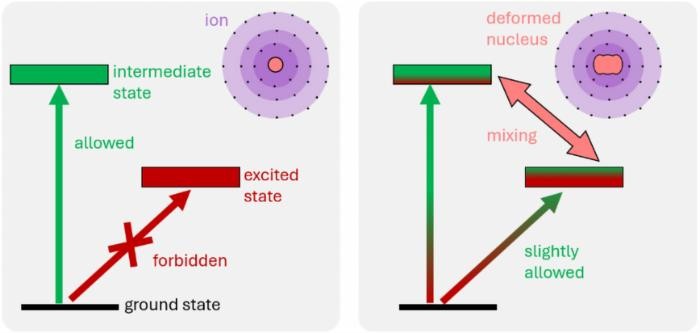
Schematic showing how the shape of ytterbium-173 nucleus affects the clock transition
Nuclear effect The deformed shape of the ytterbium-173 nucleus (right) makes it possible to excite the clock transition with a relatively low-power laser. The same transition is forbidden (left) if the nucleus is not deformed. (Courtesy: Physikalisch-Technische Bundesanstalt (PTB))

An atomic transition in ytterbium-173 could be used to create an optical multi-ion clock that is both precise and stable. That is the conclusion of researchers in Germany and Thailand who have characterized a clock transition that is enhanced by the non-spherical shape of the ytterbium-173 nucleus. As well as applications in timekeeping, the transition could be used in quantum computing. Furthermore, the interplay between atomic and nuclear effects in the transition could provide insights into the physics of deformed nuclei.

The ticking of an atomic clock is defined by the frequency of the electromagnetic radiation that is absorbed and emitted by a specific transition between atomic energy levels. These clocks play crucial roles in technologies that require precision timing – such as global navigation satellite systems and communications networks. Currently, the international definition of the second is given by the frequency of caesium-based clocks, which deliver microwave time signals.

Today’s best clocks, however, work at higher optical frequencies and are therefore much more precise than microwave clocks. Indeed, at some point in the future metrologists will redefine the second in terms of an optical transition – but the international metrology community has yet to decide which transition will be used.

Broadly speaking, there are two types of optical clock. One uses an ensemble of atoms that are trapped and cooled to ultralow temperatures using lasers; the other involves a single atomic ion (or a few ions) held in an electromagnetic trap. Clocks that use one ion are extremely precise, but lack stability; whereas clocks that use many atoms are very stable, but sacrifice precision.

Optimizing performance

As a result, some physicists are developing clocks that use multiple ions with the aim of creating a clock that optimizes precision and stability.

Now, researchers at PTB and NIMT (the national metrology institutes of Germany and Thailand respectively) have characterized a clock transition in ions of ytterbium-173, and have shown that the transition could be used to create a multi-ion clock.

“This isotope has a particularly interesting transition,” explains PTB’s Tanja Mehlstäubler – who is a pioneer in the development of multi-ion clocks.

The ytterbium-173 nucleus is highly deformed with a shape that resembles a rugby ball. This deformation affects the electronic properties of the ion, which should make it much easier to use a laser to excite a specific transition that would be very useful for creating a multi-ion clock.

Stark effect

This clock transition can also be excited in ytterbium-171 and has already been used to create a single-ion clock. However, excitation in a ytterbium-171 clock requires an intense laser pulse, which creates a strong electric field that shifts the clock frequency (called the AC Stark effect). This is a particular problem for multi-ion clocks because the intensity of the laser (and hence the clock frequency) can vary across the region in which the ions are trapped.

To show that a much lower laser intensity can be used to excite the clock transition in ytterbium-173, the team studied a “Coulomb crystal” in which three ions were trapped in a line and separated by about 10 micron. They illuminated the ions with laser light that was not uniform in intensity across the crystal. They were able to excite the transition at a relatively low laser intensity, which resulted in very small AC Stark shifts between the frequencies of the three ions.

According to the team, this means that as many as 100 trapped ytterbium-173 ions could be used to create a clock that could be used as a time standard; to redefine the second; and also to make very precise measurements of the Earth’s gravitational field.

As well as being useful for creating an optical ion clock, this multi-ion capability could also be exploited to create quantum-computing architectures based on multiple trapped ions. And because the observed effect is a result of the shape of the ytterbium-173 nucleus, further studies could provide insights into nuclear physics.

The research is described in Physical Review Letters.


The post Ion-clock transition could benefit quantum computing and nuclear physics appeared first on Physics World.

  •  

Earth observation’s adoption gap is a supply design problem

Artist’s rendering of EarthDaily’s first satellite, currently in orbit. Credit: EarthDaily

For more than a decade, the Earth observation industry has insisted that commercial adoption is just around the corner. Yet adoption outside defense remains limited, uneven, and difficult to sustain. The question is no longer whether EO is valuable, but whether the industry is delivering it in a form commercial users can actually use. The […]

The post Earth observation’s adoption gap is a supply design problem appeared first on SpaceNews.

  •  

The power of a poster

Most researchers know the disappointment of submitting an abstract to give a conference lecture, only to find that it has been accepted as a poster presentation instead. If this has been your experience, I’m here to tell you that you need to rethink the value of a good poster.

For years, I pestered my university to erect a notice board outside my office so that I could showcase my group’s recent research posters. Each time, for reasons of cost, my request was unsuccessful. At the same time, I would see similar boards placed outside the offices of more senior and better-funded researchers in my university. I voiced my frustrations to a mentor whose advice was, It’s better to seek forgiveness than permission.” So, since I couldn’t afford to buy a notice board, I simply used drawing pins to mount some unauthorized posters on the wall beside my office door.

Some weeks later, I rounded the corner to my office corridor to find the head porter standing with a group of visitors gathered around my posters. He was telling them all about my research using solar energy to disinfect contaminated drinking water in disadvantaged communities in Sub-Saharan Africa. Unintentionally, my illegal posters had been subsumed into the head porter’s official tour that he frequently gave to visitors.

The group moved on but one man stayed behind, examining the poster very closely. I asked him if he had any questions. “No, thanks,” he said, “I’m not actually with the tour, I’m just waiting to visit someone further up the corridor and they’re not ready for me yet. Your research in Africa is very interesting.” We chatted for a while about the challenges of working in resource-poor environments. He seemed quite knowledgeable on the topic but soon left for his meeting.

A few days later while clearing my e-mail junk folder I spotted an e-mail from an Asian “philanthropist” offering me €20,000 towards my research. To collect the money, all I had to do was send him my bank account details. I paused for a moment to admire the novelty and elegance of this new e-mail scam before deleting it. Two days later I received a second e-mail from the same source asking why I hadn’t responded to their first generous offer. While admiring their persistence, I resisted the urge to respond by asking them to stop wasting their time and mine, and instead just deleted it.

So, you can imagine my surprise when the following Monday morning I received a phone call from the university deputy vice-chancellor inviting me to pop up for a quick chat. On arrival, he wasted no time before asking why I had been so foolish as to ignore repeated offers of research funding from one of the college’s most generous benefactors. And that is how I learned that those e-mails from the Asian philanthropist weren’t bogus.

The gentleman that I’d chatted with outside my office was indeed a wealthy philanthropic funder who had been visiting our university. Having retrieved the e-mails from my deleted items folder, I re-engaged with him and subsequently received €20,000 to install 10,000-litre harvested-rainwater tanks in as many primary schools in rural Uganda as the money would stretch to.

Kevin McGuigan
Secret to success Kevin McGuigan discovered that one research poster can lead to generous funding contributions. (Courtesy: Antonio Jaen Osuna)

About six months later, I presented the benefactor with a full report accounting for the funding expenditure, replete with photos of harvested-rainwater tanks installed in 10 primary schools, with their very happy new owners standing in the foreground. Since you miss 100% of the chances you don’t take, I decided I should push my luck and added a “wish list” of other research items that the philanthropist might consider funding.

The list started small and grew steadily ambitious. I asked for funds for more tanks in other schools, a travel bursary, PhD registration fees, student stipends and so on. All told, the list came to a total of several hundred thousand euros, but I emphasized that they had been very generous so I would be delighted to receive funding for any one of the listed items and, even if nothing was funded, I was still very grateful for everything he had already done. The following week my generous patron deposited a six-figure-euro sum into my university research account with instructions that it be used as I saw fit for my research purposes, “under the supervision of your university finance office”.

In my career I have co-ordinated several large-budget, multi-partner, interdisciplinary, international research projects. In each case, that money was hard-earned, needing at least six months and many sleepless nights to prepare the grant submission. It still amuses me that I garnered such a large sum on the back of one research poster, one 10-minute chat and fewer than six e-mails.

So, if you have learned nothing else from this story, please don’t underestimate the power of a strategically placed and impactful poster describing your research. You never know with whom it may resonate and down which road it might lead you.

The post The power of a poster appeared first on Physics World.

  •  
❌