Connexion
Scientists quantify behaviour of micro- and nanoplastics in city environments

Plastic has become a global pollutant concern over the last couple of decades: it is widespread in society, not often disposed of effectively, and generates both microplastics (1 µm to 5 mm in size) and nanoplastics (smaller than 1 µm) that have infiltrated many ecosystems – including being found inside humans and animals.
Over time, bulk plastics break down into micro- and nanoplastics through fragmentation mechanisms that create much smaller particles with a range of shapes and sizes. Their small size has become a problem because they are increasingly finding their way into waterways that pollute the environment, into cities and other urban environments, and are now even being transported to remote polar and high-altitude regions.
This poses potential health risks around the world. While the behaviour of micro- and nanoplastics in the atmosphere is poorly understood, it’s thought that they are transported by transcontinental and transoceanic winds, which causes the spread of plastic in the global carbon cycle.
However, the lack of data on the emission, distribution and deposition of atmospheric micro- and nanoplastic particles makes it difficult to definitively say how they are transported around the world. It is also challenging to quantify their behaviour, because plastic particles can have a range of densities, sizes and shapes that undergo physical changes in clouds, all of which affect how they travel.
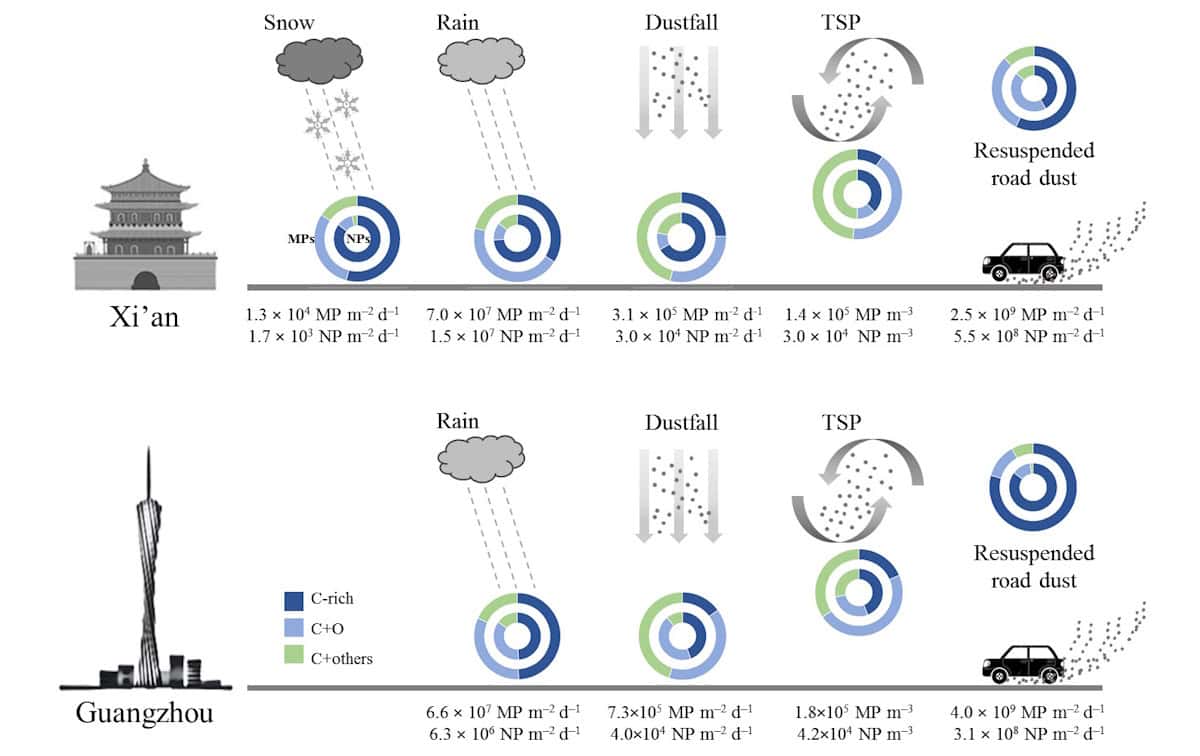
A global team of researchers has developed a new semi-automated microanalytical method that can quantify atmospheric plastic particles present in air dustfall, rain, snow and dust resuspension. The research was performed across two Chinese megacities, Guangzhou and Xi’an.
“As atmospheric scientists, we noticed that microplastics in the atmosphere have been the least reported among all environmental compartments in the Earth system due to limitations in detection methods, because atmospheric particles are smaller and more complex to analyse,” explains Yu Huang, from the Institute of Earth Environment of the Chinese Academy of Sciences (IEECAS) and one of the paper’s lead authors. “We therefore set out to develop a reliable detection technique to determine whether microplastics are present in the atmosphere, and if so, in what quantities.”
Quantitative detection
For this new approach, the researchers employed a computer-controlled scanning electron microscopy (CCSEM) system equipped with energy-dispersive X-ray spectroscopy to reduce human bias in the measurements (which is an issue in manual inspections). They located and measured individual micro- and nanoplastic particles – enabling their concentration and physicochemical characteristics to be determined – in aerosols, dry and wet depositions, and resuspended road dust.
“We believe the key contribution of this work lies in the development of a semi‑automated method that identifies the atmosphere as a significant reservoir of microplastics. By avoiding the human bias inherent in visual inspection, our approach provides robust quantitative data,” says Huang. “Importantly, we found that these microplastics often coexist with other atmospheric particles, such as mineral dust and soot – a mixing state that could enhance their potential impacts on climate and the environment.”
The method could detect and quantify plastic particles as small as 200 nm, and revealed airborne concentrations of 1.8 × 10⁵ microplastics/m3 and 4.2 × 10⁴ nanoplastics/m3 in Guangzhou and 1.4 × 10⁵ microplastics/m3 and 3.0 × 10⁴ nanoplastics/m3 in Xi’an. This is two to six orders of magnitude higher for both microplastic and nanoplastic fluxes than reported previously via visual methods.
The team also found that the deposition samples were more heterogeneously mixed with other particle types (such as dust and other pollution particles) than aerosols and resuspension samples, which showed that particles tend to aggregate in the atmosphere before being removed during atmospheric transport.
The study revealed transport insights that could be beneficial for investigating the climate, ecosystem and human health impacts of plastic particles at all levels. The researchers are now advancing their method in two key directions.
“First, we are refining sampling and CCSEM‑based analytical strategies to detect mixed states between microplastics and biological or water‑soluble components, which remain invisible with current techniques. Understanding these interactions is essential for accurately assessing microplastics’ climate and health effects,” Huang tells Physics World. “Second, we are integrating CCSEM with Raman analysis to not only quantify abundance but also identify polymer types. This dual approach will generate vital evidence to support environmental policy decisions.”
The research was published in Science Advances.
The post Scientists quantify behaviour of micro- and nanoplastics in city environments appeared first on Physics World.