↩ Accueil

Vue lecture

Making the unprecedented EU Space Act effective for all

Ariane 6 liftoff

The EU Space Act was formally proposed by the European Commission (EC) on June 25, 2025. While it doesn’t aim to codify all European Union (EU) space activities, it does address several key issues that EU officials have determined are increasingly important to the continent’s concerns: safety, through tracking space objects and mitigating space debris; resilience, […]

The post Making the unprecedented EU Space Act effective for all appeared first on SpaceNews.

  •  

Saving the Titanic: the science of icebergs and unsinkable ships

When the Titanic was built, her owners famously described her as “unsinkable”. A few days into her maiden voyage, an iceberg in the North Atlantic famously proved them wrong. But what if we could make ships that really are unsinkable? And what if we could predict exactly how long a hazardous iceberg will last before it melts?

These are the premises of two separate papers published independently this week by Chunlei Guo and colleagues at the University of Rochester, and by Daisuke Noto and Hugo N Ulloa of the University of Pennsylvania, both in the US. The Rochester group’s paper, which appears in Advanced Functional Materials, describes how applying a superhydrophobic coating to an open-ended metallic tube can make it literally unsinkable – a claim supported by extensive tests in a water tank. Noto and Ulloa’s research, which they describe in Science Advances, likewise involved a water tank. Theirs, however, was equipped with cameras, lasers and thermochromic liquid crystals that enabled them to track a freely floating miniature iceberg as it melted.

Imagine a spherical iceberg

Each study is surprising in its own way. For the iceberg paper, arguably the biggest surprise is that no-one had ever done such experiments before. After all, water and ice are readily available. Fancy tanks, lasers, cameras and temperature-sensitive crystals are less so, yet surely someone, somewhere, must have stuck some ice in a tank and monitored what happened to it?

Noto and Ulloa’s answer is, in effect, no. “Despite the relevance of melting of floating ice in calm and energetic environments…most experimental and numerical efforts to examine this process, even to date, have either fixed or tightly constrained the position and posture of ice,” they write. “Consequently, the relationships between ice dissolution rate and background fluid flow conditions inferred from these studies are meaningful only when a one-way interaction, from the liquid to the solid phase, dominates the melting dynamics.”

The problem, they continue, is that eliminating these approximations “introduces a significant technical challenge for both laboratory experiments and numerical simulations” thanks to a slew of interactions that would otherwise get swept under the rug. These interactions, in turn, lead to complex dynamics such as drifting, spinning and even flipping that must be incorporated into the model. Consequently, they write, “fundamental questions persist: ‘How long does an ice body last?’”

  • Tracking a melting iceberg: This side view of the experiment shows fluid motions as moving particles and temperature distributions as colours of the thermochromic liquid crystal particles. Meltplume (dark colour) formed beneath the floating ice plunges down, penetrating through the thermally stratified layer (red: cold, blue: warm). Note: this video has no sound. (Courtesy: Noto and Ulloa, Science Advances 12 5 DOI: 10.1126/sciadv.ady352)

To answer this question, Noto and Ulloa used their water-tank observations (see video) to develop a model that incorporates the thermodynamics of ice melting and mass balance conservation. Based on this model, they correctly predict both the melting rate and the lifespan of freely floating ice under self-driven convective flows that arise from interactions between the ice and the calm, fresh water surrounding it. Though the behaviour of ice in tempestuous salty seas is, they write, “beyond our scope”, their model nevertheless provides a useful upper bound on iceberg longevity, with applications for climate modelling as well as (presumably) shipping forecasts for otherwise-doomed ocean liners.

The tube that would not sink

In the unsinkable tube study, the big surprise is that a metal tube, divided in the middle but open at both ends, can continue to float after being submerged, corroded with salt, tossed about on a turbulent sea and peppered with holes. How is that even possible?

“The inside of the tube is superhydrophobic, so water can’t enter and wet the walls,” Guo explains. “As a result, air remains trapped inside, providing buoyancy.”

Importantly, this buoyancy persists even if the tube is damaged. “When the tube is punctured, you can think of it as becoming two, three, or more smaller sections,” Guo tells Physics World. “Each section will work in the same way of preventing water from entering inside, so no matter how many holes you punch into it, the tube will remain afloat.”

So, is there anything that could make these superhydrophobic structures sink?  “I can’t think of any realistic real-world challenges more severe than what we have put them through experimentally,” he says.

We aren’t in unsinkable ship territory yet: the largest structure in the Rochester study was a decidedly un-Titanic-like raft a few centimetres across. But Guo doesn’t discount the possibility. He points out that tubes are made from ordinary aluminium, with a simple fabrication process. “If suitable applications call for it, I believe [human-scale versions] could become a reality within a decade,” he concludes.

The post Saving the Titanic: the science of icebergs and unsinkable ships appeared first on Physics World.

  •  

Scientists quantify behaviour of micro- and nanoplastics in city environments

Abundance and composition of atmospheric plastics
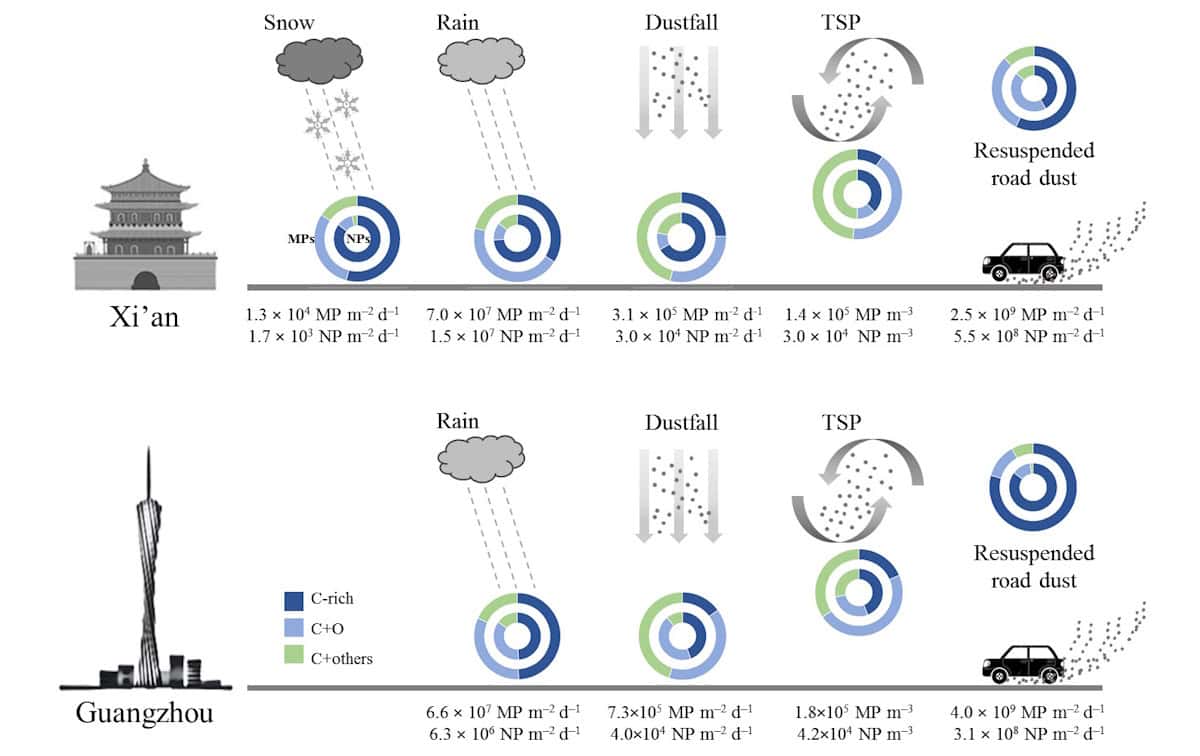
Measuring atmospheric plastics Abundance and composition of microplastics (MP) and nanoplastics (NP) in aerosols and estimated fluxes across atmospheric compartments in semiarid (Xi’an) and humid subtropical (Guangzhou) urban environments. (TSP: total suspended particles) (Courtesy: Institute of Earth Environment, CAS)

Plastic has become a global pollutant concern over the last couple of decades: it is widespread in society, not often disposed of effectively, and generates both microplastics (1 µm to 5 mm in size) and nanoplastics (smaller than 1 µm) that have infiltrated many ecosystems – including being found inside humans and animals.

Over time, bulk plastics break down into micro- and nanoplastics through fragmentation mechanisms that create much smaller particles with a range of shapes and sizes. Their small size has become a problem because they are increasingly finding their way into waterways that pollute the environment, into cities and other urban environments, and are now even being transported to remote polar and high-altitude regions.

This poses potential health risks around the world. While the behaviour of micro- and nanoplastics in the atmosphere is poorly understood, it’s thought that they are transported by transcontinental and transoceanic winds, which causes the spread of plastic in the global carbon cycle.

However, the lack of data on the emission, distribution and deposition of atmospheric micro- and nanoplastic particles makes it difficult to definitively say how they are transported around the world. It is also challenging to quantify their behaviour, because plastic particles can have a range of densities, sizes and shapes that undergo physical changes in clouds, all of which affect how they travel.

A global team of researchers has developed a new semi-automated microanalytical method that can quantify atmospheric plastic particles present in air dustfall, rain, snow and dust resuspension. The research was performed across two Chinese megacities, Guangzhou and Xi’an.

“As atmospheric scientists, we noticed that microplastics in the atmosphere have been the least reported among all environmental compartments in the Earth system due to limitations in detection methods, because atmospheric particles are smaller and more complex to analyse,” explains Yu Huang, from the Institute of Earth Environment of the Chinese Academy of Sciences (IEECAS) and one of the paper’s lead authors. “We therefore set out to develop a reliable detection technique to determine whether microplastics are present in the atmosphere, and if so, in what quantities.”

Quantitative detection

For this new approach, the researchers employed a computer-controlled scanning electron microscopy (CCSEM) system equipped with energy-dispersive X-ray spectroscopy to reduce human bias in the measurements (which is an issue in manual inspections). They located and measured individual micro- and nanoplastic particles – enabling their concentration and physicochemical characteristics to be determined – in aerosols, dry and wet depositions, and resuspended road dust.

“We believe the key contribution of this work lies in the development of a semi‑automated method that identifies the atmosphere as a significant reservoir of microplastics. By avoiding the human bias inherent in visual inspection, our approach provides robust quantitative data,” says Huang. “Importantly, we found that these microplastics often coexist with other atmospheric particles, such as mineral dust and soot – a mixing state that could enhance their potential impacts on climate and the environment.”

The method could detect and quantify plastic particles as small as 200 nm, and revealed airborne concentrations of 1.8 × 10⁵ microplastics/m3 and 4.2 × 10⁴ nanoplastics/m3 in Guangzhou and 1.4 × 10⁵ microplastics/m3 and 3.0 × 10⁴ nanoplastics/m3 in Xi’an. This is two to six orders of magnitude higher for both microplastic and nanoplastic fluxes than reported previously via visual methods.

The team also found that the deposition samples were more heterogeneously mixed with other particle types (such as dust and other pollution particles) than aerosols and resuspension samples, which showed that particles tend to aggregate in the atmosphere before being removed during atmospheric transport.

The study revealed transport insights that could be beneficial for investigating the climate, ecosystem and human health impacts of plastic particles at all levels. The researchers are now advancing their method in two key directions.

“First, we are refining sampling and CCSEM‑based analytical strategies to detect mixed states between microplastics and biological or water‑soluble components, which remain invisible with current techniques. Understanding these interactions is essential for accurately assessing microplastics’ climate and health effects,” Huang tells Physics World. “Second, we are integrating CCSEM with Raman analysis to not only quantify abundance but also identify polymer types. This dual approach will generate vital evidence to support environmental policy decisions.”

The research was published in Science Advances.

The post Scientists quantify behaviour of micro- and nanoplastics in city environments appeared first on Physics World.

  •  

Oxford Space Systems Wrapped Rib Antenna Successfully Deployed In-Orbit on CarbSAR Mission

Harwell and Guildford, UK – Oxford Space Systems and Surrey Satellite Technology Limited (SSTL) today announced the successful in-orbit deployment of Oxford Space Systems’ Wrapped Rib Antenna on SSTL’s CarbSAR […]

The post Oxford Space Systems Wrapped Rib Antenna Successfully Deployed In-Orbit on CarbSAR Mission appeared first on SpaceNews.

  •  

Michele Dougherty steps aside as president of the Institute of Physics

The space physicist Michele Dougherty has stepped aside as president of the Institute of Physics, which publishes Physics World. The move was taken to avoid any conflicts of interest given her position as executive chair of the Science and Technology Facilities Council (STFC) – one of the main funders of physics research in the UK.

Dougherty, who is based at Imperial College London, spent two years as IOP president-elect from October 2023 before becoming president in October 2025. Dougherty was appointed executive chair of the STFC in January 2025 and in July that year was also announced as the next Astronomer Royal – the first woman to hold the position.

The changes at the IOP come in the wake of UK Research and Innovation (UKRI) stating last month that it will be adjusting how it allocates government funding for scientific research and infrastructure. Spending on curiosity-driven research will remain flat from 2026 to 2030, with UKRI prioritising funding in three key areas or “buckets”.

The three buckets are: curiosity-driven research, which will be the largest; strategic government and societal priorities; and supporting innovative companies. There will also be a fourth “cross-cutting” bucket with funding for infrastructure, facilities and talent. In the four years to 2030, UKRI’s budget will be £38.6bn.

While the detailed implications of the funding changes are still to be worked out, the IOP says its “top priority” is understanding and responding to them. With the STFC being one of nine research councils within UKRI, Dougherty is stepping aside as IOP president to ensure the IOP can play what it says is “a leadership role in advocating for physics without any conflict of interest”.

In her role as STFC executive chair, Dougherty yesterday wrote to the UK’s particle physics, astronomy and nuclear physics community, asking researchers to identify by March how their projects would respond to flat cash as well as reductions of 20%, 40% and 60% – and to “identify the funding point at which the project becomes non-viable”. The letter says that a “similar process” will happen for facilities and labs.

In her letter, Dougherty says that the UK’s science minister Lord Vallance and UKRI chief executive Ian Chapman want to protect curiosity-driven research, which they say is vital, and grow it “as the economy allows”. However, she adds, “the STFC will need to focus our efforts on a more concentrated set of priorities, funded at a level that can be maintained over time”.

Tom Grinyer, chief executive officer of the IOP, says that the IOP is “fully focused on ensuring physics is heard clearly as these serious decisions are shaped”. He says the IOP is “gathering insight from across the physics community and engaging closely with government, UKRI and the research councils so that we can represent the sector with authority and evidence”.

Grinyer warns, however, that UKRI’s shift in funding priorities and the subsequent STFC funding cuts will have “severe consequences” for physics. “The promised investment in quantum, AI, semiconductors and green technologies is welcome but these strengths depend on a stable research ecosystem,” he says.

“I want to thank Michele for her leadership, and we look forward to working constructively with her in her capacity at STFC as this important period for physics unfolds,” adds Grinyer.

Next steps

The nuclear physicist Paul Howarth, who has been IOP president-elect since September, will now take on Dougherty’s responsibilities – as prescribed by the IOP’s charter – with immediate effect, with the IOP Council discussing its next steps at its February 2026 meeting.

With a PhD in nuclear physics, Howarth has had a long career in the nuclear sector working on the European Fusion Programme and at British Nuclear Fuels, as well as co-founding the Dalton Nuclear Institute at the University of Manchester.

He was a non-executive board director of the National Physical Laboratory and until his retirement earlier this year was chief executive officer of the National Nuclear Laboratory.

In response to the STFC letter, Howarth says that the projected cuts “are a devastating blow for the foundations of UK physics”.

“Physics isn’t a luxury we can afford to throw away through confusion,” says Howarth. “We urge the government to rethink these cuts, listen to the physics community, and deliver to a 10-year strategy to secure physics for the future.”

The post Michele Dougherty steps aside as president of the Institute of Physics appeared first on Physics World.

  •  

AI-based tool improves the quality of radiation therapy plans for cancer treatment

This episode of the Physics World Weekly podcast features Todd McNutt, who is a medical physicist at Johns Hopkins University and the founder of Oncospace. In a conversation with Physics World’s Tami Freeman, McNutt explains how an artificial intelligence-based tool called Plan AI can help improve the quality of radiation therapy plans for cancer treatments.

As well as discussing the benefits that Plan AI brings to radiotherapy patients and cancer treatment centres, they examine its evolution from an idea developed by an academic collaboration to a clinical product offered today by Sun Nuclear, a US manufacturer of radiation equipment and software.

This podcast is sponsored by Sun Nuclear.

The post AI-based tool improves the quality of radiation therapy plans for cancer treatment appeared first on Physics World.

  •  
❌