In this episode of Space Minds, Mike Gruss sits down with a panel of experts at the Johns Hopkins University Bloomberg Center to discuss the future of the United States […]
Voyager Technologies and Max Space, a company working on expandable habitats, plan to work together to see how that technology could be used for lunar exploration.
As nighttime noise rises, millions turn to pink noise for relief, but the steady hum meant to protect sleep may quietly interfere with the brain’s most restorative stage.
Few modern systems are as consequential — or as exposed — as the Global Positioning System. A temporary loss of access to its positioning, navigation and timing signals would ripple through the global economy and severely impair military operations. Yet despite repeated warnings that GPS signals can be jammed, spoofed or denied — often using […]
SAN FRANCISCO — Morpheus Space raised $15 million in a Series A+ funding round announced Feb. 5. “This funding is intended to accelerate our production as we focus on bringing our GO-2 Electric Propulsion System fully to market,” Morpheus CEO Kevin Lausten told SpaceNews. “It’s about getting the product in the hands of our customers.” […]
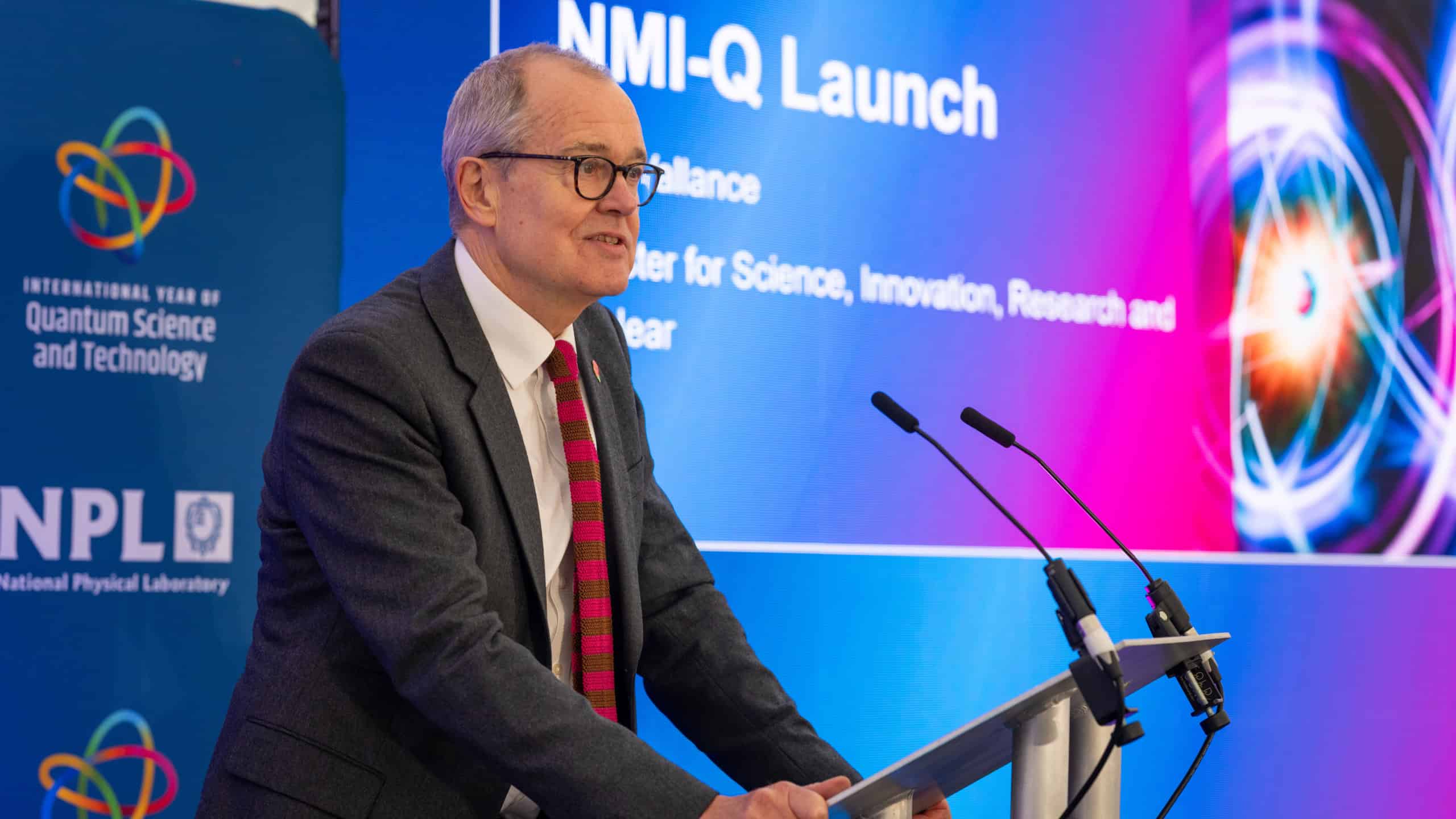
High-level backing “Quantum Metrology: From Foundations to the Future” was held at NPL as part of the global celebrations for the UNESCO International Year of Quantum Science and Technology. Above: Lord Vallance, UK Minister for Science, Innovation, Research and Nuclear, opens the workshop with the official launch of the NMI-Q collaboration, an international metrology initiative that aims to accelerate the adoption of quantum technologies and applications. (Courtesy: NPL)
The UNESCO International Year of Quantum Science and Technology (IYQ) ends on an exotic flourish this month, with the official closing ceremony – which will be live-streamed from Accra, Ghana – looking back on what’s been a global celebration “observed through activities at all levels aimed at increasing public awareness of the importance of quantum science and applications”.
The timing of IYQ has proved apposite, mirroring as it does a notable inflection point within the quantum technology sector. Advances in fundamental quantum science and applied R&D are accelerating on a global scale, harnessing the exotic properties of quantum mechanics – entanglement, tunnelling, superposition and the like – to underpin practical applications in quantum computing and quantum communications.
Quantum metrology, meanwhile, has progressed from its roots in fundamental physics to become a cornerstone of technology innovation, yielding breakthroughs in fields such as precision timing, navigation, cryptography and advanced imaging – and that’s just for starters.
Collaborate to accelerate
Notwithstanding all this forward motion, IYQ has also highlighted significant challenges when it comes to scaling quantum systems, achieving fault tolerance and ensuring reproducible performance. Enter NMI-Q, an international initiative that leverages the combined expertise of the world’s leading National Metrology Institutes (NMIs) – from the G7 countries and Australia – to accelerate the adoption of foundational hardware and software technologies for quantum computing systems and the quantum internet.
Cyrus Larijani “We want NMI-Q to blossom into something much bigger than the individual NMIs.” (Courtesy: NPL)
The NMI-Q partnership was officially launched in November last year at the IYQ conference “Quantum Metrology: From Foundations to the Future”, an event hosted by NPL. Together, the respective NMIs will conduct collaborative pre-standardization research; develop a set of “best measurement practices” needed by industry to fast-track quantum innovation; and, ultimately, shape the global standardization effort in quantum technologies.
“NMI-Q has an ambitious and broad-scope brief, but it’s very much a joined-up effort when it comes to the division of labour,” says Cyrus Larijani, NPL’s head of quantum programme. The rationale being that no one country can do it all when it comes to the performance metrics, benchmarks and standards needed to take quantum breakthroughs out of the laboratory and into the commercial mainstream.
Post-launch, NMI-Q has received a collective “uptick” from the quantum community, with the establishment of internationally recognized standards and trusted benchmarks seen as core building blocks for the at-scale uptake and interoperability of quantum technologies. “What’s more,” adds Larijani, “there’s a clear consensus for collaboration over competition [between the NMIs], supported by shared development roadmaps and open-access platforms to avoid fragmentation and geopolitical barriers.”
Follow the money
In terms of technology push, the scale of investment – both public and private sector – in all things quantum means that the nascent supply chain is evolving at pace, linking component manufacturers, subsystem developers and full-stack quantum computing companies. That’s reinforced by plenty of downstream pull: all sorts of industries – from finance to healthcare, telecoms to energy generation – are seeking to understand the commercial upsides of quantum technologies, but don’t yet have the necessary domain knowledge and skill sets to take full advantage of the opportunities.
Given that context, the onus is on NMI-Q to pool its world-leading expertise in quantum metrology to inform evidence-based decision-making among key stakeholders in the “quantum ecosystem”: investors, policy-makers, manufacturers and, ultimately, the end-users of quantum applications. “Our task is to make sure that quantum technologies are built on reliable, scalable and interoperable foundations,” notes Larijani. “That’s the crux of where we’re going with NMI-Q.”
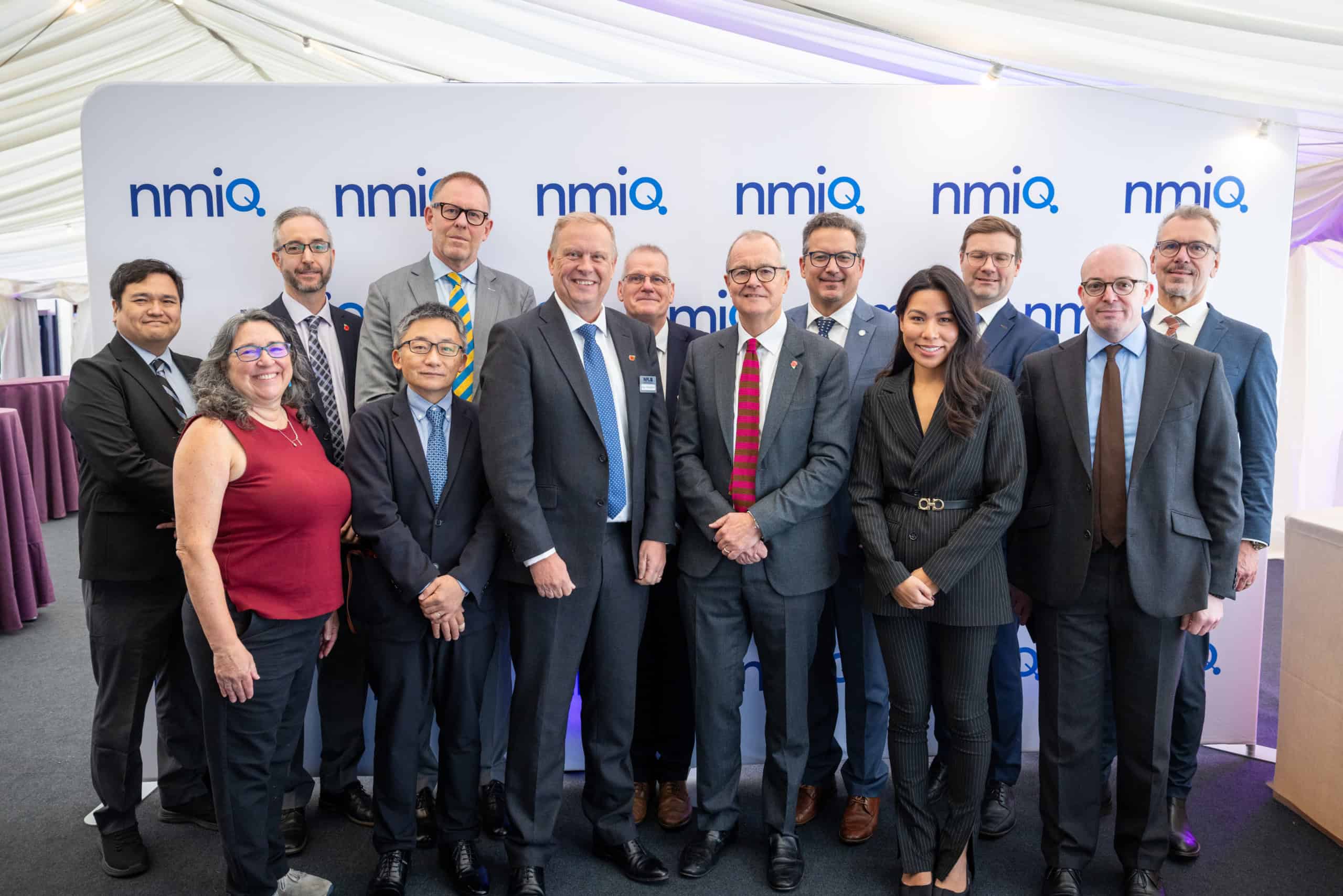
Made to measure NMI-Q leverages the combined expertise of NMIs from the G7 countries and Australia to shape the global standardization effort in quantum science and technology. Above: NMI-Q representatives gathered at NPL in November for the collaboration’s official launch, announced by UK science minister Lord Vallance (front row, third from right). (Courtesy: NPL)
Right now, NPL and its partner NMIs are busy shaping NMI-Q’s work programme and deliverables for 2026 and beyond, with the benchmarking of quantum computers very much front-and-centre. Their challenge lies in the diversity of quantum hardware platforms in the mix; also the emergence of two different approaches to quantum computing – one being a gate-based framework for universal quantum computation, the other an analogue approach tailored to outperforming classical computers on specific tasks.
“In this start-up phase, it’s all about bringing everyone together to define and assign the granular NMI-Q work packages and associated timelines,” says Larijani. Operational and strategic alignment is also mandatory across the member NMIs, so that each laboratory (and its parent government) is fully on board with the collaboration’s desired outcomes. “It’s going very well so far in terms of aligning members’ national interests versus NMI-Q’s direction of travel,” adds Larijani. “This emphasis on ‘science diplomacy’, if you like, will remain crucial to our success.”
Long term, NMI-Q’s development of widely applicable performance metrics, benchmarks and standards will, it is hoped, enable the quantum technology industry to achieve critical mass on the supply side, with those economies of scale driving down prices and increasing demand.
“Ultimately, though, we want NMI-Q to blossom into something much bigger than the individual NMIs, spanning out to engage the supply chains of member countries,” says Larijani. “It’s really important for NPL and the NMI-Q partners to help quantum companies scale their offerings, advance their technology readiness level and, sooner than later, get innovative products and services into the market.”
That systematic support for innovation and technology translation is evident on the domestic front as well. The UK Quantum Standards Network Pilot – which is being led by NPL – brings together representatives from industry (developers and end-users), academia and government to work on all aspects of standards development and ensure that UK quantum technology companies have access to global supply chains and markets.
Quantum impact
So what does success look like for Larijani in 2026? “We’re really motivated to work with as many quantum companies as we can – to help these organizations launch new quantum products and applications,” he explains. Another aspiration is to encourage industry partners to co-locate their R&D and innovation activities within NPL’s Institute for Quantum Standards and Technology.
“There are moves to establish a quantum technology cluster at NPL to enable UK and overseas companies to access our specialist know-how and unique measurement capability,” Larijani concludes. “Equally, as a centre-of-excellence in quantum science, we can help to scale the UK quantum workforce as well as encourage our own spin-out ventures in quantum metrology.”
Quantum futures: inclusive, ethical, sustainable
“Quantum Metrology: From Foundations to the Future” was held at NPL as part of UNESCO’s IYQ global celebrations. Organized by a steering committee of NMI-Q members, the conference explored quantum metrology and standards as enablers of technology innovation; also their role as “a cornerstone for trust, interoperability, and societal benefit in quantum innovation and adoption”.
The commitments below – articulated as formal recommendations for UNESCO – reflect the collective vision of conference delegates for an inclusive, ethical and sustainable quantum future…
Governance and ethics: attendees emphasized the need for robust governance and ethical oversight in quantum technologies. They called for the establishment of neutral international bodies, ideally under UN leadership, to ensure fair and transparent governance. Inclusivity was highlighted as essential, with a strong focus on extending benefits to developing nations and maintaining open dialogue. Concerns were raised about risks linked to scalability, security and potential misuse by non-state actors, underscoring the importance of proactive monitoring.
Standards and infrastructure: participants advocated for sustained funding to develop international standards and benchmarking frameworks. They also stressed the value of shared fabrication facilities and testbeds to democratize access and accelerate innovation globally.
Education and talent: education and talent development emerged as a priority, with recommendations to launch fully funded MSc programmes, practical placements and mentoring networks. Strengthening links between industry and academia, alongside outreach to schools, are seen as vital for early engagement and long-term skills development.
Societal impact: delegates urged that societal impact remain central to quantum initiatives. Applications in healthcare, climate modelling and sustainability should be a priority; also arts and cultural integration efforts to foster public understanding and ethical reflection.
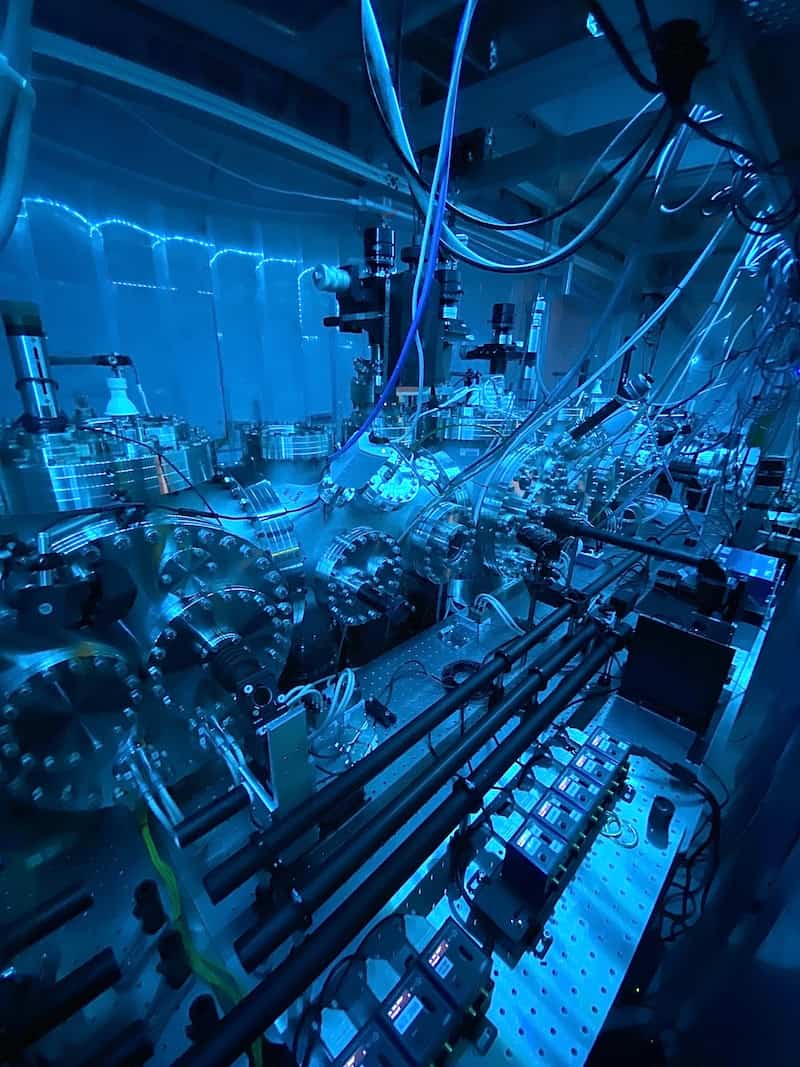
Massively quantum: The University of Vienna’s Multi-Scale Cluster Interference Experiment (MUSCLE), where researchers detected quantum interference in massive nanoparticles. (Courtesy: S Pedalino / Uni Wien)
Classical mechanics describes our everyday world of macroscopic objects very well. Quantum mechanics is similarly good at describing physics on the atomic scale. The boundary between these two regimes, however, is still poorly understood. Where, exactly, does the quantum world stop and the classical world begin?
Researchers in Austria and Germany have now pushed the line further towards the macroscopic regime by showing that metal nanoparticles made up of thousands of atoms clustered together continue to obey the rules of quantum mechanics in a double-slit-type experiment. At over 170 000 atomic mass units, these nanoparticles are heavier than some viroids and proteins – a fact that study leader Sebastian Pedalino, a PhD student at the University of Vienna, says demonstrates that quantum mechanics remains valid at this scale and alternative models are not required.
Multiscale cluster interference
According to the rules of quantum mechanics, even large objects behave as delocalized waves. However, we do not observe this behaviour in our daily lives because the characteristic length over which this behaviour extends – the de Broglie wavelength λdB = h/mv, where h is Planck’s constant, m is the object’s mass and v is its velocity – is generally much smaller than the object itself.
In the new work, a team led by Vienna’s Markus Arndt and Stefan Gerlich, in collaboration with Klaus Hornberger at the University of Duisburg-Essen, created clusters of sodium atoms in a helium-argon mixture at 77 K in an ultrahigh vacuum. The clusters each contained between 5000 and 1000 atoms and travelled at velocities of around 160 m s−1, giving them de Broglie wavelengths between 10‒22 femtometres (1 fm = 10-12 m).
To observe matter-wave interference in objects with such ultra-short de Broglie wavelengths, the team used an interferometer containing three diffraction gratings constructed with deep ultraviolet laser beams in a so-called Talbot–Lau configuration. The first grating channels the clusters through narrow gaps, from which their wave function expands. This wave is then modulated by the second grating, resulting in interference that produces a measurable striped pattern at the third grating.
This result implies that the clusters’ location is not fixed as it propagates through the apparatus. Instead, its wave function is spread over a span dozens of times larger than an individual cluster, meaning that it is in a superposition of locations rather than occupying a fixed position in space. This is known as a Schrödinger cat state, in reference to the famous thought experiment by physicist Erwin Schrödinger in which he imagined a cat sitting in a sealed box to be both dead and alive at once.
Pushing the boundaries for quantum experiments
The Vienna-Duisburg-Essen researchers characterized their experiment by calculating a quantity known as macroscopicity that combines the duration of the quantum state (its coherence time), the mass of the object in that state and the degree of separation between states. In this work, which they detail in Nature, the macroscopicity reached a value of 15.5 – an order of magnitude higher than the best known previous reported measurement of this kind.
Arndt explains that this milestone was reached thanks to a long-term research programme that aims to push quantum experiments to ever higher masses and complexity. “The motivation is simply that we do not yet know if quantum mechanics is the ultimate theory or if it requires any modification at some mass limit,” he tells Physics World. While several speculative theories predict some degree of modification, he says, “as experimentalists our task is to be agnostic and see what happens”.
Arndt notes that the team’s machine is very sensitive to small forces, which can generate notable deflections of the interference fringes. In the future, he thinks this effect could be exploited to characterize the properties of materials. In the longer term, this force-sensing capability could even be used to search for new particles.
Interpretations and adventures
While Arndt says he is “impressed” that these mesoscopic objects – which are in principle easy to see and even to localize under a scattering microscope – can be delocalized on a scale more than 10 times their size if they are isolated and non-interacting, he is not entirely surprised. The challenge, he says, lies in understanding what it means. “The interpretation of this phenomenon, the duality between this delocalization and the apparently local nature in the act of measurement, is still an open conundrum,” he says.
Looking ahead, the researchers say they would now like to extend their research to higher mass objects, longer coherence times, higher force sensitivity and different materials, including nanobiological materials as well as other metals and dielectrics. “We still have a lot of work to do on sources, beam splitters, detectors, vibration isolation and cooling,” says Arndt. “This is a big experimental adventure for us.”
SAN FRANCISCO — Viridian Space Corp. signed a cooperative research and development agreement (CRADA) with the Air Force Research Laboratory. The five-year CRADA will provide the Southern California startup with access to testing facilities and satellite-operations expertise at AFRL’s Kirtland Air Force Base in New Mexico. “There seems to be a good collaborative opportunity for testing […]
Learn how Miocene fossils from the Mojave Desert reveal that pronghorn running adaptations developed long before high-speed cheetahs appeared in North America.
In the ongoing measles outbreak in South Carolina that has infected more than 800 people, some children have developed a rare but serious complication called encephalitis.
 Connexion