Connexion
World’s smallest QR code paves the way for ultralong-life data storage

A team headed up at TU Wien in Austria has set the Guinness World Record for creating the world’s smallest QR code. Working with industry partner Cerabyte, the researchers produced a stable and repeatedly readable QR code with an area of just 1.977 µm2. When read out – using an electron microscope, as its structure is too fine to be seen with a standard optical microscope – the QR code links to a scientific webpage at TU Wien.
But this wasn’t just a ploy to get into the record books, the QR code was created as part of the team’s research into ceramic data storage materials. Unlike conventional magnetic or electronic data storage media, which degrade within decades, ceramic-based storage is designed to withstand extreme temperatures, radiation, chemical corrosion and mechanical damage.
As such, information stored in ceramic materials could endure for centuries, or even millennia. And in contrast to today’s data centres, ceramics preserve stored information without any energy input and without requiring cooling.
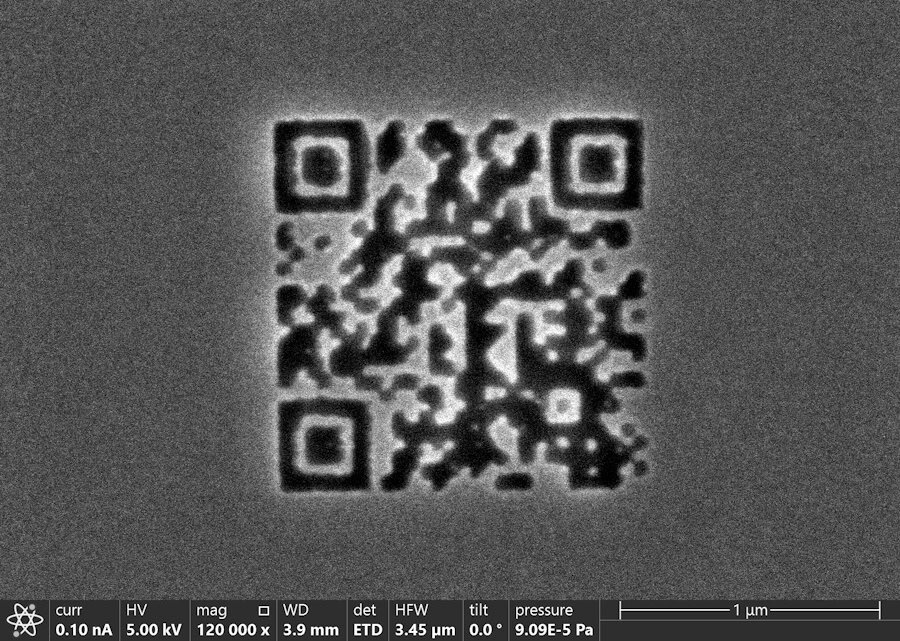
To create these ultralong-life data storage systems, the researchers use focused ion beams to mill the QR code into a thin film of chromium nitride, a durable ceramic often used to coat high-performance cutting tools. As each individual pixel is just 49 nm in size, roughly 10 times smaller than the wavelength of visible light, the code cannot be imaged using visible light. But when examined with an electron microscope, the QR code could indeed be read out reliably.
After the writing process, the entire stack of ceramic films is subjected to extreme conditions, such as high temperatures, corrosive environments and mechanical stress, to evaluate the material’s long-term durability and readout stability.
Pushing storage to its limits
Creating a “tiny QR code” was not the team’s initial goal, but emerged as a natural outcome of pushing this storage technology to its limits, says Paul Mayrhofer from TU Wien’s Institute of Materials Science and Technology.
“During a discussion with one of my PhD students, Erwin Peck, we realised that the writing procedure we had developed already produced features smaller than what had previously been reported for QR codes,” he explains. “This sparked the idea: if we can reliably write structures at that scale, why not intentionally create the smallest QR code possible?”
To claim its place in the record books, the QR code was successfully milled and read out in the presence of witnesses and its size independently verified using calibrated scanning electron microscopy at the University of Vienna. It is now officially recognized by Guinness as the world’s smallest QR code, and is roughly one third the size of the previous record holder.
Mayrhofer points out that the storage capacity of the ceramic data storage technology far surpasses that of a single QR code. “Based on current estimates, a cartridge of 100 x 100 x 20 mm with ceramic storage medium could potentially store on the order of 290 terabytes of raw data,” he says.
As well as offering this impressive raw capacity, for practical applications it’s also crucial that the ceramic storage offers high writing speed, which determines how efficiently large datasets can be stored, and low energy consumption during writing, which will influence the potential for scalability and sustainability. The researchers are currently working to optimize both of these parameters.
“Humanity has preserved information for millennia when carved in stone, yet much of today’s digital information risks being lost within decades,” project leader Alexander Kirnbauer tells Physics World. “Our long-term goal is to create an ultrastable, sustainable data storage technology capable of preserving information for extremely long times – potentially thousands to millions of years. In essence, we want to develop a form of storage that ensures the knowledge of our digital age does not disappear over time.”
The post World’s smallest QR code paves the way for ultralong-life data storage appeared first on Physics World.