Aalto is turning to Australia as a key operating base to bolster the business case for initial commercial services of its stratospheric pseudo-satellite over Japan, now pushed to 2027 amid regulatory hurdles and ongoing system-integration work.
A 2023 law championed by Republicans requires the CDC have a director confirmed by the Senate. For months, though, it’s had only acting directors—and the White House won’t say when that will change.
Here at Physics World we are always on the look out for physicists with extraordinary talents outside of science. In 2023, for example we were in awe of Harvard University’s Jenny Hoffman who ran across the US in 47 days, 12 hours and 35 minutes – shattering the previous record by one week.
Now, coverage of the Winter Olympics in Italy has revealed that the Chinese freestyle skier Eileen Gu had studied physics at Stanford University. The most decorated female Olympic freestyle skier in history, US-born Gu bagged two gold medals and a silver at the 2022 Beijing games and added two silvers at Milano Cortina.
Gu has subsequently switched majors to international relations at Stanford, but we can still celebrate her as an honorary physicist.
Physics-rich event
Indeed, freestyle skiing is quite possibly the most physics-rich of all Olympic events. Athletes must consider friction, gravity and the conservation of momentum and angular momentum to perfect their skiing.
Now, I’m not suggesting that studying free-body diagrams of freestyle manoeuvres is essential for Olympic success, but I live in hope that an understanding of classical mechanics can improve one’s skiing. (I’m not sure why I believe this, because a PhD and decades of writing about physics certainly hasn’t improved my skiing!).
As well as being lauded for her prowess on the snow, Gu has found herself at the centre of an international furore regarding her choice of competing for China rather than for the US. So, international relations combined with physics seems like a very good course of study!
A new way of extracting energy from ocean waves has been proposed by a researcher in Japan. The system couples a gyroscope to an electrical generator and could be fine tuned to extract energy from a wide range of wave conditions. A prototype of the design is currently being built for testing in a wave tank. If successful, the system could be used to generate electricity onboard ships.
Ocean waves contain huge amounts of energy and humans have tried to harness this energy for centuries. But, despite the development of myriad technologies and a number of trials, the widespread commercial conversion of wave energy remains an elusive goal. One important problem is that most generation schemes only work within a narrow range of wave conditions – and the ocean can be a very messy place.
Now, Takahito Iida at the University of Osaka has proposed a new energy-harvesting technology that uses gyroscopic flywheel system that can be tuned to absorb energy efficiently over a broad range of wave frequencies.
“Wave energy devices often struggle because ocean conditions are constantly changing,” says Iida. “However, a gyroscopic system can be controlled in a way that maintains high energy absorption, even as wave frequencies vary.”
Wobbling top
At the heart of the technology is gyroscopic precession, whereby a torque on a rotating object causes the object’s axis of rotation to trace out a circle. This is familiar to anyone who has played with a spinning top, which will wobble (precess) when perturbed.
Iida’s device is called a gyroscopic wave energy converter and comprises a spinning flywheel mounted on a floating platform (see figure). On calm seas, the gyroscope’s axis of rotation points in a fixed direction thanks to the conservation of angular momentum. However, waves will cause the platform to pitch from side-to-side, exerting torques on the gyroscope and causing it to precess. It is this precession that drives a generator to deliver electrical power.
To design the system, Iida used linear wave theory to model the coupled interactions between waves, the platform, the gyroscope and the generator. This allowed him to devise a scheme for tuning the gyroscope frequency and generator parameters so that an energy conversion efficiency of 50% is achieved for a variety of wave conditions.
The effect of the generator was modelled as a spring-damper. This is a system that responds to a torque by storing and then returning some energy to the gyroscope (the spring), and removing some energy by converting it to electricity (the damper). Iida discovered that a maximum conversion of 50% occurs when the spring coefficient of the generator is adjusted such that the gyroscope’s resonant frequency matches the resonant frequency of the floating platform.
Fundamental constraint
Iida explains that 50% is the maximum efficiency that can be achieved. “This efficiency limit is a fundamental constraint in wave energy theory. What is exciting is that we now know that it can be reached across broadband frequencies, not just at a single resonant condition.”
Iida tells Physics World that a small prototype (approximately 50 cm3 in size) is being built and will be tested in a 100 m-long tank.
The next step will be the development of a system with a generating capacity of about 5 kW. Iida says that the ultimate goal is a 300 kW generator.
Iida also explains that the gyroscopic wave energy converter is designed to operate untethered to the seabed. As a result he says the system would be ideal for use as an auxiliary power system for a ship. “The target output of 300 kW is based on the assumed auxiliary power demand of a typical commercial vessel,” says Iida.
NASA completed a second wet dress rehearsal for the Artemis 2 mission on Feb. 19 without any of the hydrogen leaks seen in the first such test earlier this month.
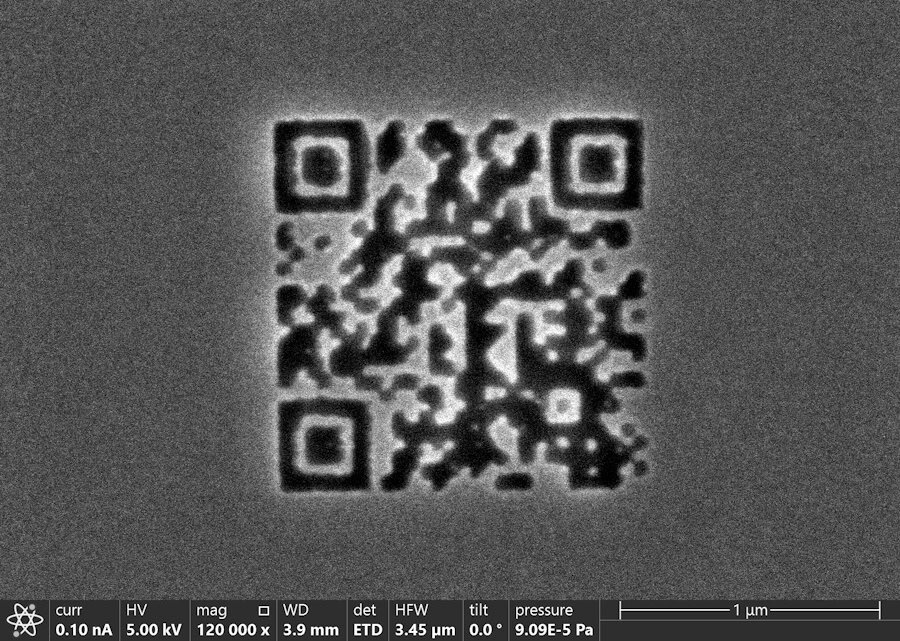
A team headed up at TU Wien in Austria has set the Guinness World Record for creating the world’s smallest QR code. Working with industry partner Cerabyte, the researchers produced a stable and repeatedly readable QR code with an area of just 1.977 µm2. When read out – using an electron microscope, as its structure is too fine to be seen with a standard optical microscope – the QR code links to a scientific webpage at TU Wien.
But this wasn’t just a ploy to get into the record books, the QR code was created as part of the team’s research into ceramic data storage materials. Unlike conventional magnetic or electronic data storage media, which degrade within decades, ceramic-based storage is designed to withstand extreme temperatures, radiation, chemical corrosion and mechanical damage.
As such, information stored in ceramic materials could endure for centuries, or even millennia. And in contrast to today’s data centres, ceramics preserve stored information without any energy input and without requiring cooling.
Invisible code The world’s smallest QR code can only be read out using an electron microscope. (Courtesy: TU Wien)
To create these ultralong-life data storage systems, the researchers use focused ion beams to mill the QR code into a thin film of chromium nitride, a durable ceramic often used to coat high-performance cutting tools. As each individual pixel is just 49 nm in size, roughly 10 times smaller than the wavelength of visible light, the code cannot be imaged using visible light. But when examined with an electron microscope, the QR code could indeed be read out reliably.
After the writing process, the entire stack of ceramic films is subjected to extreme conditions, such as high temperatures, corrosive environments and mechanical stress, to evaluate the material’s long-term durability and readout stability.
Pushing storage to its limits
Creating a “tiny QR code” was not the team’s initial goal, but emerged as a natural outcome of pushing this storage technology to its limits, says Paul Mayrhofer from TU Wien’s Institute of Materials Science and Technology.
“During a discussion with one of my PhD students, Erwin Peck, we realised that the writing procedure we had developed already produced features smaller than what had previously been reported for QR codes,” he explains. “This sparked the idea: if we can reliably write structures at that scale, why not intentionally create the smallest QR code possible?”
To claim its place in the record books, the QR code was successfully milled and read out in the presence of witnesses and its size independently verified using calibrated scanning electron microscopy at the University of Vienna. It is now officially recognized by Guinness as the world’s smallest QR code, and is roughly one third the size of the previous record holder.
Mayrhofer points out that the storage capacity of the ceramic data storage technology far surpasses that of a single QR code. “Based on current estimates, a cartridge of 100 x 100 x 20 mm with ceramic storage medium could potentially store on the order of 290 terabytes of raw data,” he says.
As well as offering this impressive raw capacity, for practical applications it’s also crucial that the ceramic storage offers high writing speed, which determines how efficiently large datasets can be stored, and low energy consumption during writing, which will influence the potential for scalability and sustainability. The researchers are currently working to optimize both of these parameters.
“Humanity has preserved information for millennia when carved in stone, yet much of today’s digital information risks being lost within decades,” project leader Alexander Kirnbauer tells Physics World. “Our long-term goal is to create an ultrastable, sustainable data storage technology capable of preserving information for extremely long times – potentially thousands to millions of years. In essence, we want to develop a form of storage that ensures the knowledge of our digital age does not disappear over time.”
Learn how a simple blood test measuring a key Alzheimer’s protein may help estimate when symptoms are likely to begin, potentially reshaping prevention research.
NASA has classified the flawed Starliner crewed test flight in 2024 as its most serious level of mishap, with the agency’s leadership citing shortfalls in how officials oversaw the program.
 Connexion