Genuine multipartite entanglement is the strongest form of entanglement, where every part of a quantum system is entangled with every other part. It plays a central role in advanced quantum tasks such as quantum metrology and quantum error correction. To detect this deep form of entanglement in practice, researchers often use entanglement witnesses which are fast, experimentally friendly tests that certify entanglement whenever a measurable quantity exceeds a certain bound.
In this work, the researchers significantly extend previous witness‑construction methods to cover a much broader family of multipartite quantum states. Their approach is built within the multi‑qudit stabiliser formalism, a powerful framework widely used in quantum error correction and known for describing large classes of entangled states, both pure and mixed. They generalise earlier results in two major directions: (i) to systems with arbitrary prime local dimension, going far beyond qubits, and (ii) to stabiliser subspaces, where the stabiliser defines not just a single state but an entire entangled subspace.
This generalisation allows them to construct witnesses tailored to high‑dimensional graph states and to stabiliser‑defined subspaces, and they show that these witnesses can be more robust to noise than those designed for multiqubit systems. In particular, witnesses tailored to GHZ‑type states achieve the strongest resistance to white noise, and in some cases the authors identify the most noise‑robust witness possible within this construction. They also demonstrate that stabiliser‑subspace witnesses can outperform graph‑state witnesses when the local dimension is greater than two.
Overall, this research provides more powerful and flexible tools for detecting genuine multipartite entanglement in noisy, high‑dimensional and computationally relevant quantum systems. It strengthens our ability to certify complex entanglement in real‑world quantum technologies and opens the door to future extensions beyond the stabiliser framework.
Acoustic waves are usually thought of as purely longitudinal, moving back and forth in the direction the wave is travelling and having no intrinsic rotation, therefore no spin (spin‑0). Recent work has shown that acoustic waves can in fact carry local spin‑like behaviour. However, until now, the total spin angular momentum of an acoustic field was believed to vanish, with the local positive and negative spin contributions cancelling each other to give an overall global spin‑0. In this work, the researchers show that acoustic vortex beams can carry a non‑zero longitudinal spin angular momentum when the beam is guided by certain boundary conditions. This overturns the long‑held assumption that longitudinal waves cannot possess a global spin degree of freedom.
Using a self‑consistent theoretical framework, the researchers derive the full spin, orbital and total angular momentum of these beams and reveal a new kind of spin–orbit interaction that appears when the beam is compressed or expanded. They also uncover a detailed relationship between the two competing descriptions of angular momentum in acoustics which are canonical‑Minkowski and kinetic‑Abraham. They demonstrate that only the canonical‑Minkowski form is truly conserved and directly tied to the beam’s azimuthal quantum number, which describes how the wave twists as it travels.
The team further demonstrates this mechanism experimentally using a waveguide with a slowly varying cross‑section. They show that the effect is not limited to this setup, it can also arise in evanescent acoustic fields and even in other wave systems such as electromagnetism. These results introduce a missing fundamental degree of freedom in longitudinal waves, offer new strategies for manipulating acoustic spin and orbital angular momentum, and open the door to future applications in wave‑based devices, underwater communication and particle manipulation.
Quantum-entangled sensors placed over a kilometre apart could allow interferometric measurements of optical light with single photon sensitivity, experiments in the US suggest. While this proof-of-principle demonstration of a theoretical proposal first made in 2012 is not yet practically useful for astronomy, it marks a significant step forward in quantum sensing.
Radio telescopes are often linked together to provide more detailed images with better angular resolution than would otherwise be possible. The Event Horizon Telescope array, for example, performs very long baseline interferometry of signals from observatories on four continents to take astrophysical images such as the first picture of a black hole in 2019. At shorter wavelengths, however, much weaker signals are often parcelled into higher-energy photons. “You start getting this granularity at the single photon level,” says Pieter-Jan Stas at Harvard University.
According to textbook quantum mechanics, one can create an interferometric image from single photons by recombining their paths at a single detector – provided that their paths are not measured before then. This principle is used in laboratory spectroscopy. In astronomical observations, however, attempting to transport single photons from widely spread telescopes to a central detector would almost certainly result in them being lost. The baseline of infrared and optical telescopes is therefore restricted to about 300 m.
In 2012, theorist Daniel Gottesman, then at the Perimeter Institute for Theoretical Physics in Canada, and colleagues proposed using a central single source of entangled photons as a quantum repeater to generate entanglement between two detection sites, putting them into the same quantum state. The effect of an incoming photon on this combined state could therefore be measured without having to recombine the paths and collect the photon at a central detector.
Hidden information
“In reality, the photon will be in a superposition of arriving at both of the detectors,” says Stas. “That’s where this advantage comes from – you have this photon that is delocalized and arrives at both the left and the right station – so you truly have this baseline that helps you with improving your resolution, but to do this you have to keep the ‘which path’ information hidden.”
The 2012 proposal was not thought to be practical, because it required distributing entanglement at a rate comparable with the telescope’s spectral bandwidth. In 2019, however, Harvard’s Mikail Lukin and colleagues proposed integrating a quantum memory into the system. In the new research, they demonstrate this in practice.
The team used qubits made from silicon–vacancy centres in diamond. These can be very long lived because the spin of the centre’s electron (which interacts with the photon) is mapped to the nuclear spin, which is very stable. The researchers used a central laser as a coherent photon source to generate heralded entanglement to certify that the qubits were event-ready. “It’s not like you have to receive the space signal to be simultaneous with the arrival of the photon,” says team member Aziza Suleymanzade at the University of California, Berkeley. “In our case, we distribute entanglement, and it has some coherence time, and during that time you can detect your signal.”
Using two detectors placed in adjacent laboratories and synthetic light sources, the researchers demonstrated photon detection above vacuum fluctuations in fibres over 1.5 km in length. They acknowledge that much work remains before this can be viable in practical astronomy, such as a higher rate of entanglement generation, but Stas says that “this is one step towards bringing quantum techniques into sensing”.
Similar work in China
The research is described in Nature. Researchers in China led by Jian-Wei Pan have achieved a similar result, but their work has yet to be peer reviewed.
Yujie Zhang of the University of Waterloo in Canada points out that Lukin and colleagues have done similar work on distributed quantum communication and the quantum internet. “The major difference is that for most of the original protocols, what people care about is trying to entangle different quantum memories in the quantum network so then they can do gates on those quantum memories,” he says. “There’s nothing about extra information from the environment…This one is different in that they have to get the information mapped from the starlight to their quantum memory.” He notes several difficulties acknowledged by the researchers – such as that vacancy centres are very narrowband, but says that now people know the system can work, they can work to show that it can beat classical systems in practice.
“I think this is definitely a step towards [realizing the protocol envisaged in 2012],” says Gottesman, now at the University of Maryland, College Park. “There have been previous experiments where they generated the entanglement and they did some interference but they didn’t have the repeater aspect, which is the real value-added aspect of doing quantum-assisted interferometry. Its rate is still well short of what you’d need to have a functioning telescope, but this is putting one of the important pieces into place.”
PLD Space has raised $209 million to ramp up production of the Spanish startup’s Miura 5 launch vehicle, marking the largest funding round for a European space company announced so far this year.
Learn how four decades of solar observations uncovered hidden changes inside the Sun and what they could mean for future solar cycles and space weather.
The heads of university physics departments in the UK have published an open letter expressing their “deep concern” about funding changes announced late last year by UK Research and Innovation (UKRI), the umbrella organisation for the UK’s research councils.
Addressed to science minister Patrick Vallance, the letter says the cuts are causing “reputational risk” and calls for “strategic clarity and stability” to ensure that UK physics can thrive.
It has so far been signed by 58 people who represent 45 different universities, including Birmingham, Bristol, Cambridge, Durham, Imperial College, Liverpool, Manchester and Oxford.
The letter says that the changes at UKRI “risk undermining science’s fundamental role in improving our prosperity, health and quality of life, as well as delivering sustainable growth through innovation, productivity and scientific leadership”.
The signatories warn that the UK’s international standing in physics is “a strategic asset” and that areas such as particle physics, astronomy and nuclear physics are “especially important”.
Raising concerns
The decision by the heads of physics to write to Vallance comes in the wake of UKRI stating in December that it will be adjusting how it allocates government funding for scientific research and infrastructure.
The Science and Technology Facilities Council (STFC), which is part of UKRI, stated that projects would need to be cut given inflation, rising energy costs as well as “unfavourable movements in foreign exchange rates” that have increased STFC’s annual costs by over £50m a year.
The STFC noted that it would need to reduce spending from its core budget by at least 30% over 2024/2025 levelswhile also cutting the number of projects financed by its infrastructure fund.
The council has already said two UK national facilities – the Relativistic Ultrafast Electron Diffraction and Imaging facility and a mass spectrometry centre dubbed C‑MASS – will now not be prioritised.
In addition, two international particle-physics projects will not be supported: a UK-led upgrade to the LHCb experiment at CERN as well as a contribution to the Electron-Ion Collider at the Brookhaven National Laboratory that is currently being built.
Philip Burrows, director of the John Adams Institute for Accelerator Science at the University of Oxford, who is one of the signatories of the letter, told Physics World that the cuts are “like buying a Formula-1 car but not being able to afford the driver”.
Burrows admits that the STFC has been hit “particularly hard” by its flat-cash settlement, given that a large fraction of its expenditure pays the UK’s subscriptions to international facilities and operating the UK’s flagship national facilities.
But because most of the rest of the STFC’s budget supports scientists to do research at those facilities, he is concerned that the funding cuts will fall disproportionately on the science programme.
“Constraining these areas risks weakening the very talent pipeline on which the UK’s innovation economy depends,” the letter states. “Fundamental physics also delivers substantial public engagement and cultural impact, strengthening public support for science and reinforcing the UK’s reputation as a global scientific leader.”
The signatories also say they are “particularly concerned” about the UK’s capacity to lead the scientific exploitation of major international projects. “An abrupt pause in funding for key international science programmes risks damaging UK researchers’ competitive advantage into the 2040s,” they note.
The letter now calls on the government to work with UKRI and STFC to “stabilise” curiosity-driven grants for physics within STFC “at a minimum of flat funding in real terms” as well as protect post-docs, students and technicians from the cuts.
It also calls on the UK to develop a long-term strategy for infrastructure and call on the government to address facilities cost pressures through “dedicated and equitable mechanisms so that external shocks do not singularly erode the UK’s research base in STFC-funded research areas”.
The news comes as Michele Dougherty today formally stepped down from her role as IOP president. Dougherty, who also holds the position of executive chair of the STFC, had previously stepped back from presidential duties on 26 January due to a conflict of interest.
Paul Howarth, who has been IOP president-elect since September, will now become IOP president.
A lesson from private equity investing in defense and space technology is that while the sector has become trendy among investors, success in the long run depends on sustained government engagement
The Earth’s magnetic poles have reversed 540 times over the past 170 million years. Usually, these reversals are relatively speedy in geological terms, taking around 10,000 years to complete. Now, however, scientists in the US, France and Japan have found evidence of much slower reversals deep in Earth’s geophysical past. Their findings could have important implications for our understanding of Earth’s climate and evolutionary history.
Scientists think the Earth’s magnetic field arises from a dynamo effect created by molten metal circulating inside the planet’s outer core. Its consequences include the bubble-like magnetosphere, which shields us from the solar wind and cosmic radiation that would otherwise erode our atmosphere.
From time to time, this field weakens, and the Earth’s magnetic north and south poles switch places. This is known as a geomagnetic reversal, and we know about it because certain types of terrestrial rocks and marine sediment cores contain evidence of past reversals. Judging from this evidence, reversals usually take a few thousand years, during which time the poles drift before settling again on opposite sides of the globe.
Looking into the past
Researchers led by Yuhji Yamamoto of Kochi University, Japan and Peter Lippert at the University of Utah, US, have now identified two major exceptions to this rule. Drawing on evidence obtained during the Integrated Ocean Drilling Program expedition in 2012, they say that around 40 million years ago, during the Eocene epoch, the Earth experienced two reversals that took 18,000 and 70,000 years.
The team based these findings on cores of sediment extracted off the coast of Newfoundland, Canada, up to 250 metres below the seabed. These cores contain crystals of magnetite that were produced by a combination of ancient microorganisms and other natural processes. The iron oxide particles within these crystals align with the polarity of the Earth’s magnetic field at the time the sediments were deposited. Because marine sediments are far less affected by erosion and weathering than sediments onshore, Yamamoto says the information they preserve about past Earth environments – including geomagnetic conditions – is exceptionally clean.
Significance for evolutionary history
The team says the difference between a geomagnetic reversal that takes 10,000 years and one that takes 70,000 years is significant because prolonged intervals of weaker geomagnetic fields would have exposed the Earth to higher amounts of cosmic radiation for longer. The effects on living creatures could have been devastating, says Lippert. As well as higher rates of genetic mutations due to increased radiation, he points out that organisms from bacteria to birds use the Earth’s magnetic field while navigating. “A lower strength field would create sustained pressures on these organisms to adapt,” he says.
If humans had existed at the time of these reversals, the effects on our species could have been similarly profound. “Modern humans (Homo sapiens) are thought to have begun dispersing out of Africa only about 50,000 years ago,” Yamamoto observes. “If a geomagnetic reversal can persist for a period comparable to – or even longer than – this timescale, it implies that the Earth’s environment could undergo substantial and continuous change throughout the entire period of human evolution.”
Although our genetic ancestors dodged that particular bullet, Yamamoto thinks the team’s findings, which are published in Nature Communications Earth & Environment, offer a valuable perspective on how evolution and environmental change could interact in the future. “This period corresponds to an epoch when Earth was far warmer than it is today, and when Greenland is thought to have been a truly ‘green land’,” he explains. “We also know that atmospheric CO₂ concentrations during this era were comparable to levels projected for the end of this century, making it an important ‘climate analogue’ for understanding near‑future climate conditions.”
The discovery could also have more direct implications for future life on Earth. The magnitude of the Earth’s magnetic field has decreased by around 5% in each century since records began. This decrease, combined with the slow drift of our current magnetic North Poletowards Siberia, could indicate that we are in the early stages of a new geomagnetic reversal. Re‑evaluating the duration of such reversals is thus not only an issue for geophysicists, Yamamoto says. It’s also an important opportunity to reconsider fundamental questions about how we should coexist with our planet and how we ought to confront a continually changing environment.
Motivation for future studies
John Tarduno, a geophysicist at the University of Rochester, US, who was not involved in the study, describes it as “outstanding” work that “documents an exciting discovery bearing on the nature of magnetic shielding through time and the geomagnetic reversal process”. He agrees that reduced shielding could have had biotic effects, and adds that the discovery of long reversal transitions could influence scientific thinking on the statistics of field reversals – including questions of whether the field retains some “memory” of previous events. “This new study will provide motivation to examine reversal transitions at very high resolution,” Tarduno says.
For their next project, Yamamoto and colleagues aim to use sequences of lava flows in Iceland to analyse how the Earth’s magnetic field evolved. Lippert’s team, for its part, will be studying features called geomagnetic excursions that appear in both deep sea and terrestrial sediments. Such excursions are evidence of short-lived, incomplete attempts at field reversals, and Lippert explains that they can be excellent stratigraphic markers, helping scientists correlate records on geological timescales and compare them with samples taken from different parts of the world. “Excursions, like long reversals, can inform our understanding of what ultimately causes a geomagnetic field reversal to start and persist to completion,” he says.
As satellite communications constellations grow in size and number, they are also competing for a scarce and increasingly valuable resource: spectrum, the bands of radio frequencies that are crucial for communications and broadband service — and for tracking weather. The pace is intensifying as companies race to expand global communications networks, raising alarms at some […]
Fusion adopter Debbie Callahan is chief strategy officer at Focused Energy. (Courtesy: Focused Energy)
With the world’s energy demands increasing, and our impact on the climate becoming ever clearer, the search is on for greener, cleaner energy production. That’s why research into fusion energy is undergoing something of a renaissance.
Construction of the International Thermonuclear Experimental Reactor (ITER) in France – the world’s largest fusion experiment – is currently under way, while there are numerous other large-scale facilities and academic research projects too. There has also been a rise in the number of smaller commercial companies joining the race.
One person at the forefront of fusion research is Debbie Callahan – a plasma physicist who spent 35 years working at the National Ignition Facility (NIF) at Lawrence Livermore National Laboratory in the US. She is now chief strategy officer at Focused Energy, a laser-fusion firm based in Germany and California, which is trying to generate energy from the laser-driven fusion of hydrogen isotopes.
Callahan recently talked to Physics World online editor Hamish Johnston about working in the fusion sector, Focused Energy’s research and technology, and the career opportunities available. The following is an edited extract of their conversation, which you can hear in full on the Physics World Weekly podcast.
How does NIF’s approach to fusion differ from that taken by magnetic confinement facilities such as ITER?
To get fusion to happen, you need three elements that we sometimes call the triple product. You need a certain amount of density in your plasma, you need temperature, and you need time. The product of those has to be over a certain value.
Magnetic fusion and inertial fusion are kind of the opposite of each other. In a magnetic fusion system like ITER, you have a low-density plasma, but you hold it for a long time. You do that by using magnetic fields that trap the plasma and keep it from escaping.
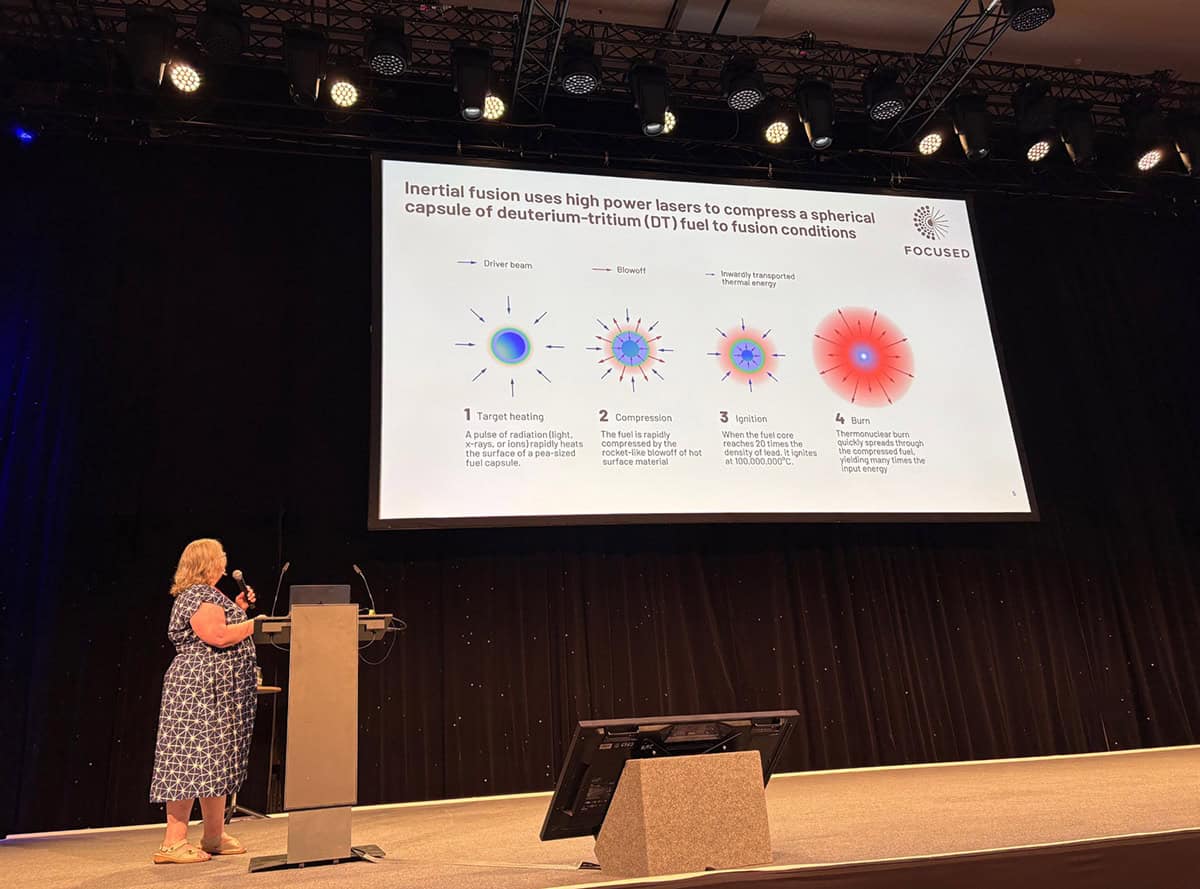
In inertial fusion – like at NIF – it’s the opposite. You don’t hold the plasma together at all, it’s only held by its own inertia, and you have a very high density for a short time. In both cases, you can make fusion happen.
What is the current state of the art at NIF, in terms of how much energy you have to put in to achieve fusion versus how much you get out?
To date, the best shot at NIF – by which I mean an individual, high-energy laser bombardment of the target capsule – occurred during an experiment in April 2025, which had a target gain of about 4.1. That means that they got out 4.1 times the amount of energy that they put in. The incident laser energy for those shots is around two megajoules, so they got out about eight megajoules.
This is a tremendous accomplishment that’s taken decades to get to. But to make inertial fusion energy successful and use it in a power plant, we need significantly higher gains of more like 50 to 100.
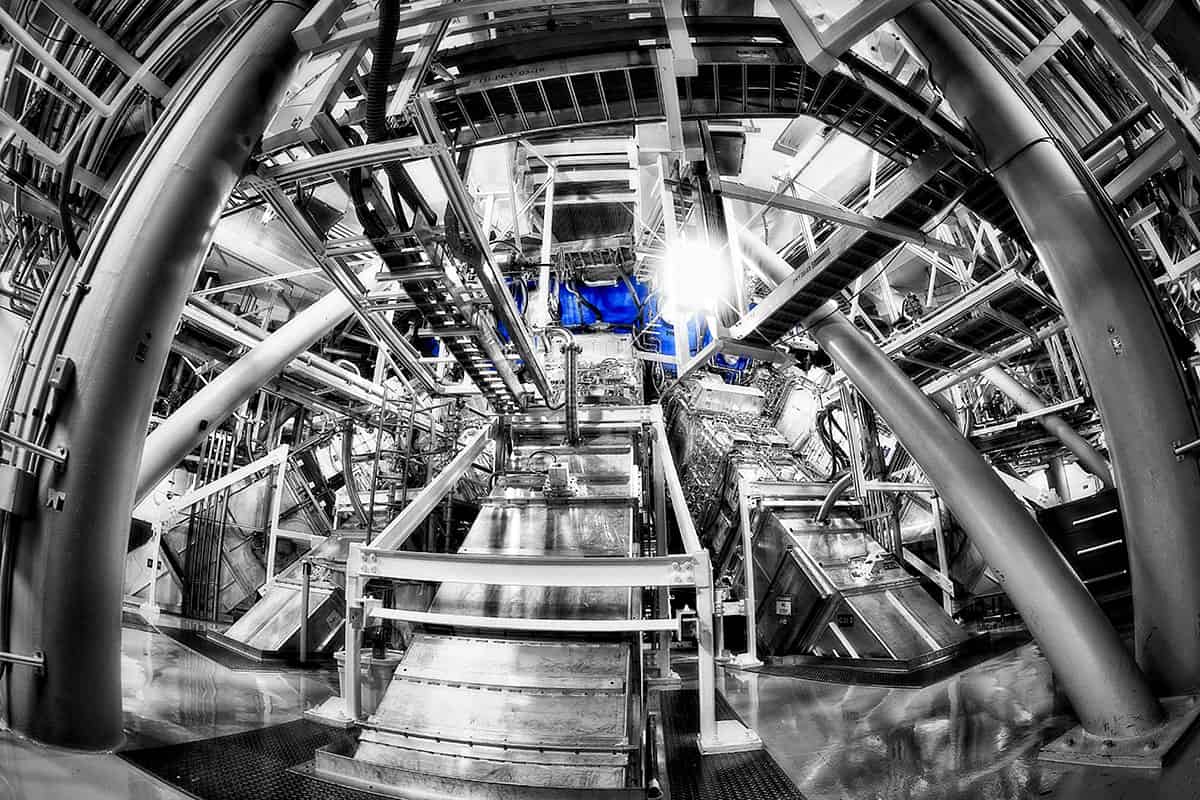
Captured beams The target chamber of the National Ignition Facility (NIF) at Lawrence Livermore National Laboratory. NIF has demonstrated that inertial fusion can work with deuterium–tritium fuel, but it is a research facility not a commercial endeavour. (Courtesy: Lawrence Livermore National Laboratory/Damien Jemison)
Can you explain Focused Energy’s approach to fusion?
Focused Energy was founded in July 2021, and has offices in the US and Germany. Just a month later, we achieved fusion ignition, which is when the fusion fuel becomes hot enough for the reactions to sustain themselves through their own internal heating (it is not the same as gain).
At NIF lasers are fired into a small cylinder of gold or depleted uranium and the energy is converted into X-rays, which then drive the capsule. It’s what’s called laser indirect drive. At Focused Energy, however, we’re directly driving the capsule. The laser energy is put directly on the capsule, with no intermediate X-rays.
The advantage of this approach is that converting laser energy to X-rays is not very efficient. It makes it much harder to get the high target gains that we need. At Focused Energy, we believe that direct drive is the best option for fusion energy to get us to a gain of over 50.
So is boosting efficiency one of your key goals to make fusion practical at an industrial level?
Yes, exactly. You have to remember that NIF was funded for national security purposes, not for fusion energy. It wasn’t designed to be a power plant – the goal was just to generate fusion energy for the first time.
In particular, the laser at NIF is less than 1% efficient but we believe that for fusion power generation, the laser needs to be about 10% efficient.
So one of the big thrusts for our company is to develop more efficient lasers that are driven by diodes – called diode pump solid state lasers.
Can you tell us about Focused Energy’s two technologies called LightHouse and Pearl Fuel?
LightHouse is our fusion pilot plant. When operational, it will be the first power plant to produce engineering gain greater than one, meaning it will produce more energy than it took to drive it. In other words, we’ll be producing net electricity.
For NIF, in contrast, gain is the amount of energy out relative to the amount of laser energy in. But the laser is very inefficient, so the amount of electricity they had to put in to produce that eight megajoules of fusion energy is a lot.
Meanwhile, Pearl is the capsule the laser is aimed at in our direct drive system. It’s filled with deuterium–tritium fuel derived from sea water and lithium.
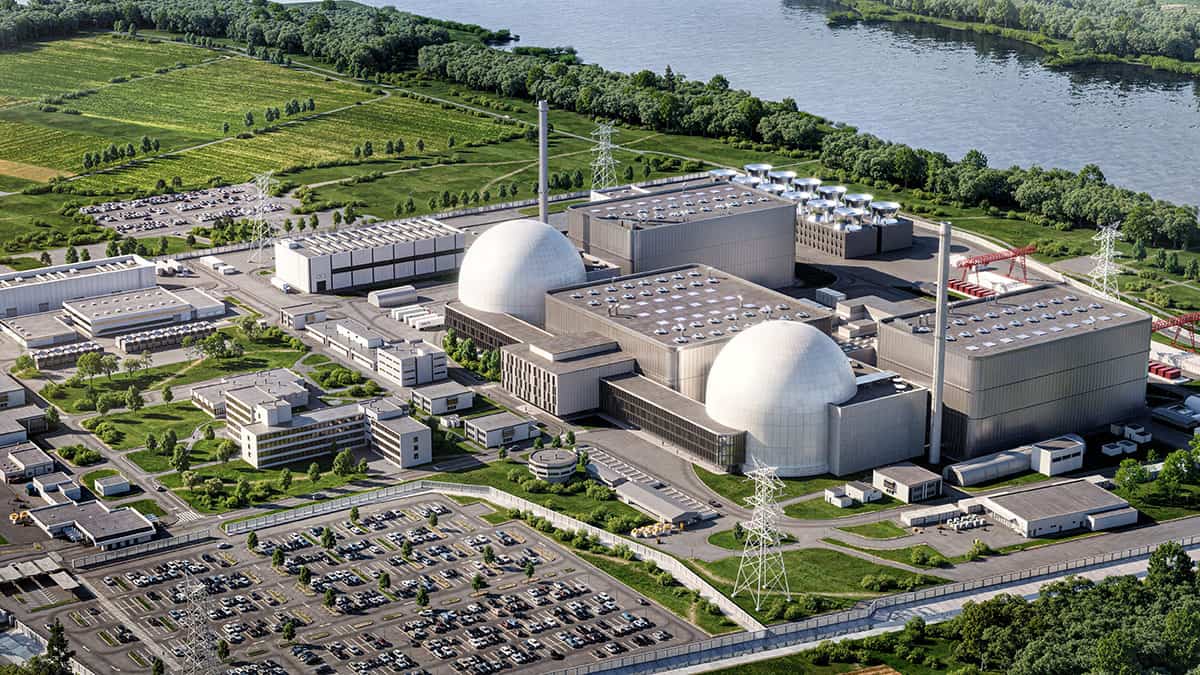
Rejuvenating nuclear A rendering of Focused Energy’s proposed fusion power plant at the Biblis fission power plant in Germany, which was shut down in 2011. (Courtesy: Focused Energy)
How do you develop the capsule to absorb the laser energy and give as much of it to the fuel as possible?
The development of the capsule for a fusion power plant is quite complicated. First, we need it to be a perfect sphere so it compresses spherically. The materials also need to efficiently absorb the laser light so you can minimize the size of that laser.
You have to be able to cheaply and quickly mass produce these targets too. While NIF does 400 shots per year, we will need to do about 900,000 shots a day – about 10 per second. We’ll also have to efficiently remove the exploded target material from the reactor chamber so that it can be cleared for the next shot.
It’s a very complicated design that needs to bring together all the pieces of the power plant in a consistent way.
When you are designing these elements, what plays a bigger role – computer simulations or experiments?
Computer simulations play a large part in developing these designs. But one of the lessons that I learned from NIF was that, although the simulation codes are state of the art, you need very precise answers, and the codes are not quite good enough – experimental data play a huge role in optimizing the design. I expect the same will be true at Focused Energy.
A third factor that’s developing is artificial intelligence (AI) and machine learning. In fact, at Livermore, a project working on AI contributed to achieving gain for the first time in December 2022. I only see AI’s role in fusion getting bigger, especially once we are able to do higher repetition rate experiments, which will provide more training data.
What intellectual property (IP) does Focused Energy have in addition to that for the design of the Pearl target and the LightHouse plant?
We also have IP in the design of the lasers – they are not the same lasers as used at NIF. And I think there’ll be a lot of IP around how we fabricate the targets. After all, it’s pretty complicated to figure out how to build 900,000 targets a day at a reasonable cost.
We’ll see a lot of IP coming out of this project in those areas, but there’s also the act of putting it all together. How we integrate these things in order to make a successful plant is important.
What are the challenges of working with deuterium and tritium as materials for fusion?
We chose deuterium and tritium because they are the easiest elements to fuse, and have been successfully demonstrated as fusion fuel by NIF.
Deuterium can be found naturally in sea water, but getting tritium – which is radioactive – is more complicated. We breed it from lithium. Our reactor designs have lithium in them, and the neutrons from the fusion reactions breed the tritium.
Making sure that we have enough tritium, and figuring out how to extract that material to use it for future shots, is a big task. We have to be able to breed enough tritium to keep the plant going.
To work on this, we have a collaboration funded by the US Department of Energy to work with Savannah River National Lab in South Carolina. They have a lot of expertise in designing these tritium-extraction systems.
How will you capture the heat from the deuterium–tritium fusion reaction?
We will use a conventional steam cycle to convert the heat into electricity. It’s funny – we’ll have this very hi-tech way of producing heat, but at the end of the day, we will use a traditional system to produce the electricity from that heat.
So what’s the timeline on development?
Our plan is to have a pilot plant up by the end of the 2030s. It’s a fairly aggressive timeline given the things that we have to do. But that’s part of being a start-up – we have to take some risks and try to move quickly to achieve our goal.
To help that we have, in my view, a superpower – we have one foot in Europe and one foot in the US. There are a lot of opportunities between the two continents to partner with other companies, universities and governments. I think that makes us strong because we have access to some of the best talent from around the world.
How does working at Focused Energy compare with life as an academic at Lawrence Livermore?
There are a lot of similarities. My role now is to bring the knowledge and skills I learned at NIF to Focused Energy, so it’s been a natural transition.
In fact, there was a lot of pressure working at NIF. We were trying to move very quickly, so it’s actually very similar to working in a start-up like Focused Energy.
One of the big differences is the level of bureaucracy. Working for a government-funded lab meant there were lots of rules and paperwork, which takes up your time and you don’t always see the value in it.
In contrast, working for a small start-up means we can move more quickly because we don’t have as many of those kinds of constraints. Personally, I find that great because it leaves more time for the fun and interesting things – like trying to get fusion on the grid.
Are you still involved in academic research in any way?
As a firm, we are still out there collaborating with academics. Last year, for example, we gave four separate presentations at the American Physical Society Division of Plasma Physics meeting.
Active collaboration Debbie Callahan presenting the work of Focused Energy at the IEEE Pulsed Power and Plasma Science Conference in Berlin in June 2025. (Courtesy: Focused Energy)
I feel very strongly about peer review. Of course, publishing isn’t our number one priority, but we need feedback from others. We’re trying to do something that no-one’s done before, so it’s important to have our colleagues give us feedback on what we’re doing, point out mistakes we’re making or things we’re forgetting.
Working with universities and national labs in both Europe and the US is vital. Communicating with others in the field is important for us to get to where we want to go.
And of course, being an active part of the fusion community is good for recruitment too. We regularly give presentations at conferences that students attend. We meet those students and they learn about our work – and they might be future employees for our company.
What’s your advice for early-career physicists keen on joining the fusion industry?
There are so many opportunities right now, especially compared to the start of my career when the work was mainly just at universities or national labs. Nowadays, there are a lot of companies in the sector. Not all of them will survive because there’s only so much money, but there are still lots of opportunities. If you’re interested in fusion energy, go for it.
The field is always developing. There’s new stuff happening every day – and new problems. So if you like problem-solving, it’s great, especially if you want to do something good for the world.
There are also opportunities for people who are not plasma physicists. At Focused Energy we have people across so many fields – those who work on lasers, others who work on reactor design, some developing the AI and machine learning, and those who work on target physics, like me. To achieve fusion energy, we need physicists, engineers, mathematicians and computer scientists. We need researchers, technicians and operators. There’s going to be tremendous growth in this sector.
Learn how newly discovered Purgatorius fossils in Colorado’s Denver Basin are filling gaps in the Paleocene fossil record and clarifying early primate evolution after the dinosaur extinction.
 Connexion