China has designated aerospace to be an “emerging pillar industry” in a draft national economic plan, also setting major objectives for the five years ahead.
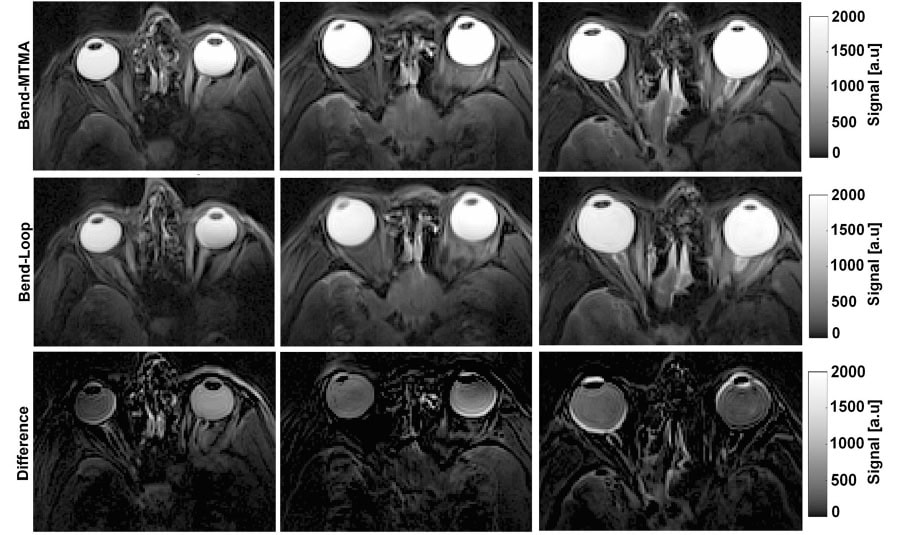
In vivo imaging T2-weighted MRI of three healthy volunteers (left to right columns) using the bend-MTMA and bend-loop antennas reveals increased intraocular signal for the metamaterial-based bend-MTMA configuration. (Courtesy: CC BY 4.0/Advanced Materials 10.1002/adma.202517760)
MRI is one of the most important imaging tools employed in medical diagnostics. But for deep-lying tissues or complex anatomic features, MRI can struggle to create clear images in a reasonable scan time. A research team led by Thoralf Niendorf at the Max Delbrück Center in Germany is using metamaterials to create a compact radiofrequency (RF) antenna that enhances image quality and enables faster MRI scanning.
Imaging the subtle structures of the eye and orbit (the surrounding eye socket) is a particular challenge for MRI, due to the high spatial resolution and small fields-of-view required, which standard MRI systems struggle to achieve. These limitations are generally due to the antennas (or RF coils) that transmit and receive the RF signals. Increasing the sensitivity of these antennas will increase signal strength and improve the resolution of the resulting MR images.
To achieve this, Niendorf and colleagues turned to electromagnetic metamaterials – artificially manufactured, regularly arranged structures made of periodic subwavelength unit cells (UCs) that interact with electromagnetic waves in ways that natural materials do not. They designed the metamaterial UCs based on a double-square split-ring resonator design, tailored for operation at a high magnetic field strength of 7.0 T.
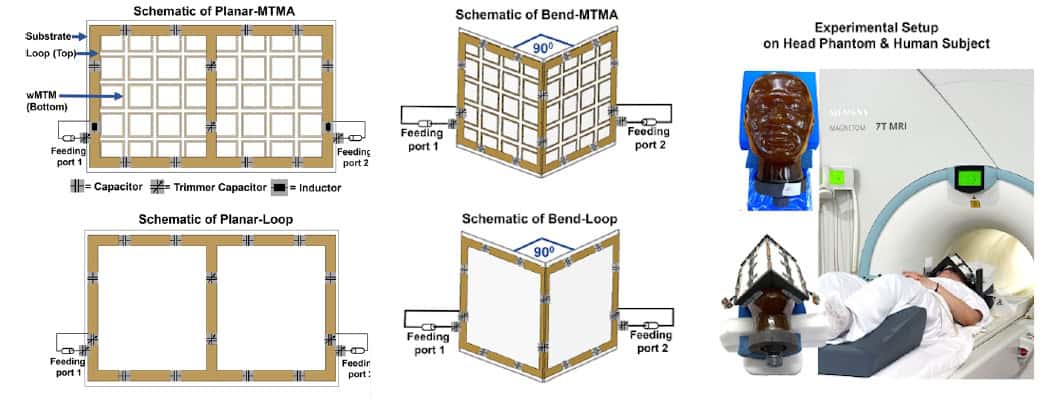
In their latest study, led by doctoral student Nandita Saha and reported in Advanced Materials, the researchers created a metamaterial-integrated RF antenna (MTMA) by fabricating the UCs into a 5 x 8 array. They built two configurations: a planar antenna (planar-MTMA); and a version with a 90° bend in the centre (bend-MTMA) to conform to the human face. For comparison, they also built conventional counterparts without the metamaterial (planar-loop and bend-loop).
The researchers simulated the MRI performances of the four antennas and validated their findings via measurements at 7.0 T. Tests in a rectangular phantom showed that the planar-MTMA demonstrated between 14% and 20% higher transmit efficiency than the planar-loop (assessed via B₁+ mapping).
They next imaged a head phantom, placing planar antennas behind the head to image the occipital lobe (the part of the brain involved in visual processing) and bend antennas over the eyes for ocular imaging. For the planar antennas, B₁+ mapping revealed that the planar-MTMA generated around 21% (axial), 19% (sagittal) and 13% (coronal) higher intensity than the planar-loop. Gradient-echo imaging showed that planar-MTMA also improved the receive sensitivity, by 106% (axial), 94% (sagittal) and 132% (coronal).
Antenna design and deployment Layout of the planar and bend antennas, and the experimental setups for imaging an anatomical head phantom and a volunteer in a 7.0 T whole-body MRI system. (Courtesy: CC BY 4.0/Advanced Materials 10.1002/adma.202517760)
The bend antennas exhibited similar trends, with B₁+ maps showing transmit gains of roughly 20% for the bend-MTMA over the bend-loop. The bend-MTMA also outperformed the bend-loop in terms of receive signal intensity, by approximately 30%.
“With the metamaterials we developed, we were able to guide and modulate the RF fields generated in MRI more efficiently,” says Niendorf. “By integrating metamaterials into MRI antennas, we created a new type of transmitter and detector hardware that increases signal strength from the target tissue, improves image sharpness and enables faster data acquisition.”
In vivo imaging
Importantly, the new MRI antenna design is compatible with existing MRI scanners, meaning that no new infrastructure is needed for use in the clinic. The researchers validated their technology in a group of volunteers, working closely with partners at Rostock University Medical Center.
Before use on human subjects, the researchers evaluated the MRI safety of the four antennas. All configurations remained well below the IEC’s specific absorption rate (SAR) limit. They also assessed the bend-MTMA (which showed the highest SAR) using MR thermometry and fibre optic sensors. After 30 min at 10 W input power, the temperature increased by about 1.5°C. At 5 W, the increase was below 0.5°C, well within IEC safety thresholds and thus used for the in vivo MRI exams.
The team first performed MRI of the eye and orbit in three healthy adults, using the bend-loop and bend-MTMA antennas positioned over the eyes. Across all volunteers, the bend-MTMA exhibited better transmit performance in the ocular region that the bend-loop.
The bend-MTMA antenna also generated larger intraocular signals than the bend-loop (assessed via T2-weighted turbo spin-echo imaging), with signal increases of 51%, 28% and 25% in the left eyes, for volunteers 1, 2 and 3, respectively, and corresponding gains of 27%, 26% and 29% for their right eyes. Overall, the bend-MTMA provided more uniform and higher-intensity signal coverage of the ocular region at 7.0 T than the bend-loop.
To further demonstrate clinical application of the bend-MTMA, the team used it to image a volunteer with a retinal haemangioma in their left eye. A 7.0 T MRI scan performed 16 days after treatment revealed two distinct clusters of structural change due to the therapy. In addition, one of the volunteer’s ocular scans revealed a sinus cyst, an unexpected finding that showed the diagnostic benefit of the bend-MTMA being able to image beyond the orbit and into the paranasal sinuses and inferior frontal lobe.
The team used the planar antennas to image the occipital lobe, a clinically relevant target for neuro-ophthalmic examinations. The planar-MTMA exhibited significantly higher transmit efficiency than the planar-loop, as well as higher signal intensity and wider coverage, enhancing the anatomical depiction of posterior brain regions.
“Clearer signals and better images could open new doors in diagnostic imaging,” says Niendorf. “Early ophthalmology applications could include diagnostic confirmation of ambiguous ophthalmoscopic findings, visualization and local staging of ocular masses, 3D MRI, fusion with colour Doppler ultrasound, and physio-metabolic imaging to probe iron concentration or water diffusion in the eye.”
He notes that with slight modifications, the new antennas could enable MRI scans depicting the release and transport of drugs within the body. Their geometry and design could also be tuned to image organs such as the heart, kidneys or brain. “Another pioneering clinical application involves thermal magnetic resonance, which adds a thermal intervention dimension to an MRI device and integrates diagnostic guidance, thermal treatment and therapy monitoring facilitated by metamaterial RF antenna arrays,” he tells Physics World.
WARSAW — Polish chemical propulsion startup Liftero has signed a deal with India’s commercial in-orbit servicing specialist OrbitAID where Liftero will supply green chemical propulsion for OrbitAID’s in-orbit servicing spacecraft. Under the contract, Liftero will supply two multi-thruster BOOSTER configurations for an upcoming OrbitAID mission expected in the fourth quarter of 2026. The mission will […]
Learn how social media posts in the U.S. were used to measure public reaction to Daylight Saving Time and why the fall clock change sparks stronger frustration.
Inspired by the loss of their mother, they have poured millions into studying a key protein behind frontotemporal dementia. But all has not gone according to plan
IRVINE, Calif., March 5, 2026 — Terran Orbital, a Lockheed Martin Company and a leading satellite solutions provider, announced today the appointment of Kwon Park as senior director of manufacturing […]
SAN FRANCISCO – Southern California startup General Galactic plans to launch a 500-kilogram satellite later this year to demonstrate a novel multimode propulsion system. When the Trinity mission travels to low-Earth orbit on the SpaceX Transporter-18 rideshare, no earlier than October, General Galactic will test its Genesis platform, which pairs chemical and electric engines. “We’re […]
LONDON – In-orbit services provider Infinite Orbits announced plans March 3 to acquireLondon-based in-orbit servicing and manufacturing startup Lunasa, marking a step in the company’s expansion into the United Kingdom. The acquisition, the value of which the companies didn’t disclose, will bring together the Infinite Orbits’ and Lunasa’s investments into complementary spacecraft rendezvous and life […]
Learn how advanced scanning and 3D reconstruction revealed the face of the Little Foot fossil and new insights into Australopithecus and early human evolution in Africa.
Humans are generating more data than ever before. While much of these data do not need to be stored long-term, some – such as scientific and historical records – would ideally still be retrievable in decades, or even centuries. The problem is that modern digital archive systems such as hard disk drives do not last that long. This means that data must regularly be transferred to new media, which is costly and time-consuming.
A team at Microsoft Research now claims to have found a solution. By using ultrashort, intense laser pulses to “write” data units called phase voxels into glass chips, the team says it has created a medium that could store 4.8 terabytes (TB) of data error-free for more than 10::000 years – a span that exceeds the age of history’s oldest surviving written records.
Direct laser writing
The idea of writing data into glass or other durable media with lasers is not new. Direct laser writing, as it is known, involves focusing high-power pulses, usually just femtoseconds (10-15 s) long, on a three-dimensional region within a medium. This modifies the medium’s optical properties in that region, and each modified region becomes a data-storage unit known as a voxel, which is the 3D equivalent of a pixel.
Because the laser’s energy is focused on a very small volume, the voxels created with this method can be very densely packed. Changing the amplitude and polarization of the laser’s output changes what information gets encoded at each voxel, and an optical microscope can “read out” this information by picking up changes in the light as it passes through each modified region. In terms of the media used, glass is particularly promising because it is thermally and chemically stable and is robust to moisture and electromagnetic interference.
Direct laser writing does have some limitations, however. In particular, encoding information generally requires multiple laser pulses per voxel, restricting the technique’s throughput and efficiency.
Two types of voxel, one laser pulse
Microsoft Research’s “Project Silica” team says it overcame this problem by encoding information in two types of voxel: phase voxels and birefringent voxels. Both types involve modifying the refractive index of the medium, and thus the speed of light within it. The difference is that whereas phase voxels create an isotropic change in the refractive index, birefringent voxels create an anisotropic change by rotating the voxel in the plane of the 120-mm square, 2-mm-thick glass chip.
Crucially, both types of voxel can be produced using a single laser pulse. According to Project Silica team leader Richard Black, this makes the modified region smaller and more uniform, minimizing effects such as light scattering that can interfere with read-outs from neighbouring voxels. It also allows many voxel layers to be written into, and then read out from, a single glass chip. The result is a system that can generate up to 10 million voxels per second, which equates to 25.6 million bits of data per second (Mbit s−1).
Performance of different types of glass
The Microsoft researchers studied two types of glass, both of which have better mechanical properties than ordinary window glass. In 301 layers of fused silica glass, they achieved a data density of 1.59 Gbit mm−3 using birefringent voxels, with a write throughput of 25.6 Mbit s−1 and a write efficiency of 10.1 nJ per bit. In 258 layers of borosilicate glass, the data density reached 0.678 Gbit mm−3 using phase voxels. Here, the write throughput was 18.4 Mbit s−1 and the write efficiency 8.85 nJ per bit.
“The phase voxel discovery in particular is quite notable because it lets us store data in ordinary borosilicate glass, rather than pure fused silica; do it with a single laser pulse per voxel; and do it highly parallel in close proximity,” says Black. “That combination of cheaper material and much simpler and faster writing and reading was a genuinely exciting moment for us.”
The researchers also showed that they could directly inscribe the glass using four independent laser beams in parallel, further increasing the write speeds for both types of glass.
Surviving “benign neglect”
To determine how long these inscribed glass plates could store data, the team repeatedly heated them to 500 °C, simulating their long-term ageing at lower temperatures. The results of these experiments suggest that encoded data could be retrieved after 10::000 years of storage at 290 °C. However, Black acknowledges that this figure does not account for external effects such as mechanical stress or chemical corrosion that could degrade the glass and the data it stores. Another unaddressed challenge is that storage capacity and writing speed will both need to grow before the technology can compete with today’s data centres.
If these deficiencies can be remedied, Black thinks the clearest potential applications would be in national libraries and other facilities that store scientific data and cultural records. “It’s also compelling for cloud archives where data is written once and kept indefinitely,” Black says. He points out that the team has already demonstrated proofs of concept with Warner Bros., the Global Music Vault and the Golden Record 2.0 project, a “cultural time capsule” inspired by the literal golden records launched on the Voyager spacecraft in the 1970s.
A common factor across all these organizations, Black explains, is that they need media that can survive “benign neglect” – something he says Project Silica delivers. He adds that the project also provides what he calls operational proportionality, meaning that its costs are primarily a function of the operations performed on the data, not the length of time the data are kept. “This completely alters the way we think about keeping archival material,” he says. “Once you have paid to keep the data, there is little point in deleting it, and you might as well keep it.”
Microsoft began exploring direct laser data storage in glass nearly a decade ago thanks to team member Ant Rowstron, who recognized the potential of work being done by physicist Peter Kazansky and colleagues at the University of Southampton, UK. The latest version of the technique, which is detailed in Nature, grew out of that collaboration, and Black says its capabilities are limited only by the power and speed of the femtosecond laser being used. “We have now concluded our research study and are sharing our results so that others may build on our work,” he says.
In this episode of Space Minds, Jeff Foust moderates a panel at AIAA AscendxTexas on the role Texas is playing in the space economy. With a series of industry leaders they […]
For decades, space has served as humanity’s most demanding testing laboratory, where only the most resilient technologies survive the vacuum, radiation and temperature extremes beyond Earth’s protective embrace. Today, we stand at an inflection point where artificial intelligence is poised to fundamentally transform how we explore, understand and operate in space. But making AI-powered space […]
LONDON – The United Kingdom is refocusing its funding priorities with a new 500 million pound ($668 million) space funding package that aligns more closely with economic growth and national security priorities, Liz Lloyd, the UK minister for the Digital Economy at the Department for Science, Innovation and Technology, said March 4. Speaking here at […]
“Surround sound for biological cells,” is how Luke Cox describes the ultrasound technology that Impulsonics has developed to solve the “unsticking problem” in biomedical science. Cox is co-founder and chief executive of UK-based Impulsonics, which spun-out of the University of Bristol in 2023.
He is also my guest in this episode of the Physics World Weekly podcast. He explains why living cells tend to stick together and why this can be a barrier to scientific research and the development of new medical treatments.
The system uses an array of ultrasound transducers to focus sound so that it frees-up and manipulates cells in a way that does not alter their biological properties. This is unlike chemical unsticking processes, which can change cells and impact research results.
We also chat about Cox’s career arc from PhD student to chief executive and explore opportunities for physicists in the biomedical industry.
The following articles are mentioned in the podcast:
 Connexion