Exclusive: Luxury aircraft owned by property tycoon close to US president’s family has twice flown Palestinian men from Arizona to Tel Aviv
On the morning of 21 January, Israeli authorities left eight Palestinian men at a West Bank checkpoint. Disoriented and cold, they were dressed in prison-issued tracksuits and carried their few belongings in plastic bags.
Hours earlier, they had been sitting with their wrists and ankles shackled on the plush leather seats of a private jet owned by the Florida property tycoon Gil Dezer, a longtime business partner of Donald Trump.
As Starmer apologises for believing Mandelson’s ‘lies’, just how damaging will the latter’s links to Jeffrey Epstein be for the PM’s own reputation? John Harris and Kiran Stacey discuss the latest. Plus, the mood on the ground from the Gorton and Denton by-election
The hosts managed to just about get the Santagiulia arena ready for Italy’s win over France – and the locals responded
“Ladies and gentlemen! The women’s preliminary Group B match between Italy and France will get under way in five minutes! And the question is: Are! You! Ready! For! Hockey?!” Well, quite.
That had been the question for the last five months, as it happens, ever since it first became obvious that construction of Milan’s new Santagiulia arena was running massively behind schedule. At the test event last month the ice was grey because there was so much building dust in it, and midway through the match a man had to come on to the rink to repair a melted patch with a watering can.
Furnish says he and his husband felt ‘violated’ by the Daily Mail, who allegedly used information gained unlawfully
David Furnish has said it is “an abomination” that the publisher of the Daily Mail was able to write “narrow-minded” stories about him and his husband, Elton John, using information allegedly secured by unlawful means.
In evidence submitted to the high court, Furnish said he and John had been “violated” by the Mail, after being told that it had worked with private detectives to intercept their phone calls and personal details.
After weeks of talks mining companies say they cannot reach a deal that delivers value for shareholders
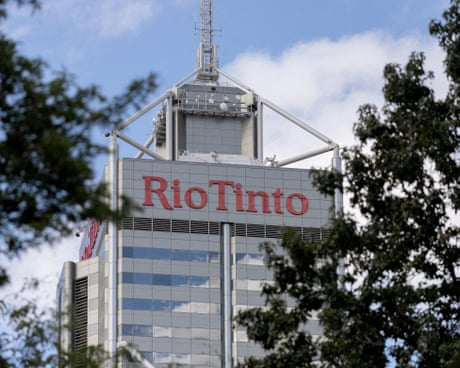
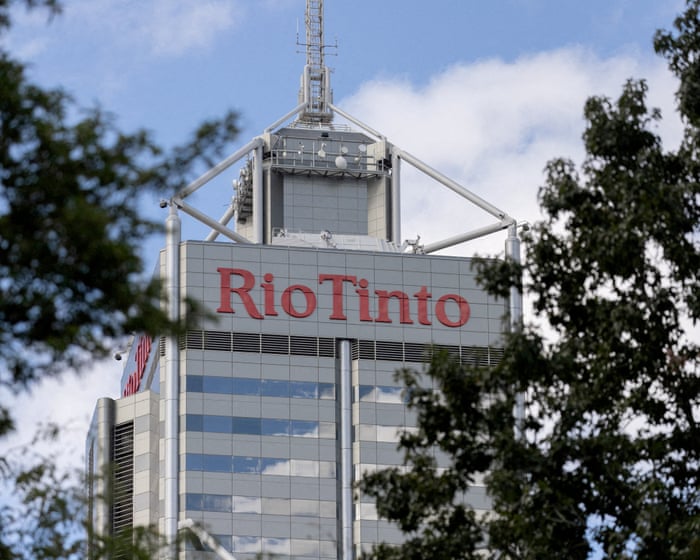
Rio Tinto and Glencore have abandoned plans for a $260bn merger, walking away from a deal that would have created the world’s largest mining company.
Rio Tinto said it was no longer considering a “merger or other business combination” with Glencore after it “determined that it could not reach an agreement that would deliver value to its shareholders”.
Artists from Bernini to Louise Bourgeois are brought together in a new exhibition exploring the uncomfortable erotic parables of the ancient Roman poet
On three massive screens in a darkened room, snakes glide over the face of artist Juul Kraijer – covering her eyes, caressing her lips. She is the silent but terrifying snake-headed Medusa, and one of the surprises in an exhibition at the Rijksmuseum in Amsterdam revolving around Greek and Roman myths.
While the show features rarely lent works from masters such as Caravaggio, Bernini, Rodin and Brâncuși, it marries them with modern artists who reinterpret the legends where male gods do all they can to get their wicked way and the powerless are punished. Transgender bodies, bare breasts and even a volcanic vulva appear in artworks inspired by Roman poet Ovid’s masterpiece, Metamorphoses.
A new retrospective celebrates the work of the cat credited with roles in Breakfast at Tiffany’s, The Comedy of Terrors and Rhubarb
In the midst of Oscar season, it becomes evident just how much work it takes to win an Academy Award, both in on-screen work and off-screen campaigning. Consider, however, that multiple actors have won more than one Oscar. (Emma Stone, one of this year’s best actress nominees, won twice in the past decade.) Only a single cat, meanwhile, has twice won the Patsy – the Picture Animal Top Star of the Year. (The award, given by the American Humane Association, not to be confused with the Humane Society, was discontinued in 1986.) That cat is Orangey, the subject of a small retrospective at New York City’s Metrograph cinema. Plenty of rep houses will play a movie like Breakfast at Tiffany’s around Valentine’s Day; the Metrograph is going deeper into the Orangey catalogue for a wider variety of titles and genres.
Breakfast at Tiffany’s does offer Orangey his most famous role: the rather less colorfully named Cat, pet of Holly Golightly (Audrey Hepburn), who calls him a “poor slob without a name”. Orangey features heavily in the film’s climax, when Holly releases her pet into an alley as she prepares to leave town, only to have Paul (George Peppard) rush to retrieve him. It completes a running thread that Cat is a part of Holly’s wildness as well as her potential domestication. What better animal, of course, than one equally prone to draping himself over his makeshift mistress and making yowling leaps around her apartment?
Exclusive: Campaigners say proposed cut from £11.9bn over past five years to £9bn over next five years will cost lives and livelihoods
The UK plans to slash its aid to poor countries stricken by the climate crisis by more than a fifth, the Guardian has learned, despite promises to increase assistance and warnings from campaigners that the move will cost lives and livelihoods.
Ministers plan to cut climate finance for the developing world from £11.6bn over the past five years to £9bn in the next five. In real terms, accounting for inflation, this would represent a cut of about 40% in spending power since 2021, when the £11.6bn budget was agreed.
Though lab-made peptides are touted as a cure-all, they are not FDA-regulated and pose serious risks, experts warn
Here’s a new trend that sounds unwise: buying unregulated substances from dealers in foreign countries and injecting them into your body.
And yet, grey-market injectable peptides – a category of substances with obscure, alphanumeric names like BPC-157, GHK-Cu, or TB-500 – have developed a devoted following among biohackers and health optimizers.
National Museum, Cardiff In a superb, mystical retrospective, the painter sheds social trappings – and her clothes – as she uses her enormous intelligence to paint purely
This is Gwen John straight, no chaser. Cardiff’s National Museum has put together a superb, daunting retrospective of the woman who is now, perhaps, the most famous Welsh artist. It is not a blow-by-blow biographical story of how she was born in Haverfordwest in 1876, how she and her brother Augustus both loved art as children, how she insisted on going to the Slade School of Fine Art like him then made her life in bohemian France. Instead, the moment you enter the show, you are plunged into her spiritual, austere existence. We meet her in the glory of her solitude, painting cats and the sparse rooms she rented in Paris and women alone in moments of calm thought.
There is a row of variants of a young woman in a blue dress with long dark hair sitting weakly in an armchair, a table at her elbow, all painted in about 1920. In most there’s a cup and teapot on the table, in one it’s a bowl of soup. She looks down as she reads a letter, occasionally a book. Their titles vary too – The Letter, The Seated Woman, The Convalescent.
Man misidentified by London supermarket using Facewatch system says: ‘I shouldn’t have to prove I am not a criminal’
A man was ordered to leave a supermarket in London after staff misidentified him using controversial new facial recognition technology.
Warren Rajah was told to abandon his shopping and leave the local store he has been using for a number of years after an “Orwellian” error in a Sainsbury’s in Elephant and Castle, London.
Leicester breached PSR rules for period ending 2023-24
Club outside the relegation zone on goal difference
Leicester City have been deducted six points after being found in breach of the Premier League’s financial rules. The punishment, determined by an independent disciplinary commission, leaves them outside the Championship relegation zone on goal difference.
A hearing took place in November after Leicester were alleged to have breached profitability and sustainability regulations for the three-season period ending with 2023-24. There were also two further charges against the club for failing to cooperate and failing to submit their financial accounts on time.
Donald Trump’s former adviser told Epstein in 2019 that he was ‘focused on raising money for Le Pen and Salvini’ before European elections
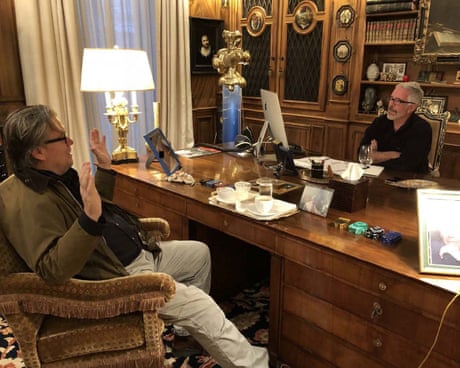
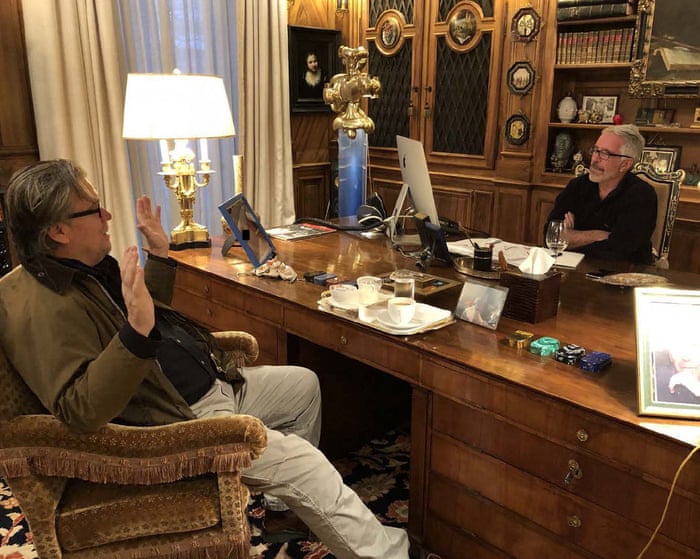
Dozens of messages contained in the latest tranche of Epstein files lay bare the attempts by Donald Trump’s former chief strategist Steve Bannon to tap Jeffrey Epstein for support and funding to bolster European far-right parties.
The messages mostly date to 2018 and 2019, when Bannon, after being sacked by Trump, regularly visited Europe in his quest to forge a movement in the European parliament uniting ultra-rightwing and Eurosceptic forces from several countries including Italy, Germany, France, Hungary, Poland, Sweden and Austria.
It is not good enough just to criticize Trump. We must offer a positive vision that will improve the lives of Americans
At this difficult moment in American history, it’s imperative that we have the courage to be honest with ourselves.
The United States, once the envy of the world, is now a nation in profound decline. For the sake of our children and future generations, we must reverse that decline and change, in very fundamental ways, the direction of our country.
We must create a vibrant democracy by ending Citizens United and preventing billionaires from buying elections.
Whether the Democratic establishment likes it or not, we must guarantee healthcare as a human right through Medicare for All.
We must build millions of affordable homes and apartments and give our younger generation the opportunity to own a home of their own.
We must make public colleges, universities, trade schools and medical schools tuition-free and have the best childcare and public school system in the entire world.
We must expand Social Security and bring back traditional pension plans so that every senior in this country can retire with dignity.
We must raise the minimum wage to a living wage and guarantee every worker the right to join a union.
We must demand that the wealthiest people and most profitable corporations in America pay their fair share in taxes.
Bernie Sanders is a US senator, and ranking member of the health, education, labor, and pensions committee. He represents the state of Vermont and is the longest-serving independent in the history of Congress
Former truck driver, now 80, allegedly one of many ‘sniper tourists’ who paid Bosnian Serb soldiers to be allowed fire on city
An elderly Italian man is under investigation as part of an investigation by prosecutors in Milan into individuals who allegedly paid members of the Bosnian Serb army for trips to Sarajevo so they could kill citizens during the four-year siege of the city in the 1990s.
The 80-year-old is being investigated on charges of aggravated murder, a source close to the case told the Guardian. The man, a former truck driver from the northern Italian region of Veneto, is the first suspect to be placed under investigation since the inquiry began in November.
From pirates and skateboarders in Hastings to legends and locks in Devizes, from dolphins in Scarborough to the ‘artists’ town’ of Kirkcudbright, readers put forward their favourite places
Culture secretary Lisa Nandy has launched a search for the UK’s first “town of culture”, similar to the city of culture programme, which honoured Bradford last year. After the Guardian’s writers nominated theirs – including Ramsgate in Kent, Falmouth in Cornwall, Abergavenny in Monmouthshire and Portobello in Edinburgh – we asked readers which UK towns they would put forward.
There is a look of despair in Starmer’s eyes – and a feeling in the room that the endgame has begun
It’s beginning to feel terminal. Not that there hasn’t been talk of Labour MPs wanting to remove Keir Starmer before. Just that this time there’s the sense of a tipping point being reached. No more second chances. No praying for a miracle that will never come in the May elections. A quantum shift of collective despair.
You can’t escape the irony. Starmer has always prided himself on being Mr Rules. It’s how he got elected. He might be a bit dull and lack charisma, but you can count on him to be reliable. To play by the rules. And now he has been undone by having given the prime Washington job to a man who was the epitome of Mr No Rules. And he had thought he had been so clever by acting out of character to make Peter Mandelson the US ambassador. Many in his cabinet had congratulated him, as had many Tories. A sleazy diplomat for a sleazy president. A match made in heaven.
As fewer people choose to pair up, let alone marry, it could be that our species’ mating patterns are moving closer to the natural order
Monogamy, you may have heard, is in crisis. Fewer people are in relationships, let alone opting to be in one ’til death. And even those who have already exchanged vows seem to be increasingly looking for wiggle room. “Quiet divorce” – mentally checking out of your union, rather than going through the rigmarole of formally dissolving it – is reportedly on the rise, as is “ethical non-monogamy” (ENM) and opening up a relationship to include other partners.
This is borne out by my experience on mainstream dating apps. About one profile in every 10 I come across seems to express a preference for “ENM” or polyamory, or mentions an existing wife or girlfriend. The best you can hope for, if you’re prepared to accept those terms, is that the “primary partner” really is across the arrangement as described.
Arsenal staff member was in Chelsea half before cup tie
‘There are certain etiquettes in football,’ Rosenior says
Liam Rosenior has accused Arsenal of disrespecting Chelsea by disrupting their warm-up before the second leg of their Carabao Cup semi-final.
Television cameras caught Chelsea’s head coach losing his cool and aiming a foul-mouthed outburst at an unidentified member of Arsenal staff for straying into the wrong half of the pitch before the sides met at the Emirates Stadium on Tuesday. Rosenior, who was seen telling someone to stay in their half, looked livid at the time and said on Thursday that there were “certain etiquettes in football” to observe, after being asked why the incident angered him so much.
Industry leaders urge EU to tell authorities to stand down entry-exit system controls if needed
Travel industry leaders have called on the European Commission to tell all border authorities to stand down the new entry-exit system (EES) if needed as fears increase of summer disruption.
European airports have warned of a potentially “disastrous” experience for passengers and huge queues unless the biometric controls for foreign visitors are relaxed.
South Crofty site could get $225m funding as US seeks to secure supply of critical metal
Donald Trump has aggressively pursued investment into hi-tech industries in recent months, but the US administration has now set its sights on a more traditional sector: tin mining in Cornwall.
The South Crofty mine, near the village of Pool, could start up again after nearly three decades aided by a potential $225m (£166m) investment from across the Atlantic, creating 300 jobs.
Some backbenchers blame Pm’s chief of staff for Peter Mandelson’s appointment as ambassador
After the release of a vast tranche of documents and emails that shed further light on the close relationship between Peter Mandelson and Jeffrey Epstein, the government has come under intense pressure to release details about its vetting process before Mandelson’s appointment as US ambassador in December 2024.
Below, we look at how much Keir Starmer knew about Mandelson’s relationship with Epstein, and what vetting process the former peer went through for the top diplomatic job in Washington.
As Emerald Fennell’s provocative adaptation hits screens, this narration from the White Lotus actor reminds us of the brilliance of Brontë’s tempestuous novel
Rare is the Wuthering Heights adaptation that fails to ruffle the feathers of the Brontë faithful. Andrea Arnold’s 2011 film was criticised for its grit and gloom while Emerald Fennell’s new version, which arrives in cinemas on Valentine’s Day, was described as “aggressively provocative” after test screenings. Perhaps now is the time to return to the source material. In the audioverse, there have already been readings by Michael Kitchener, Daniel Massey, Juliet Stevenson, Patricia Routledge and Joanne Froggatt, though I favour this 2020 edition narrated by Aimee Lou Wood, of Sex Education and The White Lotus fame.
Set in Yorkshire, Emily Brontë’s tempestuous novel opens with Mr Lockwood, the new tenant at Thrushcross Grange, visiting his sullen landlord, Heathcliff, at his remote farmhouse where he gets snowed in. Bedding down for the night, he stumbles upon the diaries of the late Catherine Earnshaw, who writes of her love for Heathcliff, an orphan brought by her father to live with the family. Later Mr Lockwood has a nightmare in which the ghost of Catherine begs to be let in through the window (a scene immortalised in song by Kate Bush). The following day he returns to Thrushcross Grange where he asks the housekeeper, Nellie, to tell him about the Earnshaws. Nellie shares a dark tale of abuse, revenge and doomed love.
Yunchan Lim (Decca) The 21-year-old pianist gives a fine, muscular account of the Goldbergs, with touches of playfulness, in this live recording from Carnegie Hall
Yunchan Lim recorded the Goldberg Variations live at Carnegie Hall last year, riding the momentum of a run of performances, including two in London. Those who enjoyed his interpretation at Wigmore Hall will find plenty of the same rewarding elements here, not least the seeming ease with which the 21-year-old pianist untangles the music’s complex web of threads. Yet it’s good to find his interpretation wasn’t set in stone. Perhaps the New York performance had a more muscular bent, or perhaps the hints of romanticism in the later variations in London don’t register as strongly on a recording as in the hall.
What is more striking on the recording is a strength in the faster variations that sometimes verges on the mechanical: impressive, and a little overdone. There are touches of playfulness too – when in a couple of the variations he switches to a higher octave, the music sounds like it’s on helium, lighter than air. The slow variation halfway through is deeply felt, the long 25th variation touchingly done without quite staring into the abyss in the way that some performances do. It will be interesting to hear how Lim’s interpretation of the Goldbergs develops over the years, but this is a fine account to start with.
 Connexion