Connexion
Ukraine war briefing: Russia pounds cities across country ahead of fresh round of peace talks

Couple killed near Kyiv and apartment block hit while US says territorial issue of Donetsk ‘very difficult’ to resolve. What we know on day 1,436
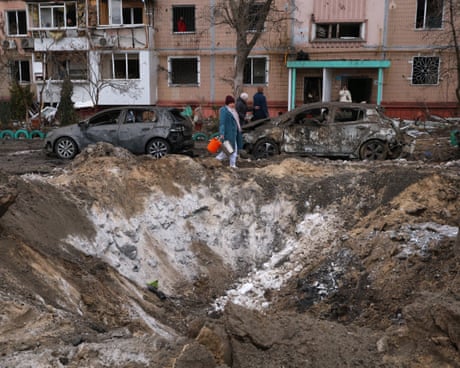
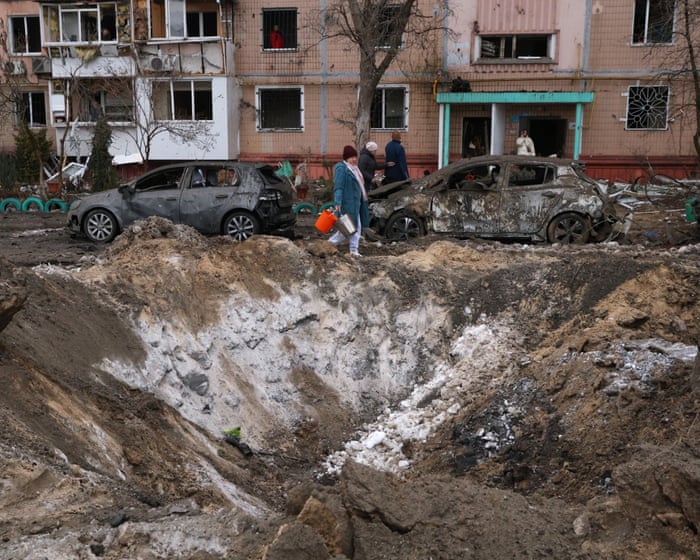
Russia has hit cities across Ukraine with drones and a missile, killing a couple near the capital of Kyiv one day after five people died in an attack on a passenger train. The attack came ahead of a fresh round of peace talks due at the weekend. Officials said four people, including two children, sought medical attention after the strikes overnight to Wednesday. President Volodymyr Zelenskyy condemned the attack on the apartment block, as well as another strike with short-range rockets on what he described as a residential area without military targets in the southern city of Zaporizhzhia. “We will respond fairly to Russia for this and other similar attacks,” he wrote on social media. Russian strikes on other locations across the country included the southern port city of Odesa as well as the central city of Kryvyi Rih.
The territorial issue of Donetsk is “very difficult” to resolve, the US secretary of state has said, saying there is active work under way to reconcile the issue at US-mediated talks to end Russia’s war in Ukraine. “It’s still a bridge we have to cross,” Marco Rubio said on Wednesday. “It’s still a gap, but at least we’ve been able to narrow down the issue set to one central one, and it will probably be a very difficult one,” he told a US Senate foreign relations committee hearing, referring to the eastern Ukrainian region where Moscow wants Kyiv to surrender land. Rubio said the US may the join the new Russia-Ukraine talks this week but that said US participation would be more junior than last week when Donald Trump envoys Steve Witkoff and son-in-law Jared Kushner joined negotiations in Abu Dhabi that were Ukrainian and Russian officials’ first face-to-face talks on Trump’s plan to end the war.
Life will be particularly tough for Ukrainians over the next three weeks due to plunging temperatures and intense Russian attacks on the energy system that have already deprived millions of light and heat, a senior lawmaker said on Wednesday. “The bad news is that there will indeed be frosts, and it will be difficult,” Andriy Gerus, the head of the parliament’s energy committee, told the national TV channel, Marathon. “The good news is that we need to hold out for three weeks, and then it will get easier,” he added, citing predicted warmer temperatures and increased solar power from longer days.
Russian strikes against Odesa have escalated sharply in recent months as conflict centred on the Black Sea has heated up again after it had settled into stalemate, Peter Beaumont reports from the southern Ukrainian city. The biggest recent strike – on 13 December, in which 160 drones and missiles targeted energy infrastructure – left large parts of the city without water and electricity for days on end, marking the beginning of a period of almost daily attacks.
Ukraine has urged the European Union not to be afraid of taking “physical” action against Russia’s “shadow fleet”, pointing to the example of Venezuela-linked oil tankers seized by the US. Visiting Berlin, the Ukrainian presidency’s special representative for sanctions, Vladyslav Vlasiuk, also said on Wednesday that work was still needed on western components found in Russian weapons, which he said was proof that Moscow was circumventing sanctions. Calling for “robust actions”, he said that only increased pressure on Russia could help with negotiations to bring the war to an end. The volume of oil transported in 2025 by Russia’s “shadow fleet” – a flotilla of old oil tankers that aim to get around international sanctions – was the same as the previous year, Vlasiuk said.
Continue reading...
© Photograph: Kateryna Klochko/AP
© Photograph: Kateryna Klochko/AP
© Photograph: Kateryna Klochko/AP