The high-risk nature of the sport creates enjoyment for the competitors regardless of the hunt for medals and this positive feeling helps attract spectators
As the Winter Olympics approaches, we get to watch sports many of us have never tried. How can we connect to these sports? What should we look out for? What can we enjoy and learn? Research by three-times Olympian Lesley McKenna into what makes snowboarding meaningful offers us some great ideas.
As a British athlete, coach and team manager, McKenna experienced first-hand the pressures of managing athlete performance, wellbeing and the pursuit of medals. She saw the push and pull between the inherent creativity in pipe and park snowsport events and the drive for standardisation to make it easier to compare athletes.
Ministers’ proposals to tackle ‘forever chemicals’ fail to match tougher stance taken in Europe, say experts
Environmental campaigners have criticised a “crushingly disappointing” UK government plan to tackle “forever chemicals”, which they warn risks locking in decades of avoidable harm to people and the environment.
The government said its Pfas action plan set out a “clear framework” of “coordinated action … to understand where these chemicals are coming from, how they spread and how to reduce public and environmental exposure”.
Based on a real-life case of a teacher charged with abusing a child, Japan’s master of the extreme doesn’t sit on the fence in this two-sided retelling
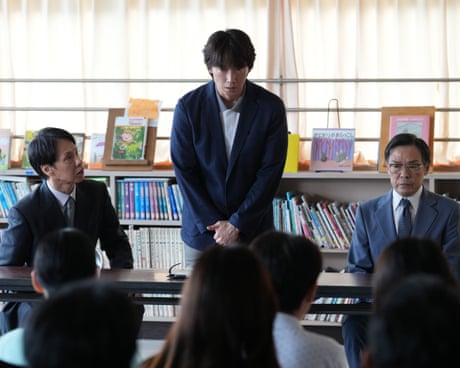
Takashi Miike, Japan’s maestro of the extreme, now takes on a relatively sedate and mainstream genre: the courtroom drama. But he can’t help bringing to it his signature shocks and unsubtle tropes. Sham is based on a real-life case from 2003 that convulsed Japanese media and public opinion. In the city of Fukuoka in south-west Japan, primary school teacher Seiichi Yabushita was accused of racially abusing and beating a pupil and driving him close to suicide on the grounds of the child supposedly having an American grandfather, his pure Japanese blood tainted by foreigners. But was the child lying on the instructions of his mother, the real abuser? The film is based on Fabrication: The Truth About the “Murder Teacher” in Fukuoka, investigative journalist Masumi Fukuda’s 2007 book about the case.
Mirroring the prosecution and defence cases in court, Miike gives us both sides of the story in quasi-Rashomon style: first, that of the boy’s mother Mrs Himuro (Kô Shibasaki) and in this version, the behaviour of the teacher (Gô Ayano) is truly sinister. Afterwards – the “prosecution” version having taken up very little of the film – we get the teacher’s own account, and it soon dawns on us that this is in fact the objective reality. He is a gentle, reasonable man, loved by his pupils; he wouldn’t hurt a fly and his remarks on the boy’s family background are entirely innocent. The trouble stemmed from having been persuaded by the school’s terrified headteacher to apologise to the parents in a doomed attempt to make the case go away and to confess to corporal punishment on the grounds of one misjudged chastisement after a bullying incident, intended to show him how awful violence is.
Is equality at the heart of our social problems? A whistle-stop tour of the greatest hits of progressive policy
If you’ve written a successful book based around one big idea, what do you make the next one about? Back in 2009, Kate Pickett’s The Spirit Level (co-authored with Richard Wilkinson) argued that inequality was the ultimate cause of almost all our social problems, from obesity and teenage pregnancy to violent crime; more equal societies, they claimed, had better outcomes across the board. While criticised – as most “big idea” books are – for overstating the case and cherrypicking evidence, they struck a chord, and some aspects of their thesis are now mainstream.
However, when it comes to the UK, there is an awkward problem, both for Pickett and for economists like me who, while not entirely convinced by The Spirit Level, would still like to see a more equal society. In the first chapter of Pickett’s new book, inequality is once again the root of all (social) evils: “if you know a country’s level of inequality, you can do a pretty good job of predicting its infant mortality rate, or prevalence of mental illness, or levels of homicide or imprisonment”. By contrast, she argues that GDP or GDP growth are very poor measures of overall welfare. Pickett then goes on to list the ways in which the UK has become a worse place to live since 2010 – higher child poverty, flattening life expectancy and child mortality, more people in prison.
By travelling during the day on scenic routes, travellers can soak up spectacular landscapes before taking in Turin’s cultural heritage
Is there a better sensation for a traveller than when a train speeds out of a tunnel? The sudden flood of light, that howling rush of air. Clearly, it’s not just me who thinks trains are the new (old) planes, with 2025 having seen a 7% rise in UK train travel, and more Europeans than ever looking to hit the rails.
It’s late December, and I’m heading out on a slow-train journey across the historic railways of the Swiss Alps and the Italian lakes. It’s a trip of roughly 1,800 miles (2,900km), crossing five countries, almost entirely by scenic daytime trains.
Modelling suggests 5.4m children under five among those who could die if budgets of donor countries such as UK and US continue to be slashed
Aid cuts could lead to more than 22 million avoidable deaths by 2030, including 5.4 million children under five, according to the most comprehensive modelling to date.
In the past two decades there have been dramatic falls in the number of young children dying from infectious diseases, driven by aid directed to the developing world, researchers wrote in the Lancet Global Health. But that progress was at risk of reversal because of abrupt budget cuts by donor countries, including the US and the UK.
Pia Paulina Guilmoth and Jesse Bull Saffire spent seven years sniffing around discarded boxes and junk shops in order to paint this peculiar portrait of their home
A fairly technical-sounding change to student loans tucked away in last November’s budget has become the catalyst for an increasingly bad-tempered row pitting the UK consumer champion Martin Lewis against the chancellor, Rachel Reeves.
In one interview, Lewis – the founder of MoneySavingExpert.com, who boasts a vast following – said he did not think the planned change to repayment terms “was a moral thing”.
‘We had 11 players available – unbelievable but true’
Cristian Romero has said it is “disgraceful” that Tottenham are operating with such a threadbare squad in an apparent dig at the club’s January recruitment strategy.
The club captain is no stranger to outspoken social media posts and he dropped another one on Monday evening shortly after the closure of the mid-season transfer window.
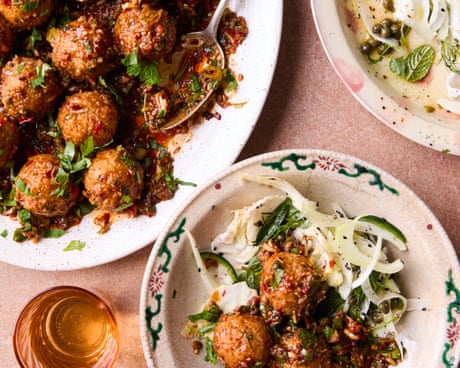
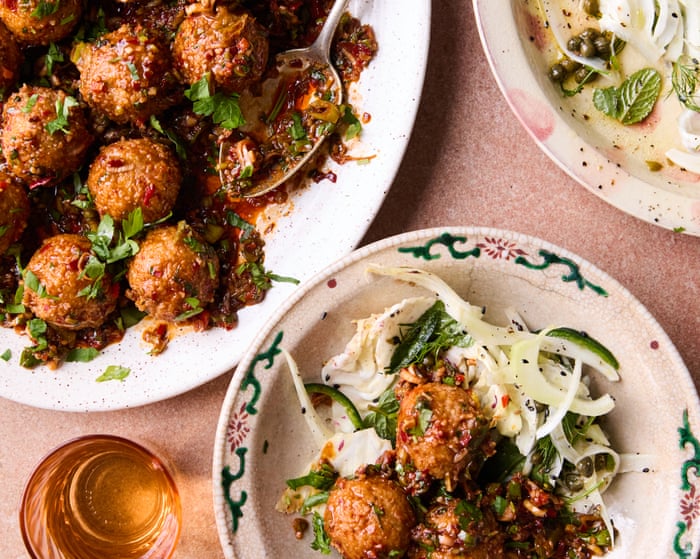
Layers of eastern spice and flavour run through these mini bulgur wheat balls in a spicy sauce of pepper and pomegranate molasses, and there’s a sprightly fennel and herb salad on the side
I have always dreamed of a return to the golden age of Arab trade, when spices, fruits and ideas voyaged across deserts and seas, creating extraordinary food cultures through exchange and curiosity. I’ve imagined bringing new flavours home, letting them transform the kitchen – but with all the madness in today’s world, that dream must stay a dream, for now. So, these recipes become my journey, a way to reconnect with that spirit and taste the magic of the Arab golden age today.
Iran’s leaders now face unprecedented peril. The regime has lost its footing, and the global mechanisms to avoid conflict no longer work
Dr Sanam Vakil is the director of Chatham House’s Middle East and North Africa programme
Forty-seven years on from the Iranian revolution, Iran is confronting a strategic reality it has never faced before – a simultaneous crisis of domestic legitimacy and a credible threat of external attack so severe that regime survival can no longer be taken for granted. Until now, Tehran has survived wars, sanctions, assassinations, mass protests and international isolation through a strategy of projecting strength abroad, repressing dissent at home and generating a permanent crisis to justify poor leadership and political failure.
Today, Donald Trump has mobilised an “armada” to the Middle East that includes the USS Abraham Lincoln carrier strike group, guided-missile destroyers, an expanded air presence and missile defence systems. This force projection suggests the US is no longer focused on containing Iran but rather compelling a final resolution of a long-running conflict. The choice at hand is either the acceptance of a US-imposed settlement or the destruction of the Islamic republic as it exists today.
Bristol Beacon If the comic’s political fervour is dialled down, there is much to enjoy in a show delivered with flair and 10-ton sarcasm
Inner peace and contentment are not always gifts to the comedian, and – who knows? – maybe that’s why Bridget Christie’s latest show is a teensy bit less thrilling than its predecessors. For Christie has found her happy place: serenely single, professionally triumphant (on the telly too, after years not finding a niche there), and absolved by menopause of the need to give a toss about almost anything. There’s comedy in that freedom from care, and Christie mines it plentifully in an entertaining 90 minutes majoring – like her Channel 4 show The Change – in what life looks like for women (or at least, this woman) when oestrogen gets out of the way.
But Jacket Potato Pizza feels like a placeholder of a show, lacking the fervour or clownish fury of her best work. Its short first half begins by contrasting quotations from Presidents Obama and Trump – but that gives a misleading impression of what’s in store. More indicative is the routine that follows, in which Christie re-enacts a story as told by her menopausal pal, a banal tale of a night out turned into a symphony of digressions, malapropisms (mixing the Benjamins Zephaniah and Netanyahu, most memorably) and vocabulary tantalisingly out of reach. It’s as much sketch as standup, and our host brings it to life with characteristic pop-eyed dismay.
Sleek car doors reduce vehicle drag but are prone to losing operability in the event of a crash, officials say
China will soon ban concealed door handles on electric vehicles (EVs), becoming the first country to do so after several deadly incidents triggered global scrutiny of the controversial design first popularised by Tesla.
According to regulations announced on Monday by the Ministry of Industry and Information Technology, cars sold in China will now be required to have a mechanical release on both the inside and outside of every door except the boot.
The far right is using pork consumption as a means to exclude, just as it was in the Inquisition. It should be a source of joy and community
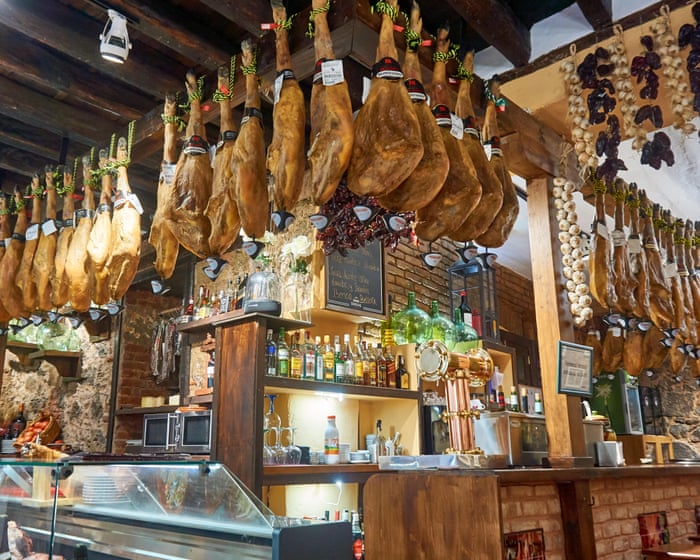
Spain makes the best ham in the world, and a multitude of incredible pork-based dishes. You have your crunchy, salty torreznos de Soria, fried cubes of pork belly, which make for a fantastic bar snack. Or cochinillo asado, a suckling pig that’s traditionally roasted in a wood oven, and so tender that it’s cut with a plate instead of a knife when serving. For the more adventurous, I recommend exploring the world of regional morcillasor blood sausages. Morcilla de Burgos, made with rice and on the harder side, keeps its structure very well and makes an excellent pintxo when sliced and fried. Or there is the moist and spreadable morcilla de León, which my local butcher sells in jars. Another to look out for is the Basque morcilla de Beasain – made with leeks, it combines fantastically with black beans, cabbage and pickled green chillies to make one of the tastiest stews you’ll ever have.
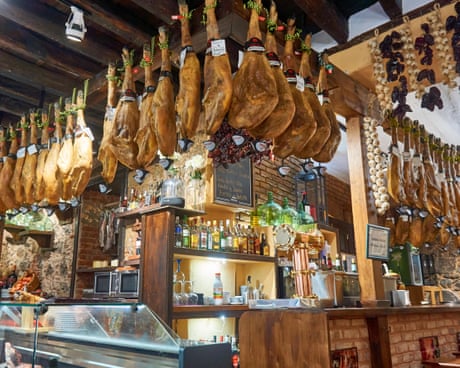
At the pinnacle, you have the gastronomic and cultural phenomenon that is jamón ibérico. It is distinct from lesser forms of jamón as it comes from the famed Iberian pigs, the best varieties of which are fed on acorns. You’ll see whole legs of it hanging in bars and restaurants across the country, and they’re a staple of the Spanish Christmas hamper, often raffled off by bars to their regular customers. Its standing in Spanish culture transcends the food world: Javier Bardem and Penélope Cruz met while filming Jamón Jamón, in which the former beats his love rival to death with a leg of ham. Meanwhile, lower-league football side CD Guijelo’s away kit sees them dressed as a plate of the stuff. It finds its way into Spain’s public festivities, such as the Lance al Jamón in the walled city of Morella, where participants have to climb its walls and grab a leg of ham hanging from the ceiling. The contestant able to hang on the longest gets to keep it.
Abbas Asaria is a food writer and chef based in Madrid
Just like men, women are increasingly being told by online influencers that the classic symptoms of middle age could be down to low testosterone. In the second part of this miniseries exploring the hormone, Madeleine Finlay finds out what testosterone supplementation is doing for women. She hears from science journalist Linda Geddes, who is taking testosterone for low libido, and from prof Susan Davis, a consultant endocrinologist and head of the Monash University Women’s Health Research Programme. Susan explains what the evidence really shows about the benefits and risks of women taking testosterone
UPFs are made to encourage addiction and consumption and should be regulated like tobacco, say researchers
Ultra-processed foods (UPFs) have more in common with cigarettes than with fruit or vegetables, and require far tighter regulation, according to a new report.
UPFs and cigarettes are engineered to encourage addiction and consumption, researchers from three US universities said, pointing to the parallels in widespread health harms that link both.
Euphoric scenes are a snub to theocracy’s culture of piety, say analysts, and carry message of rebellion
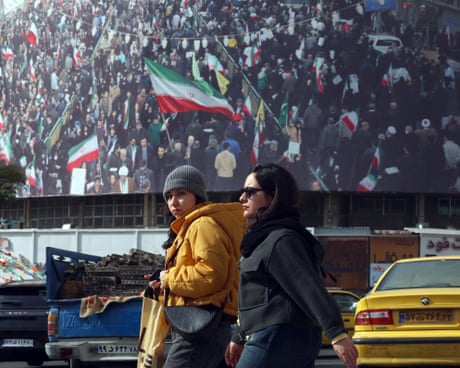
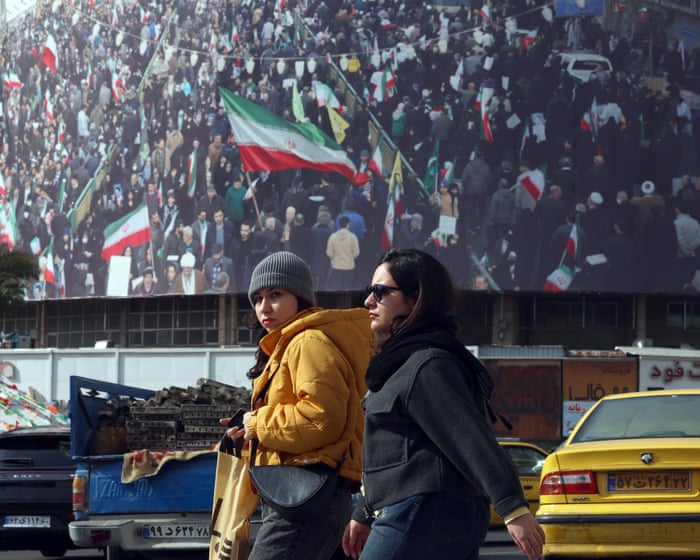
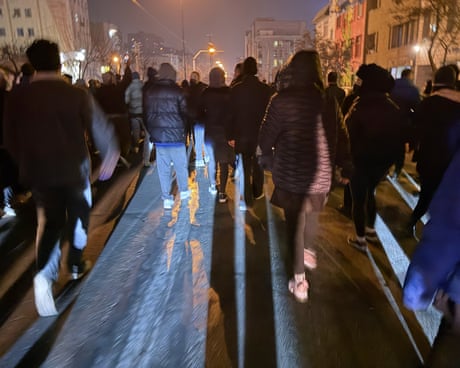
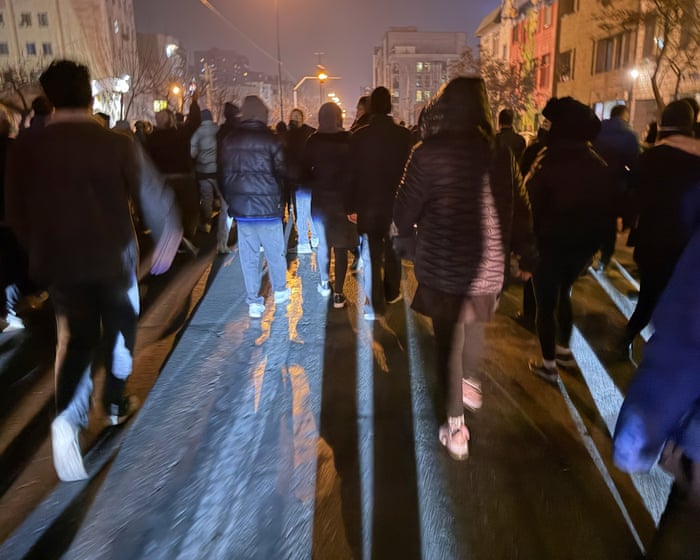
Iranians killed in recent protests that rocked the country have been laid to rest in boisterous funerals featuring loud pop music and dancing, apparently intended to convey defiance to the ruling Islamic regime.
Instead of holding sombre traditional mourning ceremonies presided over by a Shia cleric, bereaved relatives are turning the burials into exultant celebrations of the lives of their loved ones in what analysts say is an intentional snub to the culture of piety demanded by Iran’s theocracy.
Sector bounces back as consumers focus on provenance and healthy eating, but is still well behind Europe
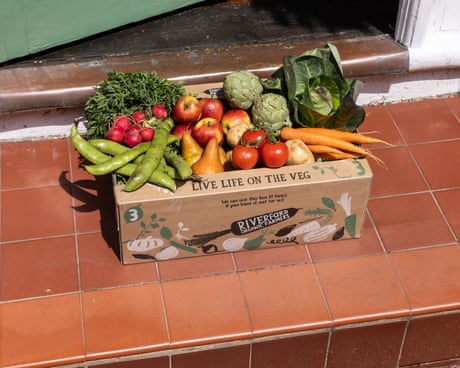
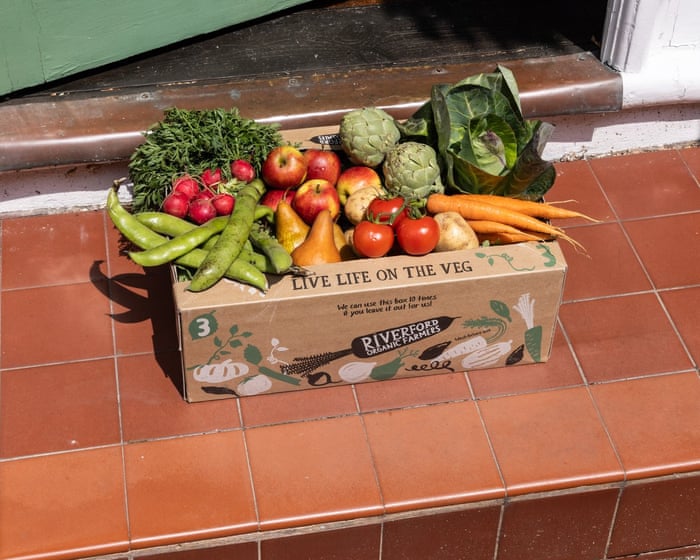
Consumers searching for healthy food from trusted sources have fuelled the UK organic market’s biggest boom in two decades, according to vegetable box seller Riverford.
The delivery business, which sells meat, cheese, cookbooks and recipe boxes alongside vegetables, recorded a 6% increase in sales to £117m in the year to May 2025, as the UK organic food and drink market grew by almost 9% in that year, according to new figures from the Soil Association. The strong growth, significantly outpacing the wider food market, helped the employee-owned business give a £1.1m bonus to workers.
At first, Mike made Tamsin feel good about herself – and his love-bombing led her to leave her family and resign from her job. Soon she had lost her car, phone and all her money
Tamsin met Mike in the summer of 2022. He was a mechanic in a garage that she walked past twice each day between home and work. After a while, he’d call out “good morning” or “good evening” and she’d wave and smile back. Then the exchanges got a little longer. (“Hard day?” “Looking forward to dinner?”) Six months later, Mike and Tamsin exchanged numbers.
Within two years, her life was wrecked. She had left her marriage, lost her home, quit her job, and sold her car and her phone, spent all her savings and racked up tens of thousands in debt. (Under her current repayment plan, it will take another eight and a half years to pay back her creditors.) Tamsin’s story seems scarcely credible and she is mortified to have to tell it. She stumbles through, piles of notes on her lap and a support worker from Victim Support at her side. Every few minutes, she breaks off to say, “It sounds so stupid”, “I sound like an absolute nutter” or “Where was my head?” In truth, she spent two years in the company of a psychopath, a master manipulator. He is in prison now, serving a 22-year sentence, but not for romance fraud, or anything involving Tamsin. Her experience, police have told her, “would not stand up in court”.
Annual review highlights growing capabilities of AI models, while examining issues from cyber-attacks to job disruption
The International AI Safety report is an annual survey of technological progress and the risks it is creating across multiple areas, from deepfakes to the jobs market.
Commissioned at the 2023 global AI safety summit, it is chaired by the Canadian computer scientist Yoshua Bengio, who describes the “daunting challenges” posed by rapid developments in the field. The report is also guided by senior advisers, including Nobel laureates Geoffrey Hinton and Daron Acemoglu.
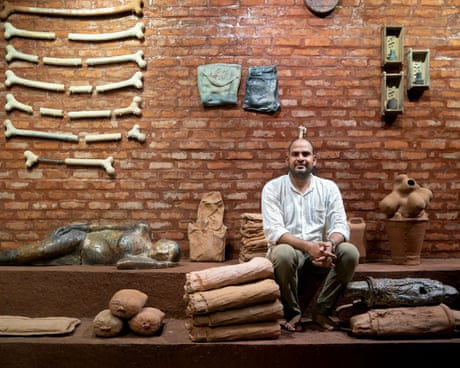
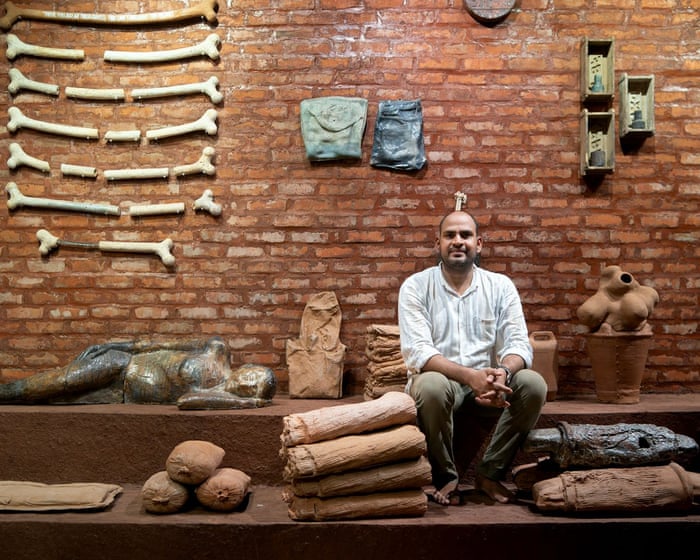
Work by almost 70 artists – including Marina Abramović – has made an art fair in Kochi one of the hottest tickets in south Asia. This sixth instalment uses farmers’ fields and patched-up buildings to take visitors ‘back to nature’
Say someone brings you a bouquet of flowers. You get a vase and one by one intuitively place each stem inside, allowing an arrangement to unfold on its own. It was on this level, as lead curator Nikhil Chopra suggests, that the Kochi-Muziris Biennale was not curated so much as created.
On a stroll through the largest contemporary art biennale in south Asia, creation takes centre stage. Against the backdrop of the coastal city’s lush strip of backwaters and the historic Fort Kochi, works by 66 artists animate Kerala’s grand colonial warehouses and bungalows where art feels less installed than encountered.
In spring 2003, exuberance at the fall of Saddam was swiftly followed by a descent into deadly chaos. Whether moving independently or embedded with troops, Guardian reporters witnessed the violence on the ground
The allied attack on Iraq began on 20 March 2003. The Guardian’s 4am edition on Friday 21 March carried the headline: “Land, sea and air assault.” The report was by Julian Borger in Washington and Rory McCarthy in Camp As Sayliyah, on the outskirts of Doha, the capital of Qatar. It opened: “The ground war began in Iraq last night as British and American marines stormed beaches on the Gulf coast in an assault on the south-eastern city of Basra, while explosions lit up Baghdad under a heavy bombardment by cruise missiles.”
The first British fatalities came shortly afterwards when a US helicopter crashed in Kuwait, killing all on board. Suzanne Goldenberg’s front-page report from Baghdad revealed that only two hours after the decapitation effort, Saddam Hussein himself had made a defiant appearance on television. A Guardian leader stated that the plain fact was this first “surgical strike” had missed its mark. Even had it reached its target, it would have been difficult to applaud. “State-ordered assassination sets an abominable precedent that encourages unwelcome emulation … The US must tread carefully – for the legal and moral grounds for this war are already very shaky.”
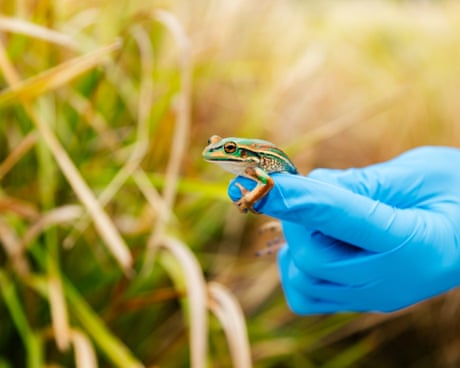
Scientists have reintroduced green and golden bell frogs to the Australian Capital Territory for the first time since the species became locally extinct four decades ago.
The first cohort of 25 frogs was released on Tuesday morning, a milestone for conservation of the animals, whose numbers have been devastated by the chytrid fungal disease that has wiped out 90 amphibian species in 50 years.
Documentary about the US first lady debuted at No 31 at Australian box office, making $32,399 from 33 screens
Melania, Amazon’s $106m (US$75m) documentary about the US first lady, has bombed at the Australian box office on its opening weekend, debuting at No 31 on the charts and taking just $982 (£503, US$688) per screen.
The documentary, directed by Brett Ratner, was screened in 33 cinemas across Australia and made $32,399 overall.
 Connexion