Donald Trump will start his day in Washington for the Board of Peace meeting at the White House.
He’ll then travel to Rome, Georgia, as part of his tour of the country to tout the administration’s affordability message. He’ll meet with local businesses there, and deliver remarks at 4pm ET.
Law defines animals including horses, donkeys and mules as pets and is backed by opposition parties
Italy could soon ban horse meat as part of a law that would define equine animals including horses, donkeys and mules as pets, making it illegal to kill them.
The bill has been drafted by Michela Vittoria Brambilla, a politician with Noi Moderati, a member of Giorgia Meloni’s ruling coalition, and is backed by opposition parties.
Those who have worked with midfielder reflect on his career as he prepares to make a 654th top-flight appearance
James Milner was the most dedicated and professional young player I’ve met. He also took the not inconsiderable transition from being at school to playing in the Leeds first team totally in his stride. Nothing fazed him. He was very level-headed.
I was in a relationship for 26 years, married for 17, and my husband had an affair. It was hidden, long term and denied until discovery. I divorced him but that was delayed and I had to live with him for a further two years. I spent a year alone in my new house with my now adult sons. Now I am a little over a year into a new relationship and suddenly panicking about it. I’m scared to go forward. I’m not sure I can commit to long term again, and if I see him looking at other women (we work together in a predominantly female workplace), I panic! I’m older than him by nine years and I feel like I want to end things to prevent getting hurt. But then I feel I’m being cowardly. How can I stop going down this road in my head?
Eleanor says: On behalf of everyone everywhere, let me say: what a schmuck thing for your husband to do. That is such a big betrayal. And the cruelty you’re living through now is that as well as teaching you to be mistrustful of others, betrayal on that magnitude teaches you to be unsure of yourself. If I misread things once …
RFK Jr ally Jay Bhattacharya was named acting director of the CDC and will be fourth leader in a year to head agency
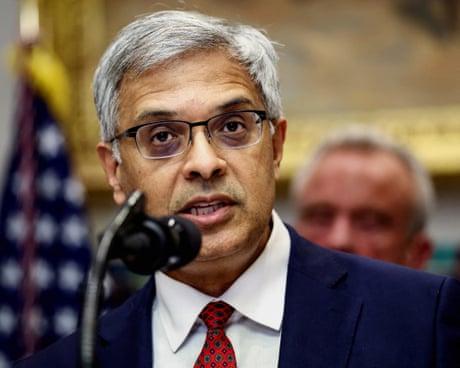
Jay Bhattacharya, the director of the National Institutes of Health (NIH), was named the acting director of the US Centers for Disease Control and Prevention (CDC) on Wednesday, making him the fourth leader in a year at the embattled agency in an unprecedented move that further consolidates power among a small group of men at the helm of US health agencies.
He’s been an ineffectual health leader whose attention will be further fractured, and as a close ally to Robert F Kennedy Jr, secretary of the US Department of Health and Human Services and a longtime vaccine critic. Bhattacharya may sign off on further changes to the vaccine schedule, observers said.
A British minister has warned that the EU’s “Made in Europe” industrial strategy could hit supply chains, increase costs and create unnecessary trade barriers between the UK and some members of the bloc.
Nick Thomas-Symonds, the UK minister for EU relations, made the comments as the EU is preparing to publish new legislation that would require European-made products to be prioritised in public procurement and consumer schemes.
What happens next hardly matters: the mystique and awe surrounding the royals had been irretrievably shattered. The former prince’s arrest must change everything
The arrest of Andrew Mountbatten-Windsor is a seismic moment for the royal family as well as for himself. On one hand, it is hard to believe any greater harm can befall the family after weeks of drip-feed from the US Department of Justice’s Epstein files. On the other, a royal arrest of this sort is unprecedented. Enough is already in the public domain to indicate that police believe that there must be a case to answer to the charge of misconduct in public office.
King Charles, who apparently was not warned in advance that his brother was to be arrested, has been scrupulous in his response. “The law must take its course,” he said, offering prosecutors“full and wholehearted support and cooperation”. Whatever happens now, a line has been crossed in the life of the nation. A once exalted royal, facing serious judicial investigation by authorities acting on behalf of the citizenry. Stripped of status and finery, he faces the spotlight as would any other inhabitant of these isles. One cannot know the outcome, but just this arrest feels like a pivotal moment.
Octogenarian leftist, who has defended child marriage, replaces José Jerí, who was voted out after a scandal
Peru’s congress elected José María Balcázar, an octogenarian leftist lawmaker who has defended child marriage, as the country’s interim president on Wednesday ahead of general elections in April. Balcázar is Peru’s ninth president since 2016.
Remembering and documentation are radical acts in Lebanon, a country with a tumultuous history and no national archive. Daher’s effervescent cultural collage is a direct challenge to collective amnesia
At one point in Lana Daher’s film Do You Love Me, a woman questions the repeated advice of those around her to simply forget Lebanon’s 15-year civil war that ended in 1990. Why does she insist on “digging into the past”, especially when “this war was no worse than the others”? Yet it is precisely her act of remembering – of knowing that she “did not dream” the actuality of war – that prompts her to dig “into the present”.
The Lebanese director’s debut feature is itself a substantive feat of excavation, with more than 20,000 sources consulted in collaboration with the editor, Qutaiba Barhamji (who worked on The Voice of Hind Rajab), to unearth the footage that would produce this 76-minute film. It is substantive also in the sense that this work was done in relation to a country that does not have a national archive.
Racism allegations in Portugal overshadowed another fine result in the Arctic and the holders being pushed by their Ligue 1 rivals
Nothing should divert attention away from what happened after Vinícius Júnior’s goal for Real Madrid in their 1-0 victory at Benfica on Tuesday. It would be frivolous to do so. The Brazilian scored one of the finest goals of a career marked by spectacular strikes, but this week’s Champions League action will be remembered for the regrettable flashpoint that followed.
Ahead of this Sunday’s awards night, we remember Joanna Lumley’s humourless stint at hosting, acrobats dressed as astronauts and the rage of Russell Crowe
Typically, the Baftas have fewer memorable moments than, say, the Oscars. This is partly because the ceremony isn’t broadcast live, so viewers are essentially treated to edited highlights. However, when Russell Crowe won for A Beautiful Mind in 2002, it was his speech that got edited out. That was because he decided to recite the Patrick Kavanagh poem Sanctity, and it went on and on. When Crowe realised what had happened, he tracked down the show’s director at the afterparty, pinned him against a wall, called him a “cunt” and then allegedly kicked three chairs across the room.
A gay couple both have entirely different accounts of a gory murder, a fascinating story unravelled in a new HBO documentary
Everyone in Old Louisville knows about the couple who killed someone. In this neighborhood of elaborate Victorian architecture and genteel walking courts, the story of Jeffrey Mundt and Joey Banis and the murder on 4th Street is a local legend that won’t go away, gossiped about at happy hours and garishly re-enacted on true crime shows like Oxygen’s Snapped: Killer Couples, which ran an episode on the case two years ago.
In some ways it’s easy to see why Mundt and Banis have become a 21st-century Leopold and Loeb, the famous gay lovers who inspired Hitchcock’s Rope. Their 2009 trial hit almost every square on the true-crime bingo card, involving meth-fueled group sex, pathological lies forming webs of deceit, intense BDSM, and a body left to rot in the basement of a haunted former sanatorium.
Corn Exchange, Edinburgh With winningly deadpan delivery, Mike Skinner’s concept album about losing £1,000 behind a TV is performed in full with a formidable band
On a stage in Edinburgh, thick with dry ice, a bus shelter materialises and a man in black steps out. Mike Skinner, AKA the Streets, has come to take us back in time. Pint in his right hand, mic in his left, he begins: “It was supposed to be so easy …” And just like that it’s 2004 again.
Had he been trying to court a mass audience, Skinner wrote in his memoir, “I certainly wouldn’t have made a concept album about someone losing a thousand pounds down the back of the TV”. Yet that is indeed the premise of his 2004 album A Grand Don’t Come for Free, a British classic which, judging by the noisy Corn Exchange crowd, is loved by more than one generation.
New technology has workers spooked, but experts say it’s creating an opening for a resurgence in worker power
In 2026, it’s a scary time to work for a living.
Gone are the days of quiet quitting, the Great Resignation, and the highly visible union-organizing battles that began the decade and signaled that perhaps worker power was on the rise again in the US. Instead, much of that momentum is being crowded out of our minds by anxieties: a worsening affordability crisis, geopolitical instability, and the specter of artificial intelligence looming over the workplace.
The homeland security department is reportedly seeking information on critical social media accounts. Look no further
The New York Times reports that the Department of Homeland Security has sent Google, Meta (owner of Facebook and Instagram) and other media corporations subpoenas for the names on accounts that criticize ICE enforcement. The department wants to identify Americans who oppose what it’s doing.
I’ll save them time.
Robert Reich, a former US secretary of labor, is a professor of public policy emeritus at the University of California, Berkeley. He is a Guardian US columnist and his newsletter is at robertreich.substack.com. His new book, Coming Up Short: A Memoir of My America, is out now
Byrne delivers a barnstorming performance as a shrink – counselled by an impatient Conan O’Brien – being pushed to the edge by stress of parenting
Here is a psychological horror-comedy of postnatal depression and lonely parental stress, like a flip-side to Eraserhead or Rosemary’s Baby; it’s a scary movie with a heroine shot almost solely in looming closeup – but instead of supernatural apparitions, there are simply the banal problems of childcare and no time to deal with them. It’s also a film about therapy and transference when there’s nothing left to transfer. Mary Bronstein is its writer-director, and her film-maker husband Ronald Bronstein serves as producer – as does Josh Safdie, whose influence, through movies such as Uncut Gems and Marty Supreme, can perhaps be detected in the sprint towards a nervous breakdown.
Rose Byrne delivers a barnstormer as Linda, a psychotherapist whose husband is away, leaving her to deal with a sick infant daughter whose face is not shown until the very end, indicating perhaps the way in which the little girl’s identity is simply that of a gigantically blank all-pervasive problem to be managed. The girl is intubated via a feeding machine that must be carted around with her, especially to the day-care hospital whose brusque doctor in charge (played by Mary Bronstein in cameo) supervises group therapy sessions that blandly reassure the parents present that all this is not their fault, while curtly reprimanding Linda for her failure to turn up to appointments and to discuss her daughter’s failure to gain the weight necessary for the tube to be removed.
Dubbed ‘the holiest of holies’, produce from this former Soviet republic today boasts a variety and deftness that’s sending sales surging
France, Italy and Spain purport to be the best-loved classical wine regions, but if you’re in the market for the real old-world deal, look no further than Georgia, which has more than 8,000 years of winemaking prowess. There’s something about this place on the lush intersection of the silk roads between Europe and Asia that gets under the skin. Perhaps it’s the combination of unpolished authenticity paired with profound generosity (guests are considered a gift from God and fed accordingly), all while being gently rocked in a cradle of civilisation, that make Georgian wine so beguiling. (My first visit in August 2023 – a khachapuri-fuelled reconnaissance for my book, Drinking the World: A Wine Odyssey – lingered in my mind long after my flight touched back down on British tarmac.
What I find most refreshing is that the country, and its wine, is completely itself, despite being hemmed in by empires with a proclivity for invasion (Persians, Turks, Mongols et al), as well as the decades spent under USSR rule, which between 1922 and 1991 switched the grape-growing focus to yield over quality. Today, you really feel the Georgian delight at flipping that old Soviet diktat on its head.
Victoria Brzezinski is co-author of Drinking the World: A Wine Odyssey, published by Pavilion Books/HarperCollins at £22. To order a copy for £19.80 go to guardianbookshop.com
Bruce Meyer promoted to interim executive director
New labor deal negotiations with owners looming
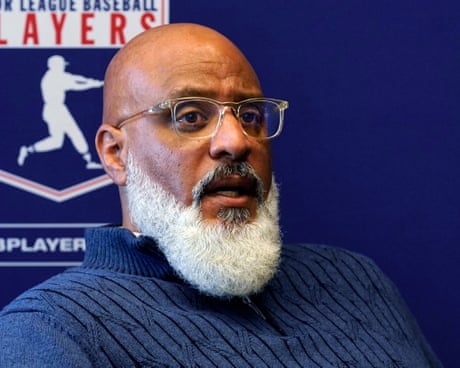
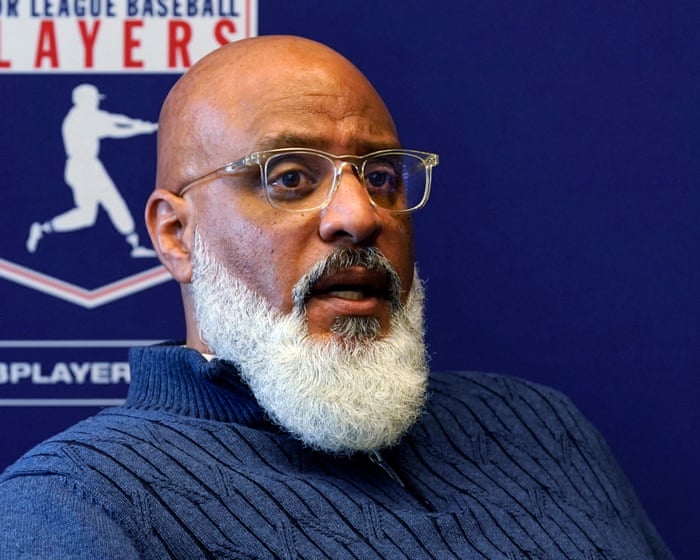
Bruce Meyer was promoted to interim executive director of the baseball players’ association on Wednesday, a day after Tony Clark’s forced resignation. It was a move for continuity ahead of the likely start in April of what figures to be contentious collective bargaining with team owners.
Clark is a former All-Star first baseman who had headed the Major League Baseball Players Association (MLBPA) since 2013. He resigned on Tuesday, just months ahead of the expected start of bargaining for a new labor contract. The current deal expires on 1 December.
Faaborgs rail against oppressive industrial agricultural system with unexpected evolution into indie artisan food firm
As a sixth-generation Iowa farmer, Tanner Faaborg is all too aware that agricultural traditions are hard to shake. So when he set in motion plans to change his family’s farm from a livestock operation housing more than 8,000 pigs each year to one that grows lion’s mane and oyster mushrooms, he knew some of his peers might laugh at him. He just did not necessarily expect his brother to be chief among them.
“My older brother has worked with pigs his entire adult life, managing about 70,000 of them across five counties,” Faaborg says. “But we got to a point where he went from laughing at me to saying: well, I guess maybe I’ll quit my job and help you out.”
Before the arrest was announced, the prime minister told BBC Breakfast “nobody is above the law” when asked about Andrew Mountbatten-Windsor.
Keir Starmer added:
Anybody who has any information should testify.
So whether it’s Andrew or anybody else, anybody who has got relevant information should come forward to whatever the relevant body is, in this particular case we’re talking about Epstein, but there are plenty of other cases.
A bill banning the sale and use of plastic and metallic glitter has yet to go through in Brazil as the capital’s sandy shores bear cost of carnival’s shine
Whether it is embellishing elaborate costumes, delicately applied as eye makeup, or smeared across bare skin, glitter is everywhere at Rio de Janeiro’s carnival in Brazil. The world’s largest party, which ended on Wednesday, leaves a trail of sparkles in its wake.
At one blocolast weekend, a huge sound truck and dancers in leopard print led thousands of revellers down the promenade at Flamengo beach. Among them was Bruno Fernandes, who had jazzed up an otherwise minimalist outfit of navy swimming briefs by smearing silver glitter over his body.
(Dead Oceans) Whether retreating from fame or heartbreak, the US musician writes gorgeous songs about the appeal of disconnection, flecked with horror and humour
Last month, Mitski released Where’s My Phone?, the first single from her eighth album Nothing’s About to Happen to Me. Its raging alt-rock is a more robust take on the lo-fi fuzz of her third album Bury Me at Makeout Creek, while UK listeners might detect a certain Britpoppy swing about its rhythm, and it ends with a guitar solo so jarringly distorted it sounds as if something is wrong with the stream. It was accompanied by a video that featured the singer as a headscarf-sporting rural mother, trying to protect her family from the attentions of the outside world with increasing violence: a milkman gets attacked, her daughter’s potential suitor is beaten bloody. It’s both funny and unsettling: there are references to Rapunzel, Grey Gardens, Grant Wood’s American Gothic and Shirley Jackson’s We Have Always Lived in the Castle – a litany of the wilfully isolated.
The visuals set the tone for the rest of Nothing’s About to Happen to Me, an album on which you’re never far from its author expressing a longing to disappear; to be, as she puts it on Instead of Here, “where nobody can reach”. On opener In a Lake, she extols moving to the city from a small town, not in search of bright lights and excitement, but obscurity, a means of obliterating your own history: “Some days you just go the long way to stay off memory lane.” On I’ll Change for You, she hymns bars – “such magic places” – precisely because of their anonymity: “You can be with other people without having anyone at all.” And on Rules, she’ll “get a new haircut … be somebody else”. All this is set to beautifully crafted music that splits the difference between alt-rock, country-infused acoustic lamentation and grander ambition: the brilliance of Rules lies in the disparity between the hopelessness of its lyric and the thickly orchestrated, perky, early 70s easy listening backing.
As Trump slashes science funding, young researchers flee abroad. Without solid innovation, the US could cease to have the largest biomedical ecosystem in the world
In April 2025, less than three months after Donald Trump returned to the White House, the federal Centers for Disease Control and Prevention (CDC) put out its latest public health alert on so-called “superbugs”, strains of bacteria resistant to antibiotics.
These drug-resistant germs, the CDC warned, are responsible for more than 3m infections in the US each year, claiming the lives of up to 48,000 Americans.
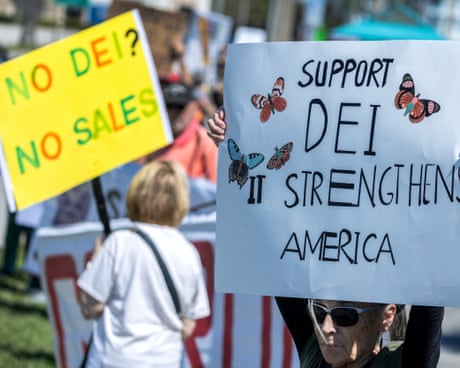
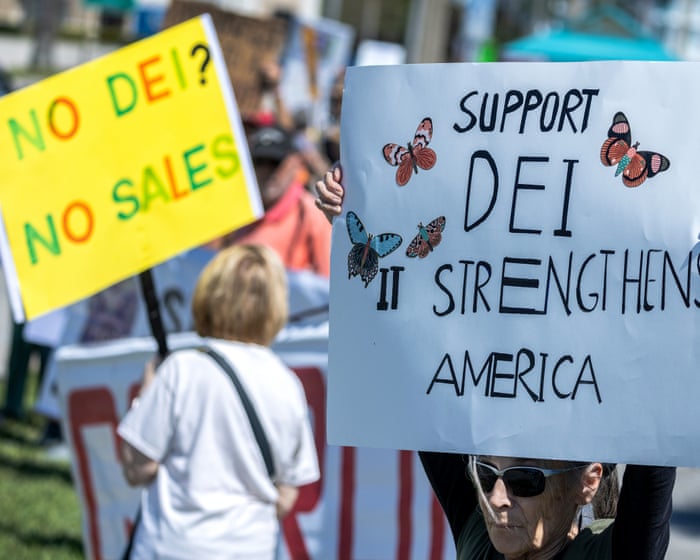
Two law professors outline strategies for equality’s survival in a Trumpian post-DEI era in new book How Equality Wins
The Trump administration’s “war on woke” seems to have claimed its biggest victim in DEI. Not so long ago, diversity, equity and inclusion was the favorite term of Fortune 500 CEOs and the political elite. More recently, it has been blamed for everything from the collapse of the Francis Scott Key Bridge in Baltimore and the deadly Los Angeles wildfires to the crash between a regional jet and a helicopter in Washington DC.
“DEI means people DIE,” Elon Musk wrote last year.
 Connexion