 Connexion
‘They’re taught that showing feelings is shameful’: eight reasons men don’t go to therapy – and why they should

A clinical psychologist on why men still don’t seek help for their mental health
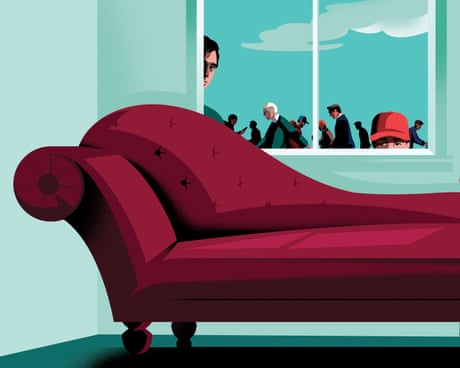
When Jake, a businessman in his 50s, first arrives at my therapy practice, it’s obvious that he has some misgivings. Jake’s marriage to Louise is in trouble, and she has insisted he come and see me. “If not for Louise, you wouldn’t be here, would you?” I enquire tentatively. He looks sheepish at first; then emboldened, he gives an emphatic “No.” As is almost always the case, Jake’s wife has registered a problem that has passed him by, and prompted his visit. Over the next few weeks, we sift through a maze of obstacles, and in the end, Jake is full of emotion: “I’m alone in the world, everyone leans on me, there’s no one for me,” he says. “There’s no one to turn to.”
It’s a common pattern, one I’ve seen throughout my 35 years as a psychologist specialising in male mental health. Men make up only 33% of referrals to NHS talking therapies. They don’t come easily, and when they do seek help in a crisis, they can disappear as suddenly as they arrive. Yet male vulnerability is clear – men report lower levels of life satisfaction than women and make up three-quarters of suicides and problems with addiction. But despite the increase in awareness around male mental health, men still tend to think there’s a stigma to speaking with a professional, even though most of those who have tried therapy have a positive experience.
Continue reading...
© Illustration: Nathalie Lees/The Guardian
© Illustration: Nathalie Lees/The Guardian
© Illustration: Nathalie Lees/The Guardian
