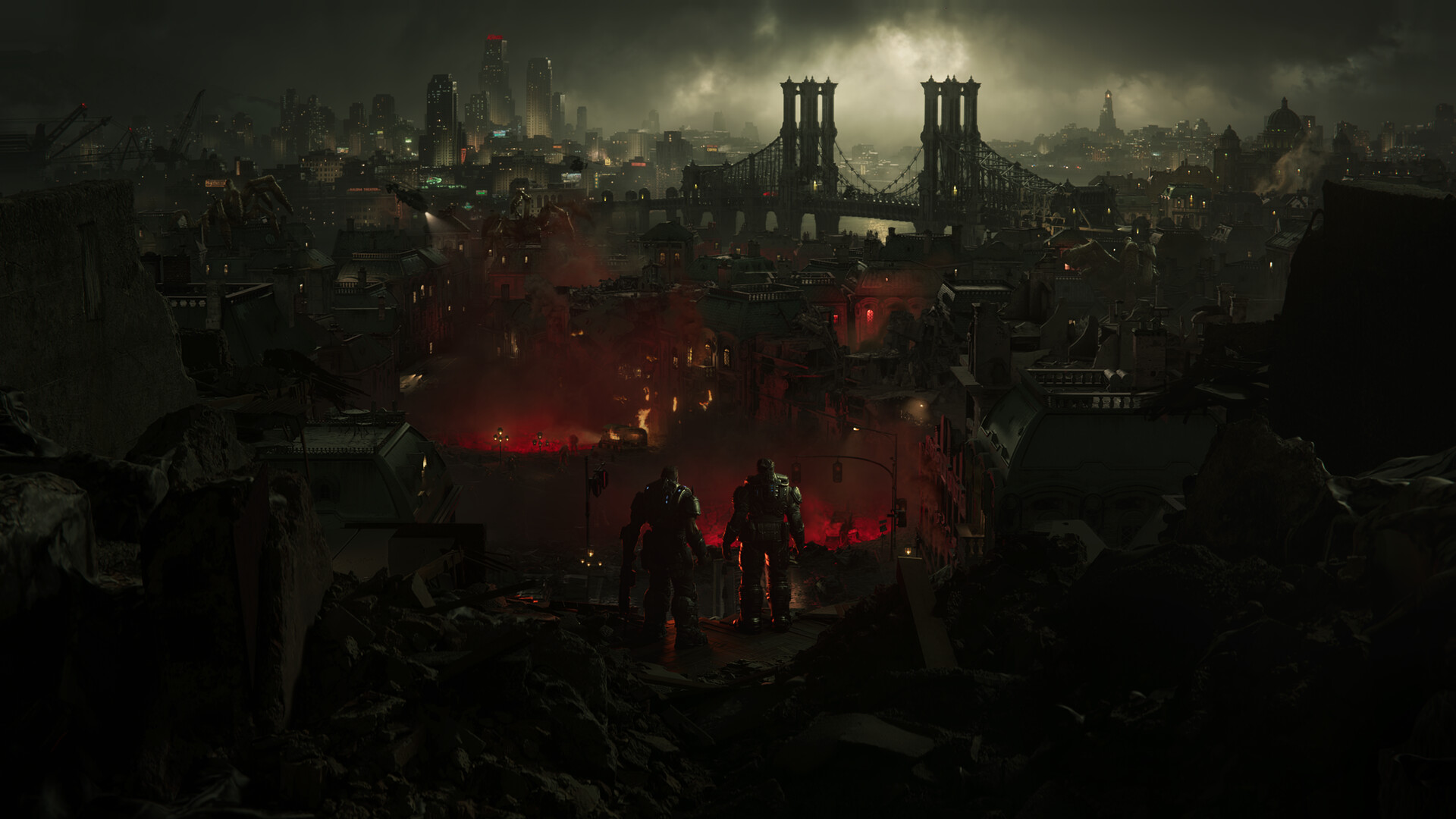
It appears that both Halo and Gears of War could be returning earlier than expected. According to one proven insider, both Halo: Campaign Evolved and Gears of War: E-Day are targeting a summer 2026 release window.
Tom Warren of The Verge, a Microsoft reporter with proven sources within the company, Microsoft wants all of its games to release well ahead of Grand Theft Auto 6 in November. As a result, Fable will be targeting a September-October launch, while Halo: Campaign Evolved is targeting an earlier release over the summer. Gears of War E-Day is also expected to launch in this timeframe, assuming it does not get delayed to 2027.
We may also be finally due for a Starfield update soon. While the game's first expansion, Shattered Space, performed disappointingly, Bethesda has supposedly been working on a massive 2.0 update for the game, as well as a second expansion and a PS5 port.
The report also claims that a new version of Fallout 3 is now in development, with the goal of hitting a similar quality bar to last year's Elder Scrolls IV: Oblivion Remastered. It is unclear if Fallout 3 Remastered will use similar tech to the Oblivion remaster, which used all the same code from the original game, but used Unreal Engine 5 graphics layered on top, keeping the entire original game and its features in-tact.
KitGuru Says: If everything here is accurate, then Xbox is going to have a very busy time over the summer and autumn months. If any games need more time, they are more likely to be pushed into 2027, than released around the GTA 6 launch in November.
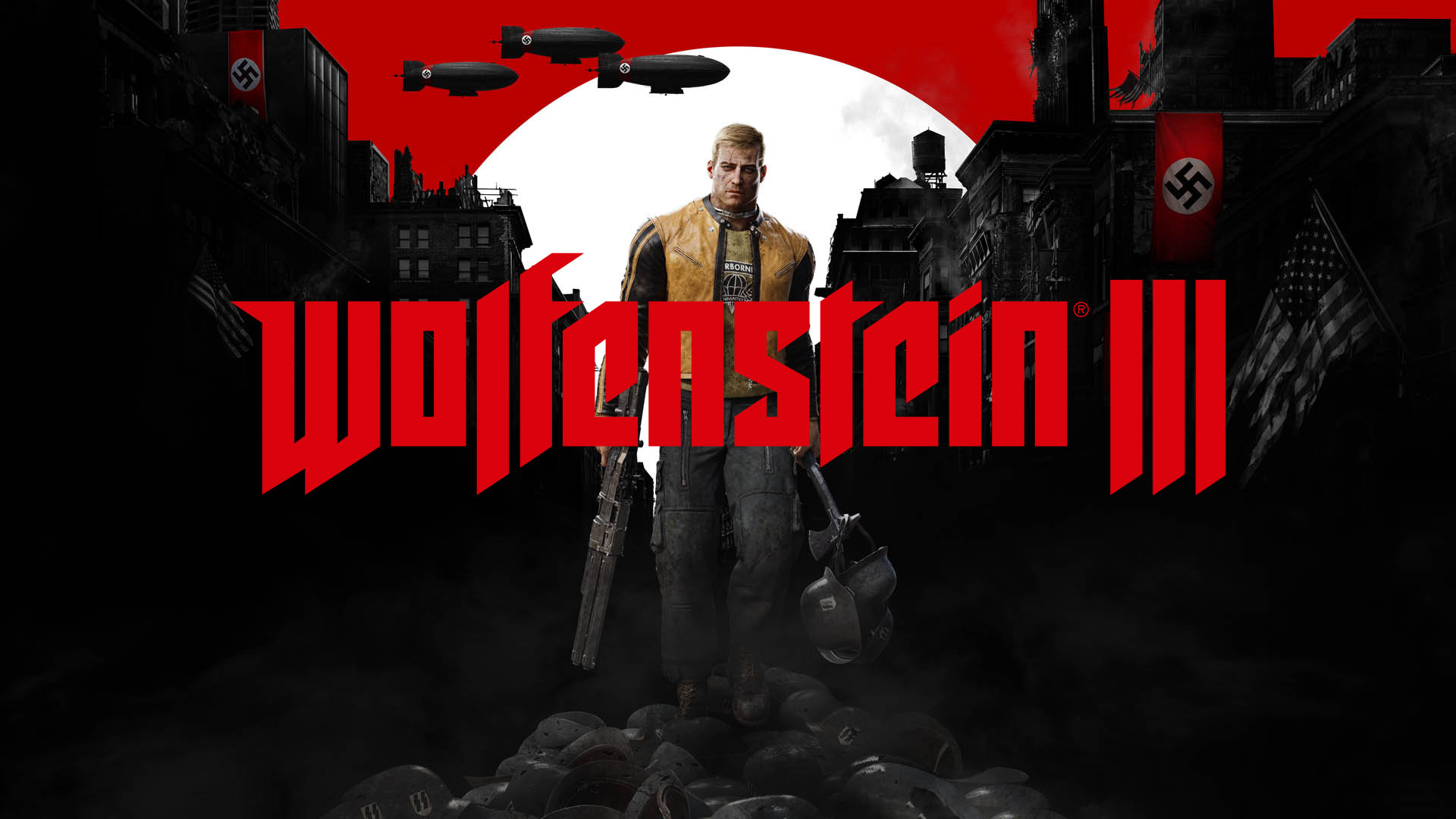
For years, it has been rumoured that a third Wolfenstein game would be coming from Machine Games. Ultimately, those plans were pushed back a bit due to Indiana Jones and the Great Circle, as Machine Games confirmed several months ago. Now though, it appears that the studio is ready to start talking about the next Wolfenstein game for real.
In an interview with GI.biz, Machine Games studio director, Jerk Gustafsson, said: “Our intention has always been to go back to Wolfenstein. We wanted to finish the trilogy. And when we do that, that is something that I don't want to comment on. It can be now, it can be later, but we're not done with it. That's what I can say.”
There is no word on when Wolfenstein 3 will surface but it appears that Machine Games is going to be returning to it soon to wrap up its trilogy. The comments come at an unusual time, as just a few weeks ago, multiple insider sources claimed that Wolfenstein 3 is indeed in development.
Wolfenstein: The New Order and Wolfenstein: The New Colossus were both incredibly well received, but both arrived during the last console generation. So far during the Xbox Series X / PS5 life cycle, Machine Games has only produced Indiana Jones and the Great Circle, which was a fantastic game in its own right.
Gustafsson expects Machine Games to release a new game “every four years”. Considering that Indiana Jones arrived in late 2024, that means we may not see Wolfenstein 3 for another couple of years.
KitGuru Says: Wolfenstein 3 has been rumoured for a long time. While not directly confirmed yet, it does sound like Machine Games is now finally working on it in earnest.
Build a Rocket Boy didn't have the best debut when MindsEye launched last year. The game launched to a flurry of negative reviews due to various technical issues. Shortly after the launch, one of the studio's CEOs alleged that the game had been subjected to a smear campaign online. Now, they are claiming to have ‘caught' those who sabotaged the project.
Insider Gaming managed to get a copy of an internal call at Build a Rocket Boy, in which it is claimed that co-CEO, Mark Gerhard, said that a “very big American company” had spent as much as €1 million to tarnish the game's reputation online. It is also alleged that a UK-based YouTuber & influencer management firm, Ritual Network, and several influencers were also part of the sabotage effort.
In a statement given to Insider Gaming, Ritual Network denied that it had anything to do with the allegations, adding that they are “not aware of any legitimate legal action” at this time.
The report says that those involved are soon to be served with lawsuits and that employees at the studio itself may have also been involved, leading to a rollout of new employee monitoring software across their PCs.
No direct evidence has been provided yet, but should lawsuits go ahead, then eventually some of the evidence will be made public. In the meantime, Build a Rocket Boy may make some of the details public via an upcoming Spy-themed mission within MindsEye.
MindsEye has had a number of updates since its launch to address technical issues with the game and will continue to be updated with new content over 2026. As of right now, the ‘recent reviews' for the game on Steam are positive, although the game's overall user score still sits at mixed.
KitGuru Says: Did you play MindsEye at all last year? What did you think of the game?
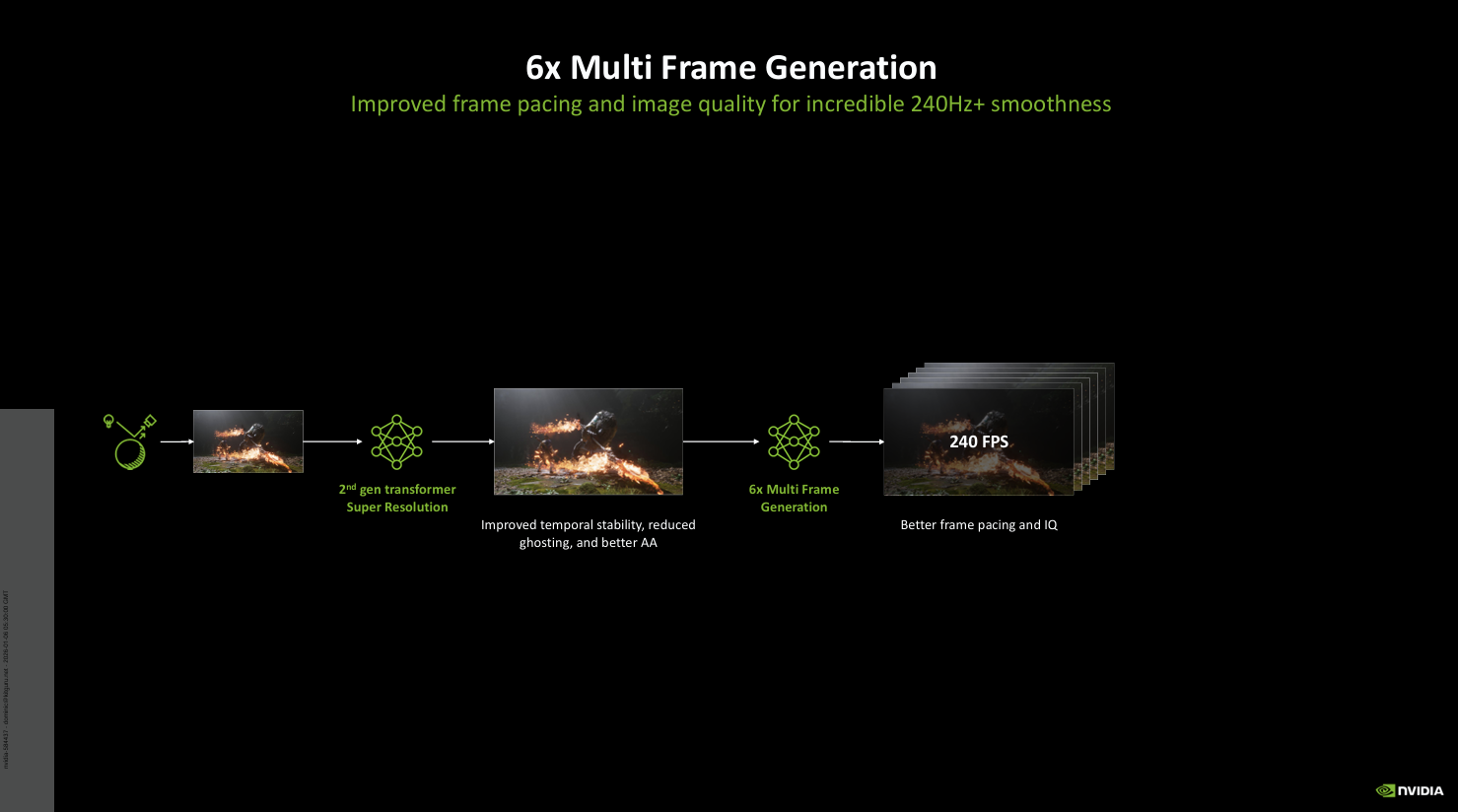
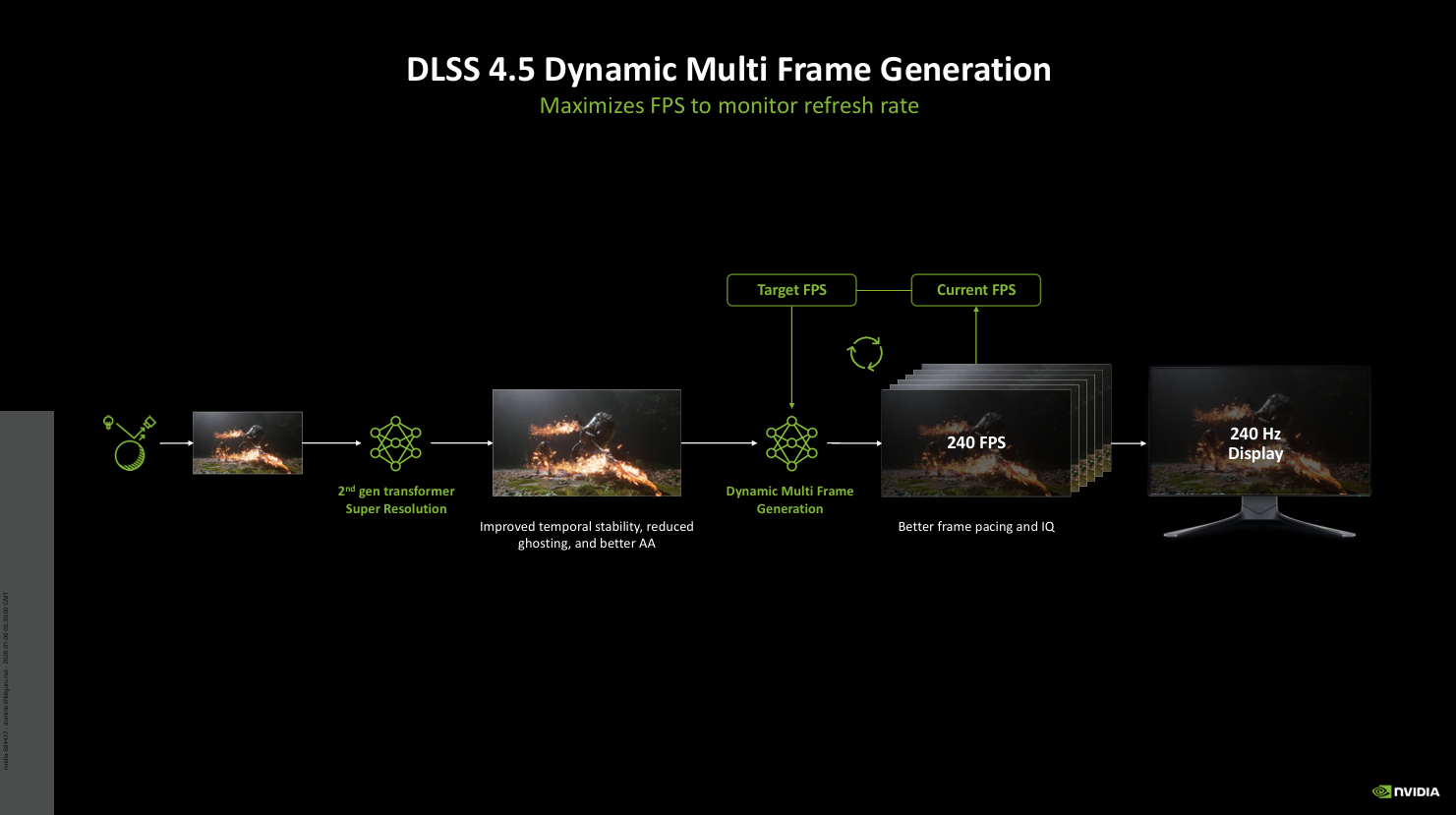
Nvidia announced at CES that it would upgrade its DLSS Multi Frame Generation with two new modes: 6x and Dynamic. The specific release dates for these modes weren't announced when they were revealed; only a vague “spring 2026” was mentioned. However, a new report points to an April 2026 launch.
According to a report from HardwareLuxx (via VideoCardz), both Dynamic Multi Frame Generation (MFG) and the Multi Frame Generation 6x mode are expected to be released publicly within the next two months. However, soon after the information started to spread, VideoCardz was contacted by Nvidia, which stated that the “spring” release remains. Given that April is part of spring, the release date shared by HardwareLuxx remains a possibility.
The Dynamic MFG system represents a shift in how Nvidia approaches frame pacing and overhead. Rather than applying a fixed multiplier, the technology dynamically scales the number of interpolated frames based on real-time scene complexity and current performance overhead. This means the system can scale down to 2x or 3x during combat scenes to preserve input latency, then ramp up to the full 6x multiplier during slower, more cinematic moments. The primary goal is to provide a more fluid experience on high-refresh-rate displays without forcing the GPU to work at maximum capacity when the scene doesn't demand it.
KitGuru says: There's some potential for increased latency when generating five frames for every one rendered, but the existence of this “Dynamic” mode suggests Nvidia is aware of the trade-offs. If the system can truly scale on the fly to match the “feel” of the gameplay, it could make those 500Hz esports monitors a lot easier to drive.
Fractal Design has unveiled the North Momentum Edition, a mid-cycle refresh of its widely acclaimed chassis. While the original North was praised for its aesthetics, there was room for improvement on the stock fans. The new Momentum Edition aims to address this directly by swapping out the standard Aspect 140 mm fans for the company's new Momentum 12 series.
The new fans are the key upgrade of the new Momentum Edition series. They feature a modernised impeller geometry, LCP blades, and fluid-dynamic bearings, which Fractal claims reduce noise by 4 dBA while lowering average GPU temperatures by roughly 2º Celsius.
Visually, the Momentum Edition cases adopt an all-black aesthetic. While the signature wood slats remain, they have been blackened to blend into the dark alloy chassis. The internal layout for the standard mid-tower remains largely unchanged, but the North Momentum XL has received some tweaks. Unlike the original XL, which comes in standard or RC (rear connector) versions, the Momentum Edition comes in a single version that falls between the two in terms of cable routing clearance, with 37 mm, while retaining the “back-connector” motherboard support from the RC variant.
Despite the internal and thermal upgrades, the front I/O remains the same, offering a single USB-C port alongside two USB-A ports. The standard North Momentum Edition is expected to retail for $179, while the larger XL model is positioned at $209.
KitGuru says: The original North was arguably the most influential case of the last few years. By integrating the new Momentum fans as standard, the Momentum Edition looks like the definitive version of an already iconic chassis.
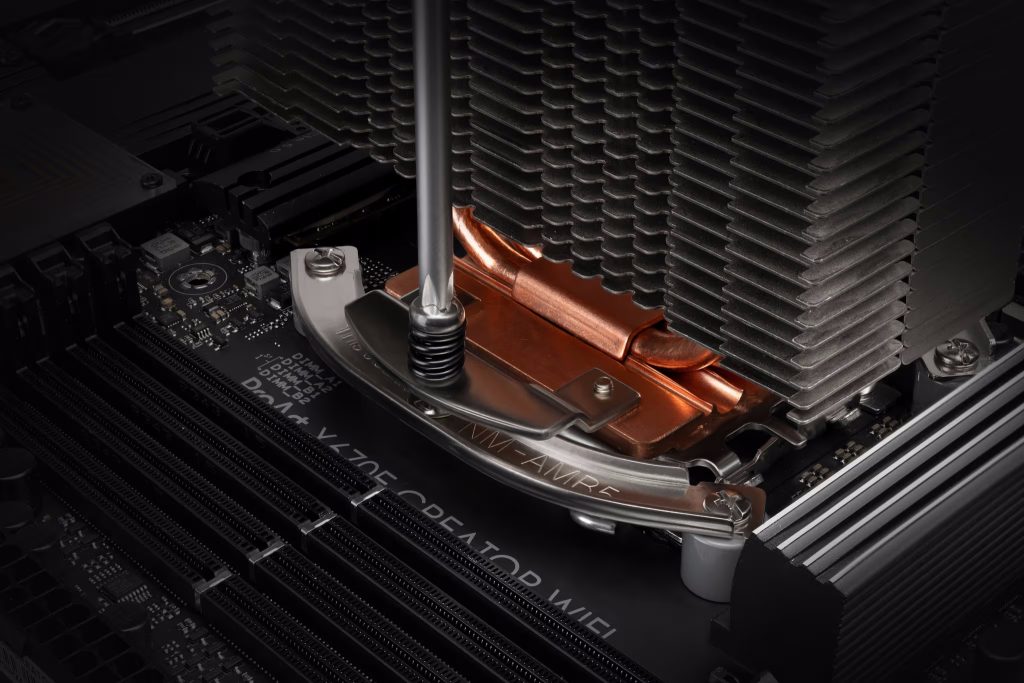
Noctua has achieved a major logistical and environmental milestone, announcing that it has now shipped its 500,000th mounting upgrade kit to customers globally.
This long-standing programme, which first launched in 2006 alongside the introduction of AMD's AM2 socket, is claimed to be a cornerstone of the brand's “compatibility-by-design” philosophy. The initiative allows users to continue using their existing heatsinks, such as the NH-D15 or NH-U12P, across multiple generations of Intel and AMD platforms without needing to purchase a new cooling solution.
According to the Austrian cooling specialist, the primary goal of the service is to treat a CPU cooler as a long-term investment rather than a disposable component. This requires a significant engineering commitment to maintain modularity and standardised mechanical parameters, such as mounting hole spacing and Z-heights, across decades of hardware evolution. The current programme reportedly covers a vast range of modern and legacy sockets. This essentially means that a Noctua owner who bought a premium tower 15 or 20 years ago could still find themselves using the same piece of nickel-plated copper on a high-performance 2026 processor.
The upgrade kits are available free of charge on the official Noctua website, and the company even covers shipping costs from its facilities in Austria and Taiwan. Users must provide proof of purchase for both their cooler and their new motherboard or CPU. For those who might have lost their receipts over the last two decades, Noctua accepts a simple photo of the cooler next to a piece of paper with the user's name as valid verification. For those who require a faster turnaround, the kits are also available from retailers.
KitGuru says: Noctua's commitment to supporting hardware from 2005 is nothing short of exemplary. Reaching half a million kits shipped is a win for consumers' wallets and sustainability, preventing hundreds of thousands of perfectly functional heatsinks from ending up in landfills. It is a rare example of a company standing behind the “buy it for life” mantra, and it's a major reason the brand remains a fan favourite among enthusiasts.
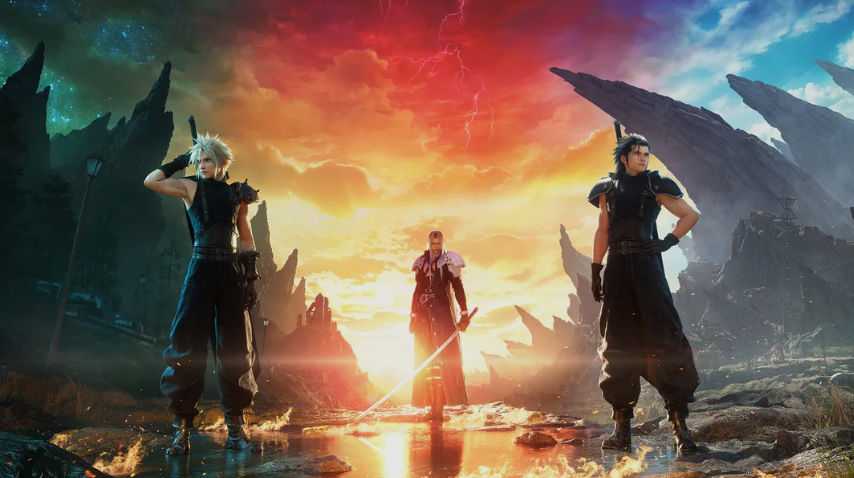
This week during a Nintendo Direct stream, Square Enix officially confirmed that Final Fantasy 7 Rebirth will be launching on the Switch 2 later this year. As expected, the publisher has also confirmed that the game will be releasing on Xbox too.
Final Fantasy 7 Rebirth will be coming to Xbox in June this year, so it should be available right alongside the newly announced Switch 2 port. While the Switch 2 version of the game is likely to make some sacrifices in the visual and performance department, the Xbox Series X version of the game should closely match the PS5 version.
Final Fantasy 7 Rebirth is the second part in the Final Fantasy 7 Remake trilogy. While the games initially started out as PlayStation exclusives, Square Enix has been bringing them to more platforms, starting with PC, followed by other consoles a year or so later.
Final Fantasy 7 Remake Part 3 is currently deep into development and may even be revealed this year, ahead of a 2027 launch. It is expected that the third and final game in the trilogy will be available on multiple platforms from day-one.
KitGuru Says: Do you think the third Final Fantasy 7 Remake game will land on PC and other consoles from day-one, alongside PS5?
HBO found success with its adaptation of The Last of Us and with the recent news that the show may wrap up with its third season, the network has now found its next big adaptation to focus on – Baldur's Gate.
There is a Baldur's Gate TV adaptation coming, as reported by Deadline. Apparently, Craig Mazin, one of the co-creators of The Last of Us series, is also heavily involved with the Baldur's Gate series and will take on writing, producing and showrunner duties. Specifically, the show will take inspiration from Larian's Baldur's Gate 3, rather than the much older games in the series.
While there are a number of acclaimed creatives behind the Baldur's Gate show, it appears that the company responsible for the series recent success, Larian Studios, will have no involvement, despite the fact that the show is going to take direct inspiration from Larian's work. Geoff Keighley revealed this in a tweet last night, saying: “Larian, the creators of Baldur’s Gate 3, tell me they have no involvement in the series”.
That may change a little bit though, as Larian CEO, Swen Vincke, has also confirmed on social media today that showrunner Craig Mazin has “reached out for a chat”, so there may be some light consulting going on, even if Larian isn't directly attached.
KitGuru Says: Are you looking forward to the Baldur's Gate adaptation?
Ubisoft has cancelled a number of games in recent weeks, including the long-awaited Prince of Persia remake. Now according to new reports, a multiplayer Assassin's Creed spin-off has also been scrapped.
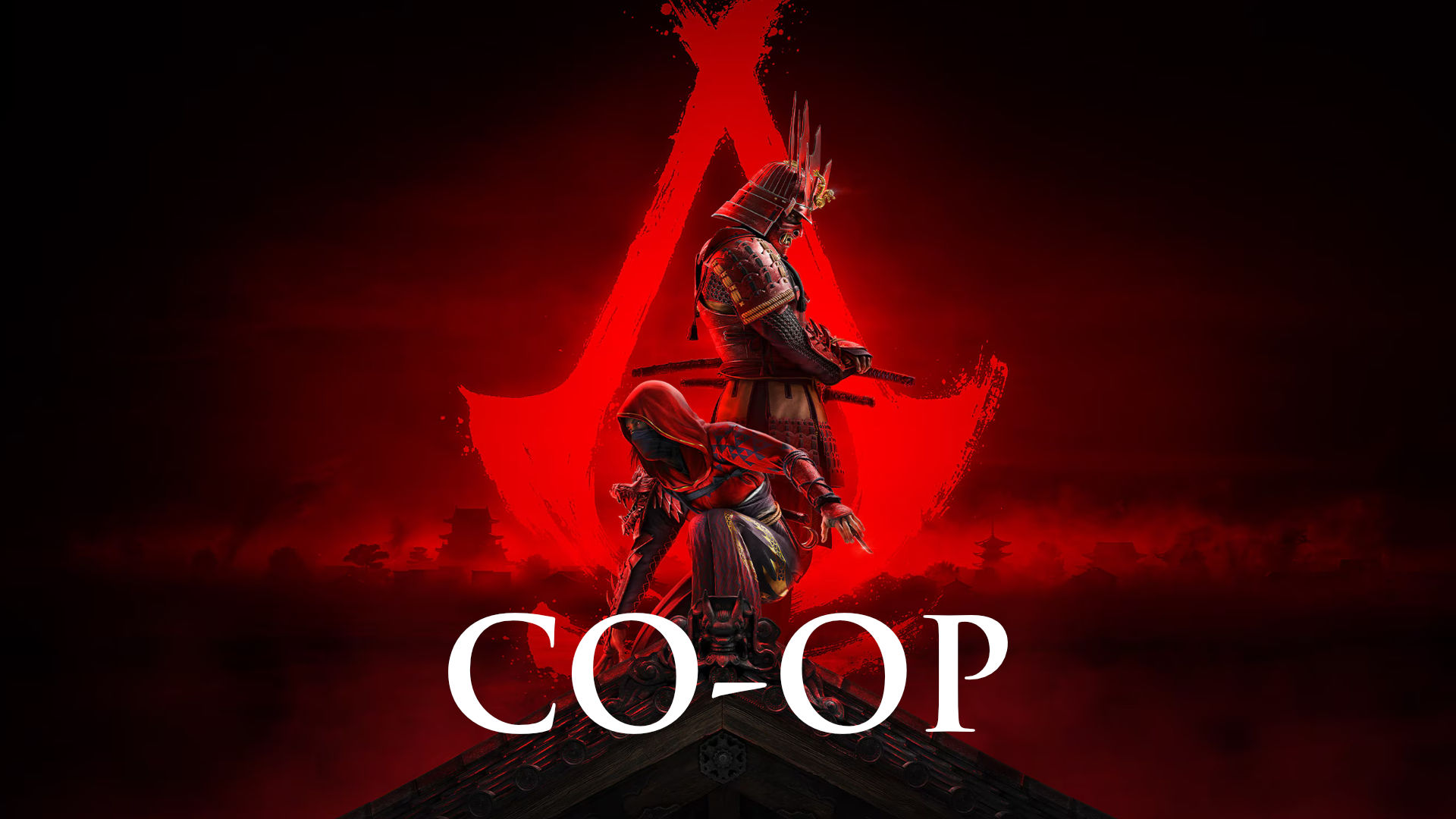
According to reports from both Origami and Insider Gaming, a new Assassin's Creed multiplayer spin-off, titled Assassin's Creed League, has been cancelled. The game was apparently set to feature up to four assassins playing in co-op, taking on missions across feudal Japan to align with last year's mainline game, Assassin's Creed Shadows.
The game was apparently set to use parts of the game world from Assassin's Creed Shadows, offering a smaller, standalone co-op experience. It isn't entirely clear why the project was scrapped, but there were plans to playtest it later this year, so it may have been somewhat playable already.
While Assassin's Creed League may no longer see the light of day, the work put into the project won't go to waste. Apparently, some of the features will be incorporated into the Anvil engine to aid in the development of future co-op games.
KitGuru Says: It sounds kind of like the team had planned an Elden Ring Nightreign style spin-off, borrowing assets from Assassin's Creed Shadows to help speed up development and reduce costs.
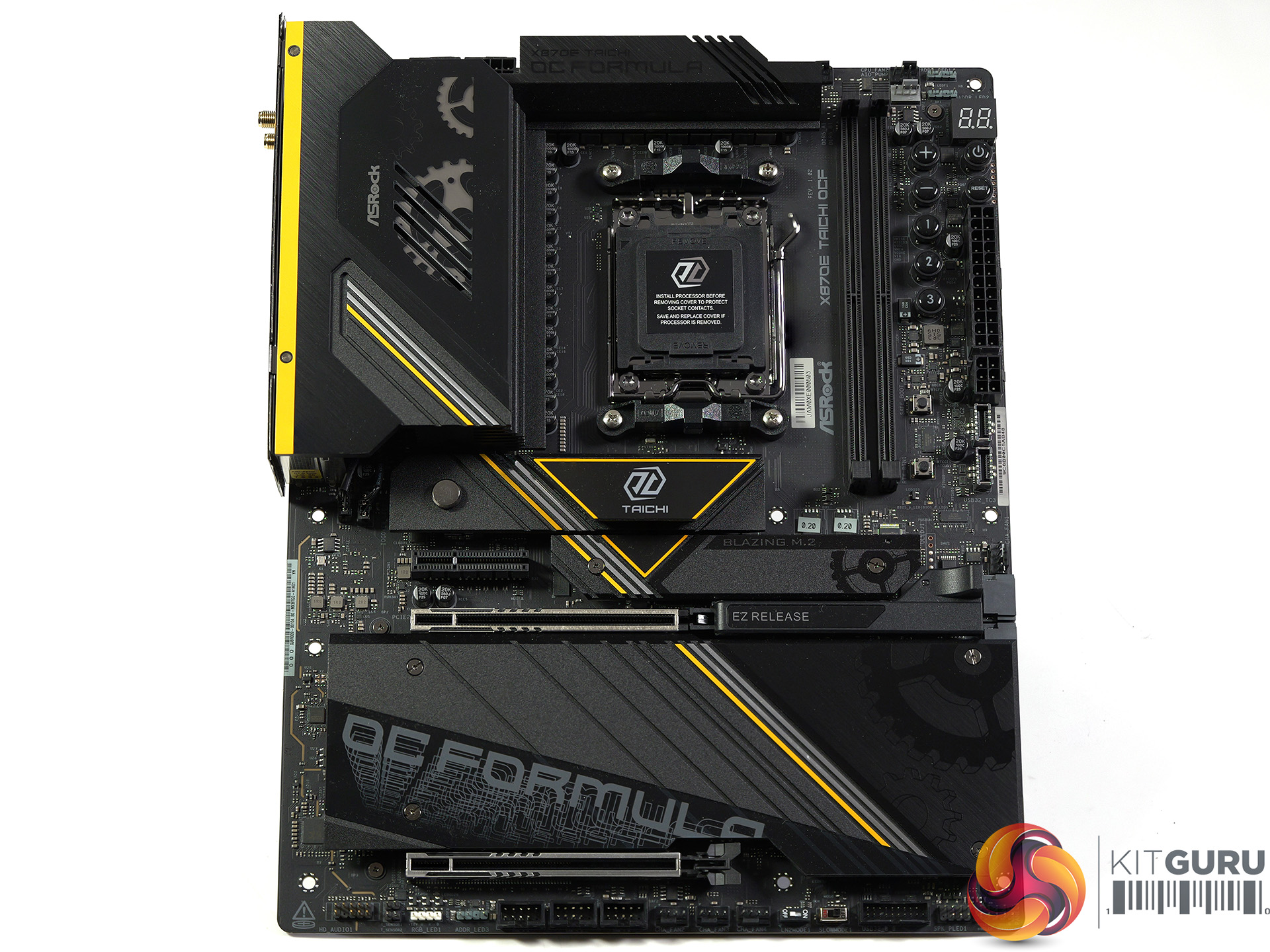
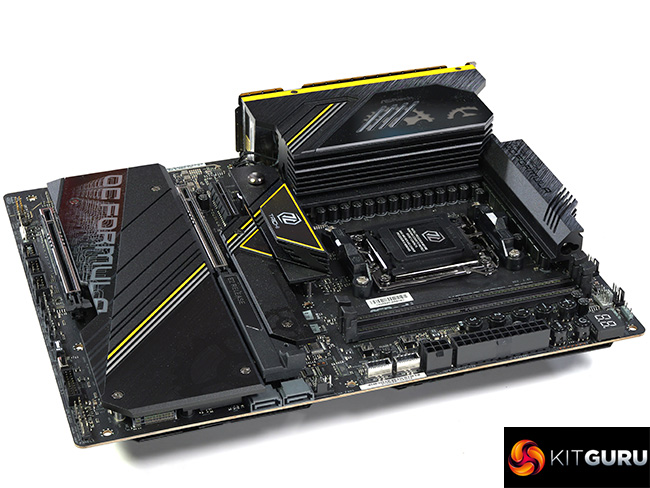
The ASRock X870E Taichi OCF is all about the Over Clocking Formula name and features. This forms a large part of our video as we dig into the function of the mysterious buttons that ASRock has positioned near the two memory slots and the main power connector.
Key features
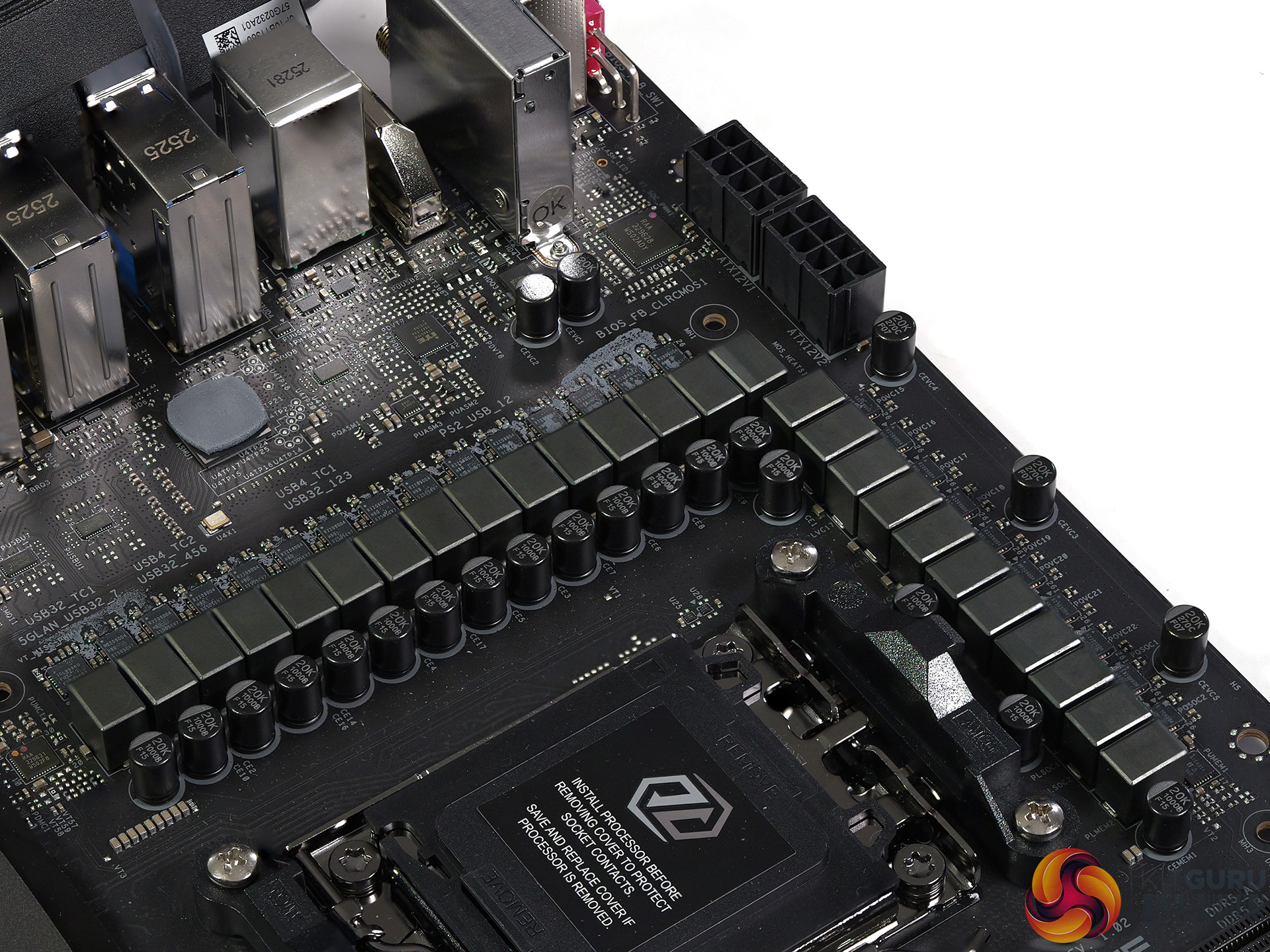
22+2+1 Power Phase, 110A SPS for VCore+SOC Dr.MOS design features the latest SPS (Smart Power Stage) technology. It’s optimised for monitoring current and temperature of each phase, thus delivering smoother and neater power to the CPU with enhanced performance and OC capability.
Extreme Memory Overclocking. Derived from the “built for stable and reliable” designing concept, ASRock does not compromise any detail. This motherboard is built with high quality materials and more importantly 1 DIMM per channel design, ASRock provides an excellent foundation for enthusiasts to utilised and enjoy the boost of DDR5 memory overclocking performance, satisfying and absolutely no sweat at all.
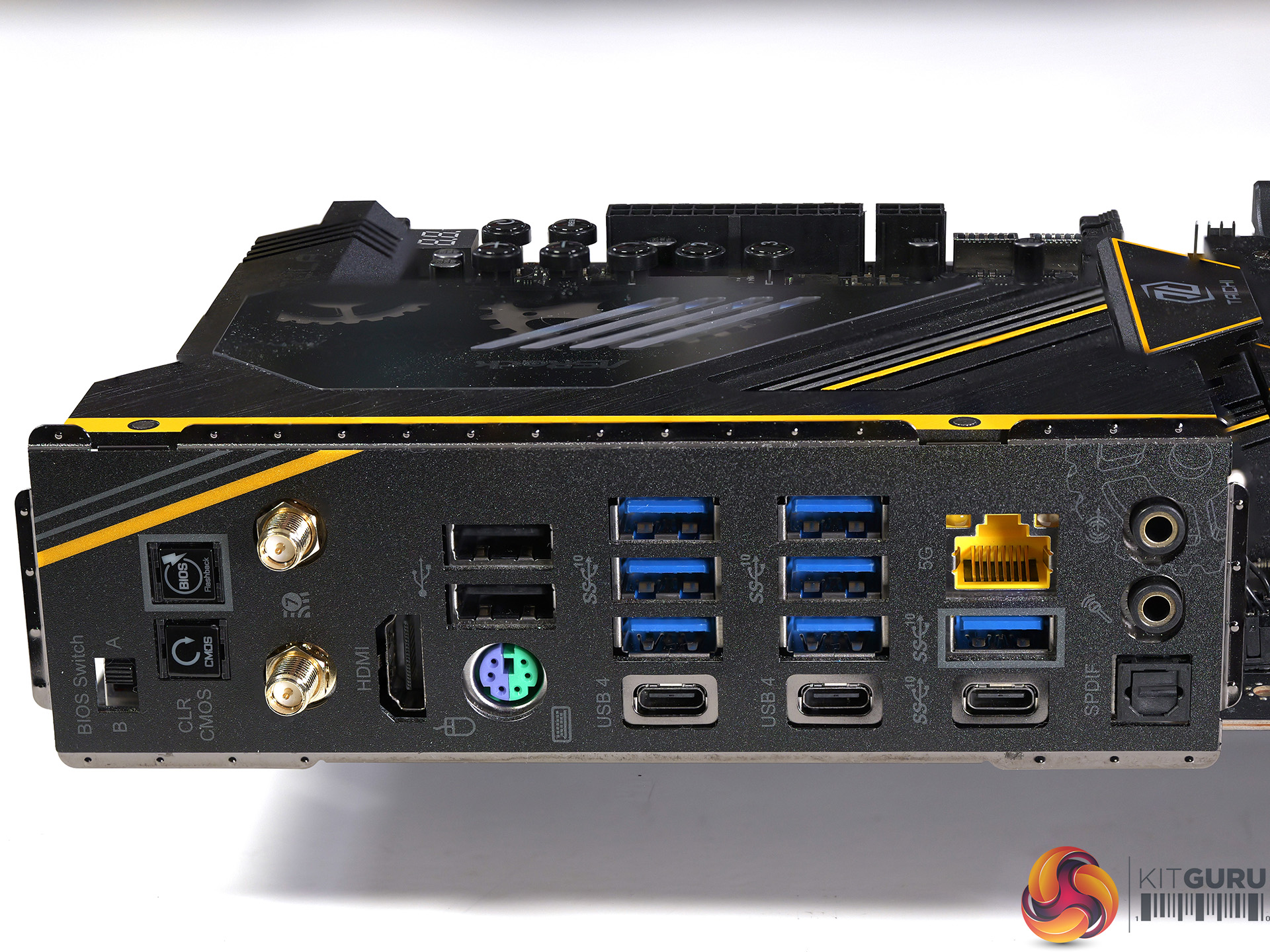
Enhanced USB4 Type-C. USB4 technology brings speed and versatility to the most advanced USB Type-C, offering a fast and simple level of connection for work or home. It enables lightning-fast 40Gbps data transfer bitrate.
Server-Grade Ultra-Low Loss PCB. The server-grade ultra-low loss PCB improves signal integrity and enhances memory overclocking potential, delivering the most extreme memory performance.
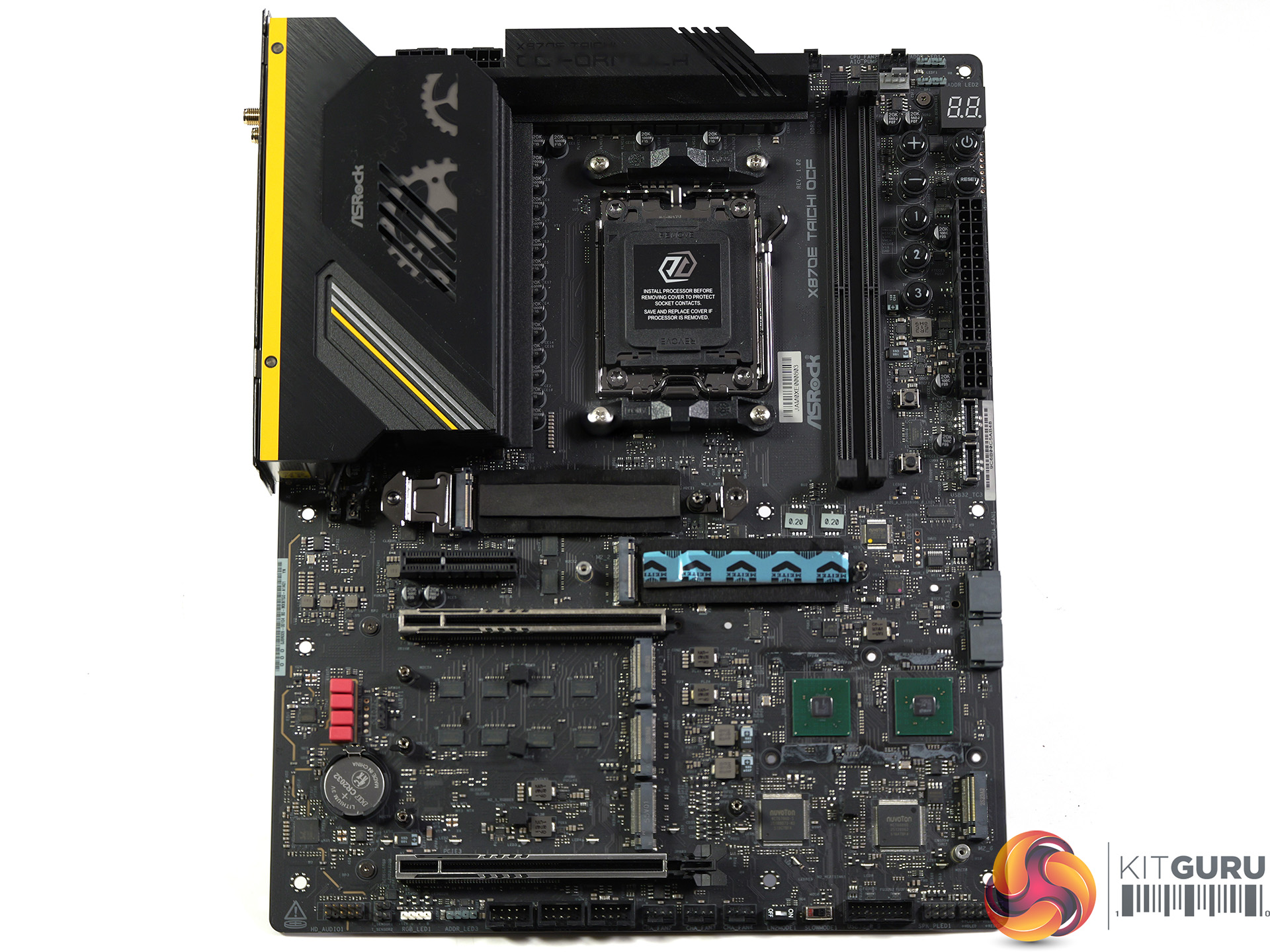
Beyond Deluxe 6 x M.2 Sockets. X870E Taichi OCF equipped with six M.2 slots for SSD and two of which even support PCIe 5.0 x4, delivering high performance and brilliant expandability, a perfect example of a flagship product.
Watch our video on YouTube at 2160p HERE Time stamps
00:00 Intro
01:19 Taichi vs Taichi OCF
02:48 Why an AM5 OC Board is Weird
03:55 ASRock Reputation and CPU Safety Concerns
04:27 ASRock Claims: Memory, BCLK, Voltage
06:40 BIOS and OC Buttons: What Actually Works
09:46 Full Board Tour and Specs
12:55 Test System Overview
13:21 Results vs Regular Taichi
14:05 Closing Thoughts and Verdict
Specification: CPU: AMD Socket AM5 support for AMD Ryzen 9000/8000/7000 Series Processors Chipset: AMD X870E VRMs:
Renesas RAA 229628 VRM controller
22+2+1 x110A Renesas R2209004 SPS VRMs
Memory: Support for DDR5 10400(O.C), 2x DDR5 DIMM sockets up to 128GB
Dual channel memory architecture, non-ECC Unbuffered DIMMs
Expansion Slots
2x PCIe 5.0 x16 (running at 1 x16 or 2 x8)
1x PCIe 4.0 x14 slot
Storage
1x M.2 PCIe 5.0 x4 from CPU
1x M.2 PCIe 5.0 x4 from CPU (shared with USB4)
2x M.2 PCIe 4.0 x4 from Chipset
1x M.2 PCIe 4.0 x2 from Chipset
1x M.2 PCIe 3.0 x4 from Chipset
2x SATA 6Gb/s connectors
USB
2x USB4 40Gbps Type-C ports rear panel
2x USB 3.2 Gen 2×2 20Gbps (1x 36W, 1x 15W) front panel
1x USB 3.2 Gen 2 10Gbps Type-C port rear panel
7x USB 3.2 Gen 2 10Gbps Type-A ports rear panel
2x USB 3.2 Gen 1 5Gbps Type-A ports front panel
8x USB 2.0 Type-A ports (2x rear, 6x front panel
Audio: Realtek ALC4082 Audio Codec Ethernet: Realtek RTL8126 5Gbit Wireless: Wi-Fi 7 and Bluetooth 5.4
7x PWM Fan headers
3x ARGB headers and 1x RGB header
BIOS chip 64MB flash Form Factor: ATX 305mm x 244mm
Performance and Overclocking
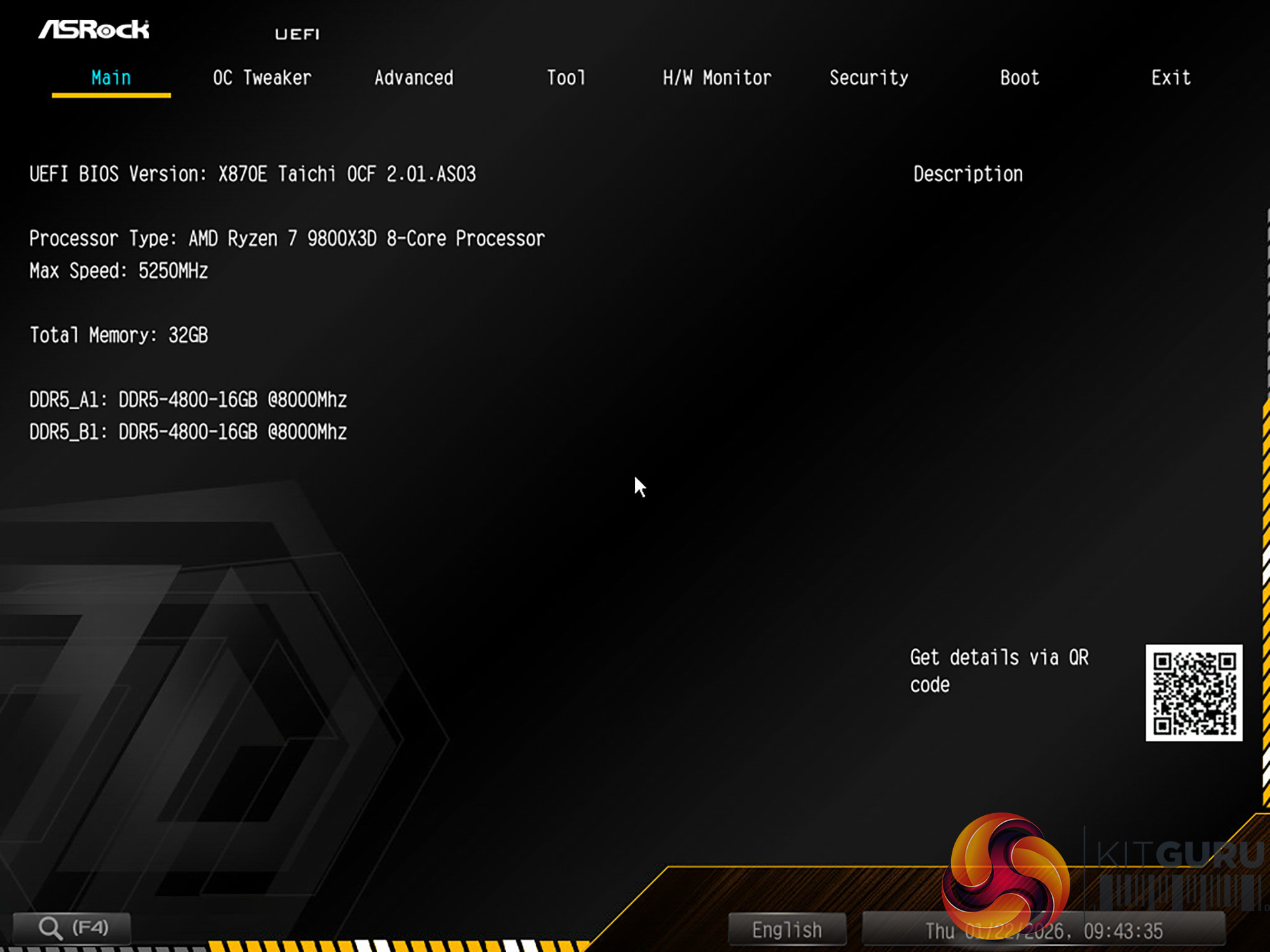
Test system Processor: AMD Ryzen 7 9800X3D Memory: 32GB G.Skill Trident Z5 Royal Neo DDR5-8000 CPU Cooler: Phanteks Glacier One 360MPH Graphics card: MSI GeForce 4090 Ventus 3X 24GB Power supply: Seasonic Focus GX-1000 SSD: 1TB Crucial T700 M.2 NVMe OS: Windows 11
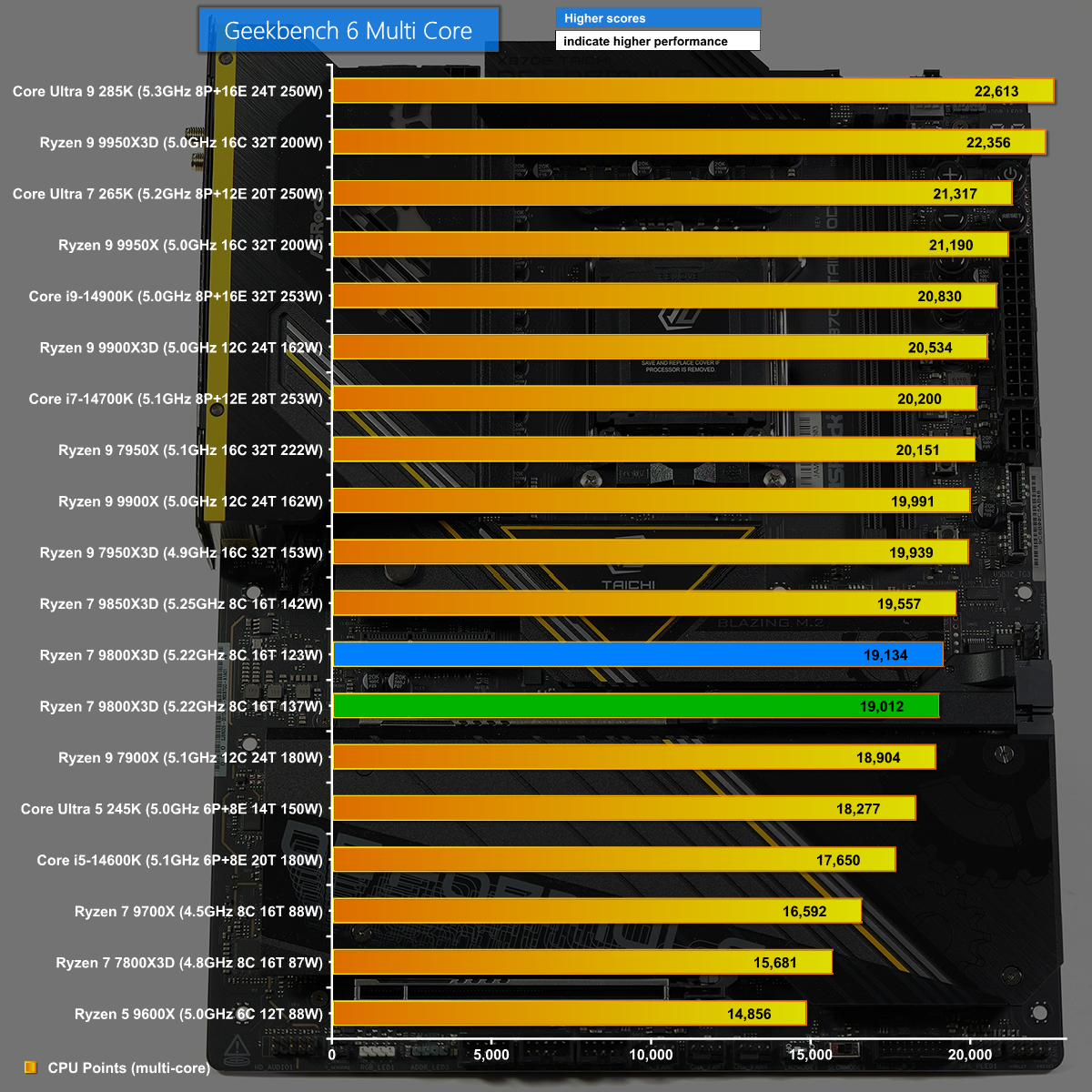
Geekbench 6 Multi Core
In Geekbench 6 Multi Core we see the blue bar for ASRock Taichi X870E OCF is effectively tied with the green bar for the regular X870E Taichi. In other words performance is perfectly decent and exactly what we expect.
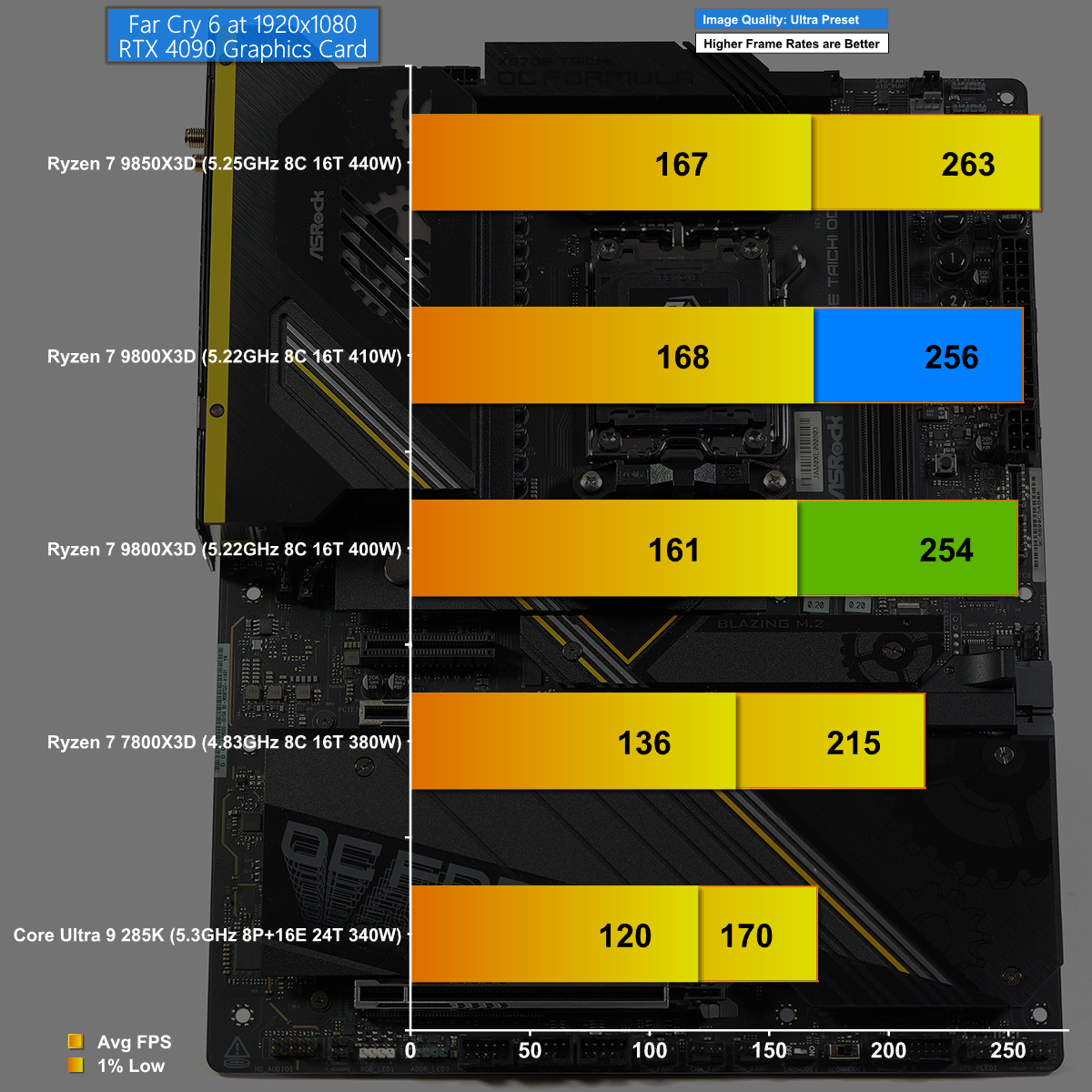
Far Cry 6 at 1080p
Playing Far Cry 6 at 1080p again shows the OCF does a good job but there is no secret sauce delivering extra performance on Auto settings.
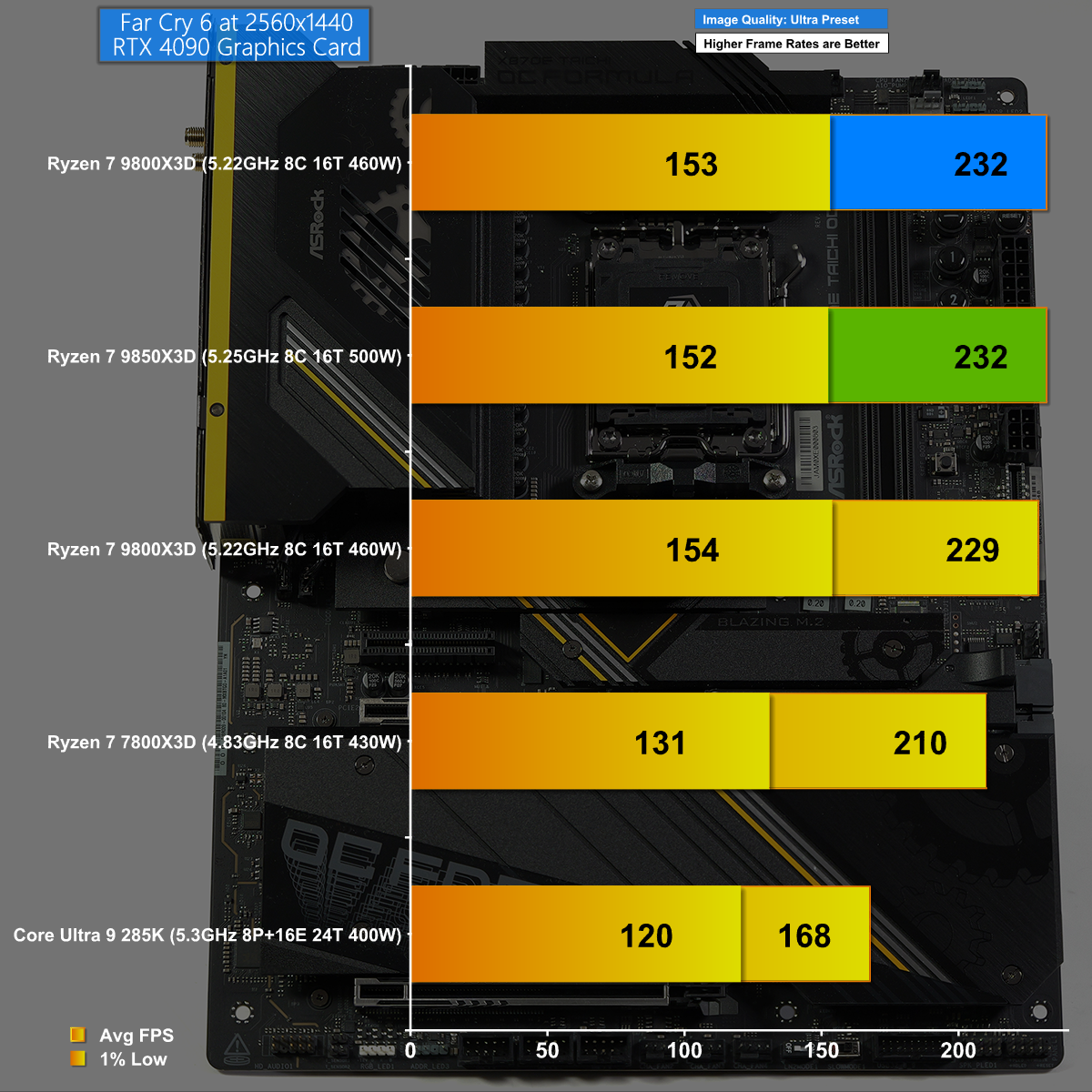
Far Cry 6 at 1440p
Finally we have Far Cry 6 at 1440p where we see the closest of ties between the regular X870E Taichi and the Taichi OCF.
Closing Thoughts
Our video about the ASRock X870E Taichi OCF is unlike most of our motherboard reviews as the single biggest question revolves around the extras that make this motherboard an Over Clocking Formula. As we demonstrate in some detail, we had a number of issues with the hardware overclocking buttons but the peculiar thing is that we weren't especially annoyed as we don't much like the idea of messing with the base clock speed of a Ryzen 9000 CPU.
Instead we prefer to think of the OCF as a variant of the regular X870E Taichi and in that sense it is perfectly OK. The addition of the overclocking buttons is an irrelevance to us and we are fine with only having two DDR5 memory slots, however we positively welcome the move from E-ATX to ATX. Also, we like the black and yellow styling and consider it a small improvement over the regular X870E Taichi.
MSRP for the ASRock X870E Taichi OCF is $500
Pros:
The hardware seems bullet proof
Good looks and smart styling
Excellent set of micro buttons and a debug display
Manual switch to select BIOS A or B
Cons:
There are concerns about ASRock motherboards damaging Ryzen CPUs
The hardware overclocking buttons don’t seem to work!
We cannot find this motherboard on sale
KitGuru says: The ASRock X870E Taichi OCF is an oddball with a number of points of interest.
Ghost of Yotei was one of PlayStation’s biggest first-party exclusives to release in 2025, with the sequel to 2020’s Tsushima receiving equally as high praise as the first entry. When it comes to sales however, despite being on a console with a smaller total userbase, Ghost of Yotei has outsold Tsushima when launch-aligned.
As part of the company’s latest fiscal earnings report, Sony offered some updated sales data for its first-party releases. Unfortunately, the console maker is rather selective when it comes to sharing official sales.
That said, we have gotten confirmation that 2025’s Ghost of Yotei is performing well so far, with Sony CFO Lin Tao revealing (as transcribed by Gamesindustry.biz) that Yotei has “exceeded the sales of Ghost of Tsushima in the same period of time.”
As mentioned, exact apples-to-apples comparisons can’t be made due to Sony’s inconsistent sharing of sales data, however based on what we do know the original Ghost of Tsushima sold 2.4 million copies within its first 3 days on the market. It then took until 128 days post-launch for the title to reach 5 million.
Yotei on the other hand was revealed to have sold a total of 3.3 million copies within its first 32 days on sale. Considering the fact that Yotei has supposedly outpaced Tsushima it will be interesting to see how many copies it will have sold by the time it reaches its 128th day on the market.
KitGuru says: What do you think of Ghost of Yotei? How does it compare to Tsushima? Will the sequel eventually outsell the original? Let us know your thoughts down below.
While Starfield is in many people’s eyes one of Bethesda Game Studios’ most disappointing products, the space-faring RPG sandbox did find a dedicated audience of players. Following on from previous rumours claiming that the Xbox console exclusive is planned to be ported to the PlayStation 5, insiders are now stating that the PS5 release is scheduled to go live this April.
While little else was shared, it has been all-but-confirmed that Bethesda is currently working on a mini-overhaul of sorts for Starfield, with focus being put on improving space traversal; though details are relatively light so far.
Regardless, assuming this release date is true, then Starfield could finally be getting its long-awaited update in a couple months’ time. It will be interesting to see how the game performs on PS5 given Starfield’s less-than-stellar reputation.
KitGuru says: What did you think of Starfield at launch? Have the updates improved the experience? Will this supposed overhaul fix the game in your eyes? Let us know down below.
Microsoft has all-but-abandoned the Xbox console in recent years, with many of its first-party releases – past, present and future – being ported over to the likes of the PlayStation 5 and Nintendo Switch. This move away from exclusivity is set to be further entrenched with the next generation of Xbox consoles, with Epic Games now officially confirming that their Games Store will arrive on the next Xbox on day-one.
“We definitely plan to be on the new hardware for Xbox, because, unless their policy or stance on it changes, they are telling us they’re going to welcome that. And we’re going [to] be there, like, on day one. That will probably require us to build in whatever their requirements are, some sort of software to support that.”
Still, assuming Epic does wind up launching its Games Store on the next gen Xbox, it will be highly interesting to see how this will impact the use of Microsoft’s own storefront on the system.
KitGuru says: Are you at all interested in the next-gen Xbox? What are your expectations towards the system? Will this be good or bad for Xbox in the long-term? Let us know your thoughts down below.
Releasing a lengthy 10-minute announcement trailer, the team at Guerrilla Games officially unveiled Horizon Hunters Gathering – a 3-player co-op experience in which you “Choose from a roster of uniquely skilled Hunters…and rally for the hunt as you face off against a deadly machine threat in action-packed combat and high-stake missions.”
Launching simultaneously on PS5 and PC, Hunters Gathering will include support for both cross-play and cross-progression alongside online matchmaking (though the game can also be played solo with two AI companions).
Perhaps the most interesting aspect of the game is its art style, with Horizon Hunters Gathering featuring a much more cartoony aesthetic when compared to the mainline Horizon entries.
So far, no release date nor a release window has been provided, however those interested in the title can sign up for future playtests right now (the details of which can be found HERE).
While the Horizon games are known for their narratives, both Zero Dawn and Forbidden West feature fun and satisfying combat. With Hunters Gathering looking to further evolve its gameplay, here’s to hoping that the co-op title winds up being a success on all fronts.
KitGuru says: What do you think of Horizon Hunters Gathering so far? Are you more interested in it or the NCSOFT MMO? Let us know down below.
When Overwatch 2 was announced, it was a very controversial move as many fans didn't believe a sequel was needed. Now a couple of years later, Blizzard has come to that realisation as well, dropping the ‘2' from the name and introducing a soft reboot of Overwatch.
As part of this soft reboot, fans can expect ten new heroes to join the roster, with five of them becoming available alongside the next major seasonal update. In the video below, you can get a closer look at all of the new changes coming to Overwatch in the coming weeks.
In addition to the new characters, Blizzard is overhauling the game's core balance by introducing sub-roles and unique passive buffs. This change further specialises the tank, damage, and support classes into categories:
TANK
Bruiser (Mauga / Orisa / Roadhog / Zarya): Reduces critical damage received. While at critical health, gain movement speed.
Sharpshooter (Ashe / Cassidy / Hanzo / Sojourn / Widowmaker): Critical hits reduce your movement ability cooldowns.
Flanker (Anran / Genji / Reaper / Tracer / Vendetta / Venture): Health packs restore more health.
Specialist (Bastion / Emre / Junkrat / Mei / Soldier: 76 / Symmetra / Torbjorn): Eliminating an enemy briefly increases your reload speed.
Recon (Echo / Freja / Pharah / Sombra): You detect enemies below half health through walls after damaging them.
SUPPORT
Tactician (Ana / Baptiste / Jetpack Cat / Lucio / Zenyatta): You can gain excess ultimate charge, which carries over after using your ultimate ability.
Medic (Kiriko / Lifeweaver / Mercy / Moira): Healing allies with your weapon also heals you.
Survivor (Brigitte / Illari / Juno / Mizuki / Wuyang): Using a movement ability activates passive health regeneration.
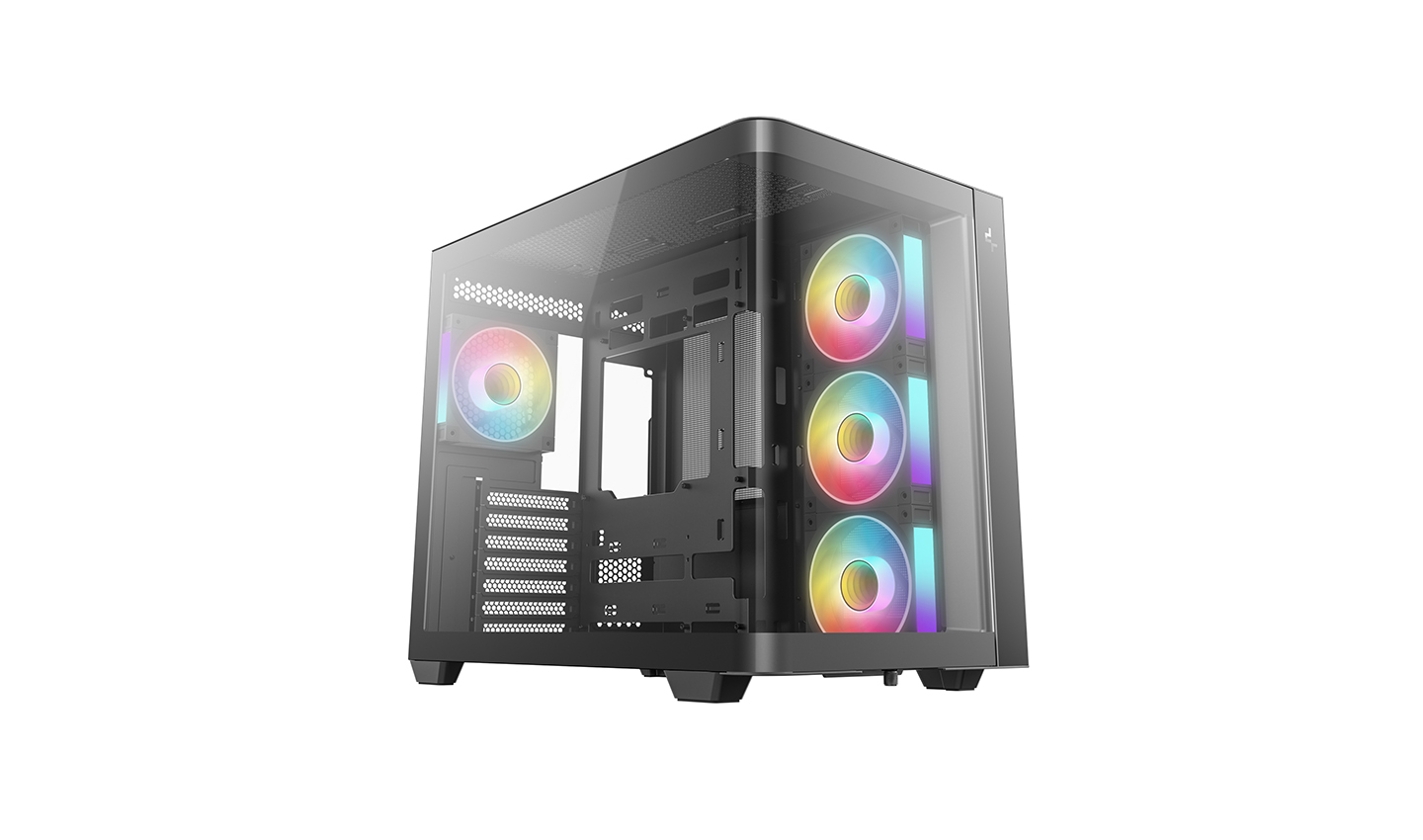
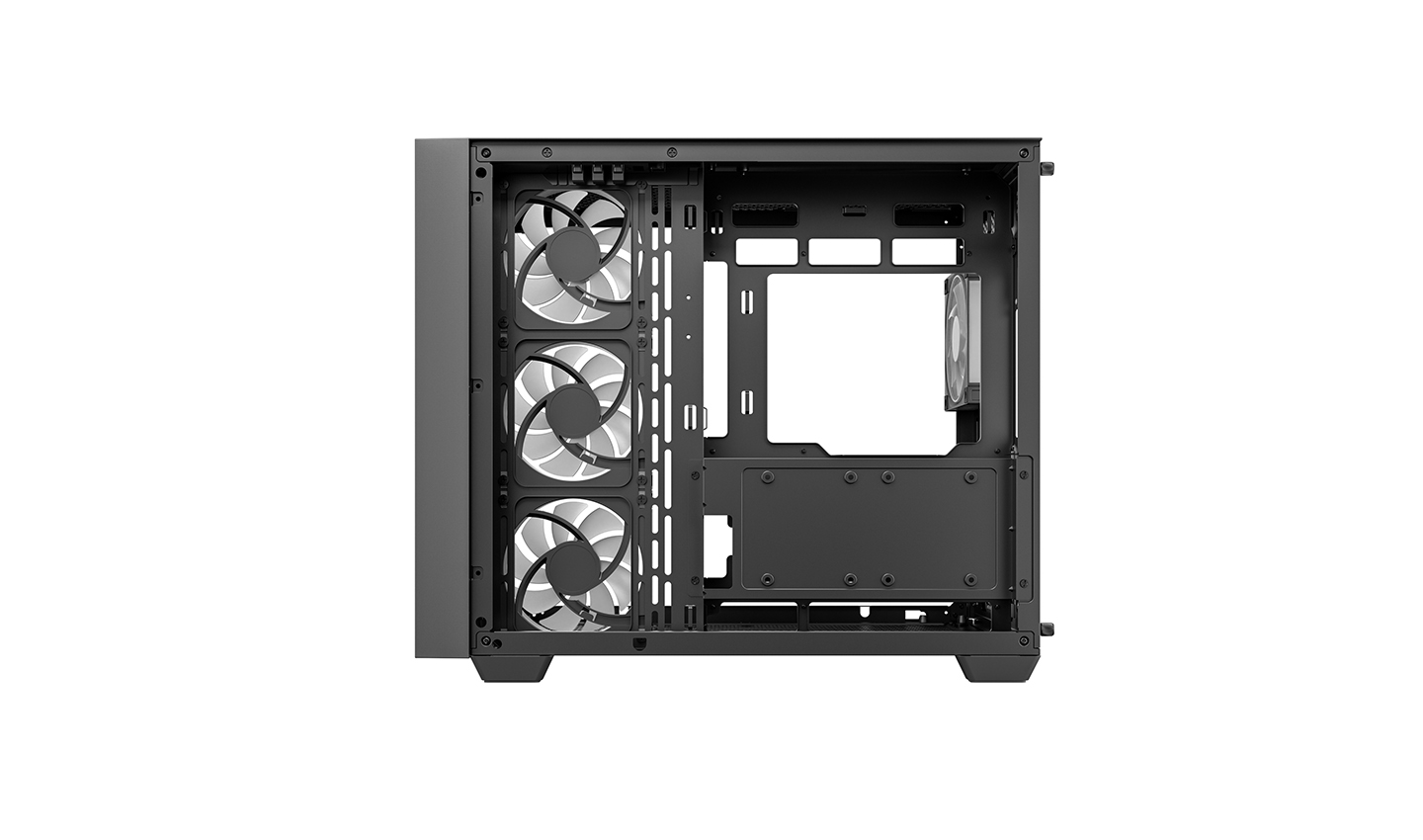
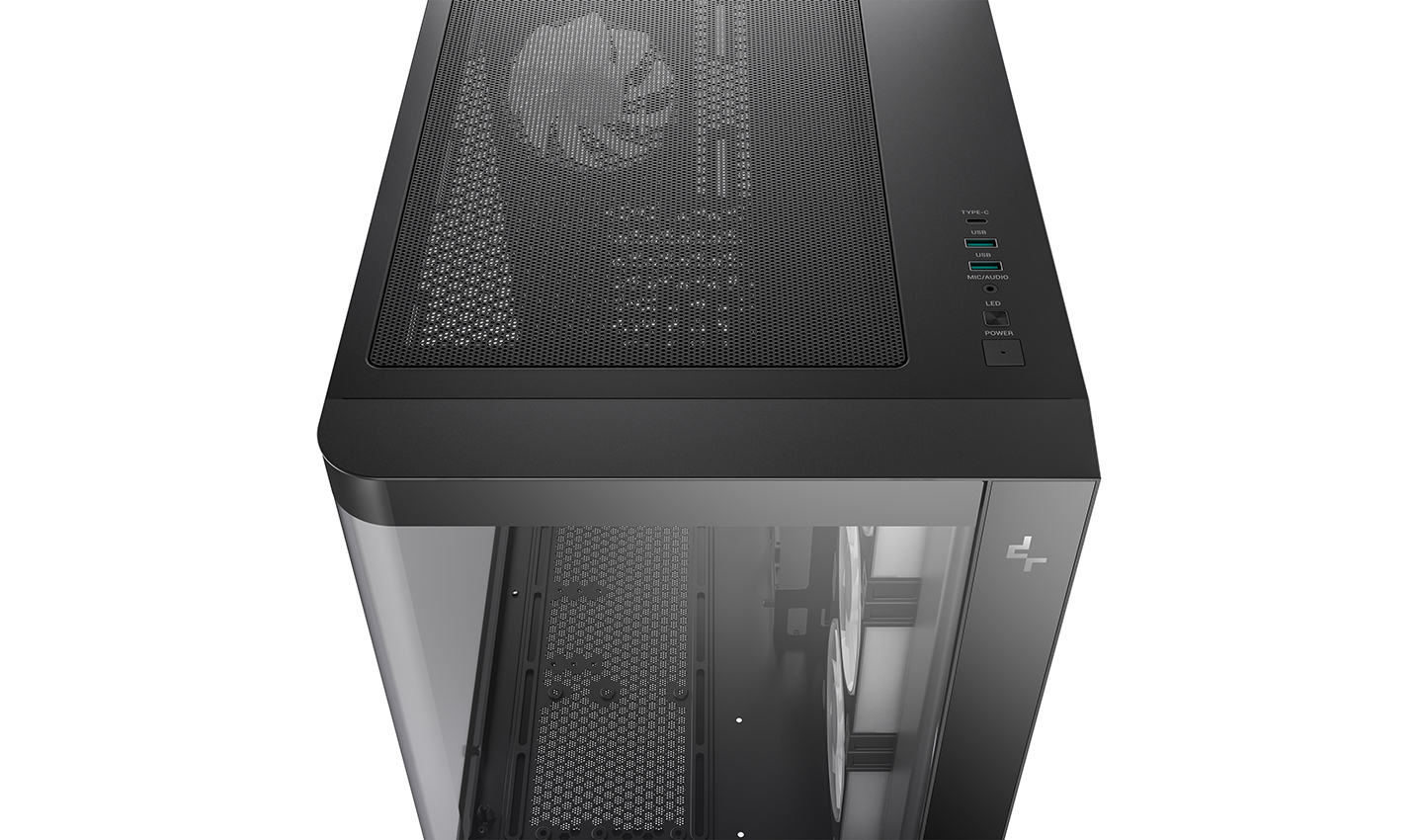
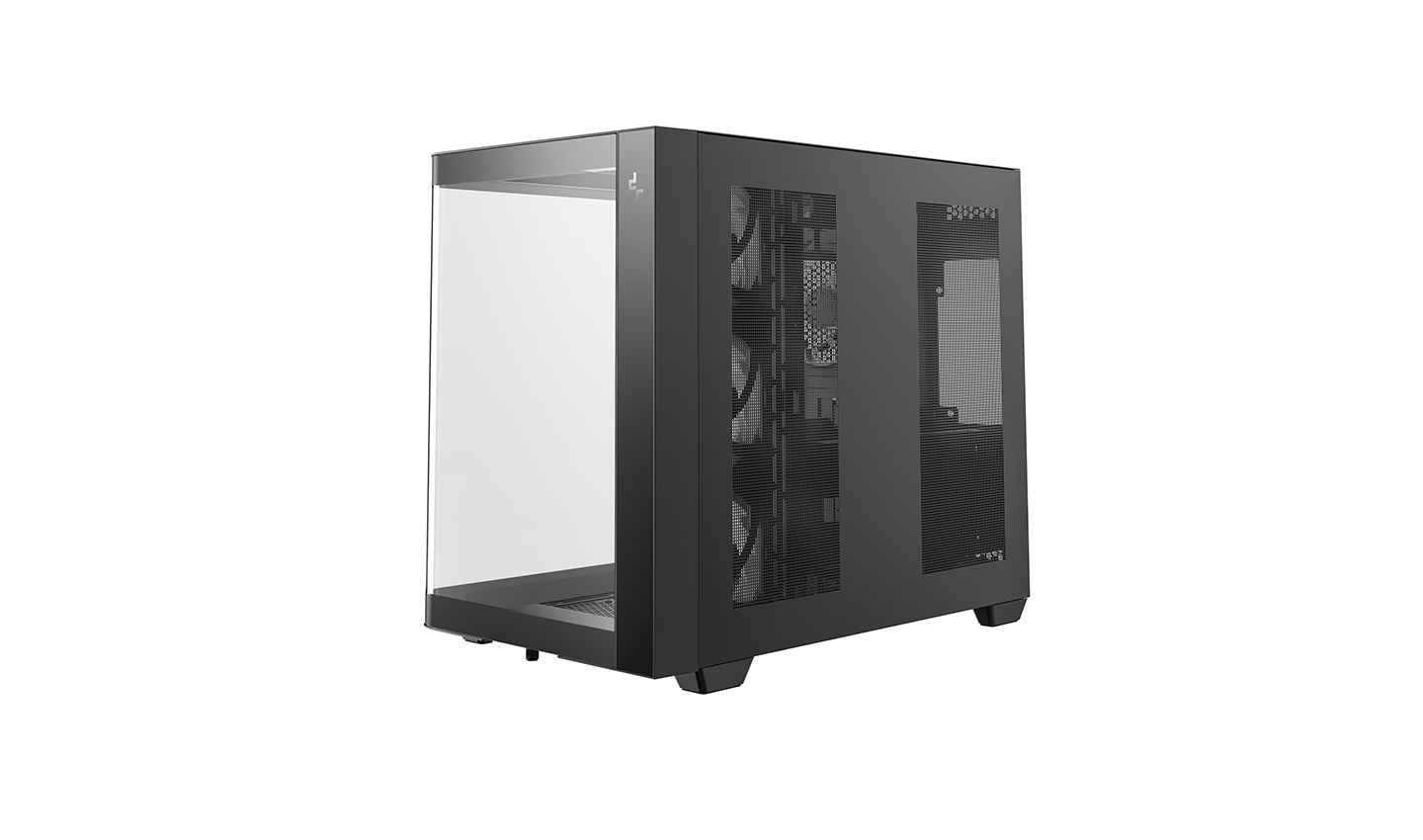
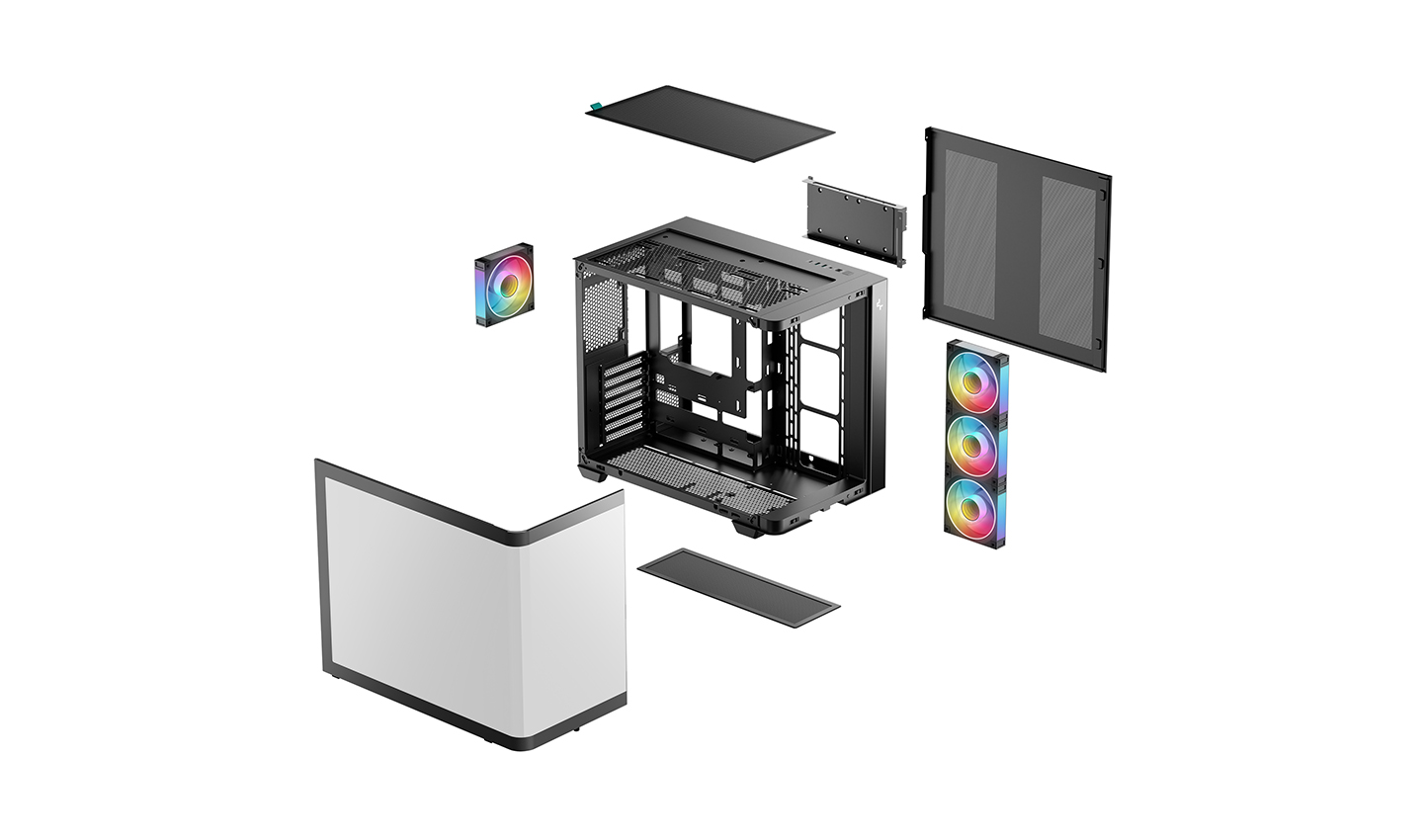
DeepCool has expanded its chassis lineup with the CG530U, a new mid-tower using the popular “fishtank” design. The new case is claimed to feature a seamless, curved tempered glass panel that wraps around the front and side, removing the traditional pillar to provide an unobstructed view of the internal hardware.
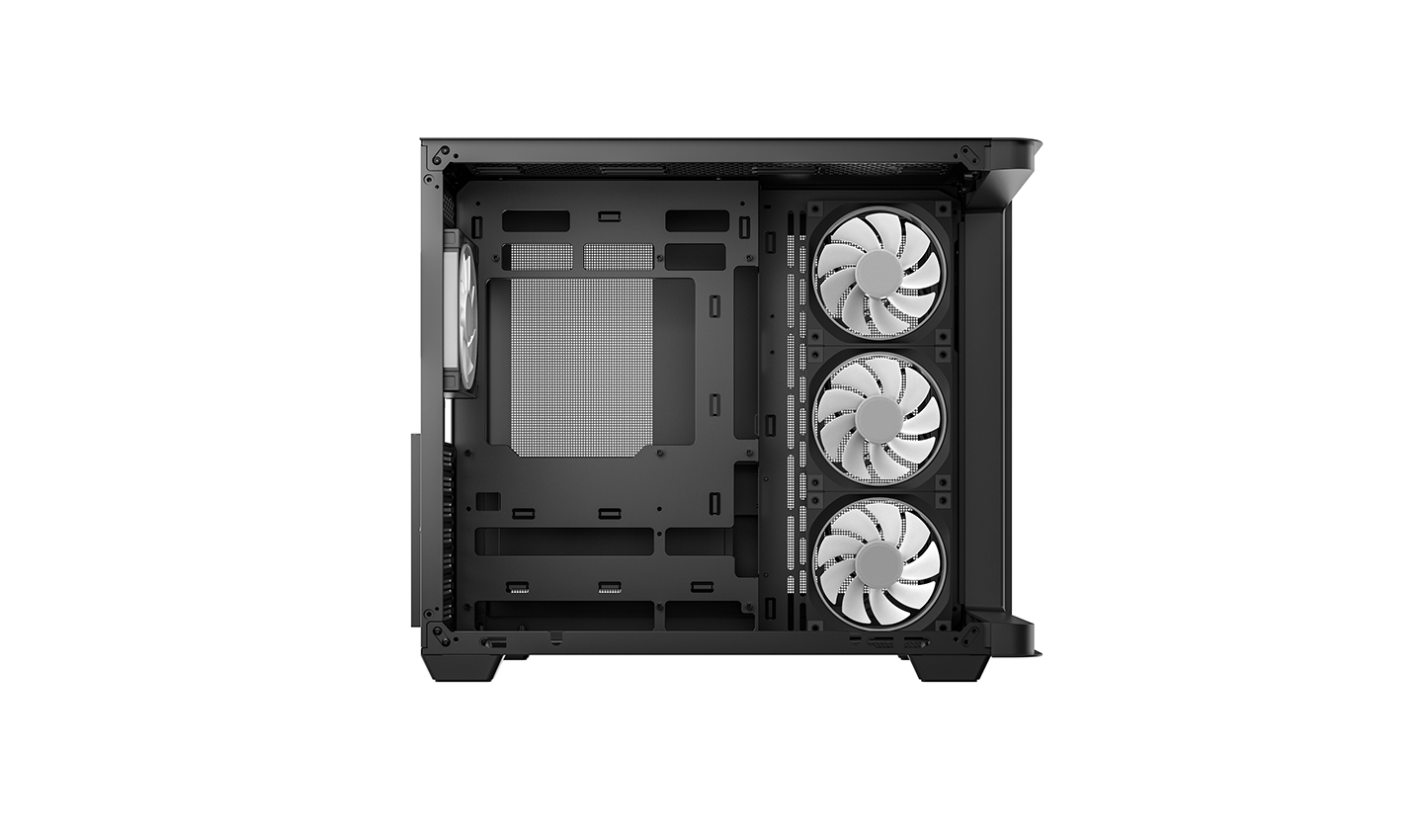
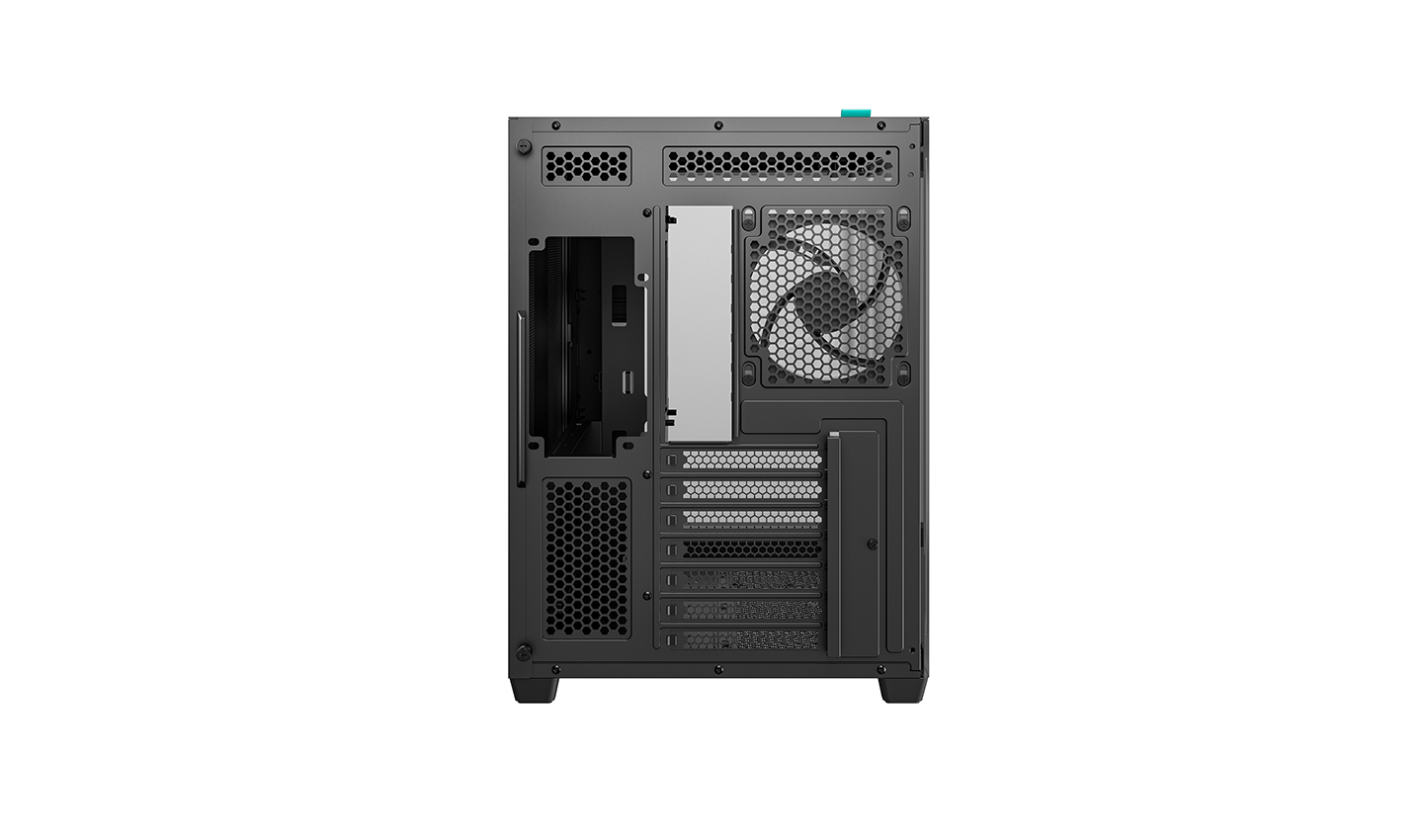
The internal architecture of the CG530U (via Cowcotland) is fully optimised for modern hardware, including support for motherboards with rear-mounted connectors. DeepCool has reportedly included four 120 mm ARGB fans as standard: one at the rear and three reverse-blade models mounted along the side. These fans feature a unique infinity mirror centre and side-strip lighting, designed to provide a high-end look without the need for immediate aftermarket upgrades.
Cooling compatible looks quite versatile, with the dual-chamber layout supporting up to ten fans in total. Builders can reportedly install a 360 mm radiator at the top or bottom of the chassis, while the side mount is supposed to be limited to a 280 mm radiator due to the internal height constraints of the 475 x 285 x 380 mm frame. Despite its relatively compact footprint, the case is said to accommodate substantial hardware, including graphics cards up to 410 mm in length and CPU air coolers up to 160 mm tall. The top panel's connectivity features two USB-A 3.0 ports and a USB-C port.
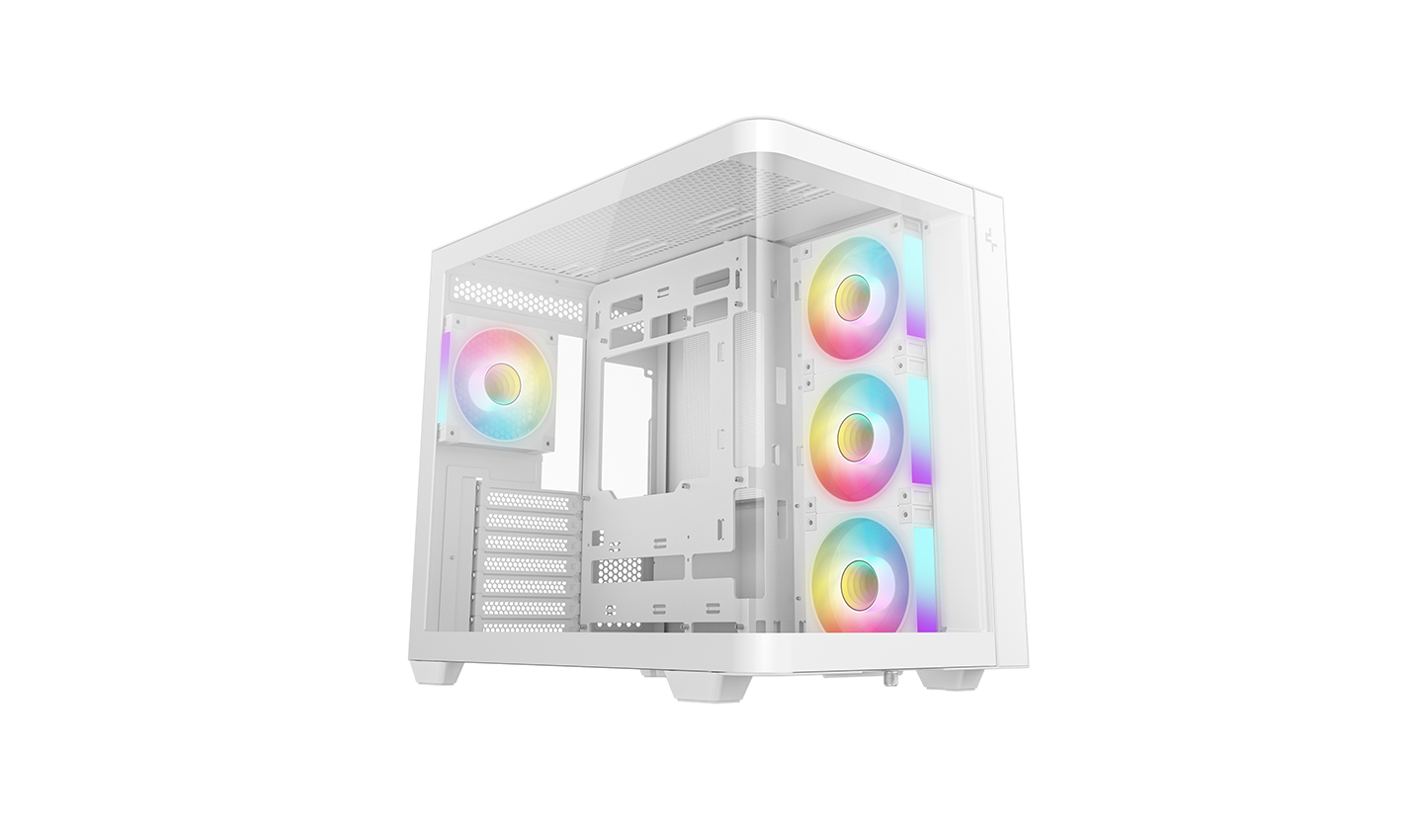
The CG530U will be available in black and white. First retailer listings (like Digitec) suggest the case is expected to cost around £70.
KitGuru says: While pillarless designs often come with a premium, at £70, the CG530U looks to be very affordable, especially considering it comes with four ARGB infinity mirror fans.
AMD CEO Dr. Lisa Su confirmed during the company's Q4 FY2025 earnings call that the silicon powering Microsoft's next-generation Xbox is currently on track for a 2027 launch.
While Microsoft itself has remained tight-lipped regarding its hardware roadmap, AMD stated that development of the semi-custom SoC is progressing well. This upcoming processor, frequently referred to in leaks as the Magnus APU, is expected to leverage AMD's Zen 6 CPU architecture alongside RDNA 5 graphics.
In the more immediate future, Valve's long-awaited Steam Machine revival appears to be entering the final stages of production. During the same earnings call, Dr. Su indicated that the AMD-powered Steam Machine remains on course to begin shipping early this year. However, Valve has since confirmed that the information isn't accurate, and the console, along with the Steam Frame VR headset, will be slightly delayed. Due to the ongoing memory and storage shortages, Valve decided to push the release window to the first half of 2026.
This compact cube is supposed to act as a more powerful sibling to the Steam Deck, housing a semi-custom Zen 4 processor and RDNA 3 graphics.
KitGuru says: AMD's confirmation of a 2027 launch for the next Xbox silicon suggests that Microsoft is eager to reset its console segment sooner rather than later, possibly to pre-empt Sony's PlayStation 6. The next Xbox may have more competition than expected though if Valve's new Steam Machine takes off.
In December, Blizzard announced the next expansion for Diablo 4 and as a bonus to anyone who pre-ordered, they would also get immediate access to the new Paladin class. A secret second playable class was also announced at the time, but with the expansion still months away, fans have only been able to speculate over what it could be. That changed this week thanks to new datamining efforts.
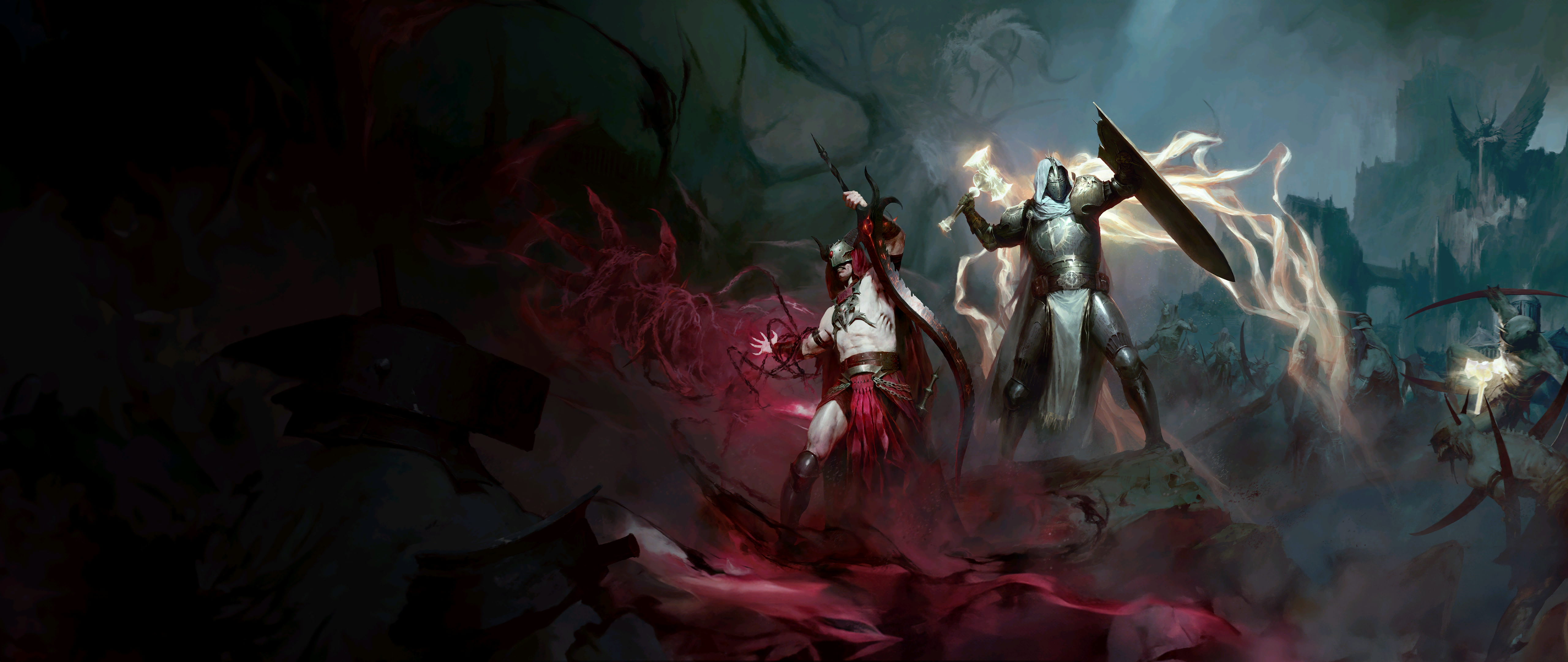
The second playable class launching alongside the new expansion is set to be a Warlock. Leaked concept art from the Public Test Realm also clearly shows a Warlock character standing next to the Paladin. While the Paladin wields holy power, the Warlock will tap into demon powers, as noted by the shadowy red hand reaching out in the key art.
A datamine of the latest Diablo 4 PTR update also contained strings noting the Warlock as a new class. Prior to this, many fans had speculated that the Amazon or Blood Knight could be part of the new expansion, but it seems Blizzard chose to introduce an entirely new class instead. While Warlocks have appeared in other Blizzard titles, notably World of Warcraft, this will be the first time one has appeared in a Diablo game.
Diablo 4: Lord of Hatred launches on April 28th 2026 for all supported platforms. Aside from the new Warlock class, the update will also add a new region to the map – the Skovos Isles, alongside hours of new story content, culminating in a showdown against Mephisto.
KitGuru Says: I really enjoyed the new Paladin class when I tried it out last month. I am hoping the Warlock will be just as fun to play when it arrives.
Fans have been eagerly awaiting for more news on Saber Interactive's Turok Origins since its reveal at The Game Awards. This afternoon during the Nintendo Direct partner showcase, we got a brand new trailer for the game, alongside confirmation that the game is releasing this year.
Previously, fans had speculated a 2026 release window for Turok: Origins but now with the latest trailer, we can narrow that down further, with the game planned to launch in Autumn 2026 for PC, PS5, Xbox Series X/S and now, Switch 2 as well.
The new trailer showcases a number of levels players will explore, from a dense jungle to rocky canyons and even swampy lowlands. Players will have to use fast movement and a mix of energy-based, ballistic and bow weapons to take down the dinosaur threats. At some point, players will also get access to a powered suit for close-up melee combat.
Turok Origins will be playable solo, but three-player co-op will also be an option for those who would prefer to play with friends.
There is still no exact release date yet but we should get one this summer as the Autumn release window approaches.
Bethesda garnered a lot of sales on the Nintendo Switch platform thanks to releases like Skyrim, DOOM and Wolfenstein. Now for the Switch 2 generation, Bethesda is bringing more of its franchises over to Nintendo's platform, including Fallout 4 Anniversary Edition.
Fallout 4 Anniversary Edition launched on other platforms late last year. Now starting on February 24th, the game will also be playable on the Switch 2, but that won't be the only game making its way over to the Nintendo platform this year.
Indiana Jones and the Great Circle is also landing on the Switch 2 platform. The game will become available on May 12th 2026.
Finally, The Elder Scrolls IV: Oblivion Remastered is also launching on the Switch 2 this year, although there is no firm release date yet, indicating that it won't arrive until the second half of the year.
KitGuru Says: While Fallout 4 should be a pretty easy game to run, Indiana Jones and the Great Circle, as well as Oblivion Remastered are two graphical masterpieces, so it will be interesting to see how well they run, and how good they look on a handheld.
Capcom's upcoming game ‘Pragmata' has been shrouded in mystery since its reveal. Today during the Nintendo Direct partner showcase, we finally got our first real look at gameplay, along with an April release date.
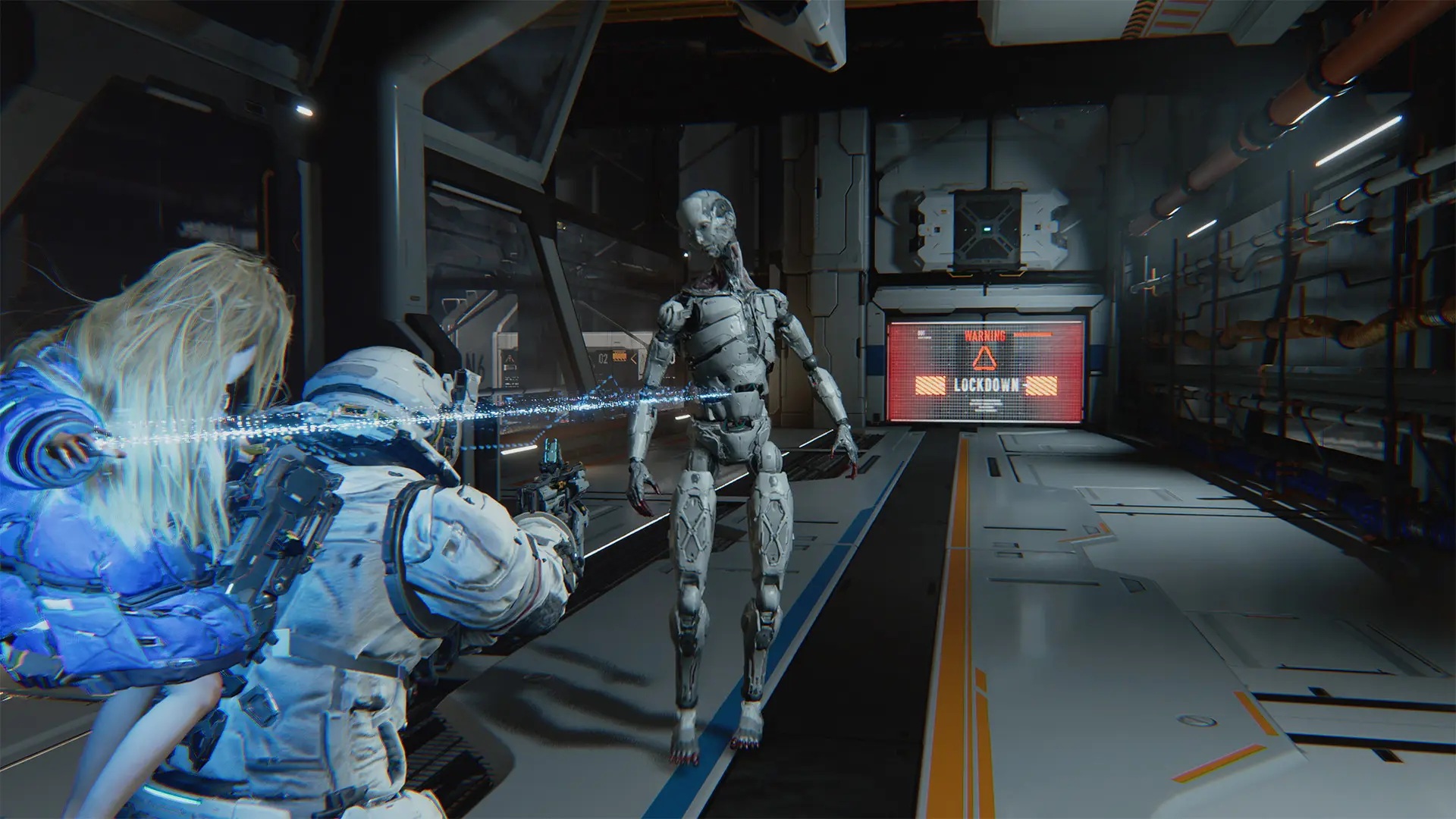
Pragmata stars Hugh Williams, who has been tasked with investigating a lunar research station. As you might expect, things don't go to plan and he ends up injured. In an effort to figure out what is going on and return home safely, he teams up with an Android, Diana, to take down dangerous AI-controlled security bots.
The combat involves a mix of hacking mini games and shooting, with different hacks giving different buffs so you can take down enemies faster, or take down even bigger bosses.
A demo for Pragmata will be available later today on Nintendo Switch 2. The game will then fully launch on April 24th.
KitGuru Says: I was initially intrigued but the hacking mini game in the middle of combat looks like it will get annoying pretty quickly. Maybe I'm wrong though. Will any of you be trying the demo later?
While it was a PS5 exclusive at launch, Final Fantasy 7 Rebirth began going multiplatform with its PC release last year. Now in 2026, the game is heading to the Nintendo Switch 2 console.
Announced this afternoon during the Nintendo Direct partner showcase, Nintendo and Square Enix confirmed that the second installment in the Final Fantasy 7 Remake trilogy will arrive on Nintendo's latest console on June 3rd.
The game will land just six months after the release of Final Fantasy 7 Remake on the Nintendo Switch 2. As this is a much larger game compared to the original remake, expect performance and resolutions to waver slightly, and you'll want to make sure you have plenty of free space handy, as it is likely to eat up more than half of the Switch 2's internal storage.
KitGuru Says: Performance looked a little choppy during the stream, but the game is still a number of months away from launch, so it should get tightened up.
This week, Nvidia is revealing the latest batch of DLSS-supported titles, alongside a few new games for its GeForce Now cloud gaming service. The headliner is Nioh 3, the most ambitious game in the series so far.
KOEI TECMO’s Nioh 3 is the latest installment in the dark samurai action series, telling the tale of a young warrior poised to become the next Shogun during Japan’s turbulent Sengoku period. The game launches tomorrow, but a free demo is already available for those who would like to try before they buy. The game will launch with DLSS 4, enabling multi-frame generation on RTX 50 GPUs, or standard Frame Generation on RTX 40 series graphics cards.
Other titles joining the DLSS ranks this week include the Sea of Remnants closed alpha, Vampires: Bloodlord Rising, Carmageddon: Rogue Shift and Nightmare Frontier.
As for GeForce Now, there are ten titles joining the library this week, including:
Indika (New release on Xbox, available on Game Pass, Feb. 3)
Menace (New release on Steam and Xbox, available on Game Pass, Feb. 5, GeForce RTX
5080-ready)
World of Warcraft: Burning Crusade Classic Anniversary Edition (New release on Battle.net,
Feb. 5)
PUBG: BLINDSPOT (New release on Steam, Feb. 5, GeForce RTX 5080-ready)
Carmageddon: Rogue Shift (New release on Steam, Feb. 6, GeForce RTX 5080-ready)
Delta Force (Steam)
Fallout Shelter (Steam)
Little Nightmares Enhanced Edition (Steam and Xbox, available on Game Pass)
Roadcraft (Xbox, available on Game Pass)
Wildgate (Epic Games Store)
GeForce Now Ultimate members will also be able to access HumantiZ on the RTX 5080 servers for the best possible performance.
In recent weeks there have been a number of user reports claiming that their AM5 CPUs died without warning. All of these reports had one thing in common – an ASRock motherboard. Now, ASRock has issued its first official statement on the matter.
For those unaware, the issue began doing the rounds on Reddit earlier this month, impacting a Ryzen 5 9600X, two Ryzen 7 9700X CPUs, a Ryzen 7 9800X3D and a Ryzen 9 9950X3D. The issue wasn't limited to one motherboard model either, spanning B850, X870 and X870E models.
In response, ASRock has offered the following statement:
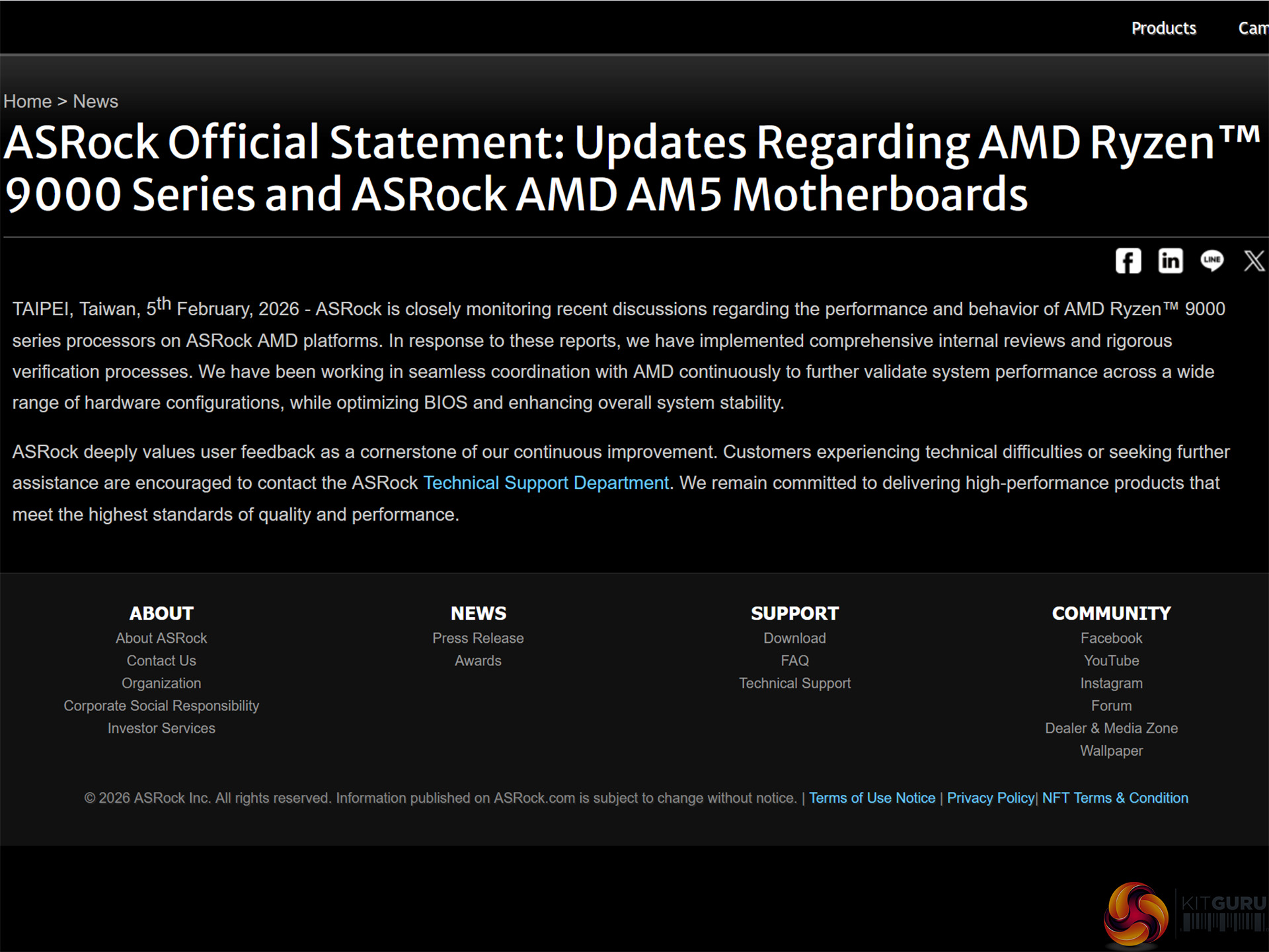
“ASRock is closely monitoring recent discussions regarding the performance and behavior of AMD Ryzen 9000 series processors on ASRock AMD platforms. In response to these reports, we have implemented comprehensive internal reviews and rigorous verification processes. We have been working in seamless coordination with AMD continuously to further validate system performance across a wide range of hardware configurations, while optimizing BIOS and enhancing overall system stability.”
“ASRock deeply values user feedback as a cornerstone of our continuous improvement. Customers experiencing technical difficulties or seeking further assistance are encouraged to contact the ASRock Technical Support Department. We remain committed to delivering high-performance products that meet the highest standards of quality and performance.”
The statement doesn't offer much but issues like this do often take time to investigate fully. Hopefully ASRock is also reaching out to those impacted to get more information to help identify the root cause.
 Connexion