↩ Accueil

Vue lecture

CES 2026: Kioxia launches new BG7 SSDs with improved efficiency

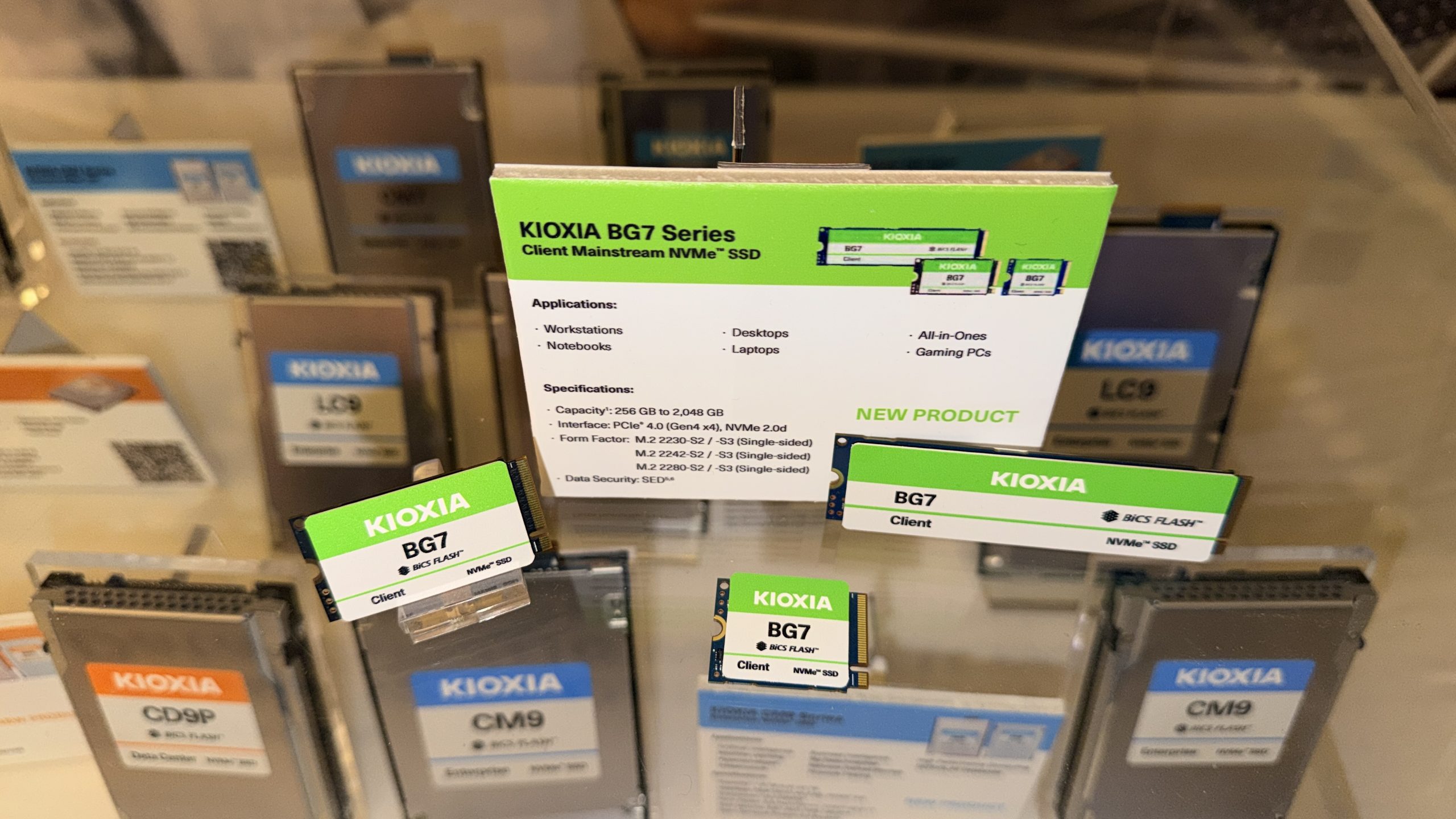
At CES this week Kioxia is launching its BG7 series SSDs at CES 2026, marking the first client‑focused drives to use the company’s eighth‑generation BiCS Flash paired with its new CMOS‑Bonded‑to‑Array (CBA) architecture. The update targets thin‑and‑light notebooks, compact desktops and OEM systems, promising stronger performance and improved power efficiency over the previous BG6 generation.

The move to BiCS Flash Gen 8 brings a notable uplift in throughput. Kioxia rates the BG7 for up to 7,000MB/s sequential reads and as much as 1,000,000 IOPS in random workloads, translating to roughly a 10% improvement in random performance and around 16% in sequential reads compared to BG6. Power efficiency sees the biggest generational jump with sequential‑write efficiency up by approximately 67%. This improvement is achieved through a combination of CBA‑enhanced memory cells, refined control circuitry and an updated SSD controller.

The BG7 series also expands the physical formats available. Alongside the familiar M.2 2230 and 2280 options, Kioxia is adding a new M.2 2242 model to support a wider range of OEM designs and space‑constrained systems. NVMe 2.0d support has been introduced as well, giving system builders finer control over power states and device behaviour.

As with previous entries in the BG line, the BG7 remains a DRAM‑less design, relying on Host Memory Buffer (HMB) to keep costs down while maintaining responsiveness. Capacities span 256GB, 512GB, 1TB and 2TB, and the drives connect over PCIe 4.0. Security‑conscious deployments can opt for models supporting TCG Opal 2.01 self‑encrypting drive functionality.

KitGuru Says: With DRAM being in short supply for consumer-oriented products at the moment, DRAM-less SSDs should become more prominent across the consumer market.

The post CES 2026: Kioxia launches new BG7 SSDs with improved efficiency first appeared on KitGuru.
  •  

Wolfenstein 3 reportedly in development according to multiple insiders

The Wolfenstein series saw a massive resurgence in popularity following the release of 2014’s pseudo-reboot The New Order and 2017’s The New Colossus…with the 2019 spin-off Youngblood being a bit more contentious. After taking a break from the series to work on Indiana Jones and The Great Circle, the team behind the two mainline modern Wolfenstein titles – Machine Games – are reportedly developing a proper 3rd entry.

First reported by known Xbox leaker Jez Corden in a piece discussing the future of Xbox in 2026 and beyond, the insider claimed to have “heard that Wolfenstein III is also on the cards to coincide with the upcoming Wolfenstein Amazon TV show.”

Though far from definitive at the time, the publication Kotaku have since corroborated the claim, stating that they “can confirm it’s true from our own sources.”

Wolfenstein Machine Games

Given that the team only recently released Indiana Jones and The Great Circle back in late 2024 (and have worked on various ports and updates since), don’t expect Wolfenstein 3 to arrive any time soon.

That said, back in October the team at Machine Games did tease that work on their next project had officially begun, and so it’s possible we could get an early initial announcement in the not-too-distant future. We will have to wait and see.

KitGuru says: What do you think of the modern Wolfenstein games? Did you enjoy Indiana Jones? How long do you think we’ll have to wait for an official announcement? Let us know down below.

The post Wolfenstein 3 reportedly in development according to multiple insiders first appeared on KitGuru.
  •  

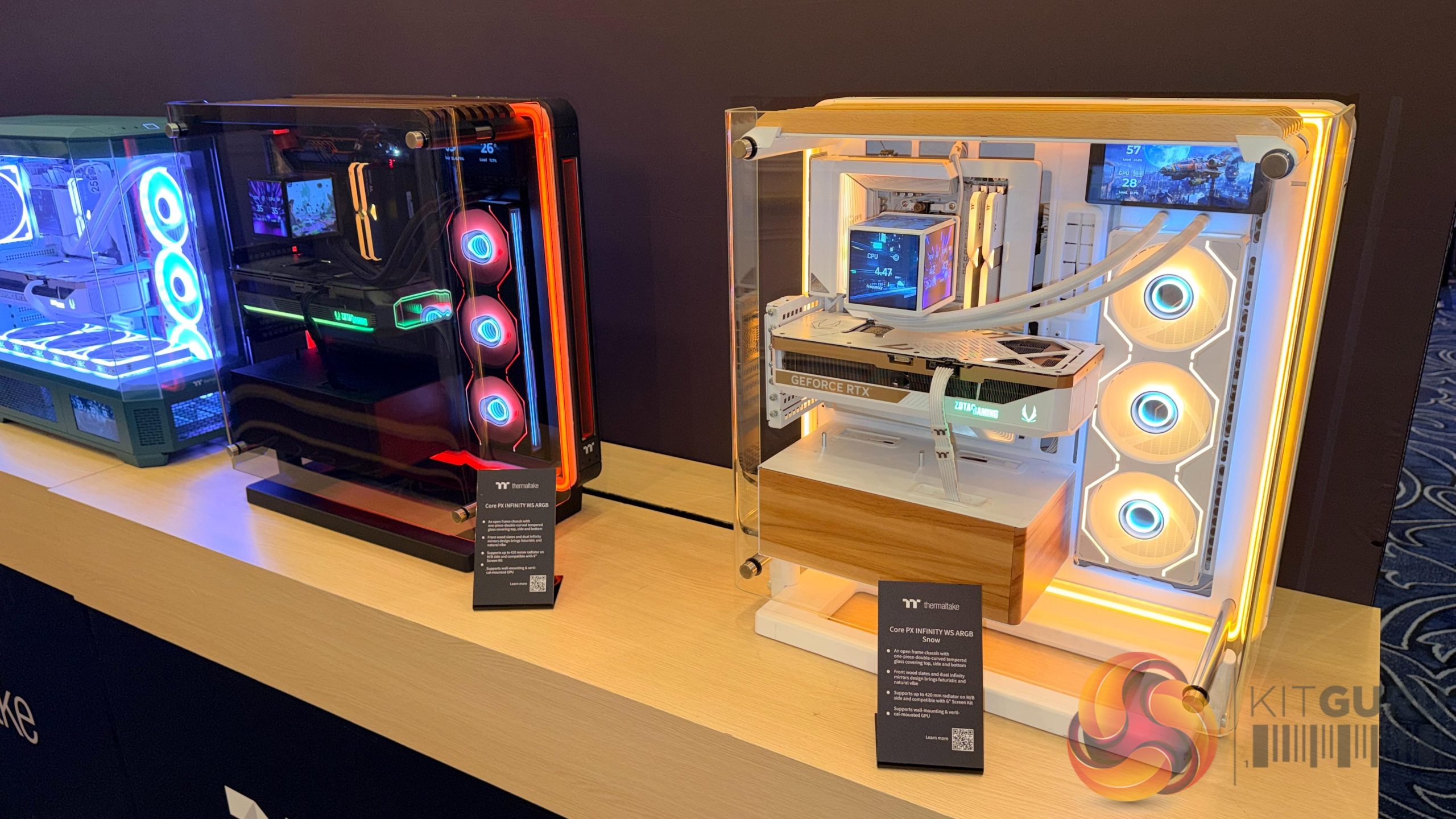
CES 2026: Thermaltake launches new cases, expands racing sim line-up and more

This week at CES we caught up with Thermaltake to get a first-hand look at their new product launches. In our video, we take you through it all, direct from the CES show floor.

Watch via YouTube below:

Timestamps:
00:00 View Cross TG Case
00:40 GK500 Go-Kart Simulator
01:08 GR900 Racing Simulator Cockpit
01:25 GR700 Racing Race Car Simulator
01:41 Race peripherials
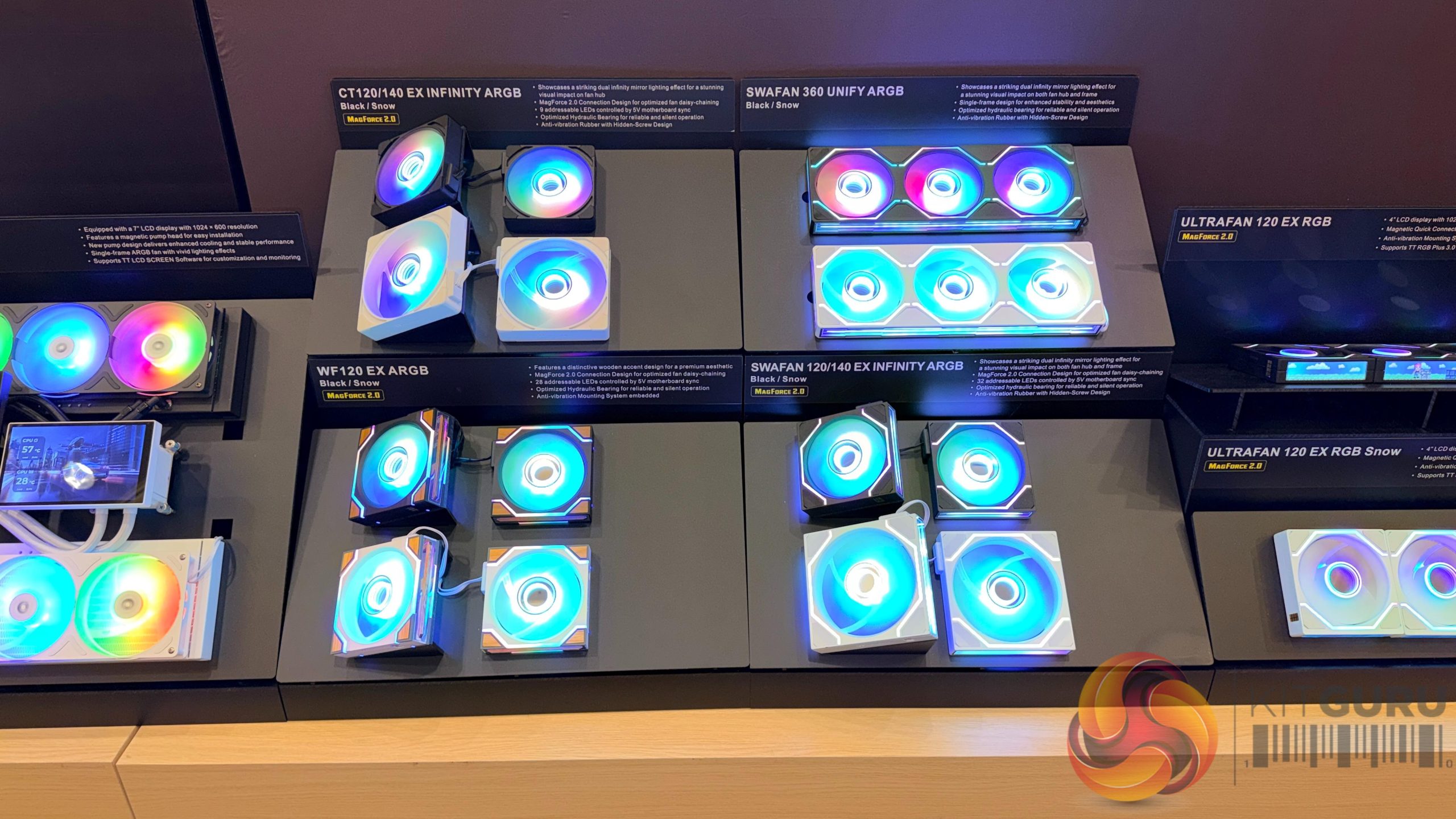
01:53 New Fan Series
02:29 New System components
02:46 AI Forge Software
03:16 Core PX Series Cases
03:50 Power Supplies
04:24 Retro Gaming Kit

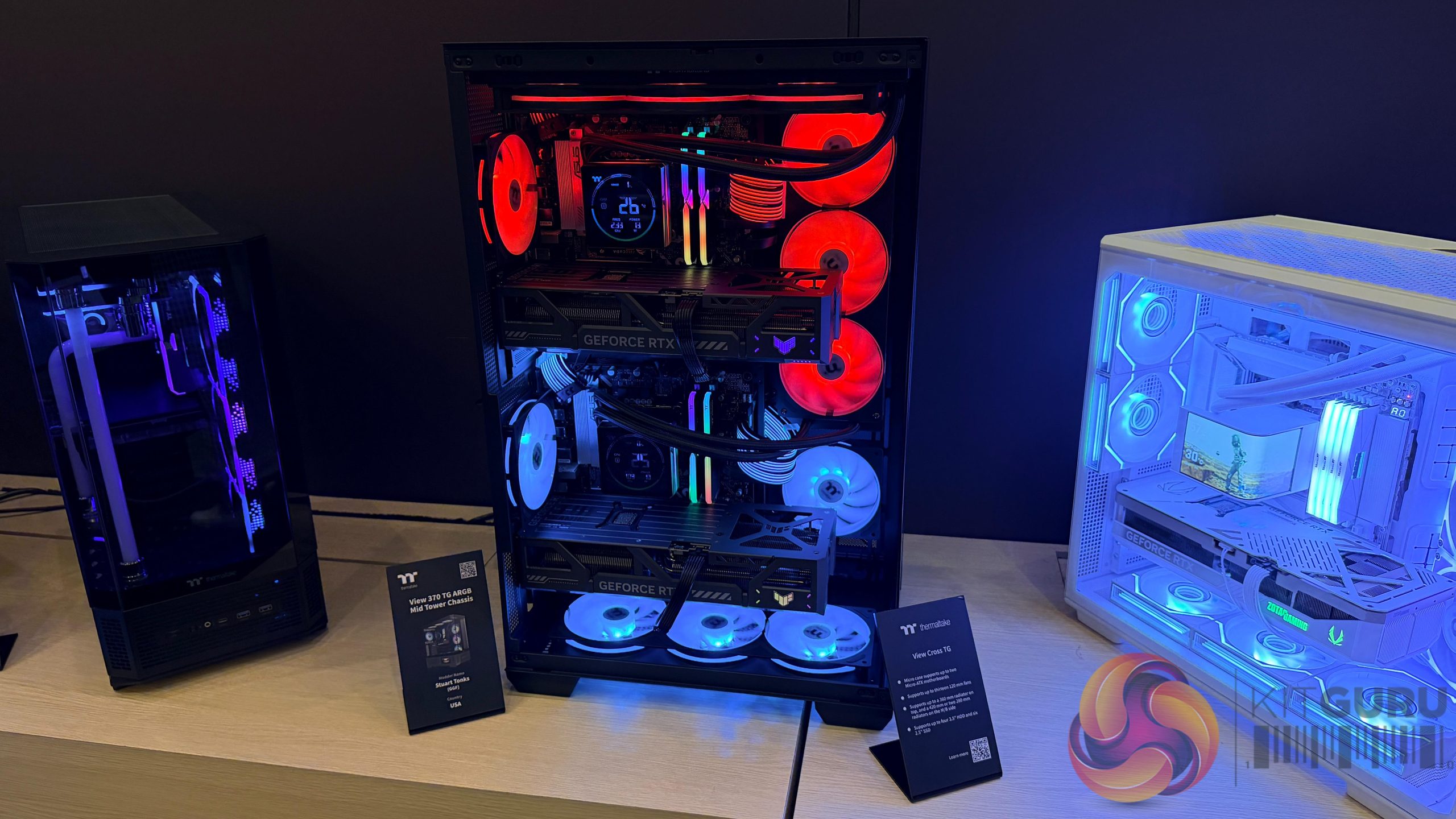
Thermaltake’s View 370 TG ARGB is a mid‑tower chassis built around panoramic presentation, using a four‑piece tempered‑glass layout that wraps across the front and side for full component visibility. It supports Mini‑ITX to ATX boards, including hidden‑connector designs from ASUS, MSI, and Gigabyte, and offers room for up to ten 120mm fans and 360mm radiators, with two ARGB fans pre‑installed. The case also supports vertical GPU mounting and an optional 6‑inch LCD panel on the PSU shroud for system stats or custom graphics via TT RGB Plus 3.0. Front I/O includes USB‑C, dual USB‑A, and HD audio, while removable dust filters cover the major intake points for easier upkeep.

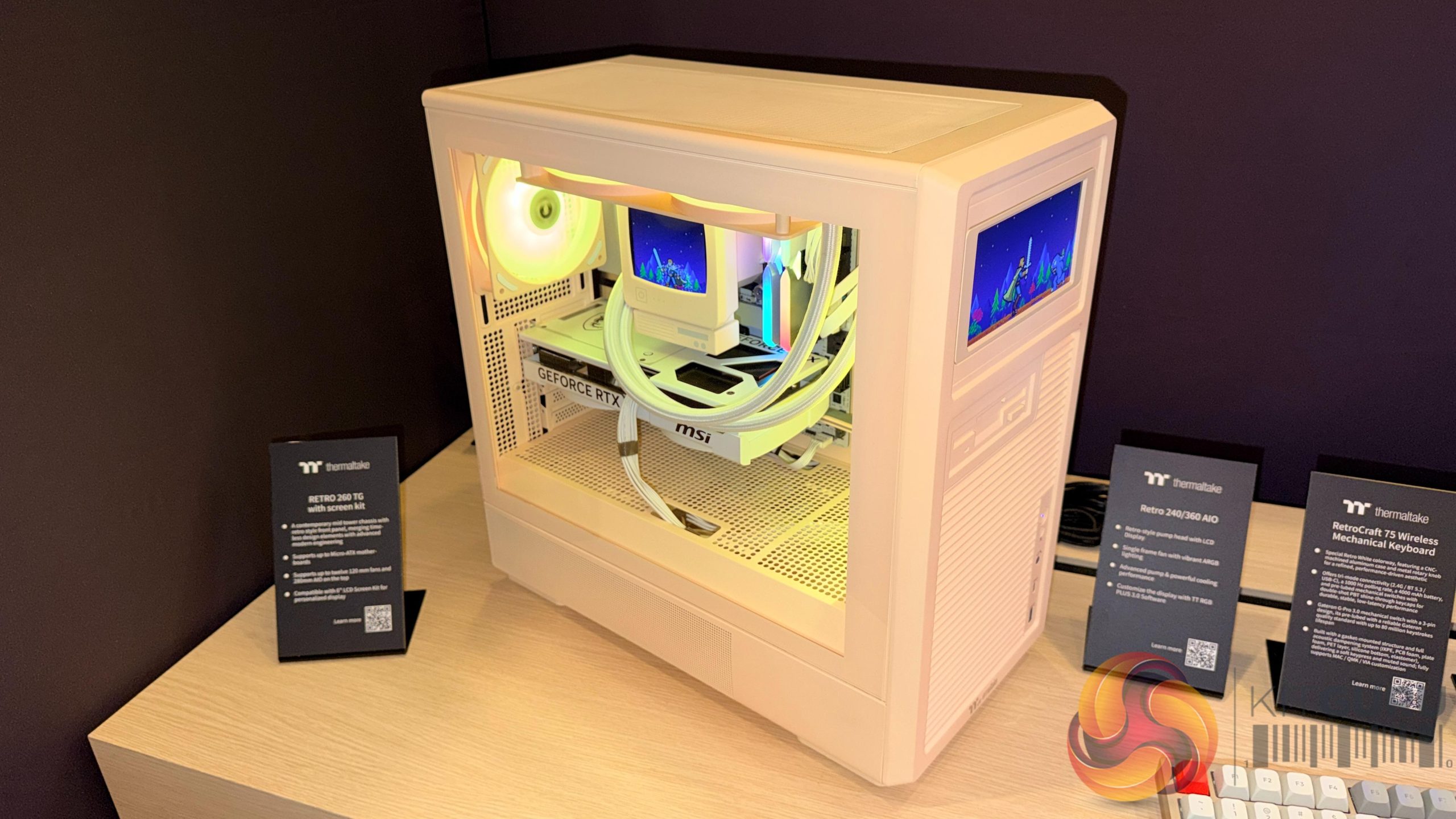
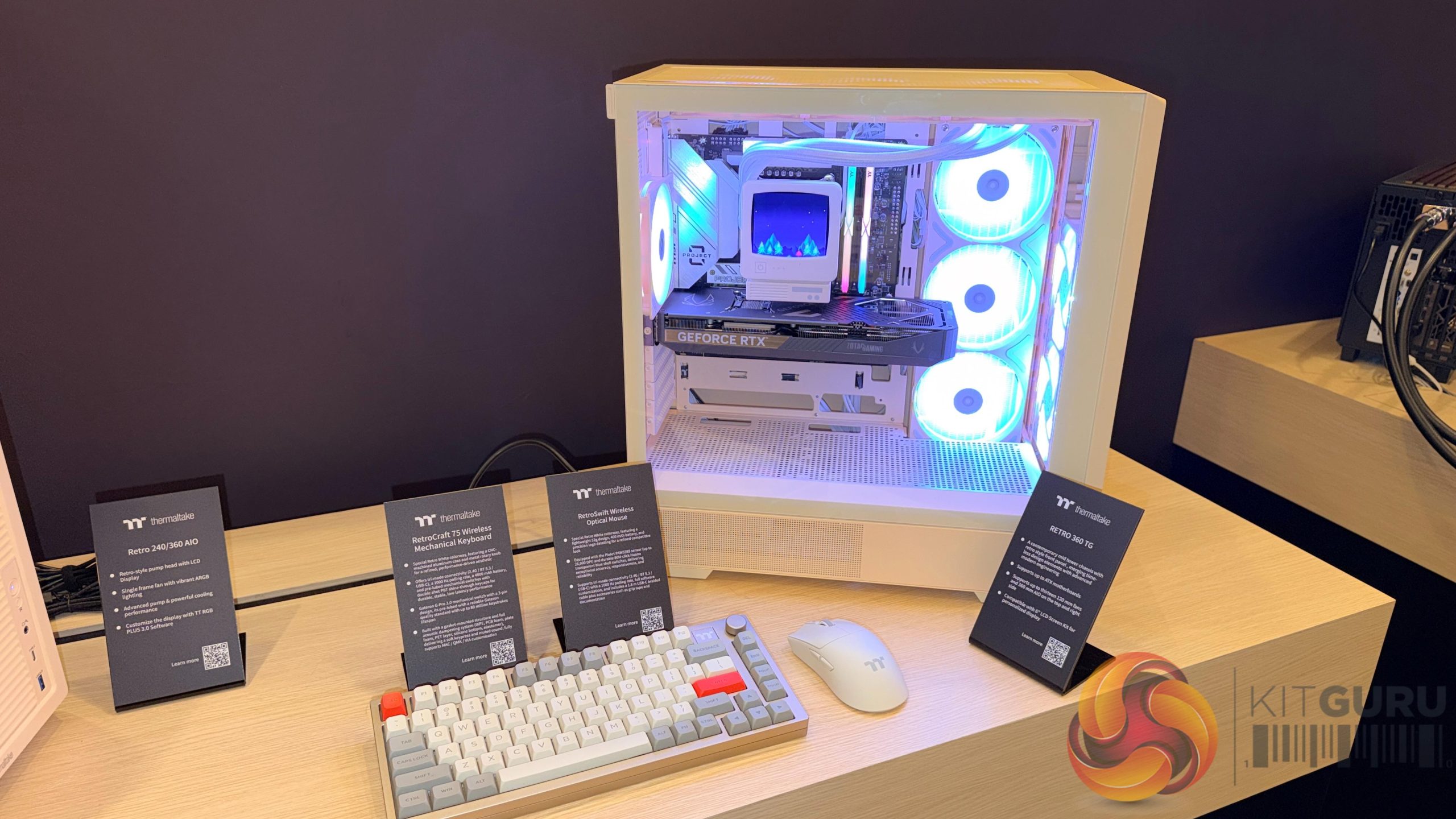
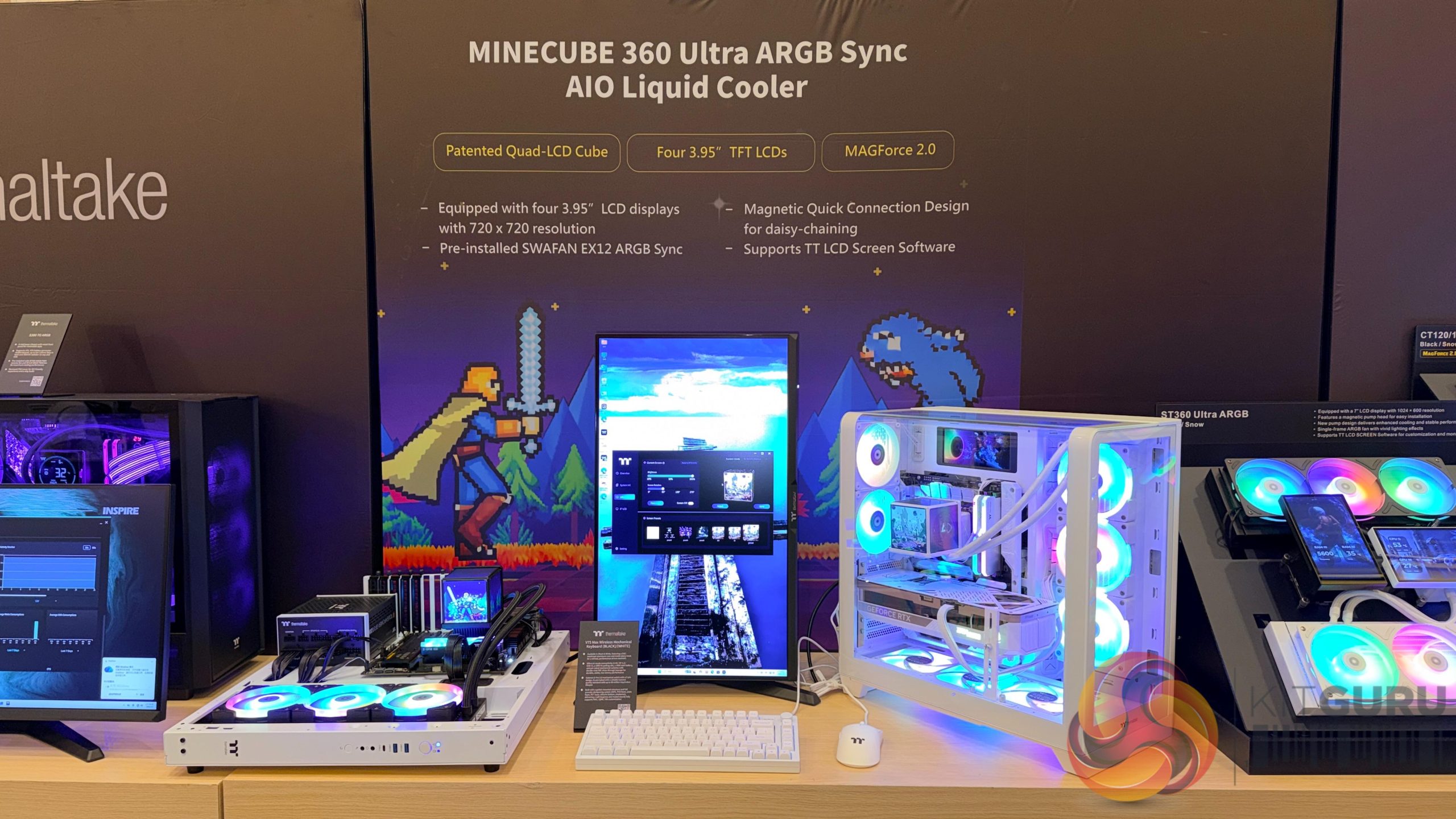
Next up we have the new Retro Series, which brings 90s workstation styling to modern hardware. Starting with the compact Retro 260 TG mATX chassis, despite its old-school look this case supports hidden‑connector motherboards, up to nine 120mm fans, a 280mm top radiator, and the company’s optional 6‑inch LCD display. The larger Retro 360 TG scales the design to a mid‑tower with ATX support, room for twelve 120mm fans, dual 360mm radiator mounts, and updated front I/O including USB‑C. Rounding out the lineup is the Retro Ultra ARGB Sync AIO cooler, which will be available in 240mm and 360mm sizes and features a CRT‑inspired 3.6‑inch LCD display on the CPU block.

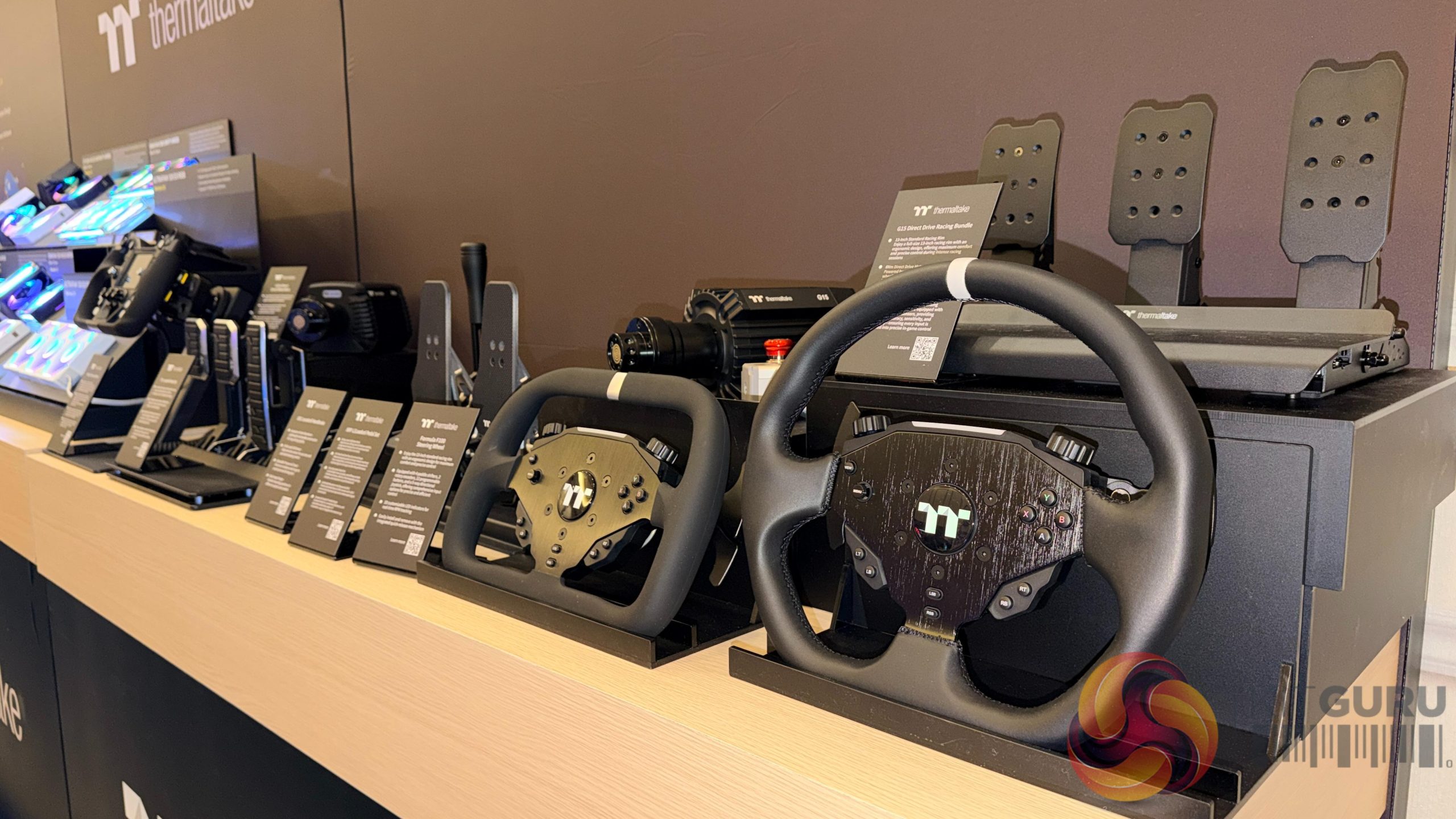
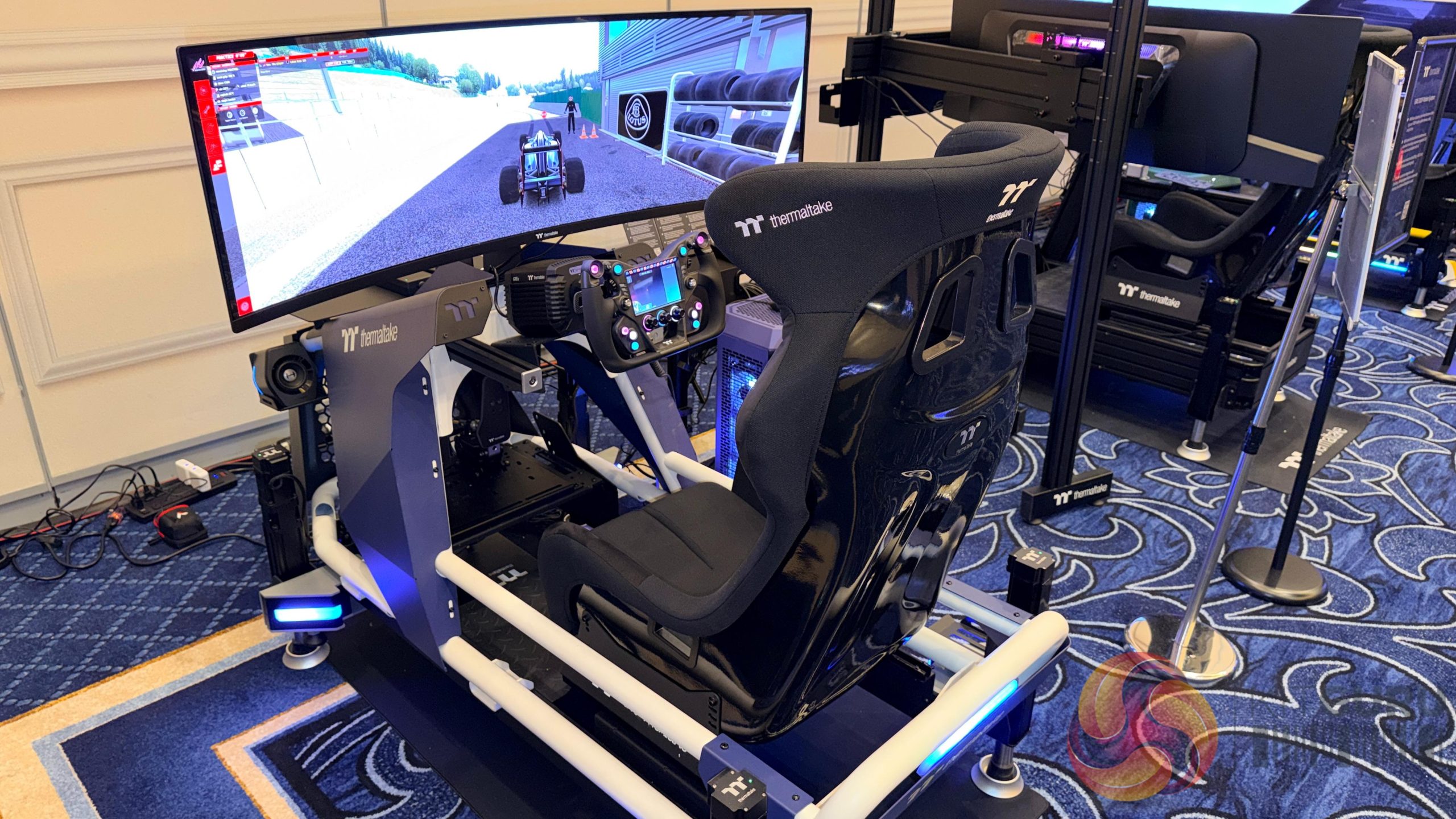
Thermaltake is also expanding its sim‑racing portfolio at CES with three new cockpits and updated peripherals. The flagship GR900 uses an anodised aluminium profile frame with extensive adjustability and support for single or triple displays and can be paired with motion systems for full professional‑grade feedback. The GR700 offers a more accessible tubular‑steel design with support for belt‑ and direct‑drive wheels, an integrated monitor mount, and optional 3DOF motion for added immersion. For karting fans, the GK500 delivers an authentic low‑slung posture with adjustable seating, steering and pedals for both children and adults. Aside from the new cockpits, Thermaltake also has new wheel and pedal sets coming out, including the XRW G1 steering wheel with a five‑inch touchscreen, RGB indicators, Hall‑effect paddles and CNC‑machined construction, plus the XRP L1 load‑cell pedal set built around a 200kg sensor, adjustable pedal mechanics and high‑resolution Hall sensors for precise braking control.

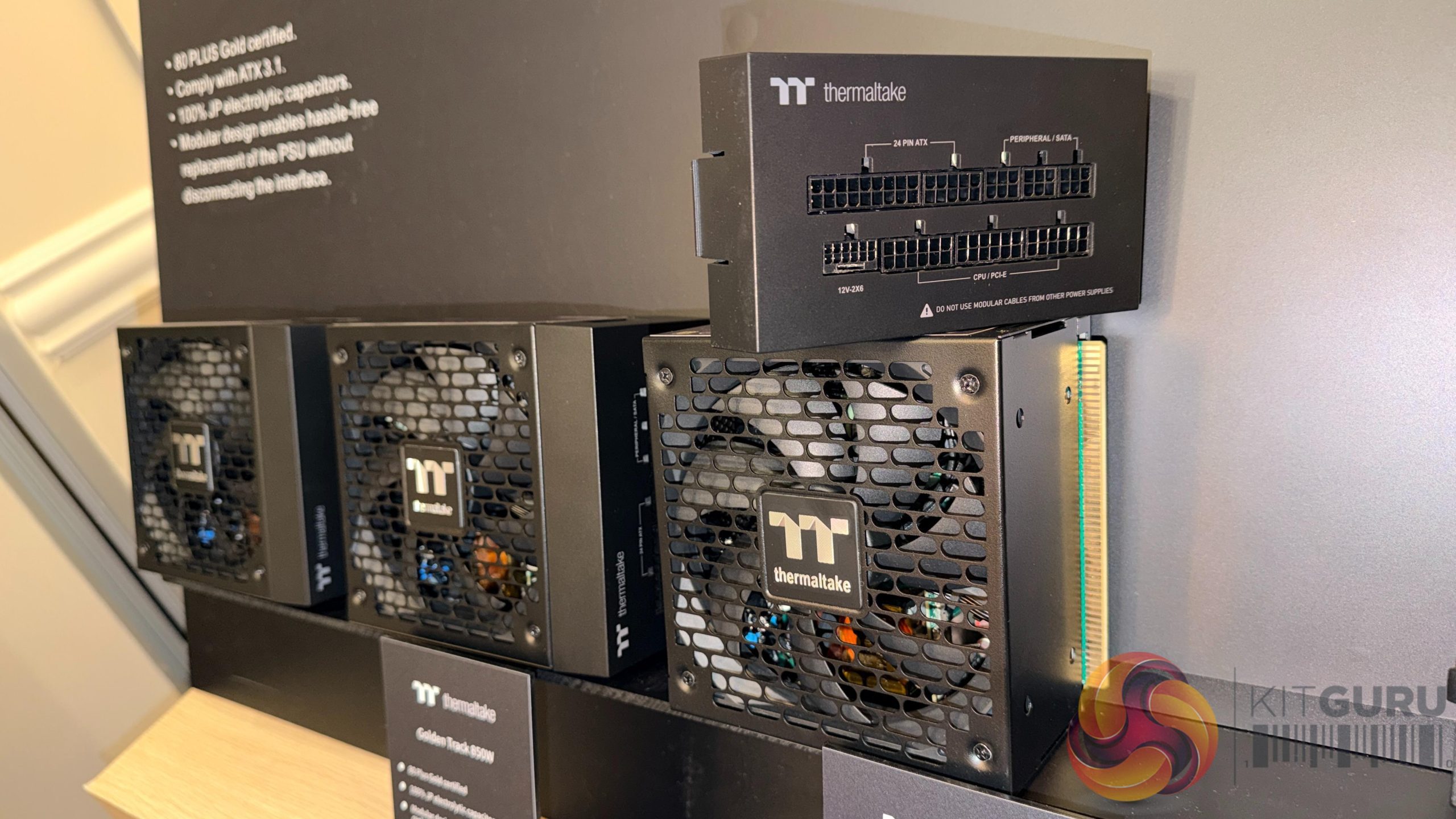
On the power supply front Thermaltake has something quite innovative on show. The Golden Track Series offers a new modular approach to power supplies, launching in 750W, 850W, 1000W and 1200W models, built around a new gold‑finger connector that links the power‑supply body to a fixed rear backplane. Instead of unplugging cables or re‑routing wiring, users can swap the PSU module itself for a higher‑wattage unit while leaving the interface and all cabling in place.

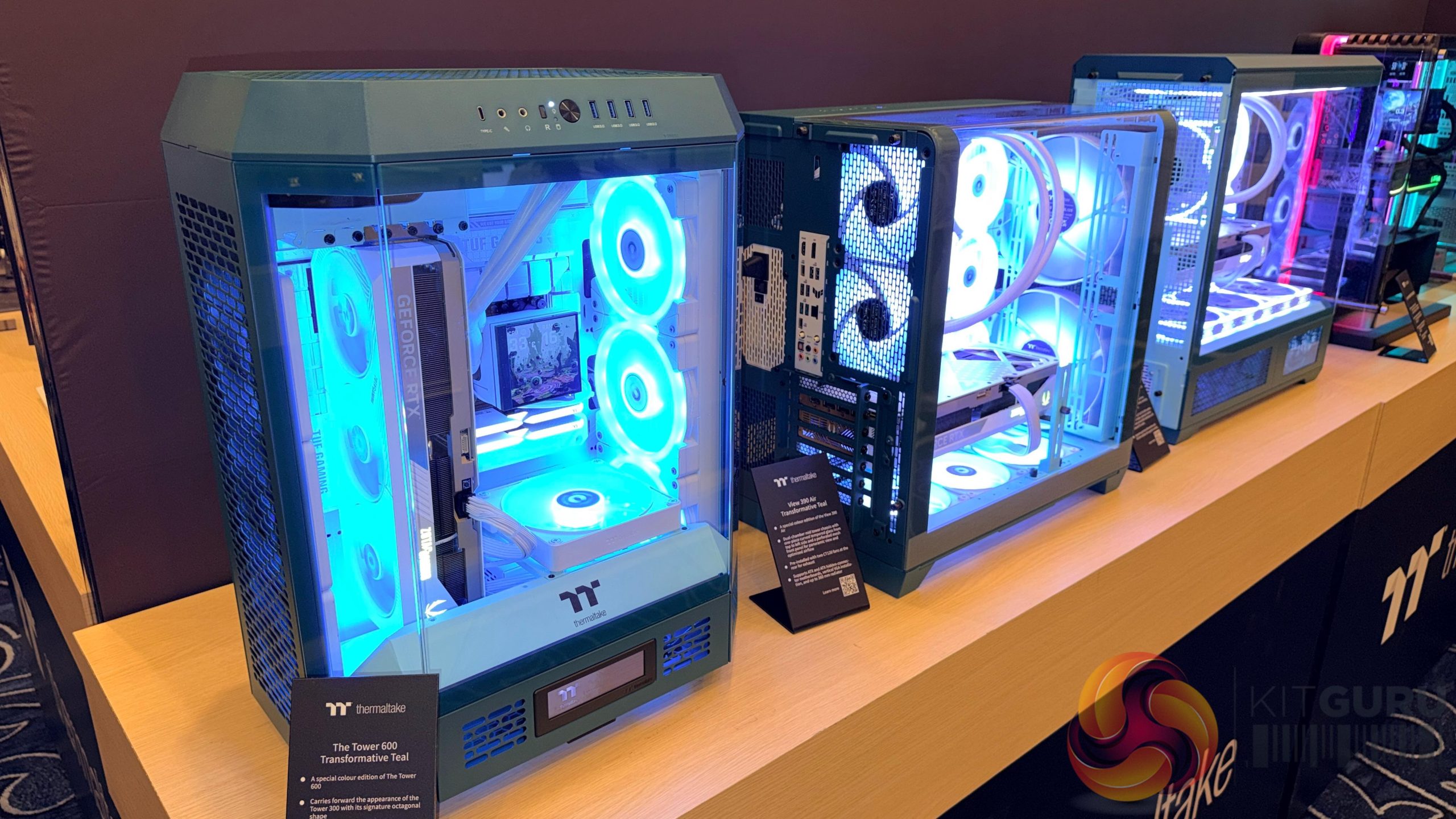
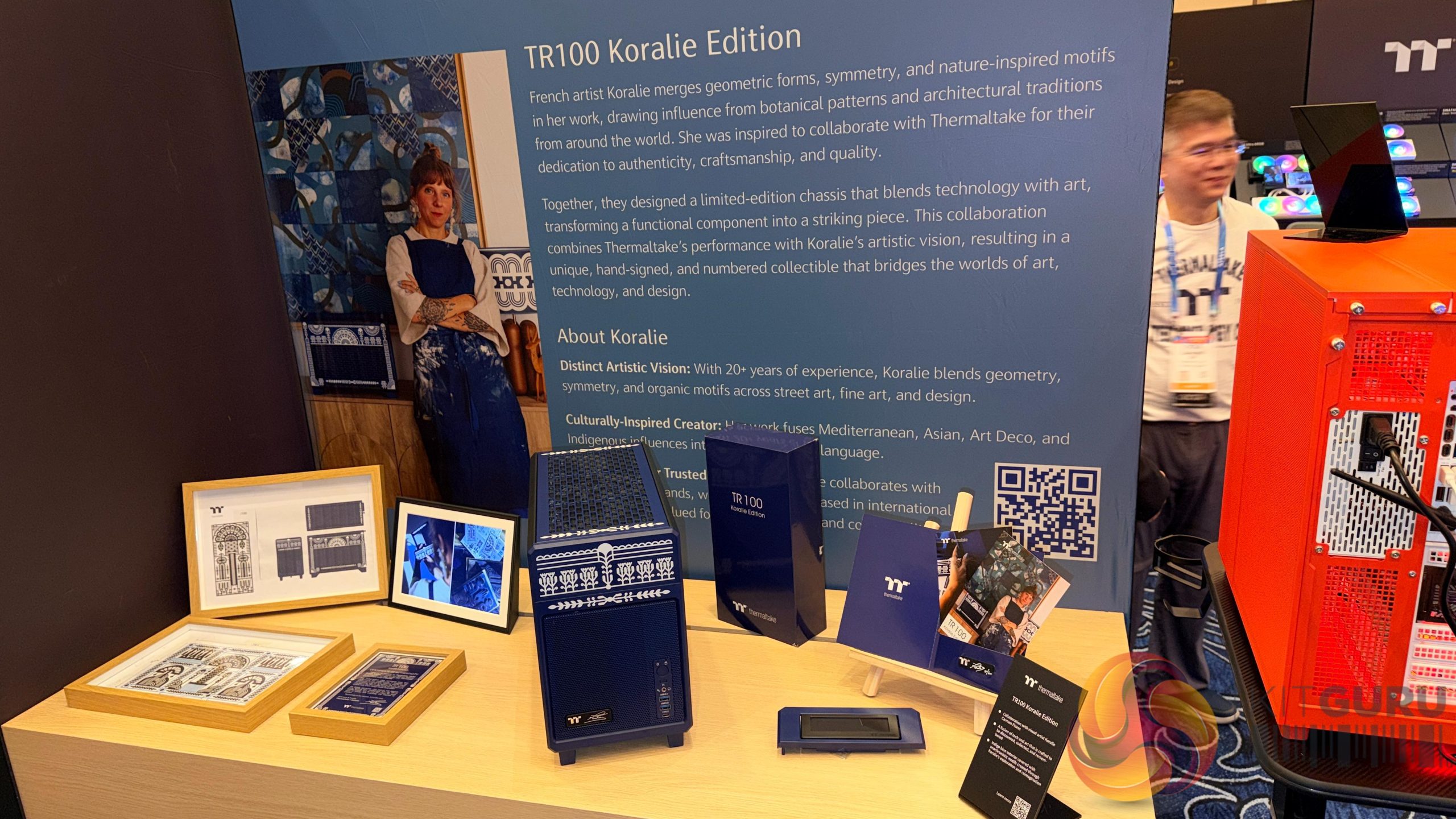
Last on our list we have two design‑focused updates: Transformative Teal, a new blue‑green colourway being applied across several existing chassis, and the TR100 Koralie Edition, a limited‑run artistic re‑skin of the company’s compact Mini‑ITX case. Transformative Teal is positioned as a calming, sustainability‑inspired shade that will appear on refreshed versions of The Tower 600, View 390 Air and View 600 TG, while the TR100 Koralie Edition adds a deep blue finish and geometric motifs created with French artist Koralie Carmen Flores.

KitGuru Says: What did you think of Thermaltake's CES showing this year? 

The post CES 2026: Thermaltake launches new cases, expands racing sim line-up and more first appeared on KitGuru.
  •  

Black Ops 7 x Fallout officially unveiled and detailed

In recent years Call of Duty has ramped up the number and intensity of their crossover events – with Black Ops 6 being the most egregious in this regard. Following plenty of backlash, Activision seems to have toned down their plans for Black Ops 7, officially announcing a somewhat more grounded Fallout crossover.

Though initially teased late last year, the team at Treyarch / Activision have now fully unveiled the first crossover coming to Black Ops 7; with COD x Fallout officially launching on the 8th of January alongside Season 1 Reloaded.

In what might be their most comprehensive crossover yet, this limited-time event will of course include the obligatory event pass (featuring both a paid and free track to earn various Fallout-themed cosmetics).

In addition, a paid bundle will be made available for purchase which focuses on Amazon’s Fallout show protagonist Lucy.

In terms of actual content however, the crossover will introduce a bunch of new modes across the board including:

  • Deathclaw Hunt World Event [Endgame]
  • Nuketown map variant ‘Vault Town’ [Multiplayer]
  • S.P.E.C.I.A.L. Mayhem mode [Multiplayer]
  • The Ghouls mode [Multiplayer]
  • Project RADS mode [Zombies]
  • Power Armor Royale [Warzone]

While a far cry from some of Fortnite’s more all-encompassing cross-overs, this latest collab will likely go down much more smoothly in the eyes of fans when compared to Black Ops 6’s offerings. We will have to wait and see – but with Microsoft owning both Call of Duty and Fallout, they’ll likely be winning either way.

KitGuru says: What do you think of Season 1 Reloaded? Are you looking forward to the crossover? How does it compare to BO6’s best? Let us know down below.

The post Black Ops 7 x Fallout officially unveiled and detailed first appeared on KitGuru.
  •  

CES 2026: MSI unveils new laptop line-up with Intel Core Ultra 3 CPUs

We've already covered a number of MSI launches at CES this week. In this article, our attention turns towards new laptops, including new models powered by Intel's new Core Ultra 3 processors, along with Nvidia RTX graphics.

MSI has overhauled its laptop lineup for CES 2026, introducing redesigned business systems, refreshed gaming hardware, and a new colour variant of its Claw handheld. The announcement is led by a major update to the Prestige series, which now adopts a smoother, more rounded design and a full‑aluminium chassis aimed at professionals who want lighter hardware without compromising performance.

The Prestige 14 drops to 1.32kg, while the Prestige 16 comes in at 1.59kg, both powered by Intel’s new Core Ultra Series 3 processors and paired with Intel Arc B390 graphics. MSI claims the 81Wh battery can deliver more than 30 hours of video playback, and the updated cooling system uses a vapor chamber, dual fans, and an Intra Flow design to keep noise below 30dBA.

The Prestige 14 and 16 Flip extend the same hardware into a 2‑in‑1 form factor with touchscreens and stylus support. MSI includes its new Nano Pen, which docks into the chassis for charging and can deliver 45 minutes of use from a 15‑second top‑up. As part of a collaboration with Microsoft, the pen also supports a Copilot press‑to‑talk shortcut for voice input. The Flip models add a larger touchpad with custom gesture zones, enterprise‑grade security features, and an optional 2.8K 120Hz OLED display with DisplayHDR True Black 1000 certification.

For users who prioritise portability, the Prestige 13 AI+ has been updated and now weighs just 899g, making it the lightest 13‑inch magnesium‑aluminium laptop available. It also moves to Intel’s latest processors and retains the same security and connectivity features as the larger Prestige models.

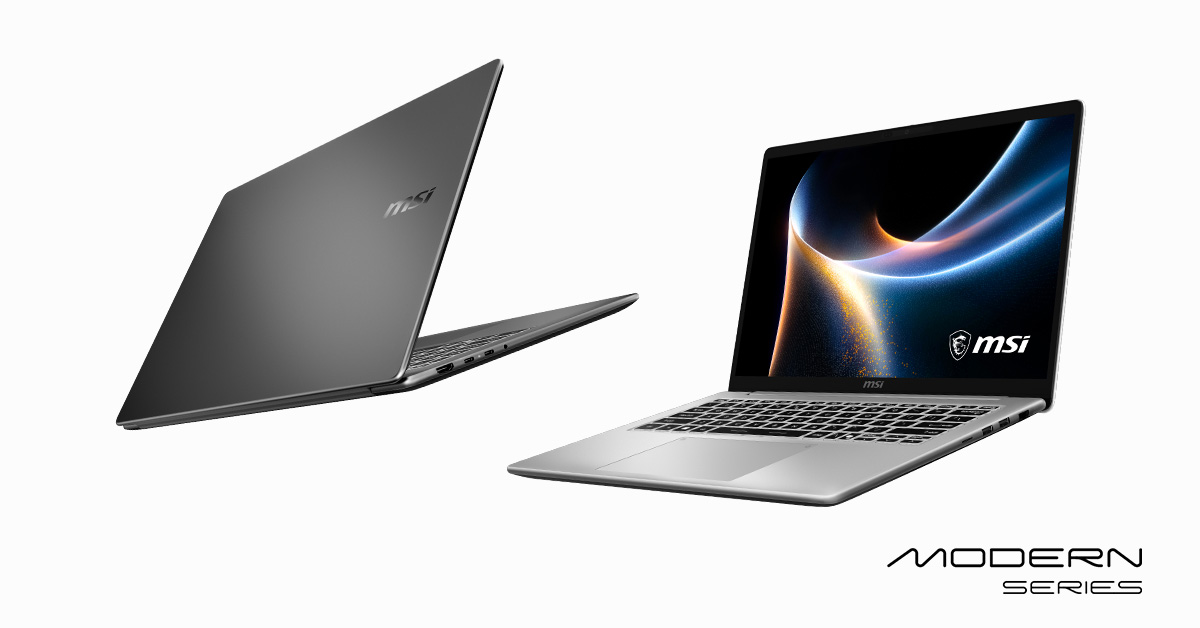
MSI’s mainstream Modern 14S and 16S laptops have also been refreshed with more metal in the chassis and a cleaner design. Both models use Intel Core Ultra Series 3 processors and include dual memory slots for easier upgrades. Connectivity covers USB‑A, USB‑C with charging and display support, HDMI, LAN, and a microSD reader. Despite the added metal, the Modern 14S remains portable at 1.3kg and as thin as 11.1mm in its OLED configuration.

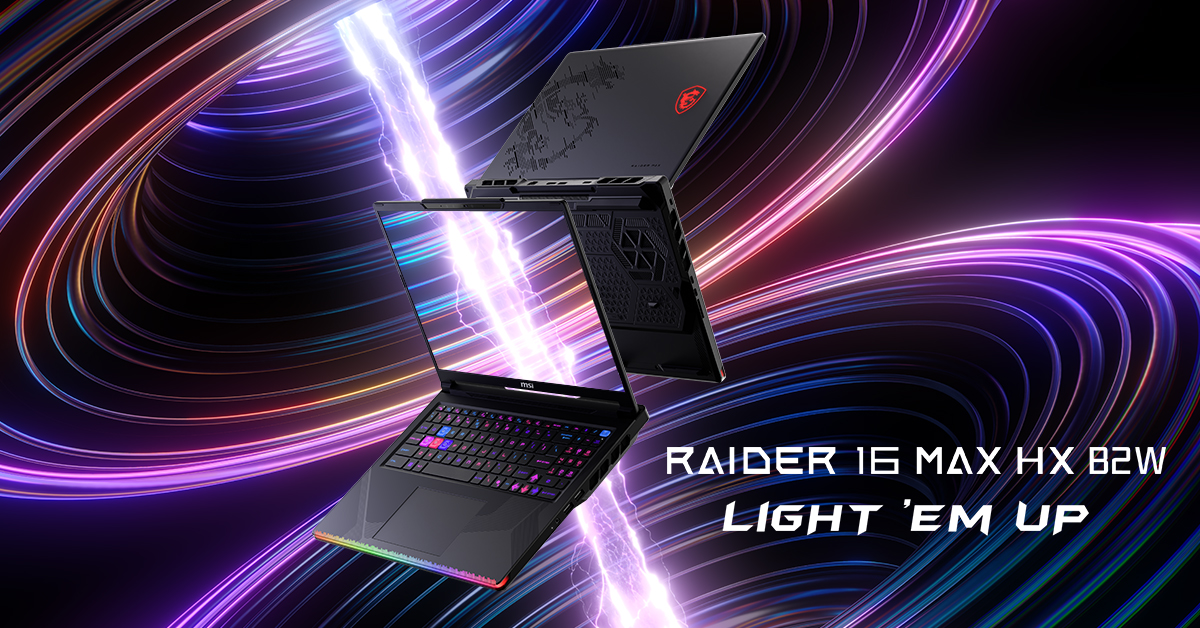
On the gaming side, MSI is pushing performance with the new Raider 16 Max HX, which the company says is the first laptop capable of delivering 300W of total system power. It can allocate up to 175W to an RTX 5090 or 5080 GPU while feeding 125W to an Intel Core Ultra 200HX processor. Cooling is handled by a redesigned Cooler Boost Trinity system with three fans, six heat pipes, five exhaust vents, and phase‑change thermal compound. The laptop also includes a quick‑access bottom panel for easier upgrades and a 2.5K 240Hz OLED display.

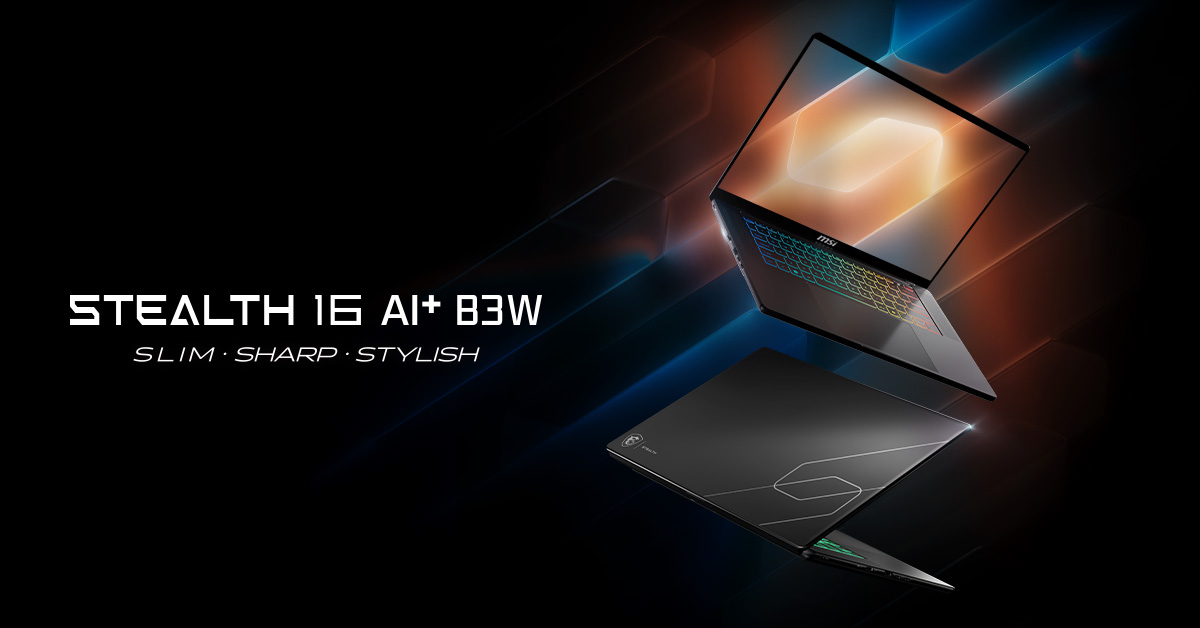
The Stealth 16 AI+ has been updated with a thinner, lighter chassis while offering higher GPU power limits and improved cooling. It includes a 90Wh battery, dual upgradeable slots, and a full aluminium build under 2kg. The Crosshair 16 Max HX and Crosshair 16 HX round out the gaming lineup with up to 200W system power, optional QHD+ 165Hz OLED displays, and a revised port layout.

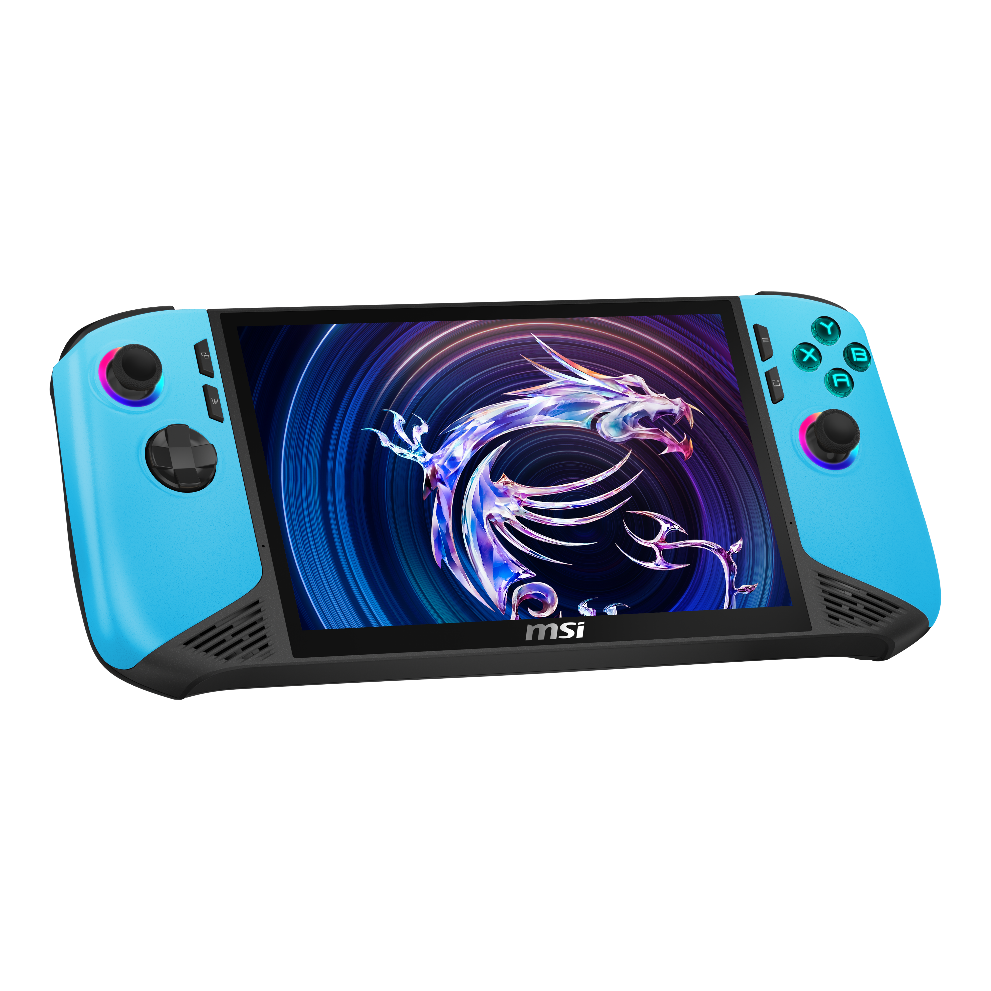
MSI also introduced a Glacier Blue edition of its Claw 8 AI+ handheld, offering the same Intel Core Ultra 200V hardware and Arc Xe2 graphics in a new finish.

KitGuru Says: Are you thinking of going with an MSI laptop this year? 

The post CES 2026: MSI unveils new laptop line-up with Intel Core Ultra 3 CPUs first appeared on KitGuru.
  •  

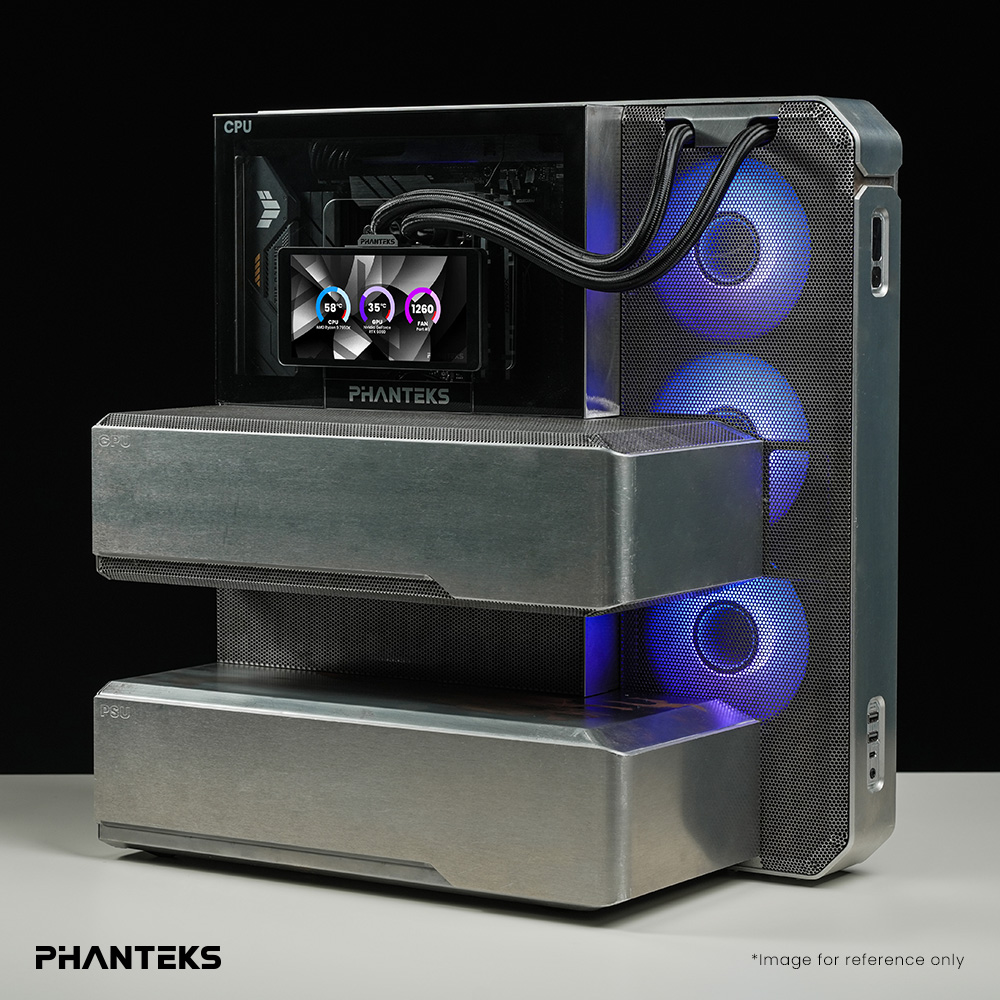
CES 2026: Phanteks shows off open-air chassis prototype – the Exo 626

While CES is often used as a platform to launch new products definitely coming to market, it is also occasionally used to showcase prototype products that are not yet ready. This year, Phanteks is showing off a new concept device of its own – the Exo 626. 

The Exo 626 is an open-air chassis, a first for the company. It is inspired by exoskeletal design, as the name implies, and provides a compartmentalised layout for your components:

As you can see in the image, the motherboard and AIO cooler are visible, but the GPU, power supply and most cables are locked away in their own enclosures. The AIO radiator also sits to the side in its own compartment, with a mesh panel providing holes for airflow.

Phanteks says this is a concept at the moment, but more details on the Exo 626 will be shared at a later stage. Perhaps it will make a second appearance later this year at Computex.

KitGuru Says: What do you think of this concept from Phanteks? Do you think future PCs should move towards a compartmentalised layout? 

The post CES 2026: Phanteks shows off open-air chassis prototype – the Exo 626 first appeared on KitGuru.
  •  

CES 2026: Sandisk launches new Optimus series SSDs, replacing WD Blue and WD_Black

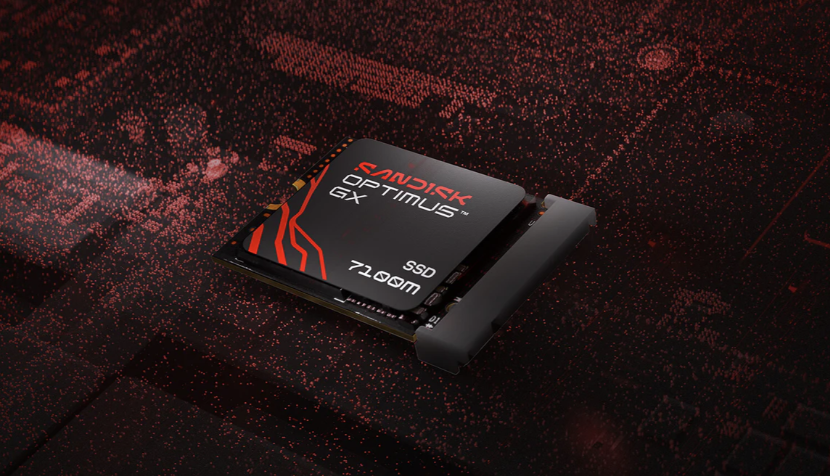
At CES this week, Sandisk is announcing a big rebranding of its internal SSD line-up. The WD Blue and WD Black ranges are being replaced. Moving forward, Sandisk will launch Sandisk Optimus, Optimus GX and Optimus Pro SSDs. The first set of drives are also ready to hit the market in the coming weeks.

Sandisk says the Optimus branding is intended to simplify the lineup and give customers a clearer sense of performance tiers as the company expands its storage offerings for gamers, creators, and professionals. “The SANDISK Optimus brand redefines what performance means for consumer needs,” said Heidi Arkinstall, VP of Global Consumer Brand and Digital Marketing, adding that the change is designed to make it easier for buyers to identify the right drive.

The base Sandisk Optimus line targets creators looking for faster everyday performance and replaces the WD Blue range, including the WD Blue SN5100 NVMe SSD. The Optimus GX tier is aimed at gaming systems, offering higher speeds, larger capacities, and improved efficiency – taking over from the WD_BLACK SN7100. At the top end, the Optimus GX Pro line becomes the flagship, positioned for AI PCs, workstations, and high‑end gaming rigs. It replaces the WD_BLACK SN8100 and incorporates higher capacities and Sandisk’s latest storage technologies.

Unfortunately, we don't have pricing details yet for these drives, but they should be similarly priced to previous WD Blue and WD_Black offerings.

KitGuru Says: How do you feel about WD Blue and Black being replaced? 

The post CES 2026: Sandisk launches new Optimus series SSDs, replacing WD Blue and WD_Black first appeared on KitGuru.
  •  

CES 2026: Corsair’s latest full-size keyboard replaces numpad with Elgato Stream Deck

It has been years since Corsair acquired Elgato. During that time, Corsair and Elgato have operated independently, but this year, the two are joining forces on a new product for the first time. The new Corsair Galleon 100 SD is a new full-size keyboard from Corsair, but rather than having a numpad, the keyboard has been equipped with a 12-key Elgato Stream Deck.

The company says the device combines engineering from both Corsair and Elgato to meet long‑standing community requests for a single input solution that handles gameplay, apps, and device control. “The GALLEON 100 SD marks a new era of input that our community has been clamoring for,” said Tobias Brinkmann, VP and GM of Gaming Peripherals at Corsair. “This isn't just a better keyboard. It's a solution to the reality of modern gaming, where managing apps, info, and devices is just as critical as performance.”

The keyboard includes 12 LCD keys, two multifunction dials, and a 5‑inch colour display for real‑time system and game information. All controls are configured through the Stream Deck app, with support for folders, profile switching, and the full plugin ecosystem.

Corsair says the integration allows players to trigger abilities, macros, and complex sequences without menu diving, while also offering quick access to apps like Spotify, voice chat, and system monitoring. Dozens of game profiles and hundreds of plugins from the Elgato Marketplace are supported, just as they would be on a standalone Stream Deck.

Beyond the Stream Deck features, the Galleon 100 SD uses Corsair’s AXON engine with polling rates up to 8,000Hz, plus FlashTap SOCD handling for directional‑input control. The board ships with pre‑lubed MLX Pulse switches, gasket mounting, six layers of dampening, and an aluminium frame. A cushioned wrist rest, RGB light bar, and Web Hub customisation round out the design.

As you might expect, this keyboard won't come cheap, as you are effectively getting two products in one. The Galleon 100 SD is expected to become available at the end of January, priced at $349.99.

KitGuru Says: If I were to ever go back to a full-sized keyboard, it would be for something like this. Standard numpads are of little use to many gamers, but a host of Stream Deck keys would provide some really interesting functionality.

The post CES 2026: Corsair’s latest full-size keyboard replaces numpad with Elgato Stream Deck first appeared on KitGuru.
  •  

CES 2026: AOC launches its first Agon G-Sync Pulsar gaming monitor

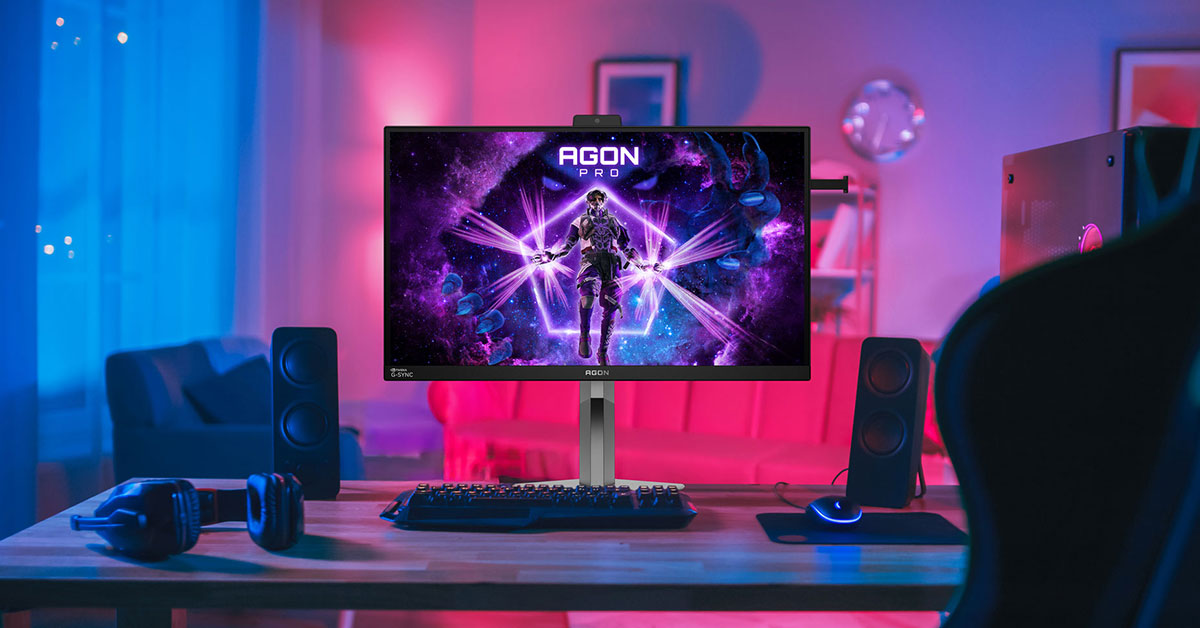
At CES this week, AOC is launching its latest Agon gaming monitor, the AGON PRO AG276QSG2. Developed in close collaboration with NVIDIA, this is one of the first G-Sync Pulsar displays hitting the market, enabling higher levels of motion clarity and responsiveness for competitive gaming.

G‑SYNC Pulsar is designed to deliver up to four times clearer motion by combining backlight strobing with G‑SYNC Variable Refresh Rate, eliminating the traditional trade‑off between motion clarity and stutter‑free gameplay. Fast‑moving targets appear sharper and easier to track, giving competitive players more consistent visual information during gameplay. The monitor also supports NVIDIA’s Ambient Adaptive Technology, using a built‑in sensor to automatically adjust brightness and colour temperature based on room lighting.

The AG276QSG2 is built around a 360Hz Fast IPS panel with 1ms GtG response time, ensuring rapid pixel transitions for esports titles. HDR support is included, with G‑SYNC HDR providing calibrated colour accuracy and automatic HDR brightness tuning across both Windows and supported games.

AGON by AOC has also focused on the physical design, offering a fully ergonomic stand, an aluminium‑accented esports aesthetic, and customisable Light FX illumination. A full suite of I/O connectivity ensures compatibility with multi‑platform setups.

The AGON PRO AG276QSG2 will be available starting in February with an MSRP of £559.

KitGuru Says: Are you thinking about making the jump to a G-Sync Pulsar monitor this year?

The post CES 2026: AOC launches its first Agon G-Sync Pulsar gaming monitor first appeared on KitGuru.
  •  

CES 2026: Corsair unveils new peripherals for the enthusiast segment

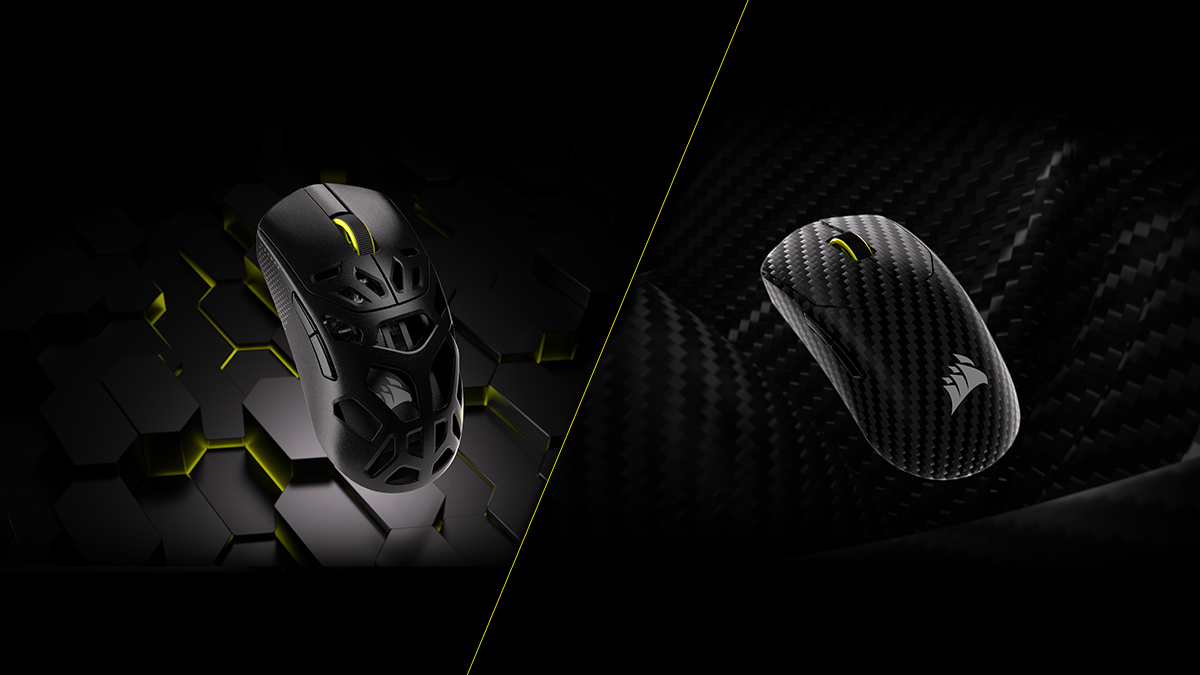
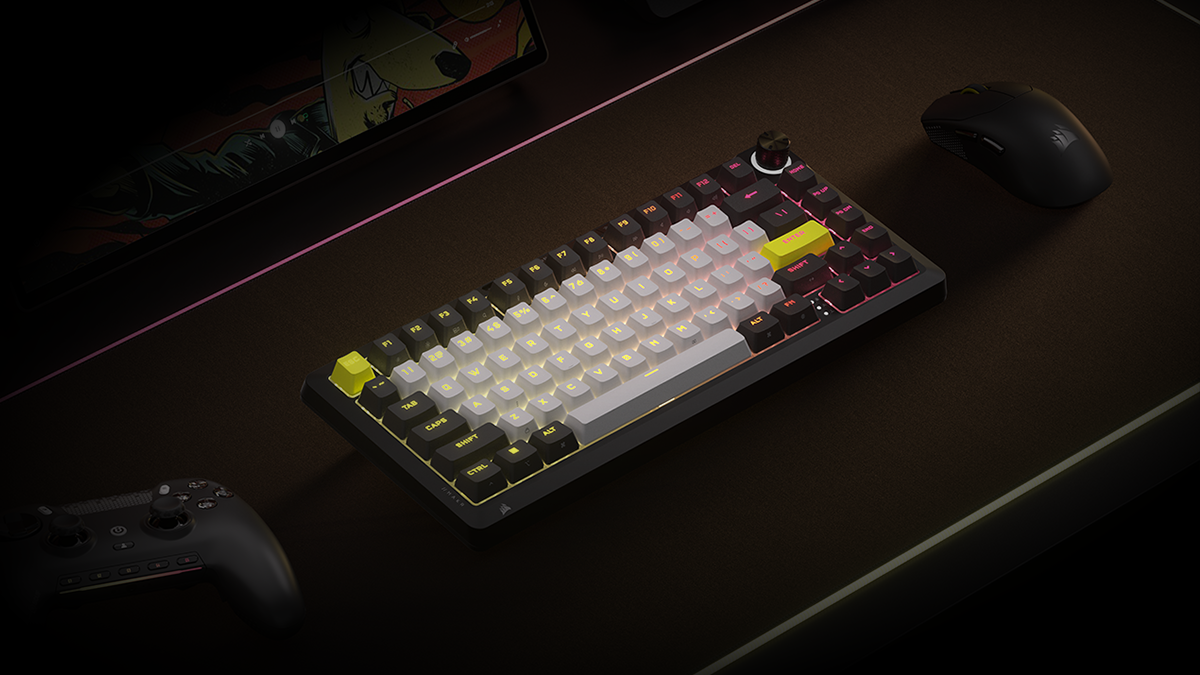
Corsair has arrived at CES 2026 with a clear focus on the upper echelons of competitive play, unveiling a refreshed peripheral lineup that prioritises new materials and rapid‑response Hall Effect technology. For mice, Corsair is introducing two iterations of the Sabre V2 Pro wireless mouse: one built from carbon fibre and the other from magnesium alloy. As for keyboards, the company has revealed the Makr Pro 75, an enthusiast‑grade mechanical keyboard that brings magnetic switch functionality to the Makr platform.

The new Sabre V2 Pro Wireless variants use high‑rigidity shells while keeping weight to a minimum. The Sabre V2 Pro CF utilises a 55g carbon fibre unibody, while the Sabre V2 Pro MG features a 56g magnesium alloy chassis. Both models retain the 8000Hz hyper‑polling capability and the 33,000 DPI Marksman S optical sensor found in the ultralight model. These material‑focused versions instead aim to eliminate micro‑flex during high‑intensity sessions. Battery life is rated at up to 120 hours at a 1000Hz polling rate, dropping to around 21 hours at 8000Hz.

The Makr Pro 75 serves as the spiritual successor to the original Makr 75. Unlike its predecessor, which focused heavily on the barebones experience, the Pro 75 arrives as a fully assembled unit featuring MGX Hyperdrive magnetic switches. These Hall Effect switches enable performance features such as Rapid Trigger and FlashTap SOCD, allowing near‑instantaneous counter‑strafing and movement resets. The keyboard maintains its enthusiast roots with an aluminium frame, an FR4 switch plate, and eight layers of internal sound damping. Modularity remains a key selling point, with support for secondary modules such as an LCD or a wireless add‑on.

To complement the new hardware, Corsair also debuted the MM Pro Control Large esports‑tuned cloth mousepad. Designed for high‑precision tracking, the pad features a 4mm‑thick cushioned surface and a hex‑patterned polyurethane base to ensure stability during rapid flicks. The sloped edges are intended to provide more consistent stopping power, helping players who struggle with overtravel on standard cloth surfaces.

All these peripherals are now on sale, with the Sabre V2 Pro CF priced at £159.99 and the MG at £119.99. The new Makr Pro 75 is £219.99, and the MM Pro Control Large is £49.99.

KitGuru says: While a 56g magnesium mouse might seem counterintuitive compared to the 36g plastic original, the added structural rigidity and premium feel could be a major draw for players who find ultralight plastic a bit too “toy‑like”

The post CES 2026: Corsair unveils new peripherals for the enthusiast segment first appeared on KitGuru.
  •  

CES 2026: Razer goes all-in on AI with Project Ava and Snapdragon-powered wearables

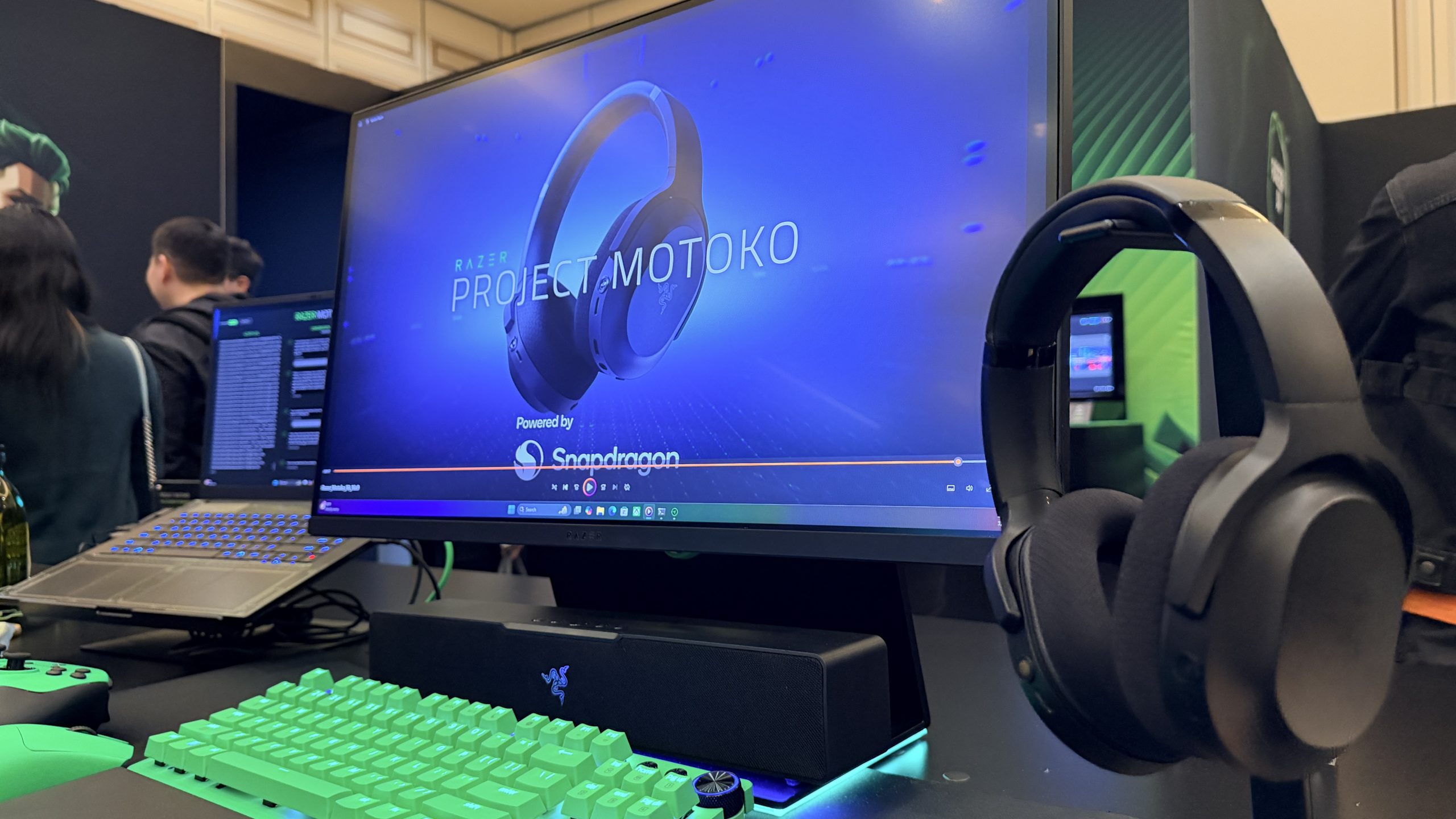
Razer is using its CES 2026 campaign to showcase its “AI Gaming Ecosystem”, moving beyond traditional peripherals and into autonomous digital companions and enterprise‑grade AI workstations. The lineup is headlined by Project Ava, a physical evolution of Razer’s earlier AI coaching software, and Project Motoko, an AI‑integrated headset positioned as an alternative to smart glasses for the AI‑driven generation.

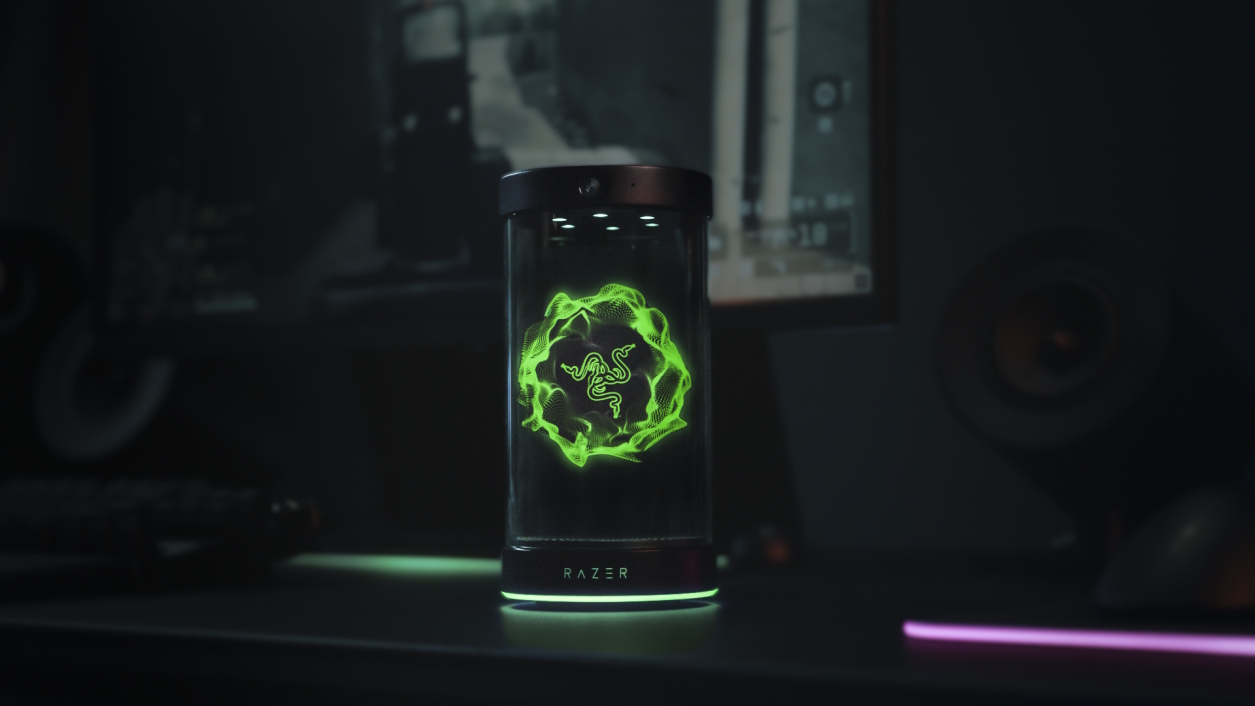
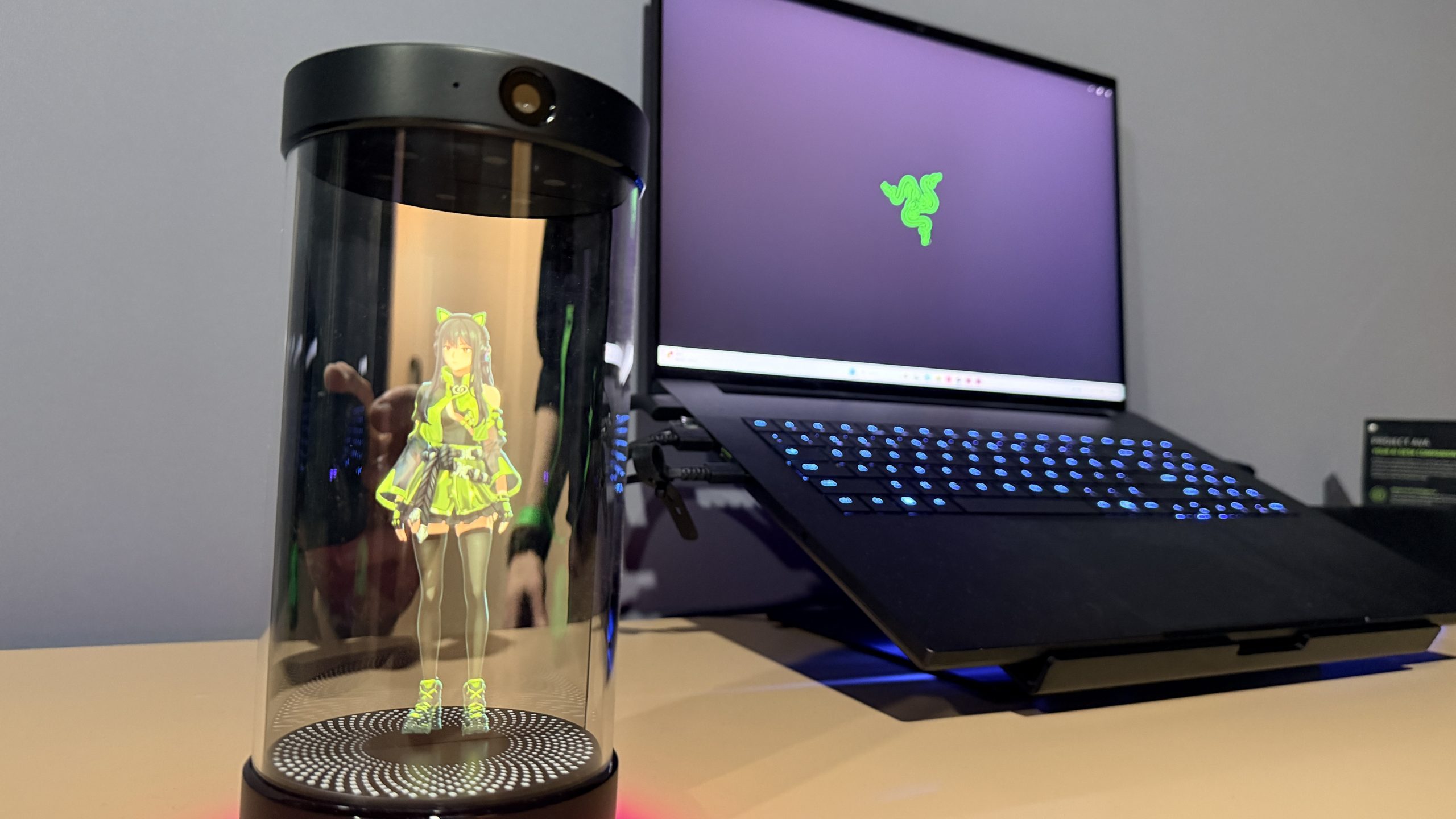
Starting with Project Ava, this cylindrical desktop device houses a 5.5‑inch animated avatar inside a transparent shell. Evolving from an abstract esports coach into a full “digital partner”, Ava uses a top‑mounted camera and PC Vision Mode to monitor gameplay or productivity in real time. Whether offering weapon loadout recommendations in shooters or managing your calendar while you work, Ava is designed as a persona‑driven assistant that sits beside your monitor rather than appearing as an on‑screen overlay. Razer has already opened reservations in the US, featuring the default character “Kira”, with support for custom avatars planned for the future.

For users on the move, Project Motoko introduces an AI‑powered wireless headset built on Qualcomm Snapdragon silicon. Unlike current smart glasses, Motoko relies on high‑fidelity audio feedback and dual first‑person cameras to deliver visual and environmental awareness. It supports translation, object recognition, and real‑time guidance, all while offering up to 40 hours of battery life. Razer is keeping the platform engine‑agnostic, enabling it to run local or cloud‑based models from OpenAI, Google, or even Tenstorrent’s mobile accelerators.

Razer is also making a pivot into the enterprise and research sectors with a dedicated suite of AI development tools:

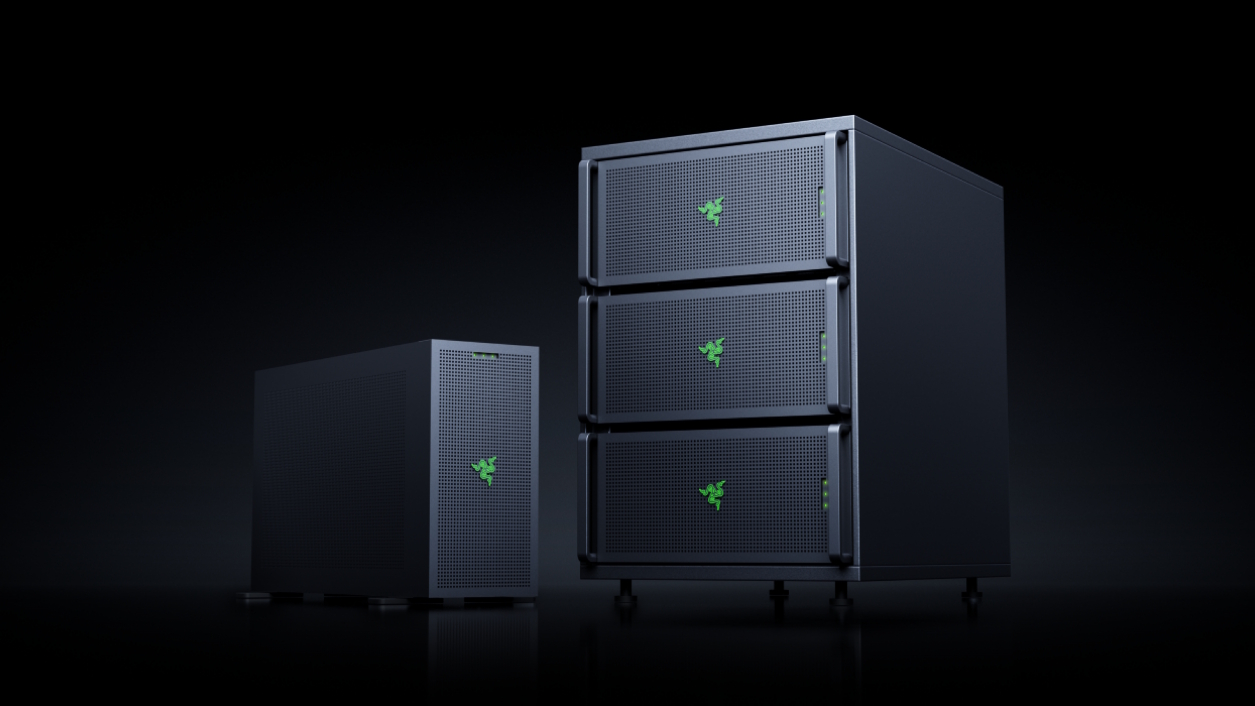
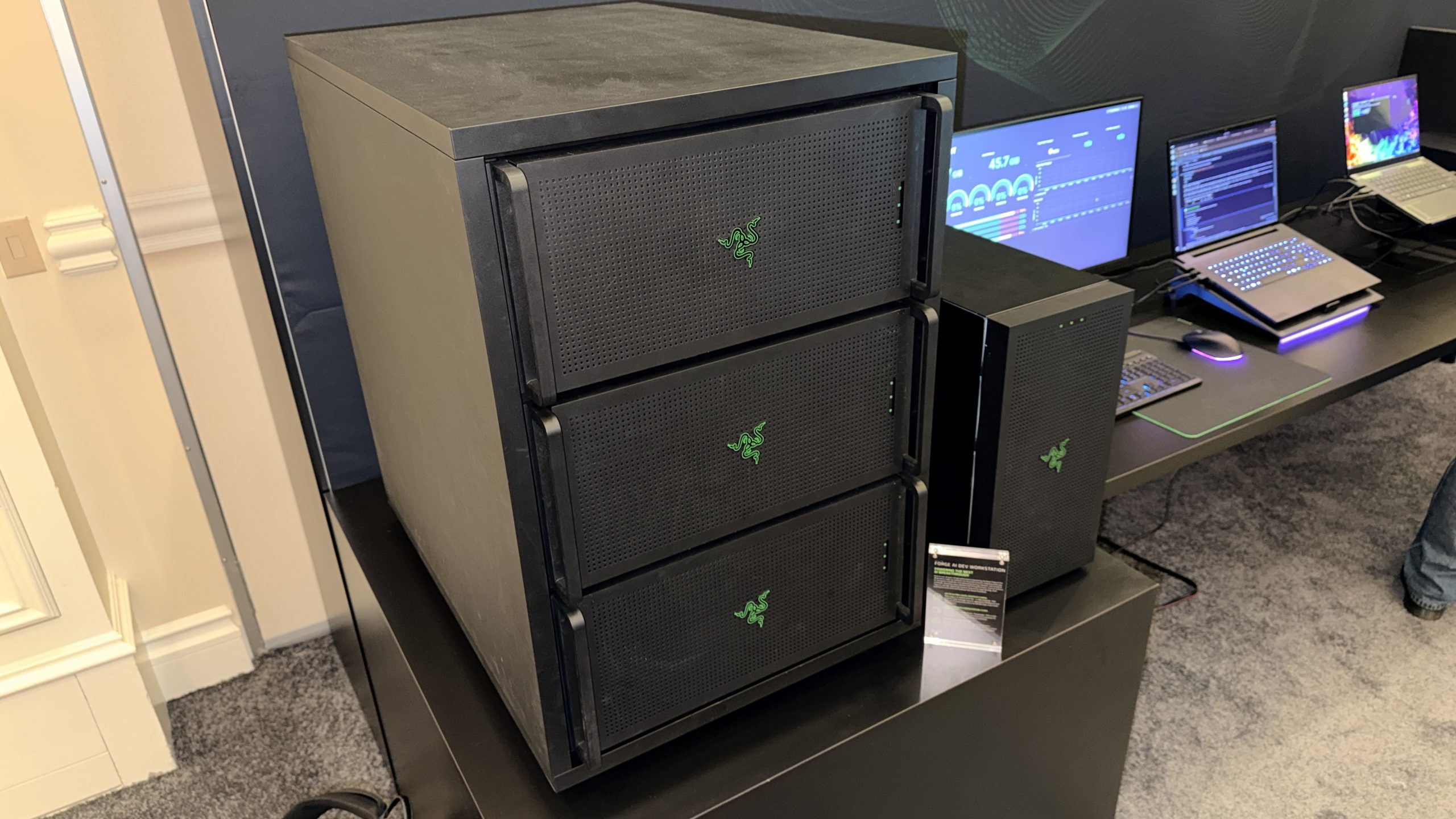
  • Razer Forge AI Dev Workstation: A localised powerhouse built for training Large Language Models (LLMs) and running complex simulations. It supports multiple professional GPUs (including the Nvidia RTX Pro 6000 Blackwell series) and workstation-class CPUs from the AMD Threadripper Pro or Intel Xeon W lines.
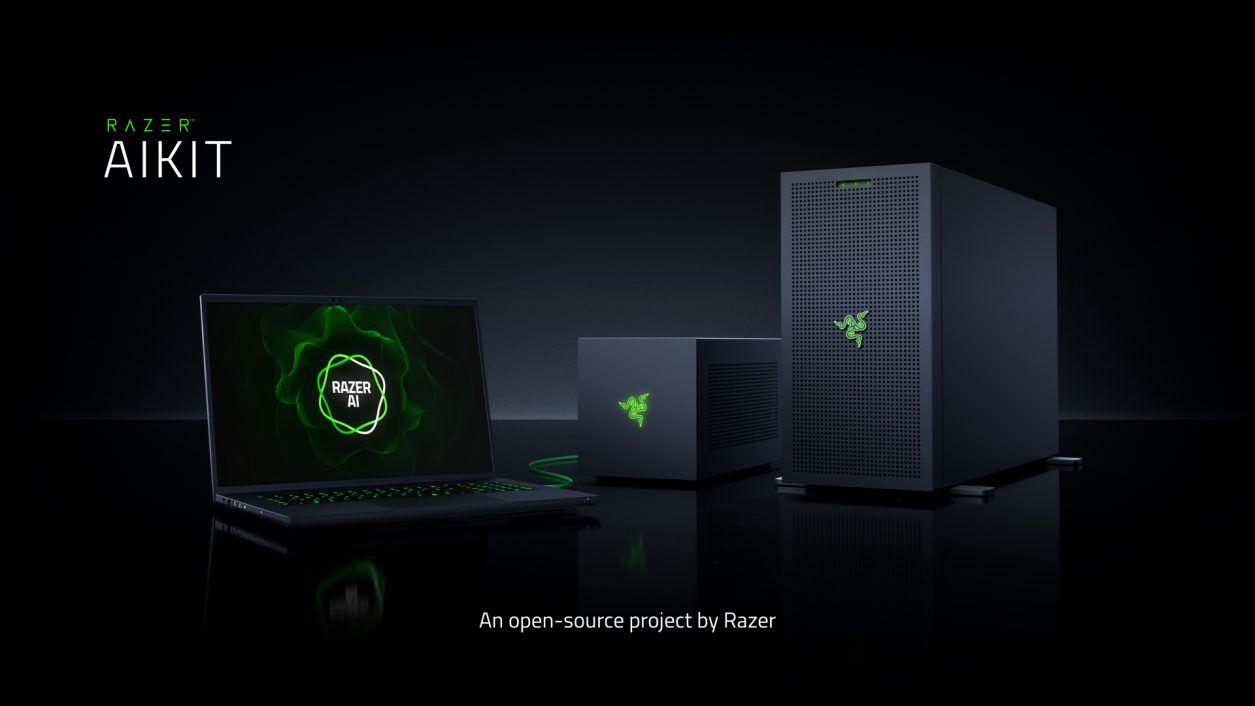
  • Razer AIKit: An open-source, local-first workflow tool available on GitHub. It allows researchers to fine-tune models on local hardware with cloud-comparable performance, featuring automatic GPU discovery and cluster formation.
  • Tenstorrent Partnership: In collaboration with Jim Keller's Tenstorrent, Razer is launching a compact AI accelerator that connects via Thunderbolt 5. Using “Wormhole” technology, these modular units can be daisy-chained to provide desktop-class generative AI performance to laptops and handheld PCs.

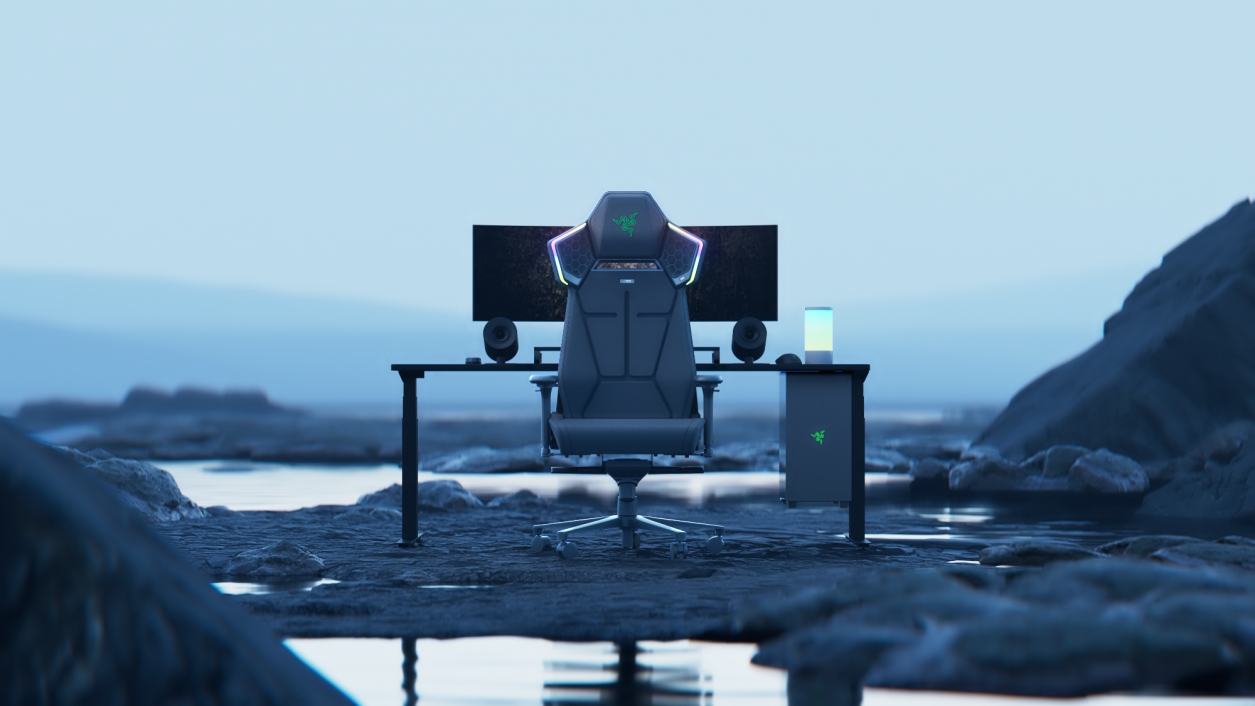
Razer’s gaming chair lineup has also been refreshed with the Razer Iskur V2 NewGen. While maintaining the price point of its predecessor, the NewGen model introduces Razer’s Gen‑2 EPU Leather with “CoolTouch” technology and a more breathable dual‑density foam cushion. For those seeking something beyond a standard office chair, Project Madison is a concept seat that integrates Sensa HD Haptics directly into the frame, vibrating in sync with game events or THX Spatial Audio for a multisensory experience.

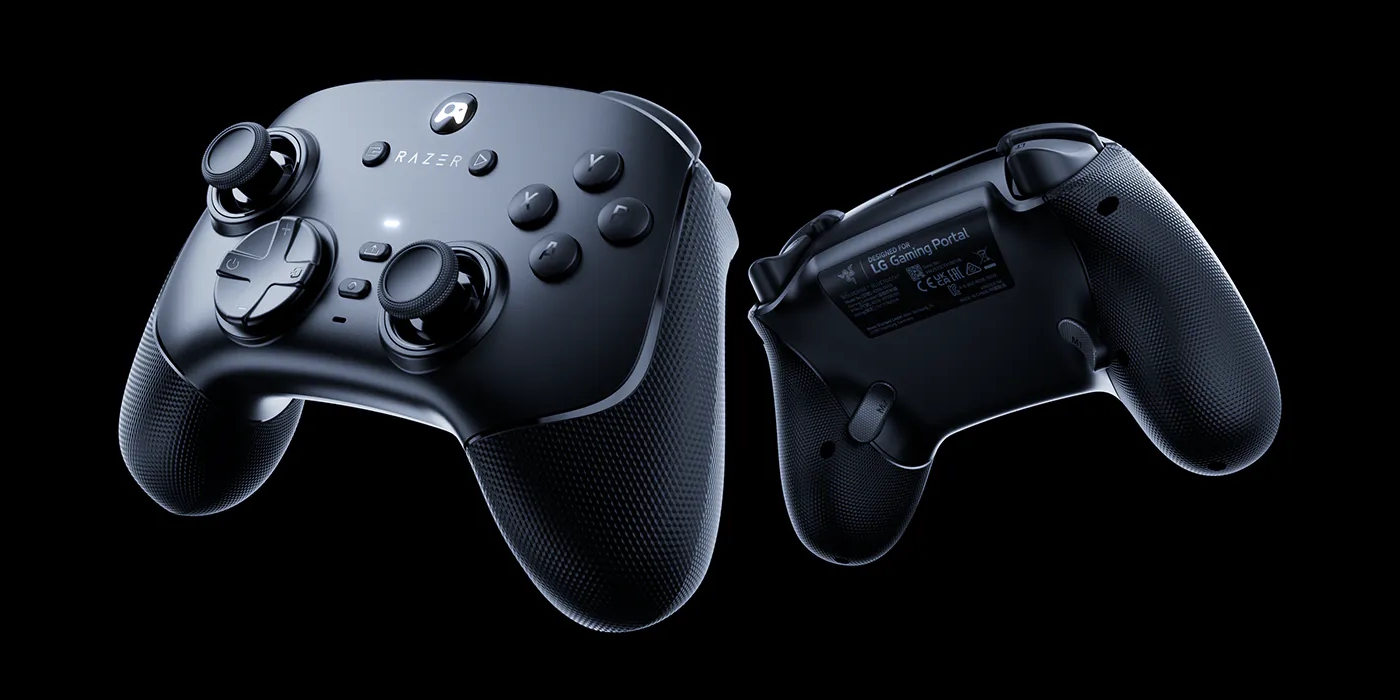
Lastly, the new Razer Wolverine V3 Bluetooth arrives as the “world’s fastest” wireless controller optimised for cloud gaming. Developed in partnership with LG, it features ultra‑low‑latency Bluetooth and integrated TV controls, allowing users to navigate LG’s gaming portals and cloud services without a separate remote.

KitGuru says: With this announcement, it's safe to say that Razer is no longer just a gaming brand. It's positioning itself as a hardware provider for the AI era. While Project Ava is probably the most interesting product for its core audience, the Forge workstation and the Tenstorrent accelerator suggest Razer is serious about capturing the professional AI market as well.

The post CES 2026: Razer goes all-in on AI with Project Ava and Snapdragon-powered wearables first appeared on KitGuru.
  •  

CES 2026: ASUS opens door for next-gen, high-performance systems

During the European Hardware Association Tech Tour, KitGuru was invited to ASUS headquarters in Taipei for an early look at a wide range of hardware planned for 2026. Rather than focusing on individual launches, the briefings were structured around broader design themes – power delivery, thermal density, system integration and the growing need to treat modern PCs as complete platforms rather than collections of parts. 

What follows is an overview of how ASUS is approaching that challenge across its 2026 high-performance portfolio – starting with its new motherboards/platforms. 

ROG Crosshair X870E and the NEO Refresh
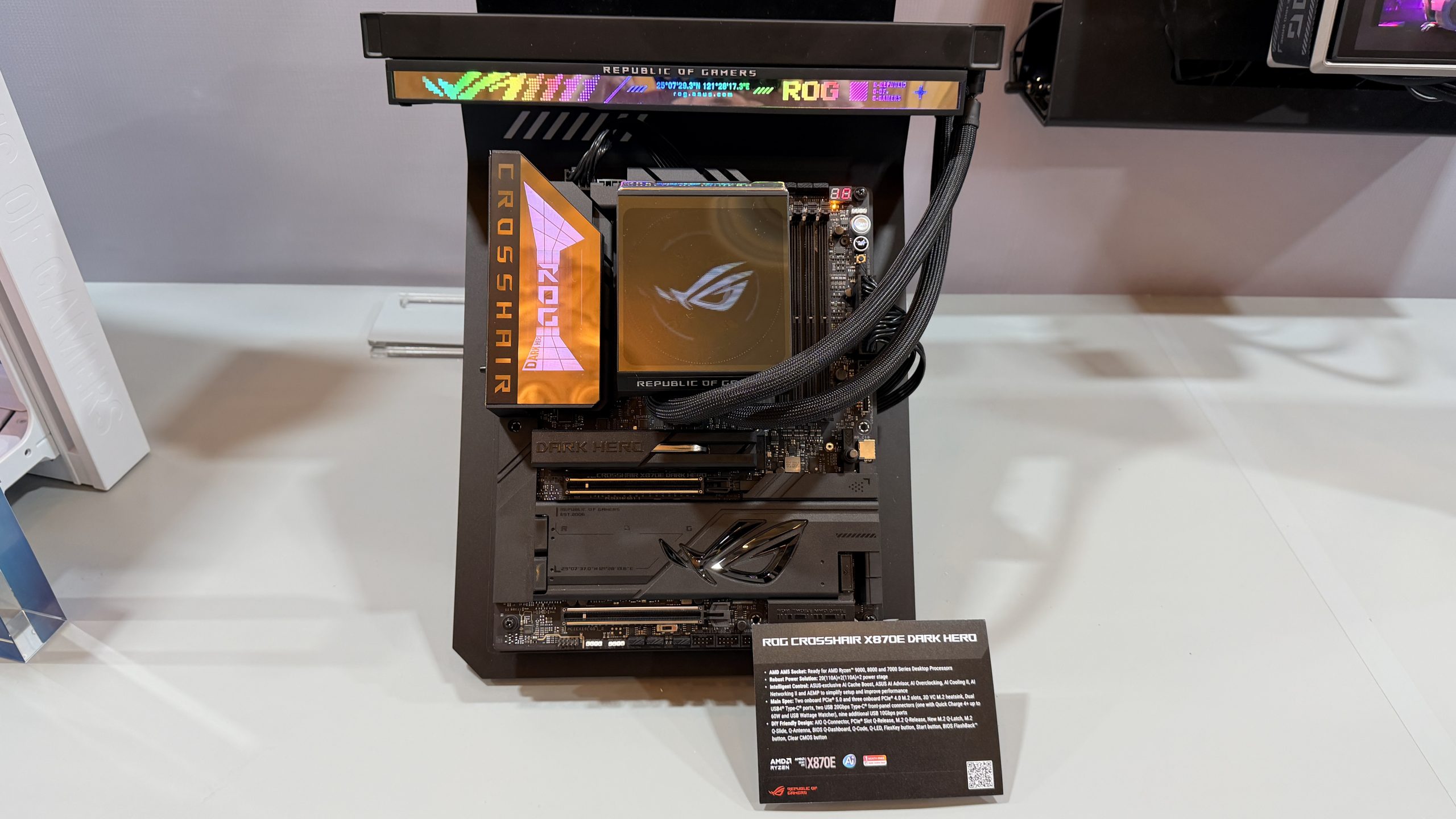
At the centre of ASUS' next-generation strategy sits the ROG Crosshair X870E platform, positioned as the flagship foundation for upcoming AMD systems. Two models lead that charge – the Crosshair X870E Glacial and Crosshair X870E Dark Hero – each targeting slightly different priorities while sharing the same underlying design intent. More will be announced about the NEO refresh closer to the launch in February 2026.

Power delivery and future-proofing
ASUS is explicit that these boards are designed with future AMD CPUs in mind, including processors that may, in theory, demand 200W or more of sustained power draw. While no such CPUs have been announced publicly (at the time of writing), this expectation aligns with broader industry conversations around rising power density and sustained boost behaviour. 

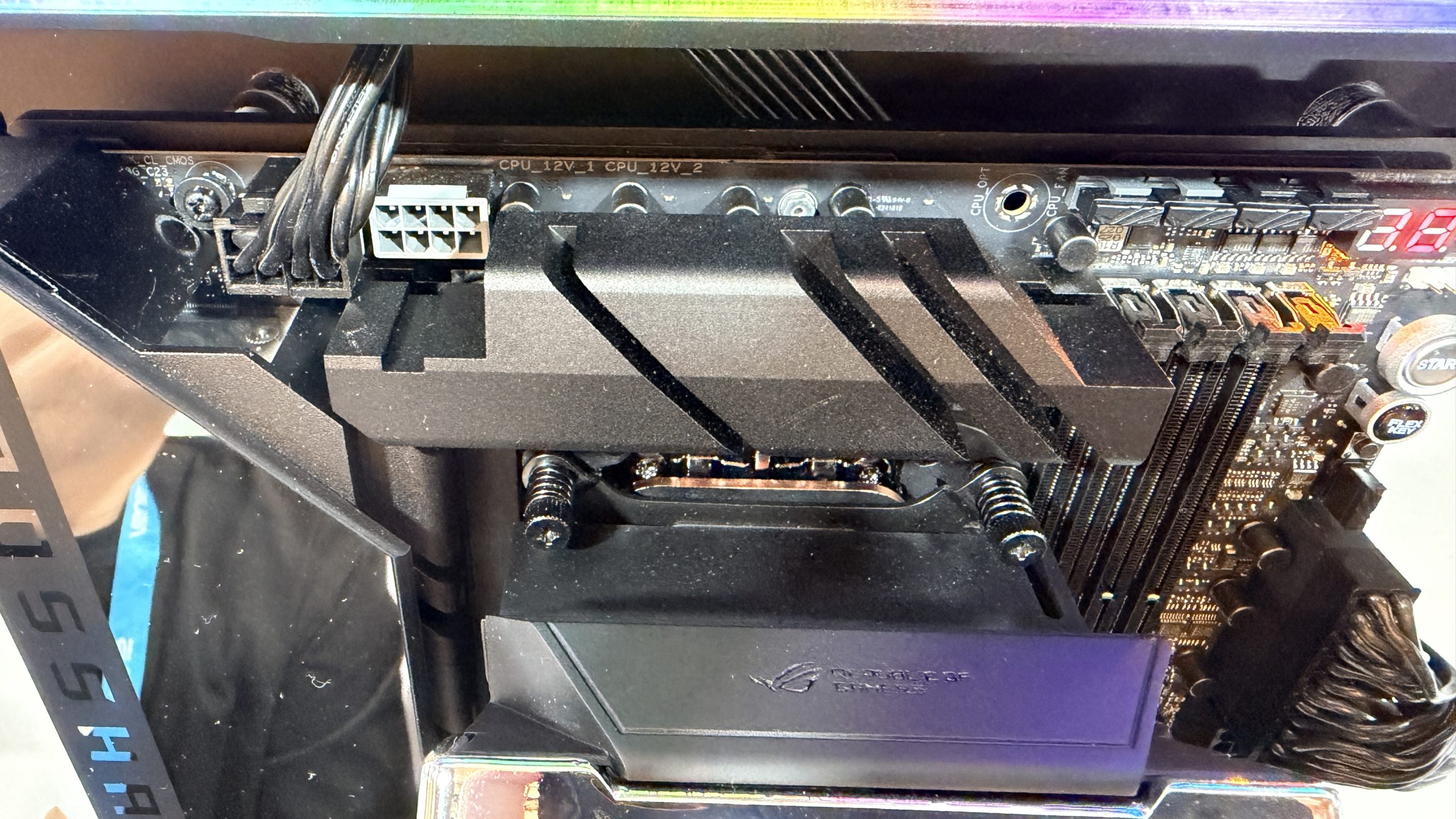
The Glacial model features a 24(110A)+2(110A)+2 power stage design, while the Dark Hero uses a 20(110A)+2(110A)+2 configuration, both employing ProCool II connectors, MicroFine alloy chokes and premium metallic capacitors. The intent here is not peak benchmarking, but long-term electrical stability under heavy, sustained loads.

Within the motherboard industry, there is also a growing belief that next-generation platforms could unlock 5–15% gaming performance gains, depending on workload and configuration. This is not positioned as a guarantee, but as a byproduct of improved signal integrity, memory routing and platform optimisation rather than dramatic architectural shifts. All of which could be pretty useful as we head into a year where gamers might need to step back slightly on graphics card and system memory options.

Connectivity and segmentation
Networking is another area where ASUS differentiates clearly between the two boards. The Glacial integrates dual Realtek 10Gb Ethernet, while the Dark Hero combines 10Gb and 5Gb Ethernet, with both boards featuring on-board WiFi 7 (802.11be) and ASUS' WiFi Q-Antenna system. 

Thermal engineering as a motherboard feature
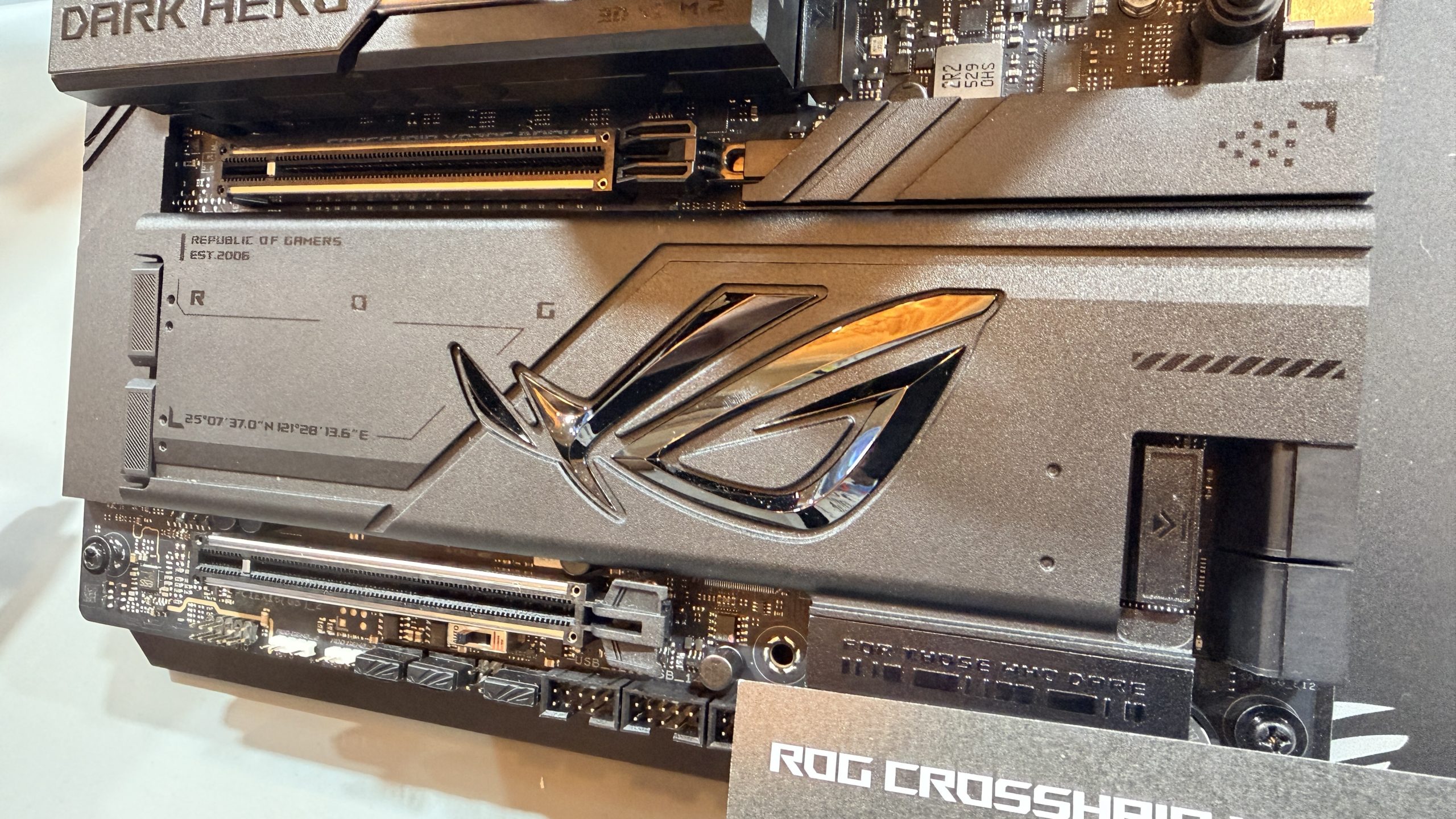
Thermal design is treated as a first-class concern. Both boards use large, integrated heatsinks tied into the I/O shroud, linked by heatpipes and high-conductivity thermal pads. One PCIe 5.0 M.2 slot benefits from ASUS' 3D vapour chamber M.2 heatsink, explicitly designed to cope with the heat output of next-generation storage. With PCI-Express Gen 6 on the horizon, we will need to get used to active cooling for SSDs as being a standard topic of discussion. 

Memory cooling is also integrated into the control logic via ROG Memory Q-Fan, reinforcing the idea that modern motherboards are now active thermal managers rather than passive backplanes.

The NEO refresh
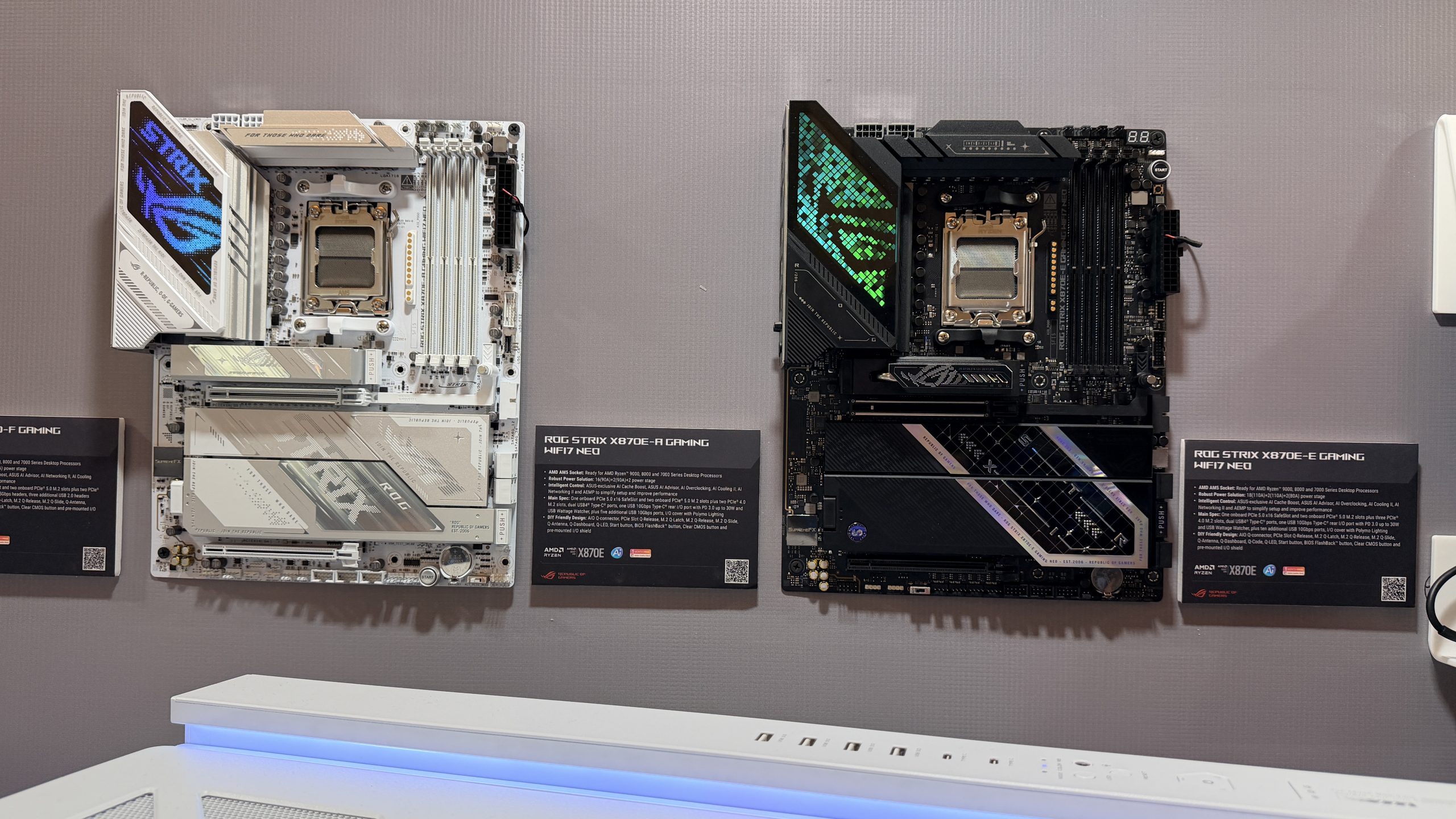
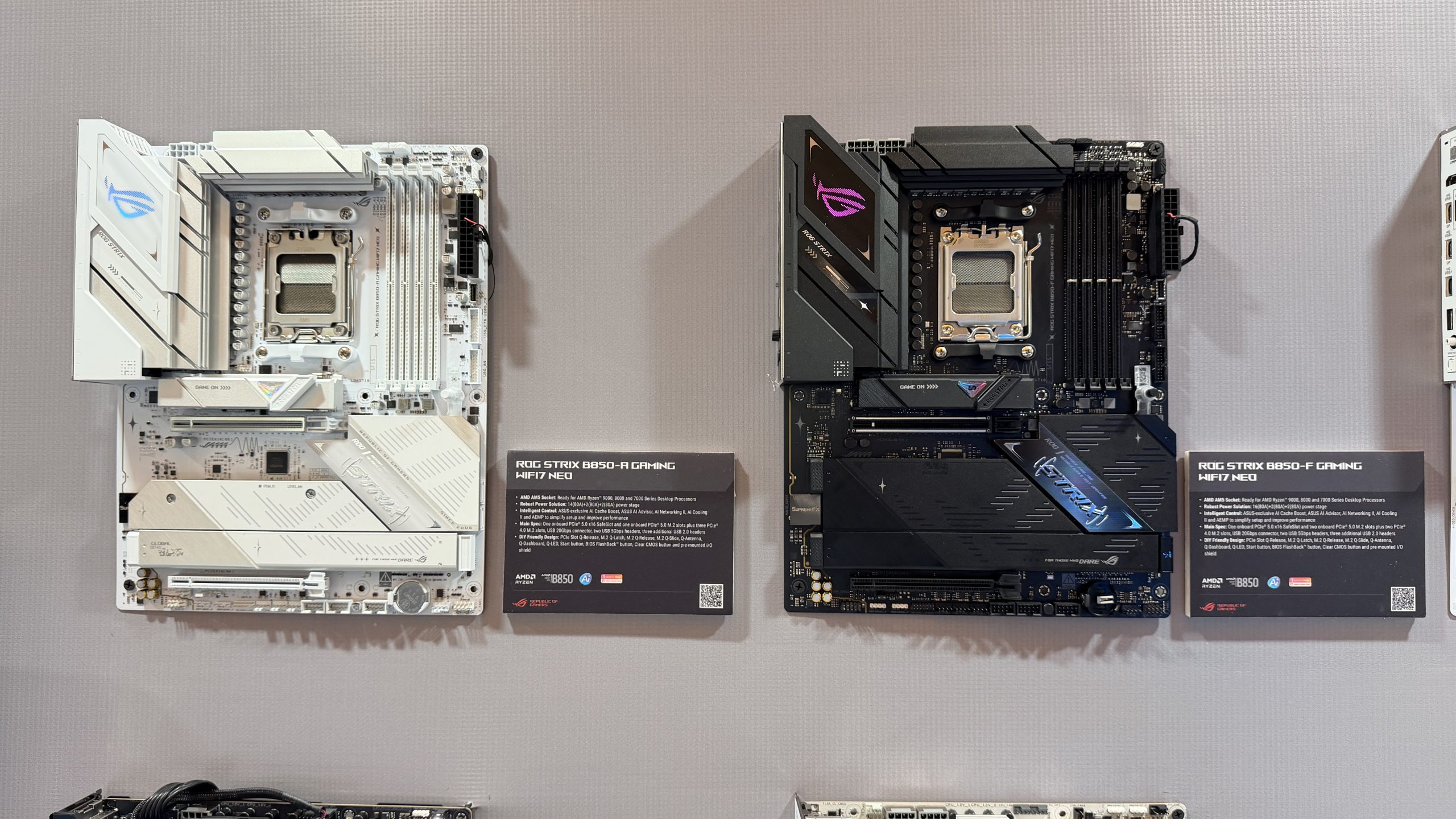
Sitting beneath the Crosshair flagships and more affordable for the masses, is the refreshed ROG Strix NEO series, covering X870E and B850 models. ASUS describes this as more than a cosmetic update. A redesigned memory routing architecture using via-in-pad routing and improved impedance continuity enables ASUS to quote much faster overclocked memory speeds. 

We were shown ‘ASUS internal figures’ – and KitGuru will look to validate them independently once hardware is available. The more important takeaway is that memory stability and compatibility appear to be the primary goal, rather than chasing record-setting frequencies. 

Additional platform changes include asynchronous clocking, expanded M.2 support while maintaining PCIe 5.0 x16 GPU bandwidth, and a renewed BIOS interface. ASUS has also introduced ASUS MB Manager, initially on the NEO series, to separate motherboard-level RGB and system control from the broader Armoury Crate ecosystem. 

ASUS ExpertCenter Pro ET900N G3
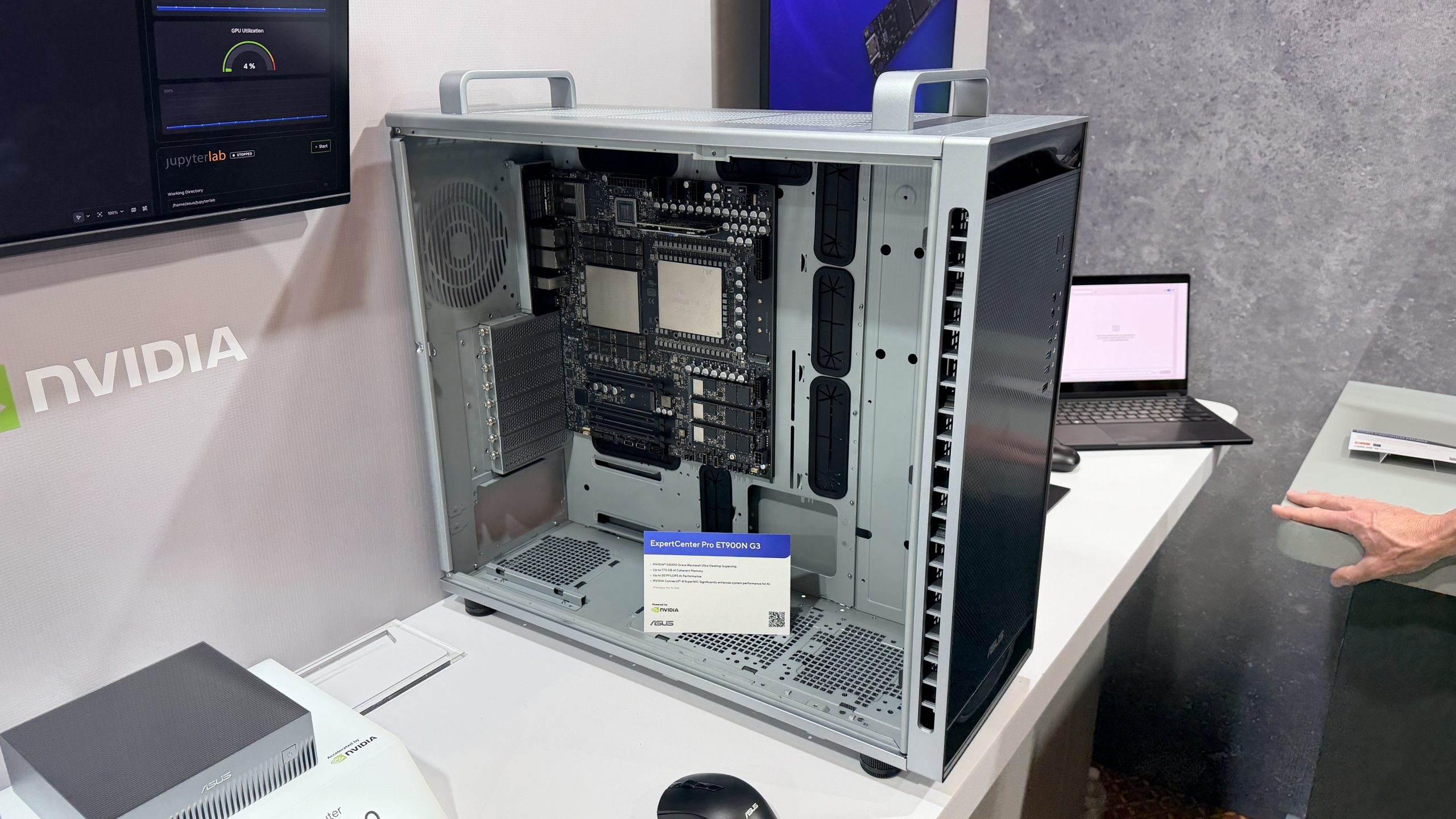
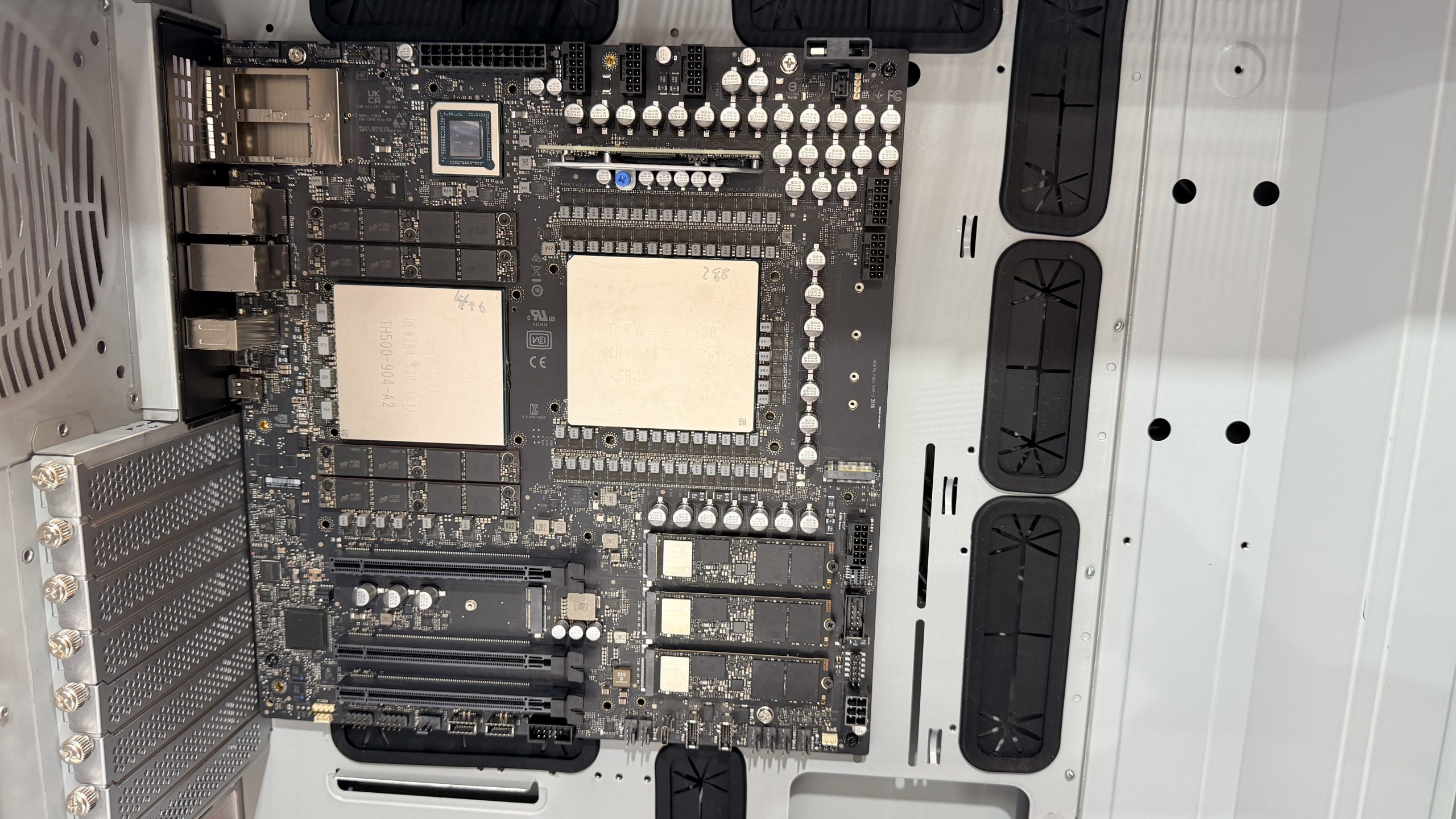
The most striking system shown during the tour was arguably the ASUS ExpertCenter Pro ET900N G3. This is a desktop form factor AI supercomputer built around NVIDIA Grace and Blackwell technologies. 

ASUS positions the ET900N G3 as a bridge between traditional workstations and rack-mounted server infrastructure. According to figures provided by ASUS, the system offers higher PFLOPS compute capability than a four-GPU NVIDIA HGX H200 SXM system, based on FP8 model performance comparisons. The figures shown are claims by ASUS. We expect that real-world performance will depend on workload and configuration. 

The rationale behind the creation of the ET900N G3 becomes clearer when viewed against industry pricing. HGX H200 SXM systems are widely understood to cost hundreds of thousands of dollars once GPUs, chassis, networking, power and cooling infrastructure are accounted for. By contrast, ET900N G3 is designed to deliver serious AI compute in environments that cannot justify data-centre-scale deployments. 

Features such as ConnectX-8 SuperNICs, QSFP 400G networking, and Multi-Instance GPU (MIG) support reinforce that this is not a consumer product, but a workstation-class tool aimed at research, enterprise AI, and edge compute scenarios. 

Thermal Solutions: ROG Ryuo and Strix LC IV 

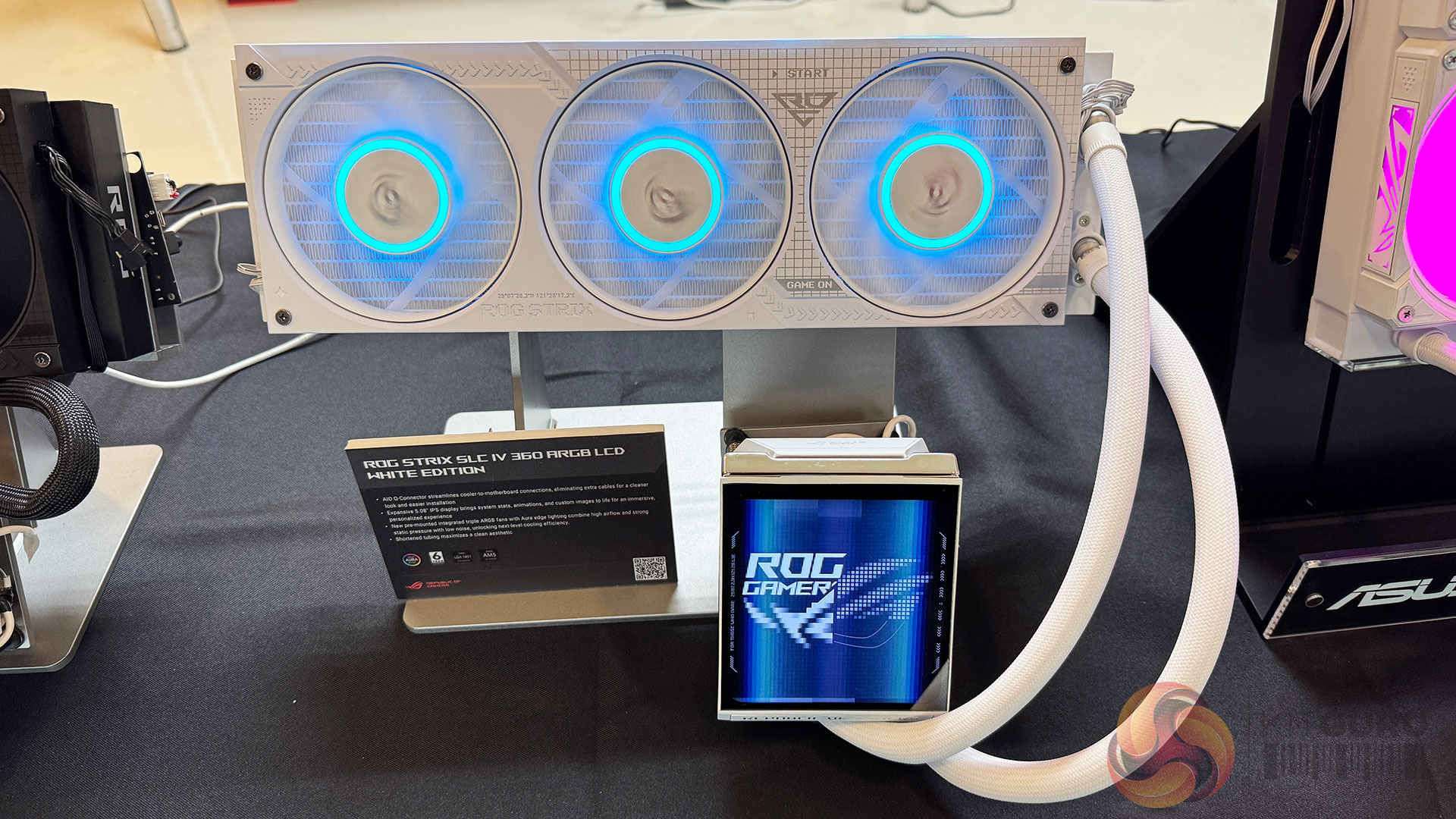
As CPU power draw begins to rise again, ASUS is also evolving its cooling ecosystem. The ROG Ryuo IV and introduces Asetek Emma Gen8 V2 pumps, with the Ryuo IV and ROG Strix SLC/LC IV AIO coolers benefiting from updated cold plates and an emphasis on installation simplicity. 

A notable design change is the AIO Q-Connector, which consolidates cabling between the cooler and compatible ASUS motherboards into a single connection. While this reduces cable clutter and simplifies builds, it also reinforces a clever ecosystem lock-in, which is a trade-off that ASUS appears willing to make in pursuit of cleaner system design. 

The integrated 5.08-inch IPS LCD, running at 720 × 720 and 60Hz, is positioned less as a novelty and more as a system monitoring surface, capable of displaying thermals, fan speeds and custom visuals. We did ask about future models with much higher refresh rates on bigger screens, but were told (with a smile) that 5” and 60Hz was probably all that was needed. 

Graphics: ASUS ProArt GeForce RTX 5090 32GB GDDR7 OC Edition 

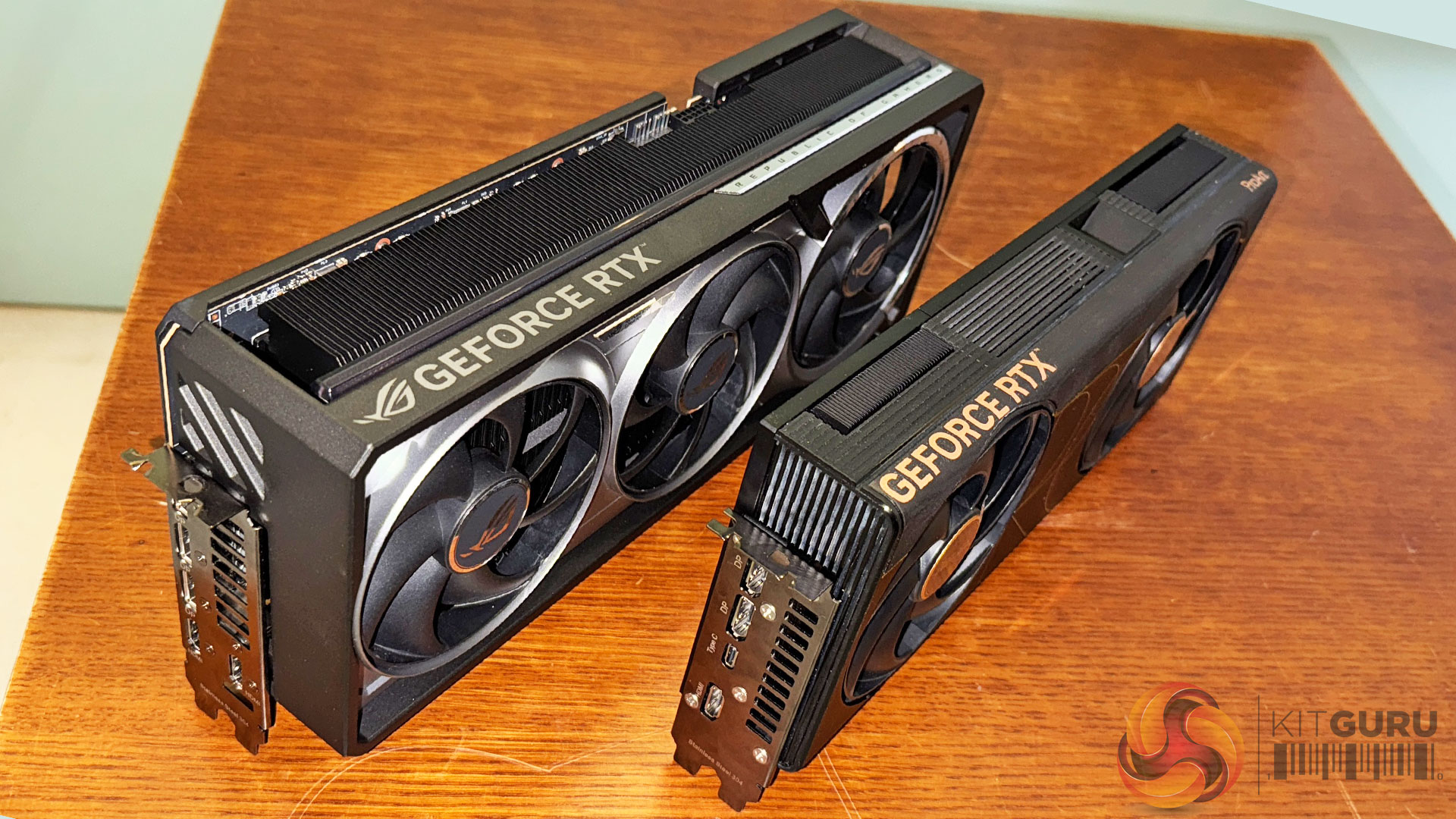
Last year, ASUS demonstrated the ROG Astral RTX 5090, a physically enormous statement GPU. The ProArt RTX 5090 shown this year, is effectively the counterpoint. All of the important hardware in a much smaller package. 

According to ASUS, the ProArt card occupies roughly a quarter of the volume of the largest Astral designs (see below), while remaining SFF-ready in a 2.5-slot form factor. This immediately broadens its appeal to professional workstations, compact builds and creator systems – where physical space and airflow matter as much as raw performance. 

Cooling is handled via liquid metal on the GPU die, a vapour chamber, dual Axial-tech fans and a double-vented backplate designed to actively exhaust heat rather than trap it within the chassis. ASUS also highlights USB-C output support and ProArt-specific software tuning for professional workflows. 

ASUS claims performance parity with flagship RTX 5090 silicon while maintaining acoustics and thermals suitable for sustained workloads. As always, KitGuru will be looking to validate those claims through independent testing.  

Chassis and Airflow: ROG Cronox and Eurux GR120 

The final piece of the system puzzle is airflow and enclosure design, and this is where ASUS' BTF (Hidden Connector) strategy becomes most visible. 

ROG Cronox PC Case
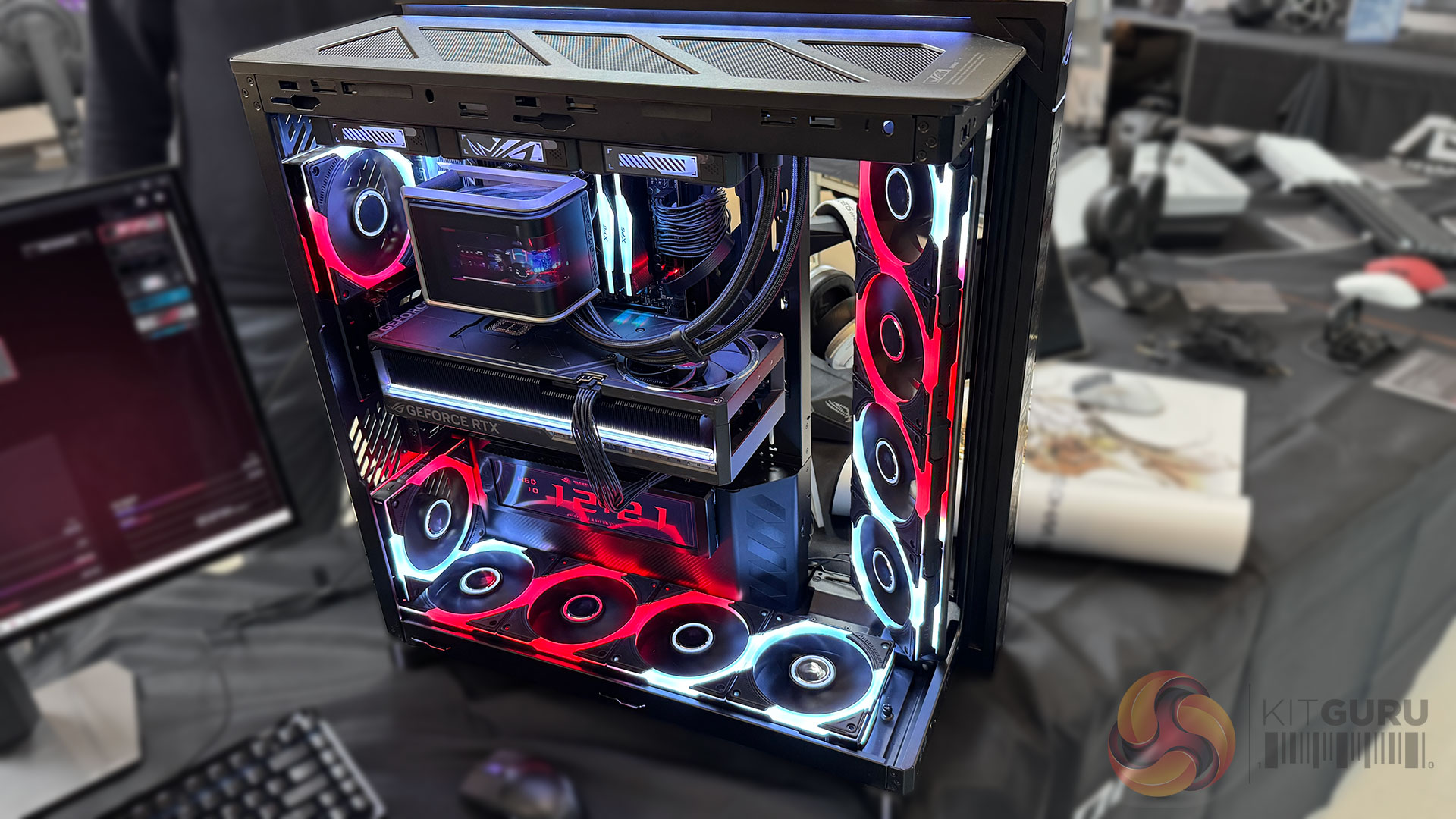
The ROG Cronox is a large, airflow-focused chassis that will be sold separately. It features an aluminium-trimmed structural frame, a tool-free curved glass side panel, and support for up to 14 × 120 mm fans. 

Cooling support includes dual 360mm radiators, GPUs up to 400mm in length, and CPU coolers up to 180mm tall. A patented rotatable side fan bracket allows airflow to be redirected at a 45-degree angle, prioritising either cooling efficiency or system visibility depending on the build. 

A built-in 9.2-inch LCD panel (1920 × 420, 400 nits, 60Hz) provides system monitoring and visual customisation, reinforcing the theme of integrated, system-level control rather than bolt-on accessories.

BTF integration
The chassis briefing delivered by ASUS, also revealed the Hero BTF version of the new X870E Crosshair motherboards and a ROG Astral GeForce RTX 5090 BTF Edition graphics card. While not every build will adopt BTF, it provides a clean link between motherboard design, GPU layout, and chassis airflow, reducing visible cables and improving internal airflow paths. 

ROG Eurux GR120 ARGB fan
Completing the airflow story is the ROG Eurux GR120 ARGB fan, featuring LCP fan blades, CNC-milled brass bearing shells, and ASUS-quoted performance figures of 91 CFM airflow, 4.6mmH₂O static pressure, and 33 dB(A) noise levels at up to 2600 RPM. 

Figures shows are ASUS claims but, on paper, they position the GR120 as a fan capable of handling dense radiator and chassis scenarios, particularly when paired with the Cronox case and BTF-style builds. It will be interesting to see if we can achieve the same cooling standards as ASUS claim with this kind of set-up. 

KitGuru Says: Taken individually, each of these products serves a specific audience. Viewed together, they form a coherent picture of where ASUS believes high-performance systems are heading: Higher sustained power, tighter thermal budgets, cleaner physical layouts and platforms engineered as complete ecosystems rather than collections of parts. Many of the figures quoted here come directly from ASUS briefings, and KitGuru will be looking to see how those claims translate into real-world performance once hardware becomes available. 

The post CES 2026: ASUS opens door for next-gen, high-performance systems first appeared on KitGuru.
  •  

January’s Humble Choice line-up includes Sonic Frontiers; Hunt Showdown and more

2026 is officially here, and seeing as how it’s a new month, Humble has another set of games available to claim right now as part of its Humble Choice subscription service. Kicking off the year with a strong selection of titles, January’s line-up includes Sonic Frontiers; Hunt Showdown; the Tomb Raider Classic collection and more.

Available to add to your library from now, January 2026’s Humble Choice line-up is as follows:

  • Sonic Frontiers
  • Tomb Raider IV-VI Remastered
  • Hunt Showdown 1896
  • Etrian Odyssey II HD
  • Nice Day for Fishing
  • Metal Slug Tactics
  • Settlement Survival
  • Wizard of Legend 2

All in all this marks a pretty good month for Choice subscribers, with Sonic Frontiers offering a fun open zone to dash around and complete various platforming puzzles – all the while offering a set of more traditional boost-era stages as well.

Tomb Raider IV-VI Remaster is, as it says, a remaster of Lara Croft’s earlier outings. Released a little under a year ago, this package offers options for both classic and enhanced visuals thanks to the efforts of remaster specialists Aspyr.

Wizard of Legend 2 meanwhile is a fun single-player or co-op rogue-like offering a mix of dungeon crawling, fun and fast gameplay as well as a wide variety of upgrades. Though somewhat of a downgrade in art style compared to the first entry, Wizard of Legend 2 is still definitely worth checking out.

As always, a portion of your subscription will go towards charity, with this month supporting Gamers Outreach: “A nonprofit organization that exists to empower hospitalized families through video games.”

KitGuru says: What do you think of January’s offerings? Is this a solid start to 2026? Let us know your thoughts down below.

The post January’s Humble Choice line-up includes Sonic Frontiers; Hunt Showdown and more first appeared on KitGuru.
  •  

CES 2026: Sudokoo launches full line-up of CPU coolers

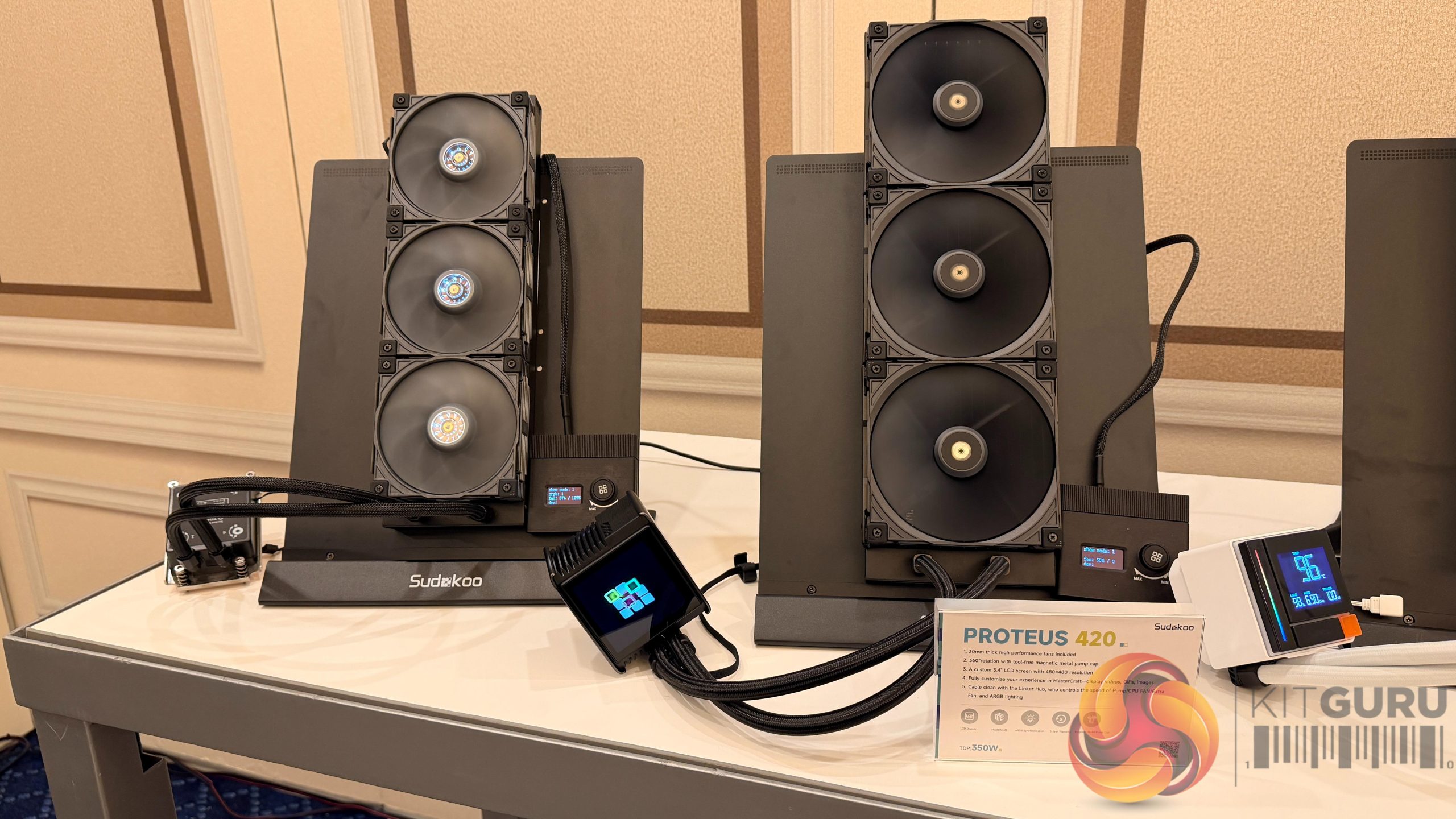
Sudokoo is making its first CES appearance this year, bringing along a host of new CPU coolers, covering both air and AIO units. We stopped by their booth to get a first-hand look at the new range.

Watch via YouTube below:

Timestamps:
00:00 SK700V Mach
00:55 SK600VC
01:18 ST720
01:45 Aetherflex 360
02:16 Energlo 360
03:06 Proteus 420
03:35 Workstation Liquid Cooler
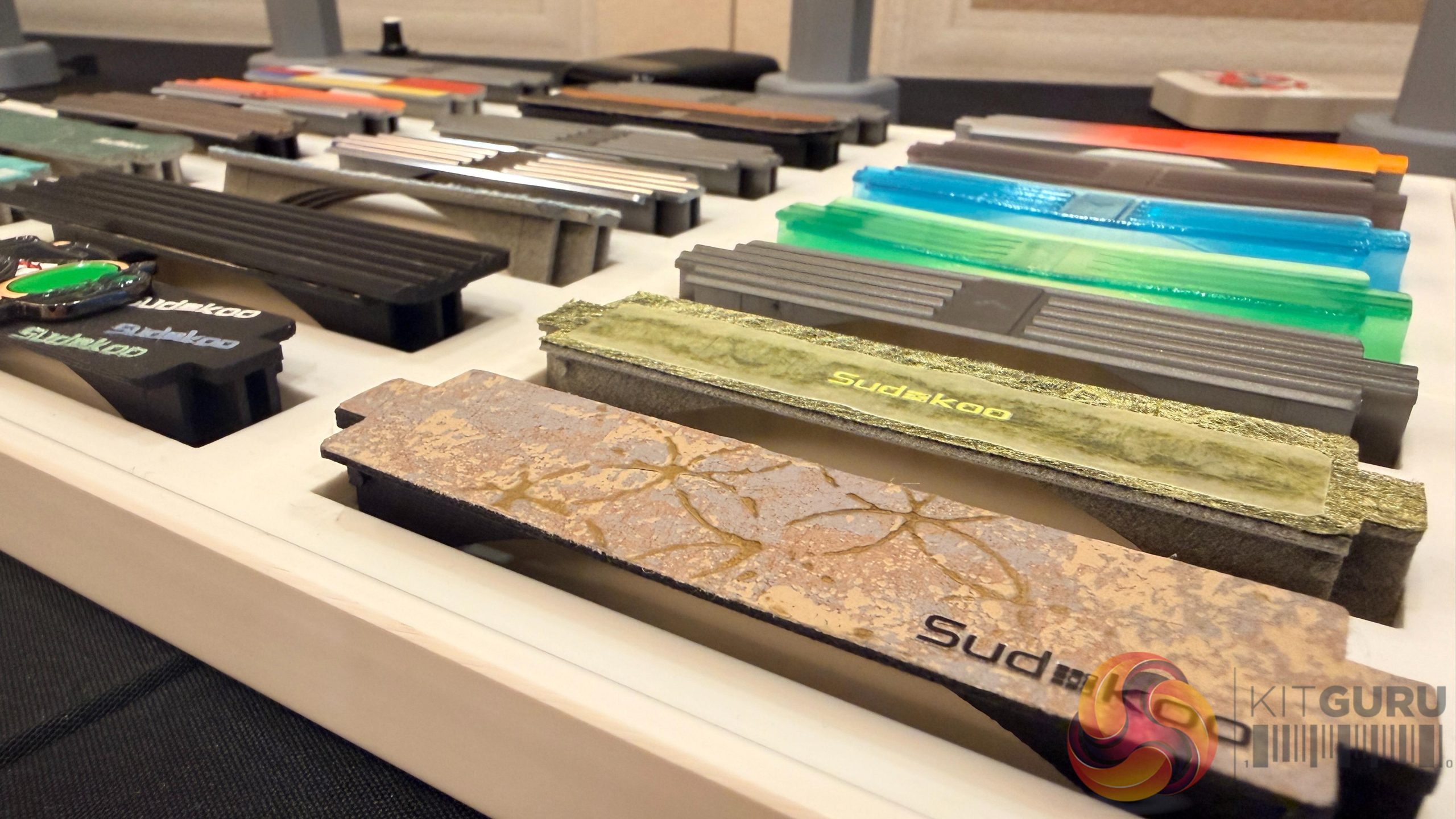
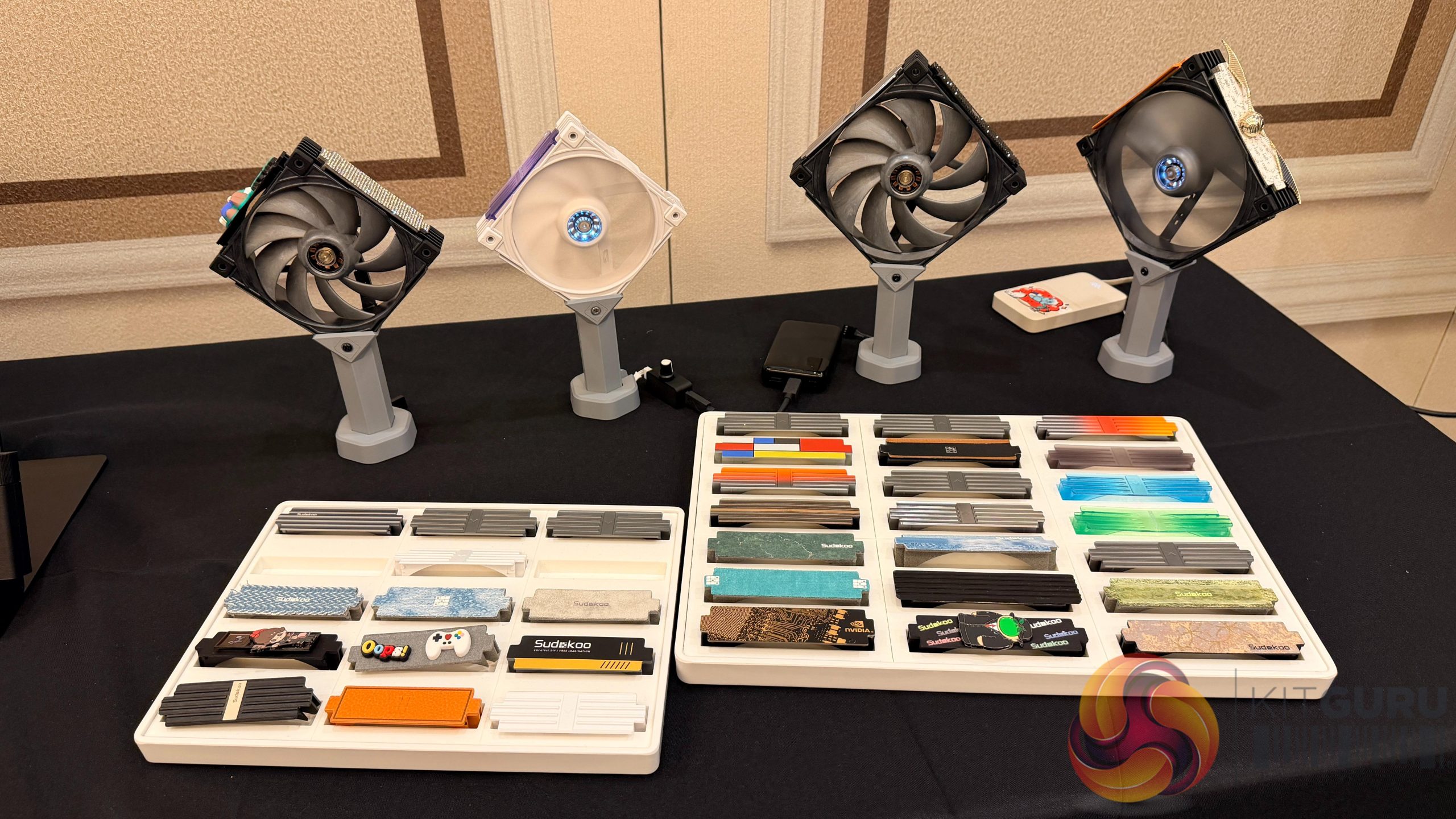
03:51 Fans and Custom options
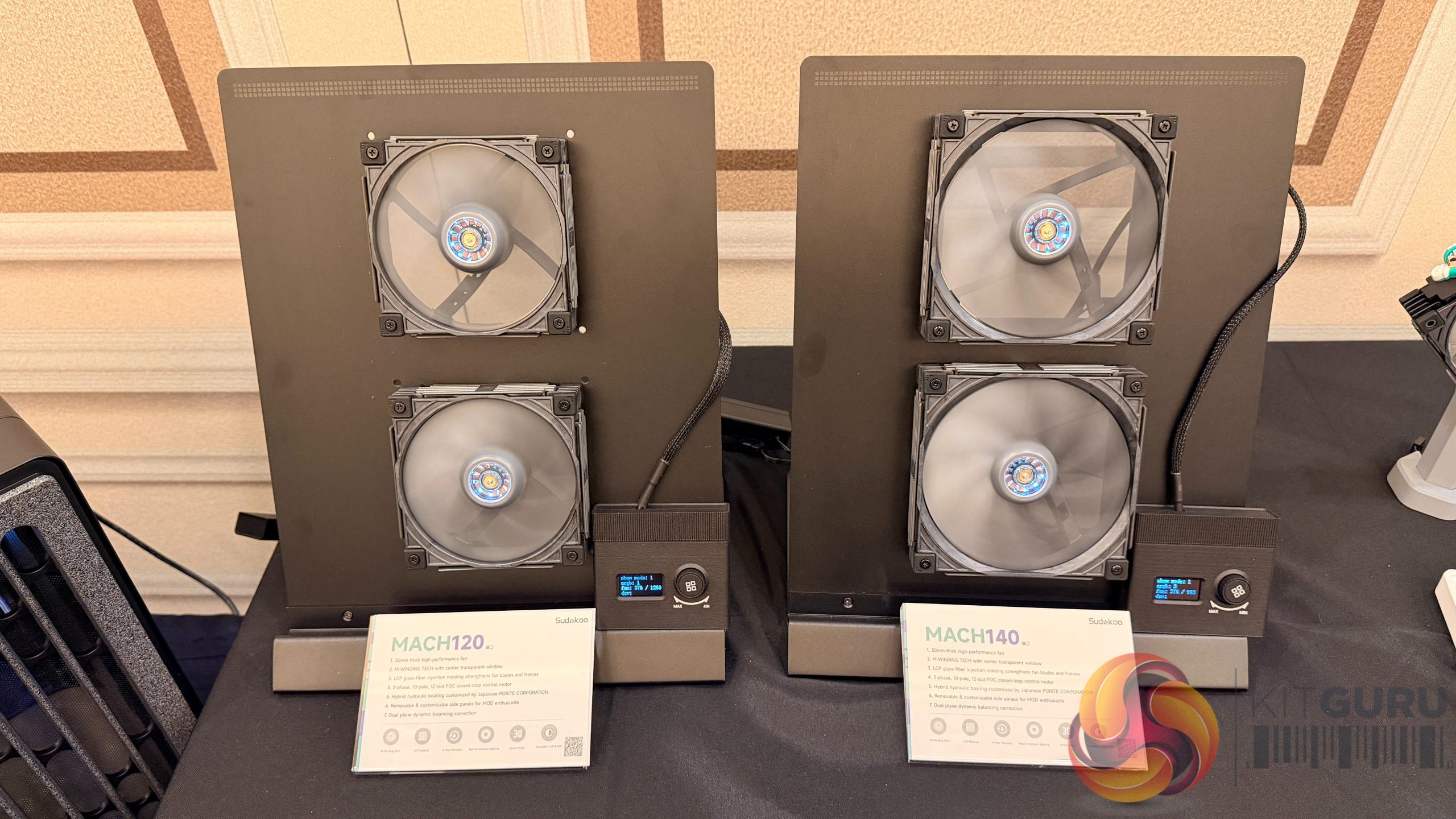
04:35 Mach 120 and Mach 140 Fans
04:50 Proteus 360 Display
04:58 Modded Aircoolers – coming soon
05:27 Cross section of fans
05:41 Magnetic Astra Fans

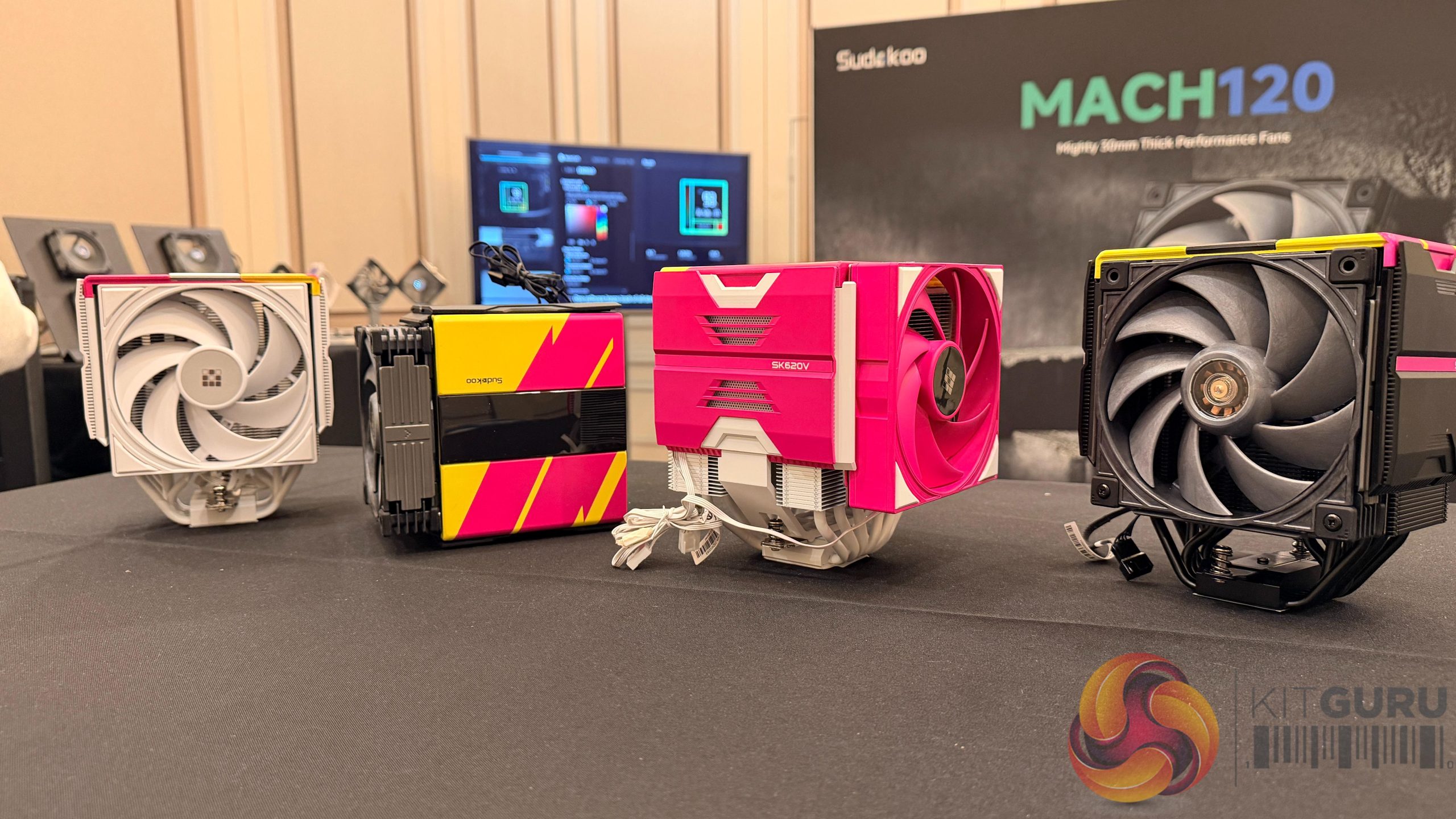
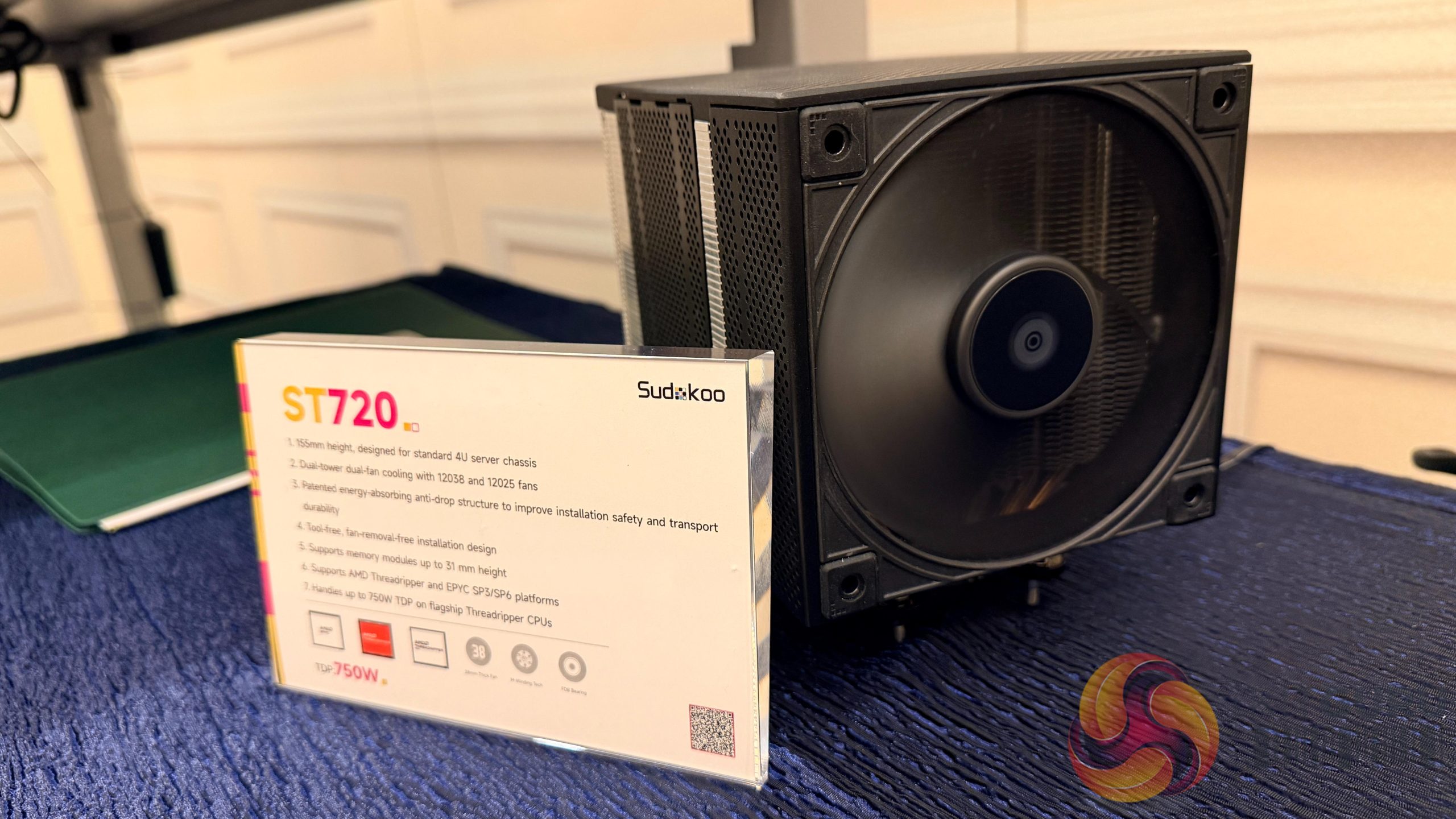
The flagship ST720 is positioned for workstation and server environments where thermal stability and compact dimensions are critical. The cooler supports up to 750W TDP on AMD’s top-end Threadripper processors and is fully compatible with Threadripper and EPYC SP3/SP6 platforms. With a 155mm height, it is sized for standard 4U chassis deployments.

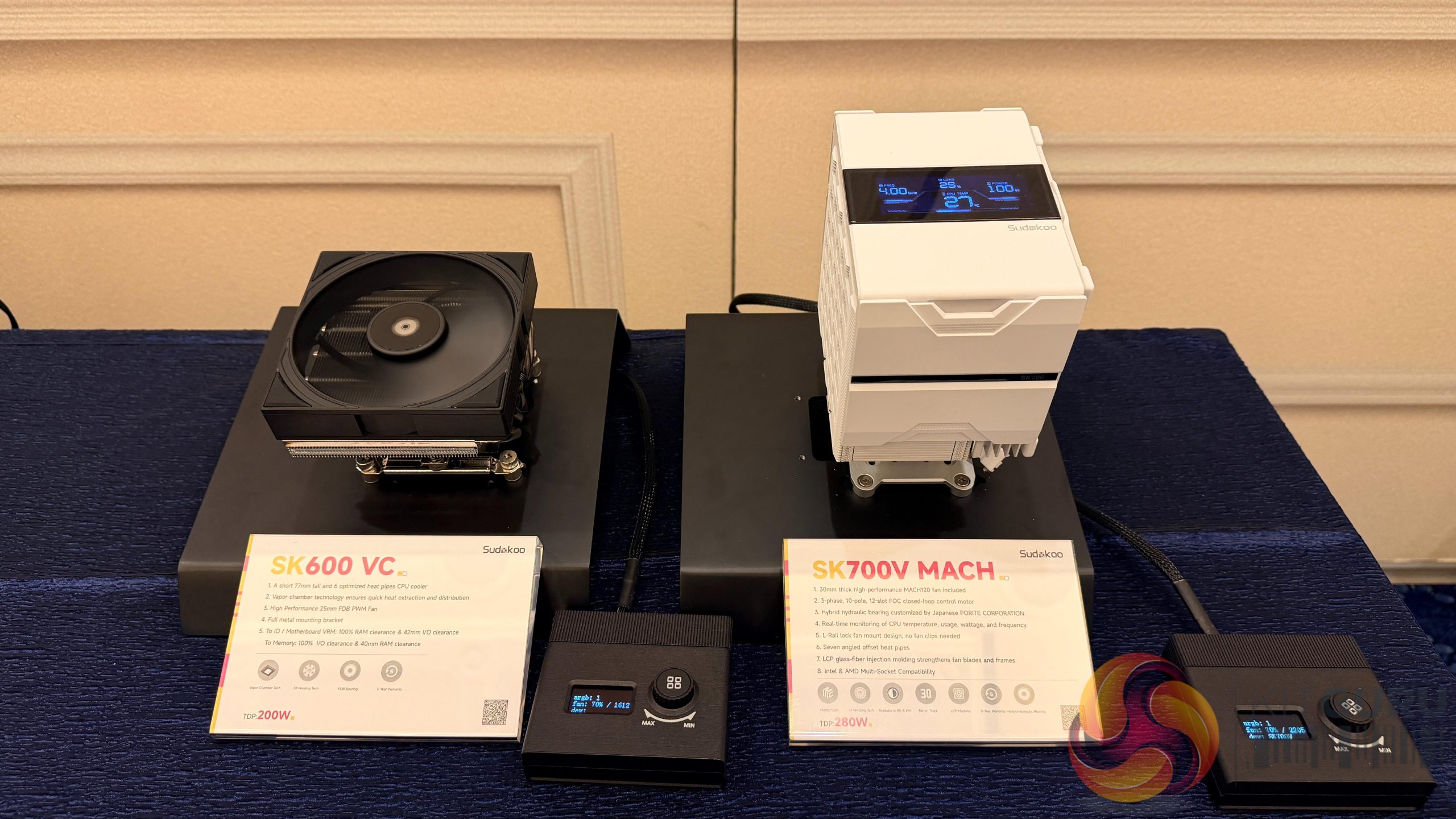
For small‑form‑factor builders, the SK600 VC introduces an ultra‑low‑profile design built around a vapor chamber cold plate and six heat pipes. The cooler stands 77mm tall and uses a 25mm FDB PWM fan, which should give you enough clearance for most RAM sticks on the market.

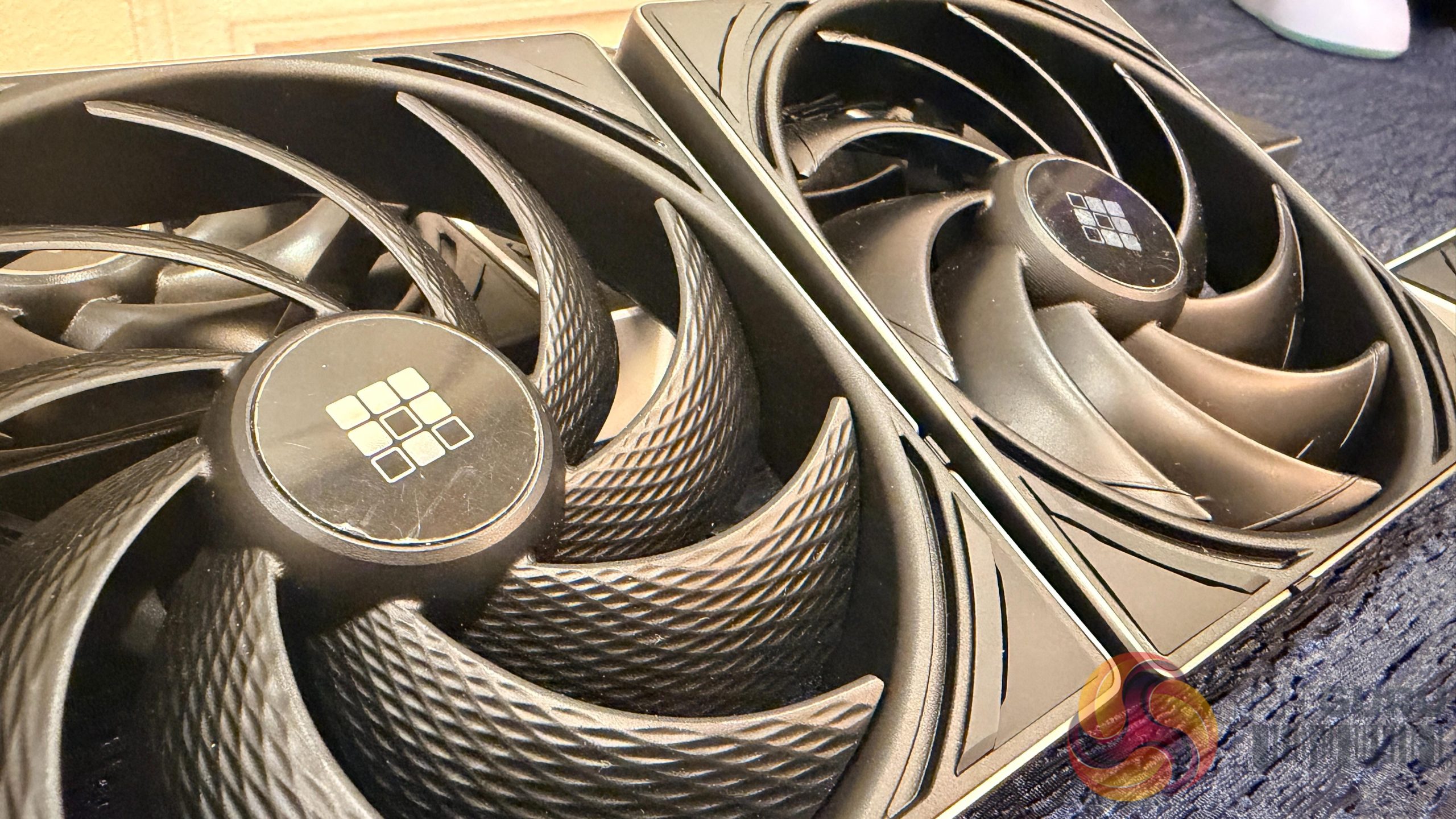
Enthusiast users are the target for the SK700V MACH, a revised version of the company’s high‑end air cooler. The MACH edition includes a 30mm‑thick MACH120 fan and adopts an L‑Rail lock mounting system intended to eliminate traditional fan clips and simplify installation. Intel and AMD multi‑socket support is included.

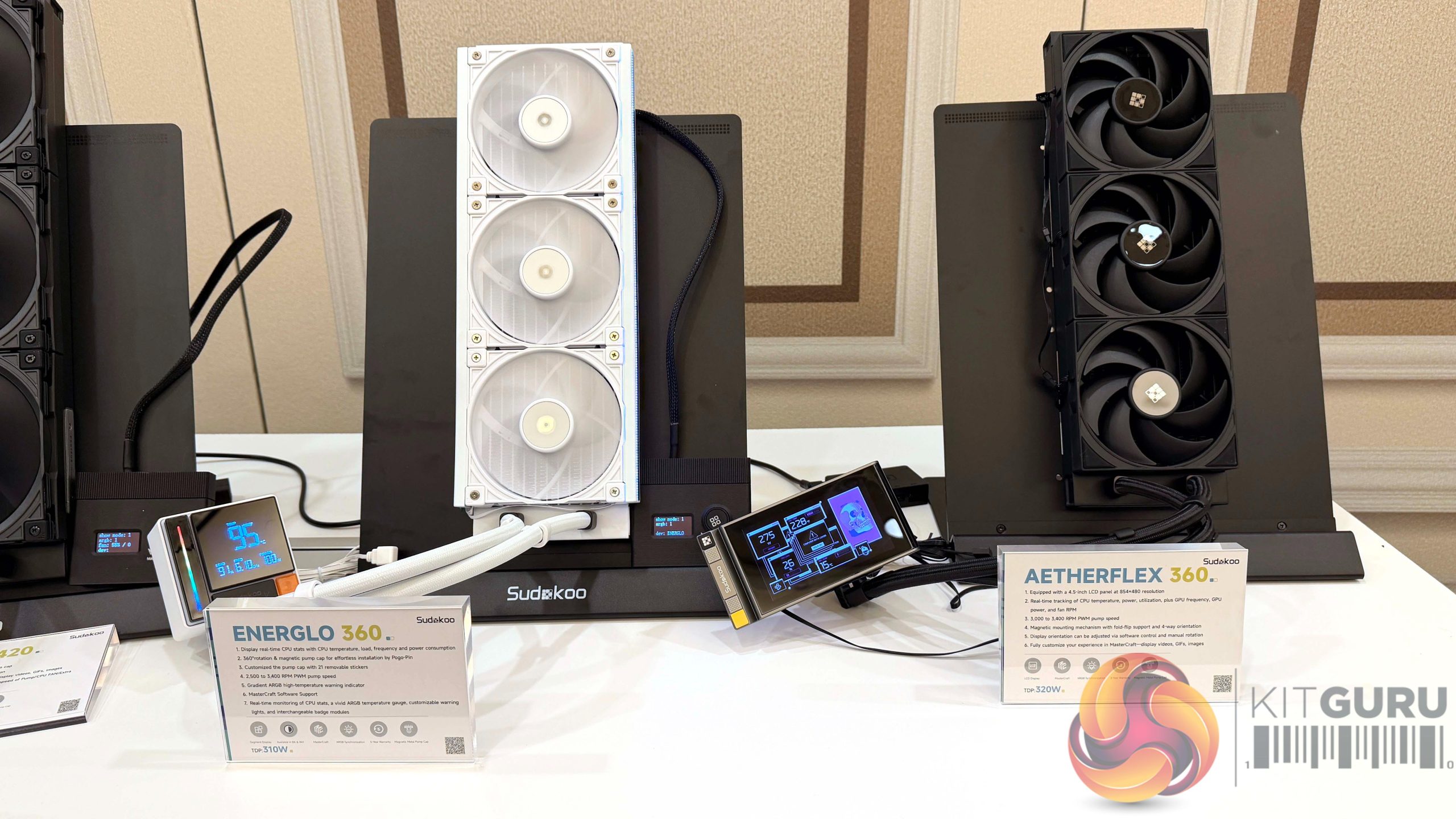
SUDOKOO is also entering the liquid cooling market with the AETHERFLEX 360, a 360mm AIO designed around real‑time system monitoring. The unit features a 4.5‑inch LCD display with an 854×480 resolution panel capable of showing CPU temperature, power and utilisation, along with GPU frequency, GPU power, and fan RPM. The cooler uses a magnetic mounting system with fold‑flip support for easier installation and adjustment.

KitGuru Says: Sudokoo has built out an impressive looking line-up of coolers. We'll look forward to seeing some of these units in action in the months ahead.

The post CES 2026: Sudokoo launches full line-up of CPU coolers first appeared on KitGuru.
  •  

January’s Xbox Game Pass line-up include Star Wars Outlaws; RE: Village and more

Twice a month, Microsoft offers an update on their Xbox Game Pass library, announcing which titles will be arriving over the coming weeks and which will be departing. Microsoft has now officially unveiled the first drop of new titles joining Game Pass this January, including but not limited to Atomfall; Rematch; Star Wars Outlaws; Resident Evil Village and more.

Being released in a staggered form, Xbox Game Pass’ line-up for the first half of January 2026 is as follows:

Available now:

  • Brews & Bastards
  • Little Nightmares Enhanced Edition

Arriving on the 7th of January (to the mid-tier Game Pass Premium):

  • Atomfall
  • Lost in Random: The Eternal Die
  • Rematch
  • Warhammer 40,000: Space Marine – Master Crafted Edition 

Game Pass Village

Coming Soon:

  • Final Fantasy (8th Jan)
  • Star Wars Outlaws (13th Jan)
  • My Little Pony: A Zephyr Heights Mystery (15th Jan)
  • Resident Evil Village (20th Jan)
  • Mio: Memories in Orbit (20th Jan)

As mentioned, a number of titles are also set to depart from the service – with the following being removed on the 15th of January:

  • Flintlock The Siege of Dawn
  • Neon White
  • Road 96
  • The Ascent
  • The Grinch Christmas Adventures

Further details on the upcoming games can be found HERE, but all-in-all the first few weeks of January is looking pretty good for Xbox Game Pass – even if many of the biggest titles were already available on GP Ultimate.

KitGuru says: What do you think of January’s line-up so far? Is it worth the price hike? Let us know down below.

The post January’s Xbox Game Pass line-up include Star Wars Outlaws; RE: Village and more first appeared on KitGuru.
  •  

Riot Games officially announce console release date for 2XKO

Right at the tail-end of last year, Riot Games seemingly accidentally leaked the official console release date for their new 2v2 fighter 2XKO. Though essentially already known, Riot have now republished the trailer officially confirming that 2XKO is launching on consoles in under two week’s time.

Making the announcement via an official console trailer, the team at Riot Games have once again (but properly this time) unveiled the console release date for 2XKO – with the free-to-play fighter arriving on the 20th of January alongside the game’s first Season.

As mentioned, 2XKO is a 2v2 fighter set in the world of League of Legends. Officially released back in September on PC, the game currently features a total of 11 playable characters, with more coming during the aforementioned Season 1.

As of now, the list of champions includes the following:

  • Ahri
  • Blitzcrank
  • Braum
  • Darius
  • Ekko
  • Illaoi
  • Jinx
  • Teemo
  • Vi
  • Warwick
  • Yasuo

Developing a fighting game is no easy task, and while early reactions to the PC version have been positive, we will have to wait and see what console players think of the game when it arrives in less than two weeks’ time.

KitGuru says: Are you looking forward to the console release? Have you tried it on PC yet? Which characters do you hope are added early on in its post-launch life? Let us know down below.

The post Riot Games officially announce console release date for 2XKO first appeared on KitGuru.
  •  

CES 2026: Intel launches 18A ‘Panther Lake’ Core Ultra 3 CPUs

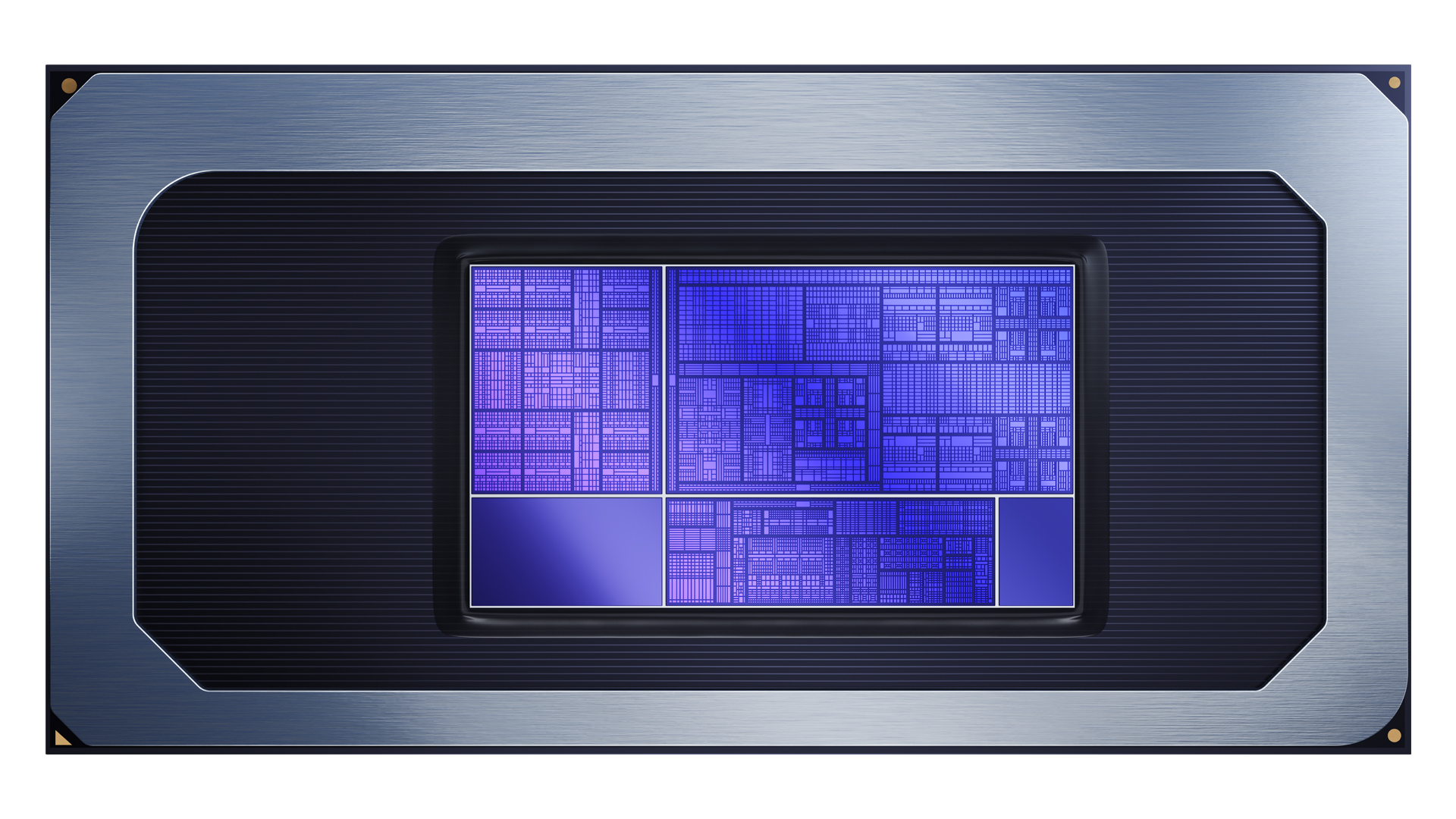
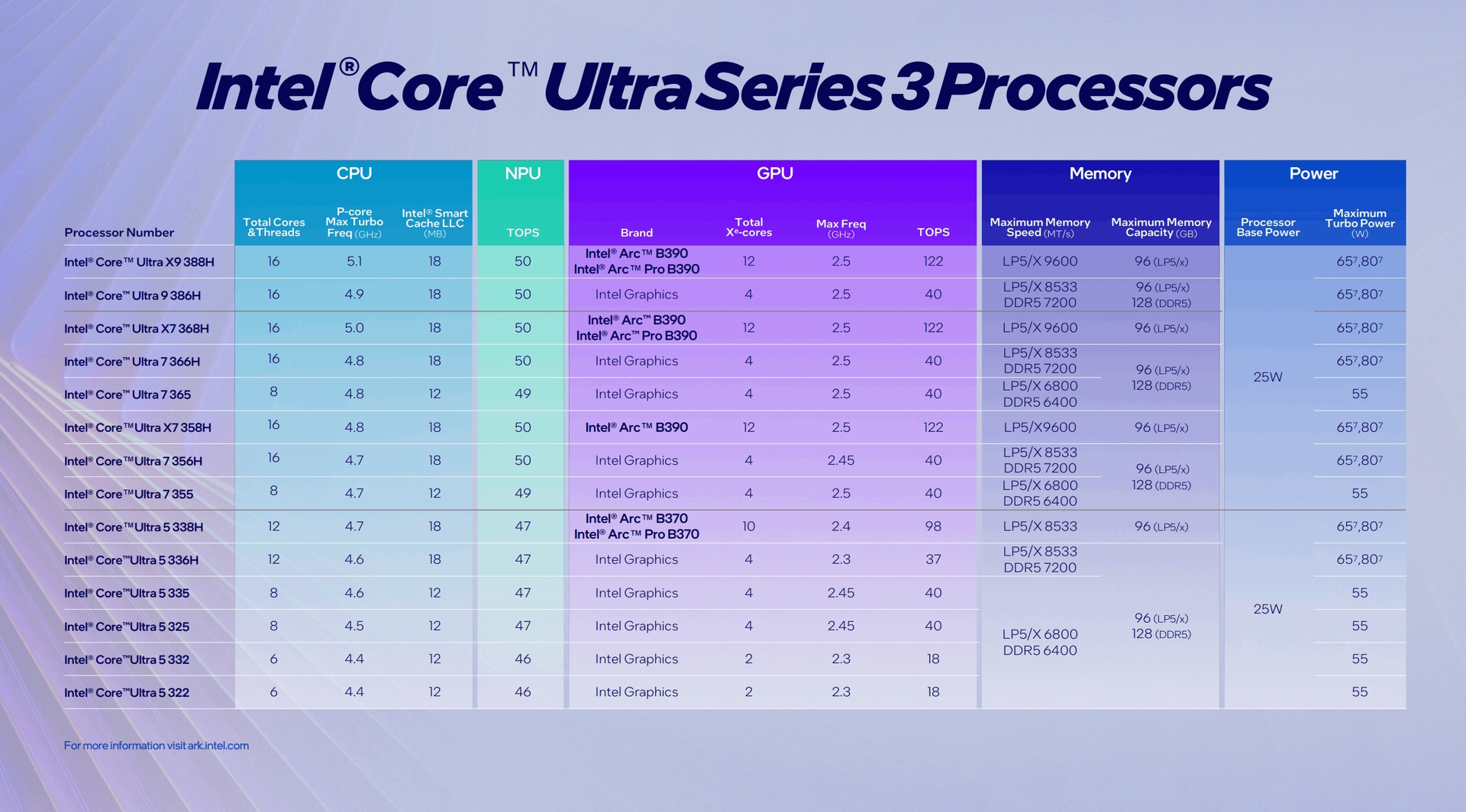
Intel has officially launched its third-generation Core Ultra mobile processors at CES 2026, marking the long-awaited debut of its Intel 18A process technology. Also known as Panther Lake, the Core Ultra Series 3 is the first compute platform designed and manufactured entirely in the US using 18A silicon. With a focus on mobile efficiency and integrated graphics, Intel is claiming a 76% uplift in gaming performance and a 60% improvement in multithreaded performance over the previous generation.

The Core Ultra Series 3 lineup introduces a new naming convention. The flagship Intel Core Ultra X9 388H and Ultra X7 models feature a dedicated “X” prefix, denoting the inclusion of the new Arc B‑series integrated GPU. Built on the Xe3 architecture (derived from the upcoming Battlemage desktop series), the top-tier B390 iGPU includes 12 Xe-cores and is reportedly capable of matching the performance of a discrete Nvidia RTX 4050 laptop GPU. To further boost frame rates, these integrated graphics support XeSS 3, which incorporates AI-driven multi-frame generation similar to DLSS 4.

Architecturally, Panther Lake features a multi-tile design. The compute tile, built on the 18A node, introduces a new core configuration with up to four Cougar Cove P-cores, eight Darkmont E-cores, and four low-power Darkmont E-cores. Despite a lower P-core count than the previous generation, Intel claims that architectural refinements and the die shrink deliver a 60% improvement in multithreaded performance at 25W. The NPU has also been upgraded to the NPU 5 architecture, delivering 50 standalone TOPS for local AI tasks and meeting the requirements of Microsoft’s latest Copilot+ PC standards.

For the first time, these processors are certified for 24/7 reliability across a temperature range from -40°C to 100°C. In robotics and video analytics workloads, Intel says the integrated AI acceleration offers a significant total cost of ownership (TCO) advantage, delivering up to 4.5× higher throughput on vision language models (VLMs) compared to traditional CPU-plus-discrete-GPU configurations. Intel also claims these chips can offer up to 27 hours of battery life.

Laptops powered by the Intel Core Ultra Series 3 are available for pre-order now. Global retail availability is scheduled for January 27th, 2026, with more than 200 designs from partners including MSI, Lenovo, and ASUS expected to reach the market in the first half of the year.

KitGuru says: Intel's 18A node is finally here, and on paper, Panther Lake looks very competitive. It will be interesting to put these chips to the test in the months ahead. 

The post CES 2026: Intel launches 18A ‘Panther Lake’ Core Ultra 3 CPUs first appeared on KitGuru.
  •  

CES 2026: Acer debuts 1000Hz monitor, new Predator laptops

Today at CES, we stopped by to visit Acer to get a look at a wide range of both gaming and productivity-focused gear. This includes the new Predator XB273U F6, an ultra fast QHD gaming monitor that can hit a peak refresh rate of 1000Hz, as well as new laptops, projectors and more.

Watch via YouTube below:

Timestamps:
00:00 laptops, laptops and more laptops
00:20 Helios NEO 165 AI (INTEL)
00:38 Nitro V 165 AI (INTEL)
01:02 Nitro V 16 AI (AMD)
01:20 Predator XB273U F6
01:38 Predator X34 F3
01:50 Acer Nitro 30
02:03 Some more laptops
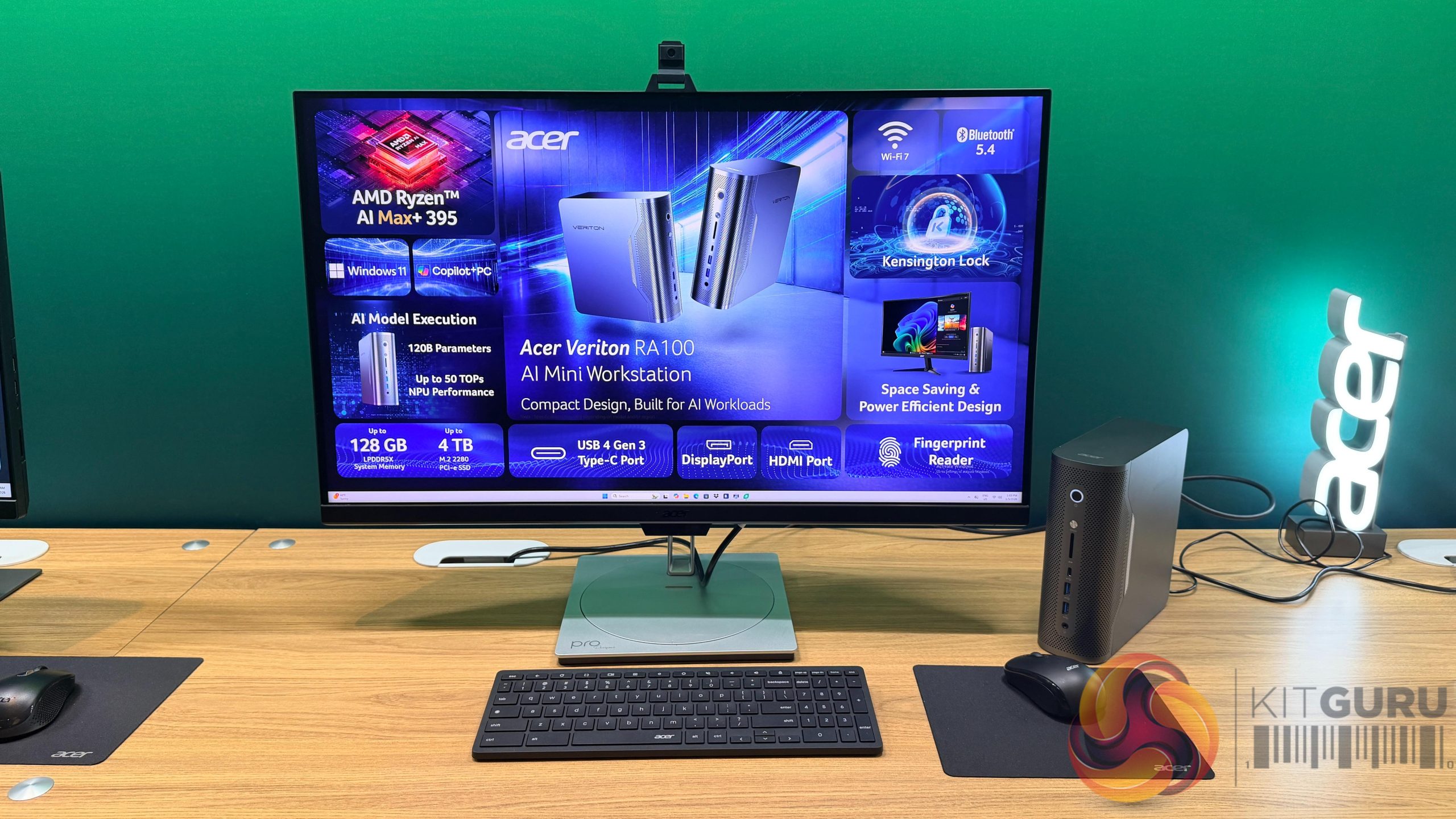
03:25 Veriton RA100 Ai Mini Workstation
03:44 ProDesigner PE320QX
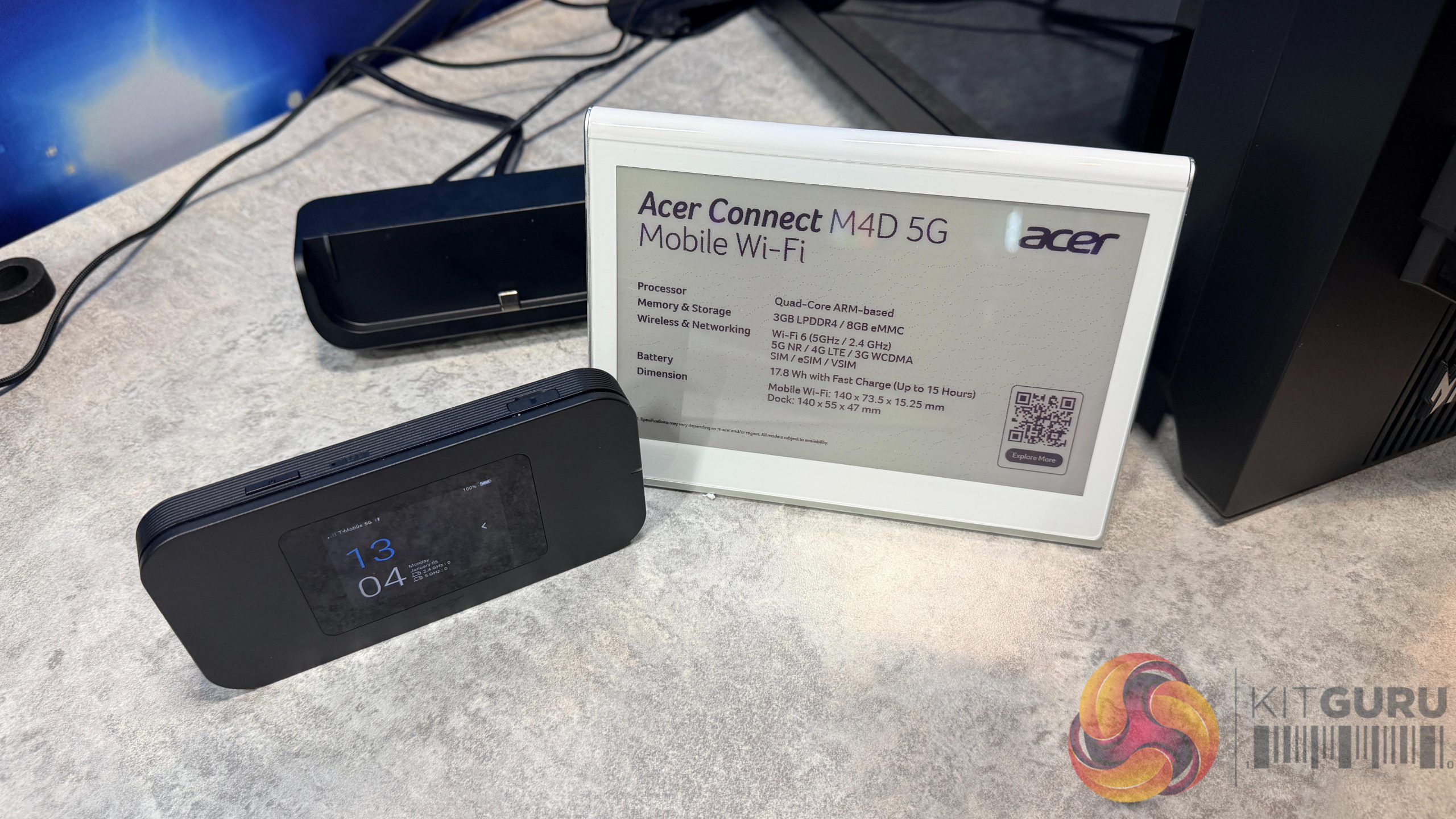
03:55 Connect M4D 5G Mobile WiFi
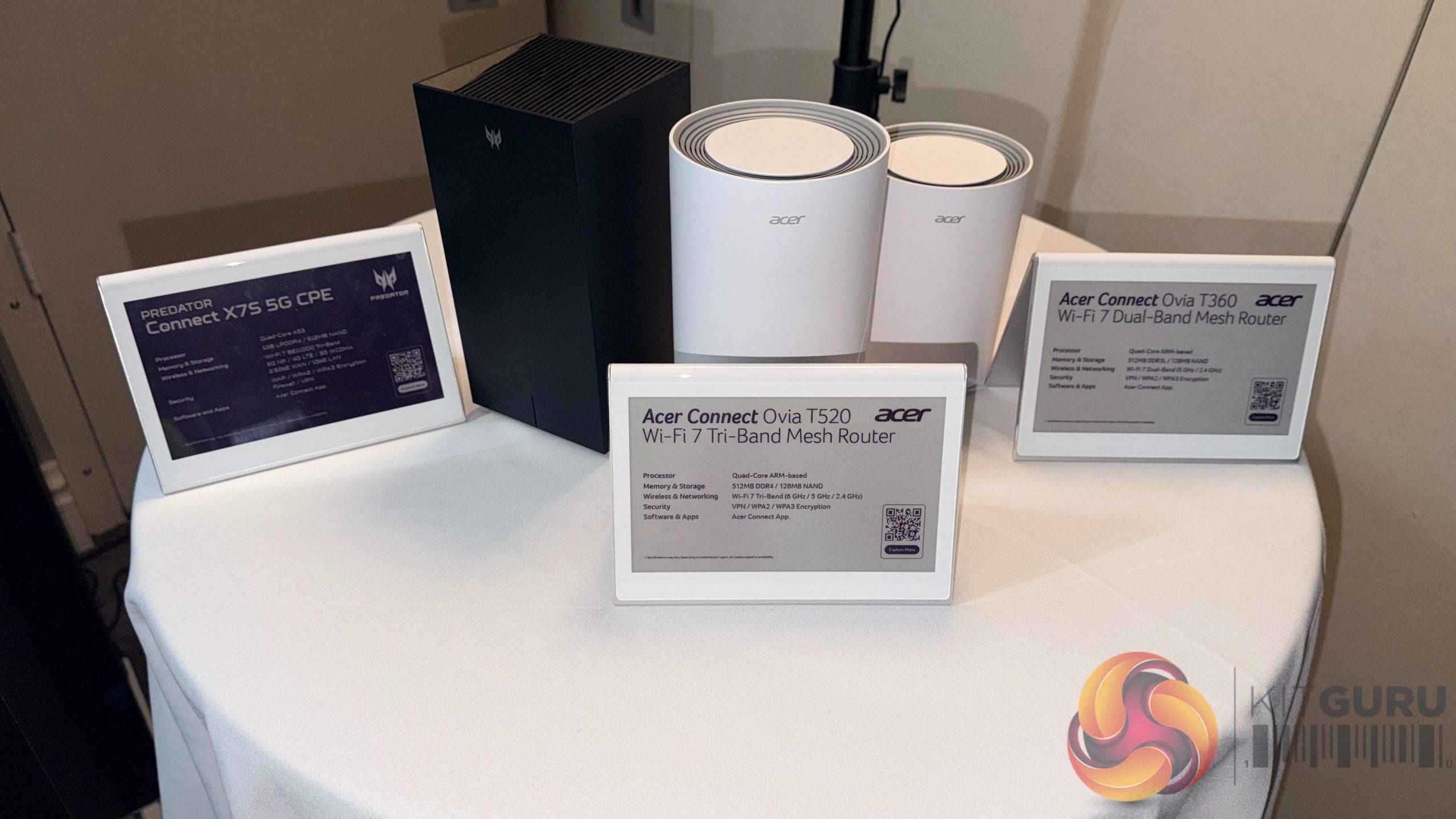
04:28 Connect X75 5G CPE and routers

Acer’s CES presence this year puts a strong emphasis on displays, starting with a trio of high‑refresh gaming monitors and a new 6K creator panel. The Predator XB273U F6 leads the group, a 27‑inch QHD IPS monitor that runs at 500Hz natively and can reach 1000Hz through its Dynamic Frequency and Resolution mode. It’s aimed squarely at competitive players, backed by AMD FreeSync Premium, factory‑calibrated color, and full ergonomic adjustment.

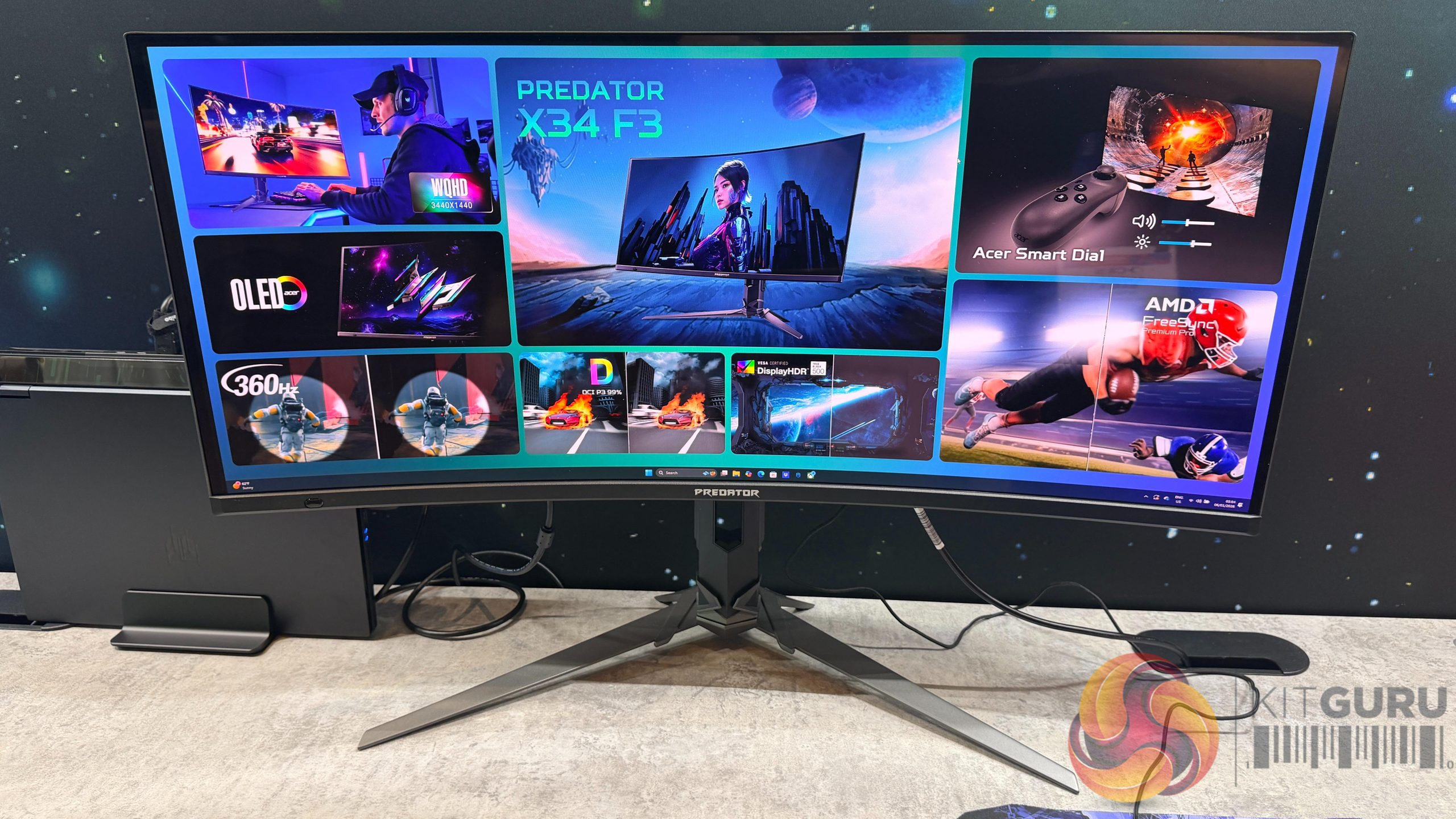
The curved Predator X34 F3 showcases Acer’s QD‑OLED implementation at 360Hz, delivering deep contrast, a 0.03ms response time, and FreeSync Premium Pro support. For users who split time between gaming and creative work, the Nitro XV270X P offers a 5K/165Hz mode alongside a 1440p/330Hz option. Acer is also showing the ProDesigner PE320QX, a 31.5‑inch 6K display with HDR600, wide‑gamut coverage, USB4 connectivity, and a Reflection‑Free coating designed for studio environments.

Another highlight of the display section is the Vero HL1820, a 4K RGB laser projector built around color accuracy and long‑term efficiency. It outputs 5500 lumens, covers 106% of BT.2020, supports 1080p/240Hz gaming, and uses a mercury‑free laser engine rated for up to 30,000 hours.

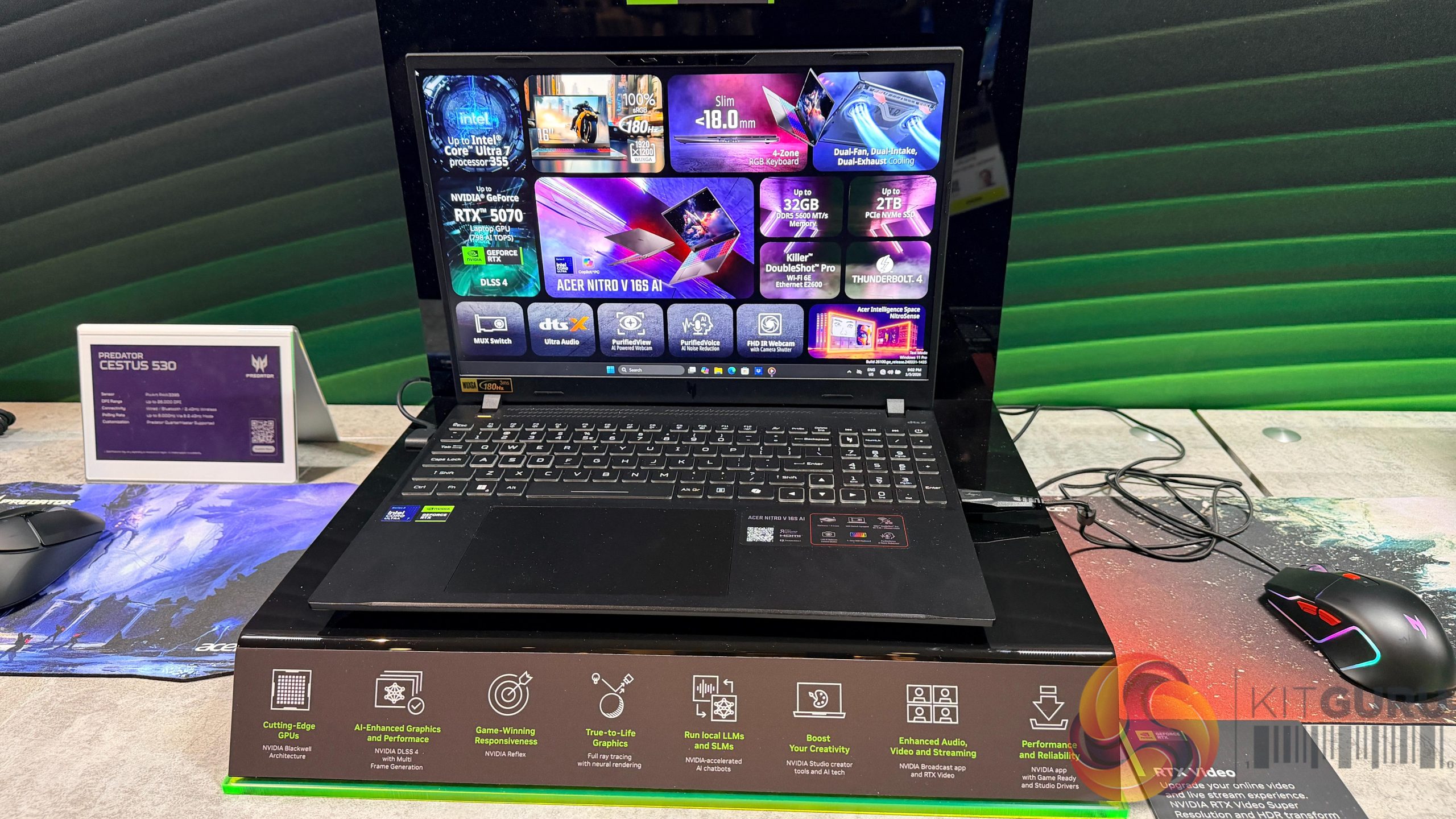
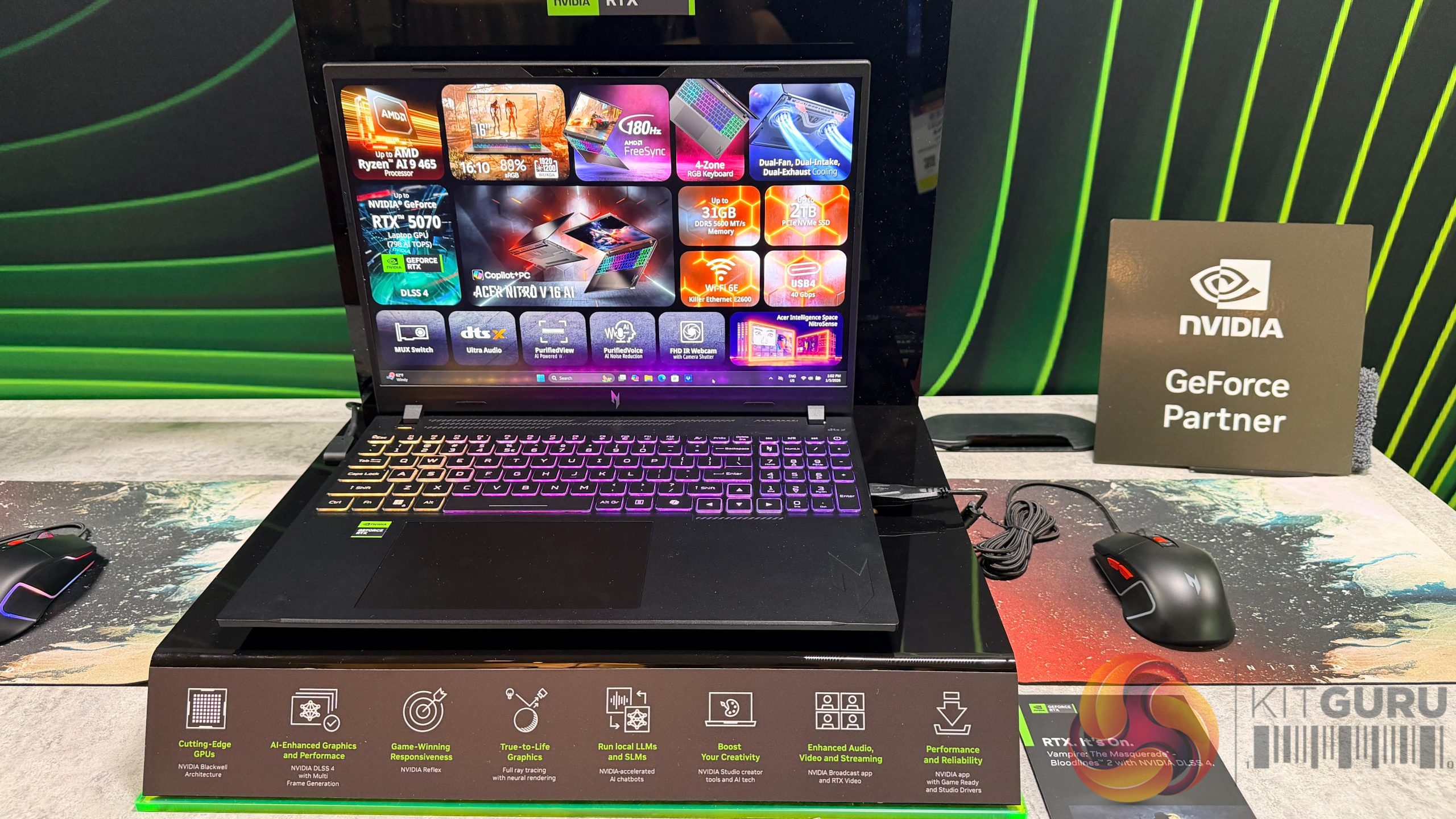
The company’s gaming laptop lineup is moving to Intel’s new Core Ultra Series 3 processors and NVIDIA’s GeForce RTX 50‑series GPUs. The Predator Helios Neo 16S AI sits at the top, pairing up to a Core Ultra 9 386H with an RTX 5070 Laptop GPU inside an 18.9mm metal chassis. The model on display features a 16‑inch WQXGA OLED panel, liquid metal cooling, and support for up to 64GB of DDR5 memory. The Nitro V 16 AI and Nitro V 16S AI serve as more accessible options, both offering up to a Core Ultra 7 355 and RTX 5070 Laptop GPU, with the 16S model slimming down to under 17.9mm. All three systems support Acer Intelligence Space and Copilot+ PC features on Windows 11, with on‑device NPUs accelerating tasks like Live Captions and image generation.

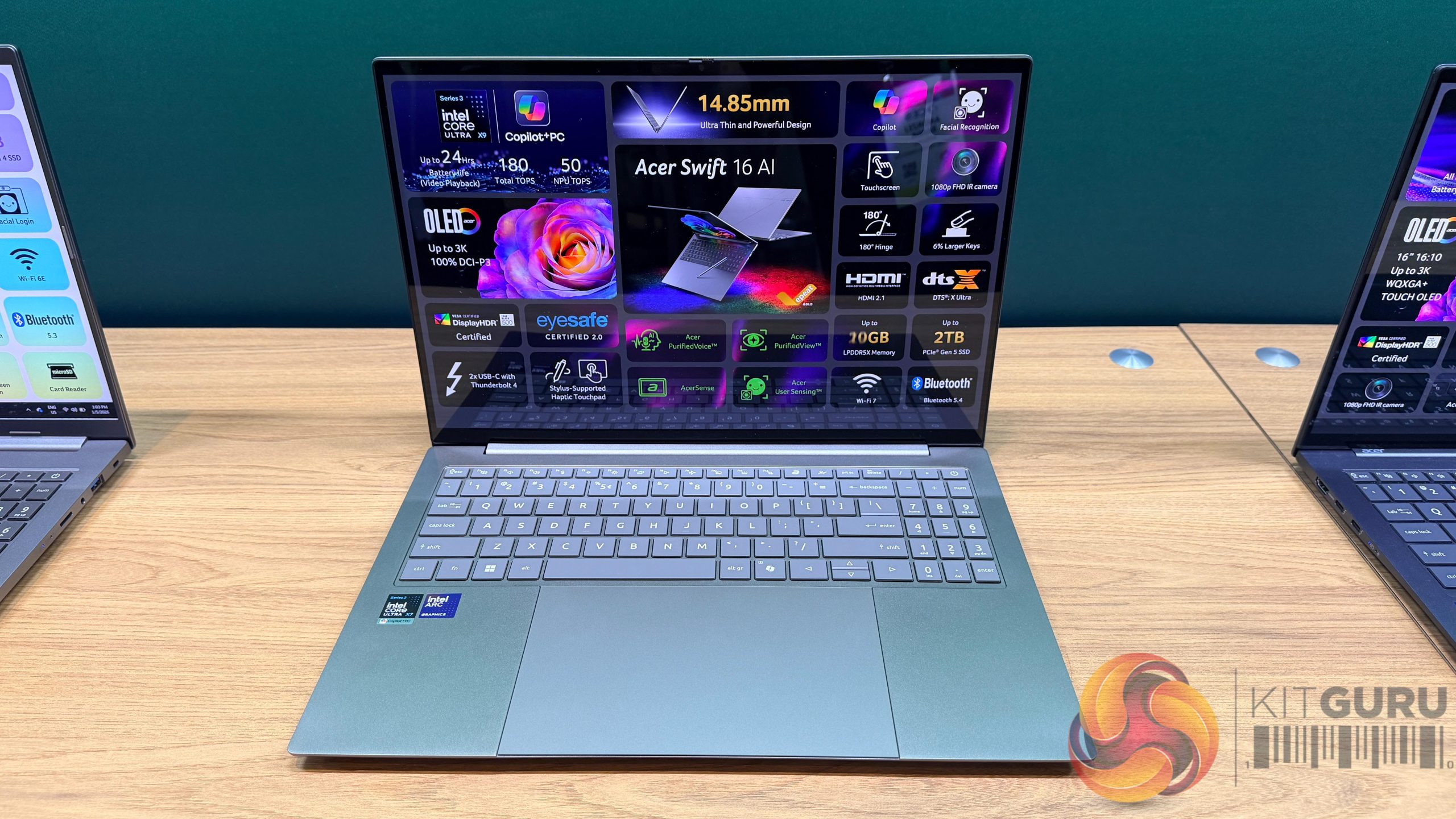
Acer’s broader AI‑focused notebook strategy is represented by the new Swift AI series. The Swift 16 AI is the flagship, built from aluminum and powered by up to an Intel Core Ultra X9 388H with integrated Arc B390 graphics. Acer is showcasing its unusually large haptic touchpad, which supports stylus input and is designed for direct interaction with AI‑driven creative tools. The laptop features a 16‑inch 3K OLED 120Hz touch display and DTS:X Ultra speakers.

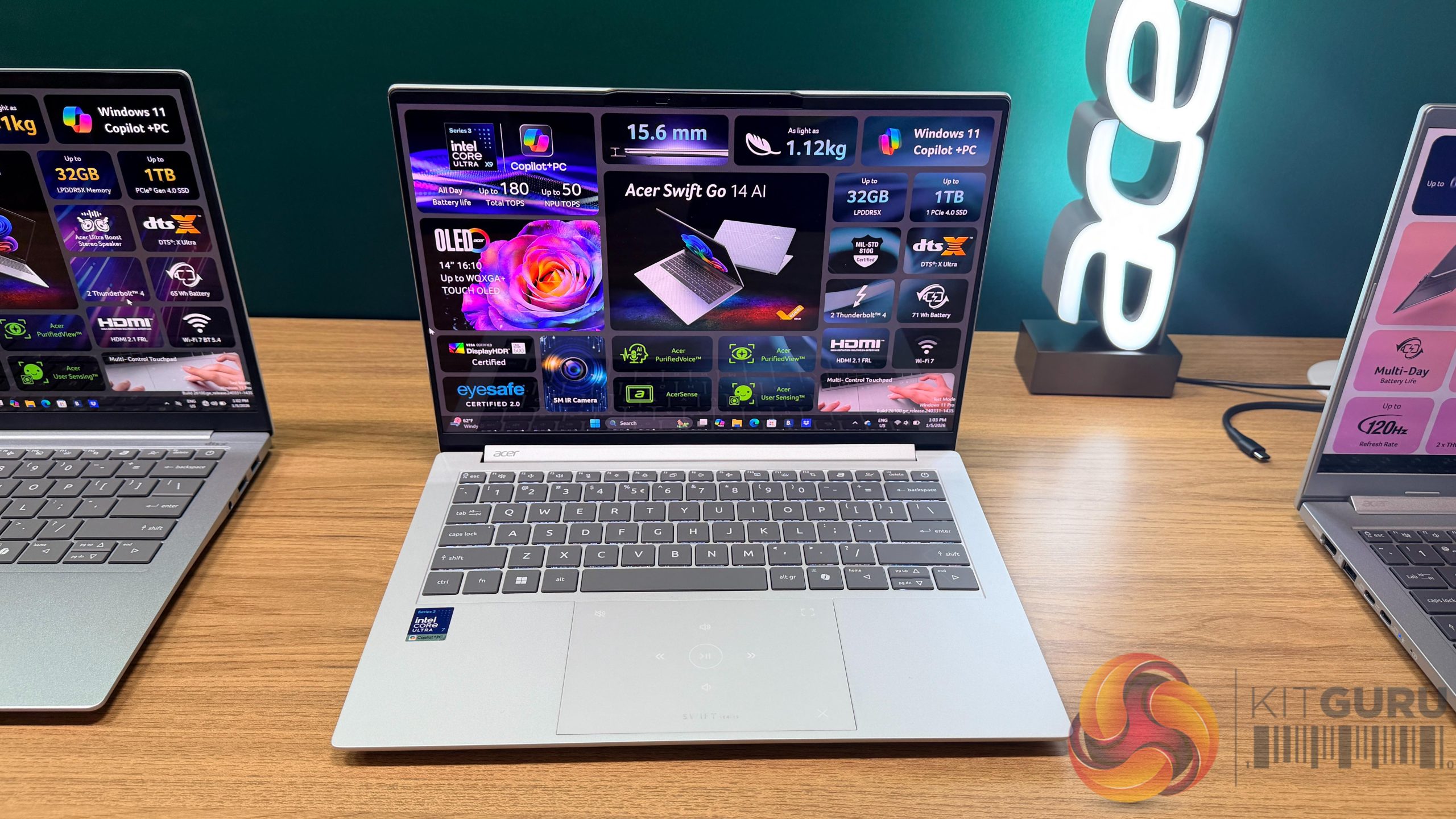
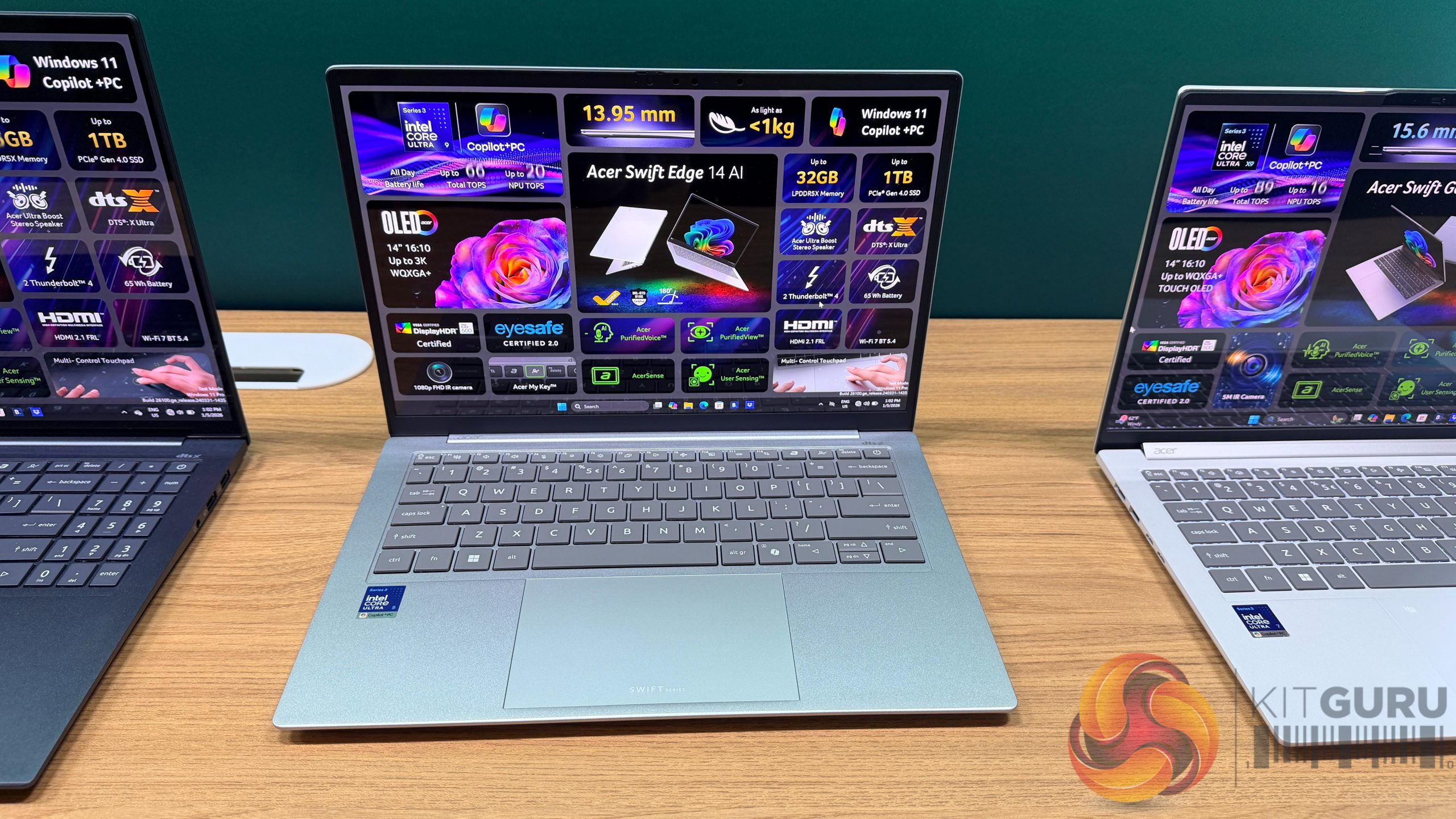
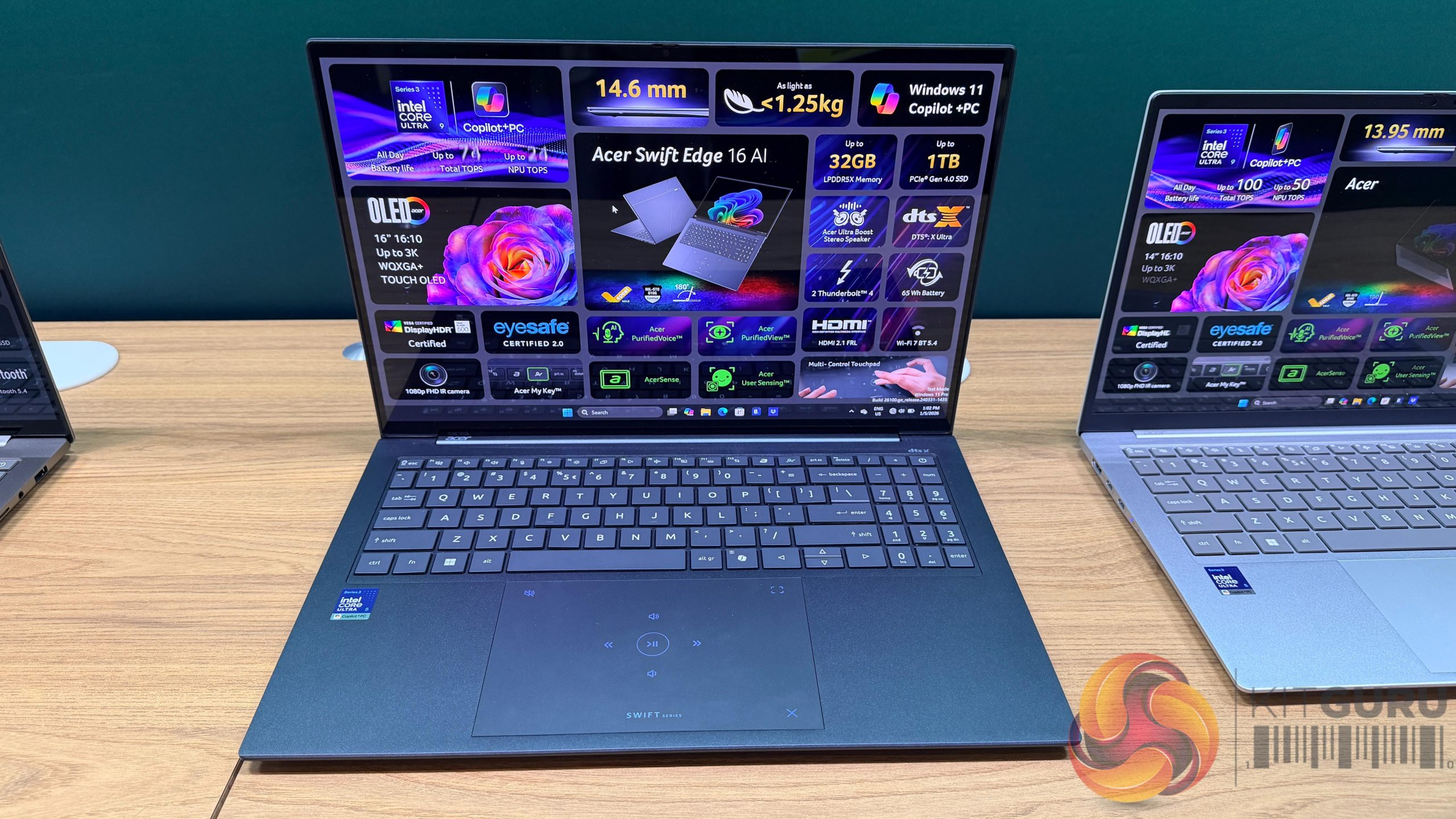
The Swift Edge 14 and 16 AI models emphasise portability, with the 14‑inch version weighing under 1kg while still offering up to a Core Ultra 9 386H, 3K OLED display options, Wi‑Fi 7, and MIL‑STD durability. The Swift Go 14 and 16 AI models round out the lineup with more mainstream pricing but similar hardware options, including OLED displays, 180‑degree hinges, and 5MP IR webcams.

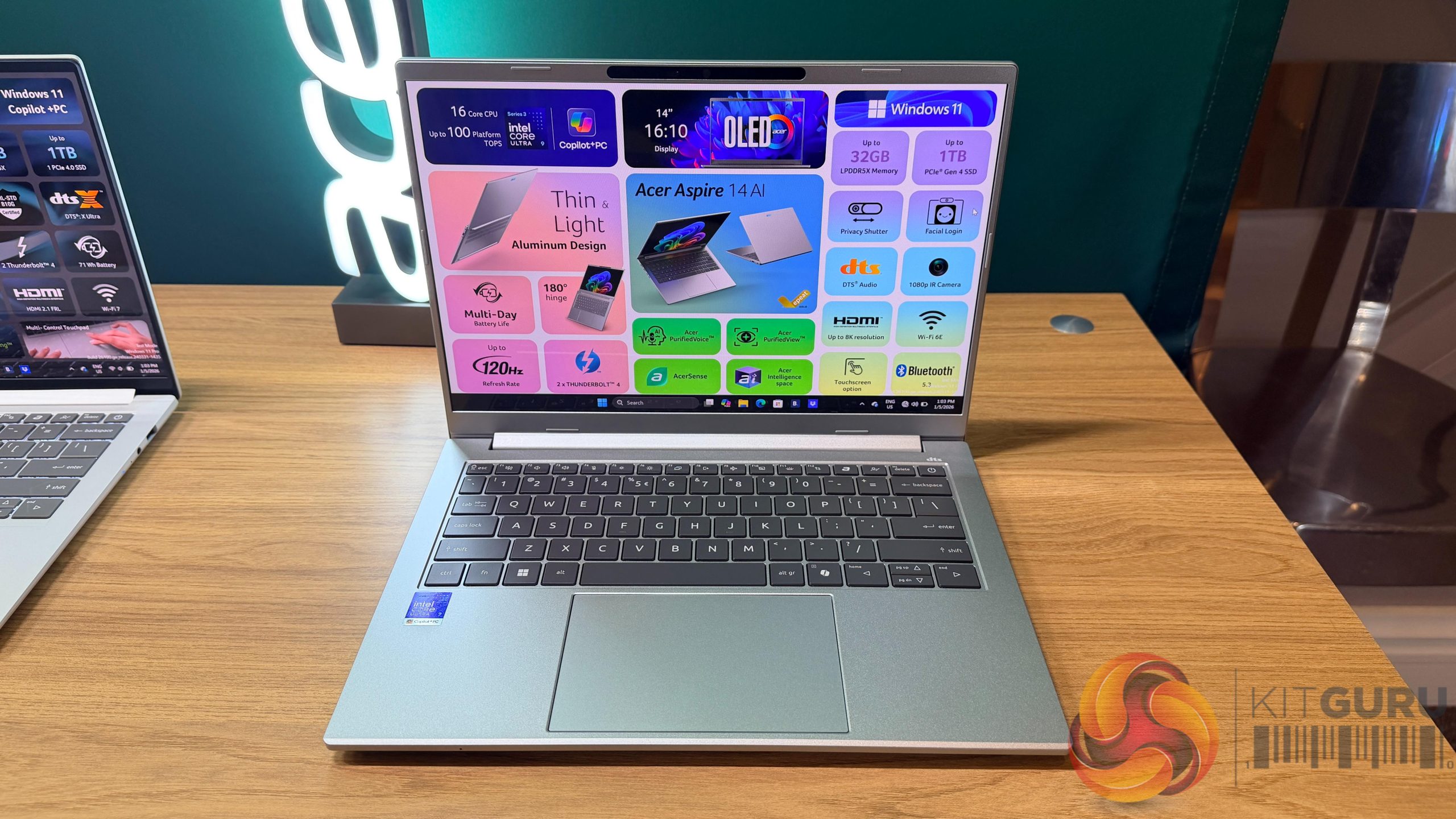
Acer is also updating its Aspire line for 2026 with the Aspire 14 AI and Aspire 16 AI. Both run up to a Core Ultra 9 386H, support up to 32GB of memory and 2TB of PCIe Gen 4 storage, and offer WUXGA displays up to 120Hz with optional OLED panels. The designs remain thin and light with 180‑degree hinges, large touchpads, and a full set of ports including Thunderbolt 4 and HDMI 2.1. Acer’s AI‑powered features like PurifiedVoice, PurifiedView, AcerSense, and the customisable My Key are included across the range.

Discuss on our Facebook page, HERE.

KitGuru Says: Acer had a lot of products launching at CES this week. We'll see all of these monitors and laptops rolling out to the retail market in the coming months.

The post CES 2026: Acer debuts 1000Hz monitor, new Predator laptops first appeared on KitGuru.
  •  

Sigourney Weaver, Jason Isaacs and more officially cast in live-action Tomb Raider show

Back in 2024 it was officially announced that Amazon was working on a live-action adaptation of the popular video game franchise Tomb Raider. While the titular Lara Croft was already confirmed to be played by Game of Thrones’ Sophie Turner, a large selection of the rest of the show’s cast have now been revealed.

Taking to the official Tomb Raider subreddit to make the announcement, Amazon Studios unveiled the list of supporting actors which have been cast in the upcoming live-action TV Prime Video show.

As mentioned, we already knew that Sophie Turner would be taking on the role of Lara Croft. That said, Amazon have now unveiled nearly a dozen other actors set to appear in the show, including but not limited to:

  • Jason Isaacs as Atlas DeMornay (Lara’s uncle)
  • Bill Paterson as Winston (Croft family Butler)
  • Martin Bobb-Semple as Zip (Lara’s friend)
  • Celia Imrie as Francine (Head of Advancement at the British Museum)
  • Sigourney Weaver as Evelyn Wallis (“a mysterious, high-flying woman who is keen to exploit Lara's talents”)

Tomb Raider live-action

Alongside the cast announcement, showrunner Phoebe Waller-Bridge shared the following message: “Tomb Raider boasts a plethora of iconic characters. I am thrilled to have been able to bring some personal and fan favourites to the screen while also introducing a few new rascals of our own to the mix. This cast is beyond my wildest dreams!”

The full list of announced cast members can be found HERE. Little is known about the plot for this live-action Tomb Raider, but with so many original characters being included, expect a story which is adjacent – but not directly comparable – to the games which it is based on.

KitGuru says: Are you looking forward to the show? What do you think of the announced cast? Could this be the best Tomb Raider adaptation yet? Let us know down below.

The post Sigourney Weaver, Jason Isaacs and more officially cast in live-action Tomb Raider show first appeared on KitGuru.
  •  

CES 2026: GIGABYTE rethinks GPU cooling with Windforce Hyperburst on RTX 5090 Infinity

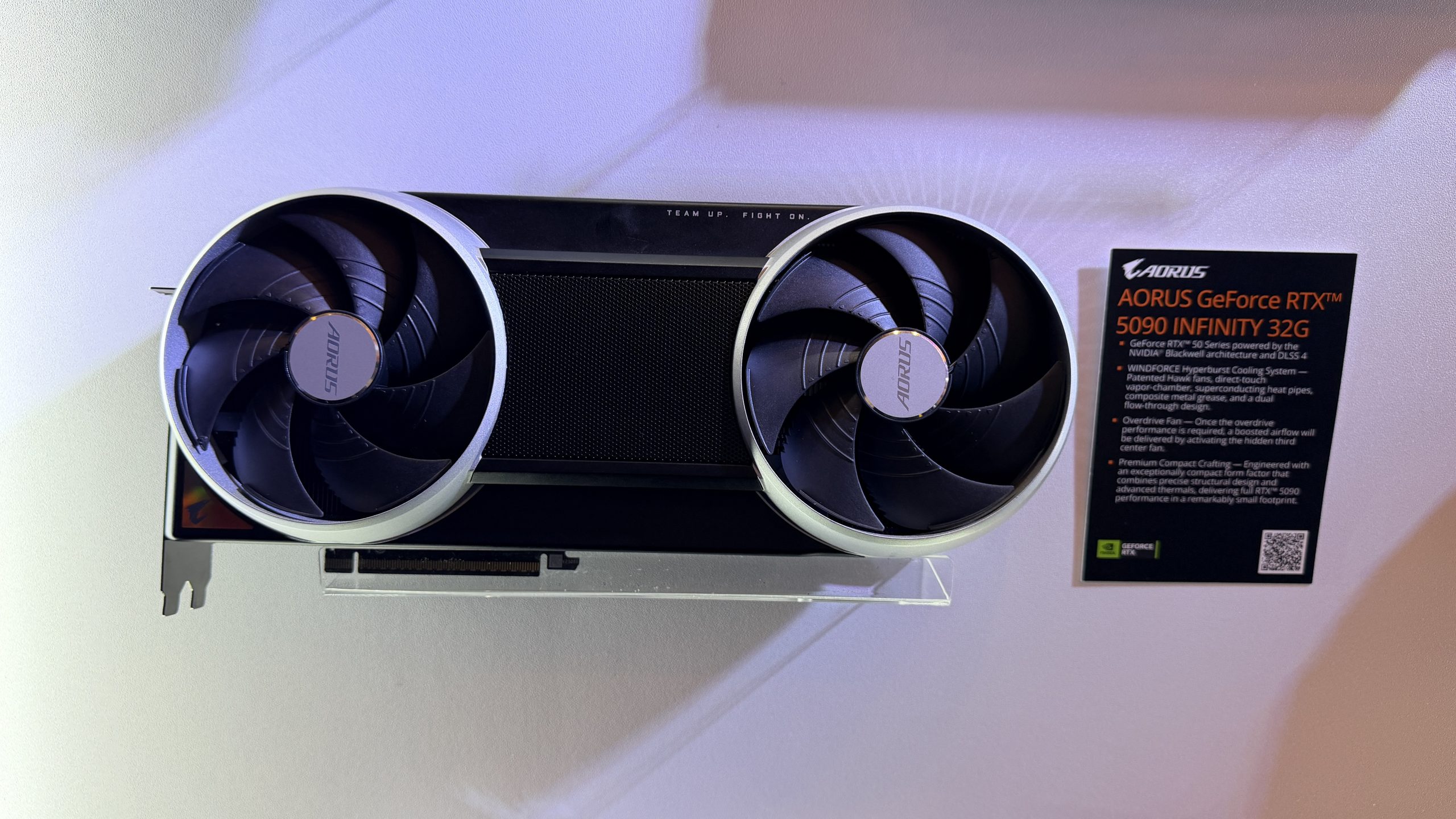
At CES this week, Gigabyte is showcasing its new RTX 5090 Infinity graphics card, which makes some rather bold changes to traditional GPU cooler design. The radically redesigned Windforce Hyperburst cooler is the star of the show here, moving away from the typical triple-fan shroud we are used to seeing towards a very unique design that we've not ever seen before on a custom-cooled GPU.

Gigabyte is positioning this as a next‑generation thermal solution. The Hyperburst system is paired with GIGABYTE’s first separated PCB layout, a design approach originally pioneered by Nvidia. By splitting the board and opening up the structure, the card enables a Double Flow Through path that pushes air across both sides of the backplate with fewer obstructions. A dedicated Overdrive Fan sits at the centre of the card and only activates under heavy load, injecting an extra column of airflow when temperatures spike.

Aside from the cooler, this GPU is your typical RTX 5090, offering the best performance currently available in a gaming GPU, with full support for the latest features like DLSS 4 and enhanced AI compute capabilities. Unfortunately, we don't have any specific data on how cool the GPU runs, or what clock speeds it achieves out of the box, but we should hear more on that in the coming months.

GIGABYTE has wrapped the new cooler in a circular, die‑cast metal frame with a matching circular heatsink and the company’s RGB Halo lighting. Despite the unconventional design, the card maintains a relatively compact footprint at 33cm long and 14.5cm tall, keeping it compatible with a wide range of cases.

Discuss on our Facebook page, HERE.

KitGuru Says: What do you think of the new Windforce Hyperburst cooler? Do you think we'll see more of this design for future generation graphics cards?

The post CES 2026: GIGABYTE rethinks GPU cooling with Windforce Hyperburst on RTX 5090 Infinity first appeared on KitGuru.
  •  

CES 2026: ASRock debuts full line-up of AIO liquid coolers

At CES this week, ASRock has introduced a complete next‑generation AIO liquid cooling lineup, expanding its hardware portfolio beyond motherboards and graphics cards. The new range covers high‑end enthusiast systems, workstation platforms, gaming PCs and mainstream builds, with each series targeting a different segment.

At the top of the stack, the Taichi AQUA series offers a dual‑mode top cover that can switch between a magnetic 3.4‑inch LCD display and a transparent window showing coolant flow. The Taichi AQUA 360 LCD uses a dual‑pump design rated for 500W+ TDP, a 38mm radiator, an integrated flow indicator and LCP fans with dual‑ball‑bearing construction and IP54 protection.

The WS series is aimed at workstation platforms such as AMD Ryzen Threadripper (sTR5) and Intel Xeon W (LGA4677). It features a full‑coverage cold plate designed for large workstation CPUs, along with the same dual‑pump 500W+ architecture, 38mm radiator and LCP fans. ASRock positions this series for sustained, high‑load operation.

For gaming systems, the Phantom Gaming 360 LCD combines a 3.4‑inch LCD display with a 32mm radiator and a 3‑phase, 6‑slot pump. A VRM cooling module assists with thermal management around the CPU socket, while high‑output fans and a Halo ARGB frame provide airflow and lighting.

The Steel Legend series focuses on everyday durability, retaining the 3.4‑inch LCD display, 3‑phase pump and VRM cooling module, supported by LCP fans and dual‑ball‑bearing construction for consistent airflow.

For mainstream builders, the Challenger and Pro series emphasise ease of installation and balanced performance. The Challenger models include a 3‑inch smart digital display, pre‑installed fans with hidden cabling, a quick‑release mounting bracket and multifunctional tube clips. The Pro series adds ARGB lighting and uses a tuned fan configuration to balance cooling, noise and aesthetics.

All models include a 6‑year warranty, with ASRock positioning the lineup as part of a broader effort to build a unified ecosystem across its PC hardware products.

Discuss on our Facebook page, HERE.

KitGuru Says: Would you opt for an ASRock AIO cooler to go with an ASRock motherboard? 

The post CES 2026: ASRock debuts full line-up of AIO liquid coolers first appeared on KitGuru.
  •  

Asus reveals next-gen displays, new gaming peripherals and WiFi 8 devices

Ahead of CES, members of the European Hardware Association, including KitGuru, were invited to Asus HQ to get an early look at upcoming gaming hardware. Here, we take you through Asus ROG's next-generation gaming monitors, as well as new peripherals and WiFi 8 devices. 

Visual output and immersion

ASUS framed its 2026 display line-up as a series of portfolios, rather than a set of isolated products. Gaming and professional are well understood market segments, but there is now increased emphasis on ‘prosumer’ products that bridge the gap.Across all markets, ASUS is clearly trying to address clarity, brightness control and long-term usability.

A key technical change highlighted early in our tour of the company’s new products was the shift to a new RGB stripe pixel layout in next-generation OLED panels. ASUS stressed that this change is central to improving text clarity and colour precision as well as overall image stability, particularly at higher brightness levels. Alongside this, ASUS is using its own BlackShield film-coating technology to improve perceived black levels and reduce glare by up to 40%. Hardness is also increased for 2.5x more scratch resistance. This enhancement for the ROG Swift OLED PG34WCDN certainly adds to the premium look/feel of this screen.

At the gaming end of the spectrum we have the ROG Swift OLED PG27UCWM (Tandem RGB OLED) and PG34WCDN (RGB QD-OLED). ASUS claims higher sustained brightness, improved colour volume (PG27UCWM) & refresh rates designed to match next-generation GPUs, with DisplayPort 2.1a support positioned as an important part of future-proofing.
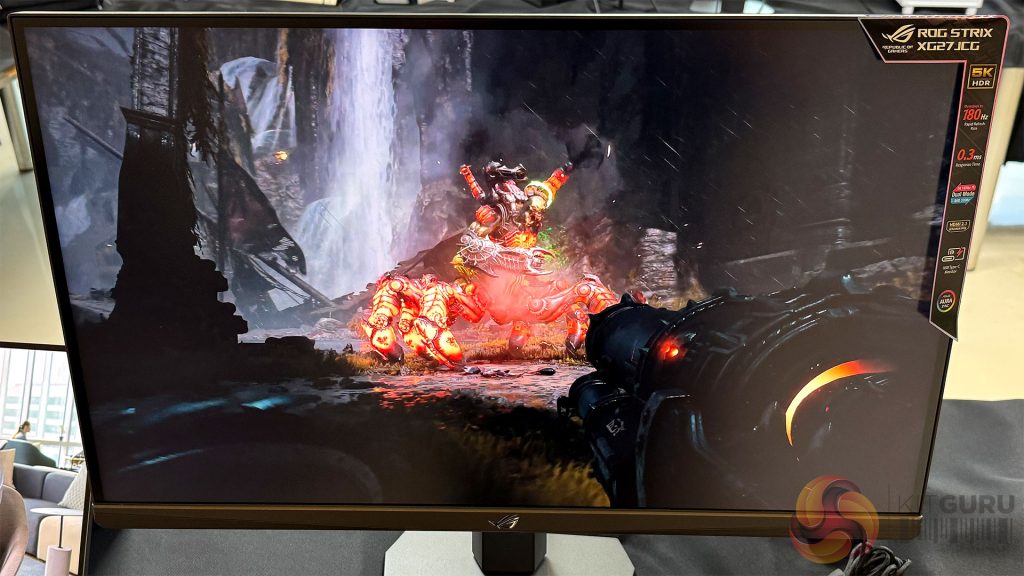
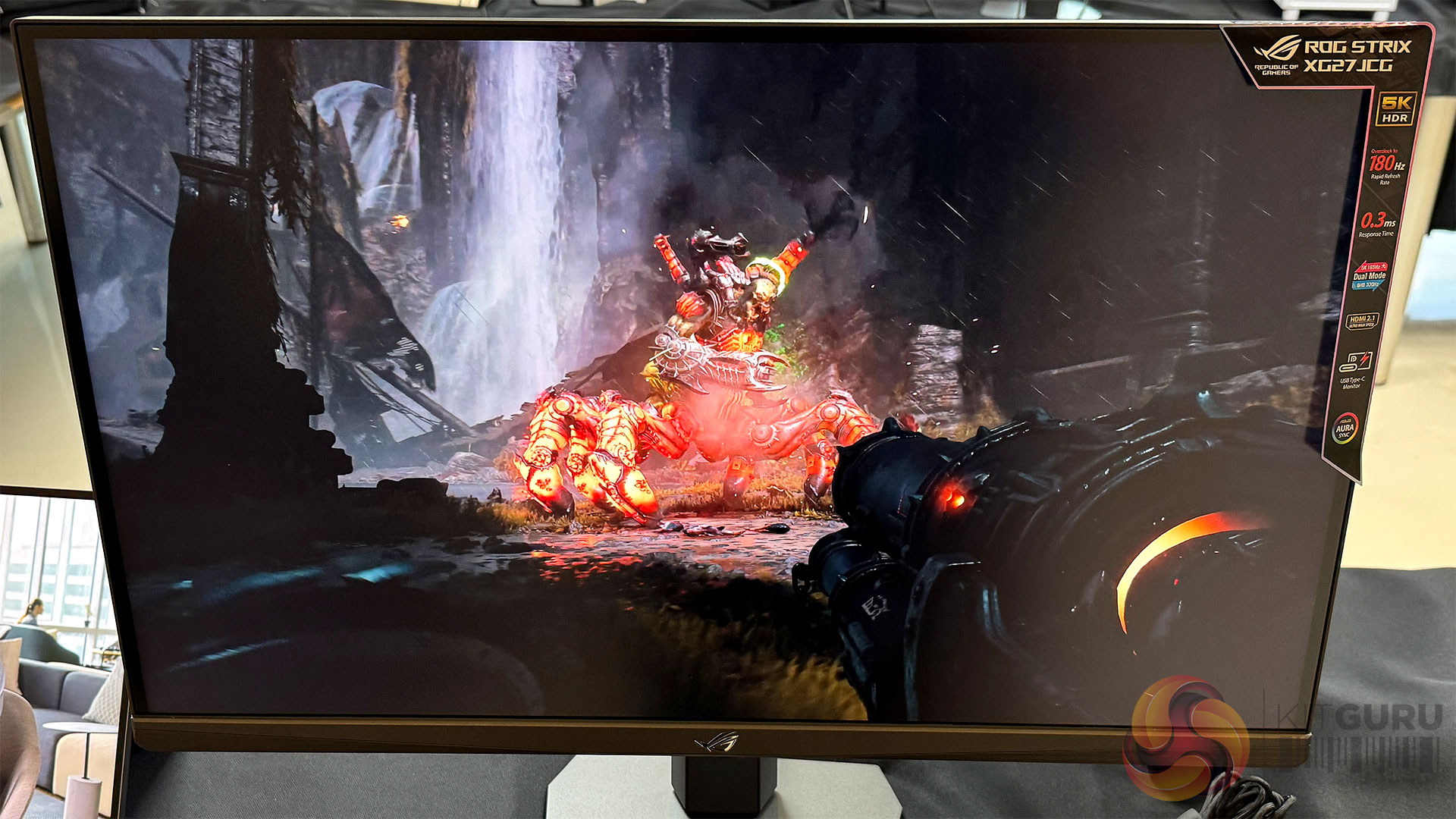
The ROG Strix 5K XG27JCG pushes resolution and refresh rate simultaneously. This 5K screen uses a fast IPS panel with a 0.3ms G2G response and 218 PPI density, guaranteeing that you won’t see any pixels from a normal seated distance. Other nice features included DisplayWidget Center, AI gaming AI features like Dynamic Crosshair, Dynamic Shadow Boost and AI Visual. This screen will initially list close to £699. The Dual Mode feature allows for effortless switching between immersive 5K at 180Hz for cinematic adventures and lightning-fast QHD (2560 x 1440) at 330Hz for peak performance.

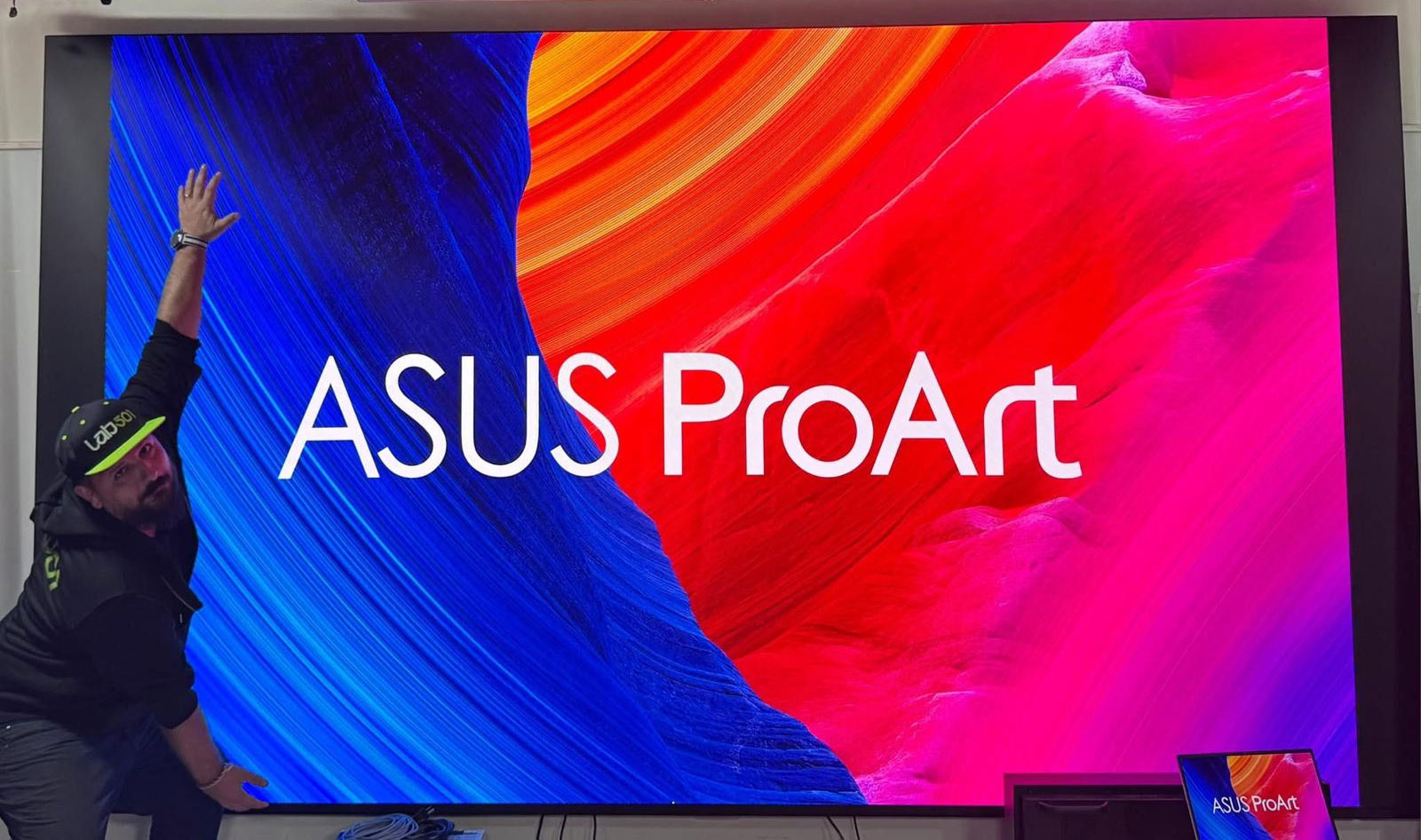
ASUS also presented a timeline of gaming monitor evolution, showing how OLED and high refresh rates have converged over recent years. Extending that timeline further into the future, ASUS demonstrated something very different during the tour – for which we were taken to a secured area on another floor. The product being guarded was the ProArt Cinema PQ09. This is a 162-inch Micro LED display with a 4K 10-bit panel, 0.93mm pixel pitch, 1,200 nits peak brightness, a claimed 1,000,000:1 contrast ratio and 99 percent DCI-P3 coverage with Delta E below 2. To help you get a sense of the true size of this monitor, we enlisted the help  (and wing span) of Tudor from Lab501. With an indicated price of around $160,000, this is obviously not a ‘general consumer product’ right now, and it is unlikely to be appearing in everyday gaming setups any time soon. That said, it serves as a useful reference point for where display technology is heading, and it underlines how much headroom still exists beyond today’s OLED panels.  

ASUS is also continuing to explore alternative ways to experience large-format displays. The ROG XREAL R1 AR gaming glasses aim to deliver a perceived screen size of up to 171” with refresh rates peaking as high as 240Hz. ASUS acknowledges that adoption of wearable displays remains uncertain, but the technical ambition is clear. Certainly if you need a large desktop are on a plane or train, then your traditional LED options will be limited – so the ROG gaming glasses could make sense for certain categories of user.

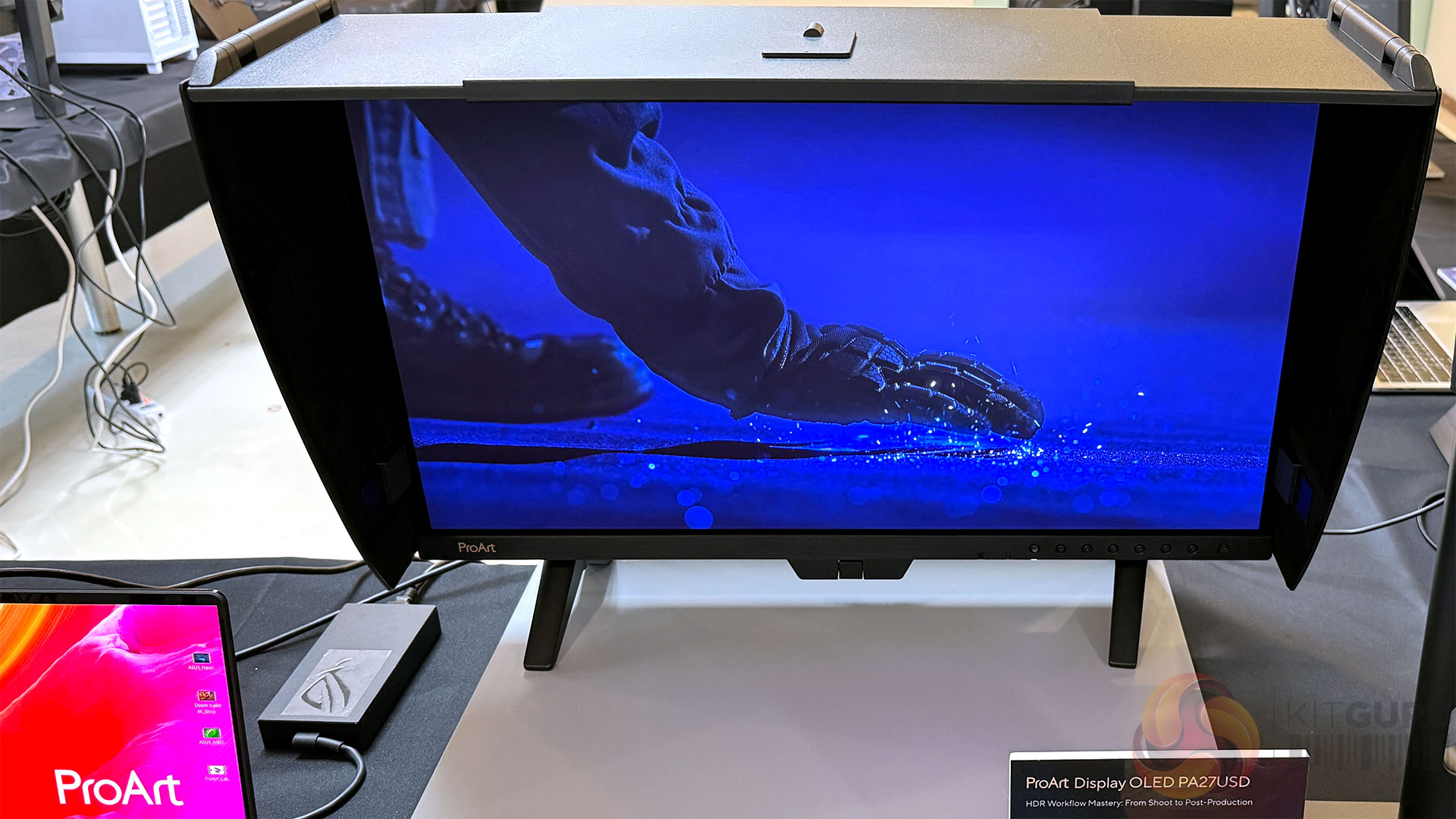
At the professional end of the spectrum, ASUS highlighted a deliberate strategy of pushing flagship ProArt products further upmarket while simultaneously broadening access for creators and prosumers. Displays such as the ProArt Display OLED PA27USD and PA32UCDMR-K are designed for users who have outgrown basic office monitors, but who don’t necessarily operate in full studio environments.

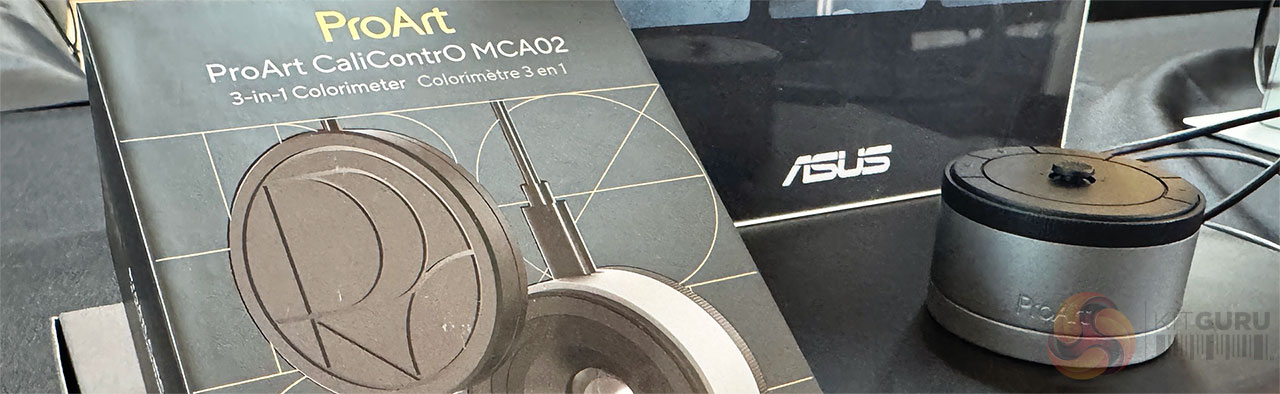
ASUS cited growing demand from content creators and hybrid professionals who need accurate colour, higher brightness and modern connectivity without stepping into prohibitively expensive territory. ASUS insists that its ProArt screens have been targeted at professional creators. As such, thePA32UCDMR-K is Calman Ready with ColourSpace integrated and is supplied with a monitor hood – as well as the latest version of ASUS' Colorimeter, the MCA02.

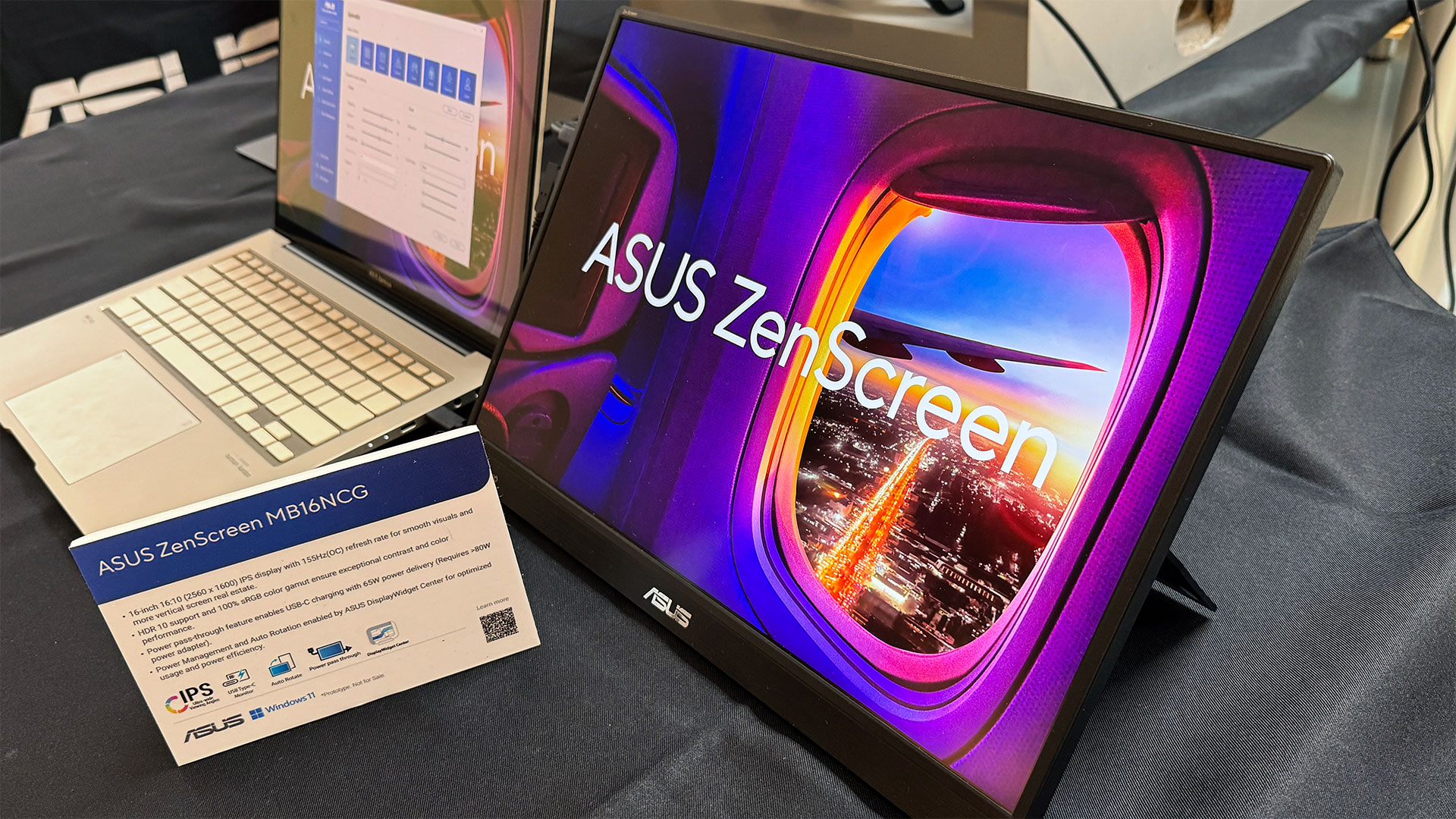
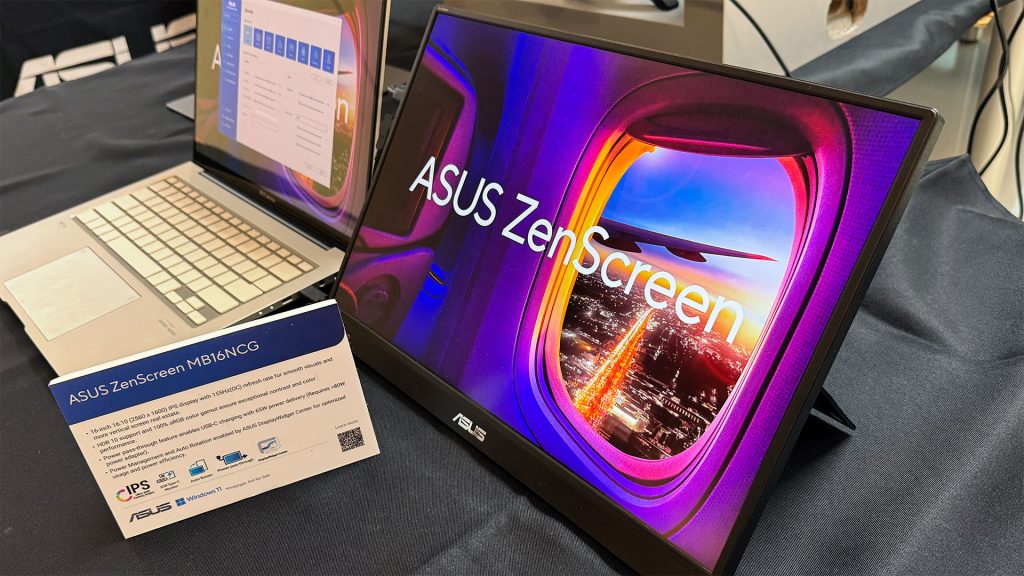
Finally, ASUS briefly covered more consumer-oriented and portable displays, including the ZenScreen OLED MQ16FC and ZenScreen MB16NCG. While these products sit slightly outside KitGuru’s core focus, the USB Type-C connectivity, power pass through, 100% sRGB high refresh rates and sub-1kg weight of 16” (16:10 ratio) models like the MB16NCG, make them genuinely interesting as laptop companions for travel and flexible work setups.
Networking and routers

Networking was presented as one of the most misunderstood performance bottlenecks in modern systems. ASUS was keen to emphasise that WiFi-7 is not obsolete, nor is it a failed standard. In fact, ASUS positions WiFi-7 as very much ‘now’, with meaningful improvements over WiFi-6 when implemented properly.

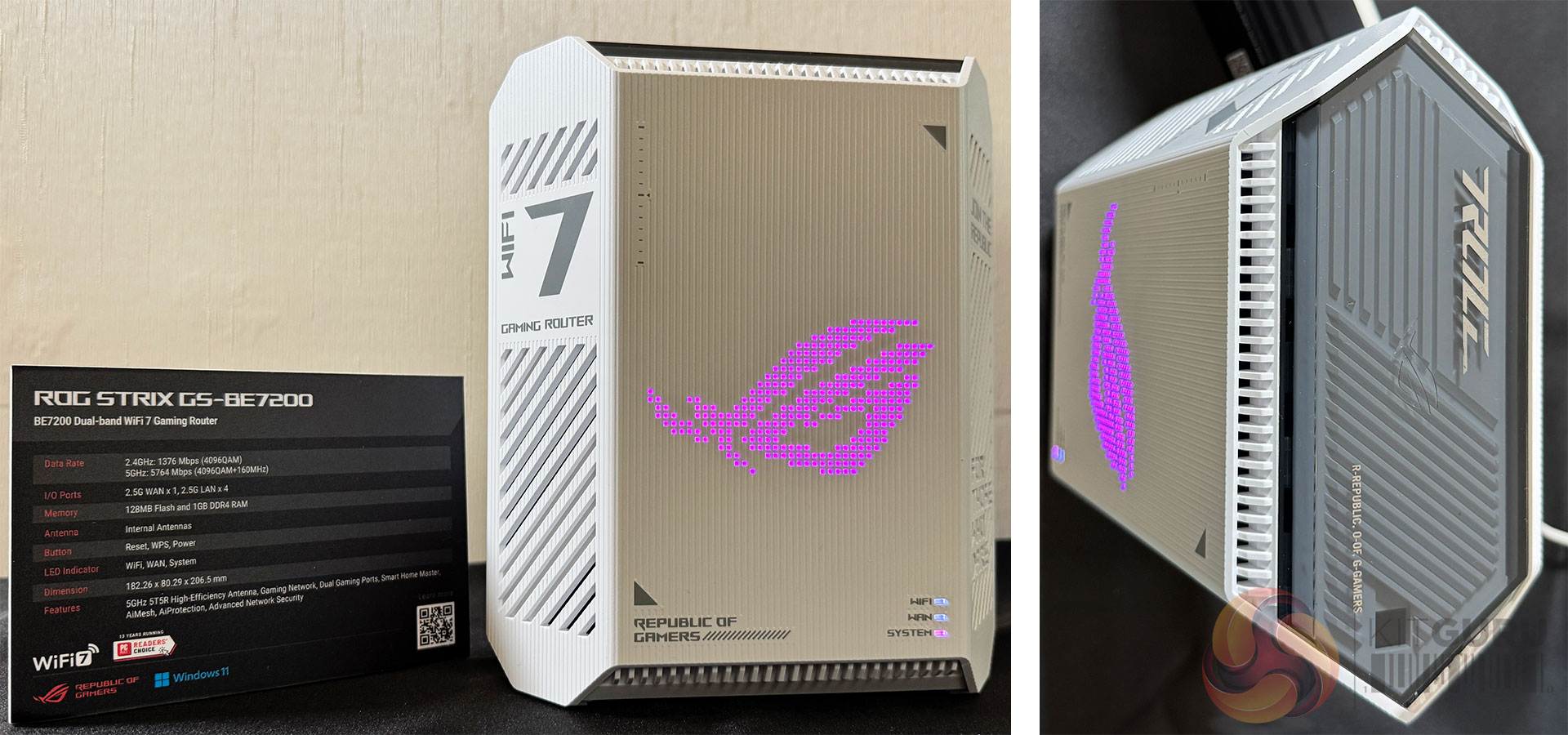
Products such as the ROG Strix GS-BE7200 were used to demonstrate what a well-executed WiFi-7 router can deliver today, including improved 5GHz performance at range, better handling of DFS channels and more consistent throughput in real homes. ASUS claims up to 15 percent better 5GHz performance compared to previous designs (5GHz 4T4R), though as with all such figures, real-world results will depend on environment and client devices.
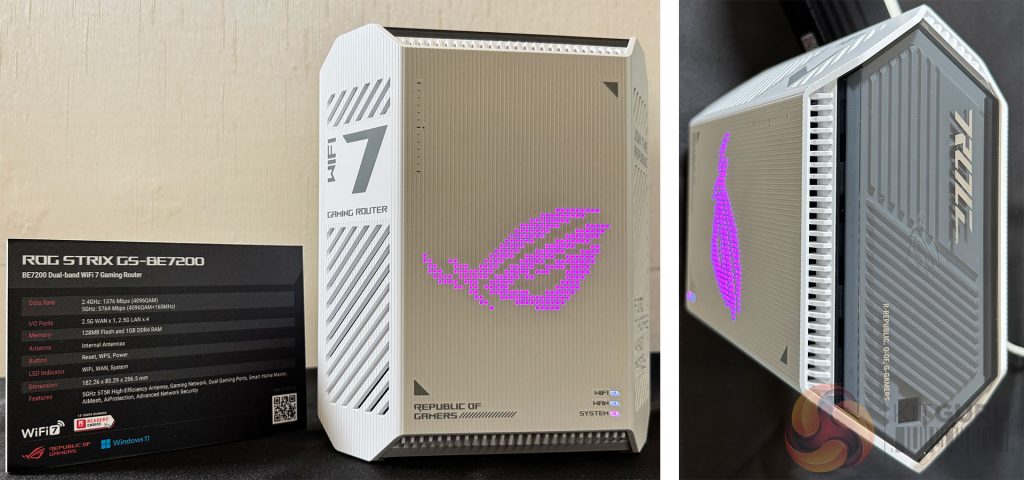
At the same time, ASUS acknowledged that WiFi-7 adoption has been slower than expected. One reason is that many users struggled to see a compelling upgrade path from a strong WiFi-6 router to an average WiFi-7 one, particularly when headline speed increases did not always translate into day-to-day improvements. We’ve certainly found gaps between manufacturer’s claimed maximum speeds and our own real-world testing in 3-floor houses built with bricks.

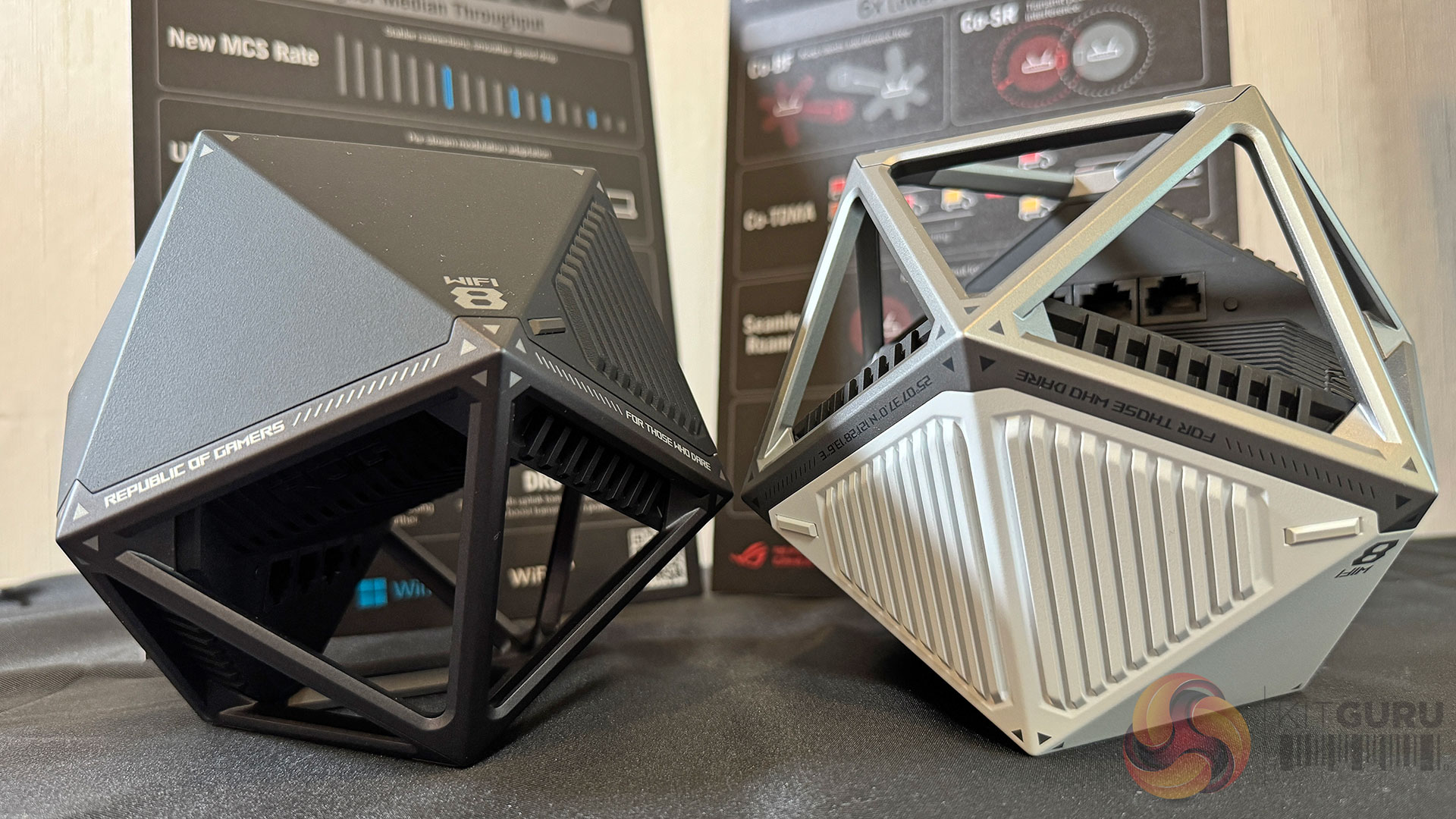
Slides covering WiFi-8 made it clear that ASUS expects early hardware to arrive ahead of 802.11bn standards receiving final ratification. The standard could be finalised around the middle of 2028 – while WiFi-8 hardware could start to ship as early as 2026. Bear in mind that we are talking about WiFi-8 routers and not clients – which will normally follow on a little later. For reference, KitGuru saw its first WiFi-7 dongle at IFA 2025, back in August.

Crucially, ASUS is framing WiFi-8 as a shift in priorities, rather than a simple speed race. Specifically emphasising the move towards aggregate bandwidth, multi-user performance and latency consistency, rather than peak single-device throughput. ASUS claims improvements of up to two times mid-range throughput, two times lower latency, and significantly higher reliability compared to WiFi-7, with a particular focus on more balanced uplink and downlink performance.
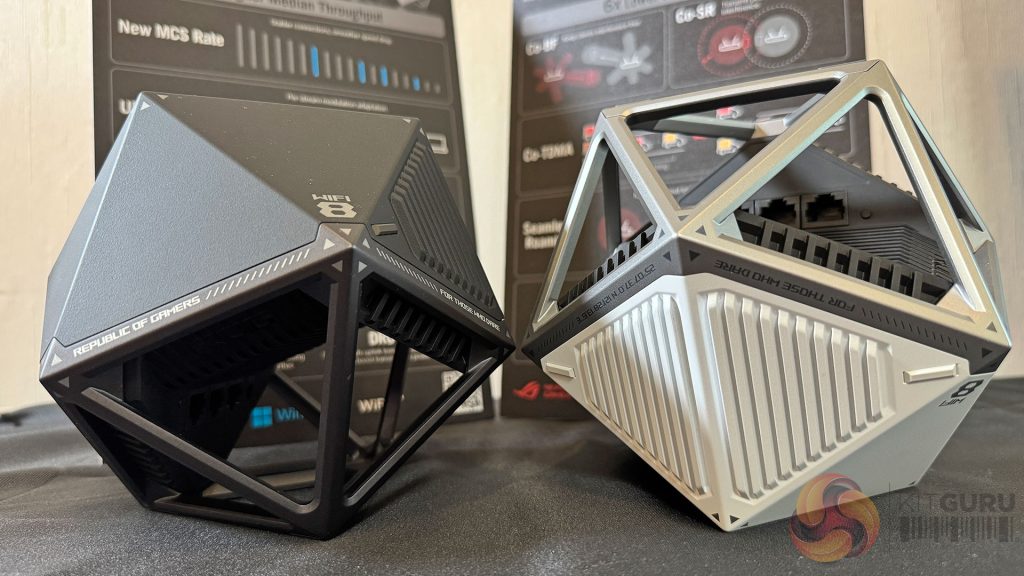
ASUS also leaned into the idea that AI-driven optimisation will increasingly sit at the network layer. Many users intuitively expect AI to make complex systems behave better without manual tuning, and ASUS positions WiFi-8 routers as platforms that can intelligently manage traffic based on device behaviour, workload type, and contention, rather than simply pushing more raw bandwidth.

On this Tech Tour, we got to hold WiFi-8 routers that bear more than a passing resemblance to next-gen TIE Fighters from Star Wars.

Alongside consumer and gaming routers, ASUS highlighted its ProArt Creator networking products, including the ProArt Router PRT-BE5000 and ProArt Switch PQG-U1080. These are positioned as practical solutions for creators and small studios who need reliable wired and wireless performance, multi-gigabit connectivity, and simple management, without stepping into full enterprise networking complexity. Moving to an expensive next-gen router at home will be far harder to justify than installing such devices in a video/creator studio environment.

Gaming peripherals

ASUS’ gaming peripherals presentation focused on refinement rather than reinvention. Across keyboards, mice, and headsets, the emphasis was on precision, consistency, and wireless maturity.

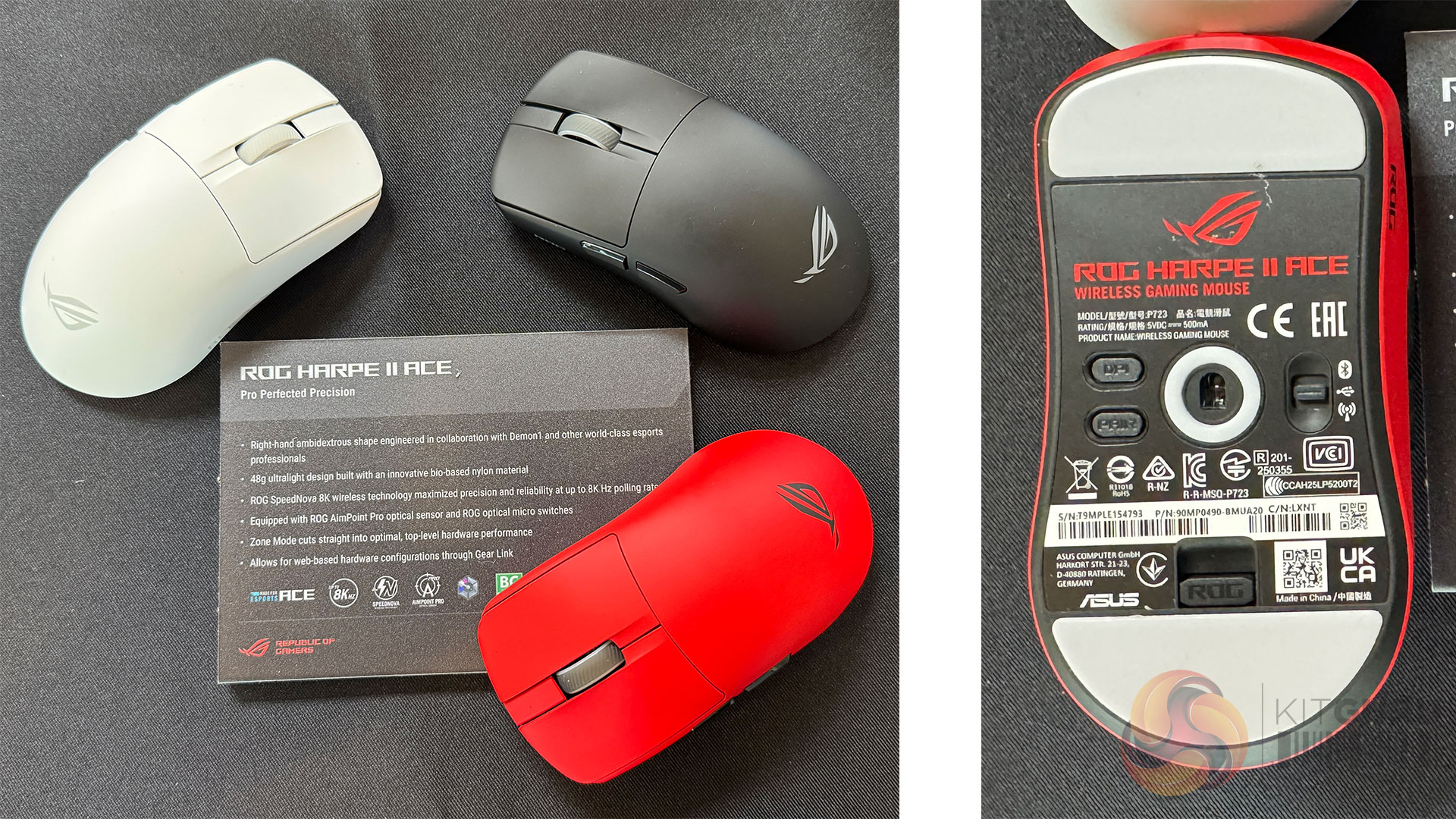
Keyboards such as the ROG Falchion Ace 75 HE, reflect the continued move towards Hall Effect and ROG HFX V2 magnetic switches, with ASUS focusing on actuation consistency and longevity. Similarly, mice like the ROG Harpe II Ace and ROG Keris II Origin build on optical sensors, high polling rates, and shapes informed by esports feedback, where marginal gains are now more about ergonomics and feel than raw specifications. Essentially, physically-lighter mice in cooler colours with faster responses.

Wireless technology is no longer treated as a compromise. ROG’s SpeedNova technology appears across multiple devices, supporting low latency, stable connections, and multi-device setups. In practical terms, wireless input now feels like the default at the high end, rather than an optional convenience. In general, you can choose your own battery life by keeping the RGB disco lights on or off.

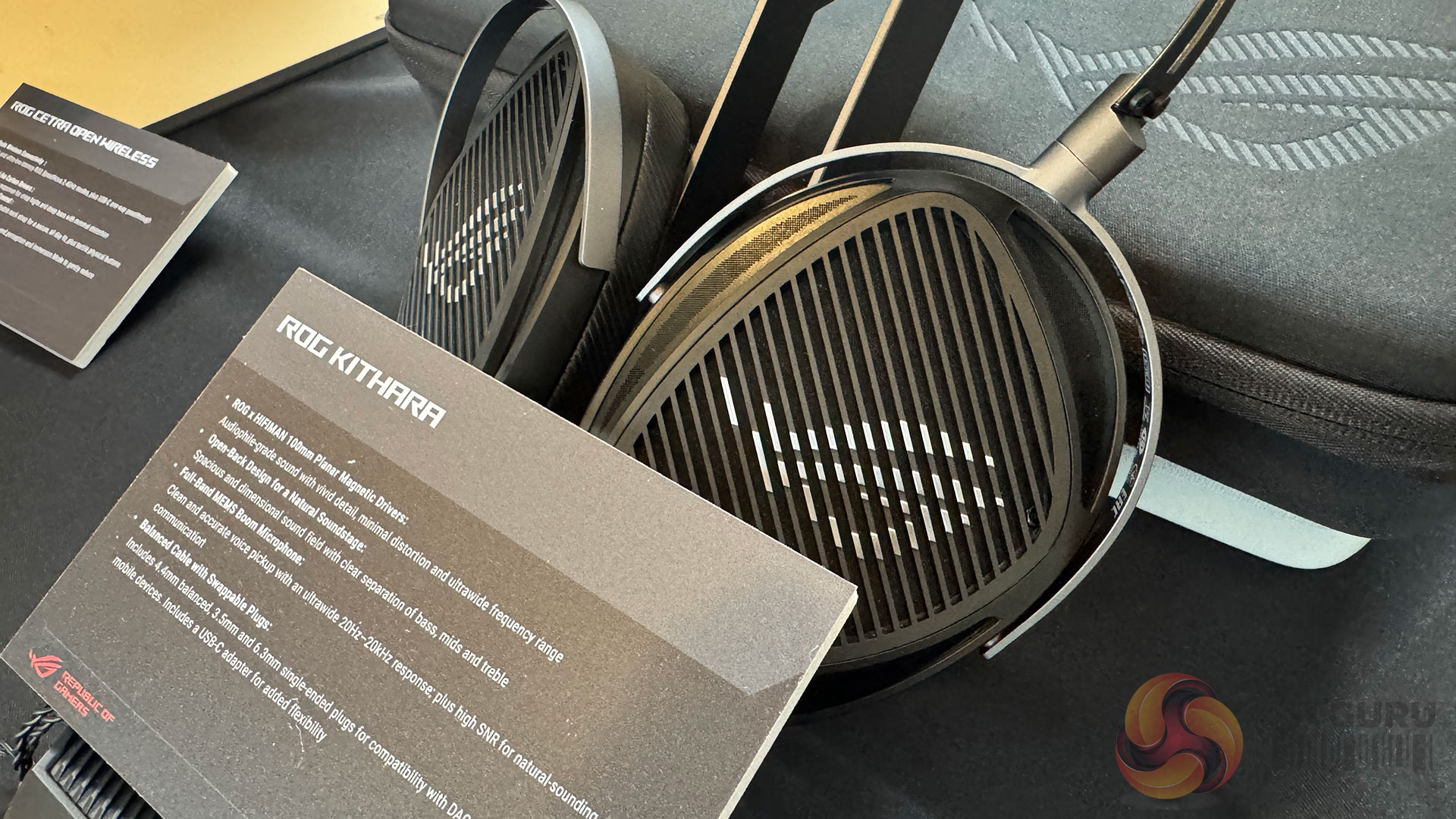
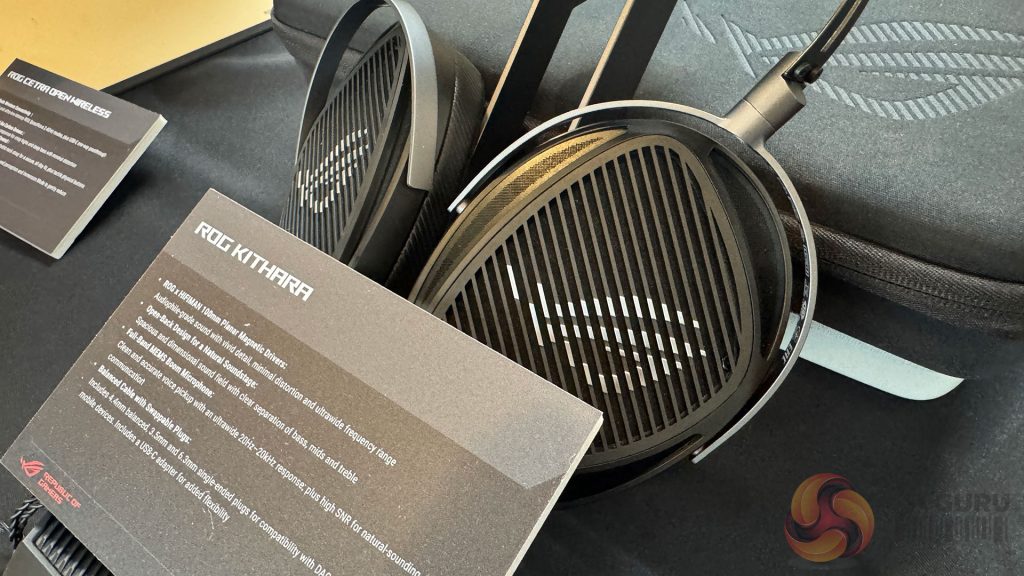
Audio was clearly the centrepiece of the peripherals briefing. The ROG Kithara was positioned as a flagship product, with ASUS indicating an expected price point around $299 at launch. This is not a budget product, but instead aims to deliver high quality audio for those who value mobility as well as audiophile-grade sound. ROG-customised HIFIMAN 100mm planar magnetic drivers deliver lifelike audio with sharp, precise detail. Engineered for competitive play, the Kithara headset features an integrated full-band MEMS microphone for clear in-game communication.

A balanced headphone cable with swappable plugs, along with a USB-C adapter, ensures uncompromised audio fidelity and broad compatibility across a wide range of devices. At this price level, expectations will be high, and independent testing will be essential to determine whether the experience justifies the price.
The KJP series of peripherals was also shown as a design-led extension of the ROG ecosystem, including headset, mouse and mouse pad. While these products are more about aesthetic and brand expression than performance leadership, they sit alongside a broader line-up that remains firmly focused on competitive use.

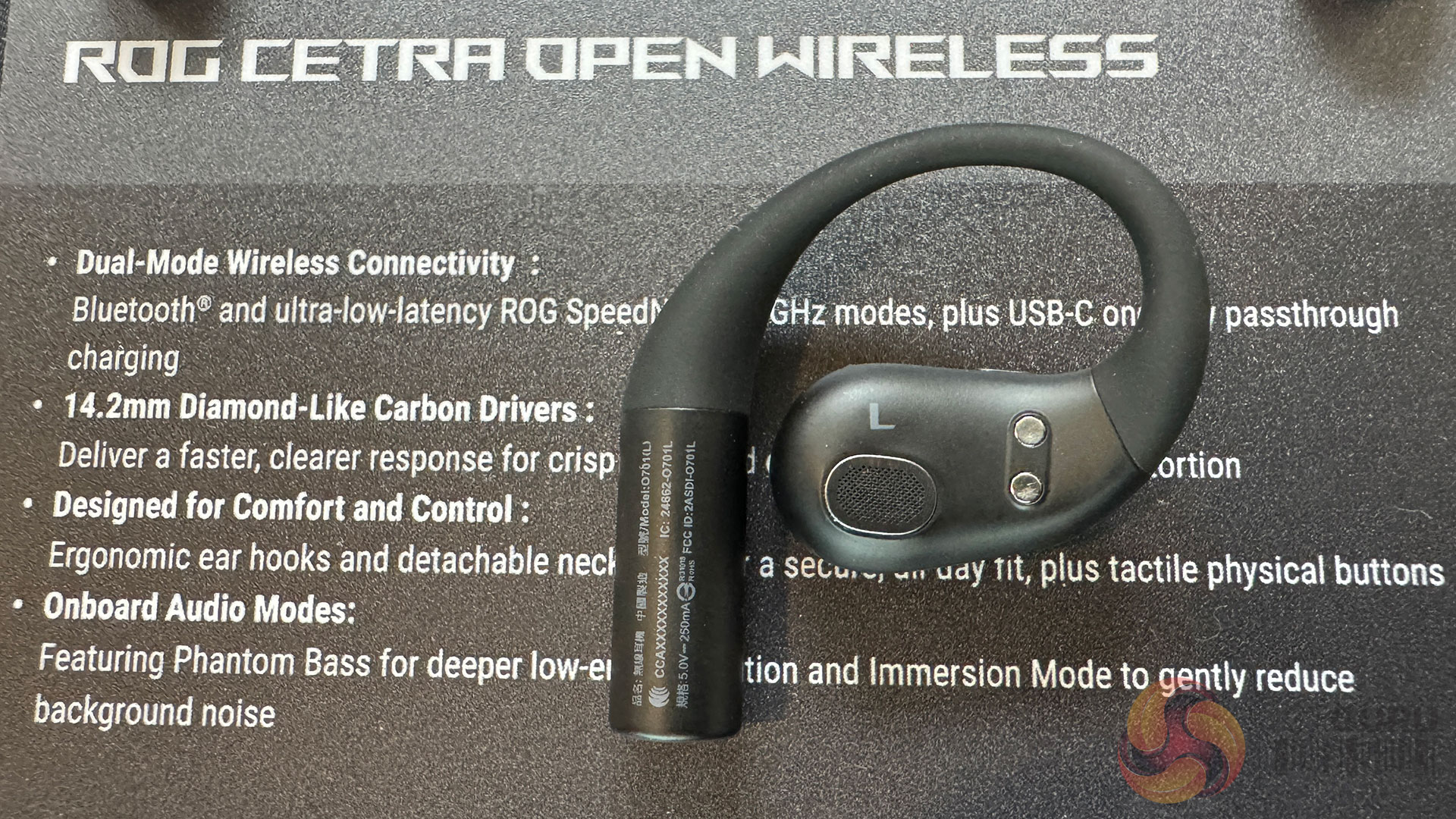
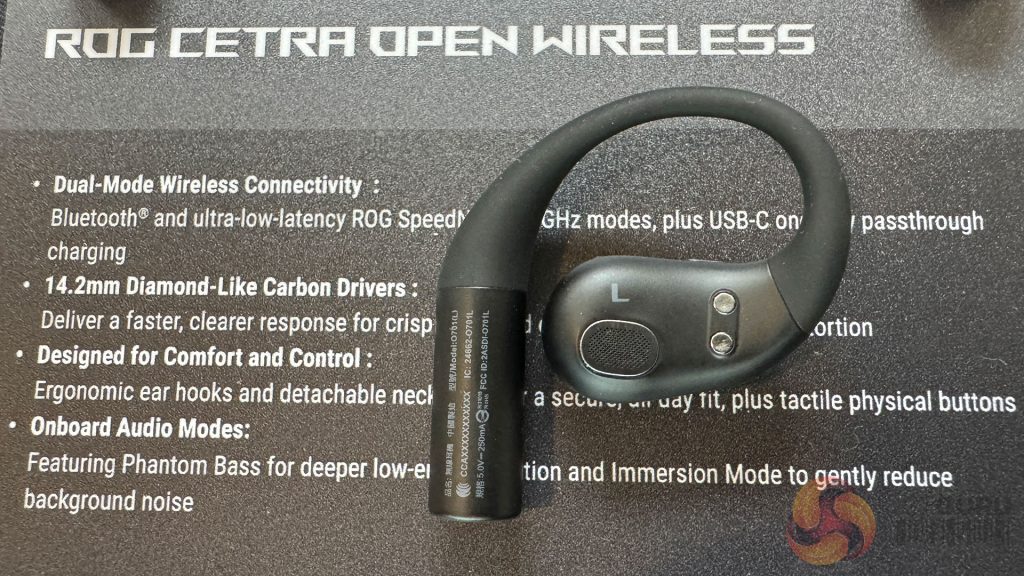
Finally, another neatly-designed audio product comes to market in the form of the ROG Cetra Open Wireless earbuds. In addition to Bluetooth, they offer ultra-low-latency ROG SpeedNova 2.4GHz – as well as USB-C one-way pass-through charging. The 14.2mm diamond-like carbon drivers promise faster, clearer response and, overall, the ‘ergonomic ear hook' design promises comfort should you decide to use them all day. There are tactical/physical buttons to make them easier to adjust – and the Cetra features Phantom Bass for deeper low-end perceived tones – as well as ‘Immersion Mode' to get rid of the noise of the outside world.
Compact compute and NUC systems 

The ASUS NUC and mini PC strategy spans a wide range of use cases, from education and commercial deployments to gaming and AI development. What became clear during the briefing is that not all AI performance figures are created equal. Specifically, there’s a lot of questionable emphasis on TOPS figures at the lower end of the performance scale.

Systems such as the ASUS NUC 16 Pro and ExpertCenter PN55 offer between 55 AI TOPS and 180 platform TOPS of AI performance, depending on configuration. In real-world terms, this level of capability is sufficient for local assistants, transcription, image processing and OS-level features such as Microsoft Copilot+. It could be useful, but it is not transformative compute. At this level, AI performance often feels like a compliance requirement rather than a compelling reason to upgrade, and it is difficult to ignore the influence of platform mandates and co-marketing incentives in shaping these products.

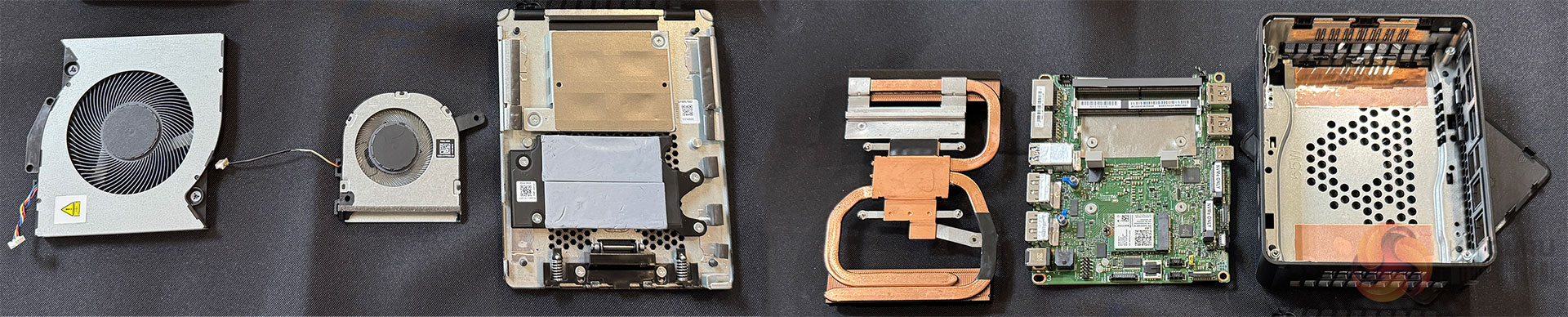
The complexities involved in building modern NUCs is not to be under-estimated. Cooling with longevity, as the components themselves continue to get better, is a challenge. 
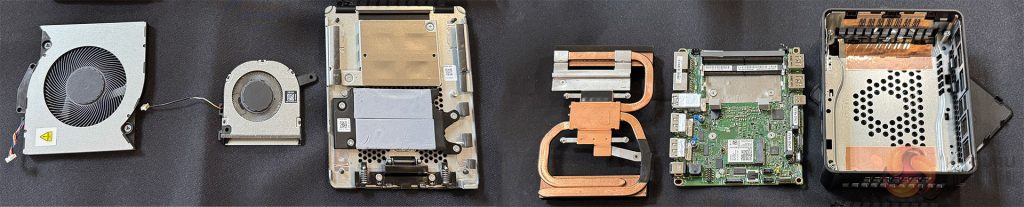
That doesn’t make these systems irrelevant. They could definitely make sense for colleges, offices and edge deployment situations where space, power efficiency, manageability and reliability matter more than raw AI throughput. ASUS’ own categorisation of these devices as ‘Everyday AI’ and ‘Next Level AI’ is accurate, rather than hugely overstated. 

The ROG GR70 is where the compact compute story becomes far more convincing. With CPU options up to the AMD Ryzen 9 9955HX3D processor and an NVIDIA GeForce RTX 5070 Laptop GPU in a 3-litre chassis – this is a serious gaming system rather than a marketing exercise. Here, performance will be judged on frame rates, thermals and acoustics. On paper, the specification suggests a genuinely capable compact gaming machine.

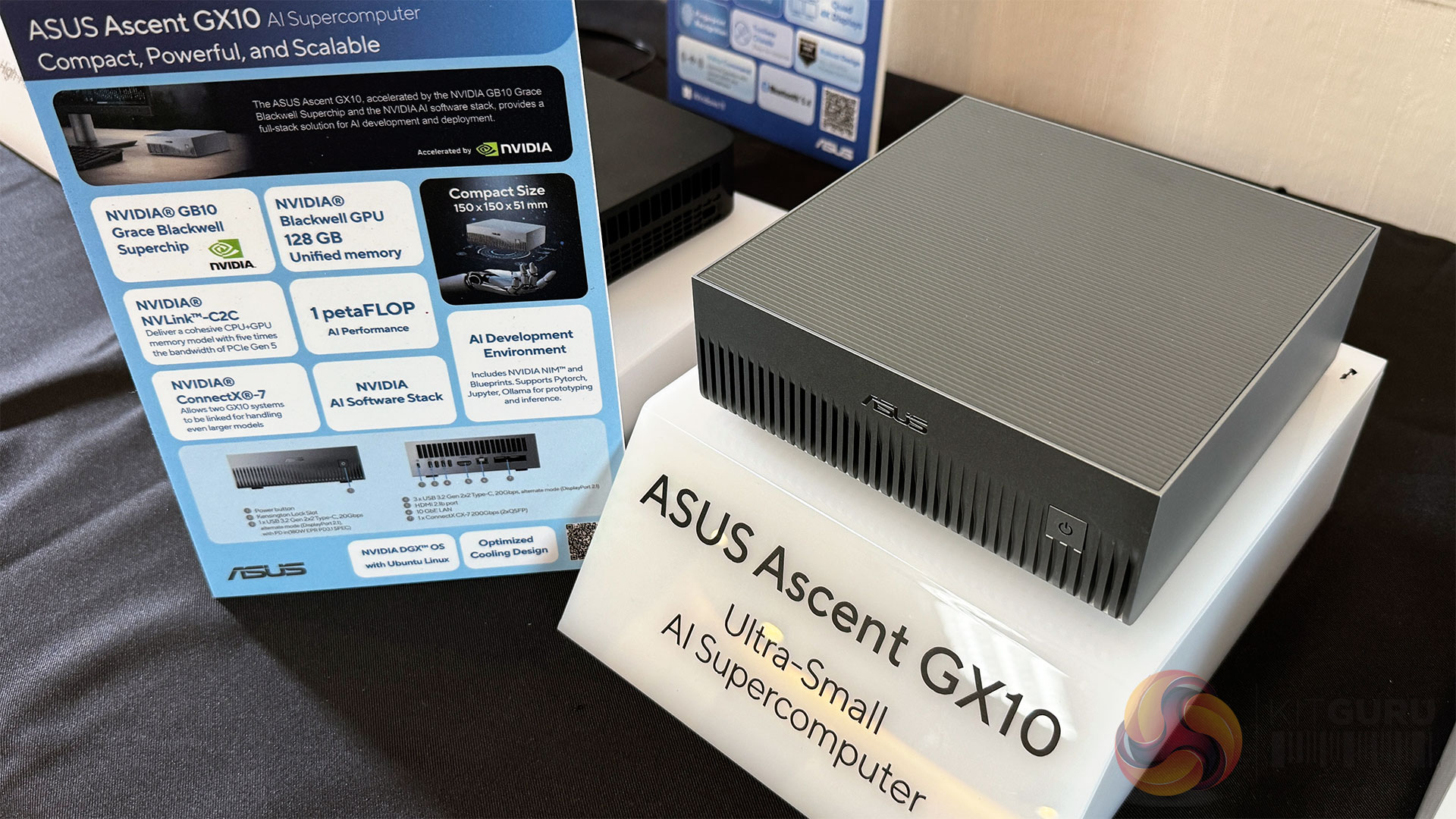
The stand-out product, however, is the ASUS Ascent GX10. With a claimed 1 petaFLOP of AI performance, powered by the NVIDIA GB10 Grace Blackwell Superchip and supported by 128GB of unified memory, this system moves decisively into desktop supercomputer territory.

ASUS claims the GX10 can handle models of up to 200 billion parameters, bringing serious AI development capability into an ultra-compact 150×150×51mm enclosure.
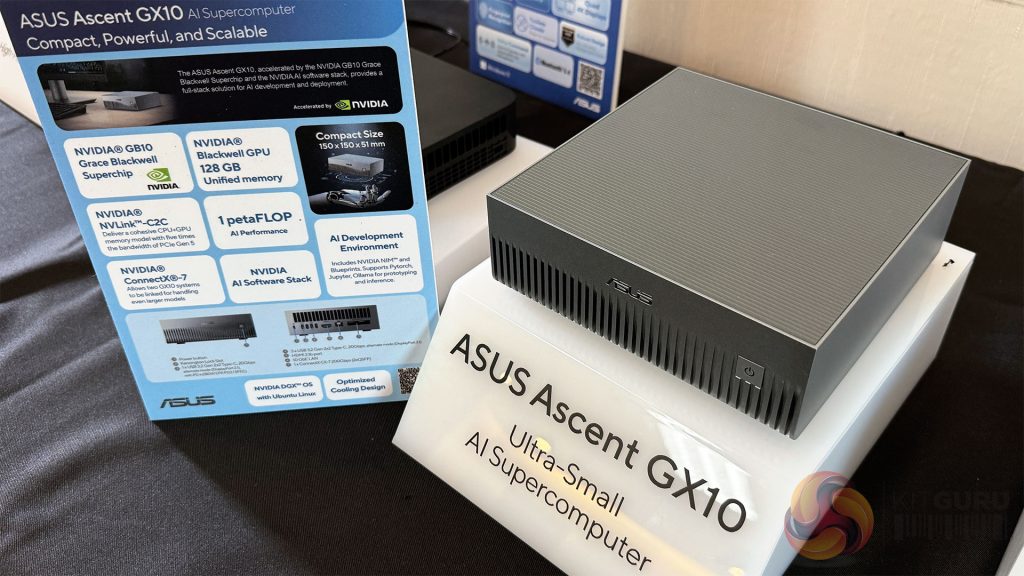
This mirrors the philosophy behind the larger ET900N G3 shown earlier in the tour, but in an even more accessible form. For organisations and developers looking to build, test, and refine AI models locally, offline, or in secure environments, the Ascent GX10 could prove genuinely compelling.

Discuss on our Facebook page, HERE.

KitGuru says: Across displays, networking, peripherals, and compact systems, the ASUS 2026 portfolio reflects a shift towards experience and integration as the primary differentiators. Many of the performance figures discussed here come directly from ASUS briefings, and KitGuru will be looking to validate those claims through independent testing as products become available.

The post Asus reveals next-gen displays, new gaming peripherals and WiFi 8 devices first appeared on KitGuru.
  •  

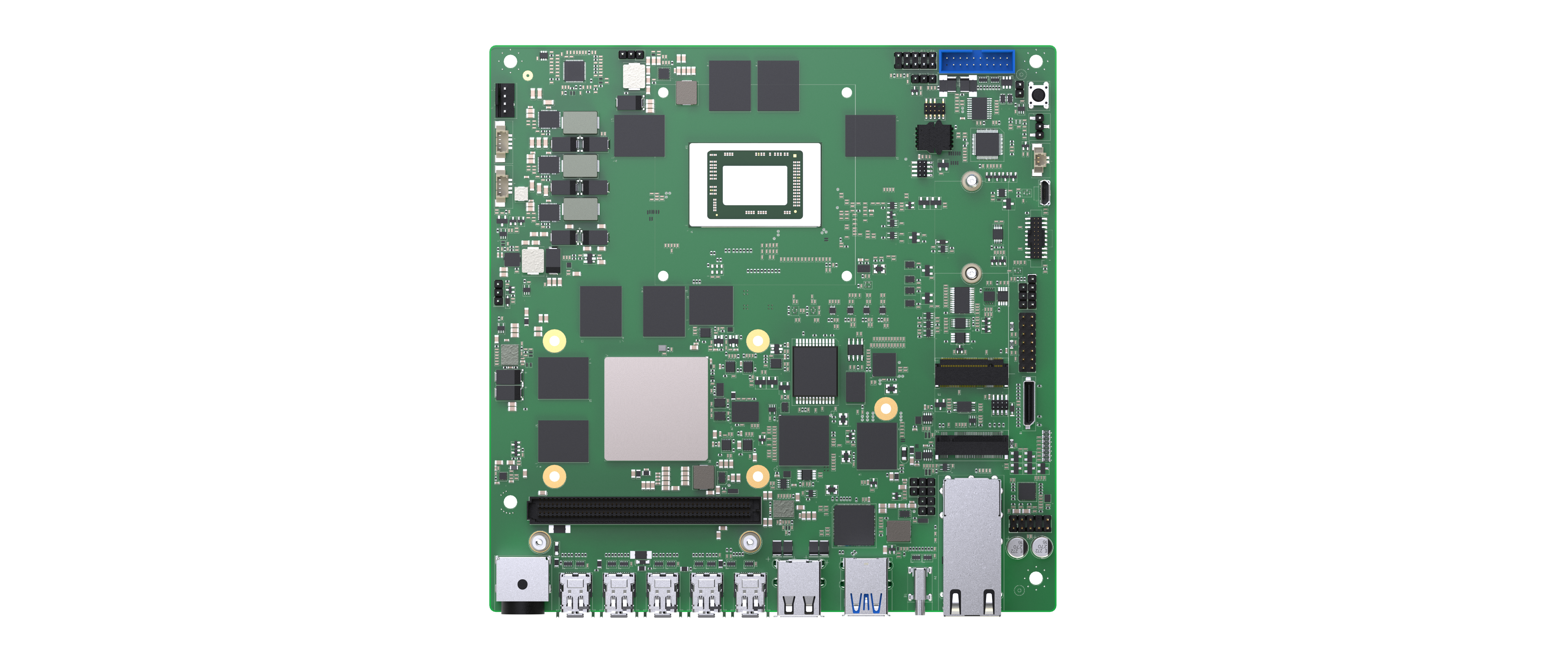
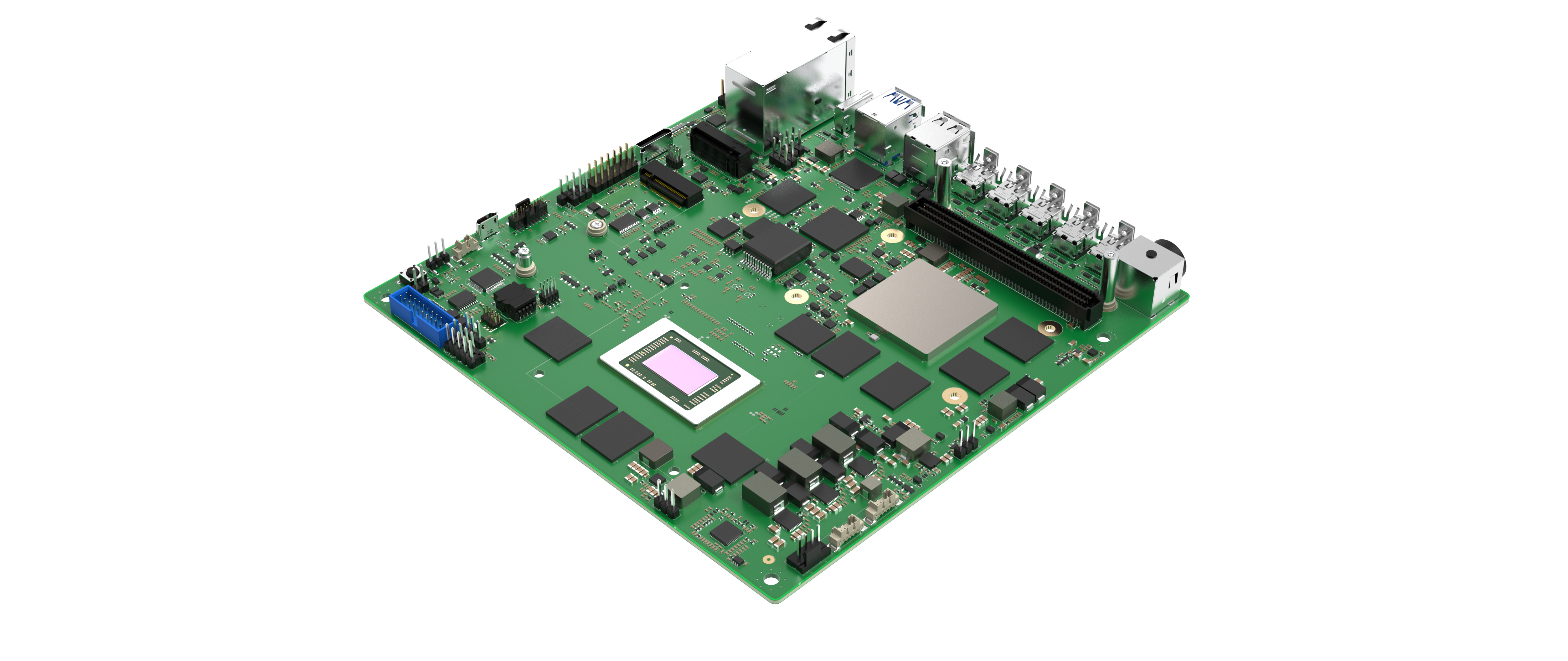
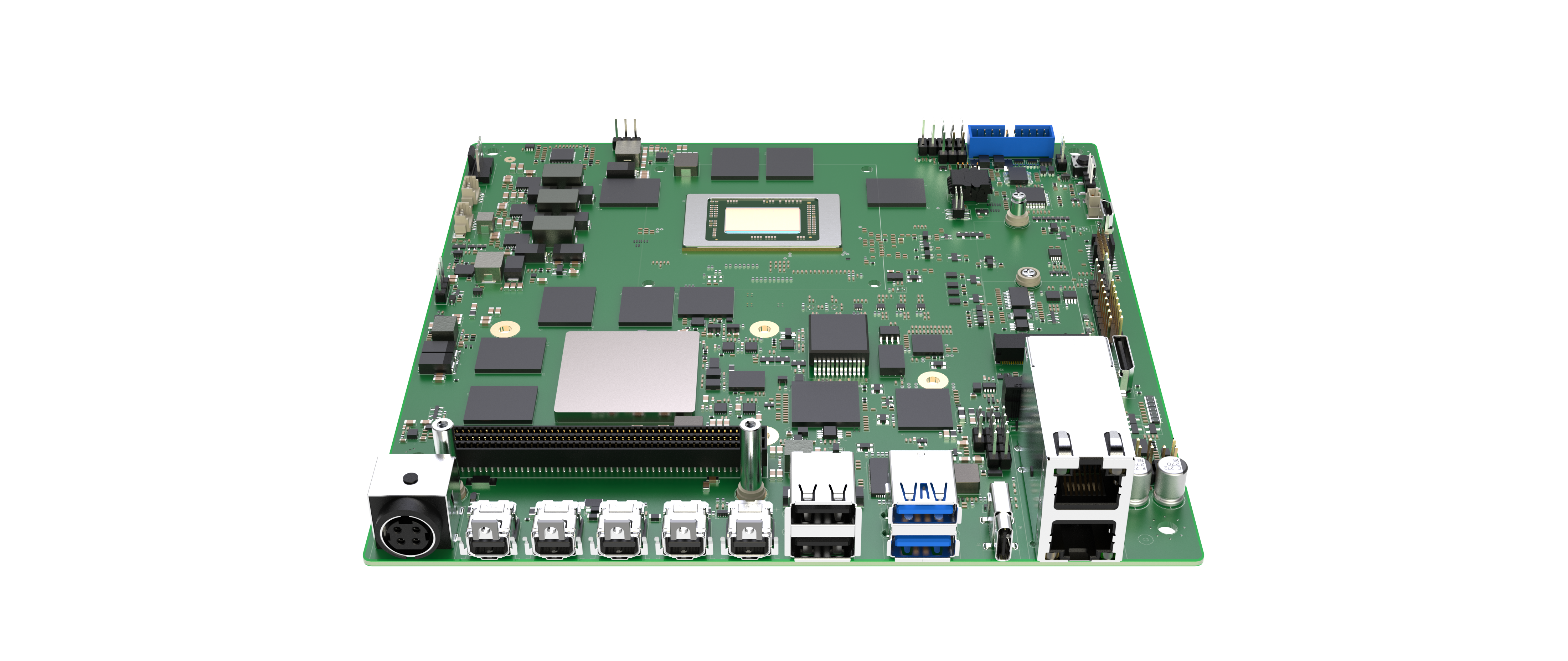
CES 2026: Sapphire launches new Edge+ motherboard with embedded Ryzen AI

At CES this week, Sapphire has introduced the EDGE+ VPR-7P132, a Mini‑ITX AMD Embedded+ motherboard designed to handle increasingly complex AI workloads at the edge. The board combines AMD’s new Ryzen AI Embedded P132 Series APU with a Versal AI Edge Series Gen 2 adaptive SoC, creating a dual‑processor platform aimed at robotics, machine vision, industrial automation, and other latency‑sensitive deployments.

The design allows workloads to be split across CPU cores, RDNA 3.5 graphics, the XDNA 2 NPU, and the Versal device’s programmable logic and AI engines. The Ryzen AI Embedded processor manages OS, networking, visualisation, and general application tasks, delivering more than 50 TOPS of AI performance and supporting quad‑4K output, high‑speed Ethernet, USB, and NVMe storage. The Versal AI Edge Gen 2 SoC handles deterministic, real‑time functions such as sensor ingress, pre‑processing, and inference, ensuring predictable behaviour when timing is critical.
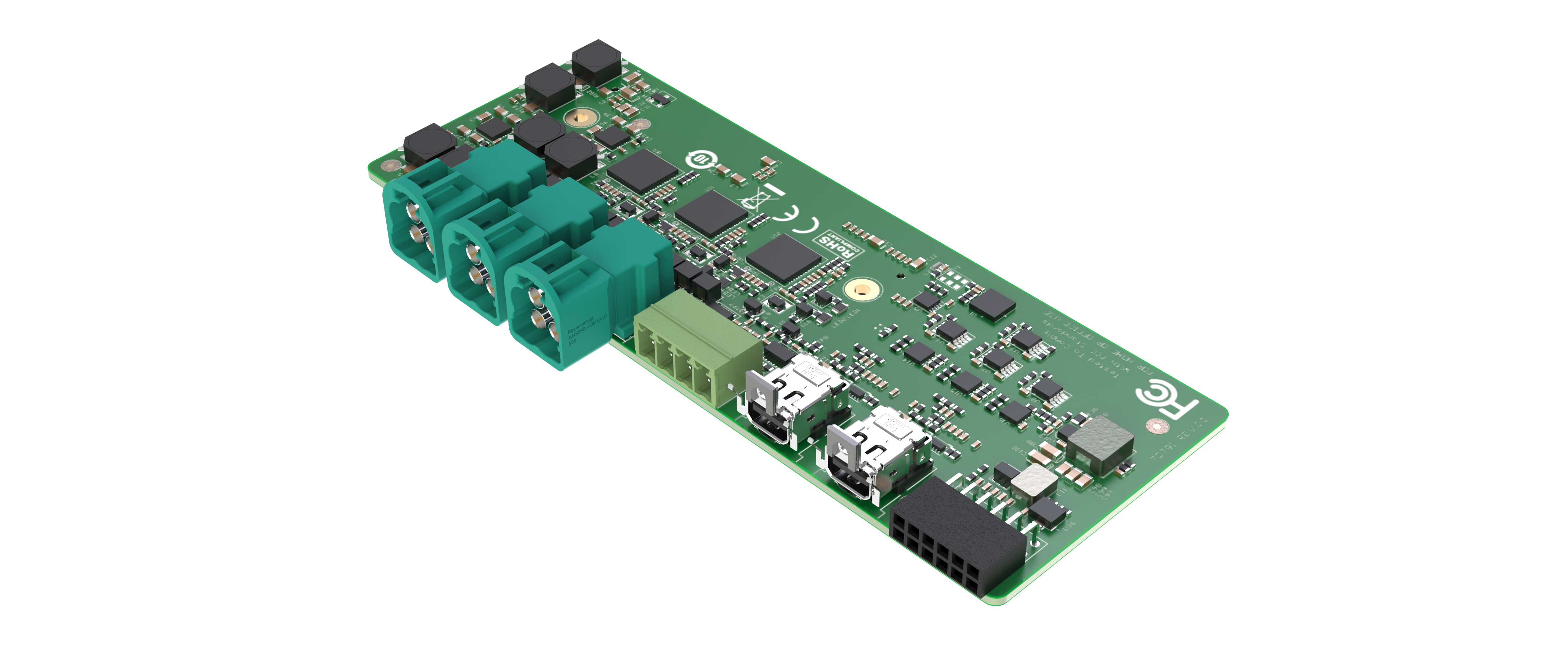
Despite its 170×170mm footprint, the EDGE+ VPR-7P132 includes five display outputs, dual 10Gb Ethernet, USB4, multiple USB and audio interfaces, and PCIe Gen4 expansion via M.2 and OCuLink. An optional I/O daughterboard expands support further with three Quad GMSL2 C/D‑PHY interfaces for up to 12 cameras, two CAN‑FD ports, and additional mini DisplayPort outputs tied directly to the Versal subsystem.
The platform is built for continuous operation, with LPDDR5 support, onboard UFS storage, TPM 2.0, and compatibility with Ubuntu, Yocto Linux, QNX, and VxWorks. SAPPHIRE positions the board as a scalable solution for developers building edge systems that need both high‑performance application processing and deterministic AI acceleration.

Discuss on our Facebook page, HERE.

KitGuru Says: This isn't necessarily something that will be of interest to the gamers in our audience, but those in IT and enterprise looking to integrate AI throughout their workflows will want to keep an eye on the work Sapphire is doing in the AI Mini PC space.

The post CES 2026: Sapphire launches new Edge+ motherboard with embedded Ryzen AI first appeared on KitGuru.
  •  

Far Cry 3 seemingly next in line to receive 60fps current-gen patch

Ubisoft has been one of the better publishers when it comes to updating their back-catalogue of games for current-gen hardware, with multiple Assassin’s Creed titles; Far Cry entries and most recently The Division 1 all getting 60fps patches on PS5 and Series X|S. It appears as though more such updates are in the works, with Ubisoft teasing that the iconic Far Cry 3 could be next in line.

Responding to one Twitter user who wrote: “Far Cry 3 classic edition and Blood Dragon 60fps update when? Please tell me soon!” the official Far Cry page posted a meme featuring the known ‘smug stickman’ – suggesting that such an update is in the works.

As mentioned, Ubisoft have released a ton of performance patches for various last-gen titles, including but not limited to: Far Cry 4; Far Cry 5; Assassin’s Creed Syndicate; AC: Origins; Odyssey and The Division 1. As such it is unsurprising that one of the most iconic titles ‘Far Cry 3’ would be seeing a similar treatment.

Far Cry 3 60fps

All that being said, as with pretty much all previous 60fps updates, expect little else in the way of enhancements. This means that Far Cry 3 on PS5 will likely still operate at 1440p albeit at 60fps instead of 30. Unfortunately, don’t expect any major changes otherwise – meaning it will still likely feature a rather narrow field of view (among other last-gen compromises).

Still, having as many last-gen titles as possible updated to offer 60fps at the very least is welcome to see. Hopefully we get a formal announcement soon.

KitGuru says: What do you think of Ubisoft’s ongoing support for last-gen titles? Would you like to see more games get native current-gen enhancements instead? Or is 60fps enough of an improvement? Let us know down below.

The post Far Cry 3 seemingly next in line to receive 60fps current-gen patch first appeared on KitGuru.
  •  
❌